Stay Ahead, Stay ONMINE

Last Breath: How Woody Harrelson movie started with a chat in an Aberdeen pub

Hollywood has turned its attention to the North Sea as Woody Harrelson’s Last Breath is set to hit cinemas, however, the story would have never been picked up if it wasn’t for a chat in an Aberdeen pub. In 2012 North Sea diver Chris Lemons plunged to the depths of the North Sea when his […]

Hollywood has turned its attention to the North Sea as Woody Harrelson’s Last Breath is set to hit cinemas, however, the story would have never been picked up if it wasn’t for a chat in an Aberdeen pub.

In 2012 North Sea diver Chris Lemons plunged to the depths of the North Sea when his lifeline became tangled.

Lemons was diving beneath the Bibby Topaz when the vessel’s dynamic positioning computer failed, causing it to drift in high winds and rough seas.

The diver’s umbilical became tangled in the Huntington Manifold, around 127 miles off the coast of Aberdeen, leading to a daring rescue attempt befitting of a Hollywood blockbuster.

The line, which was supplying heat, oxygen and communications to Lemons snapped leaving him stranded 300 feet below the water’s surface with five minutes of oxygen.

Lemons’ fellow divers Duncan Allcock and Dave Yuasa sprang into action, saving him and forging a North Sea legend.

It took 40 minutes for the team on the Topaz to regain control of the vessel, return to the location and pull Chris from the icy depths of the North Sea.

‘It’s those who witnessed it who suffered the trauma more than we did’

During this time Lemons lost consciousness as those onboard the vessel watched on in horror.

He recounted: “I often say that when you mention trauma it’s those who witnessed it who suffered the trauma more than we did.

“I think partly because you know all that footage you see of me twitching and lying on the bottom, I’m unconscious for all of that so I feel disassociated from it in many ways, unlike anyone else looking in on that wondering if he’s going to make it.”

He explained: “100 odd people on the vessel that night had to watch that in real-time on screens all around the boat and it goes on for 40 minutes.”
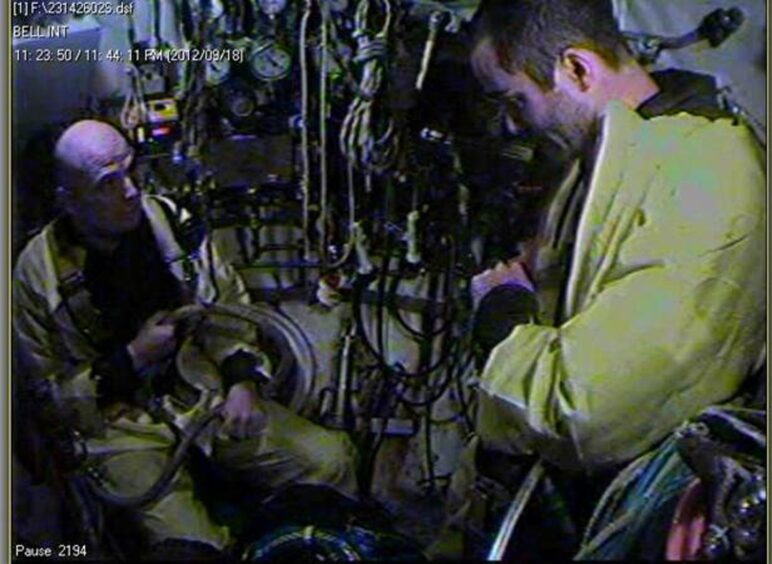
© Supplied by Bibby
Chris and Dave in the bell, after recovery.

This life-or-death tale did not deter Lemons from work beneath the waves. He continued to dive and even returned to the site of the incident soon after.

“People find it strange that we went back,” said Lemons.

“Three weeks later it was, after we were shut down by the HSE, obviously for the investigation and to put the root cause of the accident to bed.

“I don’t think it was something I considered that much at the time. We came out of it, I say we I mean the three of us in the water, almost euphoric that we’d got away with this.

“We certainly, and I think I can speak for the other two, don’t feel we suffered any trauma and I think that’s partly because we did get away with it.”

Despite Lemons’ renewed confidence in safety training, some of those onboard the Bibby Topaz were discouraged and subsequently left the industry.

He added: “We had people who decided never to work with divers again and left the industry and people who’ve had sleepless nights. It’s amazing how trauma effects those who witness it as much, if not more, than those who are directly involved.”

Hollywood and a chat in an Aberdeen pub

The events of this daring rescue were immortalised in a Netflix documentary in 2019 which featured Lemons, his loved ones and those he shared a diving bell with in 2012.

However, the idea for the documentary came from a chat in an Aberdeen pub and a chance encounter.

The diver explained how before the Netflix documentary there was a short film that can now be watched on YouTube that broadcast his experience.

“There was a sort of precursor to the documentary that was made by Richard da Costa. It was really him who found the story if you like,” he explained.

“As all these things happen, I met him in a pub in Aberdeen and I told him the story and he said ‘Has anyone ever made a film out of this?’ and I said no.”

Following this chance encounter a film called ‘Lifeline’ was produced.

As a result, entertainment behemoth Netflix turned its attention to Lemons’ story.

“Richard had worked in as an actor for Alex [Parkinson] at some point, and they bumped into each other on Brighton Pier, or something like that, and exchanged the story.”
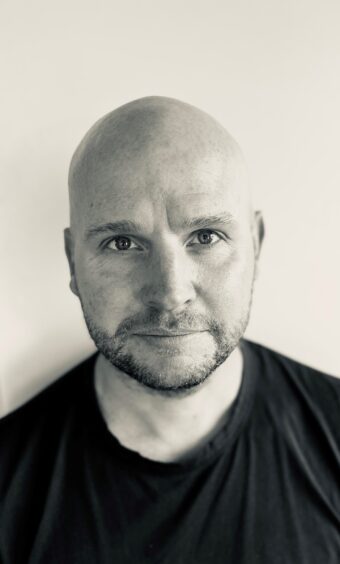
© Supplied by thinkPR
Chris Lemons.

Alex Parkinson has become well acquainted with Lemon’s tale as he worked on the 2019 documentary and has returned to the director’s chair for Focus Features’ dramatic retelling starring Woody Harrelson.

“Alex wasn’t cited as the director originally for the for the feature film,” Lemons added.

When the studio settled on Parkinson as the film’s director Lemons was “delighted for him”.

“That was the best thing that came out of the film coming together for me was that Alex was going to get this big Hollywood break, I guess.”

Speaking on his involvement in the Hollywood production, the North Sea diver added: “To some extent, it’s the same as the documentary, they’ve kept us at arm’s length, really, I think it’s so we don’t meddle more than anything else.”

He said that the trio of divers were made aware of the coming cinematic adaptation “not long after the last breath documentary came out”.

“It was one of those things that you think is never going to happen. It seemed ridiculous at the time that they even made a documentary to us. It was slightly surreal and the thought of that becoming a fictionalised version, which is how they presented it at the time, seemed a bit remote,” Lemons added.

No helium voices?

He explained that the three divers depicted in the film have all been to see the movie-making process “at separate times”.

“I went over during pre-production so I don’t think they had actually started filming. They were building all the sets and I spent a week out there with a couple of the actors, with Finn Cole, who’s playing me, and Simu Liu who’s playing Dave.”

During his time on set he spoke about “the production design and then spent time with the actors, talking through the incident and talking about the world because, obviously, it’s this strange world that people don’t know too much about,” he explained.
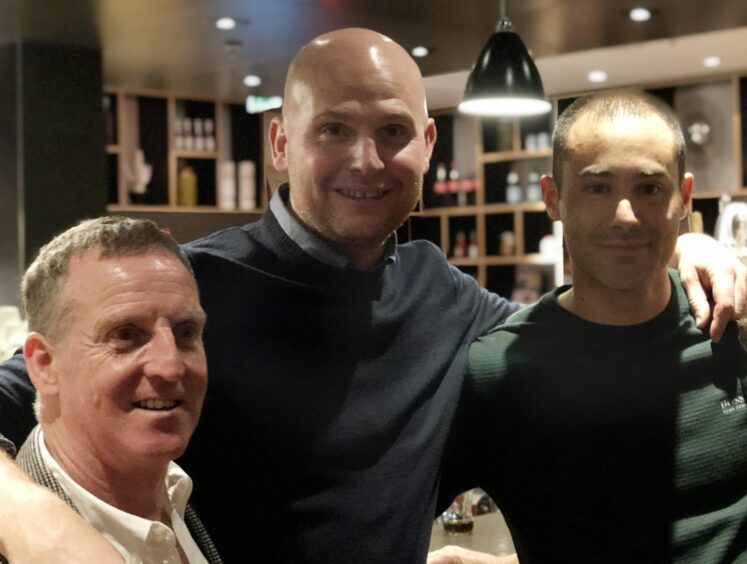
© Supplied by Chris Lemons
Duncan Allcock, Chris Lemons, Dave Yuasa.

Lemons has yet to see the film, which premiers on 28 February, and the first time he saw the trailer was when it got released to the public.

Despite this, Lemons is confident that the big-screen rendition of this true-life event will be faithful.

He said: “It very much follows the story, it uses our names (obviously) and in terms of the incident it’s a pretty close representation.

“There are several elements in it that are that are fictionalised, little things like dive control and the bridge and ROV, they’re all on the bridge, I think just to facilitate conversation and dialogue between the actors and things like that.”

In addition to this, the divers “don’t have helium voices,” Lemons commented. However, that may have taken away from some of the film’s more dramatic moments.

Who’d play you in a movie?

Lemons is played by Cole of Peaky Blinders fame, a casting decision that prompted the diver to get caught up with the Birmingham-based crime series.

It is a common conversation many people have “Who would play you in a movie of your life”, now Lemons has a definitive answer.

Speaking on Cole’s casting, he joked: “He’s a young, good-looking lad with a full head of hair, it wasn’t a stretch for me really.

“Woody Harrelson is playing Duncan and looking at him as you see me now is probably a better fit, isn’t it? It’s a younger version of me, it’s great and it’s really flattering the thought of anybody playing you is amazing.

“It was really lovely to meet him. Obviously, he’s from Peaky Blinders, which I hadn’t really seen when I met him, but I’ve since watched a bit.”

Lemons continues to share his story

Lemmons now does public speaking, sharing his experience and delivering safety talks.

“It’s sort of grown arms and legs and it’s not something I’ve sought out much in the past, but it seems to come to me quite a lot,” he said.

“I do the speaking more and more now and I’m at that point almost where because of all the publicity surrounding the films, I’m thinking of transitioning into doing that quite a lot more really.”

However, he added “I still love my day job” so he’s faced with a difficult decision.

Lemons travels the world to deliver his talk and notably hosted an evening for the Society of Petroleum Engineers (SPE) Young Professionals section in Aberdeen a couple of years ago.

He has also delivered speeches in Australia, Malaysia, Canada, Brazil and France as well.

He said: “I use it in industry quite a lot, but I also use it outside of our industry, you know outside of oil and gas to all sorts of companies all around the world.”

Recommended for you

Shape
Shape
Stay Ahead

Explore More Insights

Stay ahead with more perspectives on cutting-edge power, infrastructure, energy,  bitcoin and AI solutions. Explore these articles to uncover strategies and insights shaping the future of industries.

Shape

Cisco extends Nexus 9000 support to Intel Gaudi 3 AI accelerators

Partnerships, validated designs strengthen Cisco offerings Cisco’s AI offerings also include Nvidia technologies, such as Spectrum-X-based switches that are part of Cisco Secure AI Factory with Nvidia.  Cisco also works with AMD and its Instinct AI GPUs for networking and compute stack in large AI clusters. In addition, Cisco integrates

Read More »

F5 tackles AI security with new platform extensions

F5 AI Guardrails deploys as a proxy between users and AI models. Wormke describes it as being inserted as a proxy layer at the “front door” of AI interaction, between AI applications, users and agents. It intercepts prompts before they reach the model and analyzes outputs before they return to

Read More »

USGS notes ‘significant’ undiscovered resources in Woodford, Barnett shales in Permian basin

The Woodford and Barnett shales in the Permian basin contain technically recoverable resources of 28.3 tcf of gas and 1.6 billion bbl of oil in New Mexico and Texas, according to the US Geological Survey (USGS). The gas volumes are enough to supply the United States for 10 months at the current rate of consumption, while the oil volumes account for 10 weeks’ supply for the nation, the USGS said in its Jan. 14 assessment release of undiscovered gas and oil in the Woodford and Barnett shales in the Permian basin. Since production began in the late 1990s, the Woodford and Barnett shales have produced 26 million bbl of oil, equal to one day’s US consumption, USGS said.   The shales of the Woodford and Barnett occur up to 20,000 ft below the surface, at greater depths than other resources in the Permian, USGS said in the release, noting “advances in unconventional production – hydraulic fracturing and horizontal drilling – now make it possible to produce energy resources from previously inaccessible and technically challenging formations, such as the Woodford and Barnett.”  “The US economy and our way of life depend on energy, and USGS oil and gas assessments point to resources that industry hasn’t discovered yet.  In this case, we have assessed there are significant undiscovered resources in the Woodford and Barnett shales in the Permian Basin,” said Ned Mamula, USGS director.

Read More »

Glenfarne’s Texas LNG project fully subscribed, moves focus to financing, FID

Texas LNG Brownsville LLC, part of Glenfarne Group LLC, has signed a definitive 20-year agreement with RWE Supply & Trading for the supply of 1 million tonnes/year (tpy) of LNG from the 4-million tpy Texas LNG export plant to be constructed in the Port of Brownsville, Tex. Deliveries can be shipped by RWE to locations in Europe and worldwide, with expected commissioning commencement in 2030. Glenfarne has now finalized conversion of all of Texas LNG’s previously noted Heads of Agreements to fully binding long-term definitive offtake agreements. “With the completion of offtake negotiations, Glenfarne is now focusing on finalizing the financing process as we advance toward a final investment decision in early 2026,” said Vlad Bluzer, partner at Glenfarne, and co-president Texas LNG. Texas LNG features the use of electric drive motors for LNG production, reducing emissions. The RWE agreement provides a framework to monitor, report, and verify greenhouse gas emissions (GHG) from the well head to LNG loading to document how LNG cargoes produced from the Texas LNG terminal support the reduction of GHG emissions across the LNG value chain. Kiewit is leading the engineering, procurement, and construction of Texas LNG under a lump-sum turnkey structure. The agreement with Texas LNG is RWE’s second long-term supply contract for LNG from the US. In 2022, RWE and Sempra Infrastructure signed a 15-year  supply contract for about 2.25 million tpy of LNG. 

Read More »

Beacon begins oil, gas production from Zephyrus field in US Gulf

Beacon Offshore Energy LLC, Houston, has started oil and natural gas production from Zephyrus field in the Gulf of Mexico. Initial well production began in late December 2025. The Miocene aged development lies in Mississippi Canyon Block 759, about 130 miles southeast of New Orleans, La., in water depths of 3,100-3,600 ft. The Zephyrus discovery well (Zephyrus #1) was drilled by Beacon in 2023, encountering high quality oil in the Middle Miocene Cris “I” aged M2 sand (M2), the company noted in its Jan. 16 release. Beacon and partners worked with Shell Offshore Inc. to connect Zephyrus field to the existing Shell-operated West Boreas subsea infrastructure for further processing on the Shell-operated Olympus tension-leg production platform in the Mars Corridor. The infrastructure-led development resulted in reduced emissions, lower development costs, and shortened time to first oil, Beacon said, and was further made possible by incorporating a High Integrity Pressure Protection System into the 9-mi. Zephyrus subsea infrastructure. Beacon drilled a second well in Zephyrus field (Zephyrus #2) reaching total measured depth of 26,270 ft. The well encountered 116 net ft of pay including in the M2 sand currently producing in the Zephyrus #1 well and two additional high quality Miocene sands in the M0 and UM1. Beacon is currently conducting completion operations and expects to begin production from Zephyrus #2 by the end of this year’s first quarter. Beacon is operator of the Zephyrus development. Partners are Houston Energy, HEQ II, Red Willow Offshore, Westlawn Americas Offshore, and Murphy Exploration & Production.

Read More »

Vaalco Energy confirms productive reservoirs in Gabon’s Etame field

Vaalco Energy Inc. confirmed a productive reservoir system in Etame field offshore Gabon. The phase three drilling program started in fourth-quarter 2025 with the drilling of two pilot wells. The first well, ET-15P, was drilled to a total depth of 2,397 m in the western Etame-1V fault block, targeting the Gamba and encountered high-quality reservoir sands consistent with pre-drill projections. Pressure data confirmed strong communication with nearby producing wells, supporting the presence of a connected and productive reservoir system with initial estimates of 2.4–3.2 million bbl of oil in place. Additionally, the well successfully evaluated the deeper Dentale formation, where good-quality, oil-bearing sands were encountered confirming the continuity of the original oil-water contact across this part of the field and further strengthening the development potential of the Etame asset. The second pilot well, ET-15P-ST1, was drilled to a depth of 2,175 m on the western side of the main Etame fault block, also targeting the Gamba, and encountered multiple high-quality sand intervals, delivering about 9 m of net reservoir and 4 m of net pay across two sand lobes. Detailed analysis and volumetric assessment are underway to determine future commercial viability. Vaalco is currently drilling the ET-15P, a horizontal production sidetrack, confirmed by the first pilot hole, which the company expects to have on production later in the first quarter. The drilling program in Gabon includes drilling multiple development wells, appraisal or exploration wells, and workovers, with options to drill additional wells. Wells will be drilled at both Etame and Seent platforms, as well as a re-drill and a number of workovers in the Ebouri field to access production and reserves previously removed from proved reserves due to the presence of hydrogen sulfide. Vaalco is operator at the Etame Marin block (58.8%).

Read More »

Vår Energi confirms Zagato discovery in Barents Sea

Vår Energi ASA confirmed the Zagato oil discovery in production license (PL) 229 in the Goliat area of the Barents Sea, the Norwegian Offshore Directorate said in a Jan. 16 release. The licensees are considering a tieback of the discovery, which is preliminarily estimated to hold 3.3-11.9 million std cu m of recoverable oil (21-75 MMboe), to existing Goliat field infrastructure. Drilling details Appraisal well 7122/8-3 A, the 14th well drilled in the license, was drilled in 410 m of water by the COSLProspector rig to 2,285 m MD and 2,268 m TVD subsea. Drilling was terminated in the Kobbe formation in the Middle Triassic. The well’s objective was to delineate the 7122/8-3 S Zagato discovery in the formation. The discovery was proven in Lower Jurassic-Upper Triassic reservoir rocks in the Realgrunnen Subgroup and in Middle Triassic reservoir rocks in the Kobbe formation in 2025. The well encountered multiple oil columns totaling 63 m in the Kobbe formation in reservoir rocks comprising a total of 38 m with moderate to good reservoir quality. The total thickness in the Kobbe formation is 189 m. Oil-water contacts were encountered 2,098 m and 2,187 m subsea in respective upper and lower reservoir zones in the Kobbe formation. The oil-water contact was not encountered in the middle reservoir zone in the Kobbe formation. The well has been permanently plugged. Vår Energi is operator of PL 229 (65%) with partner Equinor Energy AS (35%).

Read More »

Chevron reaches FID to expand Leviathan production

Chevron Mediterranean Ltd. (CML), a subsidiary of Chevron Corp., has reached a final investment decision (FID) to expand production capacity of the Leviathan production platform 10 km offshore Dor, Israel. Stage 1 of the Eastern Mediterranean includes drilling three offshore wells, adding subsea infrastructure, and enhancing treatment infrastructure on the platform to increase total natural gas delivery to about 21 billion cu m/year (bcmy) from the Leviathan reservoir. Leviathan typically produces about 12 bcmy. There is potential for additonal expansion, said partner NewMed Energy LP in a separate release. Stage 2 would expand total gas production capacity to about 23 bcmy by laying a fourth pipeline between the field and the platform and installing additional subsea systems, the company said. FID for Stage 2 is expected in the coming years, it said. The total budget for Leviathan is about $2.36 billion. First gas from the expansion project is expacted in second-half 2029. The Leviathan reservoir lies within the I/14 Leviathan South and I/15 Leviathan North leases and contains estimated 2P reserves of about 22.4 tcf. Chevron Mediterranean is operator (39.66%) with partners NewMed Energy (45.34%) and Ratio Energies (15%).

Read More »

CleanArc’s Virginia Hyperscale Bet Meets the Era of Pay-Your-Way Power

What CleanArc’s Project Really Signals About Scaling in Virginia The more important story is what the project signals about how developers believe they can still scale in Virginia at hyperscale magnitude. To wit: 1) The campus is sized like a grid project, not a real estate project At 900 MW, CleanArc is not simply building a few facilities. It is effectively planning a utility-interface program that will require staged substation, transmission, and interconnection work over many years. The company describes the campus as a “flagship” designed for scalable demand and sustainability-focused procurement. Power delivery is planned in three 300 MW phases: the first targeted for 2027, the second for 2030, and the final block sometime between 2033 and 2035. That scale changes what “site selection” really means. For projects of this magnitude, the differentiator is no longer “Can we entitle buildings?” but “Can we secure a credible path for large power blocks, with predictable commercial terms, while regulators are rewriting the rules?” 2) It’s being marketed as sustainability-forward in a market that increasingly requires it CleanArc frames the campus as aligned with sustainability-focused infrastructure: a posture that is no longer optional for hyperscale procurement teams. That does not mean the grid power itself is automatically carbon-free. It means the campus is being positioned to support the modern contracting stack, involving renewables, clean-energy attributes, and related structures, while still delivering what hyperscalers buy first: capacity, reliability, and delivery certainty. 3) The timing is strategic as Virginia tightens around very large load CleanArc is launching its flagship in the nation’s premier data center corridor at the same moment Virginia has moved to formalize a large-customer category that explicitly includes data centers. The implication is not that Virginia has become anti-data center. It is that the state is entering a phase where it

Read More »

xAI’s AI Factories: From Colossus to MACROHARDRR in the Gigawatt Era

Colossus: The Prototype For much of the past year, xAI’s infrastructure story did not unfold across a portfolio of sites. It unfolded inside a single building in Memphis, where the company first tested what an “AI factory” actually looks like in physical form. That building had a name that matched the ambition: Colossus. The Memphis-area facility, carved out of a vacant Electrolux factory, became shorthand for a new kind of AI build: fast, dense, liquid-cooled, and powered on a schedule that often ran ahead of the grid. It was an “AI factory” in the literal sense: not a cathedral of architecture, but a machine for turning electricity into tokens. Colossus began as an exercise in speed. xAI took over a dormant industrial building in Southwest Memphis and turned it into an AI training plant in months, not years. The company has said the first major system was built in about 122 days, and then doubled in roughly 92 more, reaching around 200,000 GPUs. Those numbers matter less for their bravado than for what they reveal about method. Colossus was never meant to be bespoke. It was meant to be repeatable. High-density GPU servers, liquid cooling at the rack, integrated CDUs, and large-scale Ethernet networking formed a standardized building block. The rack, not the room, became the unit of design. Liquid cooling was not treated as a novelty. It was treated as a prerequisite. By pushing heat removal down to the rack, xAI avoided having to reinvent the data hall every time density rose. The building became a container; the rack became the machine. That design logic, e.g. industrial shell plus standardized AI rack, has quietly become the template for everything that followed. Power: Where Speed Met Reality What slowed the story was not compute, cooling, or networking. It was power.

Read More »

Sustainable Data Centers in the Age of AI: Page Haun, Chief Marketing and ESG Strategy Officer, Cologix

Artificial intelligence has turned the data center industry into a front-page story, often for the wrong reasons. The narrative usually starts with megawatts, ends with headlines about grid strain, and rarely pauses to explain what operators are actually doing about it. On the latest episode of The Data Center Frontier Show, Page Haun, Chief Marketing and ESG Strategy Officer at Cologix, laid out a more grounded reality: the AI era is forcing sustainability from a side initiative into a core design principle. Not because it sounds good, but because it has to work. From fuel cells in Ohio to closed-loop water systems that dramatically outperform industry norms, Cologix’s approach offers a case study in what “responsible growth” looks like when rack densities climb, power timelines stretch, and communities demand more than promises. The AI-Era Sustainability Baseline AI is changing the math. Power demand is rising faster than grid infrastructure can move. Communities are paying closer attention. Regulators are asking sharper questions. And the industry is discovering that speed without credibility creates friction. Haun described the current moment as a “perfect storm” where grid constraints, community concerns, and regulatory scrutiny all converge around AI-driven growth. But she also pushed back on the idea that the industry is ignoring the problem. Data center operators, utilities, and governments are already working together in ways that didn’t exist a decade ago by sharing load forecasts, coordinating long-lead infrastructure investments, and aligning power planning with customer roadmaps. One of the industry’s biggest gaps, she argued, isn’t engineering; it’s communication. Data centers still struggle to explain their role in the digital economy: education platforms, healthcare systems, streaming media, gaming, and now AI tools that enterprises are rapidly embedding into daily operations. Without that context, power usage becomes the whole story, yet it’s only part of the

Read More »

Meta Builds a Nuclear Supply Chain for the AI Era

Meta’s power announcements in January aren’t a simple case of “Meta goes nuclear.” They are better understood as Meta assembling a nuclear supply chain, using three different deal structures to target three different bottlenecks: near-term firm power, medium-term life extension and uprates at existing plants, and longer-term new-build advanced reactors. Meta says the combined package could support up to 6.6 gigawatts (GW) of new and existing clean power by 2035, building on its earlier nuclear offtake agreement with Constellation Energy and folding these moves into its broader push to scale AI and data center infrastructure. Part 1: A 20-Year Offtake Tied to Operating Reactors (Vistra) Meta’s agreement with Vistra isn’t a flashy “new reactor” announcement. It is something more important for the next decade of AI-era power: a long-duration financial commitment designed to keep existing nuclear plants running, push more megawatts (MW) out of them, and justify another round of 20-year license extensions. This is happening inside the tightest, most politically contentious power market in the U.S. right now: PJM, the Pennsylvania-New Jersey-Maryland Interconnection, currently the largest Regional Transmission Organization in the country. The agreed-upon number is a big one: 20-year power purchase agreements covering more than 2,600 megawatts of zero-carbon nuclear energy tied to three Vistra plants: Perry (Ohio), Davis-Besse (Ohio), and Beaver Valley (Pennsylvania). A meaningful share of that commitment is expected to come from uprates, or capacity increases, rather than simply reallocating existing output. The implication is straightforward. By making this commitment, nuclear power moves from at-risk legacy baseload into foundational power for AI-era infrastructure. Meta is effectively acting as a long-term anchor tenant, similar to how hyperscalers once treated early renewables to catalyze that market; but adapted to a reality where wind and solar alone cannot support 24/7 load growth. This is the fastest path to

Read More »

Designing the AI Factory: Cadence’s Sherman Ikemoto on Digital Twins, Power Reality, and the End of Guesswork

The AI data center is no longer just a building full of racks. It is a system: dense, interdependent, and increasingly unforgiving of bad assumptions. That reality sits at the center of the latest episode of The Data Center Frontier Show, where DCF Editor-in-Chief Matt Vincent sits down with Sherman Ikemoto, Senior Director of Product Management at Cadence, to talk about what it now takes to design an “AI factory” that actually works. The conversation ranges from digital twins and GPU-dense power modeling to billion-cycle power analysis and the long-running Cadence–NVIDIA collaboration. But the through-line is simple: the industry is outgrowing rules of thumb. As Ikemoto puts it, data center design has always been a distributed process. Servers are designed by one set of suppliers, cooling by another, power by another. Only at the end does the operator attempt to integrate those parts into a working system. That final integration phase, he argues, has long been underserved by design tools. The risk shows up later, as downtime, cost overruns, or performance shortfalls. Cadence’s answer is a new class of digital infrastructure: what it calls “DC elements,” validated building blocks that let operators assemble and simulate an AI factory before they ever pour concrete. The DGX SuperPOD as a Digital Building Block One of the most significant recent additions is a full behavioral model of NVIDIA’s DGX SuperPOD built around GB200 systems. This is not just a geometry file or a thermal sketch. It is a behaviorally accurate digital representation of how that system consumes power, moves heat, and interacts with airflow and liquid cooling. In practice, that means an operator can drop a DGX SuperPOD element into a digital design and immediately see how it stresses the rest of the facility: power distribution, cooling loops, airflow patterns, and failure scenarios.

Read More »

What’s causing the memory shortage?

Something else that they agree on is that OEMs, at least for now, are absorbing the increasing price and not passing it on to customers. However, that’s subject to change if the prices keep going up. “To date, we’ve not heard various vendors talking about increasing prices, but we’ve not seen those price increases hit yet, because most of the systems that are shipped into the channel and that are selling right now were shipped before the dramatic price increases hit,” said Mainelli. “What’s likely to happen, from a market perspective, is we’ll see the market grow less in 26 than we had anticipated but ASPs are likely to stay or increase. So revenues overall may not look too bad, but from a unit volume that’s likely going to be impacted as prices go up,” he said. Finally, they agree that if the often-rumored AI bubble bursting actually happens and construction comes to a stop? If expansion stops, demand will stop and that will free up supply, argue the analysts. “If you decide that you’re going to spend before you have the demand [for AI], then you bet that there’s going to be a lot of AI demand, so you end up increasing your capex as a percent of revenue. And that’s what these guys are doing. If investors complain because it is going to impact what their return is to investors, then eventually they’ll take their foot off the gas, and then that will cause prices to the collapse,” said Handy. “We’ll be watching very closely to look at all the hyperscalers and others that are building and leveraging all this RAM connecting it to all these GPUs in the data center, to see if there’s any indication they might slow down. If they were to slow down, then

Read More »

Microsoft will invest $80B in AI data centers in fiscal 2025

And Microsoft isn’t the only one that is ramping up its investments into AI-enabled data centers. Rival cloud service providers are all investing in either upgrading or opening new data centers to capture a larger chunk of business from developers and users of large language models (LLMs).  In a report published in October 2024, Bloomberg Intelligence estimated that demand for generative AI would push Microsoft, AWS, Google, Oracle, Meta, and Apple would between them devote $200 billion to capex in 2025, up from $110 billion in 2023. Microsoft is one of the biggest spenders, followed closely by Google and AWS, Bloomberg Intelligence said. Its estimate of Microsoft’s capital spending on AI, at $62.4 billion for calendar 2025, is lower than Smith’s claim that the company will invest $80 billion in the fiscal year to June 30, 2025. Both figures, though, are way higher than Microsoft’s 2020 capital expenditure of “just” $17.6 billion. The majority of the increased spending is tied to cloud services and the expansion of AI infrastructure needed to provide compute capacity for OpenAI workloads. Separately, last October Amazon CEO Andy Jassy said his company planned total capex spend of $75 billion in 2024 and even more in 2025, with much of it going to AWS, its cloud computing division.

Read More »

John Deere unveils more autonomous farm machines to address skill labor shortage

Join our daily and weekly newsletters for the latest updates and exclusive content on industry-leading AI coverage. Learn More Self-driving tractors might be the path to self-driving cars. John Deere has revealed a new line of autonomous machines and tech across agriculture, construction and commercial landscaping. The Moline, Illinois-based John Deere has been in business for 187 years, yet it’s been a regular as a non-tech company showing off technology at the big tech trade show in Las Vegas and is back at CES 2025 with more autonomous tractors and other vehicles. This is not something we usually cover, but John Deere has a lot of data that is interesting in the big picture of tech. The message from the company is that there aren’t enough skilled farm laborers to do the work that its customers need. It’s been a challenge for most of the last two decades, said Jahmy Hindman, CTO at John Deere, in a briefing. Much of the tech will come this fall and after that. He noted that the average farmer in the U.S. is over 58 and works 12 to 18 hours a day to grow food for us. And he said the American Farm Bureau Federation estimates there are roughly 2.4 million farm jobs that need to be filled annually; and the agricultural work force continues to shrink. (This is my hint to the anti-immigration crowd). John Deere’s autonomous 9RX Tractor. Farmers can oversee it using an app. While each of these industries experiences their own set of challenges, a commonality across all is skilled labor availability. In construction, about 80% percent of contractors struggle to find skilled labor. And in commercial landscaping, 86% of landscaping business owners can’t find labor to fill open positions, he said. “They have to figure out how to do

Read More »

2025 playbook for enterprise AI success, from agents to evals

Join our daily and weekly newsletters for the latest updates and exclusive content on industry-leading AI coverage. Learn More 2025 is poised to be a pivotal year for enterprise AI. The past year has seen rapid innovation, and this year will see the same. This has made it more critical than ever to revisit your AI strategy to stay competitive and create value for your customers. From scaling AI agents to optimizing costs, here are the five critical areas enterprises should prioritize for their AI strategy this year. 1. Agents: the next generation of automation AI agents are no longer theoretical. In 2025, they’re indispensable tools for enterprises looking to streamline operations and enhance customer interactions. Unlike traditional software, agents powered by large language models (LLMs) can make nuanced decisions, navigate complex multi-step tasks, and integrate seamlessly with tools and APIs. At the start of 2024, agents were not ready for prime time, making frustrating mistakes like hallucinating URLs. They started getting better as frontier large language models themselves improved. “Let me put it this way,” said Sam Witteveen, cofounder of Red Dragon, a company that develops agents for companies, and that recently reviewed the 48 agents it built last year. “Interestingly, the ones that we built at the start of the year, a lot of those worked way better at the end of the year just because the models got better.” Witteveen shared this in the video podcast we filmed to discuss these five big trends in detail. Models are getting better and hallucinating less, and they’re also being trained to do agentic tasks. Another feature that the model providers are researching is a way to use the LLM as a judge, and as models get cheaper (something we’ll cover below), companies can use three or more models to

Read More »

OpenAI’s red teaming innovations define new essentials for security leaders in the AI era

Join our daily and weekly newsletters for the latest updates and exclusive content on industry-leading AI coverage. Learn More OpenAI has taken a more aggressive approach to red teaming than its AI competitors, demonstrating its security teams’ advanced capabilities in two areas: multi-step reinforcement and external red teaming. OpenAI recently released two papers that set a new competitive standard for improving the quality, reliability and safety of AI models in these two techniques and more. The first paper, “OpenAI’s Approach to External Red Teaming for AI Models and Systems,” reports that specialized teams outside the company have proven effective in uncovering vulnerabilities that might otherwise have made it into a released model because in-house testing techniques may have missed them. In the second paper, “Diverse and Effective Red Teaming with Auto-Generated Rewards and Multi-Step Reinforcement Learning,” OpenAI introduces an automated framework that relies on iterative reinforcement learning to generate a broad spectrum of novel, wide-ranging attacks. Going all-in on red teaming pays practical, competitive dividends It’s encouraging to see competitive intensity in red teaming growing among AI companies. When Anthropic released its AI red team guidelines in June of last year, it joined AI providers including Google, Microsoft, Nvidia, OpenAI, and even the U.S.’s National Institute of Standards and Technology (NIST), which all had released red teaming frameworks. Investing heavily in red teaming yields tangible benefits for security leaders in any organization. OpenAI’s paper on external red teaming provides a detailed analysis of how the company strives to create specialized external teams that include cybersecurity and subject matter experts. The goal is to see if knowledgeable external teams can defeat models’ security perimeters and find gaps in their security, biases and controls that prompt-based testing couldn’t find. What makes OpenAI’s recent papers noteworthy is how well they define using human-in-the-middle

Read More »