Stay Ahead, Stay ONMINE

Nvidia unveils Isaac GR00T blueprint to accelerate humanoid robotics

Join our daily and weekly newsletters for the latest updates and exclusive content on industry-leading AI coverage. Learn More Nvidia announced the Isaac GR00T blueprint to accelerate humanoid robotics development. At the CES 2025 keynote of Nvidia CEO Jensen Huang, Nvidia said that Isaac GR00T workflows for synthetic data and Nvidia Cosmos world foundation models […]

Join our daily and weekly newsletters for the latest updates and exclusive content on industry-leading AI coverage. Learn More


Nvidia announced the Isaac GR00T blueprint to accelerate humanoid robotics development.

At the CES 2025 keynote of Nvidia CEO Jensen Huang, Nvidia said that Isaac GR00T workflows for synthetic data and Nvidia Cosmos world foundation models will supercharge development of general humanoid robots.

Over the next two decades, the market for humanoid robots is expected to reach $38 billion. To address this significant demand, particularly in industrial and manufacturing sectors, Nvidia is releasing a collection of robot foundation models, data pipelines and simulation frameworks to accelerate next-generation humanoid robot development efforts.

The Nvidia Isaac GR00T Blueprint for synthetic motion generation helps developers generate exponentially large synthetic motion data to train their humanoids using imitation learning.

Imitation learning — a subset of robot learning — enables humanoids to acquire new skills by observing and mimicking expert human demonstrations. Collecting these extensive, high-quality datasets in the real world is tedious, time-consuming and often prohibitively expensive.

Implementing the Isaac GR00T blueprint for synthetic motion generation allows developers to easily generate exponentially large synthetic datasets from just a small number of human demonstrations.

Starting with the GR00T-Teleop workflow, users can tap into the Apple Vision Pro to capture human actions in a digital twin. These human actions are mimicked by a robot in simulation and recorded for use as ground truth.

The GR00T-Mimic workflow then multiplies the captured human demonstration into a larger synthetic motion dataset. Finally, the GR00T-Gen workflow, built on the Nvidia Omniverse and Nvidia Cosmos platforms, exponentially expands this dataset through domain randomization and 3D upscaling.

The dataset can then be used as an input to the robot policy, which teaches robots how to move and interact with their environment effectively and safely in NVIDIA Isaac Lab, an open-source and modular framework for robot learning.

World Foundation Models Narrow the Sim-to-Real Gap
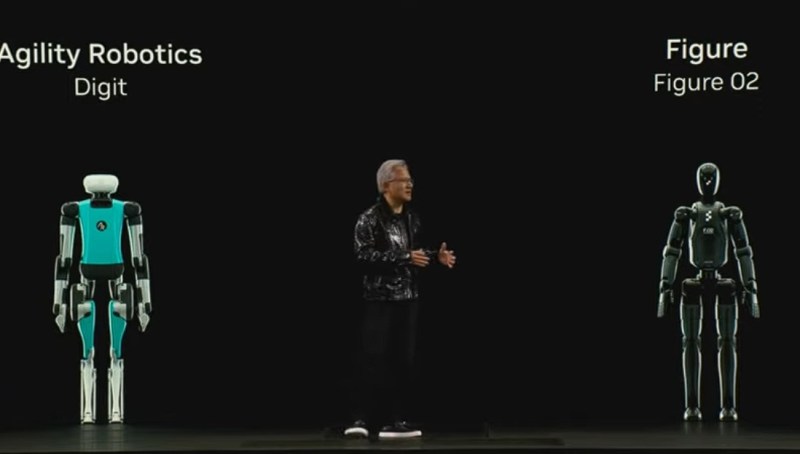
Which one is not the robot?

Nvidia also announced Cosmos at CES, a platform featuring a family of open, pretrained world foundation models purpose-built for generating physics-aware videos and world states for physical AI development. It includes autoregressive and diffusion models in a variety of sizes and input data formats. The models were trained on 18 quadrillion tokens, including 2 million hours of autonomous driving, robotics, drone footage and synthetic data.

In addition to helping generate large datasets, Cosmos can reduce the simulation-to-real gap by upscaling images from 3D to real. Combining Omniverse — a developer platform of application programming interfaces and microservices for building 3D applications and services — with Cosmos is critical, because it helps minimize potential hallucinations commonly associated with world models by providing crucial safeguards through its highly controllable, physically accurate simulations.

An Expanding Ecosystem
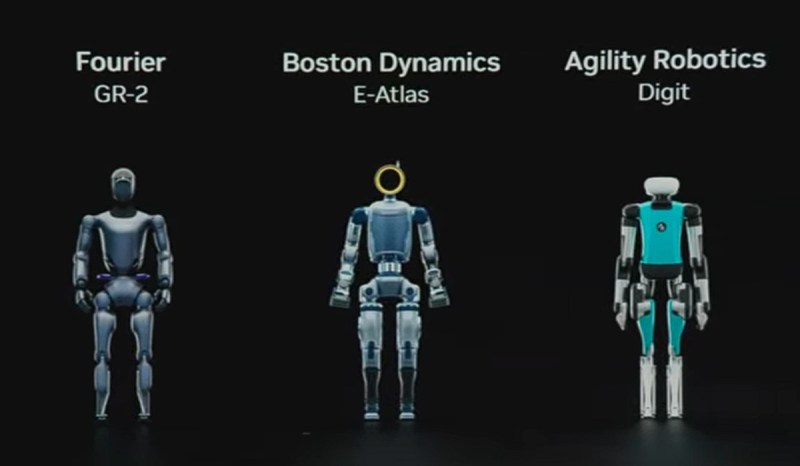
Nvidia GR00T generates synthetic data for robots.

Collectively, Nvidia Isaac GR00T, Omniverse and Cosmos are helping physical AI and humanoid innovation take a giant leap forward. Major robotics companies have started adopting and demonstrated results with Isaac GR00T, including Boston Dynamics and Figure.

Humanoid software, hardware and robot manufacturers can apply for early access to Nvidia’s humanoid robot developer program.


Shape
Shape
Stay Ahead

Explore More Insights

Stay ahead with more perspectives on cutting-edge power, infrastructure, energy,  bitcoin and AI solutions. Explore these articles to uncover strategies and insights shaping the future of industries.

Shape

Yea or nay: Will Nvidia H200 chips go to China?

He noted, “the broader implications and potential impacts may signal to enterprise customers of Nvidia that perhaps they don’t need the latest and greatest GPUs from [them] either to achieve acceptable results across select AI workloads. It is doubtful that Nvidia would commission additional production issues for H200 without China

Read More »

Chinese AI firm trains state-of-the-art model entirely on Huawei chips

The pricing positions GLM-Image as a cost-effective option for enterprises generating marketing materials, presentations, and other text-heavy visual content at scale. Technical approach and benchmark performance GLM-Image employs a hybrid architecture combining a 9-billion-parameter autoregressive model with a 7-billion-parameter diffusion decoder, according to Zhipu’s technical report. The autoregressive component handles

Read More »

ENAP Secures Deal to Use Oxiquim Terminal

Chile’s National Petroleum Company (ENAP) has signed an agreement with Oxiquim allowing ENAP to transfer and store fuels at Oxiquim’s terminal in the municipality of Coronel, Región del Biobío. The agreement allows ENAP to use the Escuadrón Maritime Terminal starting this quarter, ENAP said in a press release. Oxiquim general manager Cecilia Pardo, in comments about the deal, noted of “limited infrastructure available for fuel storage and difficulty in executing new projects”.  Escuadrón is one of three terminals operated by Oxiquim for bulk liquid raw materials and chemicals, fuels and liquefied petroleum gas in Chile, Oxiquim says on its website. The other two are the Mejillones and Quintero terminals. “The agreement is consistent with ENAP’s recent announcement to consolidate its logistics business as a key pillar of the company, incorporating strategic partners and high service standards”, ENAP said. “This is based on the fact that ENAP has logistics assets exceeding $3 billion and that its operations span from Arica to Punta Arenas”. ENAP general manager Julio Friedmann said, “[S]ome of the main areas of work in the immediate term are to generate greater storage capacity and to develop future partnerships with third parties, always for the purpose of strengthening fuel supply throughout the territory”. Last year ENAP consolidated its logistics assets under a “Corporate Logistics Management” and announced an investment plan of $540 million over the next five years for its logistics business. “Among the main areas of focus of this new management are operational excellence, efficiency and profitability of the logistics chain, and the adaptation of infrastructure to meet current and future needs”, ENAP said in an online statement September 5, 2025. “Currently, ENAP manages logistics assets valued at over $3 billion, including a large land fleet, 11 ships, 830 kilometers [515.74 miles] of pipelines, three million cubic meters [105.94 million

Read More »

Petrofac Urges Creditors to Agree ‘Compromise’ to Clear CBI Sale

Petrofac on Wednesday called on certain creditors to sign a “voluntary arrangement” regarding their claims, to allow the British energy engineering company to proceed with a recent agreement to sell its Asset Solutions business to CB&I. Petrofac said in an online statement it has scheduled a meeting of Petrofac Facilities Management Ltd’s creditors on January 30 for a vote on “a proposed Company Voluntary Arrangement (CVA) related to the sale”. “The CVA is intended to compromise certain creditor claims to enable the completion of the sale”, the statement said. “Trade creditors, employees and certain other parties are not affected by the CVA. “Operations will continue as normal during the CVA process and Asset Solutions will continue to serve its customers and work with suppliers as usual”. Petrofac did not disclose the terms of the voluntary arrangement. “The agreed sale of Asset Solutions to CB&I is a strong outcome for the business and for around 3,000 colleagues who are expected to move across on completion”, said John Pearson, chief operating officer for Petrofac’s Asset Solutions business. “After more than two years of restructuring, this CVA is the final step to deliver that outcome, and we are asking creditors to support it so the sale can complete”. Petrofac and CB&I, a maker of storage facilities, tanks and terminals, announced their agreement December 24, 2025. “The consideration for the sale has been agreed on a debt-free cash-free basis”, Petrofac said then. “The ultimate net proceeds from the transaction will depend on the quantum of various deductions which will only be confirmed closer to completion. However, the administrators of the company expect the net proceeds to be in the range of $45m to $55m”. “The net proceeds will be distributed to the secured creditors in accordance with the intercreditor agreement entered into between the company and the secured creditors on 26

Read More »

Oil Prices Retreat After 5 Session Rebound

Oil prices retreated after a five-session rebound as concerns about the geopolitical situation in the Middle East abated to some extent. That’s what Daniel Takieddine, Co-founder and CEO of Sky Links Capital Group, said in a market analysis sent to Rigzone today, adding that “the announcement that the U.S. administration has put its latest move in the area on hold tempered immediate fears of supply disruption in an important oil producing region”. Takieddine warned, however, that geopolitical risk has not disappeared. “Tensions across major producing regions remain elevated, and developments in Eastern Europe and Latin America continue to inject uncertainty into energy supply chains,” he said in the analysis. “In parallel, U.S. crude inventory data showed a strong increase in stockpiles, reinforcing the perception that physical inventory remains plentiful and that recent gains were running ahead of underlying demand conditions,” he added. Looking ahead, Takieddine stated in the analysis that any renewed escalation in the Middle East or other producing regions would quickly push crude prices back to the upside. “However, over the long term, the concerns over an oversupplied market remain a weight on prices and could pull oil toward new lows if geopolitical risks abate more consistently,” he said. In a market comment sent to Rigzone on Thursday, Naeem Aslam, Chief Analyst at Zaye Capital Markets, noted that “crude oil prices remain volatile as markets continuously reprice the geopolitical risk premium against underlying supply-demand fundamentals”. “The latest price swings have largely been driven by shifting Middle East dynamics, including troop movements, Iran-related tension, and broader security posturing, which lifted risk premium earlier, while recent signs of de-escalation have triggered a pullback,” Aslam said in the comment. “Meanwhile, recent economic data reinforced resilient consumption and steady housing activity, supporting the view that demand remains intact but not overheating enough to

Read More »

Woodside, JERA Finalize Winter LNG Deal for Japan

JERA Co Inc and Woodside Energy Group Ltd have finalized an agreement for the Australian company to export liquefied natural gas (LNG) to the Japanese power utility in the winter months for five years. The companies already have an existing contract under which Woodside is to deliver 400,000 metric tons a year of LNG to Japan. The 10-year agreement is to fulfill its first cargo this year on a delivered basis, as announced September 18, 2024. Under the new deal, Woodside will deliver the volumes on an ex-ship basis between the months of December and February from 2027. Three cargoes totaling about 200,000 metric tons will be delivered per year, JERA said in a press release Wednesday. “Gas-fired power generation plays a critical role in meeting peak energy demand and balancing seasonal fluctuations – challenges that are becoming more pronounced as renewable energy expands”, JERA said. “Securing sufficient LNG supply during the winter months, when global gas demand surges, is essential to maintaining a stable electricity supply in Japan”. “The volumes supplied to JERA will be sourced from Woodside’s global LNG portfolio, leveraging assets such as Scarborough, North West Shelf, Pluto LNG and LALNG, once it is operational”, Woodside said in a separate online statement about the new agreement. JERA owns 15.1 percent in the Scarborough field offshore Western Australia, part of the broader Scarborough Energy Project. Scarborough Energy is on track to start exporting LNG in the second half of this year, Woodside affirmed Tuesday as it announced the arrival of the project’s floating production unit. Scarborough Energy includes the development of the Scarborough field off the coast of Karratha, the construction of a second gas processing train for Pluto LNG with a capacity of five million metric tons per annum (MMtpa) and modifications to Pluto Train 1, according to

Read More »

OEUK Highlights ‘Key to Delivering North Sea Future Plan’

Cross-sector collaboration and close consultation of industry experts will be key to delivering the North Sea Future Plan (NSFP). That’s what Mark Wilson, HSE and Operations Director at industry body Offshore Energies UK (OEUK), said in a release sent to Rigzone recently, which highlighted that OEUK will host its 2026 HSE conference on February 25, “bringing together leaders from across sectors to shape the future of the North Sea as a multi-purpose energy basin”. “Under the theme ‘Trust. Transparency. Transformation’, the conference will kick off with a pivotal session based on the UK government’s North Sea Future Plan, which will explore how co-location between offshore wind, oil and gas, and carbon capture and storage (CCUS) can deliver a safer, cleaner basin,” OEUK said in its release. The UK Department for Energy Security and Net Zero (DESNZ) announced the NSFP in a statement posted on its site back in November 2025. “We look forward to welcoming industry leaders, technical experts, regulators, and innovators to this one-day event,” Wilson said in the OEUK release. “The first session of the day is a great opportunity to hear how improved guidance, aligned standards, better data sharing, and early engagement can enable offshore energies to achieve safe and sustainable co-location across the North Sea and support the plan’s integrated vision,” he added. OEUK noted in its release that its event explores the themes of trust, transparency, and transformation across all areas of health, safety, and environment, including emissions performance. It added that the conference features full audience events as well as a series of parallel breakout sessions throughout the day. In its statement published in November last year, DESNZ announced the publication of a “landmark plan to protect existing jobs and deliver the next generation of good, new jobs”.  “The government is charting a new course for the North Sea, providing a

Read More »

BP Sees Up To $5B Impairments Tied to Low Carbon Assets

BP PLC said Wednesday it expects to book $4-5 billion in write-downs primarily related to its “transition” business for the fourth quarter of 2025. “These charges are primarily attributable to the gas and low-carbon energy segment and are excluded from underlying replacement cost profit [BP’s version of adjusted net profit]”, the British oil and gas giant said in an outlook statement ahead of results, scheduled for February 10, 2026. BP did not disclose the affected projects. BP had already recognized a net impairment charge of $881 million from natural gas and low-carbon energy for the first nine months of 2025, and $1.86 billion for 2024, in its third quarter report published November 4, 2025. BP has signed agreements to sell several energy transition-related businesses as part of a “reset” strategy that involves divesting $20 billion worth of assets by 2027 and scaling down renewables investment. On December 16, 2025 state-owned Petróleo Brasileiro SA (Petrobras) and BP solar company Lightsource BP Renewable Energy Investments Ltd said they had penned a deal under which Petrobras would acquire 49.99 percent of Lightsource BP’s subsidiaries in Brazil. Lightsource BP’s Brazilian portfolio included 1-1.5 gigawatts in different stages of development, according to a joint online statement. On August 4, 2025 Japanese power utility JERA Co Inc and BP completed the spinoff of their offshore wind portfolios into a joint venture. BP contributed its development projects in Germany and the United Kingdom and secured leases in the UK and the United States. On July 18, 2025 BP said it had agreed to divest its onshore wind business in the U.S. to LS Power Development LLC, giving up 1.3 gigawatts of net capacity from 10 projects in operation. On July 9, 2025 BP said it had penned a deal to divest its BP Pulse, convenience and mobility businesses in

Read More »

Google warns transmission delays are now the biggest threat to data center expansion

The delays stem from aging transmission infrastructure unable to handle concentrated power demands. Building regional transmission lines currently takes seven to eleven years just for permitting, Hanna told the gathering. Southwest Power Pool has projected 115 days of potential loss of load if transmission infrastructure isn’t built to match demand growth, he added. These systemic delays are forcing enterprises to reconsider fundamental assumptions about cloud capacity. Regions including Northern Virginia and Santa Clara that were prime locations for hyperscale builds are running out of power capacity. The infrastructure constraints are also reshaping cloud competition around power access rather than technical capabilities. “This is no longer about who gets to market with the most GPU instances,” Gogia said. “It’s about who gets to the grid first.” Co-location emerges as a faster alternative to grid delays Unable to wait years for traditional grid connections, hyperscalers are pursuing co-location arrangements that place data centers directly adjacent to power plants, bypassing the transmission system entirely. Pricing for these arrangements has jumped 20% in power-constrained markets as demand outstrips availability, with costs flowing through to cloud customers via regional pricing differences, Gogia said. Google is exploring such arrangements, though Hanna said the company’s “strong preference is grid-connected load.” “This is a speed to power play for us,” he said, noting Google wants facilities to remain “front of the meter” to serve the broader grid rather than operating as isolated power sources. Other hyperscalers are negotiating directly with utilities, acquiring land near power plants, and exploring ownership stakes in power infrastructure from batteries to small modular nuclear reactors, Hanna said.

Read More »

OpenAI turns to Cerebras in a mega deal to scale AI inference infrastructure

Analysts expect AI workloads to grow more varied and more demanding in the coming years, driving the need for architectures tuned for inference performance and putting added pressure on data center networks. “This is prompting hyperscalers to diversify their computing systems, using Nvidia GPUs for general-purpose AI workloads, in-house AI accelerators for highly optimized tasks, and systems such as Cerebras for specialized low-latency workloads,” said Neil Shah, vice president for research at Counterpoint Research. As a result, AI platforms operating at hyperscale are pushing infrastructure providers away from monolithic, general-purpose clusters toward more tiered and heterogeneous infrastructure strategies. “OpenAI’s move toward Cerebras inference capacity reflects a broader shift in how AI data centers are being designed,” said Prabhu Ram, VP of the industry research group at Cybermedia Research. “This move is less about replacing Nvidia and more about diversification as inference scales.” At this level, infrastructure begins to resemble an AI factory, where city-scale power delivery, dense east–west networking, and low-latency interconnects matter more than peak FLOPS, Ram added. “At this magnitude, conventional rack density, cooling models, and hierarchical networks become impractical,” said Manish Rawat, semiconductor analyst at TechInsights. “Inference workloads generate continuous, latency-sensitive traffic rather than episodic training bursts, pushing architectures toward flatter network topologies, higher-radix switching, and tighter integration of compute, memory, and interconnect.”

Read More »

Cisco’s 2026 agenda prioritizes AI-ready infrastructure, connectivity

While most of the demand for AI data center capacity today comes from hyperscalers and neocloud providers, that will change as enterprise customers delve more into the AI networking world. “The other ecosystem members and enterprises themselves are becoming responsible for an increasing proportion of the AI infrastructure buildout as inferencing and agentic AI, sovereign cloud, and edge AI become more mainstream,” Katz wrote. More enterprises will move to host AI on premises via the introduction of AI agents that are designed to inject intelligent insight into applications and help improve operations. That’s where the AI impact on enterprise network traffic will appear, suggests Nolle. “Enterprises need to host AI to create AI network impact. Just accessing it doesn’t do much to traffic. Having cloud agents access local data center resources (RAG etc.) creates a governance issue for most corporate data, so that won’t go too far either,” Nolle said.  “Enterprises are looking at AI agents, not the way hyperscalers tout agentic AI, but agents running on small models, often open-source, and are locally hosted. This is where real AI traffic will develop, and Cisco could be vulnerable if they don’t understand this point and at least raise it in dialogs where AI hosting comes up,” Nolle said. “I don’t expect they’d go too far, because the real market for enterprise AI networking is probably a couple years out.” Meanwhile, observers expect Cisco to continue bolstering AI networking capabilities for enterprise branch, campus and data centers as well as hyperscalers, including through optical support and other gear.

Read More »

Microsoft tells communities it will ‘pay its way’ as AI data center resource usage sparks backlash

It will work with utilities and public commissions to set the rates it pays high enough to cover data center electricity costs (including build-outs, additions, and active use). “Our goal is straightforward: To ensure that the electricity cost of serving our data centers is not passed on to residential customers,” Smith emphasized. For example, the company is supporting a new rate structure Wisconsin that would charge a class of “very large customers,” including data centers, the true cost of the electricity required to serve them. It will collaborate “early, closely, and transparently” with local utilities to add electricity and supporting infrastructure to existing grids when needed. For instance, Microsoft has contracted with the Midcontinent Independent System Operator (MISO) to add 7.9GW of new electricity generation to the grid, “more than double our current consumption,” Smith noted. It will pursue ways to make data centers more efficient. For example, it is already experimenting with AI to improve planning, extract more electricity from existing infrastructure, improve system resilience, and speed development of new infrastructure and technologies (like nuclear energy). It will advocate for state and national public policies that ensure electricity access that is affordable, reliable, and sustainable in neighboring communities. Microsoft previously established priorities for electricity policy advocacy, Smith noted, but “progress has been uneven. This needs to change.” Microsoft is similarly committed when it comes to data center water use, promising four actions: Reducing the overall amount of water its data centers use, initially improving it by 40% by 2030. The company is exploring innovations in cooling, including closed-loop systems that recirculate cooling liquids. It will collaborate with local utilities to map out water, wastewater, and pressure needs, and will “fully fund” infrastructure required for growth. For instance, in Quincy, Washington, Microsoft helped construct a water reuse utility that recirculates

Read More »

Can retired naval power plants solve the data center power crunch?

HGP’s plan includes a revenue share with the government, and the company would create a decommissioning fund, according to Bloomberg. The alternative? After a lengthy decommissioning process, the reactors are shipped to a remote storage facility in Washington state together dust along with dozens of other retired nuclear reactors. So the carrier itself isn’t going to be turned into a data center, but its power plants are being proposed for a data center on land. And even with the lengthening decommissioning process, that’s still faster than building a nuclear power plant from scratch. Don’t hold your breath, says Kristen Vosmaer, managing director, JLL Work Dynamics Data Center team. The idea of converting USS Nimitz’s nuclear reactors to power AI data centers sounds compelling but faces insurmountable obstacles, he argues. “Naval reactors use weapons-grade uranium that civilian entities cannot legally possess, and the Nuclear Regulatory Commission has no pathway to license such facilities. Even setting aside the fuel issue, these military-designed systems would require complete reconstruction to meet civilian safety standards, eliminating any cost advantages over purpose-built nuclear plants,” Vosmaer said. The maritime concept itself, however, does have some merit, said Vosmaer. “Ocean cooling can reduce energy consumption compared to land-based data centers, and floating platforms offer positioning flexibility that fixed facilities cannot match,” Vosmaer said.

Read More »

What exactly is an AI factory?

Others, however, seem to use the word to mean something smaller than a data center, referring more to the servers, software, and other systems used to run AI. For example, the AWS AI Factory is a combination of hardware and software that runs on-premises but is managed by AWS and comes with AWS services such as Bedrock, networking, storage and databases, and security.  At Lenovo, AI factories appear to be packaged servers designed to be used for AI. “We’re looking at the architecture being a fixed number of racks, all working together as one design,” said Scott Tease, vice president and general manager of AI and high-performance computing at Lenovo’s infrastructure solutions group. That number of racks? Anything from a single rack to hundreds, he told Computerworld. Each rack is a little bigger than a refrigerator, comes fully assembled, and is often fully preconfigured for the customer’s use case. “Once it arrives at the customer site, we’ll have service personnel connect power and networking,” Tease said. For others, the AI factory concept is more about the software.

Read More »

Microsoft will invest $80B in AI data centers in fiscal 2025

And Microsoft isn’t the only one that is ramping up its investments into AI-enabled data centers. Rival cloud service providers are all investing in either upgrading or opening new data centers to capture a larger chunk of business from developers and users of large language models (LLMs).  In a report published in October 2024, Bloomberg Intelligence estimated that demand for generative AI would push Microsoft, AWS, Google, Oracle, Meta, and Apple would between them devote $200 billion to capex in 2025, up from $110 billion in 2023. Microsoft is one of the biggest spenders, followed closely by Google and AWS, Bloomberg Intelligence said. Its estimate of Microsoft’s capital spending on AI, at $62.4 billion for calendar 2025, is lower than Smith’s claim that the company will invest $80 billion in the fiscal year to June 30, 2025. Both figures, though, are way higher than Microsoft’s 2020 capital expenditure of “just” $17.6 billion. The majority of the increased spending is tied to cloud services and the expansion of AI infrastructure needed to provide compute capacity for OpenAI workloads. Separately, last October Amazon CEO Andy Jassy said his company planned total capex spend of $75 billion in 2024 and even more in 2025, with much of it going to AWS, its cloud computing division.

Read More »

John Deere unveils more autonomous farm machines to address skill labor shortage

Join our daily and weekly newsletters for the latest updates and exclusive content on industry-leading AI coverage. Learn More Self-driving tractors might be the path to self-driving cars. John Deere has revealed a new line of autonomous machines and tech across agriculture, construction and commercial landscaping. The Moline, Illinois-based John Deere has been in business for 187 years, yet it’s been a regular as a non-tech company showing off technology at the big tech trade show in Las Vegas and is back at CES 2025 with more autonomous tractors and other vehicles. This is not something we usually cover, but John Deere has a lot of data that is interesting in the big picture of tech. The message from the company is that there aren’t enough skilled farm laborers to do the work that its customers need. It’s been a challenge for most of the last two decades, said Jahmy Hindman, CTO at John Deere, in a briefing. Much of the tech will come this fall and after that. He noted that the average farmer in the U.S. is over 58 and works 12 to 18 hours a day to grow food for us. And he said the American Farm Bureau Federation estimates there are roughly 2.4 million farm jobs that need to be filled annually; and the agricultural work force continues to shrink. (This is my hint to the anti-immigration crowd). John Deere’s autonomous 9RX Tractor. Farmers can oversee it using an app. While each of these industries experiences their own set of challenges, a commonality across all is skilled labor availability. In construction, about 80% percent of contractors struggle to find skilled labor. And in commercial landscaping, 86% of landscaping business owners can’t find labor to fill open positions, he said. “They have to figure out how to do

Read More »

2025 playbook for enterprise AI success, from agents to evals

Join our daily and weekly newsletters for the latest updates and exclusive content on industry-leading AI coverage. Learn More 2025 is poised to be a pivotal year for enterprise AI. The past year has seen rapid innovation, and this year will see the same. This has made it more critical than ever to revisit your AI strategy to stay competitive and create value for your customers. From scaling AI agents to optimizing costs, here are the five critical areas enterprises should prioritize for their AI strategy this year. 1. Agents: the next generation of automation AI agents are no longer theoretical. In 2025, they’re indispensable tools for enterprises looking to streamline operations and enhance customer interactions. Unlike traditional software, agents powered by large language models (LLMs) can make nuanced decisions, navigate complex multi-step tasks, and integrate seamlessly with tools and APIs. At the start of 2024, agents were not ready for prime time, making frustrating mistakes like hallucinating URLs. They started getting better as frontier large language models themselves improved. “Let me put it this way,” said Sam Witteveen, cofounder of Red Dragon, a company that develops agents for companies, and that recently reviewed the 48 agents it built last year. “Interestingly, the ones that we built at the start of the year, a lot of those worked way better at the end of the year just because the models got better.” Witteveen shared this in the video podcast we filmed to discuss these five big trends in detail. Models are getting better and hallucinating less, and they’re also being trained to do agentic tasks. Another feature that the model providers are researching is a way to use the LLM as a judge, and as models get cheaper (something we’ll cover below), companies can use three or more models to

Read More »

OpenAI’s red teaming innovations define new essentials for security leaders in the AI era

Join our daily and weekly newsletters for the latest updates and exclusive content on industry-leading AI coverage. Learn More OpenAI has taken a more aggressive approach to red teaming than its AI competitors, demonstrating its security teams’ advanced capabilities in two areas: multi-step reinforcement and external red teaming. OpenAI recently released two papers that set a new competitive standard for improving the quality, reliability and safety of AI models in these two techniques and more. The first paper, “OpenAI’s Approach to External Red Teaming for AI Models and Systems,” reports that specialized teams outside the company have proven effective in uncovering vulnerabilities that might otherwise have made it into a released model because in-house testing techniques may have missed them. In the second paper, “Diverse and Effective Red Teaming with Auto-Generated Rewards and Multi-Step Reinforcement Learning,” OpenAI introduces an automated framework that relies on iterative reinforcement learning to generate a broad spectrum of novel, wide-ranging attacks. Going all-in on red teaming pays practical, competitive dividends It’s encouraging to see competitive intensity in red teaming growing among AI companies. When Anthropic released its AI red team guidelines in June of last year, it joined AI providers including Google, Microsoft, Nvidia, OpenAI, and even the U.S.’s National Institute of Standards and Technology (NIST), which all had released red teaming frameworks. Investing heavily in red teaming yields tangible benefits for security leaders in any organization. OpenAI’s paper on external red teaming provides a detailed analysis of how the company strives to create specialized external teams that include cybersecurity and subject matter experts. The goal is to see if knowledgeable external teams can defeat models’ security perimeters and find gaps in their security, biases and controls that prompt-based testing couldn’t find. What makes OpenAI’s recent papers noteworthy is how well they define using human-in-the-middle

Read More »