Crusoe Brings an Established Modular Model to DSX POD
For Crusoe, NVIDIA’s announcement builds on a modular computing strategy already in operation.
In its October 21 announcement, Crusoe confirmed that its Spark modular AI data center platform will support DSX POD, extending a manufacturing and deployment approach the company says it has pursued since 2020.
Crusoe has expanded its manufacturing capabilities through the acquisition of electrical equipment specialist Easter-Owens Electric and the development of its 352,000-square-foot Crusoe Spark Factory in Brighton, Colorado.
The company also introduced Crusoe Spark Liquid, a sixth-generation modular system engineered for ultra-high-density infrastructure, including NVIDIA Vera Rubin NVL72. Next-generation liquid-cooled units are planned for 2027.
Crusoe’s vertically integrated model connects infrastructure design and manufacturing with deployment and cloud operations through Crusoe Cloud. The company says it can deliver productive AI capacity in as little as three months, although that timeline is distinct from NVIDIA’s narrower 14-day prepared-site deployment claim.
“Modular isn’t a new strategy or pivot for us. It’s been in our DNA since our founding,” said Bryan Schramm, Crusoe’s head of Spark.
Crusoe’s involvement demonstrates that the manufacturing model predates DSX POD. NVIDIA is not inventing modular data center infrastructure; it is attempting to establish a common architecture around capabilities that suppliers such as Crusoe have already spent years developing.
That distinction matters as the industry evaluates whether standardized AI factory designs can deliver manufacturing efficiencies at a scale beyond individual suppliers’ existing operations.
Vertiv and Polar Put the Deployment Model to Work in Norway
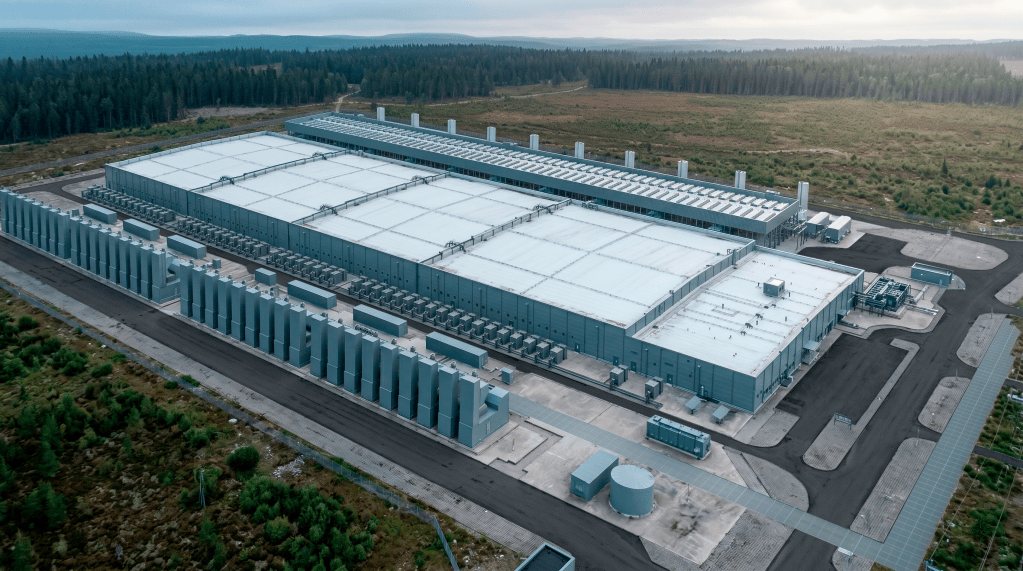
The European dimension of NVIDIA’s announcement is reflected in a deployment involving Vertiv and Polar Data Centers at Herøya, Norway.
According to Vertiv’s October 21 announcement, Polar is applying a factory-built infrastructure approach to the initial 41 MW phase of a multiphase AI data center campus designed to scale to 100 MW.
Vertiv is supplying prefabricated power and thermal infrastructure, including SmartRun overhead systems and SmartMod modules, supported by its Unify software.
The project applies principles of the broader NVIDIA DSX AI Factory reference design, rather than representing a confirmed installation of a complete DSX POD container. Even so, it offers a practical example of pre-engineered infrastructure being deployed at scale.
Vertiv has also published a model quantifying the potential economic advantage of shortening AI factory delivery.
The company’s argument starts with a distinction between the performance of installed computing equipment and the productive time available to use it. Two AI factories equipped with identical hardware may generate tokens at the same daily rate, but the facility that becomes operational earlier can produce substantially more cumulative output during its first year.
Under Vertiv’s modeled assumptions, standardized design and virtual validation reduce the configuration stage from approximately 30 days to three days. Factory-built infrastructure then cuts the modeled deployment period from 90 days to 45 days.
Together, those improvements compress the relevant engineering and deployment stages from roughly 120 days to 48 days, bringing productive AI capacity online approximately 10 weeks sooner.
Over the first year following project kickoff, that translates to 317 productive days rather than 245. Assuming identical installed computing capacity and daily production rates, Vertiv projects the accelerated approach could yield nearly 30% more cumulative AI token output during that period.
The calculation is a modeled comparison, not a claim of faster GPU performance or a measured throughput improvement at Polar. The projected advantage comes from putting the same expensive computing infrastructure into productive service sooner.
“An AI factory earns its return in tokens,” said Vertiv CEO Giordano Albertazzi.
The economic argument reflects a growing emphasis on time to first token as a measure of infrastructure delivery performance. For operators committing substantial capital to next-generation GPUs, months spent waiting for systems to become productive carry a potentially significant opportunity cost.
Virtual Twins Extend the Factory Model Into Engineering
Factory integration is only one part of the proposed transformation. Suppliers are also attempting to standardize the engineering and validation processes that precede manufacturing.
On October 22, Dassault Systèmes and Vertiv announced a collaboration to use Dassault’s 3DEXPERIENCE platform and virtual-twin technology to configure, simulate and validate AI factory infrastructure before construction.
The companies are combining Vertiv’s pre-engineered power and cooling systems with NVIDIA’s DSX AI Factory reference designs and Omniverse DSX Blueprint.
The objective is to model interconnected computing, electrical, thermal, networking and control systems within a common engineering environment, allowing changes in equipment configuration or operating requirements to be evaluated before they become field installation problems.
The collaboration extends work involving Vertiv’s SmartRun configurable virtual twin to broader infrastructure offerings, including its OneCore integrated data center platform.
The larger implication is that industrialized AI infrastructure requires more than standardized equipment. It also requires repeatable methods of configuring, testing and modifying interconnected systems for different sites, preserving design integrity from manufacturing through commissioning and subsequent technology upgrades.
An Expanding OEM and Operator Ecosystem
Other NVIDIA partners are developing complementary approaches to factory-integrated AI infrastructure.
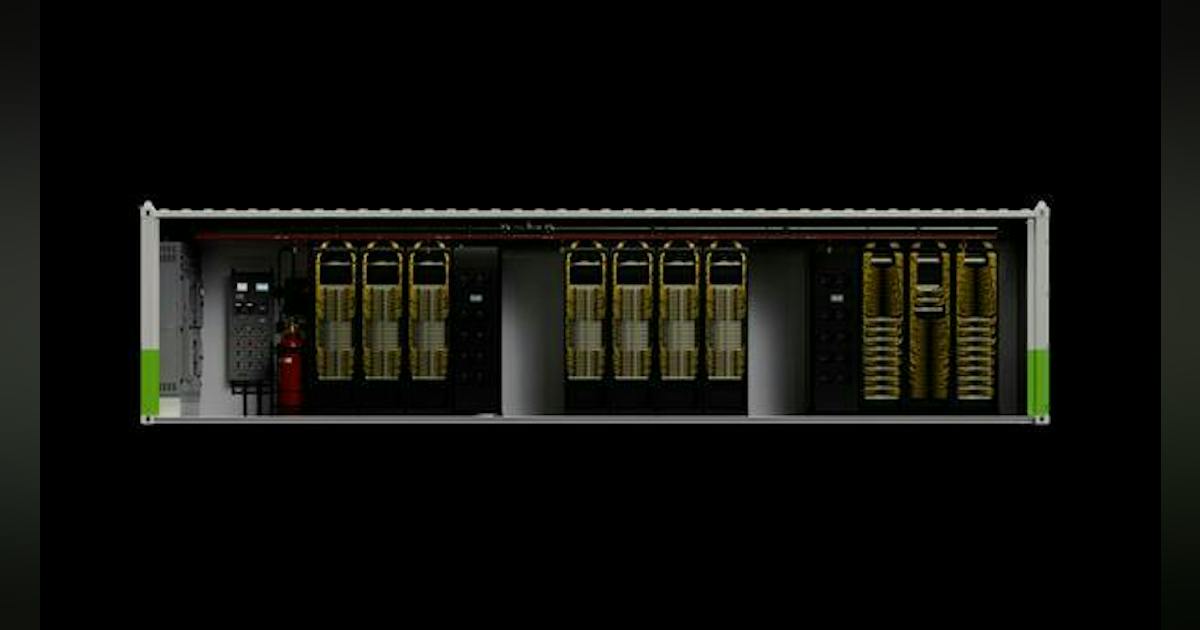
Dell Technologies has announced the Dell Modular Data Center with NVIDIA DSX POD, a containerized offering intended to integrate computing, storage, networking, rack-level power and liquid cooling. The company targets availability of its modular DSX reference design in early 2027.
HPE likewise plans to support DSX POD through its existing AI Mod Pod modular infrastructure capabilities.
Meanwhile, Singapore-based DayOne Data Centers is aligning its standardized construction and modular delivery approach with DSX POD. DayOne reports that its prefabrication strategy can support data center project delivery in approximately eight to twelve months in Southeast Asia.
That broader construction timeline provides useful context for NVIDIA’s much shorter prepared-site deployment target. Even when computing systems arrive as tested modular assemblies, the surrounding infrastructure and site development remain substantial undertakings.
Taken together, the announcements suggest an emerging ecosystem in which equipment manufacturers, mechanical and electrical infrastructure suppliers, modular data center builders and operators can coordinate around more consistent engineering and integration requirements.
DSX POD also brings into focus the progression of NVIDIA’s announcements throughout 2026. At GTC in March, Huang declared that the “inference inflection” had arrived, as reasoning models and emerging agentic workloads drove a new phase of computing demand. NVIDIA introduced its Vera Rubin DSX AI Factory reference design that month, then expanded the DSX platform in May into a broader framework spanning infrastructure design, operations and token economics.
Now, with DSX POD, that increasingly integrated architecture extends into the manufacturing and physical delivery of the AI factory itself. What began as a story about accelerating demand for inference is becoming a story about industrializing the infrastructure required to deliver it.
What the Factory Model Changes—and What It Doesn’t
There are important limits to the industrialization narrative.
NVIDIA’s 14-day deployment claim applies to a prepared site. It does not mean a greenfield AI data center can move from land acquisition to commercial operation in two weeks.
Nor does factory integration eliminate every supply chain constraint. Manufacturing complete AI systems requires dependable access to GPUs, networking equipment, electrical components, cooling systems and skilled production labor.
Some complexity is reduced at the construction site; other complexity moves upstream into manufacturing, logistics, system validation and production planning.
The industry must also demonstrate that standardized containers can accommodate successive generations of computing hardware without sacrificing the flexibility operators need for service, maintenance and upgrades.
For now, the evidence supporting industrialized deployment comes from several different sources: measured installation improvements such as the Schneider Electric-Compass study, existing modular manufacturing operations such as Crusoe’s, real-world projects applying broader DSX principles such as Polar’s Norway campus, and forward-looking programs such as Armada’s 500 MW initiative.
Those developments provide a basis for evaluating the emerging manufacturing model, but they are not yet proof that every benefit attributed to DSX POD has been achieved at commercial scale.
Ultimately, NVIDIA’s vision of a 14-day deployment remains tethered to the realities of heavy infrastructure. Securing high-voltage grid connections, substations and necessary transmission upgrades can take years, long before a site is ready to receive its first DSX POD. NVIDIA is already reaching upstream into that problem. As Data Center Frontier reported in September, its broader DSX strategy encompasses powered-land development and behind-the-meter generation, with DSX Flex designed to coordinate grid power, onsite resources and computing demand.
But neither behind-the-meter power nor factory integration eliminates infrastructure dependencies; they reorganize them. Onsite generation brings its own permitting, equipment and fuel-supply challenges, while moving integration upstream creates new dependencies on standardized components and tightly coordinated manufacturing schedules. A shortage of cooling equipment or optical transceivers could disrupt delivery of otherwise completed AI factory modules.
The ultimate test is therefore not simply whether NVIDIA can deploy an AI factory in 14 days. It is whether the power infrastructure and industrial supply chains supporting that deployment can keep pace with the speed of silicon.