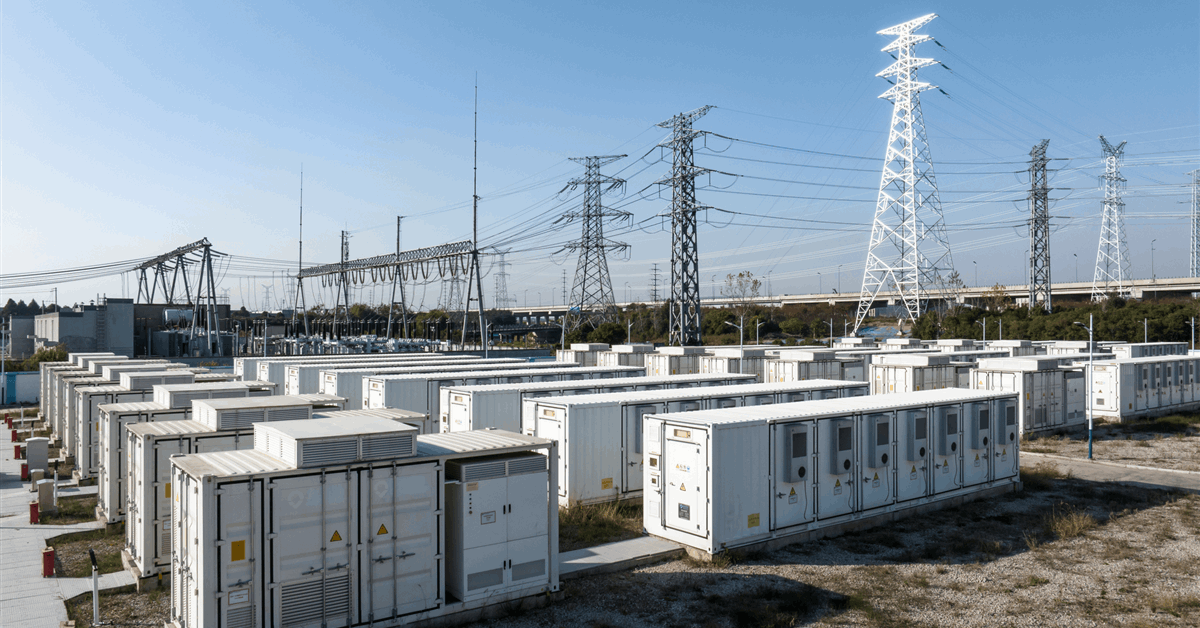
China accounted for 54 percent of last year’s record global energy storage installations and looks set to maintain its dominant position in the sector beyond the decade despite policy headwinds, Wood Mackenzie said Tuesday.
Worldwide energy storage installations in 2025 totaled 106 gigawatts (GW), up 43 percent from 2024. Global capacity now stands at about 270 GW, the Edinburgh, Scotland-based energy consultancy firm said in an insights piece on its website. “Energy storage has established itself as a critical component of the global energy transition”, WoodMac said.
By 2034 global energy storage capacity is expected to reach 1,545 GW, with China poised to contribute around half of additions in the 10-year period from 2025.
“However, the Chinese market faces considerable challenges entering 2026-27”, it said. “The removal of mandatory renewable-storage coupling requirements and the absence of established revenue frameworks create substantial uncertainty”.
Nonetheless the world’s second-biggest economy is growing renewable energy and storage to displace the more expensive gas power, WoodMac said earlier.
“China’s battery costs have dropped by over 50 percent in the last three years while its 42 GW of grid-connected energy storage additions last year (excluding pumped hydro installations) were double that of gas power in 2024”, WoodMac wrote October 30, 2025.
“Consequently, China’s gas power generation share of output has remained broadly flat in 2025 as energy storage eats into gas’s market share. The global LNG industry should take note”.
U.S. Growth
WoodMac said Tuesday the United States energy storage market appears to also continue displaying resilience against a backdrop of policy reversals, with installations growing 53 percent year-on-year in 2025.
“The passage of reconciliation legislation introduced supply chain restrictions for projects seeking federal tax credits, creating initial market uncertainty”, it said.
“However, U.S. large-scale forecast actually increased following the bill’s passage, driven by announcements of domestic cell manufacturing facilities and committed large electricity loads. Developers accelerated construction on over 13 GW of ‘safe-harbored’ projects to qualify under previous policy frameworks.
“Key growth drivers in U.S. include capacity-constrained markets where storage provides critical reliability services, state-level incentives and mandates, and the country’s first wave of battery augmentation projects.
“Approximately 12 percent of existing systems required capacity additions in 2025, creating a new market segment that is expected to expand significantly in the coming years”.
WoodMac expects the policy transitions in the U.S. and China to result in a “moderate” energy storage growth in 2026. “However, sustained long-term growth remains strong, supported by government tenders driving large-scale deployment and support schemes accelerating distributed segment adoption”, it said.
Utility-Scale Projects
On-grid energy storage installations contributed 82 percent of last year’s energy storage buildout, according to WoodMac. “This segment continues to significantly outpace both residential and C&I installations, driven by large grid applications, renewable energy integration requirements and government procurement programs”, it said.
“By 2025, average utility-scale energy storage durations reached approximately 2.5 hours globally, with some markets like Chile and Saudi Arabia developing projects with durations exceeding 3-4 hours to address specific grid requirements.
“The utility-scale segment’s leadership position is expected to continue through 2034, with projections showing sustained strong growth across all major markets.
“The business case for utility-scale storage has strengthened considerably, supported by declining battery costs, improved project economics and increasingly diverse revenue opportunities.
“Additionally, government-led tenders are driving deployment of utility storage systems. Even limited policy support can accelerate project development and provide investors with the confidence needed when fully merchant business cases appear too risky”.
To contact the author, email [email protected]
WHAT DO YOU THINK?
Generated by readers, the comments included herein do not reflect the views and opinions of Rigzone. All comments are subject to editorial review. Off-topic, inappropriate or insulting comments will be removed.
MORE FROM THIS AUTHOR