Stay Ahead, Stay ONMINE

Cohere’s first vision model Aya Vision is here with broad, multilingual understanding and open weights — but there’s a catch

Join our daily and weekly newsletters for the latest updates and exclusive content on industry-leading AI coverage. Learn More Canadian AI startup Cohere launched in 2019 specifically targeting the enterprise, but independent research has shown it has so far struggled to gain much of a market share among third-party developers compared to rival proprietary U.S. […]

Join our daily and weekly newsletters for the latest updates and exclusive content on industry-leading AI coverage. Learn More


Canadian AI startup Cohere launched in 2019 specifically targeting the enterprise, but independent research has shown it has so far struggled to gain much of a market share among third-party developers compared to rival proprietary U.S. model providers such as OpenAI and Anthropic, not to mention the rise of Chinese open-source competitor DeepSeek.

Yet Cohere continues to bolster its offerings: Today, its non-profit research division Cohere for AI announced the release of its first vision model, Aya Vision, a new open-weight multimodal AI model that integrates language and vision capabilities and boasts the differentiator of supporting inputs in 23 different languages spoken by what Cohere says in an official blog post is “half the world’s population,” making it appeal to a wide global audience.

Aya Vision is designed to enhance AI’s ability to interpret images, generate text, and translate visual content into natural language, making multilingual AI more accessible and effective. This would be especially helpful for enterprises and organizations operating in multiple markets around the world with different language preferences.

It’s available now on Cohere’s website and on AI code communities Hugging Face and Kaggle under a Creative Commons Attribution-NonCommercial 4.0 International (CC BY-NC 4.0) license, allowing researchers and developers to freely use, modify and share the model for non-commercial purposes as long as proper attribution is given.

In addition, Aya Vision is available through WhatsApp, allowing users to interact with the model directly in a familiar environment.

This limits its use for enterprises and as an engine for paid apps or moneymaking workflows, unfortunately.

It comes in 8-billion and 32-billion parameter versions (parameters refer to the number of internal settings in an AI model, including its weights and biases, with more usually denoting a more powerful and performant model).

Supports 23 languages and counting

Even though leading AI models from rivals can understand text across multiple languages, extending this capability to vision-based tasks is a challenge.

But Aya Vision overcomes this by allowing users to generate image captions, answer visual questions, translate images, and perform text-based language tasks in a diverse set of languages:

1. English

2. French

3. German

4. Spanish

5. Italian

6. Portuguese

7. Japanese

8. Korean

9. Chinese

10. Arabic

11. Greek

12. Persian

13. Polish

14. Indonesian

15. Czech

16. Hebrew

17. Hindi

18. Dutch

19. Romanian

20. Russian

21. Turkish

22. Ukrainian

23. Vietnamese

In its blog post, Cohere showed how Aya Vision can analyze imagery and text on product packaging and provide translations or explanations. It can also identify and describe art styles from different cultures, helping users learn about objects and traditions through AI-powered visual understanding.
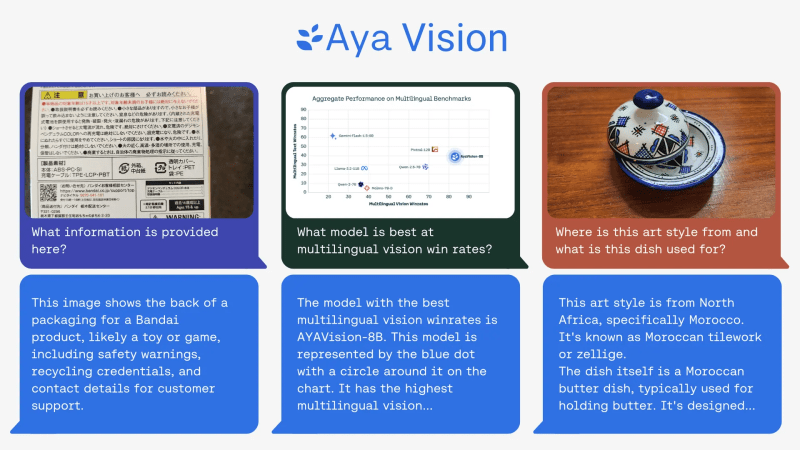
Aya Vision’s capabilities have broad implications across multiple fields:

Language learning and education: Users can translate and describe images in multiple languages, making educational content more accessible.

Cultural preservation: The model can generate detailed descriptions of art, landmarks and historical artifacts, supporting cultural documentation in underrepresented languages.

Accessibility tools: Vision-based AI can assist visually impaired users by providing detailed image descriptions in their native language.

Global communication: Real-time multimodal translation enables organizations and individuals to communicate across languages more effectively.

Strong performance and high efficiency across leading benchmarks

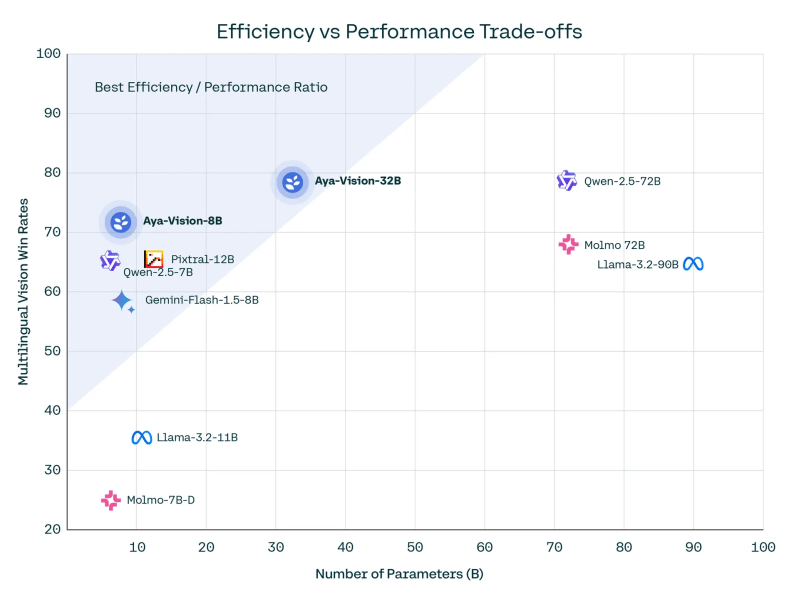
One of Aya Vision’s standout features is its efficiency and performance relative to model size. Despite being significantly smaller than some leading multimodal models, Aya Vision has outperformed much larger alternatives in several key benchmarks.

• Aya Vision 8B outperforms Llama 90B, which is 11 times larger.

• Aya Vision 32B outperforms Qwen 72B, Llama 90B and Molmo 72B, all of which are at least twice as large (or more).

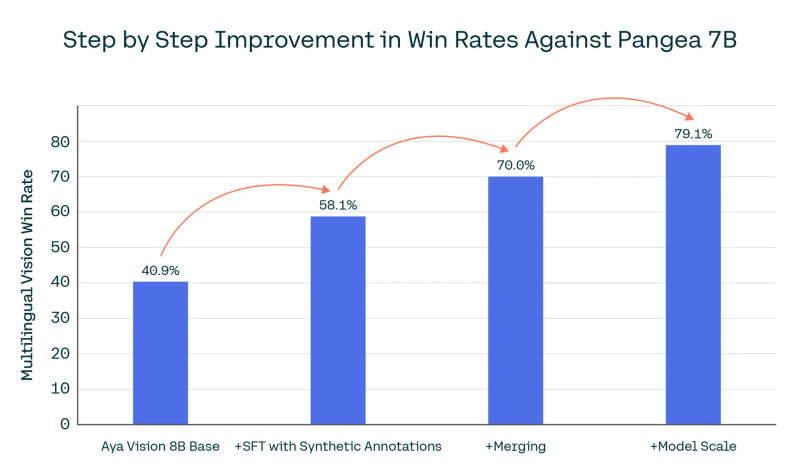
• Benchmarking results on AyaVisionBench and m-WildVision show Aya Vision 8B achieving win rates of up to 79%, and Aya Vision 32B reaching 72% win rates in multilingual image understanding tasks.

A visual comparison of efficiency vs. performance highlights Aya Vision’s advantage. As shown in the efficiency vs. performance trade-off graph, Aya Vision 8B and 32B demonstrate best-in-class performance relative to their parameter size, outperforming much larger models while maintaining computational efficiency.
The tech innovations powering Aya Vision

Cohere For AI attributes Aya Vision’s performance gains to several key innovations:

Synthetic annotations: The model leverages synthetic data generation to enhance training on multimodal tasks.

Multilingual data scaling: By translating and rephrasing data across languages, the model gains a broader understanding of multilingual contexts.

Multimodal model merging: Advanced techniques combine insights from both vision and language models, improving overall performance.

These advancements allow Aya Vision to process images and text with greater accuracy while maintaining strong multilingual capabilities.

The step-by-step performance improvement chart showcases how incremental innovations, including synthetic fine-tuning (SFT), model merging, and scaling, contributed to Aya Vision’s high win rates.
Implications for enterprise decision-makers

Despite Aya Vision’s ostensibly catering to the enterprise, businesses may have a hard time making much use of it given its restrictive non-commercial licensing terms.

Nonetheless, CEOs, CTOs, IT leaders and AI researchers may use the models to explore AI-driven multilingual and multimodal capabilities within their organizations — particularly in research, prototyping and benchmarking.

Enterprises can still use it for internal research and development, evaluating multilingual AI performance and experimenting with multimodal applications.

CTOs and AI teams will find Aya Vision valuable as a highly efficient, open-weight model that outperforms much larger alternatives while requiring fewer computational resources.

This makes it a useful tool for benchmarking against proprietary models, exploring potential AI-driven solutions, and testing multilingual multimodal interactions before committing to a commercial deployment strategy.

For data scientists and AI researchers, Aya Vision is much more useful.

Its open-source nature and rigorous benchmarks provide a transparent foundation for studying model behavior, fine-tuning in non-commercial settings, and contributing to open AI advancements.

Whether used for internal research, academic collaborations, or AI ethics evaluations, Aya Vision serves as a cutting-edge resource for enterprises looking to stay at the forefront of multilingual and multimodal AI — without the constraints of proprietary, closed-source models.

Open-source research and collaboration

Aya Vision is part of Aya, a broader initiative by Cohere focused on making AI and related tech more multilingual.

Since its inception in February 2024, the Aya initiative has engaged a global research community of over 3,000 independent researchers across 119 countries, working together to improve language AI models.

To further its commitment to open science, Cohere has released the open weights for both Aya Vision 8B and 32B on Kaggle and Hugging Face, ensuring researchers worldwide can access and experiment with the models. In addition, Cohere For AI has introduced the AyaVisionBenchmark, a new multilingual vision evaluation set designed to provide a rigorous assessment framework for multimodal AI.

The availability of Aya Vision as an open-weight model marks an important step in making multilingual AI research more inclusive and accessible.

Aya Vision builds on the success of Aya Expanse, another LLM family from Cohere For AI focused on multilingual AI. By expanding its focus to multimodal AI, Cohere For AI is positioning Aya Vision as a key tool for researchers, developers, and businesses looking to integrate multilingual AI into their workflows.

As the Aya initiative continues to evolve, Cohere For AI has also announced plans to launch a new collaborative research effort in the coming weeks. Researchers and developers interested in contributing to multilingual AI advancements can join the open science community or apply for research grants.

For now, Aya Vision’s release represents a significant leap in multilingual multimodal AI, offering a high-performance, open-weight solution that challenges the dominance of larger, closed-source models. By making these advancements available to the broader research community, Cohere For AI continues to push the boundaries of what is possible in AI-driven multilingual communication.


Shape
Shape
Stay Ahead

Explore More Insights

Stay ahead with more perspectives on cutting-edge power, infrastructure, energy,  bitcoin and AI solutions. Explore these articles to uncover strategies and insights shaping the future of industries.

Shape

AI power efficiency the target of Lotus Microsystems energy advances

By shortening current paths and integrating thermal management directly into the power-delivery structure, vStrata aims to reduce conversion losses while improving cooling efficiency. According to Lotus Microsystems, the module can achieve point-of-load efficiencies of up to 96% while reducing power-conversion losses by more than 50% compared with conventional approaches. “We

Read More »

Energy Department Issues RFP to Advance President Trump’s 172-Million-Barrel Strategic Petroleum Reserve Exchange

WASHINGTON—The U.S. Department of Energy (DOE) today issued a Request for Proposal (RFP) for an exchange of up to 40 million barrels of crude oil from the Strategic Petroleum Reserve (SPR). Today’s solicitation opens competitive bidding, continuing DOE’s execution of President Trump’s 172-million-barrel release as part of a coordinated 400-million-barrel action by International Energy Agency (IEA) member nations’ strategic reserves. Under President Trump’s leadership, DOE has advanced an unprecedented series of large-scale SPR exchange solicitations at record speed. These actions have moved critical crude oil supplies into the market to address short term supply disruptions and bolster energy security for the United States and its allies. The crude oil will originate from the SPR’s Big Hill and Bryan Mound sites. This action builds on the Department’s four previous solicitations that collectively awarded more than 133 million barrels across three completed exchanges. DOE’s earlier exchanges demonstrated the SPR’s ability to rapidly deliver crude under emergency authorities while achieving a 26 percent premium in returned barrels—expanding the reserve at no additional cost to American taxpayers. “With today’s announcement, we are accelerating the President’s commitment to a coordinated and strategic release that stabilizes global oil markets,” said DOE Acting Assistant Secretary for the Hydrocarbons and Geothermal Energy Office Curt Coccodrilli. “This exchange will help move oil swiftly to refiners, ease short-term supply pressures, and ensure the Strategic Petroleum Reserve continues to grow stronger through the return of premium barrels.” Under DOE’s exchange authority, participating companies will return the 40 million borrowed barrels with additional premium barrels, ensuring immediate market supply while increasing the SPR’s long-term inventory. Bids for this solicitation are due no later than 11:00 A.M. Central Time on Monday, June 15, 2026. For more information on the SPR, please visit DOE’s website. 

Read More »

DOE’s Hydrocarbons and Geothermal Energy Office Invests $3.6 Million to Modernize America’s Coal-Fired Power Plants

WASHINGTON—The U.S. Department of Energy’s (DOE) Hydrocarbons and Geothermal Energy Office (HGEO) today announced $3.6 million for nine design and engineering projects that will support the refurbishment or retrofit of existing coal power plants with transformational technologies that address wastewater systems and improve the efficiency, reliability, flexibility, and performance of coal and natural gas use. By upgrading our nation’s existing coal facilities, these initiatives will help strengthen the backbone of America’s power grid and ensure all American’s have access to affordable, reliable, and secure energy when they need it most. These efforts help to advance President Trump’s Executive Orders Reinvigorating America’s Beautiful Clean Coal Industry and Strengthening the Reliability and Security of the United States Electric Grid to restore common-sense energy policies that prioritize dependable power, affordability, and American workers. “America’s coal fleet is an undeniable pillar of our energy dominance and economic strength, but for too long, policies have undermined this vital industry and the dedicated workforce behind it, threatening our grid’s stability and driving up costs for everyday Americans,” said DOE Acting Assistant Secretary of the Hydrocarbons and Geothermal Energy Office Curt Coccodrilli. “With the project investments announced today, we are decisively moving to champion our existing coal plants, ensuring they continue to deliver affordable, reliable power, keep the lights on, and fuel America’s progress for generations to come.” Projects have been selected under three topic areas to provide a path forward to rapidly and cost-effectively restore the stability of the nation’s bulk power system while also finding beneficial uses for wastes generated by coal-based energy production. The projects will be executed in three phases, with design and engineering completed in Phase I, final engineering and detailed design completed in Phase II, and technology implementation and validation completed in Phase III. Selectees to receive Phase I funding include: Baker Hughes Energy Transition LLC (Houston, Texas),

Read More »

Energy Department Releases Finalized Fusion Science and Technology Roadmap to Accelerate Commercial Fusion Power

WASHINGTON—The U.S. Department of Energy (DOE) today released the finalized Fusion Science and Technology (FS&T) Roadmap, a national strategy to accelerate the development and commercialization of fusion energy on the most rapid, responsible timeline in history. Building on earlier roadmap efforts, the finalized roadmap brings together fusion science, technology, infrastructure, workforce development, and commercialization priorities into a single national strategy to support fusion pilot plants and commercial fusion power in the mid-2030s. Fusion is the process that powers the sun and stars. For decades, scientists and engineers have worked to bring that same process to Earth as a source of abundant, reliable energy. The finalized roadmap outlines how DOE, industry, universities, and national laboratories will work together to accelerate the path toward commercial fusion energy in the United States. This effort advances President Trump’s energy dominance agenda and reinforces the Administration’s commitment to expanding reliable American energy production, strengthening domestic supply chains, and maintaining U.S. leadership in critical technologies. By accelerating progress toward commercial fusion power, DOE is helping secure a future of abundant and reliable energy. “Fusion energy has entered a new era defined by extraordinary scientific progress and public-private momentum,” said DOE Under Secretary for Science Dr. Darío Gil. “With this roadmap, we now have the clarity, coordination, and sustained commitment needed to turn the promise of fusion into a reality for the American people.” Developed with input from more than 800 scientists and engineers across the public and private sectors, the finalized FS&T Roadmap reflects contributions from more than 15 private companies, over 10 National Laboratories, and more than 70 universities. The roadmap identifies the critical science and technology gaps that must be closed to realize fusion pilot plants and strengthen U.S. leadership in the global fusion industry. The FS&T Roadmap establishes a unified strategy for the U.S.

Read More »

Aramco to divest Malaysian refining assets

Petroliam Nasional Bhd. (PETRONAS) subsidiary PETRONAS Refinery & Petrochemical Corp. Sdn. Bhd. (PRPC) has agreed to buyout Saudi Arabian Oil Co.’s (Aramco) equity interests in the partners’ dual 50-50 joint ventures responsible for operating the 300,000-b/d integrated refining and petrochemical refinery of the Pengerang Integrated Complex (PIC) in southeastern Johor, Malaysia. Subject to fulfillment of customary closing conditions, Petronas will take 100% ownership and become full operator of Pengerang Refining Co. Sdn. Bhd. and Pengerang Petrochemical Co. Sdn. Bhd., collectively known as PRefChem, Aramco and Petronas said in separate releases. Aramco said divestment of the Malaysian assets will support the strategic optimization of the company’s own downstream portfolio by providing additional flexibility to pursue investments aligned with its broader downstream strategy. While Aramco will no longer hold ownership in the Malaysian ventures, the company said it will continue actively explore commercial arrangements with Petronas following the sale, including continuing its existing agreement to supply Saudi Arabian crude oil to the site, as well as opportunities related to technology exchange and integrated product distribution. Petronas said its move to take full control of the downstream assets will allow the company to further enhance operational alignment and flexibility across PRefChem’s value chain, while harnessing its international oil supply network and integrated operating model to support continued reliability and resilience across varying market conditions. Full ownership of PRefChem’s in-country operations also will strengthen Petronas’ ability to support Malaysia’s long-term energy security and industry resilience, the operator said. A definitive timeframe for when the parties expect to finalize the proposed transaction was not revealed. PRefChem operations In addition to the Johor refinery, PRefChem’s operations at PIC include a steam cracker complex equipped to produce 3.4 million tonnes/year (tpy) combined of ethylene, propylene, butadiene, benzene and raffinate-2. PRefChem also operates an associated petrochemical complex at the

Read More »

Delfin Midstream takes $5-billion FID for first FLNG vessel

@import url(‘https://fonts.googleapis.com/css2?family=Inter:[email protected]&display=swap’); .ebm-page__main h1, .ebm-page__main h2, .ebm-page__main h3, .ebm-page__main h4, .ebm-page__main h5, .ebm-page__main h6 { font-family: Inter; } body { line-height: 150%; letter-spacing: 0.025em; } button, .ebm-button-wrapper { font-family: Inter; } .label-style { text-transform: uppercase; color: var(–color-grey); font-weight: 600; font-size: 0.75rem; } .caption-style { font-size: 0.75rem; opacity: .6; } #onetrust-pc-sdk [id*=btn-handler], #onetrust-pc-sdk [class*=btn-handler] { background-color: #c19a06 !important; border-color: #c19a06 !important; } #onetrust-policy a, #onetrust-pc-sdk a, #ot-pc-content a { color: #c19a06 !important; } #onetrust-consent-sdk #onetrust-pc-sdk .ot-active-menu { border-color: #c19a06 !important; } #onetrust-consent-sdk #onetrust-accept-btn-handler, #onetrust-banner-sdk #onetrust-reject-all-handler, #onetrust-consent-sdk #onetrust-pc-btn-handler.cookie-setting-link { background-color: #c19a06 !important; border-color: #c19a06 !important; } #onetrust-consent-sdk .onetrust-pc-btn-handler { color: #c19a06 !important; border-color: #c19a06 !important; } <!–> Delfin Midstream Inc., Houston, has taken a final investment decision (FID) for the first floating liquefied natural gas (FLNG) vessel of the Delfin LNG project under development in Louisiana and offshore in the Gulf of Mexico. Delfin FLNG 1 will be the first FLNG vessel in the US and the largest FLNG project globally, with an expected export capacity of 4.4 million tonnes/year (tpy) of LNG, the company said in its June 3 release. Concurrent with the FID, a group of investors led by Global Infrastructure Partners (GIP), a part of BlackRock—including existing Delfin investors Mitsui OSK Lines Ltd. (MOL), Vitol, and Diameter Capital Partners—has agreed to invest in the first phase of the project. ]–> <!–> –><!–> –> Oct. 9, 2023 <!–> –><!–> –> July 11, 2023 <!–> –><!–> –> June 9, 2023 <!–> –><!–> –> July 2, 2021 <!–> –> <!–> The vessel is backed by long-term LNG sales agreements with Vitol, Expand Energy, Centrica, and Gunvor, Delfin said, and all necessary permits and licenses required to begin construction have been secured. Construction contracts have been executed with Samsung Heavy Industries Co. Ltd. and Black & Veatch. LNG production is scheduled to begin

Read More »

Chevron files $13.8-billion Argentina oil development proposal

Chevron Corp. applied June 2 to join Argentina’s Large Investment Incentive Regime (RIGI) for a $13.8-billion unconventional oil development at its 100% operated El Trapial-Este block in northern Neuquén province. Until recently, RIGI had attracted about $93 billion across 36 projects. Chevron’s application, which remains subject to government approval, is equivalent to almost one seventh of that total. The filing, which does not consitute a final investment decision, is Chevron’s largest individual investment proposal in Argentina since it entered the country in 1999 and the second-largest project submitted under RIGI, behind YPF SA’s $25-billion LLL Oil development.  Chevron said it is targeting production of about 30,000 b/d from El Trapial-Este, subject to the availability of takeaway infrastructure. The block currently produces about 7,000 b/d. Chevron tested the block with a 7-well pilot in 2021 and has been carrying out development since late 2022, using laterals of more than 3,000 m and techniques transferred from the US Permian basin. In 2023, Chevron committed $500 million to that phase. During the company’s first-quarter earnings call on May 1, chief executive officer Mike Wirth anchored Chevron’s 2030 targets in “assets that are operating today.” El Trapial-Este was not explicitly identified among assets described as the main base for those targets. Wirth also said Chevron would not accelerate Permian production even with Brent above $100/bbl, preferring to manage that asset for free cash flow rather than volume. In the same presentation, Wirth named Argentina among the sources of equity crude that feed Chevron’s global refining system, along with Tengiz, Guyana, the Permian, and Venezuela. The earnings call came weeks before the El proposal filing.  Vaca Muerta costs, takeaway capacity  Breakeven costs in Vaca Muerta’s best blocks are about $40/bbl at the wellhead, according to Rystad Energy, while normalized well productivity—adjusted for lateral length and fracture

Read More »

From the data center to the edge: How to build secure, effective enterprise AI infrastructure

While hyperscalers and neo-cloud providers may get the lion’s share of attention for providing AI infrastructure, many enterprises are taking a build-it-themselves approach to meet their specific AI requirements. The success of such projects is crucial to achieving business objectives, yet companies face significant challenges as they try to scale pilots to production. Organizations must keep up with the dynamic, ever-changing demands that AI applications place on compute and network infrastructure, from the data center to the edge. That means architecting systems to grow as demand warrants and to avoid performance bottlenecks. The architecture must also account for AI-driven security vulnerabilities and ensure appropriate defenses are in place. Yes, it’s a tall order. But here, in simplified form, is a three-step plan for meeting those objectives. Step one: Go modular Integrating all the required components in piecemeal fashion for an AI factory is complex, costly, and fraught with integration risk. Start with a modular design, based on proven NVIDIA reference architectures. A modular approach combines pre-validated accelerated computing hardware, AI software, and orchestration platforms, as well as networking and storage capabilities. A modular strategy speeds implementation and creates a faster time to value for your AI infrastructure. Using modules that combine compute, networking, and storage makes it easier to scale capacity as needed, whether in the data center or at edge facilities. In addition, the modular approach simplifies the job of addressing varying requirements, from inferencing engines at the edge to massive-scale model training in the data center, while staying within the same solution family. The same applies to easing integration processes, as modular platforms offer pre-validated software. The Cisco Secure AI Factory with NVIDIA approach, for example, includes hardware (Cisco AI PODS) that is pre-validated to work with NVIDIA AI Enterprise software; Cisco Security and Splunk Observability software; orchestration

Read More »

OpenAI weighs Nvidia-backed lease for 10 GW Ohio data center campus

OpenAI would control the computing equipment under a 20-year lease and begin payments once the site starts operating, with the first phase expected in 2028. Nvidia is expected to supply the hardware and guarantee both OpenAI’s lease obligations and the developer’s financing, the report added. The reported structure highlights a broader shift in AI infrastructure strategy, where model developers, chip suppliers, and energy providers are forging increasingly long-term partnerships to secure compute capacity amid surging demand. “These types of symbiotic deals are becoming the norm as AI infrastructure rolls out,” said Neil Shah, vice president for research and partner at Counterpoint Research. “If a CIO picks OpenAI to be the base layer, they shouldn’t just accept whatever infrastructure comes with it. CIOs need to negotiate and demand that OpenAI uses a mix of capacity so all your eggs are not in one premium basket like Nvidia.” OpenAI and Nvidia did not immediately respond to requests for comment.

Read More »

Arista unveils 1.6T rack-scale switch family for AI infrastructure

The new Arista family joins a growing ecosystem of vendors looking to tap into the 1.6T Ethernet world, which includes Cisco, Nvidia, Celestica and others. “Arista Network’s new 7060XE7 Series is a strong signal of where large-scale AI fabrics are heading: higher bandwidth, better power efficiency, and tighter integration between compute, optics, silicon, cooling, and network operating software,” wrote Sameh Boujelbene, vice president, data center switch and AI networks market research for Dell Oro, in a LinkedIn post. Among the features that stand out to her are “strong customer and ecosystem validation from Microsoft Azure, Oracle Cloud Infrastructure, Meta, AMD, and Broadcom.”

Read More »

Water Emerges as a Critical Constraint for AI Data Centers

“There really has been a major shift within the last couple of years,” Bajpayee said. “I would even say within the last 12 months is where we have seen suddenly a rapid increase in the data center operators’ desire to control their water destiny.” For Gradiant, the MIT-born water technology company that built its reputation serving semiconductor manufacturers, pharmaceutical companies, and industrial customers worldwide, that shift has translated into a rapidly expanding pipeline of data center opportunities. More importantly, Bajpayee believes it signals a fundamental change in how the industry thinks about water itself. The conversation is no longer centered primarily on sustainability metrics or corporate environmental goals. Instead, operators increasingly view water as a business continuity issue. “We’re seeing operators themselves come to us and tell us that these are issues they are facing,” Bajpayee said. “They want to make sure they don’t get stalled, their permits don’t get pulled, their business doesn’t get stopped, and communities don’t push them out because they didn’t figure out a way to control their water.” From Water Treatment to Water Strategy That shift is occurring as Gradiant expands deployments of its recently announced HyperSolved platform, an end-to-end cooling water management system purpose-built for AI data centers. The company says HyperSolved is now being deployed with several of the world’s largest hyperscale operators across North America, Europe, and Asia, reflecting growing industry demand for integrated approaches to water infrastructure. While compute, networking, and power systems have evolved rapidly during the AI era, water management often remains fragmented, requiring operators to coordinate multiple vendors responsible for sourcing, treatment, cooling, wastewater management, reuse, discharge, and regulatory compliance. Gradiant’s approach seeks to consolidate those functions into a single integrated platform and operating model. The timing reflects the growing scale of the challenge. New AI data center

Read More »

Data Center Jobs: Engineering, Construction, Commissioning, Sales, Field Service and Facility Tech Jobs Available in Major Data Center Hotspots

Each month Data Center Frontier, in partnership with Pkaza, posts some of the hottest data center career opportunities in the market. Here’s a look at some of the latest data center jobs posted on the Data Center Frontier jobs board, powered by Pkaza Critical Facilities Recruiting. Looking for Data Center Candidates? Check out Pkaza’s Active Candidate / Featured Candidate Hotlist  Mechanical Applications Engineer Pittsburgh, PA This position is also available in: Denver, CO; Richmond, VA and Georgetown, SC (live by the beach!). Relo available. Our client is a leading provider and manufacturer of industrial HVAC mechanical equipment used in industrial cooling applications for mission critical operations. They help their customers save money by reducing energy and operating costs and provide solutions for modernizing their customer’s existing mechanical infrastructure. This company provides cooling solutions to many of the world’s largest organizations and government facilities and enterprise clients, colocation providers and hyperscale companies. This career-growth minded opportunity offers exciting projects with leading-edge technology and innovation as well as competitive salaries and benefits. Electrical Commissioning Engineer New Albany, OH This traveling position is also available in: New York, NY; White Plains, NY; Dallas, TX; Richmond, VA; Ashburn, VA; Montvale, NJ; Charlotte, NC; Atlanta, GA; Hampton, GA; Cedar Rapids, IA; Phoenix, AZ; Salt Lake City, UT; Kansas City, MO; Omaha, NE; Chesterton, IN; Indianapolis, IN or Chicago, IL. *** ALSO looking for a LEAD EE and ME CxA Agents and CxA PMs ***  Our client is an engineering design and commissioning company that has a national footprint and specializes in MEP critical facilities design. They provide design, commissioning, consulting and management expertise in the critical facilities space. They have a mindset to provide reliability, energy efficiency, sustainable design and LEED expertise when providing these consulting services for Enterprise, Colocation and Hyperscale Companies. This career-growth minded opportunity offers exciting projects

Read More »

Fiber’s Next Act: How AI Is Driving Connectivity Closer to the Edge

ORLANDO, Fla. — Much of the conversation surrounding AI infrastructure has focused on GPUs, power generation, cooling systems, and the unprecedented scale of next-generation data center development. But at Fiber Connect 2026, another reality became increasingly clear: none of those investments matter without the network infrastructure required to connect them. That theme emerged repeatedly during a conversation between Data Center Frontier Editor-in-Chief Matt Vincent and Clearfield Chief Commercial Officer Anis Khemakhem, whose perspective sits at the intersection of broadband infrastructure, fiber deployment, and emerging AI connectivity requirements. While Clearfield is best known throughout the broadband industry for its fiber management and connectivity solutions, Khemakhem argued that AI’s rapid expansion is creating new opportunities, and new challenges, that extend well beyond traditional fiber-to-the-home deployments. “AI is driving that connectivity closer and closer to the edge,” Khemakhem said, noting that growing compute requirements and increasingly latency-sensitive workloads are fundamentally changing assumptions about where infrastructure must reside and how it must be connected. For Data Center Frontier readers, the significance lies in a growing realization that AI infrastructure is becoming as much a networking challenge as a compute challenge. Beyond the Traditional Data Center One of the more notable themes of the discussion was Khemakhem’s view that the term “data center” has become too broad to be useful. The industry often speaks of data centers as a single category, but Clearfield increasingly differentiates between hyperscale campuses, colocation facilities, central office environments, and a rapidly emerging class of edge deployments. “There is no one-size-fits-all data center,” Khemakhem said, describing a continuum that extends from hyperscale facilities all the way to edge locations positioned near users and applications. That distinction matters because many AI applications are introducing latency requirements that cannot always be addressed by centralized facilities alone. As AI inference moves closer to users,

Read More »

Microsoft will invest $80B in AI data centers in fiscal 2025

And Microsoft isn’t the only one that is ramping up its investments into AI-enabled data centers. Rival cloud service providers are all investing in either upgrading or opening new data centers to capture a larger chunk of business from developers and users of large language models (LLMs).  In a report published in October 2024, Bloomberg Intelligence estimated that demand for generative AI would push Microsoft, AWS, Google, Oracle, Meta, and Apple would between them devote $200 billion to capex in 2025, up from $110 billion in 2023. Microsoft is one of the biggest spenders, followed closely by Google and AWS, Bloomberg Intelligence said. Its estimate of Microsoft’s capital spending on AI, at $62.4 billion for calendar 2025, is lower than Smith’s claim that the company will invest $80 billion in the fiscal year to June 30, 2025. Both figures, though, are way higher than Microsoft’s 2020 capital expenditure of “just” $17.6 billion. The majority of the increased spending is tied to cloud services and the expansion of AI infrastructure needed to provide compute capacity for OpenAI workloads. Separately, last October Amazon CEO Andy Jassy said his company planned total capex spend of $75 billion in 2024 and even more in 2025, with much of it going to AWS, its cloud computing division.

Read More »

John Deere unveils more autonomous farm machines to address skill labor shortage

Join our daily and weekly newsletters for the latest updates and exclusive content on industry-leading AI coverage. Learn More Self-driving tractors might be the path to self-driving cars. John Deere has revealed a new line of autonomous machines and tech across agriculture, construction and commercial landscaping. The Moline, Illinois-based John Deere has been in business for 187 years, yet it’s been a regular as a non-tech company showing off technology at the big tech trade show in Las Vegas and is back at CES 2025 with more autonomous tractors and other vehicles. This is not something we usually cover, but John Deere has a lot of data that is interesting in the big picture of tech. The message from the company is that there aren’t enough skilled farm laborers to do the work that its customers need. It’s been a challenge for most of the last two decades, said Jahmy Hindman, CTO at John Deere, in a briefing. Much of the tech will come this fall and after that. He noted that the average farmer in the U.S. is over 58 and works 12 to 18 hours a day to grow food for us. And he said the American Farm Bureau Federation estimates there are roughly 2.4 million farm jobs that need to be filled annually; and the agricultural work force continues to shrink. (This is my hint to the anti-immigration crowd). John Deere’s autonomous 9RX Tractor. Farmers can oversee it using an app. While each of these industries experiences their own set of challenges, a commonality across all is skilled labor availability. In construction, about 80% percent of contractors struggle to find skilled labor. And in commercial landscaping, 86% of landscaping business owners can’t find labor to fill open positions, he said. “They have to figure out how to do

Read More »

2025 playbook for enterprise AI success, from agents to evals

Join our daily and weekly newsletters for the latest updates and exclusive content on industry-leading AI coverage. Learn More 2025 is poised to be a pivotal year for enterprise AI. The past year has seen rapid innovation, and this year will see the same. This has made it more critical than ever to revisit your AI strategy to stay competitive and create value for your customers. From scaling AI agents to optimizing costs, here are the five critical areas enterprises should prioritize for their AI strategy this year. 1. Agents: the next generation of automation AI agents are no longer theoretical. In 2025, they’re indispensable tools for enterprises looking to streamline operations and enhance customer interactions. Unlike traditional software, agents powered by large language models (LLMs) can make nuanced decisions, navigate complex multi-step tasks, and integrate seamlessly with tools and APIs. At the start of 2024, agents were not ready for prime time, making frustrating mistakes like hallucinating URLs. They started getting better as frontier large language models themselves improved. “Let me put it this way,” said Sam Witteveen, cofounder of Red Dragon, a company that develops agents for companies, and that recently reviewed the 48 agents it built last year. “Interestingly, the ones that we built at the start of the year, a lot of those worked way better at the end of the year just because the models got better.” Witteveen shared this in the video podcast we filmed to discuss these five big trends in detail. Models are getting better and hallucinating less, and they’re also being trained to do agentic tasks. Another feature that the model providers are researching is a way to use the LLM as a judge, and as models get cheaper (something we’ll cover below), companies can use three or more models to

Read More »

OpenAI’s red teaming innovations define new essentials for security leaders in the AI era

Join our daily and weekly newsletters for the latest updates and exclusive content on industry-leading AI coverage. Learn More OpenAI has taken a more aggressive approach to red teaming than its AI competitors, demonstrating its security teams’ advanced capabilities in two areas: multi-step reinforcement and external red teaming. OpenAI recently released two papers that set a new competitive standard for improving the quality, reliability and safety of AI models in these two techniques and more. The first paper, “OpenAI’s Approach to External Red Teaming for AI Models and Systems,” reports that specialized teams outside the company have proven effective in uncovering vulnerabilities that might otherwise have made it into a released model because in-house testing techniques may have missed them. In the second paper, “Diverse and Effective Red Teaming with Auto-Generated Rewards and Multi-Step Reinforcement Learning,” OpenAI introduces an automated framework that relies on iterative reinforcement learning to generate a broad spectrum of novel, wide-ranging attacks. Going all-in on red teaming pays practical, competitive dividends It’s encouraging to see competitive intensity in red teaming growing among AI companies. When Anthropic released its AI red team guidelines in June of last year, it joined AI providers including Google, Microsoft, Nvidia, OpenAI, and even the U.S.’s National Institute of Standards and Technology (NIST), which all had released red teaming frameworks. Investing heavily in red teaming yields tangible benefits for security leaders in any organization. OpenAI’s paper on external red teaming provides a detailed analysis of how the company strives to create specialized external teams that include cybersecurity and subject matter experts. The goal is to see if knowledgeable external teams can defeat models’ security perimeters and find gaps in their security, biases and controls that prompt-based testing couldn’t find. What makes OpenAI’s recent papers noteworthy is how well they define using human-in-the-middle

Read More »