Stay Ahead, Stay ONMINE

Cooling Consolidation Hits AI Scale: LiquidStack, Submer, and the Future of Data Center Thermal Strategy

As AI infrastructure scales toward ever-higher rack densities and gigawatt-class campuses, cooling has moved from a technical subsystem to a defining strategic issue for the data center industry. A trio of announcements in early February highlights how rapidly the cooling and AI infrastructure stack is consolidating and evolving: Trane Technologies’ acquisition of LiquidStack; Submer’s acquisition […]

As AI infrastructure scales toward ever-higher rack densities and gigawatt-class campuses, cooling has moved from a technical subsystem to a defining strategic issue for the data center industry.

A trio of announcements in early February highlights how rapidly the cooling and AI infrastructure stack is consolidating and evolving: Trane Technologies’ acquisition of LiquidStack; Submer’s acquisition of Radian Arc, extending its reach from core data centers into telco edge environments; and Submer’s partnership with Anant Raj to accelerate sovereign AI infrastructure deployment across India.

Layered atop these developments is fresh guidance from Oracle Cloud Infrastructure explaining why closed-loop, direct-to-chip cooling is becoming central to next-generation facility design, particularly in regions where water use has become a flashpoint in community discussions around data center growth.

Taken together, these developments show how the industry is moving beyond point solutions toward integrated, scalable AI infrastructure ecosystems, where cooling, compute, and deployment models must work together across hyperscale campuses and distributed edge environments alike.

Trane Moves to Own the Cooling Stack

The most consequential development comes from Trane Technologies, which on February 10 announced it has entered into a definitive agreement to acquire LiquidStack, one of the pioneers and leading innovators in data center liquid cooling.

The acquisition significantly strengthens Trane’s ambition to become a full-service thermal partner for data center operators, extending its reach from plant-level systems all the way down to the chip itself.

LiquidStack, headquartered in Carrollton, Texas, built its reputation on immersion cooling and advanced direct-to-chip liquid solutions supporting high-density deployments across hyperscale, enterprise, colocation, edge, and blockchain environments. Under Trane, those technologies will now be scaled globally and integrated into a broader thermal portfolio.

In practical terms, Trane is positioning itself to deliver cooling across the full thermal chain, including:

• Central plant equipment and chillers.
• Heat rejection and controls systems.
• Liquid distribution infrastructure.
• Direct-to-chip and immersion cooling at the server level.

Holly Paeper, President of Commercial HVAC Americas at Trane Technologies, framed the shift clearly:

“Rising chip-level power and heat densities combined with increasingly variable workloads are redefining thermal management requirements inside modern data centers. Customers need integrated cooling solutions that scale from the central plant to the chip and can adapt as performance demands continue to evolve.”

LiquidStack co-founder and CEO Joe Capes, who will continue to lead the business within Trane, emphasized the scale advantage:

“Joining Trane Technologies enables us to accelerate that mission with the resources, scale and global reach needed to power next-generation AI workloads in the most demanding compute environments.”

The acquisition builds on Trane’s minority investment in LiquidStack in 2023 and follows the company’s recently announced acquisition of Stellar Energy, reinforcing a strategy of adding specialist technologies and scaling them through Trane’s global footprint.

The signal to the industry is unmistakable: liquid cooling is no longer niche. Major HVAC incumbents now view it as core data center infrastructure.

Oracle’s Message: Cooling Must Work for Communities, Too

Cooling strategy is also becoming a community acceptance issue as AI campuses expand into new regions where water resources are already under pressure.

In a February 9 blog post, Oracle Cloud Infrastructure architect Travis Grizzel addressed the question communities increasingly ask when new data centers are proposed: “Are you going to use our water?”

Oracle’s answer is increasingly no; at least not in the way traditional evaporative cooling systems do.

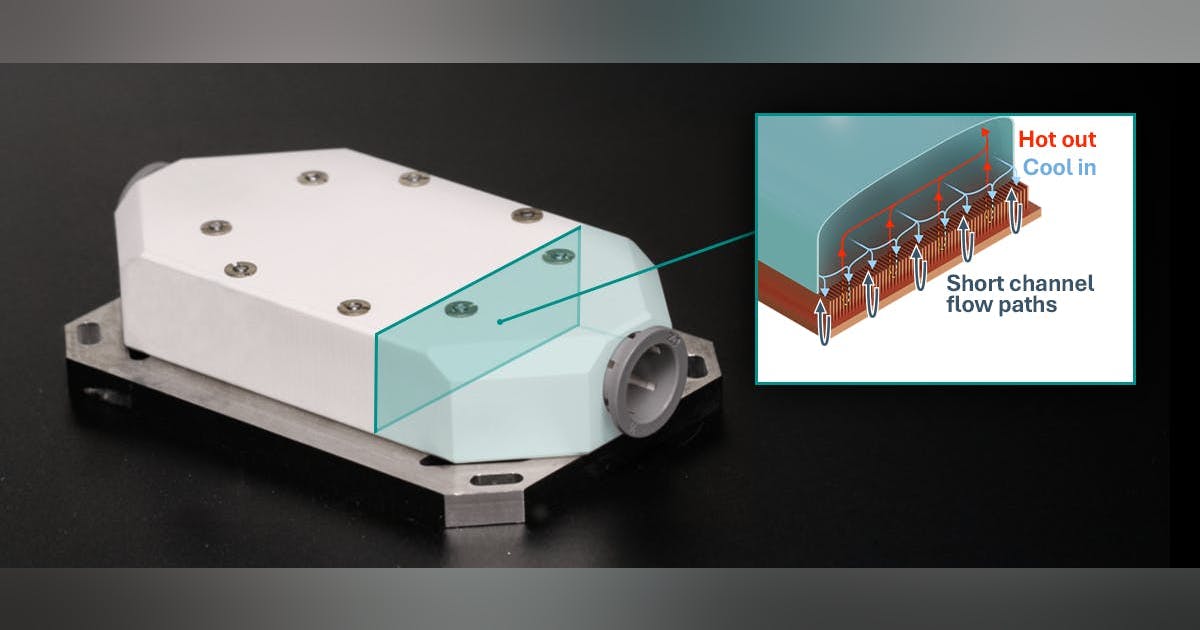
In upcoming AI infrastructure deployments across New Mexico, Michigan, Texas, and Wisconsin, Oracle plans to deploy direct-to-chip, closed-loop, non-evaporative cooling systems that do not rely on continuous consumption of potable water. Instead, cooling liquid circulates in sealed systems, removing heat directly from processors before being cooled and reused.

Grizzel summarizes the concept simply:

“The heat leaves the building; cooling liquid does not.”

Oracle’s explanation is intentionally grounded in familiar analogies. Closed-loop systems work much like home air conditioners, where refrigerant circulates rather than being consumed. Direct-to-chip designs go a step further, operating more like a car radiator: liquid absorbs heat directly at the engine; in this case, processors, before being cooled and recirculated.

The practical implications are significant:

• Cooling liquid is filled once and continuously reused.
• There is no evaporation or daily water makeup requirement.
• Top-offs are rare and occur only under abnormal conditions.
• Day-to-day water use resembles typical office occupancy needs, not industrial consumption.

Industry estimates cited by Oracle note that conventional evaporative cooling systems can consume millions of gallons of water per year per megawatt of IT load, while closed-loop systems effectively eliminate ongoing water consumption for cooling operations.

For communities wary of large AI campuses straining local water supplies, that distinction is becoming critical. And for operators, this aligns with where vendors like LiquidStack and Submer have been heading: higher efficiency, reduced environmental impact, and scalable performance suited to AI-era densities.

Submer’s Transformation: From Cooling Specialist to Infrastructure Platform

While Trane’s move reflects consolidation at the equipment level, Submer’s recent actions reveal consolidation occurring at the infrastructure platform level.

Long known for liquid cooling innovation, Submer is repositioning itself as a full-stack AI infrastructure provider accountable from chip-level cooling through deployment and operations. Two February announcements illustrate how rapidly that transition is unfolding.

The first is Submer’s acquisition of Radian Arc Operations, an infrastructure-as-a-service provider deploying GPU compute platforms directly inside telecommunications carrier networks. Radian Arc already supports more than 70 telecom and edge compute customers globally, with thousands of GPUs deployed across North America, Europe, India, the Middle East, and Asia-Pacific.

These deployments support latency-sensitive services such as cloud gaming and AI workloads while enabling in-country processing that satisfies growing sovereignty requirements. By combining Radian Arc with InferX (Submer’s NVIDIA Cloud Partner platform), Submer now spans modular facility deployment, cooling integration, AI compute platforms, sovereign cloud services, and telco-embedded GPU infrastructure.

CEO Patrick Smets described the acquisition as completing Submer’s cloud infrastructure stack:

“Bringing Radian Arc together with InferX, our AI operations and delivery platform, forms a dual-plane, sovereign, telco-focused cloud offering that is highly competitive in today’s AI datacenter market.”

He underscored how far the company has moved beyond its origins:

“Built on ten years of liquid cooling leadership, Submer has evolved into a full-stack AI datacenter provider, fully accountable from chip to operation.”

Cooling vendors, in other words, are becoming cloud infrastructure providers.

India: Sovereign AI Infrastructure at Speed

Two days earlier, on February 8, Submer announced a strategic partnership with Anant Raj Cloud, a subsidiary of Anant Raj Limited, to accelerate deployment of AI-ready infrastructure across India.

The collaboration will deploy modular, liquid-cooled AI data centers alongside neocloud and inference platforms delivered through InferX, supporting sovereign and enterprise AI workloads at scale. The partnership aligns with India’s Union Budget 2026–27 focus on AI and semiconductor ecosystem development and positions Anant Raj as a foundational infrastructure partner for India’s expanding AI economy.

Submer CEO Patrick Smets described India as reaching a critical moment:

“By combining Submer’s modular datacenter infrastructure, liquid cooling technologies and prefabricated MEP systems with Anant Raj’s campus development capabilities, we bring high-performance AI compute online fast while significantly reducing environmental impact.”

Anant Raj Managing Director Amit Sarin framed the effort in national terms:

“This collaboration expands access to high-performance computing while advancing India’s AI sovereignty goals and nurturing a scalable, homegrown ecosystem.”

The move reflects a broader global shift as nations seek sovereign AI capacity rather than relying exclusively on hyperscale deployments concentrated in a handful of regions.

Infrastructure Is Becoming Integrated, and Strategic

What links these announcements is not simply liquid cooling adoption, but a structural shift in how AI infrastructure is being deployed.

AI-scale buildouts now require integrated solutions combining cooling, modular facilities, GPU infrastructure, and cloud platforms operating across centralized hyperscale campuses and distributed edge environments. Cooling decisions increasingly shape rack density, deployment timelines, site selection, and even community acceptance.

The era in which operators assembled infrastructure piece by piece from multiple vendors is giving way to one in which they increasingly seek single accountable partners capable of delivering integrated solutions.

Cooling Becomes Strategic Infrastructure

Three themes stand out.

Cooling technology is consolidating under major infrastructure players, as demonstrated by Trane’s acquisition of LiquidStack. At the same time, companies rooted in cooling expertise, like Submer, are expanding into full AI infrastructure and cloud delivery platforms. And water- and energy-efficient cooling designs, such as those Oracle is deploying, are becoming critical not only to operations but to community acceptance.

As AI factories scale and infrastructure expands into new markets, competitive advantage will increasingly belong to companies capable of delivering scalable cooling, modular infrastructure, sovereign and distributed compute, and sustainable operations acceptable to host communities.

Cooling is no longer simply about temperature control. In 2026, it is increasingly about who controls the future of AI infrastructure deployment.


Shape
Shape
Stay Ahead

Explore More Insights

Stay ahead with more perspectives on cutting-edge power, infrastructure, energy,  bitcoin and AI solutions. Explore these articles to uncover strategies and insights shaping the future of industries.

Shape

AI agent traffic drives first profitable year for Fastly

Fetcher bots, which retrieve content in real time when users make queries to AI assistants, show different concentration patterns. OpenAI’s ChatGPT and related bots generated 68% of fetcher bot requests. In some cases, fetcher bot request volumes exceeded 39,000 requests per minute to individual sites. AI agents check multiple websites

Read More »

Oil Posts Second Straight Weekly Drop

Oil notched its first back-to-back weekly drop this year as traders weighed the prospect of expanded OPEC+ supplies against US-Iran nuclear talks and recent weakness in wider markets. West Texas Intermediate fell 1% for the week and ended the day little changed on Friday. President Donald Trump said the US deployed an additional aircraft carrier to the Middle East in case a nuclear deal is not reached with Iran. “If we don’t have a deal, we’ll need it,” Trump said at the White House. He added he thinks negotiations will ultimately be successful. Traders have been watching for any uptick in tensions between Washington and Tehran that could pose a threat to supply from the Middle East. The commodity was down earlier as OPEC+ members see scope for output increases to resume in April, believing concerns about a glut are overblown, delegates said. The group has not yet committed to any course of action or begun formal discussions for a March 1 meeting, they added. A second weekly decline in the futures market stands to snap a long run of gains for early 2026, when recurrent bouts of geopolitical tension including the US stand-off with Iran supported oil prices. At an energy conference in London this week, attendees flagged that they expect worldwide supplies to top demand this year, potentially feeding into higher inventories in the Atlantic basin, the region where global prices are set. Still, a pile-up of sanctioned oil coupled with supply disruptions in various nations has limited the impact thus far. Trading may be thinner ahead of the Presidents’ Day holiday in the US, contributing to exaggerated price swings. Oil Prices WTI for March delivery settled up 0.1% at $62.89 a barrel in New York. Brent for April settlement edged 0.3% higher to $67.75 a barrel. What

Read More »

Reliance Gets USA License to Directly Buy VEN Crude

Indian refiner Reliance Industries Ltd. has received a general license from the US government that will allow it to purchase Venezuelan oil directly, according to a person familiar with the matter.  Reliance, owned by billionaire Mukesh Ambani, applied for the permit last month and received it from the Treasury Department a few days ago, the person said, asking not to be named as the matter is not public. The move comes immediately on the heels of a trade deal with the US that slashes punitive tariffs for Indian exports but demands that the country stop importing discounted Russian oil. The Indian government has asked state-owned refiners to consider buying more Venezuelan crude, as well as oil from the US.  Venezuela is unlikely to produce large volumes of crude anytime soon, but even limited supplies provide a fallback option for India’s largest refiner. The US — which has stepped up involvement in Venezuela’s oil sector after capturing the country’s president last month — has been considering general licenses to permit purchases, trading and investment in a sprawling but threadbare industry. Reliance is the first Indian refiner to receive clearance in the current push.  Reliance has historically been an important consumer of the country’s heavy crude, having struck a term deal to secure as much as 400,000 barrels a day from Petroleos de Venezuela SA in 2012. It is among only a handful of refiners in India that have the capacity to process the high-viscosity, sour oil, which is difficult to extract and refine without diluent.  The Indian refining giant took about 25% of Venezuela’s exports in 2019, before its term deal got suspended in 2019 due to US sanctions. It last received a general license in 2024 and took crude until that expired last year, and was not renewed. Reuters first reported the issuance of

Read More »

Baker Hughes Explores $1.5B Sale of Waygate Unit

Baker Hughes Co. is exploring a potential sale of its Waygate Technologies unit, which provides industrial testing and inspection equipment, people with knowledge of the matter said.  The world’s second-biggest oilfield contractor is working with advisers to study a possible divestment of the Waygate business, which could fetch around $1.5 billion, according to the people. A sale process could kick off in the next few months and attract interest from private equity firms, the people said, asking not to be identified because the information is private.  Deliberations are ongoing and there’s no certainty they will lead to a transaction, the people said. A representative for Baker Hughes declined to comment.  Waygate, based in Hürth, Germany, makes radiographic testing systems, industrial CT scanners, remote visual inspection machines and ultrasonic testing devices. It operates in more than 80 countries and is known for brands including Krautkrämer, phoenix|x-ray, Seifert, Everest and Agfa NDT.  The company was started in 2004 as GE Inspection Technologies. It’s been under the current ownership since 2017, when General Electric Co. combined its oil and gas division with Baker Hughes in a $32 billion deal.  Baker Hughes is selling the non-core asset after agreeing last year to buy industrial equipment maker Chart Industries Inc. for about $9.6 billion in one of its biggest-ever acquisitions. Chief Executive Officer Lorenzo Simonelli said in October last year that Baker Hughes is undertaking a “comprehensive evaluation” of its capital allocation focus following the Chart deal in order to boost shareholder value.  The pending sale would join other sizeable corporate divestments in Europe. Volkswagen AG has launched the sale of a majority stake in its heavy diesel engine maker Everllence, while Continental AG is selling its Contitech business. WHAT DO YOU THINK? Generated by readers, the comments included herein do not reflect the views and opinions

Read More »

EIA Raises 2026 WTI Forecast, Lowers 2027 Projection

The U.S. Energy Information Administration (EIA) increased its 2026 West Texas Intermediate (WTI) crude oil average spot price forecast, and lowered its 2027 projection, in its latest short term energy outlook (STEO). According to the EIA’s February STEO, which was released on February 10, the EIA now sees the WTI spot price averaging $53.42 per barrel this year and $49.34 per barrel next year. In its previous STEO, which was released in January, the EIA projected that the WTI spot price would average $52.21 per barrel in 2026 and $50.36 per barrel in 2027. A quarterly breakdown included in the EIA’s latest STEO projected that the WTI average spot price will come in at $58.62 per barrel in the first quarter of this year, $53.65 per barrel in the second quarter, $51.69 per barrel in the third quarter, $50.00 per barrel in the fourth quarter, $49.00 per barrel in the first quarter of next year, $49.66 per barrel in the second quarter, $49.68 per barrel in the third quarter, and $49.00 per barrel in the fourth quarter of 2027. In its previous STEO, the EIA forecast that the WTI spot price would average $54.93 per barrel in the first quarter of this year, $52.67 per barrel in the second quarter, $52.03 per barrel in the third quarter, $49.34 per barrel in the fourth quarter, $49.00 per barrel in the first quarter of next year, $50.66 per barrel in the second quarter, $50.68 per barrel in the third quarter, and $51.00 per barrel in the fourth quarter of 2027. In a BMI report sent to Rigzone by the Fitch Group on Friday, BMI projected that the front month WTI crude price will average $64.00 per barrel in 2026 and $68.00 per barrel in 2027. Standard Chartered sees the NYMEX WTI nearby

Read More »

Some OPEC+ Members See Scope to Resume Hikes in April

Some OPEC+ members see scope for the alliance to resume supply increases in April, believing concerns of a glut in global oil markets to be overblown. The group led by Saudi Arabia and Russia hasn’t committed to any course of action or begun formal discussions ahead of its meeting on March 1, according to several delegates, who asked not to be identified as the process is private. Their ultimate decision may depend on whether US President Donald Trump launches military action against — or reaches a nuclear deal with — OPEC member Iran, one added.  Nonetheless, some nations in the Organization of the Petroleum Exporting Countries and its allies said they see room to resume the output increases the coalition paused during the seasonal demand slowdown of the first quarter.  Trump’s assertive stance toward OPEC members Venezuela and Iran, along with disruptions spanning from North America to Kazakhstan, drove oil prices to a strong start of the year despite warnings of a supply glut. Several top traders have said that prices are supported by tightness in key markets, as many of the surplus barrels are from producers subject to sanctions like Russia and Iran, and thus remain unavailable to a wider pool of buyers. That has made the market surprisingly resilient. Brent futures are up 11% this year, after spiking to a six-month high near $72 a barrel at the end of January over concerns a conflict might erupt in the Middle East. Oil inventories piled up last year at the fastest pace since the 2020 pandemic amid swelling output from both OPEC+ and its competitors in the Americas, according to the International Energy Agency, though the impact on prices was tempered as China scooped up barrels for its strategic reserves. Last April, the Saudis stunned crude traders by steering OPEC+ to

Read More »

ADNOC Drilling Delivers ‘Best Year on Record’

In a release sent to Rigzone on Thursday, ADNOC Drilling said it had delivered its “best year on record with 2025 net profit of $1.45 billion”. “ADNOC Drilling Company PJSC announced today record fourth quarter and full year 2025 results, marking a step change in scale, technology-enabled performance and excellence in execution,” the company noted in the release. “This performance represents the strongest in the company’s history, reflecting high asset utilization and continued growth across integrated drilling and oilfield services, and driven by strong operational execution across the fleet,” it added. ADNOC Drilling highlighted in the release that its 2025 net profit marked an 11 percent year on year increase. In 2025, the company reported revenue of $4.9 billion, which it pointed out was a 22 percent increase year on year, and EBITDA of $2.2 billion, which it highlighted was an increase of nine percent year on year. “2025 was a defining year for ADNOC Drilling,” ADNOC Drilling CEO Abdulla Ateya Al Messabi said in the release. “Our record breaking results were delivered by our people, whose discipline, innovation and commitment to operational excellence and safety underpin every milestone we achieve,” Messabi added. “Our resilience as a business, built on strong systems, disciplined operations and the ability to adapt at pace, continues to reinforce our competitive strength,” the CEO continued. “Through execution excellence, technology‑led efficiency and a disciplined approach to capital allocation and operations, we continue our transformation into the region’s most advanced energy services company,” Messabi said. “By expanding across the GCC, pioneering AI‑driven operations and setting new benchmarks in sustainability, we are unlocking value and helping power the UAE’s energy future. This is just the beginning of a new era of growth, innovation and impact,” Messabi went on to note. In a release posted on its site in November last year, ADNOC Drilling announced that

Read More »

From NIMBY to YIMBY: A Playbook for Data Center Community Acceptance

Across many conversations at the start of this year, at PTC and other conferences alike, the word on everyone’s lips seems to be “community.” For the data center industry, that single word now captures a turning point from just a few short years ago: we are no longer a niche, back‑of‑house utility, but a front‑page presence in local politics, school board budgets, and town hall debates. That visibility is forcing a choice in how we tell our story—either accept a permanent NIMBY-reactive framework, or actively build a YIMBY narrative that portrays the real value digital infrastructure brings to the markets and surrounding communities that host it. Speaking regularly with Ilissa Miller, CEO of iMiller Public Relations about this topic, there is work to be done across the ecosystem to build communications. Miller recently reflected: “What we’re seeing in communities isn’t a rejection of digital infrastructure, it’s a rejection of uncertainty driven by anxiety and fear. Most local leaders have never been given a framework to evaluate digital infrastructure developments the way they evaluate roads, water systems, or industrial parks. When there’s no shared planning language, ‘no’ becomes the safest answer.” A Brief History of “No” Community pushback against data centers is no longer episodic; it has become organized, media‑savvy, and politically influential in key markets. In Northern Virginia, resident groups and environmental organizations have mobilized against large‑scale campuses, pressing counties like Loudoun and Prince William to tighten zoning, question incentives, and delay or reshape projects.1 Loudoun County’s move in 2025 to end by‑right approvals for new facilities, requiring public hearings and board votes, marked a watershed moment as the world’s densest data center market signaled that communities now expect more say over where and how these campuses are built. Prince William County’s decision to sharply increase its tax rate on

Read More »

Nomads at the Frontier: PTC 2026 Signals the Digital Infrastructure Industry’s Moment of Execution

Each January, the Pacific Telecommunications Council conference serves as a barometer for where digital infrastructure is headed next. And according to Nomad Futurist founders Nabeel Mahmood and Phillip Koblence, the message from PTC 2026 was unmistakable: The industry has moved beyond hype. The hard work has begun. In the latest episode of The DCF Show Podcast, part of our ongoing ‘Nomads at the Frontier’ series, Mahmood and Koblence joined Data Center Frontier to unpack the tone shift emerging across the AI and data center ecosystem. Attendance continues to grow year over year. Conversations remain energetic. But the character of those conversations has changed. As Mahmood put it: “The hype that the market started to see is actually resulting a bit more into actions now, and those conversations are resulting into some good progress.” The difference from prior years? Less speculation. More execution. From Data Center Cowboys to Real Deployments Koblence offered perhaps the sharpest contrast between PTC conversations in 2024 and those in 2026. Two years ago, many projects felt speculative. Today, developers are arriving with secured power, customers, and construction underway. “If 2024’s PTC was data center cowboys — sites that in someone’s mind could be a data center — this year was: show me the money, show me the power, give me accurate timelines.” In other words, the market is no longer rewarding hypothetical capacity. It is demanding delivered capacity. Operators now speak in terms of deployments already underway, not aspirational campuses still waiting on permits and power commitments. And behind nearly every conversation sits the same gating factor. Power. Power Has Become the Industry’s Defining Constraint Whether discussions centered on AI factories, investment capital, or campus expansion, Mahmood and Koblence noted that every conversation eventually returned to energy availability. “All of those questions are power,” Koblence said.

Read More »

Cooling Consolidation Hits AI Scale: LiquidStack, Submer, and the Future of Data Center Thermal Strategy

As AI infrastructure scales toward ever-higher rack densities and gigawatt-class campuses, cooling has moved from a technical subsystem to a defining strategic issue for the data center industry. A trio of announcements in early February highlights how rapidly the cooling and AI infrastructure stack is consolidating and evolving: Trane Technologies’ acquisition of LiquidStack; Submer’s acquisition of Radian Arc, extending its reach from core data centers into telco edge environments; and Submer’s partnership with Anant Raj to accelerate sovereign AI infrastructure deployment across India. Layered atop these developments is fresh guidance from Oracle Cloud Infrastructure explaining why closed-loop, direct-to-chip cooling is becoming central to next-generation facility design, particularly in regions where water use has become a flashpoint in community discussions around data center growth. Taken together, these developments show how the industry is moving beyond point solutions toward integrated, scalable AI infrastructure ecosystems, where cooling, compute, and deployment models must work together across hyperscale campuses and distributed edge environments alike. Trane Moves to Own the Cooling Stack The most consequential development comes from Trane Technologies, which on February 10 announced it has entered into a definitive agreement to acquire LiquidStack, one of the pioneers and leading innovators in data center liquid cooling. The acquisition significantly strengthens Trane’s ambition to become a full-service thermal partner for data center operators, extending its reach from plant-level systems all the way down to the chip itself. LiquidStack, headquartered in Carrollton, Texas, built its reputation on immersion cooling and advanced direct-to-chip liquid solutions supporting high-density deployments across hyperscale, enterprise, colocation, edge, and blockchain environments. Under Trane, those technologies will now be scaled globally and integrated into a broader thermal portfolio. In practical terms, Trane is positioning itself to deliver cooling across the full thermal chain, including: • Central plant equipment and chillers.• Heat rejection and controls

Read More »

Infrastructure Maturity Defines the Next Phase of AI Deployment

The State of Data Infrastructure Global Report 2025 from Hitachi Vantara arrives at a moment when the data center industry is undergoing one of the most profound structural shifts in its history. The transition from enterprise IT to AI-first infrastructure has moved from aspiration to inevitability, forcing operators, developers, and investors to confront uncomfortable truths about readiness, resilience, and risk. Although framed around “AI readiness,” the report ultimately tells an infrastructure story: one that maps directly onto how data centers are designed, operated, secured, and justified economically. Drawing on a global survey of more than 1,200 IT leaders, the report introduces a proprietary maturity model that evaluates organizations across six dimensions: scalability, reliability, security, governance, sovereignty, and sustainability. Respondents are then grouped into three categories—Emerging, Defined, and Optimized—revealing a stark conclusion: most organizations are not constrained by access to AI models or capital, but by the fragility of the infrastructure supporting their data pipelines. For the data center industry, the implications are immediate, shaping everything from availability design and automation strategies to sustainability planning and evolving customer expectations. In short, extracting value from AI now depends less on experimentation and more on the strength and resilience of the underlying infrastructure. The Focus of the Survey: Infrastructure, Not Algorithms Although the report is positioned as a study of AI readiness, its primary focus is not models, training approaches, or application development, but rather the infrastructure foundations required to operate AI reliably at scale. Drawing on responses from more than 1,200 organizations, Hitachi Vantara evaluates how enterprises are positioned to support production AI workloads across six dimensions as stated above: scalability, reliability, security, governance, sovereignty, and sustainability. These factors closely reflect the operational realities shaping modern data center design and management. The survey’s central argument is that AI success is no longer

Read More »

AI’s New Land Grab: Meta’s Indiana Megaproject and the Rise of Europe’s Neocloud Challengers

While Meta’s Indiana campus anchors hyperscale expansion in the United States, Europe recorded its own major infrastructure milestone this week as Amsterdam-based AI infrastructure provider Nebius unveiled plans for a 240-megawatt data center campus in Béthune, France, near Lille in the country’s northern industrial corridor. When completed, the campus will rank among Europe’s largest AI-focused data center facilities and positions northern France as a growing node in the continent’s expanding AI infrastructure map. The development repurposes a former Bridgestone tire manufacturing site, reflecting a broader trend across Europe in which legacy industrial properties, already equipped with heavy power access, transport links, and industrial zoning, are being converted into large-scale digital infrastructure hubs. Located within reach of connectivity and enterprise corridors linking Paris, Brussels, London, and Amsterdam, the site allows Nebius to serve major European markets while avoiding the congestion and power constraints increasingly shaping Tier 1 data center hubs. Industrial Infrastructure Becomes Digital Infrastructure Developers increasingly view former industrial sites as ideal for AI campuses because they often provide: • Existing grid interconnection capacity built for heavy industry• Transport and logistics infrastructure already in place• Industrial zoning that reduces permitting friction• Large contiguous parcels suited to phased campus expansion For regions like Hauts-de-France, redevelopment projects also offer economic transition opportunities, replacing legacy manufacturing capacity with next-generation digital infrastructure investment. Local officials have positioned the project as part of broader efforts to reposition northern France as a logistics and technology hub within Europe. The Neocloud Model Gains Ground Beyond the site itself, Nebius’ expansion illustrates the rapid emergence of neocloud infrastructure providers, companies building GPU-intensive AI capacity without operating full hyperscale cloud ecosystems. These firms increasingly occupy a strategic middle ground: supplying AI compute capacity to enterprises, startups, and even hyperscalers facing short-term infrastructure constraints. Nebius’ rise over the past year

Read More »

FTC digs deeper into Microsoft’s bundling and licensing practices

Relationship with OpenAI While much of the initial query, and subsequent ones, have focused on licensing and bundling, the FTC is also looking into the company’s relationship with OpenAI, and raising questions about Microsoft’s data centers, capacity constraints, and AI spending and research. Notably, the tech giant’s initial $1 billion investment in OpenAI has grown into a multi-billion-dollar partnership, with Microsoft rolling out ChatGPT-powered features across its product line in 2023. The FTC is examining whether the relationship is an undisclosed merger that should have been subject to antitrust review. Further, the federal agency is scrutinizing Microsoft’s alleged decision to scale back its own AI research following the OpenAI investment, potentially reducing competition. Ultimately, all of this recalls the industry-shaping 1990s US federal investigation into Microsoft’s monopoly of desktop software and web browsers. A federal judge ruled at the time that the company deliberately built the Internet Explorer (IE) browser into Windows to edge out rivals like the now-defunct Netscape. And, analysts note, it’s an indication that Microsoft hasn’t learned from those past lessons. “While technology and trends may have evolved since Microsoft’s first anti-trust case in 1998, where they were forced to unbundle IE from Windows OS, their tactics have stayed remarkably the same,” Bickley noted.

Read More »

Microsoft will invest $80B in AI data centers in fiscal 2025

And Microsoft isn’t the only one that is ramping up its investments into AI-enabled data centers. Rival cloud service providers are all investing in either upgrading or opening new data centers to capture a larger chunk of business from developers and users of large language models (LLMs).  In a report published in October 2024, Bloomberg Intelligence estimated that demand for generative AI would push Microsoft, AWS, Google, Oracle, Meta, and Apple would between them devote $200 billion to capex in 2025, up from $110 billion in 2023. Microsoft is one of the biggest spenders, followed closely by Google and AWS, Bloomberg Intelligence said. Its estimate of Microsoft’s capital spending on AI, at $62.4 billion for calendar 2025, is lower than Smith’s claim that the company will invest $80 billion in the fiscal year to June 30, 2025. Both figures, though, are way higher than Microsoft’s 2020 capital expenditure of “just” $17.6 billion. The majority of the increased spending is tied to cloud services and the expansion of AI infrastructure needed to provide compute capacity for OpenAI workloads. Separately, last October Amazon CEO Andy Jassy said his company planned total capex spend of $75 billion in 2024 and even more in 2025, with much of it going to AWS, its cloud computing division.

Read More »

John Deere unveils more autonomous farm machines to address skill labor shortage

Join our daily and weekly newsletters for the latest updates and exclusive content on industry-leading AI coverage. Learn More Self-driving tractors might be the path to self-driving cars. John Deere has revealed a new line of autonomous machines and tech across agriculture, construction and commercial landscaping. The Moline, Illinois-based John Deere has been in business for 187 years, yet it’s been a regular as a non-tech company showing off technology at the big tech trade show in Las Vegas and is back at CES 2025 with more autonomous tractors and other vehicles. This is not something we usually cover, but John Deere has a lot of data that is interesting in the big picture of tech. The message from the company is that there aren’t enough skilled farm laborers to do the work that its customers need. It’s been a challenge for most of the last two decades, said Jahmy Hindman, CTO at John Deere, in a briefing. Much of the tech will come this fall and after that. He noted that the average farmer in the U.S. is over 58 and works 12 to 18 hours a day to grow food for us. And he said the American Farm Bureau Federation estimates there are roughly 2.4 million farm jobs that need to be filled annually; and the agricultural work force continues to shrink. (This is my hint to the anti-immigration crowd). John Deere’s autonomous 9RX Tractor. Farmers can oversee it using an app. While each of these industries experiences their own set of challenges, a commonality across all is skilled labor availability. In construction, about 80% percent of contractors struggle to find skilled labor. And in commercial landscaping, 86% of landscaping business owners can’t find labor to fill open positions, he said. “They have to figure out how to do

Read More »

2025 playbook for enterprise AI success, from agents to evals

Join our daily and weekly newsletters for the latest updates and exclusive content on industry-leading AI coverage. Learn More 2025 is poised to be a pivotal year for enterprise AI. The past year has seen rapid innovation, and this year will see the same. This has made it more critical than ever to revisit your AI strategy to stay competitive and create value for your customers. From scaling AI agents to optimizing costs, here are the five critical areas enterprises should prioritize for their AI strategy this year. 1. Agents: the next generation of automation AI agents are no longer theoretical. In 2025, they’re indispensable tools for enterprises looking to streamline operations and enhance customer interactions. Unlike traditional software, agents powered by large language models (LLMs) can make nuanced decisions, navigate complex multi-step tasks, and integrate seamlessly with tools and APIs. At the start of 2024, agents were not ready for prime time, making frustrating mistakes like hallucinating URLs. They started getting better as frontier large language models themselves improved. “Let me put it this way,” said Sam Witteveen, cofounder of Red Dragon, a company that develops agents for companies, and that recently reviewed the 48 agents it built last year. “Interestingly, the ones that we built at the start of the year, a lot of those worked way better at the end of the year just because the models got better.” Witteveen shared this in the video podcast we filmed to discuss these five big trends in detail. Models are getting better and hallucinating less, and they’re also being trained to do agentic tasks. Another feature that the model providers are researching is a way to use the LLM as a judge, and as models get cheaper (something we’ll cover below), companies can use three or more models to

Read More »

OpenAI’s red teaming innovations define new essentials for security leaders in the AI era

Join our daily and weekly newsletters for the latest updates and exclusive content on industry-leading AI coverage. Learn More OpenAI has taken a more aggressive approach to red teaming than its AI competitors, demonstrating its security teams’ advanced capabilities in two areas: multi-step reinforcement and external red teaming. OpenAI recently released two papers that set a new competitive standard for improving the quality, reliability and safety of AI models in these two techniques and more. The first paper, “OpenAI’s Approach to External Red Teaming for AI Models and Systems,” reports that specialized teams outside the company have proven effective in uncovering vulnerabilities that might otherwise have made it into a released model because in-house testing techniques may have missed them. In the second paper, “Diverse and Effective Red Teaming with Auto-Generated Rewards and Multi-Step Reinforcement Learning,” OpenAI introduces an automated framework that relies on iterative reinforcement learning to generate a broad spectrum of novel, wide-ranging attacks. Going all-in on red teaming pays practical, competitive dividends It’s encouraging to see competitive intensity in red teaming growing among AI companies. When Anthropic released its AI red team guidelines in June of last year, it joined AI providers including Google, Microsoft, Nvidia, OpenAI, and even the U.S.’s National Institute of Standards and Technology (NIST), which all had released red teaming frameworks. Investing heavily in red teaming yields tangible benefits for security leaders in any organization. OpenAI’s paper on external red teaming provides a detailed analysis of how the company strives to create specialized external teams that include cybersecurity and subject matter experts. The goal is to see if knowledgeable external teams can defeat models’ security perimeters and find gaps in their security, biases and controls that prompt-based testing couldn’t find. What makes OpenAI’s recent papers noteworthy is how well they define using human-in-the-middle

Read More »