Stay Ahead, Stay ONMINE

Is the Pentagon allowed to surveil Americans with AI?

The ongoing public feud between the Department of Defense and the AI company Anthropic has raised a deep and still unanswered question: Does the law actually allow the US government to conduct mass surveillance on Americans? Surprisingly, the answer is not straightforward. More than a decade after Edward Snowden exposed the NSA’s collection of bulk metadata from the phones of Americans, the US is still navigating a gap between what ordinary people think and what the law allows.  The flashpoint in the standoff between Anthropic and the government was the Pentagon’s desire to use Anthropic’s AI Claude to analyze bulk commercial data collected from Americans. Anthropic demanded that its AI not be used for mass domestic surveillance (or for autonomous weapons, which are machines that can kill targets without human oversight). A week after negotiations broke down, the Pentagon designated Anthropic a supply chain risk, a label typically reserved for foreign companies that pose a threat to national security.  Meanwhile, OpenAI, the rival AI company behind ChatGPT, sealed a deal that allowed the Pentagon to use its AI for “all lawful purposes”—language that critics say left the door open to domestic surveillance. Over the following weekend, users uninstalled ChatGPT in droves. Protesters chalked messages around OpenAI’s headquarters in San Francisco: “What are your redlines?”  OpenAI announced on Monday that it had reworked its deal to make sure that its AI will not be used for domestic surveillance. The company added that its services will not be used by intelligence agencies, such as the NSA.  CEO Sam Altman suggested that existing law prohibits domestic surveillance by the Department of Defense (now sometimes called the Department of War) and that OpenAI’s contract simply needed to reference this law. “The DoW agrees with these principles, reflects them in law and policy, and we put them into our agreement,” he wrote on X. Anthropic CEO Dario Amodei argued the opposite. “To the extent that such surveillance is currently legal, this is only because the law has not yet caught up with the rapidly growing capabilities of AI,” he wrote in a policy statement.  So, who is right? Does the law allow the Pentagon to surveil Americans using AI? Supercharged surveillance The answer depends on what we think counts as surveillance. “A lot of stuff that normal people would consider a search or surveillance … is not actually considered a search or surveillance by the law,” says Alan Rozenshtein, a law professor at the University of Minnesota Law School. That means public information—such as social media posts, surveillance camera footage, and voter registration records—is fair game. So is information on Americans picked up incidentally from surveillance of foreign nationals.  Most notably, the government can purchase commercial data from companies, which can include sensitive personal information like mobile location and web browsing records. In recent years, agencies from ICE and IRS to the FBI and NSA have increasingly tapped into this data marketplace, fueled by an internet economy that harvests user data for advertising. These data sets can let the government access information that might not be available without a warrant or subpoena, which are normally required to obtain sensitive personal data. “There’s a huge amount of information that the government can collect on Americans that is not itself regulated either by the Constitution, which is the Fourth Amendment, or statute,” says Rozenshtein. And there aren’t meaningful limits on what the government can do with all this data.  That’s because until the last several decades, people weren’t generating massive clouds of data that opened up new possibilities for surveillance. The Fourth Amendment, which protects against unreasonable search and seizure, was written when collecting information meant entering people’s homes.  Subsequent laws, like the Foreign Intelligence Surveillance Act of 1978 or the Electronic Communications Privacy Act of 1986, were passed when surveillance involved wiretapping phone calls and intercepting emails. The bulk of laws governing surveillance were on the books before the internet took off. We weren’t generating vast trails of online data, and the government didn’t have sophisticated tools to analyze the data.  Now we do, and AI supercharges what kind of surveillance can be carried out. “What AI can do is it can take a lot of information, none of which is by itself sensitive, and therefore none of which by itself is regulated, and it can give the government a lot of powers that the government didn’t have before,” says Rozenshtein.  AI can aggregate individual pieces of information to spot patterns, draw inferences, and build detailed profiles of people—at massive scale. And as long as the government collects the information lawfully, it can do whatever it wants with that information, including feeding it to AI systems. “The law has not caught up with technological reality,” says Rozenshtein. While surveillance can raise serious privacy concerns, the Pentagon can have legitimate national security interests in collecting and analyzing data on Americans. “In order to collect information on Americans, it has to be for a very specific subset of missions,” says Loren Voss, a former military intelligence officer at the Pentagon.  For example, a counterintelligence mission might require information about an American who is working for a foreign country, or plotting to engage in international terrorist activities. But targeted intelligence can sometimes stretch into collecting more data. “This kind of collection does make people nervous,” says Voss.  Lawful use OpenAI says its contract now includes language that says the company’s AI system “shall not be intentionally used for domestic surveillance of U.S. persons and nationals,” in line with relevant laws. The amendment clarifies that this prohibits “deliberate tracking, surveillance or monitoring of U.S. persons or nationals, including through the procurement or use of commercially acquired personal or identifiable information.” But the added language might not do much to override the clause that the Pentagon may use the company’s AI system for all lawful purposes, which could include collecting and analyzing sensitive personal information. “OpenAI can say whatever it wants in its agreement … but the Pentagon’s gonna use the tech for what it perceives to be lawful,” says Jessica Tillipman, a law professor at the George Washington University Law School. That could include domestic surveillance. “Most of the time, companies are not going to be able to stop the Pentagon from doing anything,” she says. The language also leaves open questions about inadvertent surveillance, and the surveillance of foreign nationals or undocumented immigrants living in the US. “What happens when there’s a disagreement about what the law is, or when the law changes?” says Tillipman. OpenAI did not respond to a request for comment. The company has not publicly shared the full text of its new contract.  Beyond the contract, OpenAI says that it will impose technical safeguards to enforce its red line against surveillance, including a “safety stack” that monitors and blocks prohibited uses. The company also says it will deploy its own employees to work with the Pentagon and remain in the loop. But it’s unclear how a safety stack would constrain the Pentagon’s use of the AI, and to what extent OpenAI’s employees would have visibility into how its AI systems are used. More important, it’s unclear whether the contract gives OpenAI the power to block a legal use of the technology.  But that might not be a bad thing. Giving an AI company power to pull the plug on its technology in the middle of government operations also carries its own risks. “You wouldn’t want the US military to ever be in a situation where they legitimately needed to take actions to protect this country’s national security, and you had a private company turn off technology,” says Voss. But that doesn’t mean there shouldn’t be hard lines drawn by Congress, she says. None of these questions are simple. They involve brutally difficult trade-offs between privacy and national security. And that’s why perhaps they should be decided by the public—not in backroom negotiations between the executive branch and a handful of AI companies. For now, AI is being regulated by contracts, not legislation.  Some lawmakers are starting to weigh in. On Monday, Senator Ron Wyden of Oregon will seek bipartisan support for legislation addressing mass surveillance. He has championed bills restricting the government’s purchase of commercial data, including the Fourth Amendment Is Not For Sale Act, which was first introduced in 2021 but has not been passed into law. “Creating AI profiles of Americans based on that data represents a chilling expansion of mass surveillance that should not be allowed,” he said in a recent statement.  

The ongoing public feud between the Department of Defense and the AI company Anthropic has raised a deep and still unanswered question: Does the law actually allow the US government to conduct mass surveillance on Americans?

Surprisingly, the answer is not straightforward. More than a decade after Edward Snowden exposed the NSA’s collection of bulk metadata from the phones of Americans, the US is still navigating a gap between what ordinary people think and what the law allows. 

The flashpoint in the standoff between Anthropic and the government was the Pentagon’s desire to use Anthropic’s AI Claude to analyze bulk commercial data collected from Americans. Anthropic demanded that its AI not be used for mass domestic surveillance (or for autonomous weapons, which are machines that can kill targets without human oversight). A week after negotiations broke down, the Pentagon designated Anthropic a supply chain risk, a label typically reserved for foreign companies that pose a threat to national security. 

Meanwhile, OpenAI, the rival AI company behind ChatGPT, sealed a deal that allowed the Pentagon to use its AI for “all lawful purposes”—language that critics say left the door open to domestic surveillance. Over the following weekend, users uninstalled ChatGPT in droves. Protesters chalked messages around OpenAI’s headquarters in San Francisco: “What are your redlines?” 

OpenAI announced on Monday that it had reworked its deal to make sure that its AI will not be used for domestic surveillance. The company added that its services will not be used by intelligence agencies, such as the NSA. 

CEO Sam Altman suggested that existing law prohibits domestic surveillance by the Department of Defense (now sometimes called the Department of War) and that OpenAI’s contract simply needed to reference this law. “The DoW agrees with these principles, reflects them in law and policy, and we put them into our agreement,” he wrote on X. Anthropic CEO Dario Amodei argued the opposite. “To the extent that such surveillance is currently legal, this is only because the law has not yet caught up with the rapidly growing capabilities of AI,” he wrote in a policy statement. 

So, who is right? Does the law allow the Pentagon to surveil Americans using AI?

Supercharged surveillance

The answer depends on what we think counts as surveillance. “A lot of stuff that normal people would consider a search or surveillance … is not actually considered a search or surveillance by the law,” says Alan Rozenshtein, a law professor at the University of Minnesota Law School. That means public information—such as social media posts, surveillance camera footage, and voter registration records—is fair game. So is information on Americans picked up incidentally from surveillance of foreign nationals. 

Most notably, the government can purchase commercial data from companies, which can include sensitive personal information like mobile location and web browsing records. In recent years, agencies from ICE and IRS to the FBI and NSA have increasingly tapped into this data marketplace, fueled by an internet economy that harvests user data for advertising. These data sets can let the government access information that might not be available without a warrant or subpoena, which are normally required to obtain sensitive personal data.

“There’s a huge amount of information that the government can collect on Americans that is not itself regulated either by the Constitution, which is the Fourth Amendment, or statute,” says Rozenshtein. And there aren’t meaningful limits on what the government can do with all this data. 

That’s because until the last several decades, people weren’t generating massive clouds of data that opened up new possibilities for surveillance. The Fourth Amendment, which protects against unreasonable search and seizure, was written when collecting information meant entering people’s homes. 

Subsequent laws, like the Foreign Intelligence Surveillance Act of 1978 or the Electronic Communications Privacy Act of 1986, were passed when surveillance involved wiretapping phone calls and intercepting emails. The bulk of laws governing surveillance were on the books before the internet took off. We weren’t generating vast trails of online data, and the government didn’t have sophisticated tools to analyze the data. 

Now we do, and AI supercharges what kind of surveillance can be carried out. “What AI can do is it can take a lot of information, none of which is by itself sensitive, and therefore none of which by itself is regulated, and it can give the government a lot of powers that the government didn’t have before,” says Rozenshtein. 

AI can aggregate individual pieces of information to spot patterns, draw inferences, and build detailed profiles of people—at massive scale. And as long as the government collects the information lawfully, it can do whatever it wants with that information, including feeding it to AI systems. “The law has not caught up with technological reality,” says Rozenshtein.

While surveillance can raise serious privacy concerns, the Pentagon can have legitimate national security interests in collecting and analyzing data on Americans. “In order to collect information on Americans, it has to be for a very specific subset of missions,” says Loren Voss, a former military intelligence officer at the Pentagon. 

For example, a counterintelligence mission might require information about an American who is working for a foreign country, or plotting to engage in international terrorist activities. But targeted intelligence can sometimes stretch into collecting more data. “This kind of collection does make people nervous,” says Voss. 

Lawful use

OpenAI says its contract now includes language that says the company’s AI system “shall not be intentionally used for domestic surveillance of U.S. persons and nationals,” in line with relevant laws. The amendment clarifies that this prohibits “deliberate tracking, surveillance or monitoring of U.S. persons or nationals, including through the procurement or use of commercially acquired personal or identifiable information.”

But the added language might not do much to override the clause that the Pentagon may use the company’s AI system for all lawful purposes, which could include collecting and analyzing sensitive personal information. “OpenAI can say whatever it wants in its agreement … but the Pentagon’s gonna use the tech for what it perceives to be lawful,” says Jessica Tillipman, a law professor at the George Washington University Law School. That could include domestic surveillance. “Most of the time, companies are not going to be able to stop the Pentagon from doing anything,” she says.

The language also leaves open questions about inadvertent surveillance, and the surveillance of foreign nationals or undocumented immigrants living in the US. “What happens when there’s a disagreement about what the law is, or when the law changes?” says Tillipman.

OpenAI did not respond to a request for comment. The company has not publicly shared the full text of its new contract. 

Beyond the contract, OpenAI says that it will impose technical safeguards to enforce its red line against surveillance, including a “safety stack” that monitors and blocks prohibited uses. The company also says it will deploy its own employees to work with the Pentagon and remain in the loop. But it’s unclear how a safety stack would constrain the Pentagon’s use of the AI, and to what extent OpenAI’s employees would have visibility into how its AI systems are used. More important, it’s unclear whether the contract gives OpenAI the power to block a legal use of the technology. 

But that might not be a bad thing. Giving an AI company power to pull the plug on its technology in the middle of government operations also carries its own risks. “You wouldn’t want the US military to ever be in a situation where they legitimately needed to take actions to protect this country’s national security, and you had a private company turn off technology,” says Voss. But that doesn’t mean there shouldn’t be hard lines drawn by Congress, she says.

None of these questions are simple. They involve brutally difficult trade-offs between privacy and national security. And that’s why perhaps they should be decided by the public—not in backroom negotiations between the executive branch and a handful of AI companies. For now, AI is being regulated by contracts, not legislation. 

Some lawmakers are starting to weigh in. On Monday, Senator Ron Wyden of Oregon will seek bipartisan support for legislation addressing mass surveillance. He has championed bills restricting the government’s purchase of commercial data, including the Fourth Amendment Is Not For Sale Act, which was first introduced in 2021 but has not been passed into law. “Creating AI profiles of Americans based on that data represents a chilling expansion of mass surveillance that should not be allowed,” he said in a recent statement.  

Shape
Shape
Stay Ahead

Explore More Insights

Stay ahead with more perspectives on cutting-edge power, infrastructure, energy,  bitcoin and AI solutions. Explore these articles to uncover strategies and insights shaping the future of industries.

Shape

Vår Energi lets 3-year contract for harsh-environment rig for NCS work

@import url(‘https://fonts.googleapis.com/css2?family=Inter:[email protected]&display=swap’); a { color: var(–color-primary-main); } .ebm-page__main h1, .ebm-page__main h2, .ebm-page__main h3, .ebm-page__main h4, .ebm-page__main h5, .ebm-page__main h6 { font-family: Inter; } body { line-height: 150%; letter-spacing: 0.025em; font-family: Inter; } button, .ebm-button-wrapper { font-family: Inter; } .label-style { text-transform: uppercase; color: var(–color-grey); font-weight: 600; font-size: 0.75rem; } .caption-style

Read More »

CERT-EU blames Trivy supply chain attack for Europa.eu data breach

Back door credentials The Trivy compromise dates to February, when TeamPCP exploited a misconfiguration in Trivy’s GitHub Actions environment, now identified as CVE-2026-33634, to establish a foothold via a privileged access token, according to Aqua Security. Discovering this, Aqua Security rotated credentials but, because some credentials remain valid during this

Read More »

French government take Bull by horns for €404 million

It’s the second time that Bull has been nationalized: The first time, in 1982 was to save it from bankruptcy. Atos, has had financial troubles of its own. In August 2024, it tried — and failed — to sell its legacy infrastructure management business. The company had already staved off

Read More »

Cisco fixes critical IMC auth bypass present in many products

Cisco has released patches for a critical vulnerability in its out-of-band management solution, present in many of its servers and appliances. The flaw allows unauthenticated remote attackers to gain admin access to the Cisco Integrated Management Controller (IMC), which gives administrators remote control over servers even when the main OS

Read More »

Latin America returns to the energy security conversation at CERAWeek

With geopolitical risk central to conversations about energy, and with long-cycle supply once again in focus, Latin America’s mix of hydrocarbons and export potential drew renewed attention at CERAWeek by S&P Global in Houston. Argentina, resource story to export platform Among the regional stories, Argentina stood out as Vaca Muerta was no longer discussed simply as a large unconventional resource, but whether the country could turn resource quality into sustained export capacity.  Country officials talked about scale: more operators, more services, more infrastructure, and a larger industrial base around the unconventional play. Daniel González, Vice Minister of Energy and Mining for Argentina, put it plainly: “The time has come to expand the Vaca Muerta ecosystem.” What is at stake now is not whether the basin works, but whether the country can build enough above-ground capacity and regulatory consistency to keep development moving. Horacio Marín, chairman and chief executive officer of YPF, offered an expansive version of that argument. He said Argentina’s energy exports could reach $50 billion/year by 2031, backed by roughly $130 billion in cumulative investment in oil, LNG, and transportation infrastructure. He said Argentine crude output could reach 1 million b/d by end-2026. He said Argentina wants to be seen less as a recurrent frontier story and more as a future supplier with scale. “The time to invest in Vaca Muerta is now,” Marín said. The LNG piece is starting to take shape. Eni, YPF, and XRG signed a joint development agreement in February to move Argentina LNG forward, with a first phase planned at 12 million tonnes/year. Southern Energy—backed by PAE, YPF, Pampa Energía, Harbour Energy, and Golar LNG—holds a long-term agreement with SEFE for 2 million tonnes/year over 8 years. The movement by global standards is early-stage and relatively modest, but it adds to Argentina’s export

Read More »

Market Focus: LNG supply shocks expose limited market flexibility

@import url(‘https://fonts.googleapis.com/css2?family=Inter:[email protected]&display=swap’); a { color: var(–color-primary-main); } .ebm-page__main h1, .ebm-page__main h2, .ebm-page__main h3, .ebm-page__main h4, .ebm-page__main h5, .ebm-page__main h6 { font-family: Inter; } body { line-height: 150%; letter-spacing: 0.025em; font-family: Inter; } button, .ebm-button-wrapper { font-family: Inter; } .label-style { text-transform: uppercase; color: var(–color-grey); font-weight: 600; font-size: 0.75rem; } .caption-style { font-size: 0.75rem; opacity: .6; } #onetrust-pc-sdk [id*=btn-handler], #onetrust-pc-sdk [class*=btn-handler] { background-color: #c19a06 !important; border-color: #c19a06 !important; } #onetrust-policy a, #onetrust-pc-sdk a, #ot-pc-content a { color: #c19a06 !important; } #onetrust-consent-sdk #onetrust-pc-sdk .ot-active-menu { border-color: #c19a06 !important; } #onetrust-consent-sdk #onetrust-accept-btn-handler, #onetrust-banner-sdk #onetrust-reject-all-handler, #onetrust-consent-sdk #onetrust-pc-btn-handler.cookie-setting-link { background-color: #c19a06 !important; border-color: #c19a06 !important; } #onetrust-consent-sdk .onetrust-pc-btn-handler { color: #c19a06 !important; border-color: #c19a06 !important; } In this Market Focus episode of the Oil & Gas Journal ReEnterprised podcast, Conglin Xu, managing editor, economics, takes a look into the LNG market shock caused by the effective closure of the Strait of Hormuz and the sudden loss of Qatari LNG supply as the Iran war continues. Xu speaks with Edward O’Toole, director of global gas analysis, RBAC Inc., to examine how these disruptions are intensifying global supply constraints at a time when European inventories were already under pressure following a colder-than-average winter and weaker storage levels. Drawing on RBAC’s G2M2 global gas market model, O’Toole outlines disruption scenarios analyzed in the firm’s recent report and explains how current events align with their findings. With global LNG production already operating near maximum utilization, the market response is being driven by higher prices and reduced consumption. Europe faces sharper price pressure due to storage refill needs, while Asian markets are expected to see greater demand reductions as consumers switch fuels. O’Toole underscores the importance of scenario-based modeling and supply diversification as geopolitical risk exposes structural vulnerabilities in the LNG market—offering insights for stakeholders navigating an increasingly uncertain global

Read More »

Libya’s NOC, Chevron sign MoU for technical study for offshore Block NC146

@import url(‘https://fonts.googleapis.com/css2?family=Inter:[email protected]&display=swap’); a { color: var(–color-primary-main); } .ebm-page__main h1, .ebm-page__main h2, .ebm-page__main h3, .ebm-page__main h4, .ebm-page__main h5, .ebm-page__main h6 { font-family: Inter; } body { line-height: 150%; letter-spacing: 0.025em; font-family: Inter; } button, .ebm-button-wrapper { font-family: Inter; } .label-style { text-transform: uppercase; color: var(–color-grey); font-weight: 600; font-size: 0.75rem; } .caption-style { font-size: 0.75rem; opacity: .6; } #onetrust-pc-sdk [id*=btn-handler], #onetrust-pc-sdk [class*=btn-handler] { background-color: #c19a06 !important; border-color: #c19a06 !important; } #onetrust-policy a, #onetrust-pc-sdk a, #ot-pc-content a { color: #c19a06 !important; } #onetrust-consent-sdk #onetrust-pc-sdk .ot-active-menu { border-color: #c19a06 !important; } #onetrust-consent-sdk #onetrust-accept-btn-handler, #onetrust-banner-sdk #onetrust-reject-all-handler, #onetrust-consent-sdk #onetrust-pc-btn-handler.cookie-setting-link { background-color: #c19a06 !important; border-color: #c19a06 !important; } #onetrust-consent-sdk .onetrust-pc-btn-handler { color: #c19a06 !important; border-color: #c19a06 !important; } The National Oil Corp. of Libya (NOC) signed a memorandum of understanding (MoU) with Chevron Corp. to conduct a comprehensive technical study of offshore Block NC146. The block is an unexplored area with “encouraging geological indicator that could lead to significant discoveries, helping to strengthen national reserves,” NOC noted Chairman Masoud Suleman as saying, noting that the partnership is “a message of confidence in the Libyan investment environment and evidence of the return of major companies to work and explore promising opportunities in our country.” According to the NOC, Libya produces 1.4 million b/d of oil and aims to increase oil production in the coming 3-5 years to 2 million b/d and then to 3 million b/d following years of instability that impacted the country’s production.   Chevron is working to add to its diverse exploration and production portfolio in the Mediterranean and Africa and continues to assess potential future opportunities in the region.  The operator earlier this year entered Libya after it was designated as a winning bidder for Contract Area 106 in the Sirte basin in the 2025 Libyan Bid Round. That followed the January 2026 signing of a

Read More »

Finder Energy advances KTJ Project with development area approval

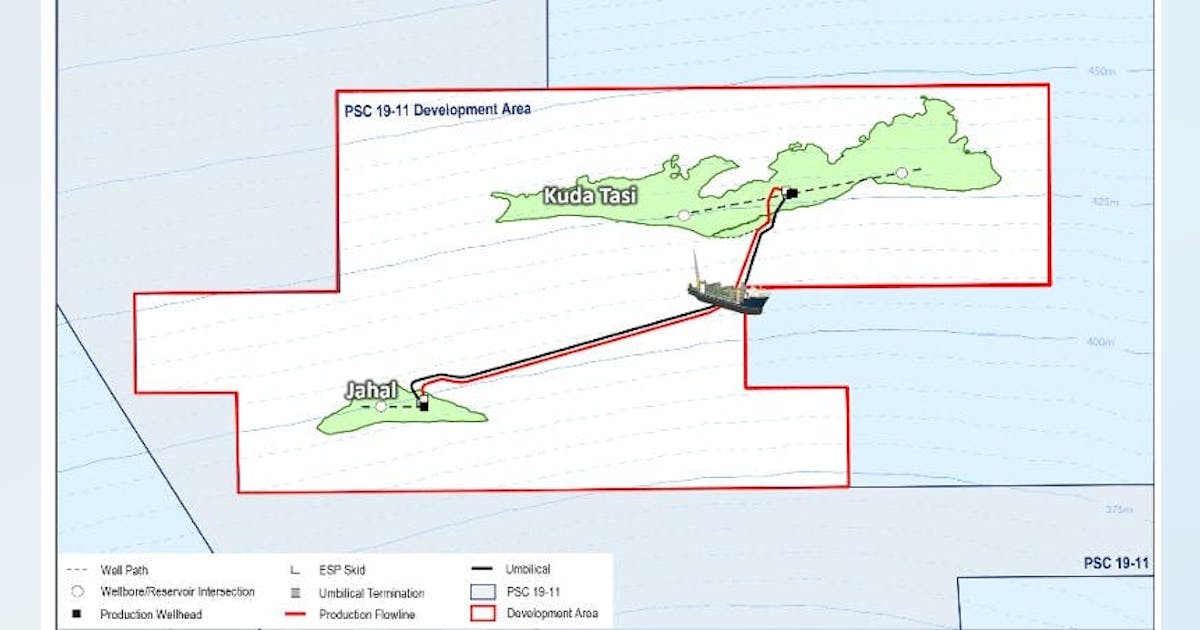
Finder Energy Holdings Ltd. received regulatory approval for a development area covering the Kuda Tasi and Jahal oil fields offshore Timor‑Leste, enabling progression toward field development. Autoridade Nacional do Petróleo (ANP) approved an 88‑sq km development area over the Kuda Tasi and Jahal oil fields (KTJ Project) within PSC 19‑11 offshore Timor‑Leste, representing the first stage of the regulatory approvals process for the project. The declaration of the development area is a precursor to the field development plan (FDP), which Finder is currently preparing for submission to ANP in second‑quarter 2026. Upon approval of the FDP, the development area would secure tenure for up to 25 years or until production ceases, allowing Finder to conduct development and production operations within the area, subject to applicable regulatory approvals and conditions. The company said its upside strategy centers on the potential for the Petrojarl I FPSO to serve as a central processing and export hub for future tiebacks of surrounding discoveries, contingent on successful appraisal and/or exploration activities within PSC 19‑11. Alternatively, longer tie‑back distances could be accommodated through a secondary standalone development in the southern portion of the PSC. Finder is continuing technical evaluation of appraisal and exploration opportunities to generate drilling targets. PSC 19‑11 lies within the Laminaria High oil province of Timor‑Leste. The KTJ Project contains an estimated 25 million bbl of gross 2C contingent resources, with identified upside of an additional 23 million bbl gross 2C contingent resources and 116 million bbl gross 2U prospective resources. Finder operates PSC 19‑11 with a 66% working interest.

Read More »

Newly formed Polar LNG aims to develop nearshore LNG project on Alaska’s North Slope

Polar Train LNG LLC, a newly launched company aiming to build an LNG plant (Polar LNG) on Alaska’s North Slope, has appointed Joel Riddle as president and chief executive officer. “Alaska’s North Slope holds one of the most significant undeveloped natural gas resources in the world,” said Riddle, adding “Polar LNG is uniquely positioned to bring this resource online—delivering reliable energy for Alaska and a strategic supply for the United States… and provides trusted energy to our allies.” In a release Mar. 31, the company said it is advancing a nearshore project at Prudhoe Bay, citing “one of the shortest LNG shipping routes from North America to key Asian markets, approximately 3,600 miles to Japan compared to over 10,000 miles from the US Gulf Coast.” The company is aiming for first LNG from the 7-million tonnes/year plant—to be developed nearshore with modular infrastructure—in 2029-2030 at a cost of $8–9 billion. According to Polar LNG, natural gas would be sourced from existing infrastructure at Prudhoe Bay and transported via a short pipeline to a nearshore plant. There, a modular gravity-based structure would process and liquefy the gas. LNG would then be loaded onto specialized ice-class carriers for year-round export. The company is exploring potential repurposing of sanctioned equipment built for Russia’s Arctic LNG 2 project and is seeking permission from the US govenment to acquire parts impacted by the sanctions, according to reports. Before joining Polar LNG, Riddle served as managing director and chief executive officer of Tamboran Resources Ltd.

Read More »

Asia bears brunt of energy shock as Middle East war disrupts liquid flows

Asia is facing a dual energy crisis marked by both soaring prices and physical supply disruptions as escalating war in the Middle East constrains flows through the Strait of Hormuz, according to a new report by Morningstar DBRS. The report highlights that roughly one-fifth of global crude oil and LNG supply has been affected by disruptions at the critical chokepoint, with Asia absorbing the majority of the impact due to its heavy dependence on imported hydrocarbons. About 83% of oil and LNG shipments passing through Hormuz are destined for Asian markets, amplifying the region’s exposure. Asia’s structural reliance on Middle Eastern energy imports has intensified the shock. Countries such as Japan and South Korea import nearly all of their energy needs, while China and India depend heavily on foreign supplies, much of it sourced from the Gulf. This dependence, combined with limited alternative shipping routes, has turned what initially appeared to be a price-driven shock into a broader supply and logistics crisis. Governments across the region have begun implementing emergency measures, including fuel rationing, price controls, and strategic reserve releases, to manage shortages and rising costs. Policy responses vary In North Asia, policymakers are leveraging stronger buffers. Japan has tapped strategic oil reserves and introduced subsidies to cushion consumers, while South Korea is relying on LNG stockpiles and fuel-switching capabilities. China has deployed administrative controls to stabilize domestic fuel prices and restrict refined product exports. By contrast, parts of South and Southeast Asia are more vulnerable. India has introduced tax relief and prioritized gas allocation, while countries such as the Philippines and Vietnam have declared energy emergencies and rolled out conservation measures. Several ASEAN (the Association of Southeast Asian Nations) economies have even implemented partial work-from-home policies to curb fuel consumption. Broader economic spillovers intensify Beyond energy markets, the disruption

Read More »

Nscale Expands AI Factory Strategy With Power, Platform, and Scale

Nscale has moved quickly from startup to serious contender in the race to build infrastructure for the AI era. Founded in 2024, the company has positioned itself as a vertically integrated “neocloud” operator, combining data center development, GPU fleet ownership, and a software stack designed to deliver large-scale AI compute. That model has helped it attract backing from investors including Nvidia, and in early March 2026 the company raised another $2 billion at a reported $14.6 billion valuation. Reuters has described Nscale’s approach as owning and operating its own data centers, GPUs, and software stack to support major customers including Microsoft and OpenAI. What makes Nscale especially relevant now is that it is no longer content to operate as a cloud intermediary or capacity provider. Over the past year, the company has increasingly framed itself as an AI hyperscaler and AI factory builder, seeking to combine land, power, data center shells, GPU procurement, customer offtake, and software services into a single integrated platform. Its acquisition of American Intelligence & Power Corporation, or AIPCorp, is the clearest signal yet of that shift, bringing energy infrastructure directly into the center of Nscale’s business model. The AIPCorp transaction is significant because it gives Nscale more than additional development capacity. The company said the deal includes the Monarch Compute Campus in Mason County, West Virginia, a site of up to 2,250 acres with a state-certified AI microgrid and a power runway it says can scale beyond 8 gigawatts. Nscale also said the acquisition establishes a new division, Nscale Energy & Power, headquartered in Houston, extending its platform further into power development. That positioning reflects a broader shift in the AI infrastructure market. The central bottleneck is no longer simply access to GPUs. It is the ability to assemble power, cooling, land, permits, data center

Read More »

Google Research touts memory-compression breakthrough for AI processing

The last time the market witnessed a shakeup like this was China’s DeepSeek, but doubts emerged quickly about its efficacy. Developers found DeepSeek’s efficiency gains required deep architectural decisions that had to be built in from the start. TurboQuant requires no retraining or fine-tuning. You just drop it straight into existing inference pipelines, at least in theory. If it works in production systems with no retrofitting, then data center operators will get tremendous performance gains on existing hardware. Data center operators won’t have to throw hardware at the performance problem. However, analysts urge caution before jumping to conclusions. “This is a research breakthrough, not a shipping product,” said Alex Cordovil, research director for physical infrastructure at The Dell’Oro Group. “There’s often a meaningful gap between a published paper and real-world inference workloads.” Also, Dell’Oro notes that efficiency gains in AI compute tend to get consumed by more demand, known as the Jevons paradox. “Any freed-up capacity would likely be absorbed by frontier models expanding their capabilities rather than reducing their hardware footprint.” Jim Handy, president of Objective Analysis, agrees on that second part. “Hyperscalers won’t cut their spending – they’ll just spend the same amount and get more bang for their buck,” he said. “Data centers aren’t looking to reach a certain performance level and subsequently stop spending on AI. They’re looking to out-spend each other to gain market dominance. This won’t change that.” Google plans to present a paper outlining TurboQuant at the ICLR conference in Rio de Janeiro running from April 23 through April 27.

Read More »

Amazon Middle East datacenter suffers second drone hit as Iran steps up attacks

Amazon was contacted for comment on the latest Bahrain drone incident, but said it had nothing to add beyond the statement in its current advisory. Denial of infrastructure Doing the damage is the Shaheed 136, a small and unsophisticated drone designed to overwhelm defenders with numbers. If only one in twenty reaches its target, the price-performance still exceeds that of more expensive systems. When aimed at critical infrastructure such as datacenters, the effect is also psychological; the threat of an attack on its own can be enough to make it difficult for organizations to continue using an at-risk facility.  Iran’s targeting of the Bahrain datacenter is unlikely to be random. Amazon opened its ME-SOUTH-1 AWS presence in 2019, and it is still believed to be the company’s largest site in the Middle East. Earlier this week, the Islamic Revolutionary Guard Corps (IRGC) Telegram channel explicitly threatened to target at least 18 US companies operating in the region, including Microsoft, Google, Nvidia, and Apple. This follows similar threats to an even longer list of US companies made on the IRGC-affiliated Tasnim News Agency in recent weeks. That strategy doesn’t bode well for US companies that have made large investments in Middle Eastern datacenter infrastructure in recent years, drawn by the growing wealth and influence of countries in the region. This includes Amazon, which has announced plans to build a $5.3 billion datacenter in Saudi Arabia, due to become available in 2026. If this is now under threat, whether by warfare or the hypothetical possibility of attack, that will create uncertainty.

Read More »

Data Center Jobs: Engineering, Construction, Commissioning, Sales, Field Service and Facility Tech Jobs Available in Major Data Center Hotspots

Each month Data Center Frontier, in partnership with Pkaza, posts some of the hottest data center career opportunities in the market. Here’s a look at some of the latest data center jobs posted on the Data Center Frontier jobs board, powered by Pkaza Critical Facilities Recruiting. Looking for Data Center Candidates? Check out Pkaza’s Active Candidate / Featured Candidate Hotlist Power Applications Engineer Pittsburgh, PA This position is also available in: Denver, CO and Andrews, SC.  Our client is a leading provider and manufacturer of industrial electrical power equipment used in industrial applications for mission critical operations. They help their customers save money by reducing energy and operating costs and provide solutions for modernizing their customer’s existing electrical infrastructure. This company provides cooling solutions to many of the world’s largest organizations and government facilities and enterprise clients, colocation providers and hyperscale companies. This career-growth minded opportunity offers exciting projects with leading-edge technology and innovation as well as competitive salaries and benefits. Electrical Commissioning Engineer Ashburn, VA This traveling position is also available in: New York, NY; White Plains, NY;  Dallas, TX; Richmond, VA; Montvale, NJ; Charlotte, NC; Atlanta, GA; Hampton, GA; New Albany, OH; Cedar Rapids, IA; Phoenix, AZ; Salt Lake City, UT;  Kansas City, MO; Omaha, NE; Chesterton, IN or Chicago, IL. *** ALSO looking for a LEAD EE and ME CxA Agents and CxA PMs. ***  Our client is an engineering design and commissioning company that has a national footprint and specializes in MEP critical facilities design. They provide design, commissioning, consulting and management expertise in the critical facilities space. They have a mindset to provide reliability, energy efficiency, sustainable design and LEED expertise when providing these consulting services for enterprise, colocation and hyperscale companies. This career-growth minded opportunity offers exciting projects with leading-edge technology and innovation as well as competitive

Read More »

No joke: data centers are warming the planet

The researchers also made use of a database provided by the International Energy Agency (IEA) that the authors pointed out contains more than 11,000 locations worldwide, of which 8,472 have been detected to dwell outside of highly dense urban areas. The latter locations were then used to “quantify the effect of data centers on the environment in terms of the LST gradient that could be measured on the areas surrounding each data center.” Asking the wrong question Asked if AI data centers are really causing local warming, or if this phenomenon is overstated, Sanchit Vir Gogia, chief analyst at Greyhound Research, said, “the signal is real, but the industry is asking the wrong question. The research shows a consistent rise in land surface temperature of around 2°C  following the establishment of large data centre facilities.” The debate, however, “has quickly shifted to causality: whether this is driven by operational heat from compute, or by land transformation during construction. That distinction matters scientifically, but it does not change the strategic implication.” Land surface temperature, said Gogia, is not the same as air temperature, and that gap will be used to challenge the findings. “But dismissing the signal on that basis would be a mistake,” he noted. “Data centers concentrate energy use, replace natural surfaces with heat-retaining materials, and continuously reject heat into the environment. Those are known drivers of thermal change.” He added, “the uncomfortable truth is this: Even if the exact mechanism is debated, the outcome aligns with first principles. Infrastructure at this scale alters its surroundings. The industry does not yet have a clean way to separate construction impact from operational impact, and that ambiguity makes the risk harder to model, not easier. This is not overstated, it is under-interpreted.” Location strategy must change But will the findings change

Read More »

Schneider Electric Maps the AI Data Center’s Next Design Era

The coming shift to higher-voltage DC That internal power challenge led Simonelli to one of the most consequential architectural topics in the interview: the likely transition toward higher-voltage DC distribution at very high rack densities. He framed it pragmatically. At current density levels, the industry knows how to get power into racks at 200 or 300 kilowatts. But as densities rise toward 400 kilowatts and beyond, conventional AC approaches start to run into physical limits. Too much cable, too much copper, too much conversion equipment, and too much space consumed by power infrastructure rather than GPUs. At that point, he said, higher-voltage DC becomes attractive not for philosophical reasons, but because it reduces current, shrinks conductor size, saves space, and leaves more room for revenue-generating compute. “It is again a paradigm shift,” Simonelli said of DC power at these densities. “But it won’t be everywhere.” That is probably right. The transition will not be universal, and the exact thresholds will evolve. But his underlying point is powerful. As rack densities climb, electrical architecture starts to matter not only for efficiency and reliability, but for physical space allocation inside the rack. Put differently, power distribution becomes a compute-enablement issue. Distance between accelerators matters, too. The closer GPUs and TPUs can be kept together, the better they perform. If power infrastructure can be compacted, more of the rack can be devoted to dense compute, improving the economics and performance of the system. That is a strong example of how AI is collapsing traditional boundaries between facility engineering and compute architecture. The two are no longer cleanly separable. Gas now, renewables over time On onsite power, Simonelli was refreshingly direct. If the goal is dispatchable onsite generation at the scale now being contemplated for AI facilities, he said, “there really isn’t an alternative

Read More »

Microsoft will invest $80B in AI data centers in fiscal 2025

And Microsoft isn’t the only one that is ramping up its investments into AI-enabled data centers. Rival cloud service providers are all investing in either upgrading or opening new data centers to capture a larger chunk of business from developers and users of large language models (LLMs).  In a report published in October 2024, Bloomberg Intelligence estimated that demand for generative AI would push Microsoft, AWS, Google, Oracle, Meta, and Apple would between them devote $200 billion to capex in 2025, up from $110 billion in 2023. Microsoft is one of the biggest spenders, followed closely by Google and AWS, Bloomberg Intelligence said. Its estimate of Microsoft’s capital spending on AI, at $62.4 billion for calendar 2025, is lower than Smith’s claim that the company will invest $80 billion in the fiscal year to June 30, 2025. Both figures, though, are way higher than Microsoft’s 2020 capital expenditure of “just” $17.6 billion. The majority of the increased spending is tied to cloud services and the expansion of AI infrastructure needed to provide compute capacity for OpenAI workloads. Separately, last October Amazon CEO Andy Jassy said his company planned total capex spend of $75 billion in 2024 and even more in 2025, with much of it going to AWS, its cloud computing division.

Read More »

John Deere unveils more autonomous farm machines to address skill labor shortage

Join our daily and weekly newsletters for the latest updates and exclusive content on industry-leading AI coverage. Learn More Self-driving tractors might be the path to self-driving cars. John Deere has revealed a new line of autonomous machines and tech across agriculture, construction and commercial landscaping. The Moline, Illinois-based John Deere has been in business for 187 years, yet it’s been a regular as a non-tech company showing off technology at the big tech trade show in Las Vegas and is back at CES 2025 with more autonomous tractors and other vehicles. This is not something we usually cover, but John Deere has a lot of data that is interesting in the big picture of tech. The message from the company is that there aren’t enough skilled farm laborers to do the work that its customers need. It’s been a challenge for most of the last two decades, said Jahmy Hindman, CTO at John Deere, in a briefing. Much of the tech will come this fall and after that. He noted that the average farmer in the U.S. is over 58 and works 12 to 18 hours a day to grow food for us. And he said the American Farm Bureau Federation estimates there are roughly 2.4 million farm jobs that need to be filled annually; and the agricultural work force continues to shrink. (This is my hint to the anti-immigration crowd). John Deere’s autonomous 9RX Tractor. Farmers can oversee it using an app. While each of these industries experiences their own set of challenges, a commonality across all is skilled labor availability. In construction, about 80% percent of contractors struggle to find skilled labor. And in commercial landscaping, 86% of landscaping business owners can’t find labor to fill open positions, he said. “They have to figure out how to do

Read More »

2025 playbook for enterprise AI success, from agents to evals

Join our daily and weekly newsletters for the latest updates and exclusive content on industry-leading AI coverage. Learn More 2025 is poised to be a pivotal year for enterprise AI. The past year has seen rapid innovation, and this year will see the same. This has made it more critical than ever to revisit your AI strategy to stay competitive and create value for your customers. From scaling AI agents to optimizing costs, here are the five critical areas enterprises should prioritize for their AI strategy this year. 1. Agents: the next generation of automation AI agents are no longer theoretical. In 2025, they’re indispensable tools for enterprises looking to streamline operations and enhance customer interactions. Unlike traditional software, agents powered by large language models (LLMs) can make nuanced decisions, navigate complex multi-step tasks, and integrate seamlessly with tools and APIs. At the start of 2024, agents were not ready for prime time, making frustrating mistakes like hallucinating URLs. They started getting better as frontier large language models themselves improved. “Let me put it this way,” said Sam Witteveen, cofounder of Red Dragon, a company that develops agents for companies, and that recently reviewed the 48 agents it built last year. “Interestingly, the ones that we built at the start of the year, a lot of those worked way better at the end of the year just because the models got better.” Witteveen shared this in the video podcast we filmed to discuss these five big trends in detail. Models are getting better and hallucinating less, and they’re also being trained to do agentic tasks. Another feature that the model providers are researching is a way to use the LLM as a judge, and as models get cheaper (something we’ll cover below), companies can use three or more models to

Read More »

OpenAI’s red teaming innovations define new essentials for security leaders in the AI era

Join our daily and weekly newsletters for the latest updates and exclusive content on industry-leading AI coverage. Learn More OpenAI has taken a more aggressive approach to red teaming than its AI competitors, demonstrating its security teams’ advanced capabilities in two areas: multi-step reinforcement and external red teaming. OpenAI recently released two papers that set a new competitive standard for improving the quality, reliability and safety of AI models in these two techniques and more. The first paper, “OpenAI’s Approach to External Red Teaming for AI Models and Systems,” reports that specialized teams outside the company have proven effective in uncovering vulnerabilities that might otherwise have made it into a released model because in-house testing techniques may have missed them. In the second paper, “Diverse and Effective Red Teaming with Auto-Generated Rewards and Multi-Step Reinforcement Learning,” OpenAI introduces an automated framework that relies on iterative reinforcement learning to generate a broad spectrum of novel, wide-ranging attacks. Going all-in on red teaming pays practical, competitive dividends It’s encouraging to see competitive intensity in red teaming growing among AI companies. When Anthropic released its AI red team guidelines in June of last year, it joined AI providers including Google, Microsoft, Nvidia, OpenAI, and even the U.S.’s National Institute of Standards and Technology (NIST), which all had released red teaming frameworks. Investing heavily in red teaming yields tangible benefits for security leaders in any organization. OpenAI’s paper on external red teaming provides a detailed analysis of how the company strives to create specialized external teams that include cybersecurity and subject matter experts. The goal is to see if knowledgeable external teams can defeat models’ security perimeters and find gaps in their security, biases and controls that prompt-based testing couldn’t find. What makes OpenAI’s recent papers noteworthy is how well they define using human-in-the-middle

Read More »