Stay Ahead, Stay ONMINE

Effortless Spreadsheet Normalisation With LLM

This article is part of a series of articles on automating Data Cleaning for any tabular dataset. You can test the feature described in this article on your own dataset using the CleanMyExcel.io service, which is free and requires no registration. Start with the why Let’s consider this Excel spreadsheet, which contains information on awards given to films. It is sourced from the book Cleaning Data for Effective Data Science and is available here. This is a typical and common spreadsheet that everyone may own and deal with in their daily tasks. But what is wrong with it? To answer that question, let us first recall the end goal of using data: to derive insights that help guide our decisions in our personal or business lives. This process requires at least two crucial things: Reliable data: clean data without issues, inconsistencies, duplicates, missing values, etc. Tidy data: a well-normalised data frame that facilitates processing and manipulation. The second point is the primary foundation of any analysis, including dealing with data quality. Returning to our example, imagine we want to perform the following actions: 1. For each film involved in multiple awards, list the award and year it is associated with. 2. For each actor/actress winning multiple awards, list the film and award they are associated with. 3. Check that all actor/actress names are correct and well-standardised. Naturally, this example dataset is small enough to derive those insights by eye or by hand if we structure it (as quickly as coding). But imagine now that the dataset contains the entire awards history; this would be time-consuming, painful, and error-prone without any automation. Reading this spreadsheet and directly understanding its structure by a machine is difficult, as it does not follow good practices of data arrangement. That is why tidying data is so important. By ensuring that data is structured in a machine-friendly way, we can simplify parsing, automate quality checks, and enhance business analysis—all without altering the actual content of the dataset. Example of a reshaping of this data: Now, anyone can use low/no-code tools or code-based queries (SQL, Python, etc.) to interact easily with this dataset and derive insights. The main challenge is how to turn a shiny and human-eye-pleasant spreadsheet into a machine-readable tidy version. What is tidy data? A well-shaped data frame? The term tidy data was described in a well‐known article named Tidy Data by Hadley Wickham and published in the Journal of Statistical Software in 2014. Below are the key quotes required to understand the underlying concepts better. Data tidying  “Structuring datasets to facilitate manipulation, visualisation and modelling.” “Tidy datasets provide a standardised way of linking the structure of a dataset (its physical layout) with its semantics (its meaning).” Data structure “Most statistical datasets are rectangular tables composed of rows and columns. The columns are almost always labelled, and the rows are sometimes labelled.” Data semantics “A dataset is a collection of values, usually either numbers (if quantitative) or strings (if qualitative). Values are organised in two ways. Every value belongs to both a variable and an observation. A variable contains all values that measure the same underlying attribute (such as height, temperature or duration) across units. An observation contains all values measured on the same unit (for example, a person, a day or a race) across attributes.” “In a given analysis, there may be multiple levels of observation. For example, in a trial of a new allergy medication, we might have three types of observations: Demographic data collected from each person (age, sex, race), Medical data collected from each person on each day (number of sneezes, redness of eyes), and Meteorological data collected on each day (temperature, pollen count).” Tidy data “Tidy data is a standard way of mapping the meaning of a dataset to its structure. A dataset is considered messy or tidy depending on how its rows, columns and tables correspond to observations, variables and types. In tidy data: Each variable forms a column. Each observation forms a row. Each type of observational unit forms a table.” Common problems with messy datasets Column headers might be values rather than variable names. Messy example: A table where column headers are years (2019, 2020, 2021) instead of a “Year” column. Tidy version: A table with a “Year” column and each row representing an observation for a given year. Multiple variables might be stored in one column. Messy example: A column named “Age_Gender” containing values like 28_Female Tidy version: Separate columns for “Age” and “Gender” Variables might be stored in both rows and columns. Messy example: A dataset tracking student test scores where subjects (Math, Science, English) are stored as both column headers and repeated in rows instead of using a single “Subject” column. Tidy version: A table with columns for “Student ID,” “Subject,” and “Score,” where each row represents one student’s score for one subject. Multiple types of observational units might be stored in the same table. Messy example: A sales dataset that contains both customer information and store inventory in the same table. Tidy version: Separate tables for “Customers” and “Inventory.” A single observational unit might be stored in multiple tables. Messy example: A patient’s medical records are split across multiple tables (Diagnosis Table, Medication Table) without a common patient ID linking them. Tidy version: A single table or properly linked tables using a unique “Patient ID.” Now that we have a better understanding of what tidy data is, let’s see how to transform a messy dataset into a tidy one. Thinking about the how “Tidy datasets are all alike, but every messy dataset is messy in its own way.” Hadley Wickham (cf. Leo Tolstoy) Although these guidelines sound clear in theory, they remain difficult to generalise easily in practice for any kind of dataset. In other words, starting with the messy data, no simple or deterministic process or algorithm exists to reshape the data. This is mainly explained by the singularity of each dataset. Indeed, it is surprisingly hard to precisely define variables and observations in general and then transform data automatically without losing content. That is why, despite massive improvements in data processing over the last decade, data cleaning and formatting are still done “manually” most of the time. Thus, when complex and hardly maintainable rules-based systems are not suitable (i.e. to precisely deal with all contexts by describing decisions in advance), machine learning models may offer some benefits. This grants the system more freedom to adapt to any data by generalising what it has learned during training. Many large language models (LLMs) have been exposed to numerous data processing examples, making them capable of analysing input data and performing tasks such as spreadsheet structure analysis, table schema estimation, and code generation. Then, let’s describe a workflow made of code and LLM-based modules, alongside business logic, to reshape any spreadsheet. Spreadsheet encoder  This module is designed to serialise into text the main information needed from the spreadsheet data. Only the necessary subset of cells contributing to the table layout is retained, removing non-essential or overly repetitive formatting information. By retaining only the necessary information, this step minimises token usage, reduces costs, and enhances model performance.. The current version is a deterministic algorithm inspired by the paper SpreadsheetLLM: Encoding Spreadsheets for Large Language Models, which relies on heuristics. More details about it will be the topic of a next article. Table structure analysis  Before moving forward, asking an LLM to extract the spreadsheet structure is a crucial step in building the next actions. Here are examples of questions addressed: How many tables are present, and what are their locations (regions) in the spreadsheet? What defines the boundaries of each table (e.g., empty rows/columns, specific markers)? Which rows/columns serve as headers, and do any tables have multi-level headers? Are there metadata sections, aggregated statistics, or notes that need to be filtered out or processed separately? Are there any merged cells, and if so, how should they be handled? Table schema estimation Once the analysis of the spreadsheet structure has been completed, it is now time to start thinking about the ideal target table schema. This involves letting the LLM process iteratively by: Identifying all potential columns (multi-row headers, metadata, etc.) Comparing columns for domain similarities based on column names and data semantics Grouping related columns   The module outputs a final schema with names and a short description for each retained column. Code generation to format the spreadsheet Considering the previous structure analysis and the table schema, this last LLM-based module should draft code that transforms the spreadsheet into a proper data frame compliant with the table schema. Moreover, no useful content must be omitted (e.g. aggregated or computed values may still be derived from other variables). As generating code that works well from scratch at the first iteration is challenging, two internal iterative processes are added to revise the code if needed: Code checking: Whenever code cannot be compiled or executed, the trace error is provided to the model to update its code. Data frame validation: The metadata of the created data frame—such as column names, first and last rows, and statistics about each column—is checked to validate whether the table conforms to expectations. Otherwise, the code is revised accordingly. Convert the data frame into an Excel file Finally, if all data fits properly into a single table, a worksheet is created from this data frame to respect the tabular format. The final asset returned is an Excel file whose active sheet contains the tidy spreadsheet data. Et voilà! The sky’s the limit for making the most of your newly tidy dataset. Feel free to test it with your own dataset using the CleanMyExcel.io service, which is free and requires no registration. Final note on the workflow Why is a workflow proposed instead of an agent for that purpose?   At the time of writing, we consider that a workflow based on LLMs for precise sub-tasks is more robust, stable, iterable, and maintainable than a more autonomous agent. An agent may offer advantages: more freedom and liberty in actions to perform tasks. Nonetheless, they may still be hard to deal with in practice; for example, they may diverge quickly if the objective is not clear enough. I believe this is our case, but that does not mean that this model would not be applicable in the future in the same way as SWE-agent coding is performing, for example. Next articles in the series In upcoming articles, we plan to explore related topics, including: A detailed description of the spreadsheet encoder mentioned earlier. Data validity: ensuring each column meets the expectations. Data uniqueness: preventing duplicate entities within the dataset. Data completeness: handling missing values effectively. Evaluating data reshaping, validity, and other key aspects of data quality. Stay tuned! Thank you to Marc Hobballah for reviewing this article and providing feedback. All images, unless otherwise noted, are by the author.

This article is part of a series of articles on automating Data Cleaning for any tabular dataset.

You can test the feature described in this article on your own dataset using the CleanMyExcel.io service, which is free and requires no registration.
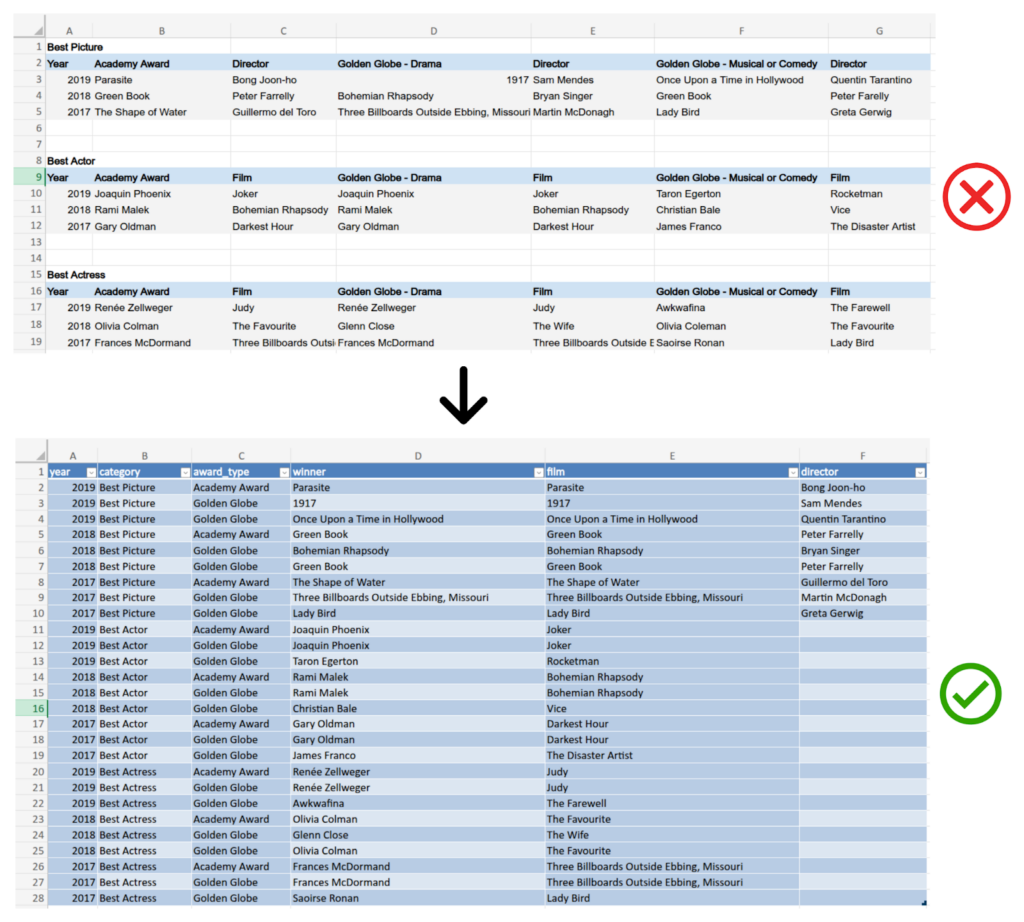
Tidy and untidy examples of a spreadsheet

Start with the why

A spreadsheet containing information about awards given to films

Let’s consider this Excel spreadsheet, which contains information on awards given to films. It is sourced from the book Cleaning Data for Effective Data Science and is available here.

This is a typical and common spreadsheet that everyone may own and deal with in their daily tasks. But what is wrong with it?

To answer that question, let us first recall the end goal of using data: to derive insights that help guide our decisions in our personal or business lives. This process requires at least two crucial things:

  • Reliable data: clean data without issues, inconsistencies, duplicates, missing values, etc.
  • Tidy data: a well-normalised data frame that facilitates processing and manipulation.

The second point is the primary foundation of any analysis, including dealing with data quality.

Returning to our example, imagine we want to perform the following actions:

1. For each film involved in multiple awards, list the award and year it is associated with.

2. For each actor/actress winning multiple awards, list the film and award they are associated with.

3. Check that all actor/actress names are correct and well-standardised.

Naturally, this example dataset is small enough to derive those insights by eye or by hand if we structure it (as quickly as coding). But imagine now that the dataset contains the entire awards history; this would be time-consuming, painful, and error-prone without any automation.

Reading this spreadsheet and directly understanding its structure by a machine is difficult, as it does not follow good practices of data arrangement. That is why tidying data is so important. By ensuring that data is structured in a machine-friendly way, we can simplify parsing, automate quality checks, and enhance business analysis—all without altering the actual content of the dataset.

Example of a reshaping of this data:

Example of a reshaping of the data from the previous spreadsheet:

Now, anyone can use low/no-code tools or code-based queries (SQL, Python, etc.) to interact easily with this dataset and derive insights.

The main challenge is how to turn a shiny and human-eye-pleasant spreadsheet into a machine-readable tidy version.

What is tidy data? A well-shaped data frame?

The term tidy data was described in a well‐known article named Tidy Data by Hadley Wickham and published in the Journal of Statistical Software in 2014. Below are the key quotes required to understand the underlying concepts better.

Data tidying 

“Structuring datasets to facilitate manipulation, visualisation and modelling.”

“Tidy datasets provide a standardised way of linking the structure of a dataset (its physical layout) with its semantics (its meaning).”

Data structure

“Most statistical datasets are rectangular tables composed of rows and columns. The columns are almost always labelled, and the rows are sometimes labelled.”

Data semantics

“A dataset is a collection of values, usually either numbers (if quantitative) or strings (if qualitative). Values are organised in two ways. Every value belongs to both a variable and an observation. A variable contains all values that measure the same underlying attribute (such as height, temperature or duration) across units. An observation contains all values measured on the same unit (for example, a person, a day or a race) across attributes.”

“In a given analysis, there may be multiple levels of observation. For example, in a trial of a new allergy medication, we might have three types of observations:

  • Demographic data collected from each person (age, sex, race),
  • Medical data collected from each person on each day (number of sneezes, redness of eyes), and
  • Meteorological data collected on each day (temperature, pollen count).”

Tidy data

“Tidy data is a standard way of mapping the meaning of a dataset to its structure. A dataset is considered messy or tidy depending on how its rows, columns and tables correspond to observations, variables and types. In tidy data:

  • Each variable forms a column.
  • Each observation forms a row.
  • Each type of observational unit forms a table.”

Common problems with messy datasets

Column headers might be values rather than variable names.

  • Messy example: A table where column headers are years (2019, 2020, 2021) instead of a “Year” column.
  • Tidy version: A table with a “Year” column and each row representing an observation for a given year.

Multiple variables might be stored in one column.

  • Messy example: A column named “Age_Gender” containing values like 28_Female
  • Tidy version: Separate columns for “Age” and “Gender”

Variables might be stored in both rows and columns.

  • Messy example: A dataset tracking student test scores where subjects (Math, Science, English) are stored as both column headers and repeated in rows instead of using a single “Subject” column.
  • Tidy version: A table with columns for “Student ID,” “Subject,” and “Score,” where each row represents one student’s score for one subject.

Multiple types of observational units might be stored in the same table.

  • Messy example: A sales dataset that contains both customer information and store inventory in the same table.
  • Tidy version: Separate tables for “Customers” and “Inventory.”

A single observational unit might be stored in multiple tables.

  • Messy example: A patient’s medical records are split across multiple tables (Diagnosis Table, Medication Table) without a common patient ID linking them.
  • Tidy version: A single table or properly linked tables using a unique “Patient ID.”

Now that we have a better understanding of what tidy data is, let’s see how to transform a messy dataset into a tidy one.

Thinking about the how

“Tidy datasets are all alike, but every messy dataset is messy in its own way.” Hadley Wickham (cf. Leo Tolstoy)

Although these guidelines sound clear in theory, they remain difficult to generalise easily in practice for any kind of dataset. In other words, starting with the messy data, no simple or deterministic process or algorithm exists to reshape the data. This is mainly explained by the singularity of each dataset. Indeed, it is surprisingly hard to precisely define variables and observations in general and then transform data automatically without losing content. That is why, despite massive improvements in data processing over the last decade, data cleaning and formatting are still done “manually” most of the time.

Thus, when complex and hardly maintainable rules-based systems are not suitable (i.e. to precisely deal with all contexts by describing decisions in advance), machine learning models may offer some benefits. This grants the system more freedom to adapt to any data by generalising what it has learned during training. Many large language models (LLMs) have been exposed to numerous data processing examples, making them capable of analysing input data and performing tasks such as spreadsheet structure analysis, table schema estimation, and code generation.

Then, let’s describe a workflow made of code and LLM-based modules, alongside business logic, to reshape any spreadsheet.
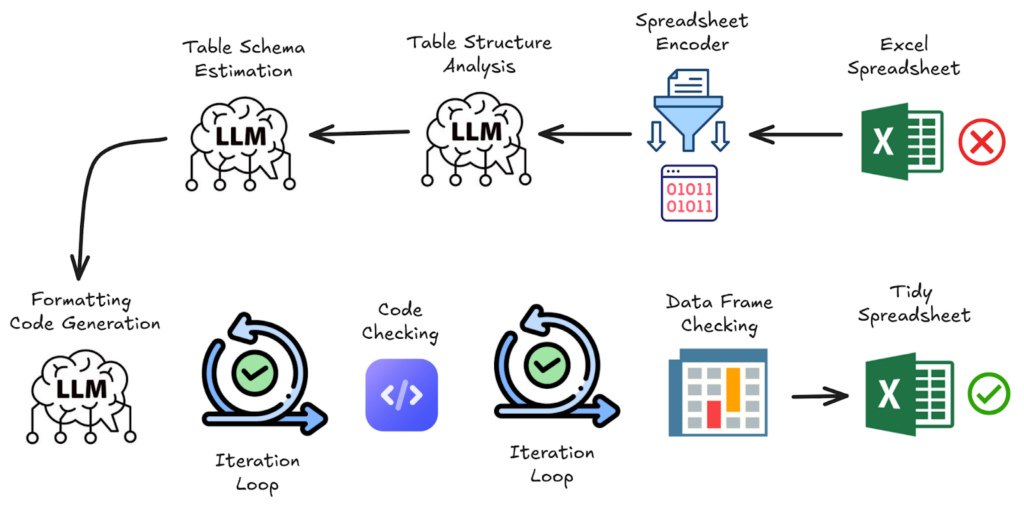
Diagram of a workflow made of code and LLM-based modules alongside business logic to reshape a spreadsheet

Spreadsheet encoder 

This module is designed to serialise into text the main information needed from the spreadsheet data. Only the necessary subset of cells contributing to the table layout is retained, removing non-essential or overly repetitive formatting information. By retaining only the necessary information, this step minimises token usage, reduces costs, and enhances model performance.. The current version is a deterministic algorithm inspired by the paper SpreadsheetLLM: Encoding Spreadsheets for Large Language Models, which relies on heuristics. More details about it will be the topic of a next article.

Table structure analysis 

Before moving forward, asking an LLM to extract the spreadsheet structure is a crucial step in building the next actions. Here are examples of questions addressed:

  • How many tables are present, and what are their locations (regions) in the spreadsheet?
  • What defines the boundaries of each table (e.g., empty rows/columns, specific markers)?
  • Which rows/columns serve as headers, and do any tables have multi-level headers?
  • Are there metadata sections, aggregated statistics, or notes that need to be filtered out or processed separately?
  • Are there any merged cells, and if so, how should they be handled?

Table schema estimation

Once the analysis of the spreadsheet structure has been completed, it is now time to start thinking about the ideal target table schema. This involves letting the LLM process iteratively by:

  • Identifying all potential columns (multi-row headers, metadata, etc.)
  • Comparing columns for domain similarities based on column names and data semantics
  • Grouping related columns  

The module outputs a final schema with names and a short description for each retained column.

Code generation to format the spreadsheet

Considering the previous structure analysis and the table schema, this last LLM-based module should draft code that transforms the spreadsheet into a proper data frame compliant with the table schema. Moreover, no useful content must be omitted (e.g. aggregated or computed values may still be derived from other variables).

As generating code that works well from scratch at the first iteration is challenging, two internal iterative processes are added to revise the code if needed:

  • Code checking: Whenever code cannot be compiled or executed, the trace error is provided to the model to update its code.
  • Data frame validation: The metadata of the created data frame—such as column names, first and last rows, and statistics about each column—is checked to validate whether the table conforms to expectations. Otherwise, the code is revised accordingly.

Convert the data frame into an Excel file

Finally, if all data fits properly into a single table, a worksheet is created from this data frame to respect the tabular format. The final asset returned is an Excel file whose active sheet contains the tidy spreadsheet data.

Et voilà! The sky’s the limit for making the most of your newly tidy dataset.

Feel free to test it with your own dataset using the CleanMyExcel.io service, which is free and requires no registration.

Final note on the workflow

Why is a workflow proposed instead of an agent for that purpose?  

At the time of writing, we consider that a workflow based on LLMs for precise sub-tasks is more robust, stable, iterable, and maintainable than a more autonomous agent. An agent may offer advantages: more freedom and liberty in actions to perform tasks. Nonetheless, they may still be hard to deal with in practice; for example, they may diverge quickly if the objective is not clear enough. I believe this is our case, but that does not mean that this model would not be applicable in the future in the same way as SWE-agent coding is performing, for example.

Next articles in the series

In upcoming articles, we plan to explore related topics, including:

  • A detailed description of the spreadsheet encoder mentioned earlier.
  • Data validity: ensuring each column meets the expectations.
  • Data uniqueness: preventing duplicate entities within the dataset.
  • Data completeness: handling missing values effectively.
  • Evaluating data reshaping, validity, and other key aspects of data quality.

Stay tuned!

Thank you to Marc Hobballah for reviewing this article and providing feedback.

All images, unless otherwise noted, are by the author.

Shape
Shape
Stay Ahead

Explore More Insights

Stay ahead with more perspectives on cutting-edge power, infrastructure, energy,  bitcoin and AI solutions. Explore these articles to uncover strategies and insights shaping the future of industries.

Shape

Nvidia Rubin GPUs may be delayed, slowing the next phase of AI infrastructure

The Rubin platform was expected to see early adoption among hyperscalers and AI-native companies, which have the infrastructure to support high-density systems, advanced cooling, and tightly integrated architectures. Hyperscalers to absorb shock Typically, hyperscalers lead early adoption of advanced GPUs, deploying them internally and through cloud platforms, with enterprises gaining

Read More »

Intel bets on Terafab to help it reassert itself in the AI chip race

Tesla, SpaceX, and xAI say that Terafab will be the largest chip manufacturing facility ever, outputting 1TW a year of compute power and “combining logic, memory and advanced packaging under one roof.” Intel’s ability to “design, fabricate, and package ultra-high-performance chips at scale” will help accelerate those 1TW/year ambitions, the

Read More »

Cisco joins Anthropic’s multivendor effort to secure AI software

In addition to model usage credits, Anthropic donated $2.5 million to Alpha-Omega and OpenSSF through the Linux Foundation, and $1.5 million to the Apache Software Foundation “to enable the maintainers of open-source software to respond to this changing landscape.” “Partners will, to the extent they’re able, share information and best

Read More »

Cloud-first vs. sovereign-first: Navigating the trade-off

Encryption is often suggested as a way to address data sovereignty because the customer holds the key to protect data in motion, in use, and at rest. However, Buest noted, most regulators have not explicitly approved the use of encryption or other security measures or deemed them sufficient for compliance.

Read More »

United States and Australia meet for Mining, Minerals and Metals Investment Ministerial

We, the Australian Minister for Resources and Northern Australia, the Hon Madeleine King MP, and Secretaries and senior representatives from the United States, including Secretary of Interior Doug Burgum, Administrator of the U.S. Environmental Protection Agency Lee Zeldin, Chairman of the U.S. Export Import Bank John Jovanovic, and Assistant Secretary of Energy Audrey Robertson,  held our inaugural Mining, Minerals, and Metals Investment Ministerial in Tokyo on 14 March 2026, to advance cooperation under the landmark bilateral agreement, the United States–Australia Framework for Securing Supply in the Mining and Processing of Critical Minerals and Rare Earths (the Framework). Under the Framework, Australia and the United States are delivering concrete outcomes to strengthen, secure, and diversify critical minerals and rare earth supply chains. Within six months of agreement of the Framework, we have each taken measures to provide at least USD $1 billion in financing to key critical minerals projects. By mobilising government and private sector capital, these investments support the development of our shared industrial base and strengthen longer term supply for defence, manufacturing, and energy supply chains. To build resilience, enhance stability, and bolster economic security in support of our shared critical minerals interests, Australia and the United States today announce the establishment of the Critical Minerals Supply Security Response Group and commit to deeper cooperation between our key agencies. In line with the Framework, the Critical Minerals Supply Security Response Group, led by senior representatives from the United States Department of Energy and the Australian Department of Industry, Science and Resources, will cooperate on priority minerals and supply chain vulnerabilities and coordinate efforts to accelerate the delivery of processed minerals under the Framework. Australia and the United States also commit to leveraging shared policy and interagency regulatory tools and, where appropriate, investments to secure critical minerals supply, including through cooperation between Australia’s

Read More »

Energy Security for Indo-Pacific Endurance, a Global Growth Center of the 21st Century

We, the ministers and representatives of Australia, Bangladesh, Brunei, Japan, Malaysia, New Zealand, Philippines, Republic of Korea, Singapore, Timor-Leste, United States, and Vietnam met in Tokyo, Japan, on March 14–15, 2026, to hold the historic Indo-Pacific Energy Security Ministerial and Business Forum. The forum was co-hosted by the Chair and Vice Chair of the U.S. National Energy Dominance Council, Secretary of the Interior Doug Burgum, Secretary of Energy Chris Wright, and Japanese Minister of Economy, Trade and Industry Akazawa Ryosei. We affirm our shared determination to work collectively to ensure stable and secure energy supply in the Indo-Pacific region. To this end, we focused on three key themes: reliable energy for Indo-Pacific growth and security; securing energy supply chains, infrastructure and maritime routes; and enabling trade and investment. To support these goals, Ministers affirm the value of: The necessity of reliable, affordable, secure and dispatchable energy from all sources depending on each country’s situation, in meeting the region’s surging energy demand.  Promoting quality as a key procurement mechanism to mitigate risk of operational liabilities. Protecting against rising cyber threats to the security of the energy grid, critical infrastructure, vehicles, and devices. Investment in comprehensive energy infrastructure that encompasses the entire energy supply chain from upstream development facilities to downstream equipment to support an affordable, reliable, and secure energy supply including baseload electricity.  Continuing to supply affordable and reliable energy sources in the Indo-Pacific region, including through emergency response measures, to benefit both producers and consumer countries. While maintaining strong relations with current partners, expanding and diversifying energy suppliers and fuel types in order to strengthen energy security. Promoting transparent, long-term energy contracts that reduce market volatility. As the global economy expands, so too does demand for energy driven by AI and electrification, we, as countries committed to a free and

Read More »

Energy Department Issues Funding Opportunity to Strengthen American Critical Minerals and Materials Supply Chain

WASHINGTON—The U.S. Department of Energy’s (DOE) Office of Critical Minerals and Energy Innovation (CMEI) and Hydrocarbons and Geothermal Energy Office (HGEO) today announced a funding opportunity of up to $69 million for technologies or processes that advance the domestic production and refining of critical materials. Projects selected through this Notice of Funding Opportunity (NOFO) will address the greatest technical obstacles to a stronger critical materials supply chain. “This funding will help establish a more secure and affordable supply of the critical minerals and materials that are foundational to American energy dominance, national security, and industrial competitiveness,” said Assistant Secretary of Energy (EERE) Audrey Robertson. DOE is seeking projects that bridge the gap between bench-scale innovations and commercially viable technologies. Selected project teams will form industry-led partnerships and conduct research and development with support from the U.S. national laboratories. The NOFO, which is part of DOE’s Critical Minerals and Materials Accelerator Program and jointly funded by CMEI’s Advanced Materials and Manufacturing Technologies Office and HGEO’s Office of Geothermal, has three primary topic areas: Production and material efficiency for critical materials including rare earth elements Processes to refine and alloy gallium, gallium nitride, germanium, and silicon carbide Cost-competitive direct lithium extraction, separation, and processing CMEI will host an informational webinar on April 16, 2026, to discuss the NOFO and application requirements. Letters of intent are due on April 21, 2026, by 5 p.m. ET. Deadlines for full applications will be staggered based on topic area, starting in May 2026. For more details on sub-topics and deadlines, visit the NOFO landing page. The Critical Minerals and Materials Accelerator is one of several programs developed through DOE’s Critical Materials Collaborative. This NOFO is part of $1 billion in critical materials funding announced by DOE in August 2025, and follows the Manufacturing Deployment Office’s announcement

Read More »

Latin America returns to the energy security conversation at CERAWeek

With geopolitical risk central to conversations about energy, and with long-cycle supply once again in focus, Latin America’s mix of hydrocarbons and export potential drew renewed attention at CERAWeek by S&P Global in Houston. Argentina, resource story to export platform Among the regional stories, Argentina stood out as Vaca Muerta was no longer discussed simply as a large unconventional resource, but whether the country could turn resource quality into sustained export capacity.  Country officials talked about scale: more operators, more services, more infrastructure, and a larger industrial base around the unconventional play. Daniel González, Vice Minister of Energy and Mining for Argentina, put it plainly: “The time has come to expand the Vaca Muerta ecosystem.” What is at stake now is not whether the basin works, but whether the country can build enough above-ground capacity and regulatory consistency to keep development moving. Horacio Marín, chairman and chief executive officer of YPF, offered an expansive version of that argument. He said Argentina’s energy exports could reach $50 billion/year by 2031, backed by roughly $130 billion in cumulative investment in oil, LNG, and transportation infrastructure. He said Argentine crude output could reach 1 million b/d by end-2026. He said Argentina wants to be seen less as a recurrent frontier story and more as a future supplier with scale. “The time to invest in Vaca Muerta is now,” Marín said. The LNG piece is starting to take shape. Eni, YPF, and XRG signed a joint development agreement in February to move Argentina LNG forward, with a first phase planned at 12 million tonnes/year. Southern Energy—backed by PAE, YPF, Pampa Energía, Harbour Energy, and Golar LNG—holds a long-term agreement with SEFE for 2 million tonnes/year over 8 years. The movement by global standards is early-stage and relatively modest, but it adds to Argentina’s export

Read More »

Market Focus: LNG supply shocks expose limited market flexibility

@import url(‘https://fonts.googleapis.com/css2?family=Inter:[email protected]&display=swap’); a { color: var(–color-primary-main); } .ebm-page__main h1, .ebm-page__main h2, .ebm-page__main h3, .ebm-page__main h4, .ebm-page__main h5, .ebm-page__main h6 { font-family: Inter; } body { line-height: 150%; letter-spacing: 0.025em; font-family: Inter; } button, .ebm-button-wrapper { font-family: Inter; } .label-style { text-transform: uppercase; color: var(–color-grey); font-weight: 600; font-size: 0.75rem; } .caption-style { font-size: 0.75rem; opacity: .6; } #onetrust-pc-sdk [id*=btn-handler], #onetrust-pc-sdk [class*=btn-handler] { background-color: #c19a06 !important; border-color: #c19a06 !important; } #onetrust-policy a, #onetrust-pc-sdk a, #ot-pc-content a { color: #c19a06 !important; } #onetrust-consent-sdk #onetrust-pc-sdk .ot-active-menu { border-color: #c19a06 !important; } #onetrust-consent-sdk #onetrust-accept-btn-handler, #onetrust-banner-sdk #onetrust-reject-all-handler, #onetrust-consent-sdk #onetrust-pc-btn-handler.cookie-setting-link { background-color: #c19a06 !important; border-color: #c19a06 !important; } #onetrust-consent-sdk .onetrust-pc-btn-handler { color: #c19a06 !important; border-color: #c19a06 !important; } In this Market Focus episode of the Oil & Gas Journal ReEnterprised podcast, Conglin Xu, managing editor, economics, takes a look into the LNG market shock caused by the effective closure of the Strait of Hormuz and the sudden loss of Qatari LNG supply as the Iran war continues. Xu speaks with Edward O’Toole, director of global gas analysis, RBAC Inc., to examine how these disruptions are intensifying global supply constraints at a time when European inventories were already under pressure following a colder-than-average winter and weaker storage levels. Drawing on RBAC’s G2M2 global gas market model, O’Toole outlines disruption scenarios analyzed in the firm’s recent report and explains how current events align with their findings. With global LNG production already operating near maximum utilization, the market response is being driven by higher prices and reduced consumption. Europe faces sharper price pressure due to storage refill needs, while Asian markets are expected to see greater demand reductions as consumers switch fuels. O’Toole underscores the importance of scenario-based modeling and supply diversification as geopolitical risk exposes structural vulnerabilities in the LNG market—offering insights for stakeholders navigating an increasingly uncertain global

Read More »

Libya’s NOC, Chevron sign MoU for technical study for offshore Block NC146

@import url(‘https://fonts.googleapis.com/css2?family=Inter:[email protected]&display=swap’); a { color: var(–color-primary-main); } .ebm-page__main h1, .ebm-page__main h2, .ebm-page__main h3, .ebm-page__main h4, .ebm-page__main h5, .ebm-page__main h6 { font-family: Inter; } body { line-height: 150%; letter-spacing: 0.025em; font-family: Inter; } button, .ebm-button-wrapper { font-family: Inter; } .label-style { text-transform: uppercase; color: var(–color-grey); font-weight: 600; font-size: 0.75rem; } .caption-style { font-size: 0.75rem; opacity: .6; } #onetrust-pc-sdk [id*=btn-handler], #onetrust-pc-sdk [class*=btn-handler] { background-color: #c19a06 !important; border-color: #c19a06 !important; } #onetrust-policy a, #onetrust-pc-sdk a, #ot-pc-content a { color: #c19a06 !important; } #onetrust-consent-sdk #onetrust-pc-sdk .ot-active-menu { border-color: #c19a06 !important; } #onetrust-consent-sdk #onetrust-accept-btn-handler, #onetrust-banner-sdk #onetrust-reject-all-handler, #onetrust-consent-sdk #onetrust-pc-btn-handler.cookie-setting-link { background-color: #c19a06 !important; border-color: #c19a06 !important; } #onetrust-consent-sdk .onetrust-pc-btn-handler { color: #c19a06 !important; border-color: #c19a06 !important; } The National Oil Corp. of Libya (NOC) signed a memorandum of understanding (MoU) with Chevron Corp. to conduct a comprehensive technical study of offshore Block NC146. The block is an unexplored area with “encouraging geological indicator that could lead to significant discoveries, helping to strengthen national reserves,” NOC noted Chairman Masoud Suleman as saying, noting that the partnership is “a message of confidence in the Libyan investment environment and evidence of the return of major companies to work and explore promising opportunities in our country.” According to the NOC, Libya produces 1.4 million b/d of oil and aims to increase oil production in the coming 3-5 years to 2 million b/d and then to 3 million b/d following years of instability that impacted the country’s production.   Chevron is working to add to its diverse exploration and production portfolio in the Mediterranean and Africa and continues to assess potential future opportunities in the region.  The operator earlier this year entered Libya after it was designated as a winning bidder for Contract Area 106 in the Sirte basin in the 2025 Libyan Bid Round. That followed the January 2026 signing of a

Read More »

Aria Networks raises $125M and debuts its approach for AI-optimized networks

That embedded telemetry feeds adaptive tuning of Dynamic Load Balancing parameters, Data Center Quantized Congestion Notification (DCQCN) and failover logic without waiting for a threshold breach or a manual intervention. The platform architecture is layered. At the lowest levels, agents react in microseconds to link-level events such as transceiver flaps, rerouting leaf-spine traffic in milliseconds. At higher layers, agents make more strategic decisions about flow placement across the cluster. At the cloud layer, a large language model-based agent surfaces correlated insights to operators in natural language, allowing them to ask questions about specific jobs or alert conditions and receive context-aware responses. Karam argued that simply bolting an LLM onto an existing architecture does not deliver the same result. “If you ask it to do anything, it could hallucinate and bring down the network,” he said. “It doesn’t have any of the context or the data that’s required for this approach to be made safe.” Aria also exposes an MCP server, allowing external systems such as job schedulers and LLM routers to query network state directly and integrate it into their own decision-making. MFU and token efficiency as the target metrics Traditional networking is often evaluated in terms of bandwidth and latency. Aria is centering its platform around two metrics: Model FLOPS Utilization (MFU) and token efficiency. MFU is defined as the ratio of achieved FLOPS per accelerator to the theoretical peak. In practice, Karam said, MFU for training workloads typically runs between 33% and 45%, and inference often comes in below 30%. “The network has a major impact on the MFU, and therefore the token efficiency, because the network touches every aspect, every other component in your cluster,” Karam said.

Read More »

New v2 UALink specification aims to catch up to NVLink

But given there are no products currently available using UALink 1.0, UALink 2.0 might be viewed as a premature launch Need to play catch up David Harold, senior analyst with Jon Peddie Research, was guarded in his reaction. “While 2.0 is a significant step forward from 1.0, we need to bear in mind that even 1.0 solutions aren’t shipping yet – they aren’t due until later this year. So, Nvidia is way ahead of the open alternatives on connectivity, indeed ahead of the proprietary or Ethernet based solutions too,” he said. What this means, he added, is that non-Nvidia alternatives are currently lagging in the market. “They need to play catch up on several fronts, not just networking. … I can’t think of a single shipping product that meaningfully has advantages over a Nvidia solution,” he said. “Ultimately UALink remains desirable since it will enable heterogeneous, multi-vendor environments but it’s quite a way behind NVLink today. ” There are plenty of signs that organizations will find it hard to break free of the Nvidia dominance, however. A couple of months ago, RISC-V pioneer SiFive signed a deal with Nvidia to incorporate Nvidia NVLink Fusion into its data center products, a departure for RISC companies. According to Harold, other companies could be joining it. “Custom ASIC company MediaTek is an NVLink partner, and they told me last week that they are planning to integrate it directly into next-generation custom silicon for AI applications,” he said. “This will enable a wider range of companies to use NVLink as their high-speed interconnect.” Other options And, Harold noted, Nvidia is already looking at other options. “Nvidia is now shifting to look at the copper limit for networking speed, with an interest in using optical connectivity instead,” said Harold.

Read More »

Nvidia’s SchedMD acquisition puts open-source AI scheduling under scrutiny

Is the concern valid? Dr. Danish Faruqui, CEO of Fab Economics, a US-based AI hardware and datacenter advisory, said the risk was real. “The skepticism that Nvidia may prioritize its own hardware in future software updates, potentially delaying or under-optimizing support for rivals, is a feasible outcome,” he said. As the primary developer, Nvidia now controls Slurm’s official development roadmap and code review process, Faruqui said, “which could influence how quickly competing chips are integrated on new development or continuous improvement elements.” Owning the control plane alongside GPUs and networking infrastructure such as InfiniBand, he added, allows Nvidia to create a tightly vertically integrated stack that can lead to what he described as “shallow moats, where advanced features are only available or performant on Nvidia hardware.” One concrete test of that, industry observers say, will be how quickly Nvidia integrates support for AMD’s next-generation chips into Slurm’s codebase compared with how quickly it integrates its own forthcoming hardware and networking technologies, such as InfiniBand. Does the Bright Computing precedent hold? Analysts point to Nvidia’s 2022 acquisition of Bright Computing as a reference point, saying the software became optimized for Nvidia chips in ways that disadvantaged users of competing hardware. Nvidia disputed that characterization, saying Bright Computing supports “nearly any CPU or GPU-accelerated cluster.” Rawat said the comparison was instructive but imperfect. “Nvidia’s acquisition of Bright Computing highlights its preference for vertical integration, embedding Bright tightly into DGX and AI Factory stacks rather than maintaining a neutral, multi-vendor orchestration role,” he said. “This reflects a broader strategic pattern — Nvidia seeks to control the full-stack AI infrastructure experience.”

Read More »

Two New England states say no to new data centers

It’s getting harder and harder for governments to ignore the impact that data centers are having on their communities, consuming vast amounts of water and driving up electricity prices, experts say. According to a Pew Research Center analysis, data centers consumed 183 terawatt-hours of electricity in 2024, more than 4% of total U.S. electricity use. That demand is projected to more than double to 426 terawatt-hours by 2030. The impact is significant. In 2023, data centers consumed about 26% of Virginia’s electricity supply, although Virginia is notable for having an extremely dense collection of data centers. Alan Howard, senior analyst for infrastructure at Omdia, says he is not surprised at all. “The amount of national press coverage regarding what is arguably a limited number of data center ‘horror’ stories has many jurisdictions and states spooked over the potential impacts data center projects might have,” he said. It’s an evolution that’s been coming for some time whereby local legislators have embraced the idea that they don’t want to learn the hard way as others already have, he argues. “All that said, it seems unlikely that there will be broad bans on data center development that would cripple the industry. There’s lots of places to go in the U.S. and developers have warmed up to siting projects in places amenable to their needs, although not ideally convenient,” said Howard.

Read More »

Nscale Expands AI Factory Strategy With Power, Platform, and Scale

Nscale has moved quickly from startup to serious contender in the race to build infrastructure for the AI era. Founded in 2024, the company has positioned itself as a vertically integrated “neocloud” operator, combining data center development, GPU fleet ownership, and a software stack designed to deliver large-scale AI compute. That model has helped it attract backing from investors including Nvidia, and in early March 2026 the company raised another $2 billion at a reported $14.6 billion valuation. Reuters has described Nscale’s approach as owning and operating its own data centers, GPUs, and software stack to support major customers including Microsoft and OpenAI. What makes Nscale especially relevant now is that it is no longer content to operate as a cloud intermediary or capacity provider. Over the past year, the company has increasingly framed itself as an AI hyperscaler and AI factory builder, seeking to combine land, power, data center shells, GPU procurement, customer offtake, and software services into a single integrated platform. Its acquisition of American Intelligence & Power Corporation, or AIPCorp, is the clearest signal yet of that shift, bringing energy infrastructure directly into the center of Nscale’s business model. The AIPCorp transaction is significant because it gives Nscale more than additional development capacity. The company said the deal includes the Monarch Compute Campus in Mason County, West Virginia, a site of up to 2,250 acres with a state-certified AI microgrid and a power runway it says can scale beyond 8 gigawatts. Nscale also said the acquisition establishes a new division, Nscale Energy & Power, headquartered in Houston, extending its platform further into power development. That positioning reflects a broader shift in the AI infrastructure market. The central bottleneck is no longer simply access to GPUs. It is the ability to assemble power, cooling, land, permits, data center

Read More »

Google Research touts memory-compression breakthrough for AI processing

The last time the market witnessed a shakeup like this was China’s DeepSeek, but doubts emerged quickly about its efficacy. Developers found DeepSeek’s efficiency gains required deep architectural decisions that had to be built in from the start. TurboQuant requires no retraining or fine-tuning. You just drop it straight into existing inference pipelines, at least in theory. If it works in production systems with no retrofitting, then data center operators will get tremendous performance gains on existing hardware. Data center operators won’t have to throw hardware at the performance problem. However, analysts urge caution before jumping to conclusions. “This is a research breakthrough, not a shipping product,” said Alex Cordovil, research director for physical infrastructure at The Dell’Oro Group. “There’s often a meaningful gap between a published paper and real-world inference workloads.” Also, Dell’Oro notes that efficiency gains in AI compute tend to get consumed by more demand, known as the Jevons paradox. “Any freed-up capacity would likely be absorbed by frontier models expanding their capabilities rather than reducing their hardware footprint.” Jim Handy, president of Objective Analysis, agrees on that second part. “Hyperscalers won’t cut their spending – they’ll just spend the same amount and get more bang for their buck,” he said. “Data centers aren’t looking to reach a certain performance level and subsequently stop spending on AI. They’re looking to out-spend each other to gain market dominance. This won’t change that.” Google plans to present a paper outlining TurboQuant at the ICLR conference in Rio de Janeiro running from April 23 through April 27.

Read More »

Microsoft will invest $80B in AI data centers in fiscal 2025

And Microsoft isn’t the only one that is ramping up its investments into AI-enabled data centers. Rival cloud service providers are all investing in either upgrading or opening new data centers to capture a larger chunk of business from developers and users of large language models (LLMs).  In a report published in October 2024, Bloomberg Intelligence estimated that demand for generative AI would push Microsoft, AWS, Google, Oracle, Meta, and Apple would between them devote $200 billion to capex in 2025, up from $110 billion in 2023. Microsoft is one of the biggest spenders, followed closely by Google and AWS, Bloomberg Intelligence said. Its estimate of Microsoft’s capital spending on AI, at $62.4 billion for calendar 2025, is lower than Smith’s claim that the company will invest $80 billion in the fiscal year to June 30, 2025. Both figures, though, are way higher than Microsoft’s 2020 capital expenditure of “just” $17.6 billion. The majority of the increased spending is tied to cloud services and the expansion of AI infrastructure needed to provide compute capacity for OpenAI workloads. Separately, last October Amazon CEO Andy Jassy said his company planned total capex spend of $75 billion in 2024 and even more in 2025, with much of it going to AWS, its cloud computing division.

Read More »

John Deere unveils more autonomous farm machines to address skill labor shortage

Join our daily and weekly newsletters for the latest updates and exclusive content on industry-leading AI coverage. Learn More Self-driving tractors might be the path to self-driving cars. John Deere has revealed a new line of autonomous machines and tech across agriculture, construction and commercial landscaping. The Moline, Illinois-based John Deere has been in business for 187 years, yet it’s been a regular as a non-tech company showing off technology at the big tech trade show in Las Vegas and is back at CES 2025 with more autonomous tractors and other vehicles. This is not something we usually cover, but John Deere has a lot of data that is interesting in the big picture of tech. The message from the company is that there aren’t enough skilled farm laborers to do the work that its customers need. It’s been a challenge for most of the last two decades, said Jahmy Hindman, CTO at John Deere, in a briefing. Much of the tech will come this fall and after that. He noted that the average farmer in the U.S. is over 58 and works 12 to 18 hours a day to grow food for us. And he said the American Farm Bureau Federation estimates there are roughly 2.4 million farm jobs that need to be filled annually; and the agricultural work force continues to shrink. (This is my hint to the anti-immigration crowd). John Deere’s autonomous 9RX Tractor. Farmers can oversee it using an app. While each of these industries experiences their own set of challenges, a commonality across all is skilled labor availability. In construction, about 80% percent of contractors struggle to find skilled labor. And in commercial landscaping, 86% of landscaping business owners can’t find labor to fill open positions, he said. “They have to figure out how to do

Read More »

2025 playbook for enterprise AI success, from agents to evals

Join our daily and weekly newsletters for the latest updates and exclusive content on industry-leading AI coverage. Learn More 2025 is poised to be a pivotal year for enterprise AI. The past year has seen rapid innovation, and this year will see the same. This has made it more critical than ever to revisit your AI strategy to stay competitive and create value for your customers. From scaling AI agents to optimizing costs, here are the five critical areas enterprises should prioritize for their AI strategy this year. 1. Agents: the next generation of automation AI agents are no longer theoretical. In 2025, they’re indispensable tools for enterprises looking to streamline operations and enhance customer interactions. Unlike traditional software, agents powered by large language models (LLMs) can make nuanced decisions, navigate complex multi-step tasks, and integrate seamlessly with tools and APIs. At the start of 2024, agents were not ready for prime time, making frustrating mistakes like hallucinating URLs. They started getting better as frontier large language models themselves improved. “Let me put it this way,” said Sam Witteveen, cofounder of Red Dragon, a company that develops agents for companies, and that recently reviewed the 48 agents it built last year. “Interestingly, the ones that we built at the start of the year, a lot of those worked way better at the end of the year just because the models got better.” Witteveen shared this in the video podcast we filmed to discuss these five big trends in detail. Models are getting better and hallucinating less, and they’re also being trained to do agentic tasks. Another feature that the model providers are researching is a way to use the LLM as a judge, and as models get cheaper (something we’ll cover below), companies can use three or more models to

Read More »

OpenAI’s red teaming innovations define new essentials for security leaders in the AI era

Join our daily and weekly newsletters for the latest updates and exclusive content on industry-leading AI coverage. Learn More OpenAI has taken a more aggressive approach to red teaming than its AI competitors, demonstrating its security teams’ advanced capabilities in two areas: multi-step reinforcement and external red teaming. OpenAI recently released two papers that set a new competitive standard for improving the quality, reliability and safety of AI models in these two techniques and more. The first paper, “OpenAI’s Approach to External Red Teaming for AI Models and Systems,” reports that specialized teams outside the company have proven effective in uncovering vulnerabilities that might otherwise have made it into a released model because in-house testing techniques may have missed them. In the second paper, “Diverse and Effective Red Teaming with Auto-Generated Rewards and Multi-Step Reinforcement Learning,” OpenAI introduces an automated framework that relies on iterative reinforcement learning to generate a broad spectrum of novel, wide-ranging attacks. Going all-in on red teaming pays practical, competitive dividends It’s encouraging to see competitive intensity in red teaming growing among AI companies. When Anthropic released its AI red team guidelines in June of last year, it joined AI providers including Google, Microsoft, Nvidia, OpenAI, and even the U.S.’s National Institute of Standards and Technology (NIST), which all had released red teaming frameworks. Investing heavily in red teaming yields tangible benefits for security leaders in any organization. OpenAI’s paper on external red teaming provides a detailed analysis of how the company strives to create specialized external teams that include cybersecurity and subject matter experts. The goal is to see if knowledgeable external teams can defeat models’ security perimeters and find gaps in their security, biases and controls that prompt-based testing couldn’t find. What makes OpenAI’s recent papers noteworthy is how well they define using human-in-the-middle

Read More »