Stay Ahead, Stay ONMINE

EsVolta poised to bring 490 MW/980 MWh of storage online in ERCOT

Utility-scale energy storage developer esVolta is close to bringing online three battery storage projects in Texas totaling 490 MW/980 MWh. The lithium-ion battery storage projects include the 150 MW/300 MWh Desert Willow project in Midlothian and the 100 MW/200 MWh Burksol project in Dickens County. The projects are slated to begin operating this quarter, according […]

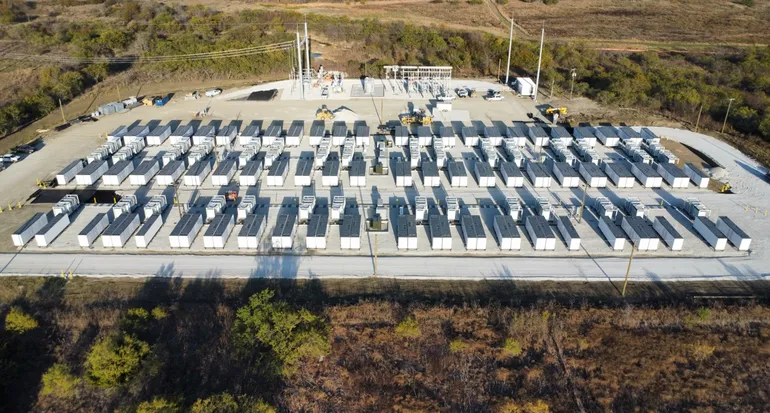
Utility-scale energy storage developer esVolta is close to bringing online three battery storage projects in Texas totaling 490 MW/980 MWh.

The lithium-ion battery storage projects include the 150 MW/300 MWh Desert Willow project in Midlothian and the 100 MW/200 MWh Burksol project in Dickens County. The projects are slated to begin operating this quarter, according to esVolta president and CEO Randolph Mann.

The 240 MW/480 MWh Anole project in Seagoville is set to come online a few months later, Mann said Monday in an email.

The projects are backed by $243 million in funding from a preferred equity investment structured by Captona and the sale of investment tax credits, according to esVolta. “This deal unlocks efficient capital to continue to deliver much-needed fast-responding clean energy resources to the [Electric Reliability Council of Texas] power grid,” the Newport Beach, California-based company said Monday.

The projects are part of a surge in energy storage development in the ERCOT market. ERCOT expects it will have 9,889 MW of storage on its system in March, according to the grid operator’s most recent Monthly Outlook for Resource Adequacy report. In March 2024, ERCOT expected to have about 4,700 MW of storage, according to its resource adequacy report from one year ago.

ERCOT provides a favorable market for storage, according to Mann. “Texas has rapidly growing electricity demand, a highly liquid wholesale market, and an increasing level of intermittent solar and wind, which creates attractive conditions for storage,” he said. 

EsVolta’s three projects have a hedge in place with a confidential commodity market participant. They will also participate in the ERCOT wholesale market, according to Mann. 

EsVolta has about 25 GW of storage projects under development across the United States, the company says, including the 250-MW Marmot Hills and the 125-MW Holly Oaks projects in California.

Infrastructure investment company Generate Capital bought esVolta in July 2022. At the time, Mann said the acquisition would help the company meet its goal to “expand the battery storage market amid increasing demand from offtakers and utilities throughout the United States.”


Shape
Shape
Stay Ahead

Explore More Insights

Stay ahead with more perspectives on cutting-edge power, infrastructure, energy,  bitcoin and AI solutions. Explore these articles to uncover strategies and insights shaping the future of industries.

Shape

Is private 5G/6G important after all?

Most process control is done using wired connections to local computers, or Wi-Fi. Wires can’t connect moving things, and they’re hard to maintain if they have to be strung a significant distance. Wi-Fi is great for a hundred feet from a hub, but it’s weak for large areas unless you

Read More »

Takeaways from Cisco’s AI Summit

Software development is in an absolute frenzy right now, Scott said. “You have very, very senior people, the best coders you’ve ever met in your life, who are just completely overwhelmed trying to keep up with the rate of progress that’s happening right now.” Optimizing AI development for agents or humans?

Read More »

Eying AI factories, Nvidia buys bigger stake in CoreWeave

Nvidia continues to throw its sizable bank account around, this time making a $2 billion investment in GPU cloud service provider CoreWeave. The company says the investment reflects Nvidia’s “confidence in CoreWeave’s business, team and growth strategy as a cloud platform built on Nvidia infrastructure.” CoreWeave is not the only

Read More »

AI, security tailwinds signal promising 2026 for Cisco

A big component of AI in communications is agentic agents talking to employees and customers, and bringing trust to the system is where Cisco should shine. It builds and runs its own infrastructure, which is secure by design. Cisco has relationships with governments all over the world, and between Webex

Read More »

Turkey, Chevron Sign Agreement on Global Exploration

Turkey signed a deal with Chevron Corp. on Thursday to jointly explore for oil and gas around the world, the country’s energy ministry said. The agreement between Chevron and state-run Turkish Petroleum Corp, known by its initials TPAO, will see the companies collaborate on onshore and offshore exploration and production activities, the ministry said. Bloomberg reported in January that Turkey was in talks with Chevron in preparation for the agreement. The deal is the latest instance of increased cooperation between Turkish and US energy companies, as Turkey looks to reduce its reliance on imported oil and natural gas — especially from Russia — and improve ties between the longtime allies. Cooperation with Chevron could help TPAO eventually produce 1 million barrels of oil per day, Energy Minister Alparslan Bayraktar said in a social media post after the signing ceremony in Istanbul. Last month, TPAO signed a memorandum of understanding with Exxon Mobil Corp unit Esso to conduct energy exploration in the Black Sea and Mediterranean Sea. WHAT DO YOU THINK? Generated by readers, the comments included herein do not reflect the views and opinions of Rigzone. All comments are subject to editorial review. Off-topic, inappropriate or insulting comments will be removed.

Read More »

Vitol, Total Snap Up North Sea Oil at Fastest Pace on Record

Vitol Group and TotalEnergies SE are hoovering up key North Sea crude supplies, part of the biggest spate of activity in almost two decades for barrels that help set global oil prices.  Over the past three days, Vitol, the world’s top independent oil trader, and French oil giant Total have snapped up 11 out of 17 cargoes that changed hands in a key pricing window run by Platts, a unit of S&P Global, according to traders and brokers.  The deals follow frenetic derivatives trading on Jan. 30, the most recent expiry period for Brent contracts, when both firms were very active.  While the precise reasons for the deals aren’t clear, dominant expiry buyers will often follow up by snapping up North Sea cargoes, tightening near-term supply and steepening the market’s price curve as cargoes get locked up. Expiry sessions often set the tone for physical markets in the following month, as traders settle, or roll over, a host of associated contracts tied to actual barrels. European oil markets have been unexpectedly strong so far this year, despite expectations for a global surplus. Supplies from Kazakhstan, a market that competes with North Sea oil, have severely disrupted, helping to tighten the availability of crude in the region, traders said. Spokespeople for Vitol and Total declined to comment. February Kazakh crude loadings have been revised down by about 300,000-400,000 barrels a day, while bad weather in other parts of the region has also curbed the availability of crude, especially from Algeria. There was also a winter storm in the US that disrupted American output, while traders are continuing to fret over whether US President Donald Trump will launch a renewed attack on Iran.  There hasn’t been a three-day period this busy in data compiled by Bloomberg going back to 2008. Less than

Read More »

USA Crude Oil Stocks Drop 3.5MM Barrels WoW

U.S. commercial crude oil inventories, excluding those in the Strategic Petroleum Reserve (SPR), decreased by 3.5 million barrels from the week ending January 23 to the week ending January 30, the U.S. Energy Information Administration (EIA) highlighted in its latest weekly petroleum status report. According to this report, which was released on February 4 and included data for the week ending January 30, crude oil stocks, not including the SPR, stood at 420.3 million barrels on January 30, 423.8 million barrels on January 23, and 423.8 million barrels on January 31, 2025. Crude oil in the SPR stood at 415.2 million barrels on January 30, 415.0 million barrels on January 23, and 395.1 million barrels on January 31, 2025, the EIA report revealed. Total petroleum stocks – including crude oil, total motor gasoline, fuel ethanol, kerosene type jet fuel, distillate fuel oil, residual fuel oil, propane/propylene, and other oils – stood at 1.690 billion barrels on January 30, the report highlighted. Total petroleum stocks were down 25.1 million barrels week on week and up 85.1 million barrels year on year, the report pointed out. “At 420.3 million barrels, U.S. crude oil inventories are about four percent below the five year average for this time of year,” the EIA noted in its latest weekly petroleum status report. “Total motor gasoline inventories increased by 0.7 million barrels from last week and are about four percent above the five year average for this time of year. Finished gasoline inventories decreased, while blending components inventories increased last week,” it added. “Distillate fuel inventories decreased by 5.6 million barrels last week and are about two percent below the five year average for this time of year. Propane/propylene inventories decreased 6.2 million barrels from last week and are about 37 percent above the five year average

Read More »

BOEM Announces ‘Major Step’ Toward Expanding Offshore Energy

In a statement posted on its website, the Bureau of Ocean Energy Management (BOEM) announced “another major step toward expanding offshore energy development pursuant to the One Big Beautiful Bill Act”. BOEM noted in the statement that it has released the Final Notice of Sale for Lease Sale Big Beautiful Gulf 2 (BBG2), which it said is the second of 30 Gulf of America lease sales required by the One Big Beautiful Bill Act. The final notice of sale will be published in the Federal Register on February 5, BOEM revealed in the statement, outlining that this satisfies the requirement for the notice to publish at least 30 days prior to the scheduled lease sale date on March 11. Lease Sale BBG2 proposes to offer approximately 15,066 unleased blocks covering about 80.4 million acres on the U.S. Outer Continental Shelf in the Gulf of America, BOEM highlighted in the statement, adding that the blocks are located three to 231 miles offshore and span water depths from nine feet to more than 11,100 feet.   BOEM noted in the statement that certain areas will be excluded from the sale, “including blocks subject to the Sept. 8, 2020, presidential withdrawal; blocks adjacent to or beyond the U.S. Exclusive Economic Zone in the Eastern Gap; blocks within the boundaries of the Flower Garden Banks National Marine Sanctuary; [and] any block which received a bid in Lease Sale BBG1”. In the statement, BOEM Acting Director Matt Giacona said, “lease Sale BBG2 is a key step in advancing BOEM’s offshore oil and gas program in the Gulf of America”. “Following the strong industry response to Lease Sale BBG1, this proposed sale aims to ensure continued investment in the U.S. Outer Continental Shelf and support American energy independence,” he added. BOEM noted in its statement that the Gulf

Read More »

Pemex Slashes Debt to 11 Year Low

Mexico’s Petroleos Mexicanos reduced its debt to the lowest level in 11 years, a hopeful sign for the struggling state-owned oil company as it seeks to reverse a decades-long production decline and revive its money-losing refining business. The company cut its total debt to roughly $84.5 billion, according to a company presentation, after receiving more than $40 billion of support last year from Mexico’s finance ministry through debt purchases and cash injections. Pemex also made about 390.2 billion pesos ($22.7 billion) of payments to partners in 2025, Chief Executive Officer Victor Rodriguez said in a press briefing Wednesday, another indication the company is making headway in whittling down its large debts to service providers. The company’s crude oil output has dropped by about 50% from its peak more than two decades ago. For years, Pemex has struggled to bring new discoveries online as production fell at many of its most prolific fields.  Mexican President Claudia Sheinbaum is seeking a turnaround by attracting more private investment to the nation’s aging oil and gas fields, with the aim of making Pemex self-sufficient by 2027. Sheinbaum said Wednesday that government financial assistance for the company may continue next year. Pemex also is taking steps to improve efficiency at its aging refineries, which have been hit by accidents and outages in recent years. Mexico’s flagship Dos Bocas plant is now producing about 300,000 barrels of fuel per day, Sheinbaum said, lifting total output at the country’s domestic refineries to around 1.2 million barrels a day. Separately, Pemex has drawn criticism from US President Donald Trump over its oil sales to Cuba. Sheinbaum said Mexico is holding diplomatic talks to keep supplying oil to the communist nation on humanitarian grounds. Mexico sold nearly $500 million of crude to the island in 2025, she said Wednesday. WHAT DO YOU THINK?

Read More »

Shell’s Profit Falls

(Update) February 5, 2026, 9:57 AM GMT: Article updated with with shares, analyst and investor reaction and context throughout. Shell Plc profits slumped in the fourth quarter, undershooting expectations as lower crude prices, a weak oil-trading performance and struggling chemicals business overshadowed stronger refining margins. Europe’s largest oil company took on more debt, maintained its quarterly share buyback of $3.5 billion and raised its dividend even as volatile oil prices pressure its plan to boost investor returns through 2030. Gearing — the ratio of net debt to equity — rose, challenging the firm’s ability to organically stick with its level of share repurchases through this year.  Investors are increasingly focused on Shell’s growth outlook after Chief Executive Officer Wael Sawan cut costs and shed underperforming assets. His goal to close a large valuation gap with Exxon Mobil Corp. and Chevron Corp. has become harder this year after the shares of the US rivals soared, buoyed by strong production from low-cost oil fields in Guyana, the Permian Basin and Kazakhstan.  Shell shares fell as much as 2.6% on Thursday, outpacing declines of peers BP Plc and TotalEnergies SE. Shell’s stock was the best performer among the world’s top five oil majors in dollar terms last year, but since mid-November the gains have fizzled and so far in 2026 it’s been lagging its peers. Still, it has outperformed European rivals during Sawan’s three-year tenure. Shell’s adjusted net income of $3.26 billion for the quarter was down 11% from a year earlier and lower than the average analyst estimate of $3.51 billion. A slight production rise — in line with expectations — was unable to lift earnings. The London-based company’s 2% year-on-year production growth in the quarter pales in comparison to that of the Americans. Chevron increased output by 20% in the fourth quarter

Read More »

Azure outage disrupts VMs and identity services for over 10 hours

After multiple infrastructure scale-up attempts failed to handle the backlog and retry volumes, Microsoft ultimately removed traffic from the affected service to repair the underlying infrastructure without load. “The outage didn’t just take websites offline, but it halted development workflows and disrupted real-world operations,” said Pareekh Jain, CEO at EIIRTrend & Pareekh Consulting. Cloud outages on the rise Cloud outages have become more frequent in recent years, with major providers such as AWS, Google Cloud, and IBM all experiencing high-profile disruptions. AWS services were severely impacted for more than 15 hours when a DNS problem rendered the DynamoDB API unreliable. In November, a bad configuration file in Cloudflare’s Bot Management system led to intermittent service disruptions across several online platforms. In June, an invalid automated update disrupted the company’s identity and access management (IAM) system, resulting in users being unable to use Google to authenticate on third-party apps. “The evolving data center architecture is shaped by the shift to more demanding, intricate workloads driven by the new velocity and variability of AI. This rapid expansion is not only introducing complexities but also challenging existing dependencies. So any misconfiguration or mismanagement at the control layer can disrupt the environment,” said Neil Shah, co-founder and VP at Counterpoint Research. Preparing for the next cloud incident This is not an isolated incident. For CIOs, the event only reinforces the need to rethink resilience strategies. In the immediate aftermath when a hyperscale dependency fails, waiting is not a recommended strategy for CIOs, and they should focus on a strategy of stabilize, prioritize, and communicate, stated Jain. “First, stabilize by declaring a formal cloud incident with a single incident commander, quickly determining whether the issue affects control-plane operations or running workloads, and freezing all non-essential changes such as deployments and infrastructure updates.”

Read More »

Intel sets sights on data center GPUs amid AI-driven infrastructure shifts

Supply chain reliability is another underappreciated advantage. Hyperscalers want a credible second source, but only if Intel can offer stable, predictable roadmaps across multiple product generations. However, the company runs into a major constraint at the software layer. “The decisive bottleneck is software,” Rawat said. “CUDA functions as an industry operating standard, embedded across models, pipelines, and DevOps. Intel’s challenge is to prove that migration costs are low, and that ongoing optimization does not become a hidden engineering tax.” For enterprise buyers, that software gap translates directly into switching risk. Tighter integration of Intel CPUs, GPUs, and networking could improve system-level efficiency for enterprises and cloud providers, but the dominance of the CUDA ecosystem remains the primary barrier to switching, said Charlie Dai, VP and principal analyst at Forrester. “Even with strong hardware integration, buyers will hesitate without seamless compatibility with mainstream ML/DL frameworks and tooling,” Dai added.

Read More »

8 hot networking trends for 2026

Recurring license fees may have dissuaded enterprises from adopting AIOps in the past, but that’s changing, Morgan adds: “Over the past few years, vendors have added features and increased the value of those licenses, including 24×7 support. Now, by paying the equivalent of a fraction of a network engineer’s salary in license fees, a mid-sized enterprise can reduce hours spent on operations and level-one support in order to allocate more of their valuable networking experts’ time to AI projects. Every enterprise’s business case will be different, but with networking expertise in high demand, we predict that in 2026, the labor savings will outweigh the additional license costs for the majority of mid-to-large sized enterprises.” 2. AI boosts data center networking investments Enterprise data centers, which not so long ago were on the endangered species list, have made a remarkable comeback, driven by the reality that many AI workloads need to be hosted on premises, either for privacy, security, regulatory, latency or cost considerations. The global market for data center networking technologies was estimated at around $46 billion in 2025 and is projected to reach $103 billion by the end of 2030, a growth rate of nearly 18%, according to BCC Research: “The data center networking technologies market is rapidly changing due to increasing use of AI-powered solutions across data centers and sectors like telecom, IT, banking, financial services, insurance, government and commercial industries.” McKinsey predicts that global demand for data center capacity could nearly triple by 2030, with about 70% of that demand coming from AI workloads. McKinsey says both training and inference workloads are contributing to data center growth, with inference expected to become the dominant workload by 2030. 3. Private clouds roll in Clearly, the hyperscalers are driving most of the new data center construction, but enterprises are

Read More »

Cisco: Infrastructure, trust, model development are key AI challenges

“The G200 chip was for the scale out, because what’s happening now is these models are getting bigger where they don’t just fit within a single data center. You don’t have enough power to just pull into a single data center,” Patel said. “So now you need to have data centers that might be hundreds of kilometers apart, that operate like an ultra-cluster that are coherent. And so that requires a completely different chip architecture to make sure that you have capabilities like deep buffering and so on and so forth… You need to make sure that these data centers can be scaled across physical boundaries.”  “In addition, we are reaching the physical limits of copper and optics, and coherent optics especially are going to be extremely important as we go start building out this data center infrastructure. So that’s an area that you’re starting to see a tremendous amount of progress being made,” Patel said. The second constraint is the AI trust deficit, Patel said. “We currently need to make sure that these systems are trusted by the people that are using them, because if you don’t trust these systems, you’ll never use them,” Patel said. “This is the first time that security is actually becoming a prerequisite for adoption. In the past, you always ask the question whether you want to be secure, or you want to be productive. And those were kind of needs that offset each other,” Patel said. “We need to make sure that we trust not just using AI for cyber defense, but we trust AI itself,” Patel said. The third constraint is the notion of a data gap. AI models get trained on human-generated data that’s publicly available on the Internet, but “we’re running out,” Patel said. “And what you’re starting to see happen

Read More »

How Robotics Is Re-Engineering Data Center Construction and Operations

Physical AI: A Reusable Robotics Stack for Data Center Operations This is where the recent collaboration between Multiply Labs and NVIDIA becomes relevant, even though the application is biomanufacturing rather than data centers. Multiply Labs has outlined a robotics approach built on three core elements: Digital twins using NVIDIA Isaac Sim to model hardware and validate changes in simulation before deployment. Foundation-model-based skill learning via NVIDIA Isaac GR00T, enabling robots to generalize tasks rather than rely on brittle, hard-coded behaviors. Perception pipelines including FoundationPose and FoundationStereo, that convert expert demonstrations into structured training data. Taken together, this represents a reusable blueprint for data center robotics. Applying the Lesson to Data Center Environments The same physical-AI techniques now being applied in lab and manufacturing environments map cleanly onto the realities of data center operations, particularly where safety, uptime, and variability intersect. Digital-twin-first deployment Before a robot ever enters a live data hall, it needs to be trained in simulation. That means modeling aisle geometry, obstacles, rack layouts, reflective surfaces, and lighting variation; along with “what if” scenarios such as blocked aisles, emergency egress conditions, ladders left in place, or spill events. Simulation-first workflows make it possible to validate behavior and edge cases before introducing any new system into a production environment. Skill learning beats hard-coded rules Data centers appear structured, but in practice they are full of variability: temporary cabling, staged parts, mixed-vendor racks, and countless human exceptions. Foundation-model approaches to manipulation are designed to generalize across that messiness far better than traditional rule-based automation, which tends to break when conditions drift even slightly from the expected state. Imitation learning captures tribal knowledge Many operational tasks rely on tacit expertise developed over years in the field, such as how to manage stiff patch cords, visually confirm latch engagement, or stage a

Read More »

Applied Digital CEO Wes Cummins On the Hard Part of the AI Boom: Execution

Designing for What Comes After the Current AI Cycle Applied Digital’s design philosophy starts with a premise many developers still resist: today’s density assumptions may not hold. “We’re designing for maximum flexibility for the future—higher density power, lower density power, higher voltage delivery, and more floor space,” Cummins said. “It’s counterintuitive because densities are going up, but we don’t know what comes next.” That choice – to allocate more floor space even as rack densities climb – signals a long-view approach. Facilities are engineered to accommodate shifts in voltage, cooling topology, and customer requirements without forcing wholesale retrofits. Higher-voltage delivery, mixed cooling configurations, and adaptable data halls are baked in from the start. The goal is not to predict the future perfectly, Cummins stressed, but to avoid painting infrastructure into a corner. Supply Chain as Competitive Advantage If flexibility is the design thesis, supply chain control is the execution weapon. “It’s a huge advantage that we locked in our MEP supply chain 18 to 24 months ago,” Cummins said. “It’s a tight environment, and more timelines are going to get missed in 2026 because of it.” Applied Digital moved early to secure long-lead mechanical, electrical, and plumbing components; well before demand pressure fully rippled through transformers, switchgear, chillers, generators, and breakers. That foresight now underpins the company’s ability to make credible delivery commitments while competitors confront procurement bottlenecks. Cummins was blunt: many delays won’t stem from poor planning, but from simple unavailability. From 100 MW to 700 MW Without Losing Control The past year marked a structural pivot for Applied Digital. What began as a single, 100-megawatt “field of dreams” facility in North Dakota has become more than 700 MW under construction, with expansion still ahead. “A hundred megawatts used to be considered scale,” Cummins said. “Now we’re at 700

Read More »

Microsoft will invest $80B in AI data centers in fiscal 2025

And Microsoft isn’t the only one that is ramping up its investments into AI-enabled data centers. Rival cloud service providers are all investing in either upgrading or opening new data centers to capture a larger chunk of business from developers and users of large language models (LLMs).  In a report published in October 2024, Bloomberg Intelligence estimated that demand for generative AI would push Microsoft, AWS, Google, Oracle, Meta, and Apple would between them devote $200 billion to capex in 2025, up from $110 billion in 2023. Microsoft is one of the biggest spenders, followed closely by Google and AWS, Bloomberg Intelligence said. Its estimate of Microsoft’s capital spending on AI, at $62.4 billion for calendar 2025, is lower than Smith’s claim that the company will invest $80 billion in the fiscal year to June 30, 2025. Both figures, though, are way higher than Microsoft’s 2020 capital expenditure of “just” $17.6 billion. The majority of the increased spending is tied to cloud services and the expansion of AI infrastructure needed to provide compute capacity for OpenAI workloads. Separately, last October Amazon CEO Andy Jassy said his company planned total capex spend of $75 billion in 2024 and even more in 2025, with much of it going to AWS, its cloud computing division.

Read More »

John Deere unveils more autonomous farm machines to address skill labor shortage

Join our daily and weekly newsletters for the latest updates and exclusive content on industry-leading AI coverage. Learn More Self-driving tractors might be the path to self-driving cars. John Deere has revealed a new line of autonomous machines and tech across agriculture, construction and commercial landscaping. The Moline, Illinois-based John Deere has been in business for 187 years, yet it’s been a regular as a non-tech company showing off technology at the big tech trade show in Las Vegas and is back at CES 2025 with more autonomous tractors and other vehicles. This is not something we usually cover, but John Deere has a lot of data that is interesting in the big picture of tech. The message from the company is that there aren’t enough skilled farm laborers to do the work that its customers need. It’s been a challenge for most of the last two decades, said Jahmy Hindman, CTO at John Deere, in a briefing. Much of the tech will come this fall and after that. He noted that the average farmer in the U.S. is over 58 and works 12 to 18 hours a day to grow food for us. And he said the American Farm Bureau Federation estimates there are roughly 2.4 million farm jobs that need to be filled annually; and the agricultural work force continues to shrink. (This is my hint to the anti-immigration crowd). John Deere’s autonomous 9RX Tractor. Farmers can oversee it using an app. While each of these industries experiences their own set of challenges, a commonality across all is skilled labor availability. In construction, about 80% percent of contractors struggle to find skilled labor. And in commercial landscaping, 86% of landscaping business owners can’t find labor to fill open positions, he said. “They have to figure out how to do

Read More »

2025 playbook for enterprise AI success, from agents to evals

Join our daily and weekly newsletters for the latest updates and exclusive content on industry-leading AI coverage. Learn More 2025 is poised to be a pivotal year for enterprise AI. The past year has seen rapid innovation, and this year will see the same. This has made it more critical than ever to revisit your AI strategy to stay competitive and create value for your customers. From scaling AI agents to optimizing costs, here are the five critical areas enterprises should prioritize for their AI strategy this year. 1. Agents: the next generation of automation AI agents are no longer theoretical. In 2025, they’re indispensable tools for enterprises looking to streamline operations and enhance customer interactions. Unlike traditional software, agents powered by large language models (LLMs) can make nuanced decisions, navigate complex multi-step tasks, and integrate seamlessly with tools and APIs. At the start of 2024, agents were not ready for prime time, making frustrating mistakes like hallucinating URLs. They started getting better as frontier large language models themselves improved. “Let me put it this way,” said Sam Witteveen, cofounder of Red Dragon, a company that develops agents for companies, and that recently reviewed the 48 agents it built last year. “Interestingly, the ones that we built at the start of the year, a lot of those worked way better at the end of the year just because the models got better.” Witteveen shared this in the video podcast we filmed to discuss these five big trends in detail. Models are getting better and hallucinating less, and they’re also being trained to do agentic tasks. Another feature that the model providers are researching is a way to use the LLM as a judge, and as models get cheaper (something we’ll cover below), companies can use three or more models to

Read More »

OpenAI’s red teaming innovations define new essentials for security leaders in the AI era

Join our daily and weekly newsletters for the latest updates and exclusive content on industry-leading AI coverage. Learn More OpenAI has taken a more aggressive approach to red teaming than its AI competitors, demonstrating its security teams’ advanced capabilities in two areas: multi-step reinforcement and external red teaming. OpenAI recently released two papers that set a new competitive standard for improving the quality, reliability and safety of AI models in these two techniques and more. The first paper, “OpenAI’s Approach to External Red Teaming for AI Models and Systems,” reports that specialized teams outside the company have proven effective in uncovering vulnerabilities that might otherwise have made it into a released model because in-house testing techniques may have missed them. In the second paper, “Diverse and Effective Red Teaming with Auto-Generated Rewards and Multi-Step Reinforcement Learning,” OpenAI introduces an automated framework that relies on iterative reinforcement learning to generate a broad spectrum of novel, wide-ranging attacks. Going all-in on red teaming pays practical, competitive dividends It’s encouraging to see competitive intensity in red teaming growing among AI companies. When Anthropic released its AI red team guidelines in June of last year, it joined AI providers including Google, Microsoft, Nvidia, OpenAI, and even the U.S.’s National Institute of Standards and Technology (NIST), which all had released red teaming frameworks. Investing heavily in red teaming yields tangible benefits for security leaders in any organization. OpenAI’s paper on external red teaming provides a detailed analysis of how the company strives to create specialized external teams that include cybersecurity and subject matter experts. The goal is to see if knowledgeable external teams can defeat models’ security perimeters and find gaps in their security, biases and controls that prompt-based testing couldn’t find. What makes OpenAI’s recent papers noteworthy is how well they define using human-in-the-middle

Read More »