Catalyzing breakthroughs in science
By proving it could navigate the massive search space of a Go board, AlphaGo demonstrated the potential for AI to help us better understand the vast complexities of the physical world. We started by attempting to solve the protein folding problem, a 50-year grand challenge of predicting the 3D structure of proteins – information that is crucial for understanding diseases and developing new drugs.
In 2020, we finally cracked this longstanding scientific problem with our AlphaFold 2 system. From there, we folded the structures for all 200 million proteins known to science and made them freely available to scientists in an open-source database. Today, over 3 million researchers around the world use the AlphaFold database to accelerate their important work on everything from malaria vaccines to plastic-eating enzymes. And in 2024, it was the honor of a lifetime for John Jumper and I to be awarded the Nobel Prize in Chemistry for leading this project, on behalf of the entire AlphaFold team.
Since AlphaGo’s win, we’ve applied its groundbreaking approach to many other areas of science and mathematics, including:
Mathematical reasoning: The most direct descendant of AlphaGo’s architecture, AlphaProof learned to prove formal mathematical statements using a combination of language models and AlphaZero’s reinforcement learning and search algorithms. Alongside AlphaGeometry 2, it became the first system to achieve a medal-standard (silver) at the International Mathematical Olympiad (IMO), proving AlphaGo’s methods could unlock advanced mathematical reasoning and laying the foundation for our most capable general models.
Gemini, our largest and most capable model, recently went even further. An advanced version of its Deep Think mode achieved gold-medal level performance at the 2025 IMO using an approach inspired by AlphaGo. Since then, Deep Think has been applied to even more complex, open-ended challenges across science and engineering.
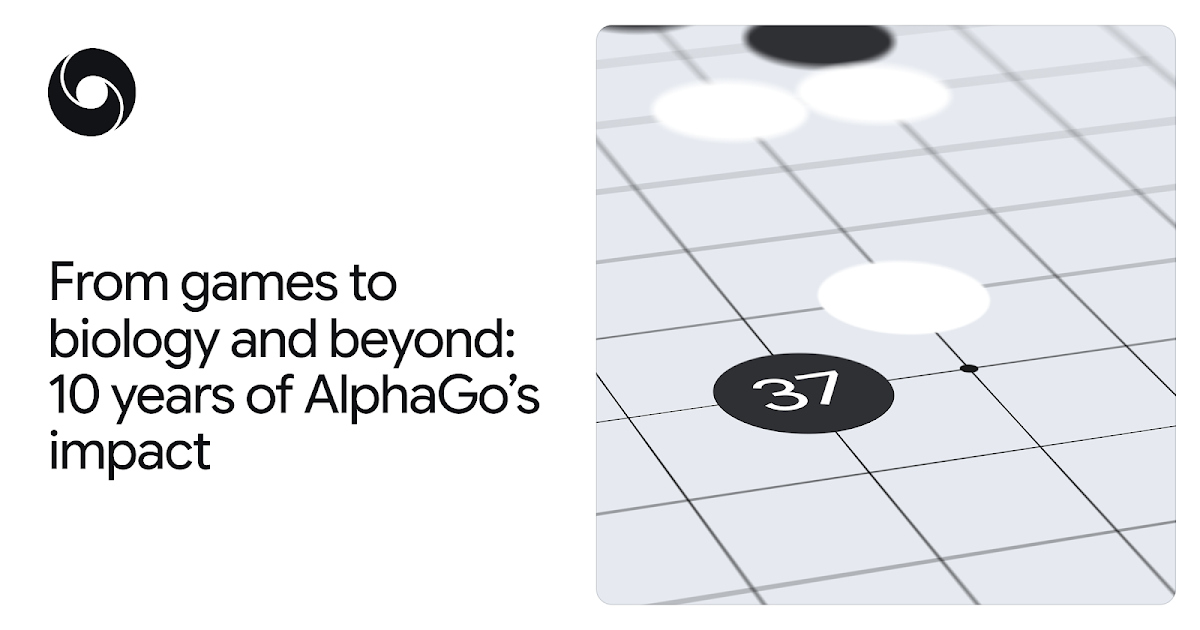
Algorithm discovery: Just as AlphaGo searched for the best move in a game, our coding agent AlphaEvolve explores the space of computer code to discover more efficient algorithms. It had its own Move 37 moment when it found a novel way to multiply matrices, a fundamental mathematical operation powering nearly all modern neural networks. AlphaEvolve is now being tested on problems ranging from data center optimization to quantum computing.
Scientific collaboration: We are integrating the search and reasoning principles pioneered with AlphaGo into an AI co-scientist. By having agents ‘debate’ scientific ideas and hypotheses, this system acts as a collaborator capable of performing the rigorous thinking necessary to identify patterns in data and solve sophisticated problems. In validation studies at Imperial College London, it analyzed decades of literature and independently arrived at the same hypothesis about antimicrobial resistance that researchers had spent years developing and validating experimentally.
We’ve also used AI to better understand the genome, advance fusion energy research, improve weather prediction and more.
As impressive as our scientific models are, they are highly specialized. To achieve fundamental breakthroughs like creating limitless clean energy or solving diseases that we don’t understand today, we need general AI systems that can find underlying structure and connections between different subject areas, and help us to come up with new hypotheses like the best scientists do.
Future of intelligence
For an AI to be truly general, it needs to understand the physical world. We built Gemini to be multimodal from the beginning so it could understand not just language, but also audio, video, images and code to build a model of the world.
To think and reason across these modalities, the latest Gemini models use some of the techniques we pioneered with AlphaGo and AlphaZero.
The next generation of AI systems will also need to be able to call upon specialized tools. For example, if a model needed to know the structure of a protein it could use AlphaFold for that.
We think the combination of Gemini’s world models, AlphaGo’s search and planning techniques, and specialized AI tool use will prove to be critical for AGI.
True creativity is a key capability that such an AGI system would need to exhibit. Move 37 was a glimpse of AI’s potential to think outside the box, but true original invention will require something more. It would need to not only come up with a novel Go strategy, as AlphaGo impressively did, but actually invent a game as deep and elegant, and as worthy of study as Go.
Ten years after AlphaGo’s legendary victory, our ultimate goal is on the horizon. The creative spark first seen in Move 37 catalyzed breakthroughs that are now converging to pave the path towards AGI – and usher in a new golden age of scientific discovery.