Stay Ahead, Stay ONMINE

Heads in the game

The Argentina v. France final of the 2022 Men’s World Cup in Qatar was shaping up to be one of the most epic games in soccer history. With just 12 minutes remaining in the extra time added to the game to break a tie, the referee had a critical decision to make—and fast. Lionel Messi, the Argentine captain and soccer legend, had just launched the ball past the French goal line, giving Argentina a 3–2 lead. The crowd roared, but a flag was raised. One ref thought that shortly before Messi kicked the ball, the Argentine forward Lautaro Martinez had been closer to the goal than any French players apart from the goalie when he’d received a pass—putting him in an illegal “offside” position.  If the head referee called Martinez offside, the goal wouldn’t count. If he declared him onside, Argentina would keep its 3–2 lead with minutes left to play.  The weight of more than just one offside call stood on that referee’s shoulders; it was the weight of the World Cup itself.  But in 2022, for the first time in the storied competition’s history, referees had access to semi-automated offside technology (SAOT), a system that could rapidly analyze the play and detect an offside player. In this case, it produced an image revealing that a French defender was slightly closer to the goal than Martinez, just barely leaving the Argentine forward in a legal attacking position.  The referee ruled that the goal counted: 3–2, Argentina. SAOT produced this image to determine whether Argentine forward Lautaro Martinez (in white) was offside. It shows that only Martinez’s fingers had crossed the vertical white line into offside territory. Players’ hands and arms are not considered for offside decisions, so Martinez was declared onside.COURTESY OF THE RESEARCHERS Argentina eventually emerged as the champion, winning a penalty shootout after a late goal by French forward Kylian Mbappé tied the game at 3–3. Only in a parallel universe will we know how the game—and the tournament—would have played out if the referee had overturned Messi’s goal. For FIFA, soccer’s international governing body, SAOT is among the latest in a portfolio of innovations used at the World Cup. From goal line technology to video assistant referee (VAR) tools, officiating tech is now commonplace at the top level of the game. But SAOT is part of a broader sports technology landscape that stretches far beyond soccer. And one of the major players in that landscape is the very team that collaborated with FIFA to bring SAOT to the pitch in the first place: the MIT Sports Lab. Founded in 2015, the lab focuses on using technology and data science to tackle real problems facing athletes, teams, and sports organizations and brands.  The lab has worked with FIFA, the NBA, the NFL, and Adidas, and it collaborates with a host of other sports organizations and industry players. Some of its work may be hiding in the soles of your running shoes, in the decisions your favorite NBA team makes, or even on soccer’s biggest stage—as was the case in what the AP called “probably the wildest final in the tournament’s 92-year history.” The MIT Sports Lab’s origin story begins around 2010, when Anette “Peko” Hosoi, the Pappalardo Professor of Mechanical Engineering, fell in love with downhill mountain biking and needed a new bike. But given the varying linkage systems, shock types, and geometries, she found it difficult to choose the best one. Encountering only minimal information online, she assigned the analysis to her 2.001 class, the introductory course on mechanics. “All of my exams that semester were bike questions,” she says. They proved to be really good engineering questions too.  Having recently earned tenure, she wondered, What if I actually built this sports thing into something bigger? In 2011, she began conceptualizing a project called STE@M (Sports Technology and Education at MIT), which would assemble students, faculty, athletes, and industry partners to tackle sports engineering challenges. As the effort kicked into gear over the next few years, Hosoi began collaborating with Christina Chase, MIT’s new entrepreneur in residence, and in 2015 the two of them cofounded the MIT Sports Lab.  Mechanical engineering professor Anette “Peko” Hosoi assigned bike engineering challenges to her students when she needed a better mountain bike. In 2015, she cofounded the MIT Sports Lab with entrepreneur and MechE lecturer Christina Chase.COURTESY OF MIT MECHANICAL ENGINEERING “It turned out that we’re the perfect combination for this because my background comes from the math, physics, engineering side,” says Hosoi. “And she comes from the entrepreneurship [and] product development side. To really interface with these different sports companies and leagues, you need to span that whole spectrum.” Chase became the lab’s managing director and Hosoi its faculty director. For over a decade, the Sports Lab has grown as interest in sports tech has skyrocketed—and it’s accumulated what younger fans would call some elite ball knowledge in the process.  This depth is exactly what its partners need.  “There’s more and more data that’s getting collected,” says Hosoi. “A lot of the teams, leagues, brands don’t necessarily have the in-house manpower to extract the information they need. So that’s where we can give them a boost.” When MIT researchers looked at early skeletal data representing soccer players in motion, they saw “skeletons” flying above the ground or completely underground, in anatomically impossible positions. The FIFA partnership has been especially fruitful—and the Sports Lab’s role in validating SAOT has probably had more impact than any other project the organizations have worked on together, says Ferran Vidal-Codina, SM ’13, PhD ’17, a former research scientist at the lab who was part of the team from FIFA, MIT, and third-party data providers that developed the technology.  The system’s viability depended on the ability to quickly access and analyze what’s known as tracking data—the record of everywhere the players and the ball move throughout a game.   To collect that information at top-level FIFA tournaments, data providers station about 12 state-of-the-art cameras around the stadium, capturing images at double or more the speed of normal broadcasting cameras. Computer vision algorithms then convert the feeds into what’s called skeletal data—3D representations of the players in motion.  “It’s a ton of data—22 players, one referee, two assistant referees, [each with] 29 joints with XYZ coordinates, 50 times per second,” says Henry Wang ’23, a former MIT varsity swimmer who earned undergrad degrees in both business analytics and computer science, economics, and data science and is now a Sloan PhD candidate and a FIFA research consultant at the MIT Sports Lab.  Lionel Messi scores Argentina’s third goal past Hugo Lloris of France during the final of the 2022 FIFA World Cup in Qatar. Argentina prevailed over France in the match.MATTHIAS HANGST/GETTY IMAGES That works out to some 108,900 data points per second for a game that lasts at least 90 minutes. And that’s just the players and referees—a chip embedded in the ball also collects position and velocity data 500 times per second. In total, that’s easily more than a dozen gigabytes of skeletal data and ball-tracking data per game. FIFA was thrilled to have that much data to work with. But around 2021, when third-party providers started offering skeletal data, the organization did not have the full range of technical skills needed to validate it. “So the data got sent to us,” says Wang. Right away, the team at the Sports Lab saw some issues. “We saw ‘skeletons’ flying above the ground or completely underground, in anatomically impossible positions,” Vidal-Codina recalls. “We saw skeletons having their bones and limbs stretching from 30 centimeters to a few meters. We saw balls doing weird motions in the air. All sorts of stuff that when you look at it—yeah, that’s definitely not ready to be used.” Often, when there’s a new idea in the works, “we’re the ones that take the first stab at it,” says Sports Lab researcher and PhD student Henry Wang ’23. “We are the ones that prototype and show it’s possible.” The lab’s job in tackling this problem was first to validate the data being fed into the system and then to confirm that the SAOT algorithm itself was performing exactly as the third-party vendors claimed it would.  In 2021 and 2022, FIFA ran a multitude of tests. Renting out a stadium for days at a time, the organization brought the data providers on site, where amateur players, or sometimes even FIFA staff, would run dozens of offside drills while those vendors collected live data. The lab focused on analyzing that data and relaying the results to FIFA and its providers, which incentivized them to make improvements while casting light on blind spots they sometimes did not know they had, Vidal-Codina says. The lab was able, for example, to analyze how the call might differ if you focused on a player’s whole body, including arms and legs, or just the center of mass. Before the technology could officially hit the pitch, the Sports Lab had to answer some key questions. First, could FIFA collect live data from the providers fast enough to make game-time assessments feasible? The researchers helped answer this by building a tool in Google Cloud to collect data as it was generated so the lab could later check the latency, allowing FIFA to understand just how “live” its data really was.  Also important: determining whether two data sets—the skeletal data and the information captured by what’s known as connected ball technology—could be combined to reliably yield a correct offside call. The lab helped do just that, developing a protocol that synched the systems collecting skeletal and connected ball data.  After validating SAOT, tweaking it, and testing it in many situations, including some official FIFA matches in 2021 and 2022, “FIFA felt it could be used at the biggest stage, which was the World Cup,” says Vidal-Codina. Indeed, FIFA president Gianni Infantino endorsed the tool himself when it debuted in Qatar. Over the course of the 64-game tournament, SAOT assisted in more than 150 offside calls, some with weighty effects. Eight goals were overturned after a referee declared the scoring team offside; two goals were added to the scoreboard after a referee had incorrectly disallowed a goal that was not, in fact, offside; and in sevencases, an offside call assisted by SAOT changed the game’s outcome.  These results highlight just how crucial a single offside decision can be, given the low scores typical in soccer—and how tools like SAOT can help improve the game. “Overall, decisions have been made quicker and better. That’s ultimately what we strive for,” Vidal-Codina says.  The technology also takes some of the pressure off referees. “I would argue that the goal of our work is to make sure that the referee is as informed as possible about the decisions that they make,” says Wang. “It’s an incredibly difficult job.” During World Cup play, SAOT’s animated visuals were shown on stadium screens and available to as many as 5 billion viewers across platforms to help them understand the referees’ calls.   But the technology is meant to assist referees, not replace them. “We don’t want people to think that we are automating referees. I can guarantee you the referee is not going anywhere,” Wang says. “We want to make sure that the human element is transparent, that it’s informed, and that we are helping referees do their job.” SAOT may have been the Sports Lab’s highest-profile FIFA project to date, but the lab has had a hand in shaping the organization’s larger innovation pipeline. It’s helped improve the way technology—from hardware like cameras to officiating tools like SAOT—gets tested and certified on its way to the pitch. Since 2021, FIFA’s process for certifying data providers’ systems has included having the Sports Lab assess their data latency from a live data collection event using the same infrastructure it built to validate SAOT. And often, when there’s a new idea in the works, “we’re the ones that take the first stab at it,” says Wang. “We are the ones that prototype and show it’s possible. It’s a call to the industry to say: ‘Hey, this is interesting.’” FIFA isn’t the only organization interested in the insights that tracking data can offer; the NBA has been collecting it for over a decade. In 2025, Hosoi and the MIT Sports Lab published a paper based on an NBA-MIT collaboration that had a unique focus: Instead of using the tracking data to analyze the game’s physical elements, they sought to understand the mental ones. “Currently, everything physical about an athlete gets measured,” Hosoi says. “But if you talk to the organizations, they tell you that the mental part of the game is just as important. And we have no tools for measuring the mental part. So the question is, can we use the physical tracking data to extract metrics for mental performance?”  In basketball, a big part of the mental game comes down to decisions around when to shoot and when to pass. But it’s not so easy to determine which players are making good or bad decisions. So MIT researchers created a metric called expected action value (EAV), which is essentially an assessment of the likelihood of a play’s success. Using a model trained on all 786,208 passes from the 2018–’19 NBA season and all 1.4 million shots from 2013 to 2019, they were able to figure out expected outcomes of different plays.  EAV takes into account the velocity of the shot and the acceleration of the player making the shot as well as the positions of players on the court. For instance, an uncontested three-point shot from the corner has a higher EAV than a two-point attempt from a player getting double-­teamed closer to the basket (or “in the paint”). This approach can tell you not only the likelihood of a successful shot but also the chances of a successful pass. If the player decides to pass instead of shoot, and the receiver of the pass has a reasonable chance to make the shot, then that was a good decision by the passer. A consistent record of high-EAV choices—passing at some times, shooting at others—means a player is making good decisions. “You can just calculate: How many times do players make good decisions? How many times do they make bad decisions? And we can rank NBA players by good decision-makers and bad decision-makers,” says Hosoi. This approach can also help teams see if points are being left on the table. Given that teams averaged about 110 points per 100 possessions in the 2019 NBA season, or 1.1 points per possession, if a player passes up a play option with an EAV of more than 1.25 for a play with a lower EAV, the Sports Lab’s model classifies it as a “missed opportunity.” Flagging these moments saves time for coaches, who have to review video for at least 82 games every season. “If we can point to the time stamps of the different games where your guys might have missed an opportunity, you can take advantage of that, right?” Hosoi says. At this point, the MIT Sports Lab doesn’t really need to advertise its services. “If you are good in sports, everybody who needs to know will know,” says Hosoi. The lab’s partners come to it if they need answers to questions—as the NFL did during the covid crisis.  At the beginning of the 2020 season, some teams had opened their stadiums for limited in-person attendance while others didn’t allow any fans. In March 2021, “there was a paper that was published that said in the cities where NFL stadiums have opened, there are spikes in covid cases,” Hosoi recalls. “And the NFL called us and said, ‘Wait, is this true? Because if this is true, we’re going to stop. Can you guys do an analysis on this?’”  After investigating, the Sports Lab identified a problem with the original paper. NFL teams made decisions about opening stadiums in conjunction with stadium owners and local governments. What the paper didn’t consider, however, was that some states had stricter covid protocols than others, and it was stadiums in those places that tended to stay closed to fans.  The lab accounted for the confounding factors involved and found that opening a stadium with distancing and masking protocols had no effect on covid cases. In fact, the analysis found that in some places, in-person attendance was correlated with case totals that were lower than expected. Hosoi hypothesizes that this was not only because the open stadiums required distanced seating and other safety measures but also because if fans were at the stadium, they were usually outdoors—not mingling in a crowded bar or at a friend’s house. Partly on the strength of these findings, the NFL decided to open all stadiums for in-person attendance in the 2021 season. The Sports Lab’s expertise isn’t limited to data analytics; companies are also welcome to bring their hardware and product quandaries to the lab. Adidas, for example, had announced development of a 3D-printed midsole for running shoes in 2015 and was eager to bring it to market. It partnered with Carbon, a Silicon Valley company specializing in the technology, and by around 2017 the shoe manufacturer had finally figured out a way to produce 3D-printed midsoles at a speed that could match the commercial scale. Still, it wasn’t quite sure how to use this innovation. Adidas approached the Sports Lab with one big question, which  Sarah Fay ’15, SM ’18, PhD ’21, summarizes as “We know we can do all this cool stuff, but what should we do in order to make a high-performing shoe?” “A regular running shoe just has a slab of foam in the bottom,” explains Fay, who tackled this project while earning her PhD. “You can only change the stiffness by changing the thickness. The exciting thing about 3D printing is that you can change the stiffness without having to change the shape, the footprint of the midsole—just by changing the lattice architecture.” But manufacturing a high-performing shoe would be tricky: No two human runners are the same, and there was not much data from the running world at the time. So Fay turned to mechanical models—in particular, the mass-spring-damper model for analyzing a system’s dynamic behavior, which Thomas McMahon, a biomechanics pioneer at Harvard, had used to assess different running surfaces in the 1970s. “Just a simple model can be super powerful,” Fay says. Fay iterated on this foundation to build a model with a center of mass, a rotating hip, and a leg that stretches. It could predict how runners of a given height, weight, and leg length would adjust their gait in response to different levels of springiness and shock absorption in a simple test shoe. This let Fay and Hosoi test gait response as they varied the stiffness of various parts of the midsole.  Sarah Fay ’15, SM ’18, PhD ’21, holds a 3D-printed midsole for a running shoe. Working with Peko Hosoi in the Sports Lab, she developed a model that makes it possible to predict how different midsoles would affect a particular runner’s gait.MELANIE GONICK/MIT To ensure the accuracy of the model, they also considered that runners typically (and often unconsciously) try to minimize what they called a “biological cost function” of running, such as the impact they feel when their foot hits the ground, or the jerkiness of their gait. In multiple simulations, they optimized their model for various biological cost functions, and they compared the resulting gaits with actual gaits recorded in a previous treadmill study. Upon finding that most runners try to minimize both the impact of their feet and the amount of energy their legs expend, Fay and Hosoi were able to optimize the model for those two factors to deliver highly accurate gait projections. And the ability to predict the gait made it possible to predict how well a shoe would perform.  Adidas used the model to help evaluate potential lattice-structured midsole designs, selecting the top performer for fabrication to do more formal testing. “Those are the shoes that Adidas ended up making and selling that I wear basically every day,” Fay says. She imagines that one day it could be possible to analyze running videos, determine the best shoe architectures for specific runners, and 3D-print shoes designed just for them. Fay was able to fill in the mathematics and engineering expertise that the Adidas team was missing. And by giving her a way to couple her technical skills with her experience as a lifelong athlete who played both field hockey and squash at MIT, the Sports Lab may have helped her find her calling. Today, she runs a sports-related research lab of her own at Smith College, where she’s an assistant professor of engineering studying the biomechanics of soccer cleats and their role in players’ risk of knee injury.  “The big part of sports for me is just that it was a safe space for me to learn how to be a leader, how to be a person, how to be a teammate,” she says. “And I figured that that’s a valid enough reason to make my career path head in that direction.” What Vidal-Codina calls the “most magical feature” of the lab is that it meets its partners in the sports industry where they are. As he puts it, its scientists can say, “Okay, what do you need help with? We may have the skills or the methodology to come to a solution. So let’s sit together and try and figure it out.” “The best thing about the Sports Lab is the community of people we’ve built—a direct connecting line from the industries and the teams to our students and to our faculty.” Anette “Peko” Hosoi, Pappalardo Professor of Mechanical Engineering, MIT But its work benefits the MIT community as much as it does the world of pro sports. The Sports Lab hosts an annual MIT Sports Summit, which brings technical and management professionals in sports to campus to help students, faculty, and industry figures make personal connections and share their work. Hosoi and Chase also teach 2.98 (Sports Technology: Engineering & Innovation), a class that involves MIT students in real industry projects. And the lab brings pro-level sports insights to MIT athletes, partnering with the athletics department on projects like analyzing the NCAA Power Index—the metric used to select and seed teams for the Division III national tournament—with an eye toward helping MIT teams maximize their chances of securing spots. Another project involves collecting athletes’ personalized weight-room stats into a dashboard to give coaches a window into their performance and enhance their recovery. The lab also worked with an MIT soccer player to create a tool that automatically tracks the passing sequences leading to goals, shedding light on which players contributed. It’s now widely used by the Institute’s soccer teams. “The best thing about the Sports Lab is the community of people we’ve built—a direct connecting line from the industries and the teams to our students and to our faculty,” Hosoi says. “That collaboration is better than the sum of the parts.”  While the lab’s work may take place behind the scenes, its influence will continue to ripple across the world of sports—from the soccer games on our televisions during this year’s World Cup to the shoes on our feet. And the lab will do it by asking the most important question of all: “How can we help?” 




The Argentina v. France final of the 2022 Men’s World Cup in Qatar was shaping up to be one of the most epic games in soccer history. With just 12 minutes remaining in the extra time added to the game to break a tie, the referee had a critical decision to make—and fast.

Lionel Messi, the Argentine captain and soccer legend, had just launched the ball past the French goal line, giving Argentina a 3–2 lead. The crowd roared, but a flag was raised. One ref thought that shortly before Messi kicked the ball, the Argentine forward Lautaro Martinez had been closer to the goal than any French players apart from the goalie when he’d received a pass—putting him in an illegal “offside” position. 

If the head referee called Martinez offside, the goal wouldn’t count. If he declared him onside, Argentina would keep its 3–2 lead with minutes left to play. 

The weight of more than just one offside call stood on that referee’s shoulders; it was the weight of the World Cup itself. 

But in 2022, for the first time in the storied competition’s history, referees had access to semi-automated offside technology (SAOT), a system that could rapidly analyze the play and detect an offside player. In this case, it produced an image revealing that a French defender was slightly closer to the goal than Martinez, just barely leaving the Argentine forward in a legal attacking position. 

The referee ruled that the goal counted: 3–2, Argentina.

SAOT produced this image to determine whether Argentine forward Lautaro Martinez (in white) was offside. It shows that only Martinez’s fingers had crossed the vertical white line into offside territory. Players’ hands and arms are not considered for offside decisions, so Martinez was declared onside.
COURTESY OF THE RESEARCHERS

Argentina eventually emerged as the champion, winning a penalty shootout after a late goal by French forward Kylian Mbappé tied the game at 3–3. Only in a parallel universe will we know how the game—and the tournament—would have played out if the referee had overturned Messi’s goal.

For FIFA, soccer’s international governing body, SAOT is among the latest in a portfolio of innovations used at the World Cup. From goal line technology to video assistant referee (VAR) tools, officiating tech is now commonplace at the top level of the game.

But SAOT is part of a broader sports technology landscape that stretches far beyond soccer. And one of the major players in that landscape is the very team that collaborated with FIFA to bring SAOT to the pitch in the first place: the MIT Sports Lab. Founded in 2015, the lab focuses on using technology and data science to tackle real problems facing athletes, teams, and sports organizations and brands. 

The lab has worked with FIFA, the NBA, the NFL, and Adidas, and it collaborates with a host of other sports organizations and industry players. Some of its work may be hiding in the soles of your running shoes, in the decisions your favorite NBA team makes, or even on soccer’s biggest stage—as was the case in what the AP called “probably the wildest final in the tournament’s 92-year history.”


The MIT Sports Lab’s origin story begins around 2010, when Anette “Peko” Hosoi, the Pappalardo Professor of Mechanical Engineering, fell in love with downhill mountain biking and needed a new bike. But given the varying linkage systems, shock types, and geometries, she found it difficult to choose the best one. Encountering only minimal information online, she assigned the analysis to her 2.001 class, the introductory course on mechanics. “All of my exams that semester were bike questions,” she says. They proved to be really good engineering questions too. 

Having recently earned tenure, she wondered, What if I actually built this sports thing into something bigger? In 2011, she began conceptualizing a project called STE@M (Sports Technology and Education at MIT), which would assemble students, faculty, athletes, and industry partners to tackle sports engineering challenges. As the effort kicked into gear over the next few years, Hosoi began collaborating with Christina Chase, MIT’s new entrepreneur in residence, and in 2015 the two of them cofounded the MIT Sports Lab. 

Anette Peko Hosoi holding the 2026 FIFA World Cup ball, Trionda.
Mechanical engineering professor Anette “Peko” Hosoi assigned bike engineering challenges to her students when she needed a better mountain bike. In 2015, she cofounded the MIT Sports Lab with entrepreneur and MechE lecturer Christina Chase.
COURTESY OF MIT MECHANICAL ENGINEERING

“It turned out that we’re the perfect combination for this because my background comes from the math, physics, engineering side,” says Hosoi. “And she comes from the entrepreneurship [and] product development side. To really interface with these different sports companies and leagues, you need to span that whole spectrum.” Chase became the lab’s managing director and Hosoi its faculty director.

For over a decade, the Sports Lab has grown as interest in sports tech has skyrocketed—and it’s accumulated what younger fans would call some elite ball knowledge in the process. 

This depth is exactly what its partners need. 

“There’s more and more data that’s getting collected,” says Hosoi. “A lot of the teams, leagues, brands don’t necessarily have the in-house manpower to extract the information they need. So that’s where we can give them a boost.”

When MIT researchers looked at early skeletal data representing soccer players in motion, they saw “skeletons” flying above the ground or completely underground, in anatomically impossible positions.

The FIFA partnership has been especially fruitful—and the Sports Lab’s role in validating SAOT has probably had more impact than any other project the organizations have worked on together, says Ferran Vidal-Codina, SM ’13, PhD ’17, a former research scientist at the lab who was part of the team from FIFA, MIT, and third-party data providers that developed the technology. 

The system’s viability depended on the ability to quickly access and analyze what’s known as tracking data—the record of everywhere the players and the ball move throughout a game.  

To collect that information at top-level FIFA tournaments, data providers station about 12 state-of-the-art cameras around the stadium, capturing images at double or more the speed of normal broadcasting cameras. Computer vision algorithms then convert the feeds into what’s called skeletal data—3D representations of the players in motion. 

“It’s a ton of data—22 players, one referee, two assistant referees, [each with] 29 joints with XYZ coordinates, 50 times per second,” says Henry Wang ’23, a former MIT varsity swimmer who earned undergrad degrees in both business analytics and computer science, economics, and data science and is now a Sloan PhD candidate and a FIFA research consultant at the MIT Sports Lab. 

overhead view of Messi and Lloris at the French goal
Lionel Messi scores Argentina’s third goal past Hugo Lloris of France during the final of the 2022 FIFA World Cup in Qatar. Argentina prevailed over France in the match.
MATTHIAS HANGST/GETTY IMAGES

That works out to some 108,900 data points per second for a game that lasts at least 90 minutes. And that’s just the players and referees—a chip embedded in the ball also collects position and velocity data 500 times per second. In total, that’s easily more than a dozen gigabytes of skeletal data and ball-tracking data per game.

FIFA was thrilled to have that much data to work with. But around 2021, when third-party providers started offering skeletal data, the organization did not have the full range of technical skills needed to validate it. “So the data got sent to us,” says Wang.

Right away, the team at the Sports Lab saw some issues. “We saw ‘skeletons’ flying above the ground or completely underground, in anatomically impossible positions,” Vidal-Codina recalls. “We saw skeletons having their bones and limbs stretching from 30 centimeters to a few meters. We saw balls doing weird motions in the air. All sorts of stuff that when you look at it—yeah, that’s definitely not ready to be used.”

Often, when there’s a new idea in the works, “we’re the ones that take the first stab at it,” says Sports Lab researcher and PhD student Henry Wang ’23. “We are the ones that prototype and show it’s possible.”

The lab’s job in tackling this problem was first to validate the data being fed into the system and then to confirm that the SAOT algorithm itself was performing exactly as the third-party vendors claimed it would. 

In 2021 and 2022, FIFA ran a multitude of tests. Renting out a stadium for days at a time, the organization brought the data providers on site, where amateur players, or sometimes even FIFA staff, would run dozens of offside drills while those vendors collected live data.

The lab focused on analyzing that data and relaying the results to FIFA and its providers, which incentivized them to make improvements while casting light on blind spots they sometimes did not know they had, Vidal-Codina says. The lab was able, for example, to analyze how the call might differ if you focused on a player’s whole body, including arms and legs, or just the center of mass.

Before the technology could officially hit the pitch, the Sports Lab had to answer some key questions. First, could FIFA collect live data from the providers fast enough to make game-time assessments feasible? The researchers helped answer this by building a tool in Google Cloud to collect data as it was generated so the lab could later check the latency, allowing FIFA to understand just how “live” its data really was. 

Also important: determining whether two data sets—the skeletal data and the information captured by what’s known as connected ball technology—could be combined to reliably yield a correct offside call. The lab helped do just that, developing a protocol that synched the systems collecting skeletal and connected ball data. 

After validating SAOT, tweaking it, and testing it in many situations, including some official FIFA matches in 2021 and 2022, “FIFA felt it could be used at the biggest stage, which was the World Cup,” says Vidal-Codina. Indeed, FIFA president Gianni Infantino endorsed the tool himself when it debuted in Qatar.

Over the course of the 64-game tournament, SAOT assisted in more than 150 offside calls, some with weighty effects. Eight goals were overturned after a referee declared the scoring team offside; two goals were added to the scoreboard after a referee had incorrectly disallowed a goal that was not, in fact, offside; and in sevencases, an offside call assisted by SAOT changed the game’s outcome. 

These results highlight just how crucial a single offside decision can be, given the low scores typical in soccer—and how tools like SAOT can help improve the game. “Overall, decisions have been made quicker and better. That’s ultimately what we strive for,” Vidal-Codina says. 

The technology also takes some of the pressure off referees. “I would argue that the goal of our work is to make sure that the referee is as informed as possible about the decisions that they make,” says Wang. “It’s an incredibly difficult job.” During World Cup play, SAOT’s animated visuals were shown on stadium screens and available to as many as 5 billion viewers across platforms to help them understand the referees’ calls.  

But the technology is meant to assist referees, not replace them. “We don’t want people to think that we are automating referees. I can guarantee you the referee is not going anywhere,” Wang says. “We want to make sure that the human element is transparent, that it’s informed, and that we are helping referees do their job.”

SAOT may have been the Sports Lab’s highest-profile FIFA project to date, but the lab has had a hand in shaping the organization’s larger innovation pipeline. It’s helped improve the way technology—from hardware like cameras to officiating tools like SAOT—gets tested and certified on its way to the pitch. Since 2021, FIFA’s process for certifying data providers’ systems has included having the Sports Lab assess their data latency from a live data collection event using the same infrastructure it built to validate SAOT. And often, when there’s a new idea in the works, “we’re the ones that take the first stab at it,” says Wang. “We are the ones that prototype and show it’s possible. It’s a call to the industry to say: ‘Hey, this is interesting.’”

FIFA isn’t the only organization interested in the insights that tracking data can offer; the NBA has been collecting it for over a decade. In 2025, Hosoi and the MIT Sports Lab published a paper based on an NBA-MIT collaboration that had a unique focus: Instead of using the tracking data to analyze the game’s physical elements, they sought to understand the mental ones.

“Currently, everything physical about an athlete gets measured,” Hosoi says. “But if you talk to the organizations, they tell you that the mental part of the game is just as important. And we have no tools for measuring the mental part. So the question is, can we use the physical tracking data to extract metrics for mental performance?” 

In basketball, a big part of the mental game comes down to decisions around when to shoot and when to pass. But it’s not so easy to determine which players are making good or bad decisions. So MIT researchers created a metric called expected action value (EAV), which is essentially an assessment of the likelihood of a play’s success. Using a model trained on all 786,208 passes from the 2018–’19 NBA season and all 1.4 million shots from 2013 to 2019, they were able to figure out expected outcomes of different plays. 

EAV takes into account the velocity of the shot and the acceleration of the player making the shot as well as the positions of players on the court. For instance, an uncontested three-point shot from the corner has a higher EAV than a two-point attempt from a player getting double-­teamed closer to the basket (or “in the paint”). This approach can tell you not only the likelihood of a successful shot but also the chances of a successful pass. If the player decides to pass instead of shoot, and the receiver of the pass has a reasonable chance to make the shot, then that was a good decision by the passer.

A consistent record of high-EAV choices—passing at some times, shooting at others—means a player is making good decisions. “You can just calculate: How many times do players make good decisions? How many times do they make bad decisions? And we can rank NBA players by good decision-makers and bad decision-makers,” says Hosoi.

This approach can also help teams see if points are being left on the table. Given that teams averaged about 110 points per 100 possessions in the 2019 NBA season, or 1.1 points per possession, if a player passes up a play option with an EAV of more than 1.25 for a play with a lower EAV, the Sports Lab’s model classifies it as a “missed opportunity.” Flagging these moments saves time for coaches, who have to review video for at least 82 games every season. “If we can point to the time stamps of the different games where your guys might have missed an opportunity, you can take advantage of that, right?” Hosoi says.


At this point, the MIT Sports Lab doesn’t really need to advertise its services. “If you are good in sports, everybody who needs to know will know,” says Hosoi. The lab’s partners come to it if they need answers to questions—as the NFL did during the covid crisis. 

At the beginning of the 2020 season, some teams had opened their stadiums for limited in-person attendance while others didn’t allow any fans. In March 2021, “there was a paper that was published that said in the cities where NFL stadiums have opened, there are spikes in covid cases,” Hosoi recalls. “And the NFL called us and said, ‘Wait, is this true? Because if this is true, we’re going to stop. Can you guys do an analysis on this?’” 

After investigating, the Sports Lab identified a problem with the original paper. NFL teams made decisions about opening stadiums in conjunction with stadium owners and local governments. What the paper didn’t consider, however, was that some states had stricter covid protocols than others, and it was stadiums in those places that tended to stay closed to fans. 

The lab accounted for the confounding factors involved and found that opening a stadium with distancing and masking protocols had no effect on covid cases. In fact, the analysis found that in some places, in-person attendance was correlated with case totals that were lower than expected. Hosoi hypothesizes that this was not only because the open stadiums required distanced seating and other safety measures but also because if fans were at the stadium, they were usually outdoors—not mingling in a crowded bar or at a friend’s house. Partly on the strength of these findings, the NFL decided to open all stadiums for in-person attendance in the 2021 season.

The Sports Lab’s expertise isn’t limited to data analytics; companies are also welcome to bring their hardware and product quandaries to the lab. Adidas, for example, had announced development of a 3D-printed midsole for running shoes in 2015 and was eager to bring it to market. It partnered with Carbon, a Silicon Valley company specializing in the technology, and by around 2017 the shoe manufacturer had finally figured out a way to produce 3D-printed midsoles at a speed that could match the commercial scale.

Still, it wasn’t quite sure how to use this innovation. Adidas approached the Sports Lab with one big question, which  Sarah Fay ’15, SM ’18, PhD ’21, summarizes as “We know we can do all this cool stuff, but what should we do in order to make a high-performing shoe?”

“A regular running shoe just has a slab of foam in the bottom,” explains Fay, who tackled this project while earning her PhD. “You can only change the stiffness by changing the thickness. The exciting thing about 3D printing is that you can change the stiffness without having to change the shape, the footprint of the midsole—just by changing the lattice architecture.”

But manufacturing a high-performing shoe would be tricky: No two human runners are the same, and there was not much data from the running world at the time. So Fay turned to mechanical models—in particular, the mass-spring-damper model for analyzing a system’s dynamic behavior, which Thomas McMahon, a biomechanics pioneer at Harvard, had used to assess different running surfaces in the 1970s. “Just a simple model can be super powerful,” Fay says.

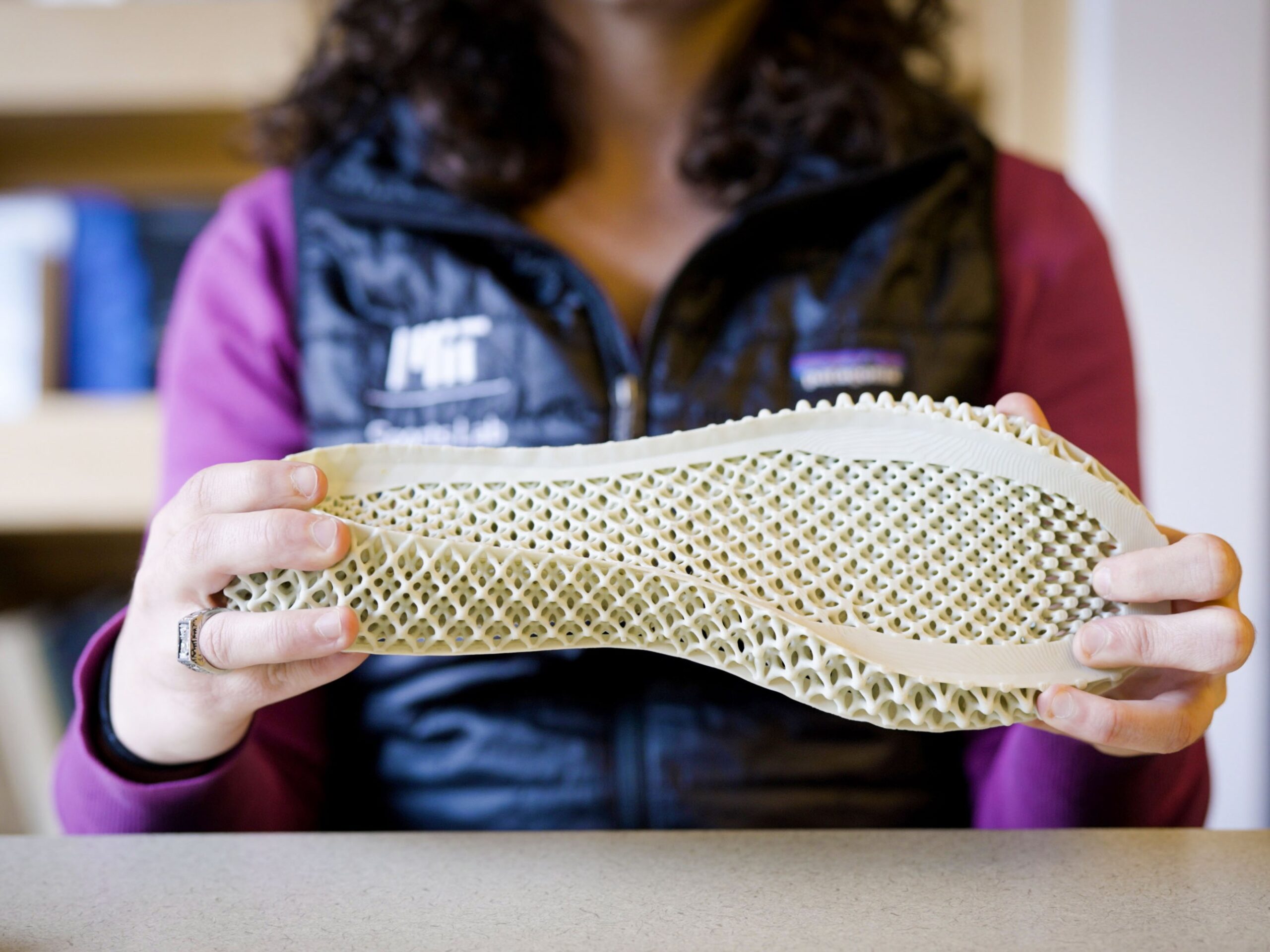
Fay iterated on this foundation to build a model with a center of mass, a rotating hip, and a leg that stretches. It could predict how runners of a given height, weight, and leg length would adjust their gait in response to different levels of springiness and shock absorption in a simple test shoe. This let Fay and Hosoi test gait response as they varied the stiffness of various parts of the midsole. 

person holding a shoe sole
Sarah Fay ’15, SM ’18, PhD ’21, holds a 3D-printed midsole for a running shoe. Working with Peko Hosoi in the Sports Lab, she developed a model that makes it possible to predict how different midsoles would affect a particular runner’s gait.
MELANIE GONICK/MIT

To ensure the accuracy of the model, they also considered that runners typically (and often unconsciously) try to minimize what they called a “biological cost function” of running, such as the impact they feel when their foot hits the ground, or the jerkiness of their gait. In multiple simulations, they optimized their model for various biological cost functions, and they compared the resulting gaits with actual gaits recorded in a previous treadmill study. Upon finding that most runners try to minimize both the impact of their feet and the amount of energy their legs expend, Fay and Hosoi were able to optimize the model for those two factors to deliver highly accurate gait projections. And the ability to predict the gait made it possible to predict how well a shoe would perform. 

Adidas used the model to help evaluate potential lattice-structured midsole designs, selecting the top performer for fabrication to do more formal testing. “Those are the shoes that Adidas ended up making and selling that I wear basically every day,” Fay says. She imagines that one day it could be possible to analyze running videos, determine the best shoe architectures for specific runners, and 3D-print shoes designed just for them.

Fay was able to fill in the mathematics and engineering expertise that the Adidas team was missing. And by giving her a way to couple her technical skills with her experience as a lifelong athlete who played both field hockey and squash at MIT, the Sports Lab may have helped her find her calling. Today, she runs a sports-related research lab of her own at Smith College, where she’s an assistant professor of engineering studying the biomechanics of soccer cleats and their role in players’ risk of knee injury. 

“The big part of sports for me is just that it was a safe space for me to learn how to be a leader, how to be a person, how to be a teammate,” she says. “And I figured that that’s a valid enough reason to make my career path head in that direction.”


What Vidal-Codina calls the “most magical feature” of the lab is that it meets its partners in the sports industry where they are. As he puts it, its scientists can say, “Okay, what do you need help with? We may have the skills or the methodology to come to a solution. So let’s sit together and try and figure it out.”

“The best thing about the Sports Lab is the community of people we’ve built—a direct connecting line from the industries and the teams to our students and to our faculty.”

Anette “Peko” Hosoi, Pappalardo Professor of Mechanical Engineering, MIT

But its work benefits the MIT community as much as it does the world of pro sports. The Sports Lab hosts an annual MIT Sports Summit, which brings technical and management professionals in sports to campus to help students, faculty, and industry figures make personal connections and share their work. Hosoi and Chase also teach 2.98 (Sports Technology: Engineering & Innovation), a class that involves MIT students in real industry projects. And the lab brings pro-level sports insights to MIT athletes, partnering with the athletics department on projects like analyzing the NCAA Power Index—the metric used to select and seed teams for the Division III national tournament—with an eye toward helping MIT teams maximize their chances of securing spots. Another project involves collecting athletes’ personalized weight-room stats into a dashboard to give coaches a window into their performance and enhance their recovery. The lab also worked with an MIT soccer player to create a tool that automatically tracks the passing sequences leading to goals, shedding light on which players contributed. It’s now widely used by the Institute’s soccer teams.

“The best thing about the Sports Lab is the community of people we’ve built—a direct connecting line from the industries and the teams to our students and to our faculty,” Hosoi says. “That collaboration is better than the sum of the parts.” 

While the lab’s work may take place behind the scenes, its influence will continue to ripple across the world of sports—from the soccer games on our televisions during this year’s World Cup to the shoes on our feet.

And the lab will do it by asking the most important question of all: “How can we help?” 

Shape
Shape
Stay Ahead

Explore More Insights

Stay ahead with more perspectives on cutting-edge power, infrastructure, energy,  bitcoin and AI solutions. Explore these articles to uncover strategies and insights shaping the future of industries.

Shape

Department of Energy Announces American Nuclear Supply Chain Loans

WASHINGTON—The U.S. Department of Energy’s (DOE) Office of Energy Dominance Financing (EDF) issued a conditional loan commitment to finance the purchase of long-lead time items needed to rebuild America’s commercial nuclear supply chain. The $17.5 billion American Nuclear Supply Chain Loans will help finance five eligible projects sponsored by utilities and energy companies nationwide to accelerate the deployment of 10 large-scale commercial nuclear reactors across the United States by up to three years. The project marks a major step toward advancing President Trump’s Executive Order, Reinvigorating the Nuclear Industrial Base, by supporting the objective of having 10 new large nuclear reactors with complete designs under construction by 2030. “Just over one year ago, President Trump directed the Energy Department and its agency partners to unleash the next American nuclear renaissance,” U.S. Energy Secretary Chris Wright said. “To accomplish that mission, these conditional loans will play an important role in reviving the supply chain needed for America to once again build large-scale commercial reactors. They will also help accelerate the timeline of building those large-scale reactors by up to three years, lowering construction costs and ensuring the United States is able to deliver on President Trump’s bold and ambitious energy addition agenda.” Westinghouse’s AP1000® units are the only licensed large-scale advanced commercial reactors operating in the United States today. Long-lead items are complex components of a nuclear power plant that require the longest time for manufacturing and delivery.   EDF financing will support up to five loans, each loan supporting two reactors at a project site. Westinghouse will partner with up to five eligible utilities and energy companies nationwide to procure the long-lead items at a fixed price. Each project will be jointly owned by Westinghouse and a utility or energy company partner. Both Westinghouse and the partner are required to

Read More »

FPSO ready for Santos-led Barossa LNG project

BW Offshore completed the Interim Performance Test (IPT) for the BW Opal floating production, storage, and offloading vessel (FPSO) as part of the commissioning program for the Santos Ltd.-operated Barossa LNG project about 285 km offshore from Darwin in the Northern Territory of Australia. The milestone is part of early-stage technical testing and adjustments following  first gas from the FPSO in September and the beginning of flow from subsea wells. BW Offshore confirmed that key production, processing, and utility systems on the FPSO were operating in an integrated manner and capable of delivering stable performance under production conditions. Following the restart of production in early May, BW Opal has continued gas production and export. Production is being managed in close coordination with Santos during this phase of the ramp-up and commissioning program. BW Opal contains a 358-m hull and accommodation for up to 140 personnel. It has gas handling capacity of 850 MMscfd and condensate handling capacity of 11,000 b/d. The FPSO will feed the Darwin LNG plant for the next two decades. The Barossa LNG project consists of the FPSO, a subsea production system, supporting in-field subsea infrastructure, a gas export pipeline, and a Darwin pipeline duplication. Up to eight subsea wells are planned (six wells from three drill centers) with contingency plans for an additional two wells. Gas and condensate is gathered from the wells through the subsea production system and then brought to the FPSO via a network of subsea infrastructure. Santos operates the Barossa LNG project (50%) with joint venture partners PRISM Energy International Australia Pty Ltd. (37.5%) and JERA Australia (12.5%).

Read More »

Equinor mulls additional Johan Sverdrup development phase

Equinor Energy AS is considering further development of the Johan Sverdrup area resources in the North Sea. Production from discoveries in Tonjer west and east and Geitungen would form the basis for the maturation of a potential phase 4 development in the northern part of the field. The volumes would be developed via subsea tieback to existing Johan Sverdrup infrastructure. Tonjer lies in the northernmost part of the Geitungen terrace in the Johan Sverdrup area. Oil was discovered in the area, but volumes and potential have been uncertain. The drilling of two appraisal wells and a sidetrack have provided a more precise assessment of the resource base.  Preliminary estimates for Tonjer and Geitungen combined are 20-30 MMboe. Further analyses of subsurface data will form the basis for more precise resource estimates. Phase 4 is now being matured towards an investment decision with a possible production start-up in 2029. Johan Sverdrup Johan Sverdrup, which accounts for about one third of Norwegian oil production, lies on the Utsira High (Utsirahøyden) in the central part of the North Sea, 65 km northeast of Sleipner field in water depths of 115 m. The main reservoir contains oil in Upper Jurassic intra-Draupne sandstone. The reservoir depth is 1,900 m. The quality of the main reservoir is excellent with very high permeability. The remaining oil resources are in sandstone in the Upper Triassic Statfjord Group and Middle to Upper Jurassic Vestland Group, as well as in spiculites in the Upper Jurassic Viking Group. Oil was also proven in Permian Zechstein carbonates. Equinor is operator of Johan Sverdrup (42.62%) with partners Aker BP (31.57%), Petoro (17.36%), and TotalEnergies (8.44%).

Read More »

Beacon advances deepwater Gulf developments with Monument, Zephyrus field work

Beacon Offshore Energy LLC is advancing two deepwater Gulf of Mexico developments, having drilled the first development well at Monument field and brought a second production well online at Zephyrus field. At Monument in Walker Ridge Block 315, the first development well reached a total depth of 32,250 ft and encountered 245 ft of net pay (true vertical thickness) in Lower Wilcox reservoirs, confirming pre-drill expectations for reservoir quality, the operator said. Beacon will continue drilling a second development well before completing the initial two-well program. First oil from the Wilcox development is expected before yearend 2026. Monument is being developed through a two-well, 17-mile subsea tieback to the Beacon-operated Shenandoah floating production system, which was designed as a regional host platform for developments in the northwestern Walker Ridge area, including Shenandoah, Monument, and Shenandoah South fields. Partners are Navitas Petroleum and Talos Energy Inc. At Zephyrus in Mississippi Canyon Block 759, production from the Zephyrus #2 well began in late April after the well was completed in first-quarter 2026. The well is producing from Miocene sands.  Combined with Zephyrus #1, which started production in late 2025, the field is expected to reach peak production of more than 20,000 boe/d. The Zephyrus development is tied back to the Shell plc-operated West Boreas subsea infrastructure, with production processed on the Olympus tension-leg platform in the Mars corridor. Partners are Houston Energy, HEQ II, Red Willow Offshore, Westlawn Americas Offshore, and Murphy Exploration & Production.

Read More »

Greece approves Chevron’s farm-in for offshore Block 10

Greece approved Chevron Corp.’s farm-in to offshore Block 10, clearing the way for the US major to complete its acquisition of a 70% interest and operatorship from HELLENiQ Energy. Greece’s Ministry of Environment and Energy and the Hellenic Hydrocarbon and Energy Resources Management Co. (HHRE) said June 15 that all administrative approvals have been completed for the transfer of the interest and operatorship. Chevron and HELLENiQ submitted the request for approval May 28. The companies also requested a 15-month extension of the second exploration phase for the block, which lies offshore the Kyparissia Gulf in the southern Ionian Sea. Following completion of the transfer, Chevron will hold a 70% interest and serve as operator, while HELLENiQ will retain the remaining 30%. Geological, geophysical, and environmental studies have been completed on the concession, including acquisition of 1,210 km of 2D seismic data in 2022 followed by 2,416 sq km of 3D seismic covering 88% of the block. The partners will use the seismic data to evaluate potential drilling targets before deciding whether to proceed to a third exploration phase, which includes an exploratory well. Chevron and HELLENiQ are already partners in four offshore concessions south of Crete and the Peloponnese, making Block 10 their fifth joint offshore license in Greece. Chevron said the agreement advances its strategy of expanding its exploration portfolio in the Eastern Mediterranean. Greek officials said the investment reflects confidence in the country’s offshore licensing framework and supports its long-term goal of strengthening Greece’s role in regional energy supply if exploration proves successful.

Read More »

Comstock farms out minority interest in midstream subsidiary for $600 million

@import url(‘https://fonts.googleapis.com/css2?family=Inter:[email protected]&display=swap’); .ebm-page__main h1, .ebm-page__main h2, .ebm-page__main h3, .ebm-page__main h4, .ebm-page__main h5, .ebm-page__main h6 { font-family: Inter; } body { line-height: 150%; letter-spacing: 0.025em; } button, .ebm-button-wrapper { font-family: Inter; } .label-style { text-transform: uppercase; color: var(–color-grey); font-weight: 600; font-size: 0.75rem; } .caption-style { font-size: 0.75rem; opacity: .6; } #onetrust-pc-sdk [id*=btn-handler], #onetrust-pc-sdk [class*=btn-handler] { background-color: #c19a06 !important; border-color: #c19a06 !important; } #onetrust-policy a, #onetrust-pc-sdk a, #ot-pc-content a { color: #c19a06 !important; } #onetrust-consent-sdk #onetrust-pc-sdk .ot-active-menu { border-color: #c19a06 !important; } #onetrust-consent-sdk #onetrust-accept-btn-handler, #onetrust-banner-sdk #onetrust-reject-all-handler, #onetrust-consent-sdk #onetrust-pc-btn-handler.cookie-setting-link { background-color: #c19a06 !important; border-color: #c19a06 !important; } #onetrust-consent-sdk .onetrust-pc-btn-handler { color: #c19a06 !important; border-color: #c19a06 !important; } Comstock Resources Inc. sold a minority equity interest in its midstream subsidiary, Pinnacle Gas Services LLC, to certain funds managed by investment firm Sixth Street. Pinnacle provides gathering and treating services for Comstock’s Western Haynesville production through 246 miles of high-pressure pipeline and two gas treating plants. The infrastructure supports development of Comstock’s 540,000-net-acre Western Haynesville position, part of its 1,074,868 gross-acre (806,980 net) Haynesville/Bossier portfolio in Texas and Louisiana. Comstock is operating four rigs in the Western Haynesville this year as it continues delineating the play and expects to drill 21 wells and bring 20 online in 2026. The company also plans to operate five rigs in its legacy Haynesville position, where it expects to drill 50 wells and bring 48 online to support production growth through 2027. <!–> –><!–> –> Oct. 31, 2023 Sixth Street invested $600 million for a 27% equity interest in Pinnacle Gas Services, while Comstock Resources retains a 73% controlling interest and continues to manage and operate Pinnacle under a management services agreement. Under the terms of deal, Sixth Street’s ownership will be reduced to 19.5% when certain return thresholds are met, with Comstock’s interest increasing to 80.5%. Comstock chief

Read More »

KKR Bets Big on AI Infrastructure With Helix Launch, Tapping Former AWS CEO Adam Selipsky to Build a New Hyperscale Model

To close industry watchers, it’s really no secret that the AI infrastructure race has entered another phase; one where capital formation itself may become as strategically important as GPUs, power procurement, or liquid cooling. And in launching Helix Digital Infrastructure, investment giant KKR is making a calculated wager that hyperscalers no longer simply need developers or financiers. They need a partner capable of orchestrating capital, energy, connectivity, and data center execution as a unified platform. The significance of that strategy is underscored by the executive chosen to lead it. Adam Selipsky, the former CEO of Amazon Web Services and one of the industry’s most experienced cloud operators, will serve as Co-Founder and CEO of Helix, bringing firsthand experience from the very class of customers the new venture intends to serve. A New Model for AI Infrastructure Helix launches with more than $10 billion in long-duration committed capital from founding investors including KKR, the Kuwait Investment Authority (KIA), NVIDIA, and Vistra. But the headline number tells only part of the story. The company has been structured around an increasingly important thesis: that AI infrastructure can no longer be assembled piecemeal. Rather than treating data centers, electrical supply, transmission capacity, and fiber connectivity as separate procurement exercises, Helix proposes a vertically coordinated approach in which a single organization manages and finances the entire infrastructure stack. According to KKR, the objective is to reduce execution risk and accelerate deployment for hyperscale customers facing unprecedented AI demand. As AI factories grow from hundreds of megawatts toward gigawatt-scale campuses, synchronization among land acquisition, utility planning, financing, construction, and technology deployment has emerged as one of the industry’s defining challenges. Helix is effectively positioning itself as an operating platform designed to simplify that complexity. Why Selipsky Matters The appointment of Adam Selipsky may be the announcement’s

Read More »

Beyond Hyperscale: Why Enterprise Data Centers Still Matter in the AI Era

“The enterprise data centers, even the new ones, tend to be far, far smaller than new hyperscale deployments,” Killian said. “Not uncommon to see enterprises deploy a quarter meg or one meg or two, maybe up to 10 megs. Whereas the hyperscale guys are deploying 40 up to 300 meg facilities.” But scale alone does not tell the story. For every one of the roughly 20 hyperscale users that dominate headlines, Killian noted, there may be 50 to 100 times as many large and mid-sized enterprise users. Those companies run critical business systems, purchase hardware, software, telecom and services, employ large data center teams, and often operate multiple facilities across domestic, edge, EMEA and Asia-Pacific footprints. In other words, enterprise demand may be smaller in unit size, but it remains massive in aggregate. And as AI shifts from training to inference, the enterprise data center could become newly strategic. Enterprise AI Is Not Hyperscale AI Killian’s central point is that enterprise infrastructure requirements differ materially from hyperscale requirements. Hyperscalers are primarily optimizing for massive scale and speed to market. Enterprises, by contrast, tend to prioritize reliability, flexibility, integration into broader IT systems, and audit and compliance. That difference has major implications for developers and colocation providers. “The real industry opportunity is to take some of the innovation and the economies of scale that we’re seeing from the hyperscale builds to deliver smaller chunks of data center capacity,” Killian said. That might mean adapting lessons from 40 MW or 100 MW campuses into enterprise-ready deployments of 2 MW, 4 MW or 8 MW. Killian pointed to providers such as DataBank and Flexential as examples of companies working to deliver hyperscale-derived efficiencies in smaller enterprise increments. He also noted that QTS and other large campus developers may reserve portions of multi-building campuses

Read More »

Revolutionizing Data Center Cooling: Innovations for AI and HPC Growth

This is a crucial point for AI infrastructure. In some markets, water can be as politically and operationally difficult as power. Evaporative cooling and cooling towers can consume large volumes of water, while discharge permits can slow projects or limit operations. Gradiant claims HyperSolved can expand access to alternative sources such as municipal reuse and impaired supplies, reduce reliance on freshwater, protect cooling performance through integrated treatment and AI-enabled operations, and minimize discharge through high-recovery concentration and reuse. The platform uses containerized systems for immediate or temporary capacity while also supporting permanent infrastructure and lifecycle operations from commissioning onward. That fits the AI data center buildout, where developers may need bridge capacity during construction, phased water infrastructure, or interim systems while permanent treatment plants are completed. This can address the speed of deployment issue that plagues many data center solutions. Water is becoming a siting and scaling variable that has to be addressed. A site may have land and power prospects, but if water sourcing, reuse, or discharge cannot be solved, the project will face higher costs, delays, and local opposition. Gradiant is positioning itself as the managed water layer for hyperscale AI, similar to how power providers, cooling vendors, and network suppliers each own critical infrastructure domains. The Pattern: Hybridization, Standardization, and Industrial Scale The announcements included here make it clear that cooling is seeing significant attention from technology vendors, and not just state-of-the-art new technologies such as direct-to-chip, but also traditional data center air cooling. T-Global and SiPearl are working on high-conductivity materials and two-phase modules for HPC chips. Castrol is providing fluids for direct-to-chip and immersion environments. These are technologies aimed at the heat source itself, where higher chip power and rack density are overwhelming conventional approaches. The reference design offerings from Johnson Controls acknowledges the importance

Read More »

Building the AI Factory: Power, Cooling, and Execution at Scale Meets the Deployment Reality Gap – Q2 Executive Roundtable

At Data Center Frontier, we rely on industry leaders not only to help us understand the most urgent challenges reshaping digital infrastructure, but also to illuminate the broader technological, operational, and market forces driving the industry’s evolution. And in the Second Quarter of 2026, those challenges increasingly revolve around a fundamental shift in emphasis: the industry is moving beyond discussing AI infrastructure in theory and into the far more demanding work of deploying, operating, and scaling it in production.  The era when hyperscale announcements and GPU roadmaps dominated the conversation is giving way to one defined by execution; where power availability, thermal management, construction schedules, supply chains, and operational discipline determine whether ambitious plans become functioning AI factories. That transition is exposing new realities. Rack densities continue to climb, liquid cooling is becoming mainstream, electrical architectures are evolving, and project timelines are compressing even as capital commitments reach unprecedented levels.  Success increasingly depends not on optimizing individual systems in isolation but on orchestrating tightly integrated environments where compute, power, cooling, networking, and facility operations function as a unified whole. At the same time, moving from pilot deployments to industrial-scale AI infrastructure introduces an entirely different class of challenges around reliability, maintainability, commissioning, and repeatable execution. For our Q2 Executive Roundtable, we brought together senior leaders whose expertise spans AI infrastructure design, mission-critical deployment, advanced thermal management, and engineering innovation to examine where the industry stands today, and what it will take to bridge the gap between AI ambition and AI deployment at scale. Drawing on perspectives from hyperscale execution, liquid cooling, and next-generation power and facility engineering, their insights explore the practical realities of building the AI factory at industrial scale.

Read More »

Upscale AI readies Skyhammer scale-up networking tech, raises new funding

Khemani said that unlike commodity data center chips repurposed for AI, Skyhammer is being developed specifically for AI scale‑up use cases and is tightly coupled to Upscale’s broader full‑stack strategy, which spans silicon, systems and software. Khemani declined to share detailed timelines, but he said Upscale expects to reveal product details on Skyhammer later this year, with actual deployment synced to when GPU and XPU vendors are ready. “The Skyhammer product doesn’t work by itself,” he explained. “It works in conjunction with XPUs and GPUs, and so for us to be deployed, the XPUs and GPUs need to incorporate scale‑up capabilities to interoperate with us.” Nvidia, Spectrum X, and strategic capital Nvidia sits at the center of Upscale AI’s story, both as a technology partner and now as a strategic investor. 

Read More »

Edge networks a particular challenge for summer power, IT staffing needs

Power failures continue to dominate data center outage causes, accounting for 45% of impactful outages in Uptime Institute’s recently released 2026 Annual Outage Analysis report. While that figure declined from the previous year, it remains significantly higher than any other category. Within power-related incidents, UPS failures, transfer switch failures, and generator failures are the leading root causes. Uptime analysts said growing grid instability, power constraints, and high-density compute deployments are creating new pressure points for operators already running closer to capacity limits, according to a recent story on the report in Network World. Beyond power issues, hardware failures—particularly related to storage—also contribute to downtime. He noted that a lack of routine updates, especially to firmware, can make these problems worse, even when the underlying hardware is still functional.

Read More »

Microsoft will invest $80B in AI data centers in fiscal 2025

And Microsoft isn’t the only one that is ramping up its investments into AI-enabled data centers. Rival cloud service providers are all investing in either upgrading or opening new data centers to capture a larger chunk of business from developers and users of large language models (LLMs).  In a report published in October 2024, Bloomberg Intelligence estimated that demand for generative AI would push Microsoft, AWS, Google, Oracle, Meta, and Apple would between them devote $200 billion to capex in 2025, up from $110 billion in 2023. Microsoft is one of the biggest spenders, followed closely by Google and AWS, Bloomberg Intelligence said. Its estimate of Microsoft’s capital spending on AI, at $62.4 billion for calendar 2025, is lower than Smith’s claim that the company will invest $80 billion in the fiscal year to June 30, 2025. Both figures, though, are way higher than Microsoft’s 2020 capital expenditure of “just” $17.6 billion. The majority of the increased spending is tied to cloud services and the expansion of AI infrastructure needed to provide compute capacity for OpenAI workloads. Separately, last October Amazon CEO Andy Jassy said his company planned total capex spend of $75 billion in 2024 and even more in 2025, with much of it going to AWS, its cloud computing division.

Read More »

John Deere unveils more autonomous farm machines to address skill labor shortage

Join our daily and weekly newsletters for the latest updates and exclusive content on industry-leading AI coverage. Learn More Self-driving tractors might be the path to self-driving cars. John Deere has revealed a new line of autonomous machines and tech across agriculture, construction and commercial landscaping. The Moline, Illinois-based John Deere has been in business for 187 years, yet it’s been a regular as a non-tech company showing off technology at the big tech trade show in Las Vegas and is back at CES 2025 with more autonomous tractors and other vehicles. This is not something we usually cover, but John Deere has a lot of data that is interesting in the big picture of tech. The message from the company is that there aren’t enough skilled farm laborers to do the work that its customers need. It’s been a challenge for most of the last two decades, said Jahmy Hindman, CTO at John Deere, in a briefing. Much of the tech will come this fall and after that. He noted that the average farmer in the U.S. is over 58 and works 12 to 18 hours a day to grow food for us. And he said the American Farm Bureau Federation estimates there are roughly 2.4 million farm jobs that need to be filled annually; and the agricultural work force continues to shrink. (This is my hint to the anti-immigration crowd). John Deere’s autonomous 9RX Tractor. Farmers can oversee it using an app. While each of these industries experiences their own set of challenges, a commonality across all is skilled labor availability. In construction, about 80% percent of contractors struggle to find skilled labor. And in commercial landscaping, 86% of landscaping business owners can’t find labor to fill open positions, he said. “They have to figure out how to do

Read More »

2025 playbook for enterprise AI success, from agents to evals

Join our daily and weekly newsletters for the latest updates and exclusive content on industry-leading AI coverage. Learn More 2025 is poised to be a pivotal year for enterprise AI. The past year has seen rapid innovation, and this year will see the same. This has made it more critical than ever to revisit your AI strategy to stay competitive and create value for your customers. From scaling AI agents to optimizing costs, here are the five critical areas enterprises should prioritize for their AI strategy this year. 1. Agents: the next generation of automation AI agents are no longer theoretical. In 2025, they’re indispensable tools for enterprises looking to streamline operations and enhance customer interactions. Unlike traditional software, agents powered by large language models (LLMs) can make nuanced decisions, navigate complex multi-step tasks, and integrate seamlessly with tools and APIs. At the start of 2024, agents were not ready for prime time, making frustrating mistakes like hallucinating URLs. They started getting better as frontier large language models themselves improved. “Let me put it this way,” said Sam Witteveen, cofounder of Red Dragon, a company that develops agents for companies, and that recently reviewed the 48 agents it built last year. “Interestingly, the ones that we built at the start of the year, a lot of those worked way better at the end of the year just because the models got better.” Witteveen shared this in the video podcast we filmed to discuss these five big trends in detail. Models are getting better and hallucinating less, and they’re also being trained to do agentic tasks. Another feature that the model providers are researching is a way to use the LLM as a judge, and as models get cheaper (something we’ll cover below), companies can use three or more models to

Read More »

OpenAI’s red teaming innovations define new essentials for security leaders in the AI era

Join our daily and weekly newsletters for the latest updates and exclusive content on industry-leading AI coverage. Learn More OpenAI has taken a more aggressive approach to red teaming than its AI competitors, demonstrating its security teams’ advanced capabilities in two areas: multi-step reinforcement and external red teaming. OpenAI recently released two papers that set a new competitive standard for improving the quality, reliability and safety of AI models in these two techniques and more. The first paper, “OpenAI’s Approach to External Red Teaming for AI Models and Systems,” reports that specialized teams outside the company have proven effective in uncovering vulnerabilities that might otherwise have made it into a released model because in-house testing techniques may have missed them. In the second paper, “Diverse and Effective Red Teaming with Auto-Generated Rewards and Multi-Step Reinforcement Learning,” OpenAI introduces an automated framework that relies on iterative reinforcement learning to generate a broad spectrum of novel, wide-ranging attacks. Going all-in on red teaming pays practical, competitive dividends It’s encouraging to see competitive intensity in red teaming growing among AI companies. When Anthropic released its AI red team guidelines in June of last year, it joined AI providers including Google, Microsoft, Nvidia, OpenAI, and even the U.S.’s National Institute of Standards and Technology (NIST), which all had released red teaming frameworks. Investing heavily in red teaming yields tangible benefits for security leaders in any organization. OpenAI’s paper on external red teaming provides a detailed analysis of how the company strives to create specialized external teams that include cybersecurity and subject matter experts. The goal is to see if knowledgeable external teams can defeat models’ security perimeters and find gaps in their security, biases and controls that prompt-based testing couldn’t find. What makes OpenAI’s recent papers noteworthy is how well they define using human-in-the-middle

Read More »

A man of many words

Brian Sietsema has a favorite word. It’s somewhat surprising that he can choose just one. He’s the person spellers rely on to confirm pronunciations and

Read More »