Your Gateway to Power, Energy, Datacenters, Bitcoin and AI

Dive into the latest industry updates, our exclusive Paperboy Newsletter, and curated insights designed to keep you informed. Stay ahead with minimal time spent.

Discover What Matters Most to You

Explore ONMINE’s curated content, from our Paperboy Newsletter to industry-specific insights tailored for energy, Bitcoin mining, and AI professionals.

AI

Lorem Ipsum is simply dummy text of the printing and typesetting industry.

Bitcoin:

Lorem Ipsum is simply dummy text of the printing and typesetting industry.

Datacenter:

Lorem Ipsum is simply dummy text of the printing and typesetting industry.

Energy:

Lorem Ipsum is simply dummy text of the printing and typesetting industry.

Shape
Discover What Matter Most to You

Featured Articles

Secretary Wright Applauds End of New Federal Wind and Solar Subsidies

WASHINGTON—U.S. Secretary of Energy Chris Wright today released the following statement regarding the Working Families Tax Cut July 4, 2026 deadline ending federal tax credit subsidies for new wind and solar projects not currently under construction. For more than three decades, the federal government has subsidized wind and solar energy generation. In 2025, wind and solar accounted for approximately three percent of total U.S. primary energy consumption. “I’m thrilled to report that after about 35 years, on July 4th, we will end the subsidies for wind and solar, thanks to the Working Families Tax Cut. “Wind and solar take a lot of land, 100 times more land for a similar amount of energy. They take an enormous amount of materials, energy intensive materials like steel and cement and polysilicon. “They take an enormous amount of additional transmission lines to connect their large land, far flung production back to where there’s demand centers. “And what do we get for all that is a relatively small amount of low value energy. It’s low value because the wind doesn’t always blow and the sun doesn’t always shine. “So they drive up the system costs and increase Americans’ electricity prices. “Enough of raising electricity prices. We’re going to drive them down. Thank you.” ###

Read More »

Trump Administration Moves to Permanently End Green New Scam Appliance Mandates

WASHINGTON—U.S. Secretary of Energy Chris Wright today announced the Department of Energy (DOE) has issued a Notice of Proposed Rulemaking to permanently end home appliance and equipment mandates that raise costs and disrupt consumer choice. The proposal will update the Department’s Process Rule used to establish energy conservation standards for household appliances and equipment, including air conditioning units, gas stoves, washing and drying machines, water heaters, refrigerators, and other products Americans rely on every day. In accordance with President Donald Trump’s Executive Order, “Unleashing Prosperity through Deregulation,” the proposal will preserve consumer choice and lower costs.  “In America, you should be able to choose a dryer that dries clothes on the first try rather than one that takes multiple cycles—unfortunately, past administrations thought otherwise,” Secretary Wright said. “For too long, the American people paid the price for mandates that restricted consumer choice and drove up costs. President Trump promised to end thisnonsense and that is exactly what we are doing. This proposed rule will preserve the American people’s ability to choose home appliances and equipment that actually work — at prices they can afford. It’s called common sense.”  “From day one, the Trump Administration has offered relief to consumers, businesses, and industries through bold deregulatory action,” said Assistant Secretary of Energy (EERE) Audrey Robertson. “This proposal is about the future. It will ensure that new regulations promote affordability, preserve consumer choice, and meet the highest standards for transparency and due diligence.”   For further details, read the full text of the Notice of Proposed Rulemaking. Comments will be accepted for 30 days after publication in the Federal Register.  DOE also issued a Request for Information seeking public input on the methodologies used in developing energy conservation standards for covered products and equipment. Comments will be accepted for 60 days after

Read More »

Energy Dominance Financing Office Celebrates One Year Since Passage of the Working Families Tax Cuts Act

WASHINGTON—The U.S. Department of Energy’s (DOE) Office of Energy Dominance Financing (EDF) celebrates the one-year anniversary of President Trump’s historic Working Families Tax Cuts. Made possible by the Working Families Tax Cuts, EDF has tallied several vital wins to rebuild supply chains, lower household energy bills, and strengthen U.S. energy and industrial leadership. The Working Families Tax Cuts expanded the scope of EDF’s more than $250 billion available loan authority to support reliable and affordable energy-related investments through the revamped and renamed Energy Dominance Financing Program (EDFP). “The prior administration had policies that undermined our grid with intermittent and expensive technologies that didn’t deliver the affordable, reliable and secure energy that Americans need,” EDF Director Gregory A. Beard said. “The Working Families Tax Cuts empowered the nation with a common-sense approach to increasing the nation’s energy supply through ensuring baseload power goes to a secure and reliable grid, securing critical mineral supply chains, winning the global AI race and launching the American nuclear renaissance.” EDF is working to rapidly implement and deploy the EDFP. Over the past year, these accomplishments include: Financing America’s nuclear renaissance EDF has financed nuclear restarts and reestablished domestic manufacturing capabilities central to the Administration’s goal of reinvigorating the U.S. nuclear industrial base. As part of a national nuclear renaissance strategy, EDF recently announced a $17.5 billion conditional loan to finance long-lead time items needed to rebuild America’s commercial nuclear supply chain. This investment will accelerate the deployment of 10 large-scale commercial nuclear reactors across the United States by up to three years. The project marks a major step toward advancing President Trump’s Executive Order, Reinvigorating the Nuclear Industrial Base, by supporting the objective of having 10 new large nuclear reactors with complete designs under construction by 2030, representing over 11 GW of secure, reliable generation. EDF

Read More »

Cheap Chinese chips could offer way out of RAM price crisis, Apple suggests

Beyond the potential political ramifications, any deal would have immediate implications for enterprise IT buyers. “CIOs should focus on the risk that this strategy could introduce. Will Apple be able to thoroughly assess those chips to completely rule out the possibility of trojan horses, backdoors, and hidden functionality such as dead man switches?” asked Flavio Villanustre, CISO for the LexisNexis Risk Solutions Group. “If Apple says that they will do, to what degree of certainty? There have been rumors about hidden backdoors in chips before, such as Supermicro in 2018, ESP32 microcontroller hidden functionality in 2025, and Microsemi backdoor in 2012, to name a few.” On the naughty list? This issue gets complicated based on what the US government ultimately does. The two Chinese manufacturers figure on the Pentagon’s so-called 1260H list of “entities identified as Chinese Military Companies,” which also includes Chinese internet giants Alibaba, Baidu, and Tencent; router maker TP-Link Technologies; and drone maker DJI. Being on that list has no real consequences for the companies concerned, but the government could move them to the Department of Commerce’s Entity List, subjecting them to export licensing requirements, or make them the subject of a Section 889 clause, barring them from government procurement deals. That could sharply change the dynamics for Apple and other technology vendors seeking cheaper RAM supplies — and for their customers.

Read More »

Achieving operational excellence with AI

In association withTeleperformance Frameworks like Lean Six Sigma and business process management (BPM) first gained traction because they promised clarity in the chaos—a structured way to bring order to messy, sprawling operations. Lean Six Sigma emphasized statistical rigor and quality control; BPM created end-to-end maps of how work should flow across departments. Both offered a repeatable way to embed habits of measurement, analysis, and accountability into day-to-day company culture. But today, those time-tested playbooks are evolving as companies seek to embed AI into established process excellence methodologies. By some estimates, the market for AI-powered process optimization is projected to exceed $113 billion within the next decade. In one study, a full 88% of business leaders anticipated increasing investments into AI-infused process intelligence in the next 12 to 18 months. Yet without the right foundations, many of those investments may not fully deliver on their potential. Companies that already operate with discipline have an edge. They can channel new tools into proven systems rather than bolting them onto shaky foundations. Organizations with mature process disciplines are also better positioned to translate AI ambition into real outcomes, as they are already accustomed to data-driven decision-making and process discipline—precisely the cultural foundation AI systems need to deliver value. Simply put: AI can accelerate process excellence, but existing process excellence is what makes AI truly impactful. Technology and process are no longer separate levers, and only organizations that pull them together stand to realize the full value of both.
Download the full report. This content was produced by Insights, the custom content arm of MIT Technology Review. It was not written by MIT Technology Review’s editorial staff. It was researched, designed, and written by human writers, editors, analysts, and illustrators. This includes the writing of surveys and collection of data for surveys. AI tools that may have been used were limited to secondary production processes that passed thorough human review.

Read More »

Cisco details Live Protect’s real-time threat mitigation capabilities

“Live Protect uses extended Berkeley Packet Filter (eBPF) technology, a powerful Linux kernel feature, through the Tetragon agent embedded in NX-OS. This allows deep visibility and enforcement directly within the kernel, monitoring system calls, file operations, process control, and network traffic to detect and prevent privilege escalation, control-plane attacks, and other sophisticated threats,” Varanasy wrote. The Live Protect vulnerability shields are basically policies for a selected, validated vulnerability condition, according to Varanasy. These shields are intended as temporary measures and should be decommissioned once a permanent software fix is applied, he said. “Live Protect is not a patch,” wrote Tom Gillis, senior vice president and general manager of the Cisco infrastructure & security group, in blog post about Live Protect in June. “It does not replace the need for core lifecycle discipline or permanent software updates. Instead, it serves as a temporary, targeted shield that mitigates the risk of a specific vulnerability with a few clicks. It is intended to be a ‘finger in the dike’, an emergency control that is applied to a running system without disrupting that system between more frequent maintenance windows.”

Read More »

Secretary Wright Applauds End of New Federal Wind and Solar Subsidies

WASHINGTON—U.S. Secretary of Energy Chris Wright today released the following statement regarding the Working Families Tax Cut July 4, 2026 deadline ending federal tax credit subsidies for new wind and solar projects not currently under construction. For more than three decades, the federal government has subsidized wind and solar energy generation. In 2025, wind and solar accounted for approximately three percent of total U.S. primary energy consumption. “I’m thrilled to report that after about 35 years, on July 4th, we will end the subsidies for wind and solar, thanks to the Working Families Tax Cut. “Wind and solar take a lot of land, 100 times more land for a similar amount of energy. They take an enormous amount of materials, energy intensive materials like steel and cement and polysilicon. “They take an enormous amount of additional transmission lines to connect their large land, far flung production back to where there’s demand centers. “And what do we get for all that is a relatively small amount of low value energy. It’s low value because the wind doesn’t always blow and the sun doesn’t always shine. “So they drive up the system costs and increase Americans’ electricity prices. “Enough of raising electricity prices. We’re going to drive them down. Thank you.” ###

Read More »

Trump Administration Moves to Permanently End Green New Scam Appliance Mandates

WASHINGTON—U.S. Secretary of Energy Chris Wright today announced the Department of Energy (DOE) has issued a Notice of Proposed Rulemaking to permanently end home appliance and equipment mandates that raise costs and disrupt consumer choice. The proposal will update the Department’s Process Rule used to establish energy conservation standards for household appliances and equipment, including air conditioning units, gas stoves, washing and drying machines, water heaters, refrigerators, and other products Americans rely on every day. In accordance with President Donald Trump’s Executive Order, “Unleashing Prosperity through Deregulation,” the proposal will preserve consumer choice and lower costs.  “In America, you should be able to choose a dryer that dries clothes on the first try rather than one that takes multiple cycles—unfortunately, past administrations thought otherwise,” Secretary Wright said. “For too long, the American people paid the price for mandates that restricted consumer choice and drove up costs. President Trump promised to end thisnonsense and that is exactly what we are doing. This proposed rule will preserve the American people’s ability to choose home appliances and equipment that actually work — at prices they can afford. It’s called common sense.”  “From day one, the Trump Administration has offered relief to consumers, businesses, and industries through bold deregulatory action,” said Assistant Secretary of Energy (EERE) Audrey Robertson. “This proposal is about the future. It will ensure that new regulations promote affordability, preserve consumer choice, and meet the highest standards for transparency and due diligence.”   For further details, read the full text of the Notice of Proposed Rulemaking. Comments will be accepted for 30 days after publication in the Federal Register.  DOE also issued a Request for Information seeking public input on the methodologies used in developing energy conservation standards for covered products and equipment. Comments will be accepted for 60 days after

Read More »

Energy Dominance Financing Office Celebrates One Year Since Passage of the Working Families Tax Cuts Act

WASHINGTON—The U.S. Department of Energy’s (DOE) Office of Energy Dominance Financing (EDF) celebrates the one-year anniversary of President Trump’s historic Working Families Tax Cuts. Made possible by the Working Families Tax Cuts, EDF has tallied several vital wins to rebuild supply chains, lower household energy bills, and strengthen U.S. energy and industrial leadership. The Working Families Tax Cuts expanded the scope of EDF’s more than $250 billion available loan authority to support reliable and affordable energy-related investments through the revamped and renamed Energy Dominance Financing Program (EDFP). “The prior administration had policies that undermined our grid with intermittent and expensive technologies that didn’t deliver the affordable, reliable and secure energy that Americans need,” EDF Director Gregory A. Beard said. “The Working Families Tax Cuts empowered the nation with a common-sense approach to increasing the nation’s energy supply through ensuring baseload power goes to a secure and reliable grid, securing critical mineral supply chains, winning the global AI race and launching the American nuclear renaissance.” EDF is working to rapidly implement and deploy the EDFP. Over the past year, these accomplishments include: Financing America’s nuclear renaissance EDF has financed nuclear restarts and reestablished domestic manufacturing capabilities central to the Administration’s goal of reinvigorating the U.S. nuclear industrial base. As part of a national nuclear renaissance strategy, EDF recently announced a $17.5 billion conditional loan to finance long-lead time items needed to rebuild America’s commercial nuclear supply chain. This investment will accelerate the deployment of 10 large-scale commercial nuclear reactors across the United States by up to three years. The project marks a major step toward advancing President Trump’s Executive Order, Reinvigorating the Nuclear Industrial Base, by supporting the objective of having 10 new large nuclear reactors with complete designs under construction by 2030, representing over 11 GW of secure, reliable generation. EDF

Read More »

Cheap Chinese chips could offer way out of RAM price crisis, Apple suggests

Beyond the potential political ramifications, any deal would have immediate implications for enterprise IT buyers. “CIOs should focus on the risk that this strategy could introduce. Will Apple be able to thoroughly assess those chips to completely rule out the possibility of trojan horses, backdoors, and hidden functionality such as dead man switches?” asked Flavio Villanustre, CISO for the LexisNexis Risk Solutions Group. “If Apple says that they will do, to what degree of certainty? There have been rumors about hidden backdoors in chips before, such as Supermicro in 2018, ESP32 microcontroller hidden functionality in 2025, and Microsemi backdoor in 2012, to name a few.” On the naughty list? This issue gets complicated based on what the US government ultimately does. The two Chinese manufacturers figure on the Pentagon’s so-called 1260H list of “entities identified as Chinese Military Companies,” which also includes Chinese internet giants Alibaba, Baidu, and Tencent; router maker TP-Link Technologies; and drone maker DJI. Being on that list has no real consequences for the companies concerned, but the government could move them to the Department of Commerce’s Entity List, subjecting them to export licensing requirements, or make them the subject of a Section 889 clause, barring them from government procurement deals. That could sharply change the dynamics for Apple and other technology vendors seeking cheaper RAM supplies — and for their customers.

Read More »

Achieving operational excellence with AI

In association withTeleperformance Frameworks like Lean Six Sigma and business process management (BPM) first gained traction because they promised clarity in the chaos—a structured way to bring order to messy, sprawling operations. Lean Six Sigma emphasized statistical rigor and quality control; BPM created end-to-end maps of how work should flow across departments. Both offered a repeatable way to embed habits of measurement, analysis, and accountability into day-to-day company culture. But today, those time-tested playbooks are evolving as companies seek to embed AI into established process excellence methodologies. By some estimates, the market for AI-powered process optimization is projected to exceed $113 billion within the next decade. In one study, a full 88% of business leaders anticipated increasing investments into AI-infused process intelligence in the next 12 to 18 months. Yet without the right foundations, many of those investments may not fully deliver on their potential. Companies that already operate with discipline have an edge. They can channel new tools into proven systems rather than bolting them onto shaky foundations. Organizations with mature process disciplines are also better positioned to translate AI ambition into real outcomes, as they are already accustomed to data-driven decision-making and process discipline—precisely the cultural foundation AI systems need to deliver value. Simply put: AI can accelerate process excellence, but existing process excellence is what makes AI truly impactful. Technology and process are no longer separate levers, and only organizations that pull them together stand to realize the full value of both.
Download the full report. This content was produced by Insights, the custom content arm of MIT Technology Review. It was not written by MIT Technology Review’s editorial staff. It was researched, designed, and written by human writers, editors, analysts, and illustrators. This includes the writing of surveys and collection of data for surveys. AI tools that may have been used were limited to secondary production processes that passed thorough human review.

Read More »

Cisco details Live Protect’s real-time threat mitigation capabilities

“Live Protect uses extended Berkeley Packet Filter (eBPF) technology, a powerful Linux kernel feature, through the Tetragon agent embedded in NX-OS. This allows deep visibility and enforcement directly within the kernel, monitoring system calls, file operations, process control, and network traffic to detect and prevent privilege escalation, control-plane attacks, and other sophisticated threats,” Varanasy wrote. The Live Protect vulnerability shields are basically policies for a selected, validated vulnerability condition, according to Varanasy. These shields are intended as temporary measures and should be decommissioned once a permanent software fix is applied, he said. “Live Protect is not a patch,” wrote Tom Gillis, senior vice president and general manager of the Cisco infrastructure & security group, in blog post about Live Protect in June. “It does not replace the need for core lifecycle discipline or permanent software updates. Instead, it serves as a temporary, targeted shield that mitigates the risk of a specific vulnerability with a few clicks. It is intended to be a ‘finger in the dike’, an emergency control that is applied to a running system without disrupting that system between more frequent maintenance windows.”

Read More »

Zululand Energy Terminal invites EPC expressions of interest

The proposed 7.5-million tonne/year (tpy) Zululand Energy Terminal (ZET) at the Port of Richards Bay, South Africa, has invited expressions of interest (EOI) from engineering, procurement and construction (EPC) contractors for development of planned LNG regasification infrastructure. Imported natural gas is expected to supply both industry and power generation. Phase 1 of the project will use a 170,000-cu m floating storage unit attached to 3 million tpy of onshore regasification capacity. Phase 2 will add 220,000 cu m of onshore storage (potentially replacing the FSU) and 4.5 million tpy of regasification.  ZET hopes to complete detailed engineering during 2027 to reach final investment decision in 2028 and start operations in 2030. Reuters reported last week that ExxonMobil Corp. had signed a preliminary deal to supply LNG to ZET. Developed as a joint between Vopak Terminal Durban and Transnet Pipelines, ZET project is expected to be South Africa’s first LNG terminal. The consortium will design, develop, construct, finance, operate, and maintain the terminal in the South Dunes Precinct at the Port of Richards Bay over a 25-year concession. EPC execution will be subject to ZET’s localization and economic development objectives. Successful contractors will be expected to support local supplier participation, skills development, and the use of local labor. Qualifying parties will be included in the project’s vendor database and may be shortlisted for subsequent phases as potential preferred contractors or subcontractors. The EOI submission window closes July 9, 2026. Interested contractors are invited to access the full EOI documentation here. South African utility Eskom and ZET earlier this month signed a head of agreement (HOA) establishing the framework for a long-term strategic partnership to support South Africa’s gas-to-power program, underpinning a planned 3-Gw power plant near the terminal in KwaZulu-Natal. Vopak Terminal Durban is owned by Royal Vopak and Reatile Group

Read More »

Petrobras greenlights renewables plant for RPBC refinery

REDUC’s fist soybean oil-based SAF sale Announcement of FID on the RPBC renewables plant followed Petrobras’ June 17 confirmation that its 239,000-b/d Duque de Caxias (REDUC) refinery in the Baixada Fluminense area of Rio de Janeiro had completed first production and sale of a first 3,800-cu m batch of SAF made from soybean oil certified under the CORSIA low Land Use Change (ILUC) risk standard, which verifies sustainability criteria and a lower risk of impact on new land areas. Produced via co-processing and featuring 1% renewable content, the SAF batch marked “commercialization of the world’s first SAF made from certified low-ILUC-risk soy [to demonstrate] Petrobras’s commitment to sustainability, the energy transition, and the development of products aligned with market and societal demands [for lower-carbon solutions],” said Angélica Laureano, Petrobras’ director of logistics, sales, and markets. In October 2025, the REDUC refinery secured Brazil’s first international approval to advance commercial-scale production of SAF via the hydroprocessed esters and fatty acids (HEFA) co-processing route complying with ISCC System GmbH’s International Sustainability Carbon Certification (ISCC) standards, validating that SAF produced at the site meets the highest international sustainability and lifecycle carbon emission standards. Developed under ICAO’s CORSIA, the ISCC CORSIA certification was a prerequisite for commercial-scale SAF production following rigorous assessment of the production’s lifecycle carbon emissions and traceability. Equipped to produce as much as 10,000 b/d of SAF using a blend of conventional petroleum and up to 1.2% renewable feedstock, REDUC’s integration of bio-based oils—such as vegetable oil—into existing refining infrastructure via the HEFA co-processing method allows the refinery to produce SAF alongside conventional jet fuel with minimal investment, Petrobras previously said.

Read More »

Equinor to expand Troll with TWIN subsea development

Equinor Energy AS and partners will invest about NOK 4 billion ($410 million) in the new Troll West increased gas recovery north (TWIN) subsea development in Troll field in the North Sea. The TWIN project consists of two wells in a template and a pipeline connected to existing subsea infrastructure. The umbilical and monoethylene glycol line will be extended to the new development. The project is expected to contribute about 11 billion std cu m of gas to Troll. It is the third step of Troll Phase 3, which produces gas from the Troll West reservoir. Recoverable reserves from Troll Phase 3, mainly gas, are estimated at 2.2 billion boe. In accordance with the Petroleum Act, the partnership will now send an announcement to the Ministry of Energy concerning the development. An environmental impact assessment has been carried out. Troll, which supplies as much as 10% of Europe’s daily demand for gas, contains about 40% of the total gas reserves on the Norwegian continental shelf and was developed in phases, with gas extraction from Troll Øst in Phase 1 and oil from Troll West in Phase 2. The oil in Troll West is produced from multiple subsea templates tied into Troll B and Troll C via pipelines. Production from the Troll C installation started in 1999. Troll C is also used for production from Fram, Fram H-Nord, and Byrding. Several amended development plans were approved in connection with installing multiple subsea templates on Troll West. Equinor Energy AS is operator of TWIN (30.55%) with partners Petoro AS (55.93%), A/S Norske Shell (8.19%), TotalEnergies EP Norge AS (3.69%), and ConocoPhillips Skandinavia AS (1.64%).

Read More »

ICYMI: Upstream M&A slows on pricing gaps while deal appetite holds

Despite a slowdown in headline deal values this spring, upstream mergers and acquisitions remain active beneath the surface. In this ICYMI episode of the Oil & Gas Journal ReEnterprised podcast, Mikaila Adams, managing editor, examines data from Enverus and Rystad Energy detailing international and North American upstream deal markets in 2025 and into 2026. The discussion explores how pricing uncertainty widened the gap between buyers and sellers, creating a temporary pause rather than a collapse in market activity. The episode also looks at where capital continues to flow and what those trends reveal about the industry’s direction. From North American consolidation led by the Devon Energy–Coterra Energy merger to continued interest in gas-weighted assets tied to Gulf Coast LNG exports, the analysis highlights the forces shaping today’s upstream M&A landscape. It also considers the likelihood of additional divestitures, private equity activity, and asset sales as companies refine their portfolios, pointing to continued dealmaking momentum even in a more volatile market. References Devon, Coterra joining forces to create 1.6 million boe/d shale titan https://www.ogj.com/general-interest/companies/news/55354563/devon-coterra-joining-forces-to-create-16-million-boe-d-shale-titan Ovintiv to divest Anadarko assets for $3 billion https://www.ogj.com/general-interest/companies/news/55358241/ovintiv-to-divest-anadarko-assets-for-3-billion Insights: Vaca Muerta’s scale, productivity—and why it has more to give https://www.ogj.com/home/podcast/55370296/insights-vaca-muertas-scale-productivityand-why-it-has-more-to-give Mitsubishi to enter US shale gas business through Haynesville asset acquisition https://www.ogj.com/general-interest/companies/news/55344199/mitsubishi-to-enter-us-shale-gas-business-through-haynesville-shale-acquisition Shell to expand Canadian operations with $16.4-billion acquisition of ARC Resources https://www.ogj.com/general-interest/companies/news/55373597/shell-to-expand-canadian-operations-with-164-billion-acquisition-of-arc-resources US upstream M&A hits $38 billion in 1Q26 before volatility temporarily pauses the market https://www.enverus.com/newsroom/u-s-upstream-ma-hits-38-billion-in-1q26-before-volatility-temporarily-pauses-the-market/ International upstream M&A stuck at historic low https://www.enverus.com/newsroom/international-upstream-ma-stuck-at-historic-low/ Upstream deal value falls 83% as oil price uncertainty widens the buyer-seller gap https://www.rystadenergy.com/insights/upstream-deal-value-falls Iran war impact on global oil markets https://www.ogj.com/IranWar

Read More »

JPMorgan conference notes: COO says EOG will ‘continue to be explorationist’

When Gaspar announced the $22 billion deal for Coterra in February, investors and analysts quickly began to question the future of the Marcellus assets that had been under Coterra’s umbrella. Activist investor Kimmeridge had been calling for Coterra’s board to divest that asset and focus on the Delaware, a push that has since landed on Gaspar’s desk and one the executive has repeatedly said will be addressed via a broader review of the enlarged Devon’s holdings. Several times during his chat with Jayaram, Gaspar touted Devon’s prowess in the Delaware—adding Coterra’s operations has grown its footprint there to nearly 750,000 acres—and delineated the review process as covering three main points. What’s the value of the various assets on their own? What’s the market for them and who might the strategic and financial buyers be? (Here, Gaspar specifically mentioned asset-backed securitization (ABS) money “that’s really entered the space.”) And thirdly, and “very fundamentally important,” how complementary are the individual business units to each other? Could discerning observers interpret the latter as suggesting that the Marcellus assets are indeed the odd duck in the group, as Kimmeridge has said? (See the map above.) And is the ABS reference more than a winking acknowledgment of a Reuters report a month ago that money manager Stone Ridge Asset Management had bid $8 billion for the Marcellus division using securitization as a big financial lever? Gaspar didn’t elaborate and Jayaram didn’t press the issue. But Gaspar emphasized that clarity around the review isn’t far away: “We’ve telegraphed this is more of a months exercise, not a years exercise. […] The view with which we are approaching this, we are aggressive. We will be mindful of how do we take this moment in time to create more value for the shareholders.”

Read More »

E&P companies remain cautious on capex, latest Dallas Fed survey shows

Enduring policy uncertainty means players are primarily reacting to price and focusing more on the short term, which showed in the Fed’s questions about capex. More than 51% of E&P executives said they are ramping up spending this quarter, an increase of nearly 12 points from Q1, while only 8% are pulling back. But asked about pushing on from there and increasing capex next year, 10% said they will do so and 80% said they’ll not change their budget in 2027. “It is going to take more time to assess to what degree the energy business and markets are permanently reordered,” one E&P executive said. “We certainly have learned that it doesn’t matter how much crude you can produce; it is meaningless if you can’t get it to your customer in the normal course of business.” Asked about where they think prices are headed, the industry players see West Texas Intermediate (WTI) oil averaging of $81/bbl at the end of this year and generally staying in that range for the next 5 years. (The price of a barrel of WTI averaged about $87 while the Fed’s survey was in the field and has since fallen to roughly $70.) Respondents expect the Henry Hub natural gas price, which averaged $3.15/MMbtu during the survey period, to be $3.36/MMbtu by year’s end and $3.75/MMbtu 2 years from now. Those numbers are down from the forecasts of 3 months ago. For more information from the Fed’s report, click here.

Read More »

LG rolls out new AI services to help consumers with daily tasks

Join our daily and weekly newsletters for the latest updates and exclusive content on industry-leading AI coverage. Learn More LG kicked off the AI bandwagon today with a new set of AI services to help consumers in their daily tasks at home, in the car and in the office. The aim of LG’s CES 2025 press event was to show how AI will work in a day of someone’s life, with the goal of redefining the concept of space, said William Joowan Cho, CEO of LG Electronics at the event. The presentation showed LG is fully focused on bringing AI into just about all of its products and services. Cho referred to LG’s AI efforts as “affectionate intelligence,” and he said it stands out from other strategies with its human-centered focus. The strategy focuses on three things: connected devices, capable AI agents and integrated services. One of things the company announced was a strategic partnership with Microsoft on AI innovation, where the companies pledged to join forces to shape the future of AI-powered spaces. One of the outcomes is that Microsoft’s Xbox Ultimate Game Pass will appear via Xbox Cloud on LG’s TVs, helping LG catch up with Samsung in offering cloud gaming natively on its TVs. LG Electronics will bring the Xbox App to select LG smart TVs. That means players with LG Smart TVs will be able to explore the Gaming Portal for direct access to hundreds of games in the Game Pass Ultimate catalog, including popular titles such as Call of Duty: Black Ops 6, and upcoming releases like Avowed (launching February 18, 2025). Xbox Game Pass Ultimate members will be able to play games directly from the Xbox app on select LG Smart TVs through cloud gaming. With Xbox Game Pass Ultimate and a compatible Bluetooth-enabled

Read More »

Big tech must stop passing the cost of its spiking energy needs onto the public

Julianne Malveaux is an MIT-educated economist, author, educator and political commentator who has written extensively about the critical relationship between public policy, corporate accountability and social equity.  The rapid expansion of data centers across the U.S. is not only reshaping the digital economy but also threatening to overwhelm our energy infrastructure. These data centers aren’t just heavy on processing power — they’re heavy on our shared energy infrastructure. For Americans, this could mean serious sticker shock when it comes to their energy bills. Across the country, many households are already feeling the pinch as utilities ramp up investments in costly new infrastructure to power these data centers. With costs almost certain to rise as more data centers come online, state policymakers and energy companies must act now to protect consumers. We need new policies that ensure the cost of these projects is carried by the wealthy big tech companies that profit from them, not by regular energy consumers such as family households and small businesses. According to an analysis from consulting firm Bain & Co., data centers could require more than $2 trillion in new energy resources globally, with U.S. demand alone potentially outpacing supply in the next few years. This unprecedented growth is fueled by the expansion of generative AI, cloud computing and other tech innovations that require massive computing power. Bain’s analysis warns that, to meet this energy demand, U.S. utilities may need to boost annual generation capacity by as much as 26% by 2028 — a staggering jump compared to the 5% yearly increases of the past two decades. This poses a threat to energy affordability and reliability for millions of Americans. Bain’s research estimates that capital investments required to meet data center needs could incrementally raise consumer bills by 1% each year through 2032. That increase may

Read More »

Final 45V hydrogen tax credit guidance draws mixed response

Dive Brief: The final rule for the 45V clean hydrogen production tax credit, which the U.S. Treasury Department released Friday morning, drew mixed responses from industry leaders and environmentalists. Clean hydrogen development within the U.S. ground to a halt following the release of the initial guidance in December 2023, leading industry participants to call for revisions that would enable more projects to qualify for the tax credit. While the final rule makes “significant improvements” to Treasury’s initial proposal, the guidelines remain “extremely complex,” according to the Fuel Cell and Hydrogen Energy Association. FCHEA President and CEO Frank Wolak and other industry leaders said they look forward to working with the Trump administration to refine the rule. Dive Insight: Friday’s release closed what Wolak described as a “long chapter” for the hydrogen industry. But industry reaction to the final rule was decidedly mixed, and it remains to be seen whether the rule — which could be overturned as soon as Trump assumes office — will remain unchanged. “The final 45V rule falls short,” Marty Durbin, president of the U.S. Chamber’s Global Energy Institute, said in a statement. “While the rule provides some of the additional flexibility we sought, … we believe that it still will leave billions of dollars of announced projects in limbo. The incoming Administration will have an opportunity to improve the 45V rules to ensure the industry will attract the investments necessary to scale the hydrogen economy and help the U.S. lead the world in clean manufacturing.” But others in the industry felt the rule would be sufficient for ending hydrogen’s year-long malaise. “With this added clarity, many projects that have been delayed may move forward, which can help unlock billions of dollars in investments across the country,” Kim Hedegaard, CEO of Topsoe’s Power-to-X, said in a statement. Topsoe

Read More »

Texas, Utah, Last Energy challenge NRC’s ‘overburdensome’ microreactor regulations

Dive Brief: A 69-year-old Nuclear Regulatory Commission rule underpinning U.S. nuclear reactor licensing exceeds the agency’s statutory authority and creates an unreasonable burden for microreactor developers, the states of Texas and Utah and advanced nuclear technology company Last Energy said in a lawsuit filed Dec. 30 in federal court in Texas. The plaintiffs asked the Eastern District of Texas court to exempt Last Energy’s 20-MW reactor design and research reactors located in the plaintiff states from the NRC’s definition of nuclear “utilization facilities,” which subjects all U.S. commercial and research reactors to strict regulatory scrutiny, and order the NRC to develop a more flexible definition for use in future licensing proceedings. Regardless of its merits, the lawsuit underscores the need for “continued discussion around proportional regulatory requirements … that align with the hazards of the reactor and correspond to a safety case,” said Patrick White, research director at the Nuclear Innovation Alliance. Dive Insight: Only three commercial nuclear reactors have been built in the United States in the past 28 years, and none are presently under construction, according to a World Nuclear Association tracker cited in the lawsuit. “Building a new commercial reactor of any size in the United States has become virtually impossible,” the plaintiffs said. “The root cause is not lack of demand or technology — but rather the [NRC], which, despite its name, does not really regulate new nuclear reactor construction so much as ensure that it almost never happens.” More than a dozen advanced nuclear technology developers have engaged the NRC in pre-application activities, which the agency says help standardize the content of advanced reactor applications and expedite NRC review. Last Energy is not among them.  The pre-application process can itself stretch for years and must be followed by a formal application that can take two

Read More »

Qualcomm unveils AI chips for PCs, cars, smart homes and enterprises

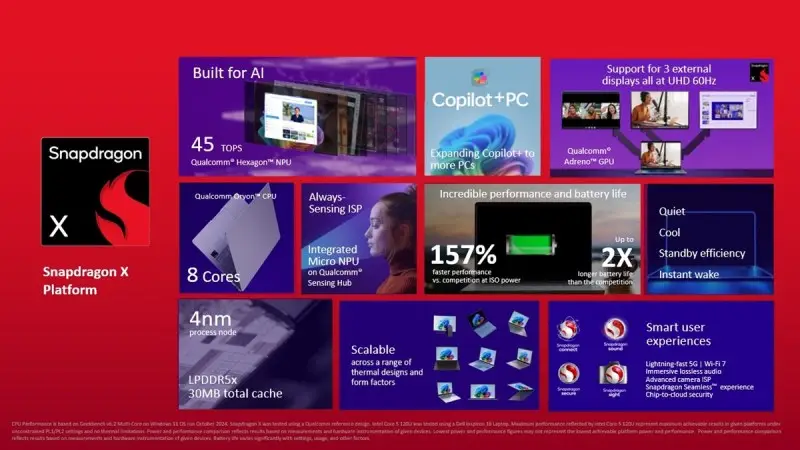
Join our daily and weekly newsletters for the latest updates and exclusive content on industry-leading AI coverage. Learn More Qualcomm unveiled AI technologies and collaborations for PCs, cars, smart homes and enterprises at CES 2025. At the big tech trade show in Las Vegas, Qualcomm Technologies showed how it’s using AI capabilities in its chips to drive the transformation of user experiences across diverse device categories, including PCs, automobiles, smart homes and into enterprises. The company unveiled the Snapdragon X platform, the fourth platform in its high-performance PC portfolio, the Snapdragon X Series, bringing industry-leading performance, multi-day battery life, and AI leadership to more of the Windows ecosystem. Qualcomm has talked about how its processors are making headway grabbing share from the x86-based AMD and Intel rivals through better efficiency. Qualcomm’s neural processing unit gets about 45 TOPS, a key benchmark for AI PCs. The Snapdragon X family of AI PC processors. Additionally, Qualcomm Technologies showcased continued traction of the Snapdragon X Series, with over 60 designs in production or development and more than 100 expected by 2026. Snapdragon for vehicles Qualcomm demoed chips that are expanding its automotive collaborations. It is working with Alpine, Amazon, Leapmotor, Mobis, Royal Enfield, and Sony Honda Mobility, who look to Snapdragon Digital Chassis solutions to drive AI-powered in-cabin and advanced driver assistance systems (ADAS). Qualcomm also announced continued traction for its Snapdragon Elite-tier platforms for automotive, highlighting its work with Desay, Garmin, and Panasonic for Snapdragon Cockpit Elite. Throughout the show, Qualcomm will highlight its holistic approach to improving comfort and focusing on safety with demonstrations on the potential of the convergence of AI, multimodal contextual awareness, and cloudbased services. Attendees will also get a first glimpse of the new Snapdragon Ride Platform with integrated automated driving software stack and system definition jointly

Read More »

Oil, Gas Execs Reveal Where They Expect WTI Oil Price to Land in the Future

Executives from oil and gas firms have revealed where they expect the West Texas Intermediate (WTI) crude oil price to be at various points in the future as part of the fourth quarter Dallas Fed Energy Survey, which was released recently. The average response executives from 131 oil and gas firms gave when asked what they expect the WTI crude oil price to be at the end of 2025 was $71.13 per barrel, the survey showed. The low forecast came in at $53 per barrel, the high forecast was $100 per barrel, and the spot price during the survey was $70.66 per barrel, the survey pointed out. This question was not asked in the previous Dallas Fed Energy Survey, which was released in the third quarter. That survey asked participants what they expect the WTI crude oil price to be at the end of 2024. Executives from 134 oil and gas firms answered this question, offering an average response of $72.66 per barrel, that survey showed. The latest Dallas Fed Energy Survey also asked participants where they expect WTI prices to be in six months, one year, two years, and five years. Executives from 124 oil and gas firms answered this question and gave a mean response of $69 per barrel for the six month mark, $71 per barrel for the year mark, $74 per barrel for the two year mark, and $80 per barrel for the five year mark, the survey showed. Executives from 119 oil and gas firms answered this question in the third quarter Dallas Fed Energy Survey and gave a mean response of $73 per barrel for the six month mark, $76 per barrel for the year mark, $81 per barrel for the two year mark, and $87 per barrel for the five year mark, that

Read More »

The Download: a startup has a solution for AI’s groupthink problem

This is today’s edition of The Download, our weekday newsletter that provides a daily dose of what’s going on in the world of technology. LLMs are stuck in a groupthink groove. This startup is trying to get them out. Open up your chatbot of choice—Claude, ChatGPT, Gemini—and type “Give me a random number between 1 and 10.” You’re going to get 7. Almost always.  That won’t work every time—but if it did for you, you may wonder if I have superpowers. I don’t. The truth is that most large language models are stuck in a rut. They are far more predictable and far less creative in their responses than you might expect. That’s fine for tasks like coding or research, but groupthink is a problem when you’re brainstorming or planning your next vacation.
The Australian startup Springboards has a solution. It built an LLM called Flint, which has been trained to come up with a wider variety of responses than mainstream LLMs to open-ended questions such as “Where should I go in Europe?” Meet the company pushing chatbots away from the obvious.
—Will Douglas Heaven The must-reads I’ve combed the internet to find you today’s most fun/important/scary/fascinating stories about technology. 1 Scientists say they have built a cell from scratch for the first timeBuilt with lab-made DNA, it can feed, grow, and multiply. (CNN)+ It brings us closer to creating synthetic life. (Quanta)+ And is arguably the greatest feat of bioengineering yet. (New Scientist $)+ But also raises concerns over the dangers of synthetic biology. (NYT $)+ Mirror organisms could threaten life on Earth. (MIT Technology Review) 2 OpenAI has proposed giving the Trump administration a 5% stakeTalks over a public ownership deal come amid rising political pressure.(FT $)+ OpenAI also proposed other US AI giants providing a 5% stake. (CNBC)+ That could include Anthropic, Google, and Meta. (Bloomberg $)+ President Trump says he wants the public to have a stake in AI. (BBC) 3 Singapore has seized a $42 million mansion tied to Nvidia chip smugglingIt was seized as part of an investigation into alleged illegal trading. (BBC)+ Days earlier, Supermicro’s Taiwan offices were raided in the probe. (FT $) 4 Anthropic’s Fable 5 is back onlineBut queries posing security risks may be routed to less powerful models. (Axios)+ Anthropic restored access yesterday after the US lifted an export ban. (BBC)+ But the battle over how to tame AI has just begun. (WSJ $)+ Anthropic has launched a new AI science product. (MIT Technology Review) 5 Meta is building its own cloud infrastructure businessIt’s exploring two ways of monetizing AI compute and models. (Bloomberg $)+ One is selling access to models hosted on Meta’s infrastructure. (CNBC)+ The other is selling “raw” computing power. (TechCrunch)

6 PlayStation will stop releasing games on discs in 2028Future PS5 games will be digital-only releases. (Verge)+ The news comes days after reports that GTA VI will have no disc. (BBC)+ It’s put a nail in physical media’s coffin. (Wired $) 7 A low-cost Chinese AI model is catching up with US giants on their home turfWestern customers are drawn to GLM-5.2’s cheap but powerful model. (Reuters $)+ Chinese open-source models are spreading fast. (MIT Technology Review)8 Google has lost its fight against a record €4.1 billion EU antitrust fineIt was charged in 2018 for using Android to ‌block rivals. (CNBC) 9 The UN has launched an “AI for Good” commissionSalesforce CEO Benioff and Rwandan President Kagame will co-chair it. (Axios) 10 People prefer AI impersonators over politiciansThe study’s findings raise alarm bells around potential public deception. (404 Media) Quote of the day “If AI overdelivers, it will impact financial stability. If AI underdelivers, it will impact financial stability.” —Torsten Slok from Apollo Global Management shares common concerns about AI at the European Central Bank’s annual conference, Reuters reports. One More Thing America was winning the race to find Martian life. Then China jumped in.In July 2024, after more than three years on Mars, the Perseverance rover came across a peculiar rocky outcrop. Instead of the usual crystals or sedimentary layers, this one had spots. Those specks were the best hint yet of alien life.  
NASA began a new mission to bring the rocks back to Earth to study. But now, just over a year and a half later, the project is on life support. As a result, those oh-so-promising rocks may be stuck out there forever.  This also means that, in the race to find evidence of alien life, America has effectively ceded its pole position to its greatest geopolitical rival: China. Beijing is now moving full steam ahead with its own version of NASA’s mission. 
Here’s how the search for Martian life has become a contest between two superpowers. —Robin George Andrews

Read More »

Why California’s carbon manure math doesn’t add up

Something stinks in California’s climate policies. Years ago, the state set up a system that pays cattle farmers across the country to turn the methane emitted from cattle manure into natural gas, encouraging the dairy sector to produce a gas we burn instead of one that just pollutes the air. It’s become wildly popular because the subsidies are extremely lucrative. But a growing body of research suggests the program is a case study in the shortcomings of our preferred approaches to climate action. Instead of simply forcing industries to directly cut their pollution or pay for it as a cost of doing business, legislators have repeatedly opted to set up convoluted incentive systems that swap climate responsibilities between parties and regions. As studies have shown again and again, these carbon offsetting and trading schemes often dramatically overstate the emissions reductions actually achieved in the one place that matters: the atmosphere. The dairy program illustrates a particular version of this problem, muddling the impacts of different types of greenhouse gases in a way that researchers argue will lock in more warming in the future.
Despite this and other concerns, California regulators decided in 2024 to extend parts of the program beyond 2050. And a recent proposal by the state’s air resources board could send millions of additional dollars to dairy farmers as part of a plan that would ease restrictions on major greenhouse-gas producers. Here’s how the system works: The state’s climate regulations require the transportation fuels industry to lower the carbon dioxide levels in its products over time—or purchase credits from other parties that cut fuel emissions, including cattle farmers.
Dairies generally spray cattle manure into giant open lagoons, where microbes gobble up organic matter and produce methane as a by-product. But if farmers set up what are known as anaerobic digesters, the sludge is redirected into covered vessels that capture the biogas, which can be converted into natural gas and injected into a pipeline. It can then be used to fuel certain vehicles or generate electricity in a power plant. Either way, petroleum companies can pay those farmers for Low Carbon Fuel Standard (LCFS) credits, to meet regulatory requirements in lieu of reducing the emissions from their own fuels. Burning biogas in a bus or turbine still releases carbon dioxide, but the idea is that this process reduces market demand to extract natural gas from the ground and avoids the release of methane, which is a far more powerful greenhouse gas (at least initially). In fact, methane is so much more powerful that under California’s program, “adding one average biogas-powered vehicle to the fleet would produce enough LCFS credits to cover the deficits incurred by 26 similar gasoline-powered vehicles,” according to Aaron Smith, a UC Berkeley economist. But there’s a problem with this carbon math. California assumes that methane exerts about 25 times the warming effect of carbon dioxide over a 100-year period. That’s not how it really works in the atmosphere, though. Methane is very powerful, but it also breaks down quickly, generally within a couple of decades. Meanwhile, carbon dioxide builds up cumulatively in the atmosphere—and much of whatever we emit will continue heating up the planet for hundreds to thousands of years. So, in effect, the state has created a system that reduces short-term warming at the cost of increasing all-but-permanent warming. Any methane that digesters capture today would have caused extra-powerful warning if released, but by 2050 that effect would have mostly faded away. Meanwhile, that additional carbon dioxide we permitted in its place could continue warming the world for millennia. It is a good idea to cut methane emissions, and dairy digesters achieve this (though not always as effectively as hoped). But we can’t swap a decrease in short-lived greenhouse gases for an increase in long-lived ones if we hope to keep global temperatures within relatively safe levels in the coming century, as researchers have long warned. We have to slash both. The problem I keep returning to, after years of covering carbon markets and offsets, is this: We need to clean up every sector, completely, over the next few decades. It’s increasingly untenable for so many of our climate ambitions to turn on getting one industry to make progress on paper by paying another one to reduce emissions, at a point when every business in every industry needs to be racing toward net zero. It’s time to move past the idea that we need to reward sectors for doing us the favor of not polluting the atmosphere, and simply require them to stop unloading the huge environmental burden of their business onto society. This article is from The Spark, MIT Technology Review’s weekly climate newsletter. To receive it in your inbox every Wednesday, sign up here.

Read More »

LLMs are stuck in a groupthink groove. This startup is trying to get them out.

EXECUTIVE SUMMARY Let’s start with a game. Open up your chatbot of choice—Claude, ChatGPT, Gemini—and type “Give me a random number between 1 and 10.” You’re going to get 7. Almost always. Now type “Another” and you’ll get 3 or 4. Type “Another” again and you’ll get 8 or 9. That won’t work every time—but if it did for you, you may wonder if I have superpowers. I don’t. The truth is that most large language models are stuck in a rut. They are far more predictable and far less creative in their responses than you might expect. That’s fine for tasks like coding or research, but groupthink is a problem when you’re brainstorming or planning your next vacation. The Australian startup Springboards has a solution. It built an LLM called Flint, which has been trained to come up with a wider variety of responses than mainstream LLMs to open-ended questions such as “Where should I go in Europe?”
“Most language models are fighting hallucinations,” says Springboards cofounder and CEO Pip Bingemann. “We welcome them.” Bingemann introduced me to the random number game when he first showed me his company’s new model. It felt like watching an illusionist with a deck of cards. “This is our sales trick, and it works every single time,” he says.
After ChatGPT and Claude both gave their 7s, Bingemann turned to Flint. It too came back with 7: “Aha, of course that was going to happen, but it’s okay—7 is a legitimate answer.” He restarted the session and prompted again: ChatGPT gave 7, Claude gave 7, Flint gave 3.7916. Run your way It’s not just numbers. When Bingemann asked ChatGPT and Claude to name a type of car, he predicted that it would be a Toyota or a Honda—and he was right. Flint came up with a Ford F-150. “There’s all this lost information that doesn’t get served up in these models,” he says. “They’re just as capable of saying a Buick or a Tesla. They just don’t—they’re biased.” Bingemann sent one last prompt to each of the three models: “Give me a tagline for a campaign for New Balance running shoes. Just the tagline.” Claude: “Run your way.” ChatGPT: “Run your way.” Flint: “Built to last, run to win.” It won’t win any awards, but at least it’s different. This weird limitation of LLMs is starting to get more attention. In November a team of researchers put out a paper, titled “Artificial Hivemind: The Open-Ended Homogeneity of Language Models (and Beyond),” that exposed a remarkable degree of repetition not only in the answers from individual LLMs but between them as well. They found that different LLMs converged on very similar answers when prompted with open-ended questions. It’s not clear exactly why this happens, but the researchers speculate it’s because most LLMs today are trained in similar ways on similar data to do similar tasks. The team won the best paper award at NeurIPS, a major AI conference. When the researchers asked 25 different LLMs (including models from the top US firms as well as open-source models from China and elsewhere) 50 times each to write a metaphor about time, most of the 1,250 responses were a version of “Time is a river” or “Time is a weaver.” (I asked some of my colleagues the same question and six people gave me six different answers. My highlight: “Time is a favorite sweatshirt, shaped by a lifetime of wear.”) When you look for it, you see repetition everywhere, says Kieran Browne, cofounder and CTO at Springboards. “The way that most chat interfaces are designed, it makes it feel like you’re having a personal conversation,” he says. “I think most people don’t really realize the extent to which they are getting the same stuff as everybody else.”

Take another example: “What should I name my band?” Most models will say something involving “glass,” “neon,” “velvet,” or “static,” says Browne.   When I tried it, ChatGPT spat out a list of 56 band names. At the top was “Glass Harbor.” Skimming through, I found “Static Empire,” “Neon Hearts,” and “Velvet Echo.” I asked Gemini; it gave me 15 suggestions, including “Static Horizon.” Some of the suggestions looked pretty cool, though. ChatGPT’s “Sofa Astronauts” caught my eye, so I googled it—and found that a band called Sofa Astronauts already exists.  (OpenAI says that training models to give reliable and coherent answers can lead them to converge around familiar, high-probability responses and that pushing harder for novelty can lead to weaker or less reliable responses. It also notes that the “Artificial Hivemind” paper studied models from 2024 that have since been updated.) Creative catapult Springboards has developed a tool backed by a selection of LLMs, including ChatGPT and Claude, that creative professionals in advertising or marketing can use to brainstorm ideas. The tool lets you drag around text produced by different models, picking the bits that you like and combining them into something new—in theory. Springboards is pitching Flint as an alternative model that users of its tool can select when looking for more variety. Zoe Scaman, founder of the business strategy startup Bodacious and chief strategy officer at 77X, a direct-to-fan marketing platform set up by Luka Dončić of the LA Lakers, has been trying it out. “I find it really useful for throwing me in completely different directions,” she says. “I use it if I want to catapult myself all over the place.” In one test, Scaman pitted Flint against Claude, Gemini, and ChatGPT by giving each of the models a classic MBA case study: How would you reinvent a finance company for today’s youth? The three mainstream models all went down the same path, she says: “You know, we need to teach financial literacy in a fun and funky way—well, that’s nothing new.” But Flint came up with something different, suggesting that the whole concept of wealth accumulation should get a rebrand. “That was really interesting,” says Scaman.
She notes that Flint is still a prototype and doesn’t work all the time. “It sometimes falls over when you start pushing it too far,” she says. “But I think that the premise behind it is really powerful.” Taking the temperature Springboards built Flint on top of Qwen 3, an open-source model from the Chinese tech giant Alibaba. “We’re a small team,” says Browne. “Training a foundation model is not on the table for us. It’s just too expensive.”
Most LLMs have settings that let you adjust the level of randomness in their output. The most common is called temperature. “Obviously, that was one of the first things we explored, because that’s what people tell you: If you want more creativity, you turn up the temperature,” says Browne. But changing those settings can also make models incoherent. Dialing up the temperature on one of OpenAI’s models to its maximum setting made it produce responses that switched from English into code halfway through a sentence, says Browne. Springboards realized that parameters were blunt instruments for what it wanted to do. It does not make sense to dial up the randomness across the board; you only want to boost it at specific points in its output, he says. For example, when you ask a chatbot “Where should I go in Europe?” the model only needs to tweak the randomness just before it names a destination, not for every word in its response. To make Flint do this, Springboards trained its version of Qwen 3 to identify the points in its output where more variety was possible and fill those spots with words or phrases that were a little more random. “Flint’s programmed to throw an oddball in. It’s more of an invitation to think wider,” says Maximilian Weigl, cofounder and chief strategy officer at Uncommon, a marketing firm. “That’s super interesting.”
Weigl’s team uses Flint alongside ChatGPT, Claude, and Gemini. “You can’t really create something boundary-breaking with tools that pull you back to the average,” he says.  And yet Weigl notes that nine times out of 10 the average is fine. You don’t always need to reach for extremes with something like Flint, he says: “Most people are fine with good enough. They want to see mass-market familiar things.” Weigl also cautions against using any LLM too much. “I have a big problem when people rely on the output from any AI, including Flint,” he says. “If I saw people on my team copy-pasting something from AI, I’d be like, ‘That’s not your job! Think, talk to other people, use your own voice.’” For now, Flint is aimed at advertisers and marketers because those are Springboards’s customers. But Bingemann and Browne insist that a lack of variety is a problem for anyone using chatbots. The idea is to give people the choice and leave it to them to decide if the result is good or not, says Bingemann. “Variety is great when you’re trying to spark ideas,” he says. “Let’s go down this route instead of letting the machines do it all and ending up in a gray, boring world.”

Read More »

The Download: Anthropic launches Claude Science, and California’s carbon manure math

This is today’s edition of The Download, our weekday newsletter that provides a daily dose of what’s going on in the world of technology. Claude Science is Anthropic’s newest flagship product At an event for pharmaceutical executives, biotech founders, and researchers yesterday, Anthropic announced Claude Science, a major new product intended to support scientific research like Claude Code supports software engineering.Like Claude Code, Claude Science can autonomously carry out meaningful work from concise, high-level instructions, with tools for computational biology and drug development. The launch signals that Anthropic is doubling down on AI for science, and the company will also use the product in its own research into drugs for rare, neglected diseases.Discover why Anthropic is betting big on AI for scientific research. —Grace Huckins Why California’s carbon manure math doesn’t add up Something stinks in California’s climate policies. 
Years ago, the state set up a system that pays cattle farmers to turn the methane emitted from cattle manure into natural gas. It’s become wildly popular because the subsidies are extremely lucrative. But research suggests the program exposes the shortcomings of carbon offsetting and trading schemes. Instead of forcing industries to directly cut their pollution or pay for it as a cost of doing business, legislators have opted for incentives that swap climate responsibilities between parties and regions. The system could ultimately lock in more warming.
Read the full story on California’s dubious carbon calculations. —James Temple This story is from The Spark, our weekly climate tech newsletter. Sign up to receive it in your inbox every Wednesday. Watch now: longevity’s next frontier—“reprogramming” your body Billions of dollars are pouring into efforts to reverse aging as scientists investigate ways to return cells to a younger state. But how close are these experimental treatments? And are they likely to work?  At a recent virtual Roundtables event, MIT Technology Review explored the answers with science editor Mary Beth Griggs and senior biotechnology reporter Jessica Hamzelou. Subscribers can now watch the full recording of the fascinating discussion. MIT Technology Review Narrated: the search for dark matter has been blown wide open For decades, physicists have hunted for weakly interacting massive particles (WIMPs), a leading candidate for dark matter. But their search has run into a new problem: neutrinos.  These tiny particles from the sun and other stars can create a “neutrino fog” that drowns out any signal of dark matter. Hitting the neutrino fog does not, however, mean an end to the search. Researchers just have to shift the focus of their hunt. They’re now casting a much wider net. New proposals include quantum sensors, liquid-helium detectors, and even searches in Jupiter’s atmosphere.

—Dan Garisto This is our latest story to be turned into an MIT Technology Review Narrated podcast, which we publish each week on Spotify and Apple Podcasts. Just navigate to MIT Technology Review Narrated on either platform, and follow us to get all our new content as it’s released. The must-reads I’ve combed the internet to find you today’s most fun/important/scary/fascinating stories about technology. 1 The US has lifted restrictions on Anthropic’s Mythos and Fable modelsAnthropic said it would begin restoring access today. (NYT $)+ The US had imposed controls over security concerns. (Bloomberg $)+ It lifted the restrictions after lengthy talks with Anthropic. (BBC)+ But the crackdown has already opened doors for Chinese AI rivals. (CNBC)2 The most detailed survey of the universe ever is now underwayIt’s using the largest digital camera on Earth. (New Scientist $) + The project is based at the Vera C. Rubin Observatory in Chile. (NYT $)+ It aims to transform our view of the cosmos. (MIT Technology Review) 3 Tech talent is fleeing the US due to H1-B visa chaosThey’re eyeing relocation to Canada, the UK, or the Gulf. (Rest of World)+ While China is poaching AI talent from the US. (CNBC)+ Visa rules are also affecting young scientists. (MIT Technology Review) 4 Trump raked in more than $1 billion from crypto businesses in 2025He reported $635 million in royalties from a Trump meme coin. (BBC)+ The rest largely came from his World Liberty Financial venture. (The Hill) 5 The UN warns that the rapid spread of AI may worsen global inequalityIt’s proposed a shared framework for responsible AI development. (Guardian)6 Companies are making LLMs talk like a caveman to curb AI spendingA senior OpenAI employee contributed to the “caveman” project. (404 Media) 7 Babies are born with the neural foundations for mathBrain recordings have identified the mechanisms. (New Scientist $)8 An independent studio has bought the OpenAI movie Amazon droppedNeon has purchased “Artificial,” which focuses on Sam Altman. (NYT $)+ Amazon had dumped it after investing in OpenAI. (Gizmodo)+ The depiction of Altman is reportedly unsympathetic. (Variety)9 AI has re-created Gene Wilder’s voice for a new “Willy Wonka” seriesWilder’s wife said his estate is “delighted” with the new show. (NBC News)+ Netflix partnered with AI company ElevenLabs on the project. (The Verge)10 NASA aims to send a spare Mars rover—and soccer ball—to the moonThe nuclear-powered “Promise” may help establish a lunar base. (NYT $) Quote of the day “Caveman save you token, save you money.”  —The GitHub repository for the “caveman” plugin explains how the project curbs AI spending by turning verbose LLM outputs into concise text. One More Thing
SELMAN DESIGN AI is dreaming up drugs that no one has ever seen. Now we’ve got to see if they work. On average, it takes more than 10 years and billions of dollars to develop a new drug. A growing number of startups are betting that AI can make the process faster and cheaper.  By predicting how potential drugs might behave in the body and discarding dead-end compounds before they leave the computer, machine-learning models can cut down on the need for painstaking lab work. 
Yet it is still early days for AI drug discovery. A lot of AI companies are making claims they can’t back up—and the technology is not a panacea. But the technology is beginning to move from promise to practice. Find out how AI is speeding up drug discovery.

Read More »

Claude Science is Anthropic’s newest flagship product

EXECUTIVE SUMMARY At an event for pharmaceutical executives, biotech founders, and researchers on Tuesday, Anthropic announced Claude Science, a major new product intended to support scientific research in the same way that Claude Code supports software engineering. Like Claude Code, Claude Science can autonomously carry out meaningful work when given concise, high-level instructions, and it has access to tools that make it particularly useful for research in computational biology and drug development. Along with launching and previewing Claude Science, which is now available to all paid Claude subscribers, Anthropic also announced that it will be using the product to pursue some of its own research into drugs for rare, neglected diseases. This is not Anthropic’s first foray into AI for science. In October, the company released plug-ins that help Claude make use of scientific software and databases under the heading “Claude for Life Sciences.” But unlike this earlier release, Claude Science is a full-featured, standalone product. Anthropic’s decision to elevate Claude Science to the same rank as Claude Code and Claude Cowork indicates that the company is taking AI’s scientific applications very seriously—or at least wants to give the impression that it is. “It represents how important this is to our mission that this is right up there with Claude Code and Claude Cowork as the next really significant product that we’re releasing,” says Eric Kauderer-Abrams, Anthropic’s head of life sciences. “Our mission is to develop AI that serves humanity’s long-term well-being, and we believe that by far the greatest opportunity to do that is in the life sciences.” For the past decade, one company—Google DeepMind—has been at the vanguard of AI for science. CEO Demis Hassabis and researcher John Jumper won the Nobel Prize in chemistry for their work on the company’s AlphaFold model, and DeepMind has also made major contributions to meteorology, materials science, and a variety of other disciplines. But in the past several months, the fast-advancing frontier of AI progress seems to have left DeepMind in the dust. When it comes to coding, which has become the most lucrative use case for LLMs, DeepMind is stuck playing catch-up.
Anthropic is well positioned to take up DeepMind’s scientific mantle. Like Hassabis, Anthropic CEO Dario Amodei is a PhD scientist—unlike OpenAI CEO Sam Altman, who’s a businessman through and through. Many scientists are already avid users of tools such as Claude Code. These days, a lot of scientific research involves some amount of coding, but not all scientists are expert software engineers, and so tools like Claude Code can make a huge difference for their productivity. And the company has recently earned a major scientific vote of confidence: Earlier this month, Jumper announced that he is leaving DeepMind for Anthropic. Since agents powered by LLMs, including Anthropic’s Opus model series, became capable of useful, independent work in late 2025, scientists have been seeing just how much they can do. In a blog post published on Anthropic’s website, the Harvard physicist Matthew Schwartz estimated, on the basis of his work with Claude Code and other Anthropic tools, that the company’s Opus 4.5 model is about as capable of executing scientific projects as a second-year graduate student.
According to Kauderer-Abrams, Claude Science isn’t intended to displace Claude Code and Claude Cowork in scientists’ workflows. Instead, it’s designed to build on what scientists already find useful about Anthropic’s products. For instance, it not only writes code but also helps scientists run their code on powerful computer clusters, which many many scientists need for their work but can be difficult to manage. And it prioritizes reproducibility, so that scientists can trace back the source of any figure or result and check it for accuracy and validity. Though Claude Science could in principle assist with any area of scientific research, it seems designed and marketed as a tool for molecular and cellular biology, and for drug development in particular. It can interface with various tools used in genetics, chemistry, and protein biology, all of which could come in handy for researchers on the hunt for new drugs. During the Tuesday event, Alexander Tarashansky, who led the development of Claude Science, demonstrated how the system could autonomously identify new drug candidates for phenylketonuria, a rare genetic disease. And Anthropic isn’t leaving all that work to the pharma companies and university labs that were represented at the event. Armed with Claude Science, it will be pursuing its own research into drug candidates for neglected diseases—both to help move science forward and to gain a clearer sense of how Claude Science works in the real world. There are obvious humanitarian reasons to prioritize drug development when creating a general-purpose scientific research tool, and AI industry leaders often cite curing disease as a major potential upside of the technology. But it’s also notable that pharmaceutical companies have far deeper pockets than academic researchers. Anthropic says it’s set to see its first profitable quarter, and if major new contracts with pharmaceutical companies are forthcoming, they could help ensure it stays profitable as the tokenmaxxing craze dies down—something that’s ever more important as an IPO approaches later this year.

Read More »

Roundtables: Longevity’s Next Frontier: “Reprogramming” Your Body

Available only for MIT Alumni and subscribers.
Listen to the session or watch below Billions of dollars are flooding into efforts to reverse aging as scientists explore ways to return cells to a younger state. But how far off are these experimental treatments? Will they really work? Watch a conversation exploring longevity’s new focus. Speakers: Mary Beth Griggs, science editor and Jessica Hamzelou, senior biotechnology reporter

[embedded content]

Recorded on June 30, 2026 Related Stories:

Read More »

Secretary Wright Applauds End of New Federal Wind and Solar Subsidies

WASHINGTON—U.S. Secretary of Energy Chris Wright today released the following statement regarding the Working Families Tax Cut July 4, 2026 deadline ending federal tax credit subsidies for new wind and solar projects not currently under construction. For more than three decades, the federal government has subsidized wind and solar energy generation. In 2025, wind and solar accounted for approximately three percent of total U.S. primary energy consumption. “I’m thrilled to report that after about 35 years, on July 4th, we will end the subsidies for wind and solar, thanks to the Working Families Tax Cut. “Wind and solar take a lot of land, 100 times more land for a similar amount of energy. They take an enormous amount of materials, energy intensive materials like steel and cement and polysilicon. “They take an enormous amount of additional transmission lines to connect their large land, far flung production back to where there’s demand centers. “And what do we get for all that is a relatively small amount of low value energy. It’s low value because the wind doesn’t always blow and the sun doesn’t always shine. “So they drive up the system costs and increase Americans’ electricity prices. “Enough of raising electricity prices. We’re going to drive them down. Thank you.” ###

Read More »

Trump Administration Moves to Permanently End Green New Scam Appliance Mandates

WASHINGTON—U.S. Secretary of Energy Chris Wright today announced the Department of Energy (DOE) has issued a Notice of Proposed Rulemaking to permanently end home appliance and equipment mandates that raise costs and disrupt consumer choice. The proposal will update the Department’s Process Rule used to establish energy conservation standards for household appliances and equipment, including air conditioning units, gas stoves, washing and drying machines, water heaters, refrigerators, and other products Americans rely on every day. In accordance with President Donald Trump’s Executive Order, “Unleashing Prosperity through Deregulation,” the proposal will preserve consumer choice and lower costs.  “In America, you should be able to choose a dryer that dries clothes on the first try rather than one that takes multiple cycles—unfortunately, past administrations thought otherwise,” Secretary Wright said. “For too long, the American people paid the price for mandates that restricted consumer choice and drove up costs. President Trump promised to end thisnonsense and that is exactly what we are doing. This proposed rule will preserve the American people’s ability to choose home appliances and equipment that actually work — at prices they can afford. It’s called common sense.”  “From day one, the Trump Administration has offered relief to consumers, businesses, and industries through bold deregulatory action,” said Assistant Secretary of Energy (EERE) Audrey Robertson. “This proposal is about the future. It will ensure that new regulations promote affordability, preserve consumer choice, and meet the highest standards for transparency and due diligence.”   For further details, read the full text of the Notice of Proposed Rulemaking. Comments will be accepted for 30 days after publication in the Federal Register.  DOE also issued a Request for Information seeking public input on the methodologies used in developing energy conservation standards for covered products and equipment. Comments will be accepted for 60 days after

Read More »

Energy Dominance Financing Office Celebrates One Year Since Passage of the Working Families Tax Cuts Act

WASHINGTON—The U.S. Department of Energy’s (DOE) Office of Energy Dominance Financing (EDF) celebrates the one-year anniversary of President Trump’s historic Working Families Tax Cuts. Made possible by the Working Families Tax Cuts, EDF has tallied several vital wins to rebuild supply chains, lower household energy bills, and strengthen U.S. energy and industrial leadership. The Working Families Tax Cuts expanded the scope of EDF’s more than $250 billion available loan authority to support reliable and affordable energy-related investments through the revamped and renamed Energy Dominance Financing Program (EDFP). “The prior administration had policies that undermined our grid with intermittent and expensive technologies that didn’t deliver the affordable, reliable and secure energy that Americans need,” EDF Director Gregory A. Beard said. “The Working Families Tax Cuts empowered the nation with a common-sense approach to increasing the nation’s energy supply through ensuring baseload power goes to a secure and reliable grid, securing critical mineral supply chains, winning the global AI race and launching the American nuclear renaissance.” EDF is working to rapidly implement and deploy the EDFP. Over the past year, these accomplishments include: Financing America’s nuclear renaissance EDF has financed nuclear restarts and reestablished domestic manufacturing capabilities central to the Administration’s goal of reinvigorating the U.S. nuclear industrial base. As part of a national nuclear renaissance strategy, EDF recently announced a $17.5 billion conditional loan to finance long-lead time items needed to rebuild America’s commercial nuclear supply chain. This investment will accelerate the deployment of 10 large-scale commercial nuclear reactors across the United States by up to three years. The project marks a major step toward advancing President Trump’s Executive Order, Reinvigorating the Nuclear Industrial Base, by supporting the objective of having 10 new large nuclear reactors with complete designs under construction by 2030, representing over 11 GW of secure, reliable generation. EDF

Read More »

Cheap Chinese chips could offer way out of RAM price crisis, Apple suggests

Beyond the potential political ramifications, any deal would have immediate implications for enterprise IT buyers. “CIOs should focus on the risk that this strategy could introduce. Will Apple be able to thoroughly assess those chips to completely rule out the possibility of trojan horses, backdoors, and hidden functionality such as dead man switches?” asked Flavio Villanustre, CISO for the LexisNexis Risk Solutions Group. “If Apple says that they will do, to what degree of certainty? There have been rumors about hidden backdoors in chips before, such as Supermicro in 2018, ESP32 microcontroller hidden functionality in 2025, and Microsemi backdoor in 2012, to name a few.” On the naughty list? This issue gets complicated based on what the US government ultimately does. The two Chinese manufacturers figure on the Pentagon’s so-called 1260H list of “entities identified as Chinese Military Companies,” which also includes Chinese internet giants Alibaba, Baidu, and Tencent; router maker TP-Link Technologies; and drone maker DJI. Being on that list has no real consequences for the companies concerned, but the government could move them to the Department of Commerce’s Entity List, subjecting them to export licensing requirements, or make them the subject of a Section 889 clause, barring them from government procurement deals. That could sharply change the dynamics for Apple and other technology vendors seeking cheaper RAM supplies — and for their customers.

Read More »

Achieving operational excellence with AI

In association withTeleperformance Frameworks like Lean Six Sigma and business process management (BPM) first gained traction because they promised clarity in the chaos—a structured way to bring order to messy, sprawling operations. Lean Six Sigma emphasized statistical rigor and quality control; BPM created end-to-end maps of how work should flow across departments. Both offered a repeatable way to embed habits of measurement, analysis, and accountability into day-to-day company culture. But today, those time-tested playbooks are evolving as companies seek to embed AI into established process excellence methodologies. By some estimates, the market for AI-powered process optimization is projected to exceed $113 billion within the next decade. In one study, a full 88% of business leaders anticipated increasing investments into AI-infused process intelligence in the next 12 to 18 months. Yet without the right foundations, many of those investments may not fully deliver on their potential. Companies that already operate with discipline have an edge. They can channel new tools into proven systems rather than bolting them onto shaky foundations. Organizations with mature process disciplines are also better positioned to translate AI ambition into real outcomes, as they are already accustomed to data-driven decision-making and process discipline—precisely the cultural foundation AI systems need to deliver value. Simply put: AI can accelerate process excellence, but existing process excellence is what makes AI truly impactful. Technology and process are no longer separate levers, and only organizations that pull them together stand to realize the full value of both.
Download the full report. This content was produced by Insights, the custom content arm of MIT Technology Review. It was not written by MIT Technology Review’s editorial staff. It was researched, designed, and written by human writers, editors, analysts, and illustrators. This includes the writing of surveys and collection of data for surveys. AI tools that may have been used were limited to secondary production processes that passed thorough human review.

Read More »

Cisco details Live Protect’s real-time threat mitigation capabilities

“Live Protect uses extended Berkeley Packet Filter (eBPF) technology, a powerful Linux kernel feature, through the Tetragon agent embedded in NX-OS. This allows deep visibility and enforcement directly within the kernel, monitoring system calls, file operations, process control, and network traffic to detect and prevent privilege escalation, control-plane attacks, and other sophisticated threats,” Varanasy wrote. The Live Protect vulnerability shields are basically policies for a selected, validated vulnerability condition, according to Varanasy. These shields are intended as temporary measures and should be decommissioned once a permanent software fix is applied, he said. “Live Protect is not a patch,” wrote Tom Gillis, senior vice president and general manager of the Cisco infrastructure & security group, in blog post about Live Protect in June. “It does not replace the need for core lifecycle discipline or permanent software updates. Instead, it serves as a temporary, targeted shield that mitigates the risk of a specific vulnerability with a few clicks. It is intended to be a ‘finger in the dike’, an emergency control that is applied to a running system without disrupting that system between more frequent maintenance windows.”

Read More »

Stay Ahead with the Paperboy Newsletter

Your weekly dose of insights into AI, Bitcoin mining, Datacenters and Energy indusrty news. Spend 3-5 minutes and catch-up on 1 week of news.

Smarter with ONMINE

Streamline Your Growth with ONMINE