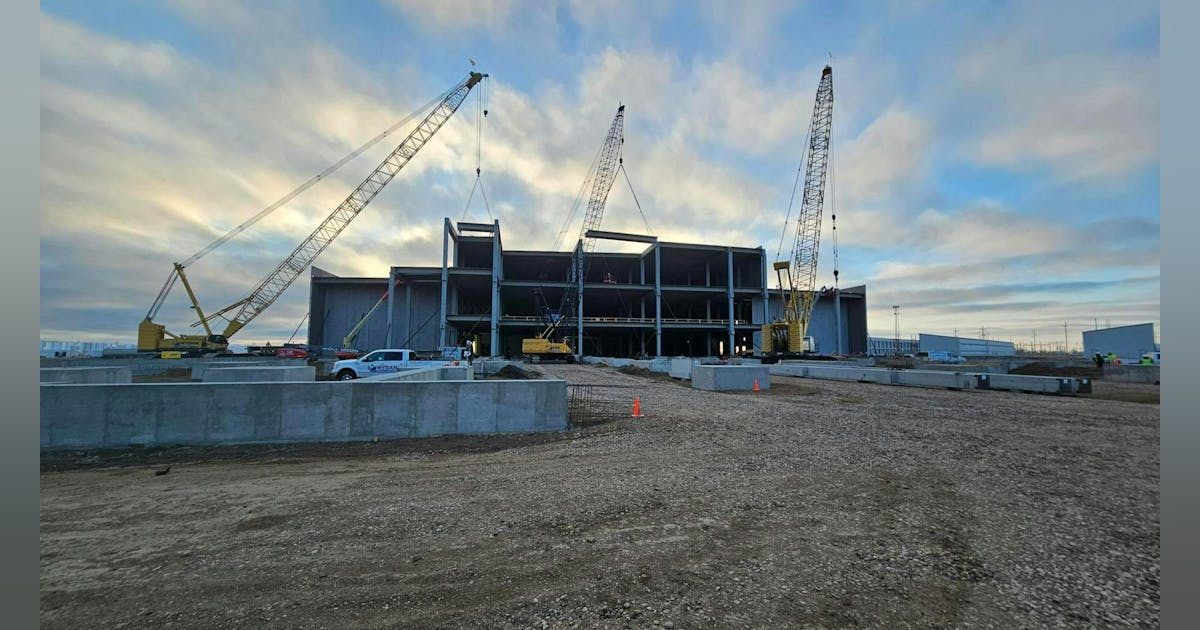
Vantage — Lighthouse (Port Washington, Wisconsin)
Although the on-site ceremonial groundbreaking occurred in 2025, Vantage Data Centers’ Lighthouse campus in Port Washington, Wisconsin, remained one of the most closely watched AI infrastructure developments entering 2026, with updated local materials posted February 19 reinforcing the project’s scale and timeline.
Announced in October 2025 in partnership with OpenAI and Oracle, Lighthouse is positioned as the Midwest anchor site within the companies’ broader Stargate expansion, which targets up to 4.5 gigawatts of additional AI capacity globally. Current plans call for four hyperscale data centers delivering nearly 902 MW of IT load on a site encompassing roughly 672 acres, with construction expected to run through 2028.
From a Land and Expand perspective, the project exemplifies the new generation of AI campuses involving large-scale land banking paired with phased delivery designed to stay ahead of hyperscale demand curves.
Just as notable is the project’s power and community framework. Vantage is working with WEC Energy Group’s We Energies on a dedicated rate structure under which the developer will underwrite 100% of the power infrastructure investment, a model explicitly designed to shield existing customers from rate increases. The utility partnership also includes plans to enable nearly 2 gigawatts of new zero-emission energy capacity, with approximately 70% allocated to the Lighthouse campus and the remainder supporting broader grid needs.
Water and environmental positioning are also central to the project narrative. Lighthouse is designed around a closed-loop liquid cooling system intended to minimize water consumption, alongside local restoration investments aimed at achieving water positivity. Vantage has also committed to preserving significant portions of the site’s natural landscape while pursuing LEED certification for the campus.
Economically, the development is expected to generate more than 4,000 primarily union construction jobs and over 1,000 long-term operational roles, while Vantage has pledged at least $175 million in regional infrastructure upgrades, including water, wastewater, and power improvements.
Taken as a case study, Lighthouse exemplifies how next-generation hyperscale campuses are increasingly structured as fully integrated infrastructure plays combining gigawatt-scale power planning, environmental positioning, and community investment well before tenant ramps fully materialize.
AVAIO Digital — Little Rock, Arkansas AI and Power Campus
Arkansas officials have positioned AVAIO Digital’s planned Little Rock development as a multi-phase AI-ready campus anchored by an initial $6 billion investment, with long-term buildout potential that could scale significantly higher. The project currently holds a 150 MW power commitment from Entergy Arkansas, but the company has indicated the campus could ultimately expand toward 1 gigawatt of demand as capacity is added over time.
That power trajectory underscores how closely the project is tied to grid planning and regional economic development strategy. With initial operations targeted for 2027, AVAIO’s approach reflects a classic land-and-expand posture in securing an early utility foothold, while signaling a much larger AI growth runway designed to align with hyperscale demand curves. Moves like this are increasingly common as emerging developers seek to lock in power positions ahead of confirmed AI tenant ramps.
Arkansas Governor Sarah Sanders said:
“AVAIO Digital’s $6 billion data center hub represents the largest economic investment in Arkansas’ history and sets the Natural State up to become a technology powerhouse that can compete with any state in the nation. Just last year, Arkansas led the way and passed legislation that reduced the regulatory timeline for new energy projects by more than half and offered new incentives to data center investments. This announcement confirms that cutting red tape and cultivating a pro-business, pro-growth environment is not only appealing to companies; it is what makes Arkansas one of the best states to live and work.”