Stay Ahead, Stay ONMINE

Meta’s Canadian AI Data Center: A New Model for Infrastructure and Energy Integration

Canada’s expansion as an artificial intelligence infrastructure market received its strongest endorsement yet on July 8, when Meta broke ground on a data center campus representing an investment of more than C$13 billion. The project, located in Sturgeon County north of Edmonton, will be Meta’s first data center in Canada and the 33rd facility in […]

Canada’s expansion as an artificial intelligence infrastructure market received its strongest endorsement yet on July 8, when Meta broke ground on a data center campus representing an investment of more than C$13 billion.

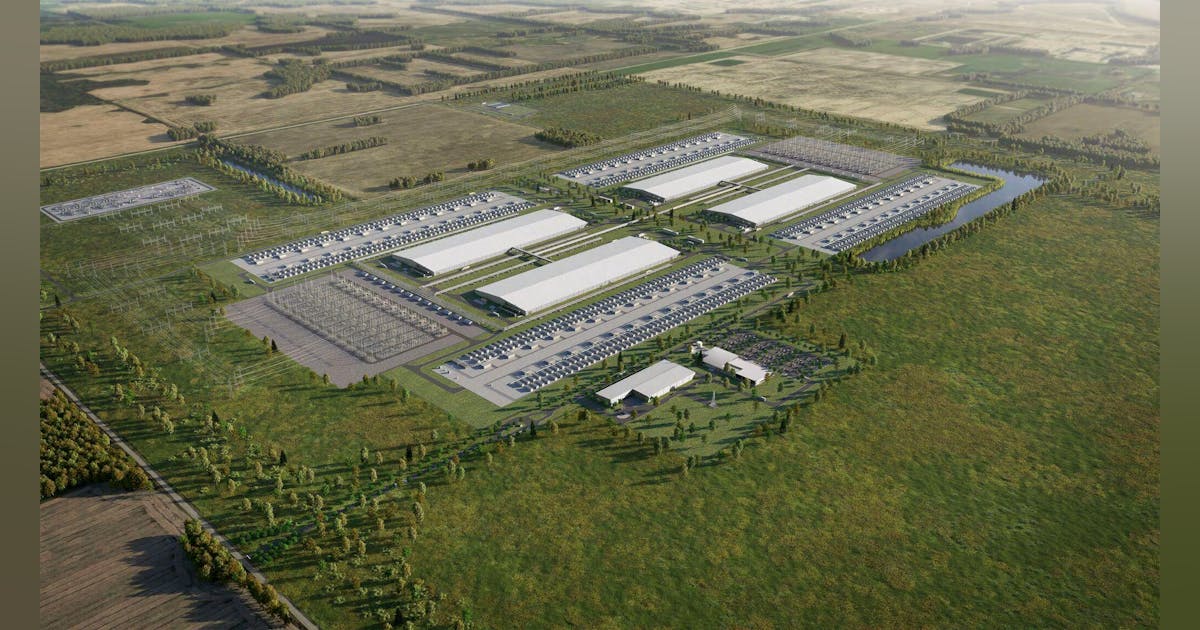
The project, located in Sturgeon County north of Edmonton, will be Meta’s first data center in Canada and the 33rd facility in its global portfolio. Planned initially at 1 GW of power capacity, the AI-optimized campus could eventually scale to 1.8 GW, placing it among the largest data center developments under construction anywhere outside the United States. The announcement follows the Canadian federal government’s May launch of consultations on a forthcoming National Electricity Strategy, which identifies AI data centers as a major source of future electricity demand. 

Approximately 3,000 construction workers are expected to be on the site at peak activity, while more than 300 permanent employees will operate the campus after completion. Meta is also committing approximately C$60 million to improvements involving local roads, water systems and other community infrastructure.

The Meta announcement illustrates a fundamental change in Canadian data center construction. Rather than selecting a building site and applying for an ordinary utility connection, Meta and its partners have spent years coordinating the data center with a purpose-built 932 MW generating station, grid upgrades and long-term natural-gas transportation agreements.

The project effectively combines a data center, a power plant and an infrastructure development program into a single construction ecosystem.

Construction Has Begun on the Canadian Campus

Meta describes the Sturgeon County project as an AI-optimized facility intended to support the computing demands of its core platforms, AI services and connected devices. The company said the buildout will occur in phases rather than delivering the entire gigawatt at once.

Alberta’s major-project registry estimates a roughly three-year construction period. That timeline will require a sustained deployment of skilled trades, construction management personnel, engineering teams and mission-critical specialists.

The work will extend far beyond data halls. A development at this scale typically involves multiple computing buildings, substations, utility yards, backup power systems, administrative space, security facilities, equipment staging areas and miles of internal electrical, mechanical and fiber infrastructure.

AI systems also impose requirements that distinguish the campus from older cloud or enterprise data centers. GPU clusters concentrate far more power in each rack, creating higher heat loads and requiring larger electrical feeds, more extensive busway systems and increasingly sophisticated liquid-cooling networks.

The Sturgeon County facility will use closed-loop liquid cooling supported by dry cooling. Meta says the cooling system will consume no water during normal operation. Water use at the campus will instead be limited primarily to domestic requirements, fire protection and equipment maintenance.

That design addresses one of the most frequent concerns surrounding large AI campuses: the potential use of millions of gallons of water. Eliminating operational cooling-water consumption does not eliminate the project’s environmental footprint, but it substantially changes the water discussion compared with AI facilities that depend heavily on cooling towers.

Dry cooling can require more equipment and may use more electricity under certain weather conditions than evaporative systems. Alberta’s comparatively cool climate gives designers an opportunity to use low outside-air temperatures to improve heat-rejection efficiency during much of the year.

The project’s industrial location is another important design choice. The site is within Alberta’s Industrial Heartland, a designated development zone northeast of Edmonton that already contains pipelines, energy facilities, petrochemical plants and heavy industrial infrastructure. Alberta officials said the selected property is not being used for residential development, food production or farming, minimizing potential community concerns for a development project of this scale.

Locating the campus within an established industrial corridor gives Meta access to infrastructure that would be difficult to reproduce at a greenfield site near a major city. It also makes it possible to colocate the data center with the enormous generating capacity required to operate it.

A Power Plant Built Around AI Demand

Six days before Meta publicly confirmed the data center, Pembina Pipeline and its partners announced a positive final investment decision on the Greenlight Electricity Centre. Greenlight will be a 932 MW combined-cycle natural gas generating facility built in the same Sturgeon County industrial area. Meta’s July 8 announcement confirmed that Greenlight would supply the company’s Canadian campus.

The Greenlight partners have entered into a long-term agreement to provide 932 MW of dedicated capacity to the data center. The power arrangement is structured as a tolling agreement, under which the customer makes capacity payments while also covering costs associated with fuel, operations and maintenance.

Greenlight is owned by Pembina and Morgan Stanley Infrastructure Partners, each holding 47.5%, and Kineticor, which owns the remaining 5%. The project carries an estimated capital cost of approximately C$4 billion, rising to approximately C$4.6 billion when construction interest and financing costs are included. The plant is scheduled to begin service during the second half of 2030. Pembina says all major regulatory approvals have been obtained and approximately 85% of project costs have been de-risked through fixed-price agreements.

Aecon and Técnicas Reunidas have been selected to handle engineering, procurement and construction under a fixed-price agreement. Siemens Energy will supply two SGT6-8000H gas turbines, two steam turbines and associated generators. Pembina will lead construction management for the generation project.

The combined-cycle configuration will use waste heat from the gas turbines to produce steam and generate additional electricity, increasing efficiency compared with a simple-cycle gas plant. Greenlight is expected to consume approximately 150 million cubic feet of natural gas each day, with transportation capacity secured through pipeline systems serving the Alberta region.

The site has already been permitted for potential expansion to 1,864 MW. That figure closely corresponds to Meta’s ability to expand the data center from 1 GW to as much as 1.8 GW, suggesting that both the generating plant and computing campus are being planned with a second major construction phase in mind.

The arrangement represents Alberta’s emerging “bring your own power” model for large data centers. Rather than requiring the provincial grid to supply the full load, developers are expected to finance new generation and the infrastructure required to connect or support their projects. This aligns with DCF’s previous coverage of the forthcoming National Electricity Strategy announced in May. 

Meta said it will pay the full cost of the new generation and grid infrastructure associated with the campus, working with Capital Power, AltaLink, and the Alberta Electric System Operator on the project’s earlier and grid-connected energy requirements. Capital Power has entered into a long-term agreement to provide 250 MW from its existing Alberta generation fleet beginning in the second half of 2028, before Greenlight enters service.

The company also said its electricity consumption will be matched with clean and renewable energy purchases, although the physical electricity serving much of the campus will be generated from natural gas.

The difference between physical power and renewable-energy matching is important. Renewable contracts or certificates may offset annual electricity consumption on an accounting basis, but they do not make the colocated gas-fired generating station carbon-free.

Alberta offers speed, land and abundant natural gas, but its electricity system has a considerably higher emissions intensity than hydro-dominated systems in Quebec, British Columbia and Manitoba. Reuters reported in June that the vast majority of Canada’s planned hyperscale capacity was concentrating in Alberta even though the province’s grid emissions intensity was nearly five times the national average. In November 2025, Ottawa and Alberta agreed to suspend application of the federal Clean Electricity Regulations in the province while negotiating a new industrial carbon-pricing arrangement.

Alberta’s Construction Strategy Pays Off

Provincial officials have spent roughly two years promoting Alberta’s energy resources, industrial land, climate and regulatory environment to technology companies. The province has also established rules intended to prevent very large data centers from shifting their power and infrastructure costs to ordinary electricity customers.

The Alberta Electric System Operator established an interim 1,200 MW connection allocation for data center projects while longer-term market rules are developed. That capacity has now been assigned. Additional large campuses will therefore need to rely substantially on newly constructed or behind-the-meter generation.

Meta’s campus demonstrates how that policy can translate into construction. The project is not waiting for the existing grid to produce an additional gigawatt of spare capacity. Instead, the company and its energy partners have assembled a package involving new generation, new transmission and existing grid resources.

This approach could allow Alberta to approve projects that would face long delays in locations where utilities must ration limited hydroelectric or transmission capacity among data centers, manufacturers, housing developments and electrification programs.

Alberta officials estimate that the Meta investment could generate approximately C$250 million annually in benefits for Albertans through royalties, taxes, levies and fees. The province also argues that the project and its new generation could reduce transmission costs for electricity customers, although the ultimate effect will depend on construction costs, power-market conditions and how infrastructure charges are allocated over time.

As we regularly see with projects of this scale, equipment procurement could be challenging. Large power transformers, switchgear, turbines, generators, heat exchangers and cooling components frequently carry long delivery times. Greenlight’s use of fixed-price contracts and its early reservation of Siemens equipment indicate how developers are attempting to control those risks years before commissioning.

A New Benchmark for the Canadian Market

Meta’s announcement does not stand alone. As we reported back in April 2026, Bell is developing a 300 MW AI data center campus near Regina, Saskatchewan, while TELUS has outlined a network of AI facilities in British Columbia. Microsoft has committed to multibillion-dollar AI and cloud infrastructure investments in Ontario, and QScale is expanding its liquid-cooled AI campus in Lévis, Quebec.

Meta’s project clearly changes the scale of the Canadian AI data center conversation. Bell and TELUS are emphasizing sovereign computing—the ability to provide Canadian companies, researchers and public institutions with advanced AI capacity hosted under Canadian jurisdiction. Meta’s campus is different. It is a hyperscaler-owned AI factory intended primarily to support the company’s global platforms and AI development.

That makes the project an international vote of confidence in Canada as a location for large-scale compute, but it also raises questions about how much of the resulting capacity and economic value will be available to Canadian organizations.

The federal government has allocated billions of dollars to expand sovereign AI computing and has solicited proposals for Canadian-hosted facilities exceeding 100 MW. Meta’s project shows that Canada can attract private infrastructure many times that size, but domestic access and foreign-owned hyperscale capacity are not the same policy objective.

The Alberta announcement also arrives amid growing municipal scrutiny elsewhere in Canada, including recent debates over potential data center moratoriums in Hamilton, Mississauga and Vancouver.

Meta’s Sturgeon County project appears more advanced than many speculative proposals because the company has publicly broken ground, the related generating plant has reached a final investment decision, major equipment has been contracted and the power project has obtained its principal regulatory approvals.

Data Centers Become Energy Infrastructure

Sturgeon County is becoming a potential template for Alberta. Future developers could pair data centers with dedicated gas generation, carbon-capture systems, renewable projects, battery storage or, eventually, nuclear generation.

The model also creates risks. The infrastructure is highly specialized and capital intensive. A significant reduction in AI demand, a change in Meta’s computing strategy or stricter carbon regulations could affect assets designed around a single enormous customer.

For now, however, the project has moved beyond the aspirational announcements that characterize much of the AI data center pipeline.

Meta has identified the site and begun construction. Pembina and its partners have taken a final investment decision on the power plant. Turbine capacity, gas transportation and major engineering contracts have been secured, while grid arrangements are advancing around a defined customer and a long-term operating plan.

Canada has spent years discussing how to convert its AI research strength into domestic infrastructure. The Sturgeon County development marks the moment when that ambition began to resemble an industrial construction program.

The scale of the investment provides clear evidence that Canada’s AI buildout is entering the gigawatt era. It also underscores the urgency behind the forthcoming National Electricity Strategy and demonstrates how Alberta’s natural gas resources, industrial land and self-generation policies are shaping where the country’s first wave of gigawatt-scale AI infrastructure will be built.


Shape
Shape
Stay Ahead

Explore More Insights

Stay ahead with more perspectives on cutting-edge power, infrastructure, energy,  bitcoin and AI solutions. Explore these articles to uncover strategies and insights shaping the future of industries.

Shape

How Port Nelson overhauled its operations with private 5G

Some 80% of New Zealand’s wine is grown and produced in the Marlborough region, making Port Nelson a critical trading gateway for the island nation. The busy port also ships forestry products, dairy, and seafood. In 2025, during a time of global trading challenges and domestic economic difficulties, 3.2m tons

Read More »

Energy Department Announces Partnership to Expand Reliable, Affordable Energy Access and Power America’s AI Future in Western Kentucky

WASHINGTON—The U.S. Department of Energy (DOE) today announced a landmark partnership with Brookfield, NextEra Energy, Big Rivers Electric Power Corporation, Jackson Purchase Energy Cooperative, and Paducah Power System to redevelop portions of DOE’s Paducah Site into a data center campus accompanied by new affordable energy infrastructure. The more than $100 billion privately funded investment, one of the largest in Kentucky’s history, is expected to create approximately 8,000 construction jobs and 600 permanent jobs. Consistent with President Trump’s Ratepayer Protection Pledge, the project’s generation and storage capacity would exceed the campus’s energy needs, allowing excess electricity to be delivered to the regional grid, helping reduce energy costs for American families and businesses. At or near the Paducah campus, NextEra Energy plans to develop 2 gigawatts (GW) of new grid-connected natural gas-fired generation, upgrade existing transmission infrastructure, and deploy up to 2.6 GW of battery energy storage to support a new 1.8 GW artificial intelligence and high-performance computing (HPC) innovation campus. “Thanks to President Trump, the U.S. government is leveraging its assets—like our federal lands—to add power generation, create jobs, and ensure the United States wins the AI race,” said U.S. Secretary of Energy Chris Wright. “The President’s Ratepayer Protection Pledge ensures America can build the energy infrastructure needed to power the AI revolution while lowering electricity costs for American families and businesses. By transforming former DOE sites into engines of innovation and economic growth, we can revitalize communities with increased tax revenue and thousands of jobs, while also strengthening America’s energy security.” “The $100 billion private sector investment in Paducah is historic,” said U.S. Congressman Andy Barr (R-KY). “I’m grateful to Secretary Wright for his leadership and partnership in securing a long-term commitment from the federal government to back this project. After speaking with local and state officials who were strongly supportive

Read More »

Nuclear Lifecycle Innovation Campuses Contenders Announced

WASHINGTON—The U.S. Department of Energy (DOE) today announced the selection of Utah, Tennessee, Oklahoma, Louisiana, and Idaho as potential host states for Nuclear Lifecycle Innovation Campuses, a new effort to strengthen and modernize the nation’s full nuclear fuel cycle. The campuses will attract significant investment, expand domestic manufacturing, and create thousands of new high-paying jobs in their respective regions. Following record levels of interest in the application process, U.S. Secretary of Energy Chris Wright signed Memorandums of Understanding with the five states to continue exploring opportunities to host Innovation Campuses and support President Trump’s bold vision for American energy dominance and national energy security. “I’m pleased to announce that after reviewing 28 applications from 26 states, the Energy Department has selected five initial contenders to further explore building Nuclear Lifecycle Innovation Campuses,” Secretary Wright said. “These campuses will be massive generators of economic growth, create thousands of high-paying jobs, and be crucial to unleashing America’s nuclear renaissance. The innovative concept is a direct result of President Trump’s leadership and ambitious directives to restore the domestic nuclear fuel cycle and get America’s nuclear industry growing again.”  “Utah welcomes the chance to help America reclaim its leadership in civil nuclear energy,” said Utah Governor Spencer J. Cox. “We’re building the advanced technologies that will drive affordable, abundant power across our country. Through Operation Gigawatt, Utah is developing the entire nuclear lifecycle, from fuel production to advanced reactor deployment—strengthening our national security while helping secure America’s energy independence. This campus will accelerate that work.” “As the global epicenter of nuclear energy, Tennessee is honored to be selected as a potential host for a Nuclear Lifecycle Innovation Campus,” said Tennessee Governor Bill Lee. “As our state answered the call during the Manhattan Project and helped shape the course of history, Tennessee stands ready once again

Read More »

Energy Secretary Secures Grid Across 17 States Amid Period of Hot Weather

WASHINGTON—The U.S. Department of Energy (DOE) issued an emergency order to keep Americans across 17 states powered during the region’s energy emergency brought on by hot weather conditions. The order directs the Southwest Power Pool, Inc. (SPP) to dispatch specified generation units and to order their operation as needed to maintain reliability. The order also authorizes SPP to direct backup generation resources to operate as a last resort before declaring an Energy Emergency Alert (EEA) 3 or during an EEA 3. The order was issued pursuant to a request from SPP. “The Trump Administration is tapping into an abundant supply of unused backup generation to maintain affordable, reliable, and secure power for hardworking American families and businesses,” said U.S. Secretary of Energy Chris Wright. “The previous administration’s energy subtraction policies weakened the grid, leaving Americans more vulnerable during emergency events. Thanks to President Trump’s leadership, we are reversing those failures and using every available tool to ensure Americans have continued access to affordable, reliable, and secure energy to power and cool their homes.” DOE estimates more than 35 gigawatts (GW) of unused backup generation remain available nationwide. On day one of his second term, President Trump declared a national energy emergency after the Biden administration’s energy subtraction agenda left behind a grid increasingly vulnerable to blackouts. Power outages cost the American people $44 billion per year, according to data from DOE’s National Laboratories. This order mitigates the possibility of power outages in the region and highlights the commonsense policies of the Trump Administration to ensure Americans have access to affordable, reliable, and secure electricity. The order is effective on July 26, 2026, and shall expire at 11:59 PM CDT on August 3, 2026.                                   

Read More »

Magnolia expands Giddings position with $4-billion WildFire Energy acquisition

In the filing, Magnolia said WildFire’s second-quarter 2025 production is expected to average 53,000 boe/d, about 70% oil, primarily from the Eagle Ford, Austin Chalk, and Woodbine formations. Magnolia said the acquisition would strengthen its position in the Eagle Ford/Austin Chalk trend by expanding its inventory of high-return drilling locations, adding development flexibility and longer laterals, and leveraging its technical expertise to improve well performance and lower costs. “WildFire has a large, low-decline oily PDP base with historic development centered on the Eagle Ford. While there are significant future Eagle Ford development opportunities, our technical teams see extensive future potential in the Austin Chalk with further upside in the Woodbine as well as other appraisal opportunities that should expand on our success in Giddings since 2018,” said Chris Stavros, Magnolia’s chairman, president, and chief executive officer. The deal is expected to result in a pro forma position in Giddings of more than 1.25 million net acres, add more than 500 miles of gas-gathering pipelines, and offer various cost savings, the company said. “Magnolia is guiding to $100 million in run rate synergies by the end of 2027, with savings coming from the chance to deploy long laterals, shared facilities and infrastructure and additional sand sourcing for operations from WildFire’s in-basin mine. As always, successful execution will be key for the longer-term success of the deal,” Enverus’ Dittmar said. Total consideration consists of $2.65 billion in cash, 32.2 million shares of Magnolia Class A common stock, and the assumption of $600 million of outstanding debt.

Read More »

Vår Energi inks deal to acquire BlueNord

Vår Energi ASA has agreed to buy BlueNord ASA as part of a proposed merger that, if completed, will expand Vår Energi’s presence beyond the Norwegian Continental Shelf (NCS), positioning the operator as Europe’s largest independent oil and gas producer. Acqusition of BlueNord would add producing assets on the Danish Continental Shelf (DCS) to Vår Energi’s current holdings, with the combined post-merger portfolio anticipated to lift long-term production to about 450,000 boe/d, with about 2.4 billion boe of reserves and resources and an estimated reserve and resource life of about 15 years. BlueNord’s portfolio includes interests in the Tyra, Halfdan, Dan, and Gorm hub areas, which are part of the Danish Underground Consortium operated by TotalEnergies SE. The assets are expected to contribute about 45,000 boe/d of net production beginning in 2026 and include about 195 million boe of net 2P reserves and 2C contingent resources, extending production beyond 2040. “The transaction marks a significant milestone in Vår Energi’s growth journey, creating the largest independent producer of oil and gas in Europe with a long-term production target of [about 450,000 b/d] and reinforcing our role as a reliable and secure supplier of energy to Europe,” said Nick Walker, Vår Energi’s chief executive officer. Vår Energi said the DCS assets complement its existing North Sea operations because of their geological, operational, and fiscal similarities to the NCS. The combination also expands the company’s exposure to European natural gas markets through access to the Nybro and Den Helder gas delivery points. The combined portfolio would maintain a production mix of about 65% oil and 35% natural gas, with operating costs projected to remain at $10-11/boe. The proposed merger remains subject to approval by BlueNord shareholders, regulatory and governmental approvals, license and partner consent, and other customary conditions. If approved, the companies said

Read More »

Bahrain’s GPIC enlists Fluor for new unit at Sitra complex

Gulf Petrochemical Industries Co. (GPIC) has awarded Fluor Corp. a contract to execute front-end engineering and design (FEED) for a proposed aromatics plant to be built at GPIC’s petrochemicals complex located across 60 hectares of reclaimed land in Sitra, Bahrain. As part of the contract, Fluor will deliver a FEED study based on commercially proven process technologies for the plant’s targeted production of 1.2 million tonnes/year (tpy) of paraxylene and 500,000 tpy of benzene, the service provider said on July 21. Critical building blocks for plastics, polyester fibers, and packaging materials, paraxylene and benzene production from the plant would help meet global demand for high‑performance consumer and industrial products, as well as expand capabilities of GPIC’s current operations at Sitra, Fluor said. GPIC’s existing complex currently uses a feedstock of natural gas domestically produced in Bahrain to produce about 1.2 million tonnes/day of ammonia, 1.2 million tonnes/day of methanol, and 1.7 million tonnes/day of urea. Neither Fluor nor GPIC revealed details regarding a timeline for completion of the proposed aromatics plant. GPIC is a joint venture of Bahrain Petroleum Co. (33.3%), SABIC Agri-Nutrients Investment Co. (33.3%), and Kuwait’s Petrochemical Industries Co. (PIC; 33.3%).

Read More »

The Gigawatt Buildout Faces the Execution Test

Demand remains abundant across the data center and AI infrastructure market. Alphabet has raised its capital spending forecast again. OpenAI has unveiled a 3.2-gigawatt project in Georgia. Hut 8 has signed another multibillion-dollar lease in Texas, while BlackRock and its partners have acquired Aligned Data Centers for approximately $40 billion. Oracle, meanwhile, could face a $7 billion collateral requirement in Wisconsin, Meta is paying more to finance a $12 billion Texas project, and proposed developments are drawing resistance across North America and beyond. Together, these developments describe a market moving into a more demanding phase. Land, power and capital remain available, but not on the same terms everywhere. The projects most likely to move are those that combine a credible customer, a durable power path, institutional financing and a development strategy capable of surviving public scrutiny. Hyperscaler Spending Keeps Rising After Google Cloud revenue grew 82% year over year to $24.8 billion in the second quarter, Alphabet increased its expected 2026 capital expenditures to between $195 billion and $205 billion. That was $15 billion above its previous forecast and more than twice the $91.5 billion the company spent in 2025. The cloud growth explains the spending without removing its financial pressure. The largest platforms are committing unprecedented cash to facilities, chips, networks and power systems whose economics will be measured over many years. OpenAI’s Project Camellia in Effingham County, Georgia, extends the scale further. OpenAI says it is designing and developing the campus itself and has contracted with Georgia Power for 3.2 GW to be delivered in phases from 2028 through 2032. Local reporting places the initial investment at at least $20 billion across roughly 1,400 acres. The 25-year power supply agreement may be as important as the campus size. OpenAI says it will cover the infrastructure costs, protect residential

Read More »

AI Clusters and the New Economics of Data Center Optics: A Conversation with Cisco’s Bill Gartner

Three Networks Inside the AI Factory Understanding the optical challenge begins with recognizing that an AI cluster contains several distinct networking environments. Gartner divided AI infrastructure into three broad tiers: scale-up, scale-out and scale-across. Each operates over a different distance, carries a different level of traffic and creates a different set of requirements for the interconnect. Scale-up describes the connections within a rack, where operators place as many GPUs as possible inside servers and then pack those servers into the available rack footprint. Gartner estimated that the bandwidth within this environment can be approximately 500 times that of a traditional wide-area network application. Scale-up connections still rely heavily on electrical interfaces because electrical interconnects remain relatively inexpensive and power efficient over short distances. Once the compute capacity of a rack has been exhausted, the cluster must expand into additional racks. This is the scale-out network, where 400G and 800G pluggable optics connect large numbers of GPU systems operating in parallel. Gartner characterized scale-out bandwidth as roughly 50 times the capacity associated with a conventional WAN environment. The third tier, scale-across, emerges when a data center reaches its practical power limit and the AI infrastructure must extend into another facility. Those data centers may be separated by tens or hundreds of kilometers, requiring coherent optical technology capable of carrying extremely high-capacity signals over longer distances. Scale-across networks can represent approximately 14 times traditional WAN bandwidth, according to Gartner. Taken together, the three tiers illustrate why optics has become inseparable from the AI infrastructure discussion. Network capacity must expand inside the rack, across rows of racks and increasingly between separate data centers—all without consuming an untenable share of the power budget or introducing failures that leave GPUs idle. When One Link Slows the Whole Cluster The reliability requirement for AI networks differs

Read More »

Meta’s Canadian AI Data Center: A New Model for Infrastructure and Energy Integration

Canada’s expansion as an artificial intelligence infrastructure market received its strongest endorsement yet on July 8, when Meta broke ground on a data center campus representing an investment of more than C$13 billion. The project, located in Sturgeon County north of Edmonton, will be Meta’s first data center in Canada and the 33rd facility in its global portfolio. Planned initially at 1 GW of power capacity, the AI-optimized campus could eventually scale to 1.8 GW, placing it among the largest data center developments under construction anywhere outside the United States. The announcement follows the Canadian federal government’s May launch of consultations on a forthcoming National Electricity Strategy, which identifies AI data centers as a major source of future electricity demand.  Approximately 3,000 construction workers are expected to be on the site at peak activity, while more than 300 permanent employees will operate the campus after completion. Meta is also committing approximately C$60 million to improvements involving local roads, water systems and other community infrastructure. The Meta announcement illustrates a fundamental change in Canadian data center construction. Rather than selecting a building site and applying for an ordinary utility connection, Meta and its partners have spent years coordinating the data center with a purpose-built 932 MW generating station, grid upgrades and long-term natural-gas transportation agreements. The project effectively combines a data center, a power plant and an infrastructure development program into a single construction ecosystem. Construction Has Begun on the Canadian Campus Meta describes the Sturgeon County project as an AI-optimized facility intended to support the computing demands of its core platforms, AI services and connected devices. The company said the buildout will occur in phases rather than delivering the entire gigawatt at once. Alberta’s major-project registry estimates a roughly three-year construction period. That timeline will require a sustained deployment of

Read More »

Nuclear Momentum Meets the Megawatt Test

Valar then supplied the most visible connection between the criticality program and data center technology. After reaching criticality, Valar advanced Ward 250 to approximately 10 kilowatts of thermal output and conducted a separate demonstration in which power from the reactor was used to run Nvidia Blackwell-based computing hardware. On July 1, Valar and Nvidia also announced that they were exploring a small Utah data center using closed-loop cooling and behind-the-meter advanced nuclear generation. The demonstration load was microscopic beside a hyperscale campus that may require hundreds of megawatts. Nvidia described the work as an exploration of how behind-the-meter advanced nuclear systems could support future AI factories, not as an agreement to purchase a specified quantity of electricity. Deployable Energy became the third developer to achieve zero-power criticality when its Unity reactor completed its experiment at Idaho National Laboratory on June 30. DOE announced the result July 1, noting that the three companies had satisfied the administration’s objective of achieving three advanced reactor criticality milestones by July 4. The commercial follow-up came quickly. On July 7, Deployable Energy and energy-infrastructure facilitator GridMarket announced a partnership aimed at data centers, hyperscalers and industrial customers. The agreement includes a committed pilot project and priority access to future Unity capacity. The companies said they were targeting 500 megawatts of annual deployments from 2030 through 2035 and more than 3 gigawatts cumulatively. The companies have not publicly named the pilot host or end customers. Even so, the committed pilot and access provisions put the arrangement ahead of a conventional memorandum of understanding. GridMarket is attempting to assemble sites, customers, technology and capital before commercial Unity units become available. Aalo Atomics completed the fourth criticality experiment on July 4, with DOE announcing the achievement July 6. Aalo-X went from groundbreaking to a sustained chain reaction in

Read More »

Why KVM-over-IP is becoming the backbone of modern infrastructure management

IT teams responsible for data centers, colocation facilities, and test labs face a persistent challenge when it comes to providing affordable, timely maintenance and troubleshooting for their organizations’ IT infrastructure. Facilities aren’t often staffed around the clock, and sending someone on-site to address every hardware failure or issue is slow and expensive, especially for colocation customers that already pay for local staff support. Additionally, when critical infrastructure goes down, organizations can’t afford to endure an outage during the time it takes to get a technician on-site. IT teams typically employ tools to enable remote access, but the most common have significant limitations and drawbacks. Remote desktop protocol (RDP), for instance, provides access, but only while the operating system is running. If the OS crashes or fails to boot, or if a firmware change ends the session, RDP is useless, and IT will need to send a technician for an on-site visit. There are also security concerns, as open software ports make RDP vulnerable to attack. Another tool, physical intelligent platform management interface (IPMI), sits below the OS layer, so it can be used regardless of the state of the OS. However, legacy IPMI implementations have historically been associated with security concerns, particularly when exposed to public or poorly secured networks. Many organizations now restrict IPMI access or supplement it with additional security controls. Some organizations have moved to Distributed Management Task Force (DMTF) Redfish because it provides stronger security. But its security behaviors, such as session timeouts, rate limiting, and lockout policies, are undefined and left to the implementer, so improper implementation poses a significant risk. KVM (keyboard, video, and mouse)-over-IP addresses both the reliability and security concerns of RDP, IPMI, and DMTF Redfish. KVM connects directly to hardware, which gives administrators remote BIOS-level access and full control of a

Read More »

AI data centers in the US may face power cuts under PJM reliability proposal

High risk for new builds While PJM coordinates the wholesale electricity grid across 13 states, including Delaware, Illinois, Indiana, Kentucky, Maryland, etc., and the District of Columbia, not every data center will be affected by this development. The proposal is expected to primarily impact new facilities that will fail to secure dedicated or contracted power supplies. “The data centers most at risk are new ones being built that haven’t signed contracts for their own power source yet, especially smaller or newer companies without deep pockets. Giant companies like Amazon, Google, or Microsoft can more easily afford to build their own backup power, so they’re safer. The riskiest locations are places already packed with data centers, like Northern Virginia and growing areas in Ohio, Pennsylvania, and Maryland, where the local power grid is already stretched thin,” noted Jain.

Read More »

Microsoft will invest $80B in AI data centers in fiscal 2025

And Microsoft isn’t the only one that is ramping up its investments into AI-enabled data centers. Rival cloud service providers are all investing in either upgrading or opening new data centers to capture a larger chunk of business from developers and users of large language models (LLMs).  In a report published in October 2024, Bloomberg Intelligence estimated that demand for generative AI would push Microsoft, AWS, Google, Oracle, Meta, and Apple would between them devote $200 billion to capex in 2025, up from $110 billion in 2023. Microsoft is one of the biggest spenders, followed closely by Google and AWS, Bloomberg Intelligence said. Its estimate of Microsoft’s capital spending on AI, at $62.4 billion for calendar 2025, is lower than Smith’s claim that the company will invest $80 billion in the fiscal year to June 30, 2025. Both figures, though, are way higher than Microsoft’s 2020 capital expenditure of “just” $17.6 billion. The majority of the increased spending is tied to cloud services and the expansion of AI infrastructure needed to provide compute capacity for OpenAI workloads. Separately, last October Amazon CEO Andy Jassy said his company planned total capex spend of $75 billion in 2024 and even more in 2025, with much of it going to AWS, its cloud computing division.

Read More »

John Deere unveils more autonomous farm machines to address skill labor shortage

Join our daily and weekly newsletters for the latest updates and exclusive content on industry-leading AI coverage. Learn More Self-driving tractors might be the path to self-driving cars. John Deere has revealed a new line of autonomous machines and tech across agriculture, construction and commercial landscaping. The Moline, Illinois-based John Deere has been in business for 187 years, yet it’s been a regular as a non-tech company showing off technology at the big tech trade show in Las Vegas and is back at CES 2025 with more autonomous tractors and other vehicles. This is not something we usually cover, but John Deere has a lot of data that is interesting in the big picture of tech. The message from the company is that there aren’t enough skilled farm laborers to do the work that its customers need. It’s been a challenge for most of the last two decades, said Jahmy Hindman, CTO at John Deere, in a briefing. Much of the tech will come this fall and after that. He noted that the average farmer in the U.S. is over 58 and works 12 to 18 hours a day to grow food for us. And he said the American Farm Bureau Federation estimates there are roughly 2.4 million farm jobs that need to be filled annually; and the agricultural work force continues to shrink. (This is my hint to the anti-immigration crowd). John Deere’s autonomous 9RX Tractor. Farmers can oversee it using an app. While each of these industries experiences their own set of challenges, a commonality across all is skilled labor availability. In construction, about 80% percent of contractors struggle to find skilled labor. And in commercial landscaping, 86% of landscaping business owners can’t find labor to fill open positions, he said. “They have to figure out how to do

Read More »

2025 playbook for enterprise AI success, from agents to evals

Join our daily and weekly newsletters for the latest updates and exclusive content on industry-leading AI coverage. Learn More 2025 is poised to be a pivotal year for enterprise AI. The past year has seen rapid innovation, and this year will see the same. This has made it more critical than ever to revisit your AI strategy to stay competitive and create value for your customers. From scaling AI agents to optimizing costs, here are the five critical areas enterprises should prioritize for their AI strategy this year. 1. Agents: the next generation of automation AI agents are no longer theoretical. In 2025, they’re indispensable tools for enterprises looking to streamline operations and enhance customer interactions. Unlike traditional software, agents powered by large language models (LLMs) can make nuanced decisions, navigate complex multi-step tasks, and integrate seamlessly with tools and APIs. At the start of 2024, agents were not ready for prime time, making frustrating mistakes like hallucinating URLs. They started getting better as frontier large language models themselves improved. “Let me put it this way,” said Sam Witteveen, cofounder of Red Dragon, a company that develops agents for companies, and that recently reviewed the 48 agents it built last year. “Interestingly, the ones that we built at the start of the year, a lot of those worked way better at the end of the year just because the models got better.” Witteveen shared this in the video podcast we filmed to discuss these five big trends in detail. Models are getting better and hallucinating less, and they’re also being trained to do agentic tasks. Another feature that the model providers are researching is a way to use the LLM as a judge, and as models get cheaper (something we’ll cover below), companies can use three or more models to

Read More »

OpenAI’s red teaming innovations define new essentials for security leaders in the AI era

Join our daily and weekly newsletters for the latest updates and exclusive content on industry-leading AI coverage. Learn More OpenAI has taken a more aggressive approach to red teaming than its AI competitors, demonstrating its security teams’ advanced capabilities in two areas: multi-step reinforcement and external red teaming. OpenAI recently released two papers that set a new competitive standard for improving the quality, reliability and safety of AI models in these two techniques and more. The first paper, “OpenAI’s Approach to External Red Teaming for AI Models and Systems,” reports that specialized teams outside the company have proven effective in uncovering vulnerabilities that might otherwise have made it into a released model because in-house testing techniques may have missed them. In the second paper, “Diverse and Effective Red Teaming with Auto-Generated Rewards and Multi-Step Reinforcement Learning,” OpenAI introduces an automated framework that relies on iterative reinforcement learning to generate a broad spectrum of novel, wide-ranging attacks. Going all-in on red teaming pays practical, competitive dividends It’s encouraging to see competitive intensity in red teaming growing among AI companies. When Anthropic released its AI red team guidelines in June of last year, it joined AI providers including Google, Microsoft, Nvidia, OpenAI, and even the U.S.’s National Institute of Standards and Technology (NIST), which all had released red teaming frameworks. Investing heavily in red teaming yields tangible benefits for security leaders in any organization. OpenAI’s paper on external red teaming provides a detailed analysis of how the company strives to create specialized external teams that include cybersecurity and subject matter experts. The goal is to see if knowledgeable external teams can defeat models’ security perimeters and find gaps in their security, biases and controls that prompt-based testing couldn’t find. What makes OpenAI’s recent papers noteworthy is how well they define using human-in-the-middle

Read More »