Stay Ahead, Stay ONMINE

NASA is building the first nuclear reactor-powered interplanetary spacecraft. How will it work?

EXECUTIVE SUMMARY MIT Technology Review Explains: Let our writers untangle the complex, messy world of technology to help you understand what’s coming next. You can read more from the series here. Just before Artemis II began its historic slingshot around the moon, Jared Isaacman, the recently confirmed NASA administrator, made a flurry of announcements from the agency’s headquarters in Washington, DC. He said the US would soon undertake far more regular moon missions and establish the foundations for a base at the lunar south pole before the end of the decade. He also affirmed the space agency’s commitment to putting a nuclear reactor on the lunar surface. These goals were largely expected—but there was still one surprise. Isaacman also said NASA would build the first-ever nuclear reactor-powered interplanetary spacecraft and fly it to Mars by the end of 2028. It’s called the Space Reactor-1 Freedom, or SR-1 for short. “After decades of study, and billions spent on concepts that have never left Earth, America will finally get underway on nuclear power in space,” he said at the event. “We will launch the first-of-its-kind interplanetary mission.” A successful mission would herald a new era in spaceflight, one in which traveling between Earth, the moon, and Mars would—according to a range of experts—be faster and easier than ever. And it might just give the US the edge in the race against China—allowing the country to beat its greatest geopolitical rival to landing astronauts on another planet. While experts agree the timeline is extremely tight, they’re excited to see if America’s space agency and its industry partners can deliver an engineering miracle. “You wake up to that announcement, and it puts a big smile on your face,” says Simon Middleburgh, co-director of the Nuclear Futures Institute at Bangor University in Wales. Little detail on SR-1 is publicly available, and NASA’s own spaceflight researchers did not respond to requests for comment. But MIT Technology Review spoke to several nuclear power and propulsion experts to find out how the new nuclear-powered spacecraft might work. Nuclear propulsion 101 Traditionally, spaceflight has been powered by chemical propulsion. Liquefied hydrogen and liquefied oxygen are mixed, and then ignited, within a rocket; the searingly hot exhaust from this explosion is ejected through a nozzle, which propels the rocket forth. Chemical propulsion offers a significant amount of thrust and will, for the foreseeable future, still be used to launch spacecraft from Earth. But nuclear propulsion would enable spacecraft to fly through the solar system for far longer, and faster, than is currently possible.  “You get more bang per kilogram,” says Middleburgh. A nuclear fuel source is far more energy-dense than its conventional cousin, which means it’s orders of magnitude more efficient. “It’s really, really, really high efficiency,” says Lindsey Holmes, an expert in space nuclear technology and the vice president of advanced projects at Analytical Mechanics Associates, an aerospace company in Virginia.  The approach also removes one other element of the traditional power equation: solar. Spacecraft, including the Artemis II mission’s Orion space capsule, often rely on the sun for power. But this can be a problem, since it doesn’t always shine in space, particularly when a planet or moon gets in its way—and as you head toward the outer solar system, beyond Mars, there’s just less sunlight available.  To circumvent this issue, nuclear energy sources have been used in spacecraft plenty of times before—including on both Voyager missions and the Saturn-interrogating Cassini probe. Known as radioisotope thermoelectric generators, or RTGs, these use plutonium, which radioactively decays and generates heat in the process. That heat is then converted into electricity for the spacecraft to use. RTGs, however, aren’t the same as nuclear reactors; they are more akin to radioactive batteries—more rudimentary and considerably less powerful. So how will a nuclear-reactor-powered spacecraft work?  Despite operational differences, the fundamentals of running a nuclear reactor in space are much the same as they are on Earth. First, get some uranium fuel; then bombard it with neutrons. This ruptures the uranium’s unstable atomic nuclei, which expel a torrent of extra neutrons—and that rapidly escalates into a self-sustaining, roasting-hot nuclear fission reaction. Its prodigious heat output can then be used to produce electricity. Doing this in space may sound like an act of lunacy, but it’s not: The idea, and even a lot of the basic technology, has been around for decades. The Soviet Union sent dozens of nuclear reactors into orbit (often to power spy satellites), while the US deployed just one, known as SNAP-10A, back in 1965—a technological demonstration to see if it would operate normally in space. The aim was for the reactor to generate electricity for at least a year, but it ran for just over a month before a high-voltage failure in the spacecraft caused it to malfunction and shut down.  Now, more than half a century later, the US wants its second-ever space-based nuclear reactor to do something totally different: power an interplanetary spacecraft. To be clear, the US has started, and terminated, myriad programs looking into nuclear propulsion. The latest casualty was DRACO, a collaboration between NASA and the Department of Defense, which ended in 2025. Like several previous efforts, DRACO was canceled because of a mix of high experimentation costs, lower prices for conventional rocket propulsion, and the difficulty of ensuring that ground tests could be performed safely and effectively (they are creating an incredibly powerful nuclear reaction, after all). But now external considerations may be changing the calculus. The Artemis program has jump-started America’s return to the moon, and the new space race has palpable momentum behind it. The first nation to deploy nuclear propulsion would have a serious advantage navigating through deep space.  “I think it’s a very doable technology,” says Philip Metzger, a spaceflight engineering researcher at the Florida Space Institute. “I’m happy to see them finally doing this.” One version of this technology is known as nuclear thermal propulsion, or NTP. You start with a nuclear reactor, one that’s cooking at around 5,000°F. Then “you’ve got a cold gas, and you squirt cold gas over the hot reactor,” says Middleburgh. “The gas expands, you shoot it out the back of a nozzle, and you have an impulse. And that impulse drives you forward.”  Because the thrust depends on the speed of the gas being ejected, the propellant gas needs to be light, making hydrogen a popular choice. But hydrogen is a corrosive and explosive substance, so using it in NTP engines can make them precarious to operate. On top of this, NTP doesn’t necessarily have a very long operating life. Alternatively, there’s nuclear electric propulsion, or NEP, which “is very low thrust, but very efficient, so you can use it for a long period of time,” says Sebastian Corbisiero, the US Department of Energy’s national technical director of space reactor programs. This method uses heat from a fission reactor to generate power. That power is used to electrify a gas and then  blast it out of the spacecraft, generating thrust.   Both NTP and NEP have been investigated by US researchers, because both have the added benefit of making it easier and safer for human beings to explore the solar system. Astronauts in space are exposed to harmful cosmic radiation, but because nuclear propulsion makes spacecraft speedier and more agile, they’d spend less time in it. “It solves the radiation problem,” says Metzger. “That’s one of the main motivations for inventing better propulsion to and from Mars.” How to build a nuclear-powered spaceship For SR-1, NASA has opted for nuclear electric propulsion. NEP is “a much simpler affair” than its thermal counterpart, says Middleburgh. Essentially, you just need to plug a nuclear reactor into a power-and-propulsion system. Luckily for NASA, it’s already got one. For many years, NASA—along with its space agency partners in Canada, Europe, Japan, and the Middle East—was preparing for Gateway, meant to be humanity’s first space station to orbit around the moon. Isaacman canceled the project in March, but that doesn’t mean its technology will go to waste; the power-and-propulsion element of the nixed space station will be used in SR-1 instead. This contraption was going to be powered by solar energy. It’ll now be attached to an in-development nuclear reactor custom built to survive in space. What might the SR-1 look like? MIT Technology Review saw a presentation by Steve Sinacore, program executive of NASA’s Space Reactor Office, that offers some clues. So far, the concept art makes it look like a colossal fletched arrow. At the back will be the power-and-propulsion system, while its tip will hold a 20-kilowatt-or-greater uranium-filled nuclear reactor. (For context, a typical nuclear plant on Earth is 50,000 times more powerful, producing a gigawatt of power.) 
MIT Technology Review Explains: Let our writers untangle the complex, messy world of technology to help you understand what’s coming next. You can read more from the series here.

Just before Artemis II began its historic slingshot around the moon, Jared Isaacman, the recently confirmed NASA administrator, made a flurry of announcements from the agency’s headquarters in Washington, DC. He said the US would soon undertake far more regular moon missions and establish the foundations for a base at the lunar south pole before the end of the decade. He also affirmed the space agency’s commitment to putting a nuclear reactor on the lunar surface.

These goals were largely expected—but there was still one surprise. Isaacman also said NASA would build the first-ever nuclear reactor-powered interplanetary spacecraft and fly it to Mars by the end of 2028. It’s called the Space Reactor-1 Freedom, or SR-1 for short. “After decades of study, and billions spent on concepts that have never left Earth, America will finally get underway on nuclear power in space,” he said at the event. “We will launch the first-of-its-kind interplanetary mission.”

A successful mission would herald a new era in spaceflight, one in which traveling between Earth, the moon, and Mars would—according to a range of experts—be faster and easier than ever. And it might just give the US the edge in the race against China—allowing the country to beat its greatest geopolitical rival to landing astronauts on another planet.

While experts agree the timeline is extremely tight, they’re excited to see if America’s space agency and its industry partners can deliver an engineering miracle. “You wake up to that announcement, and it puts a big smile on your face,” says Simon Middleburgh, co-director of the Nuclear Futures Institute at Bangor University in Wales.

Little detail on SR-1 is publicly available, and NASA’s own spaceflight researchers did not respond to requests for comment. But MIT Technology Review spoke to several nuclear power and propulsion experts to find out how the new nuclear-powered spacecraft might work.

Nuclear propulsion 101

Traditionally, spaceflight has been powered by chemical propulsion. Liquefied hydrogen and liquefied oxygen are mixed, and then ignited, within a rocket; the searingly hot exhaust from this explosion is ejected through a nozzle, which propels the rocket forth.

Chemical propulsion offers a significant amount of thrust and will, for the foreseeable future, still be used to launch spacecraft from Earth. But nuclear propulsion would enable spacecraft to fly through the solar system for far longer, and faster, than is currently possible. 

“You get more bang per kilogram,” says Middleburgh. A nuclear fuel source is far more energy-dense than its conventional cousin, which means it’s orders of magnitude more efficient. “It’s really, really, really high efficiency,” says Lindsey Holmes, an expert in space nuclear technology and the vice president of advanced projects at Analytical Mechanics Associates, an aerospace company in Virginia. 

The approach also removes one other element of the traditional power equation: solar. Spacecraft, including the Artemis II mission’s Orion space capsule, often rely on the sun for power. But this can be a problem, since it doesn’t always shine in space, particularly when a planet or moon gets in its way—and as you head toward the outer solar system, beyond Mars, there’s just less sunlight available. 

To circumvent this issue, nuclear energy sources have been used in spacecraft plenty of times before—including on both Voyager missions and the Saturn-interrogating Cassini probe. Known as radioisotope thermoelectric generators, or RTGs, these use plutonium, which radioactively decays and generates heat in the process. That heat is then converted into electricity for the spacecraft to use. RTGs, however, aren’t the same as nuclear reactors; they are more akin to radioactive batteries—more rudimentary and considerably less powerful.

So how will a nuclear-reactor-powered spacecraft work? 

Despite operational differences, the fundamentals of running a nuclear reactor in space are much the same as they are on Earth. First, get some uranium fuel; then bombard it with neutrons. This ruptures the uranium’s unstable atomic nuclei, which expel a torrent of extra neutrons—and that rapidly escalates into a self-sustaining, roasting-hot nuclear fission reaction. Its prodigious heat output can then be used to produce electricity.

Doing this in space may sound like an act of lunacy, but it’s not: The idea, and even a lot of the basic technology, has been around for decades. The Soviet Union sent dozens of nuclear reactors into orbit (often to power spy satellites), while the US deployed just one, known as SNAP-10A, back in 1965—a technological demonstration to see if it would operate normally in space. The aim was for the reactor to generate electricity for at least a year, but it ran for just over a month before a high-voltage failure in the spacecraft caused it to malfunction and shut down. 

Now, more than half a century later, the US wants its second-ever space-based nuclear reactor to do something totally different: power an interplanetary spacecraft.

To be clear, the US has started, and terminated, myriad programs looking into nuclear propulsion. The latest casualty was DRACO, a collaboration between NASA and the Department of Defense, which ended in 2025. Like several previous efforts, DRACO was canceled because of a mix of high experimentation costs, lower prices for conventional rocket propulsion, and the difficulty of ensuring that ground tests could be performed safely and effectively (they are creating an incredibly powerful nuclear reaction, after all).

But now external considerations may be changing the calculus. The Artemis program has jump-started America’s return to the moon, and the new space race has palpable momentum behind it. The first nation to deploy nuclear propulsion would have a serious advantage navigating through deep space. 

“I think it’s a very doable technology,” says Philip Metzger, a spaceflight engineering researcher at the Florida Space Institute. “I’m happy to see them finally doing this.”

One version of this technology is known as nuclear thermal propulsion, or NTP. You start with a nuclear reactor, one that’s cooking at around 5,000°F. Then “you’ve got a cold gas, and you squirt cold gas over the hot reactor,” says Middleburgh. “The gas expands, you shoot it out the back of a nozzle, and you have an impulse. And that impulse drives you forward.” 

Because the thrust depends on the speed of the gas being ejected, the propellant gas needs to be light, making hydrogen a popular choice. But hydrogen is a corrosive and explosive substance, so using it in NTP engines can make them precarious to operate. On top of this, NTP doesn’t necessarily have a very long operating life.

Alternatively, there’s nuclear electric propulsion, or NEP, which “is very low thrust, but very efficient, so you can use it for a long period of time,” says Sebastian Corbisiero, the US Department of Energy’s national technical director of space reactor programs. This method uses heat from a fission reactor to generate power. That power is used to electrify a gas and then  blast it out of the spacecraft, generating thrust.  

Both NTP and NEP have been investigated by US researchers, because both have the added benefit of making it easier and safer for human beings to explore the solar system. Astronauts in space are exposed to harmful cosmic radiation, but because nuclear propulsion makes spacecraft speedier and more agile, they’d spend less time in it. “It solves the radiation problem,” says Metzger. “That’s one of the main motivations for inventing better propulsion to and from Mars.”

How to build a nuclear-powered spaceship

For SR-1, NASA has opted for nuclear electric propulsion. NEP is “a much simpler affair” than its thermal counterpart, says Middleburgh. Essentially, you just need to plug a nuclear reactor into a power-and-propulsion system. Luckily for NASA, it’s already got one.

For many years, NASA—along with its space agency partners in Canada, Europe, Japan, and the Middle East—was preparing for Gateway, meant to be humanity’s first space station to orbit around the moon. Isaacman canceled the project in March, but that doesn’t mean its technology will go to waste; the power-and-propulsion element of the nixed space station will be used in SR-1 instead. This contraption was going to be powered by solar energy. It’ll now be attached to an in-development nuclear reactor custom built to survive in space.

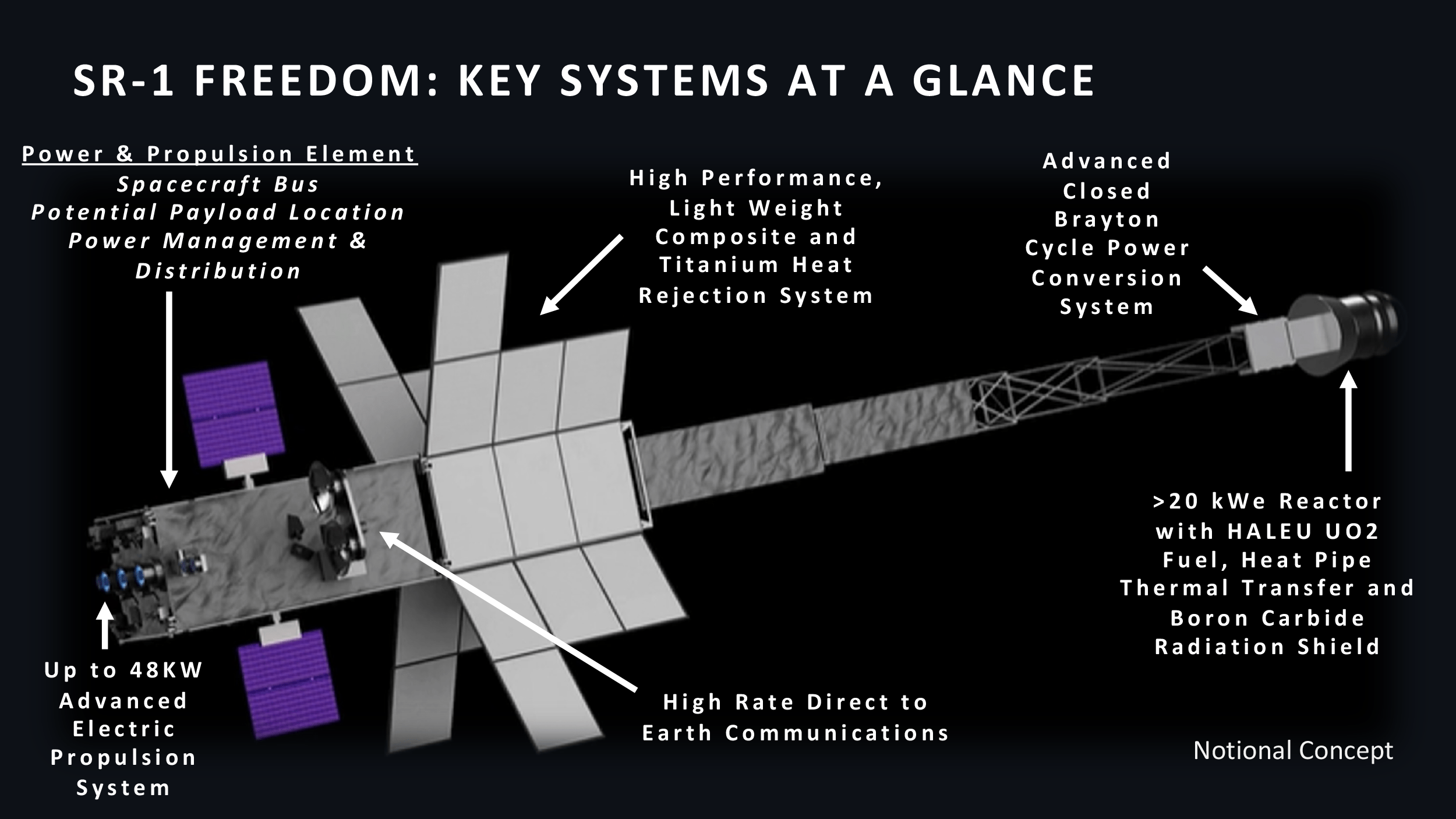
What might the SR-1 look like? MIT Technology Review saw a presentation by Steve Sinacore, program executive of NASA’s Space Reactor Office, that offers some clues. So far, the concept art makes it look like a colossal fletched arrow. At the back will be the power-and-propulsion system, while its tip will hold a 20-kilowatt-or-greater uranium-filled nuclear reactor. (For context, a typical nuclear plant on Earth is 50,000 times more powerful, producing a gigawatt of power.) 

Annotated diagram of the key systems of SR-1 Freedom. Indicated at the front is the power and propulsion element, up to 48kw Advanced electric propulsion system. Panels at the middle are high performance, light weight composite and titanium heat rejection system. At the tail there is indicated an advanced closed Brayton cycle power conversion system and a .20kWe Reactor with HALEU UO2 fuel, heat pipe thermal transfer and boron carbide radiation shield. A small attachment at midcraft is labelled. :High Rate Direct to Earth Communications.

The “fletches” on SR-1 are large fins that allow the reactor to cool down. “You have to have really large radiators,” says Holmes, since the nuclear fission process produces so much heat that much of it has to be vented into space—otherwise, the reactor and spacecraft will melt.

According to that presentation, the spacecraft’s hardware development is due to start this June. By January 2028, SR-1’s systems should be ready for assembly and testing. And by that October, the spacecraft will arrive at the launch site, ready for liftoff before the year’s end. Will the nuclear reactor manage to hold itself together? “Going through the launch safely is going to be a challenge,” says Middleburgh. “You are being shaken, rattled, and rolled.” 

Then, he says, “once you’re up in space, once you’ve got through that few minutes of hell in getting there, it’s zero-gravity considerations you have to worry about.” The question then becomes: Will the mechanics of the reactor, built on terra firma, still work? 

For safety reasons, the nuclear reactor will be switched on around two days post-launch, when it’s comfortably in space. Uranium isn’t tremendously dangerous by itself, but that can’t be said of the nuclear waste products that emerge when the reactor is activated, so you don’t want any of that to fall back to Earth. 

If this schedule is adhered to, and SR-1 works as planned, it’s expected to reach Mars about a year after launch. “It’s an aggressive timeline,” says Holmes, something she suspects is being driven partly by China’s and Russia’s own deep-space nuclear ambitions. The two countries aim to place their own nuclear reactor on the moon’s surface to power the planned International Lunar Research Station—a jointly operated lunar base—by 2035. 

Whether it flies or fails in space, SR-1’s operations should help NASA with putting a nuclear reactor on the moon soon after. “All of the things we’d be learning about how that system operates in space [are] very helpful for a surface application, because basically it’s the same,” says Corbisiero. “There’s still no air on the moon.”

And if SR-1 does triumph, it will be a game-changing victory for NASA. It will also be “a massive win for the human race, frankly,” says Middleburgh. “It will be a marvel of engineering, and it will move the dial in humans potentially taking a step on Mars.” Like many of his colleagues, including Holmes, he remains thrilled by the prospect of the first-ever nuclear-powered interplanetary spacecraft—even with the incredibly ambitious timeline. 

“These are the things that get us up in the morning,” he says. “These are the sorts of things we will remember when we’re old.”

Shape
Shape
Stay Ahead

Explore More Insights

Stay ahead with more perspectives on cutting-edge power, infrastructure, energy,  bitcoin and AI solutions. Explore these articles to uncover strategies and insights shaping the future of industries.

Shape

HPE bolsters autonomous network operations for Mist, Aruba Central

Outside of the wireless realm, HPE has added the ability to autonomously fix VLAN configuration errors in the access layer to prevent blackholing of client traffic and detect/remediate unauthorized DHCP servers. The idea is to mitigate potential external security risks and prevent end user connectivity disruptions, according to a blog

Read More »

Netskope launches AI agents for SOC and NOC automation

“Netskope AI agents are specifically designed with platform workflows in mind and deeply embedded within the architecture,” said Rich Davis, director of product and solutions marketing at Netskope, in an interview with Network World. Running agents directly on data sources reduces the need to move large volumes of data to

Read More »

OTC speakers say Venezuela reopening hinges on stability, legal clarity

The conversation comes as the Trump administration continues easing sanctions and encouraging American operators to re-engage with Venezuela’s oil and gas sector. Signs are growing that major international energy companies are reassessing opportunities in the country. ExxonMobil and ConocoPhillips have recently dispatched technical teams to evaluate oilfield infrastructure and upstream prospects, while Gulf Coast refiners have already increased imports of Venezuelan heavy crude. Panelists said the central question facing US energy companies is no longer whether Venezuela will reopen, but whether the conditions, pace, and overall risk profile of that reopening are sufficient to support large-scale, long-term capital investment. Speakers noted that Venezuela’s appeal extends far beyond short-term political change. The country holds one of the world’s largest and most diverse hydrocarbon resource bases, including extra-heavy crude in the Orinoco Belt, conventional light and medium oil, and significant offshore natural gas resources. The opportunity lies not only in the size of the resource base, but also in the long-term development potential, the panelists said. However, years of underinvestment, deteriorating infrastructure, and labor losses mean rebuilding the sector will require significant technical expertise and sustained capital commitments. Oilfield service companies are expected to play an important role if activity accelerates, particularly in offshore gas, heavy oil upgrading, drilling services, and infrastructure rehabilitation. Recent reports indicate service providers have already begun reactivating rigs and equipment stored in Venezuela in anticipation of renewed activity. Speakers emphasized that investors are seeking stable policies and durable legal frameworks before committing capital at scale. Trust in Venezuela’s legal and regulatory system remains weak following years of expropriations and contract disputes. Companies must evaluate not only Venezuela’s domestic political outlook, but also the broader geopolitical dynamics involving the US and China, Borrego noted. China’s long-standing investments and influence in Venezuela’s energy sector were referenced as an important

Read More »

NNPC advances rehab, expansion plans for idled refineries

Nigeria National Petroleum Corp. Ltd. (NNPC) has entered a memorandum of understanding (MOU) with China-based Sanjiang Chemical Co. Ltd. and Xinganchen (Fuzhou) Industrial Park Operation and Management Co. Ltd. for collaboration via a potential technical equity partnership to support ongoing rehabilitation and expansion plans at two of its currently idled in-country refining complexes. Announced in early May, the MOU’s proposed framework covers unspecified remaining rehabilitation works at subsidiary Warri Refining & Petrochemical Co. Ltd.’s (WRPC) 125,000-b/sd refinery in Nigeria’s Delta State and Port Harcourt Refining Co. Ltd.’s (PHRC) 60,000-b/sd hydroskimming refinery at Alesa-Eleme near Port Harcourt in Rivers State, NNPC said. Alongside operating and maintenance activities to help the sites achieve best-in-class, sustainable performance, the MOU also outlines proposed expansions and upgrades at both refineries to enable production of cleaner, higher-valued products, according to the company. While NNPC did not clarify the nature of expansion and upgrading plans for either of the refining sections of the sites, the operator said the potential collaboration with Sanjiang Chemical and and Xinganchen (Fuzhou) Industrial Park also would weigh options for expanding the two complex’s petrochemical capabilities, as well as future development of co-located, gas-based industrial hubs at the two locations. NNPC said formal signing of the MOU follows more than 6 months of technical and management discussions with the two Chinese firms to develop a roadmap for restoring sustained, high-performance manufacturing operations at both sites. The MOU comes as part of NNPC’s broader mission to identify potential privately held technical equity partners to help support rehabilitation and expansion of its existing but nonoperational refining infrastructure, which ideally would include a willingness to evaluate opportunities for adding co-located petrochemical production and gas-based industries at the sites, the operator said. The agreement with Sanjiang Chemical and and Xinganchen (Fuzhou) Industrial Park follows NNPC’s announcement earlier

Read More »

Oil prices touch 4-year high as Iran crisis continues

Brent crude briefly surged above $126/bbl on Apr. 30, marking a 4-year high, as escalating tensions surrounding the Iran conflict intensified concerns over prolonged disruptions to Middle East oil flows. Stay updated on oil price volatility, shipping disruptions, LNG market analysis, and production output at OGJ’s Iran war content hub. The price spike reflects a market increasingly driven by geopolitical risk. The ongoing US–Iran standoff has effectively curtailed shipping activity through the Strait of Hormuz, a critical artery for global crude trade, with negotiations showing little progress toward reopening the route. President Donald Trump reiterated that a US naval blockade of Iran would remain in place until Tehran abandons its nuclear ambitions, reinforcing expectations of a prolonged supply disruption. Amid these disruptions, US crude exports have surged, highlighting the country’s growing role as a global swing supplier. According to the US Energy Information Administration (EIA), US crude exports rose to a record 6.44 million b/d in the latest reporting week, driving the US to become a net crude exporter on a weekly basis for the first time since World War II. The shift was accompanied by a 6.2 million-bbl draw in US commercial crude inventories, underscoring the tightness in global supply as buyers in Europe and Asia turn to US barrels to offset Middle East disruptions. Meanwhile, policy and macroeconomic signals added another layer of complexity. The Federal Reserve held interest rates steady in its Apr. 29 meeting, citing persistent uncertainty around inflation and growth, particularly as higher energy prices threaten to feed into broader economic conditions. US gasoline prices have followed crude higher, rising to $4.30/gal on Apr. 30, reflecting tightening refined product balances ahead of the summer driving season.

Read More »

Expand Energy prepared to slow completion work if prices weaken further

Expand produced nearly 7.44 bcfed during the first quarter (93% natural gas), which was up nearly 10% from the first three months of 2025. Of that production, 46% came from assets in the Haynesville basin (up from about 39% a year earlier), 37% from Northeast Appalachia and the remainder from Southwest Appalachia. Wichterich, who in February replaced Nick Dell’Osso while Expand’s directors search for a new permanent leader, is looking to have full-year 2026 production average about 7.5 bcfed while deploying between 11 and 12 rigs and six to seven completion crews. The current quarter will feature some seasonal curtailments, executives said, and production is expected to remain flat from early this year. “We are in the right place at the right time,” Wichterich said on the conference call. “Our assets are reaching 90% of the expected demand growth in this country and our Haynesville [operation] is sitting at the epicenter of growth because of the LNG market. We think we are in the best position to take advantage of that.” On the LNG front, Expand executives this week signed a 20-year sales and purchase agreement with Delfin FLNG Vessel 1 that calls for Expand to supply about 1.15 million tpa. That contract replaces previous deals with Delfin and Gunvor Group and calls for the gas to be sold at a Henry Hub price and to start flowing in 2031. Expand produced a first-quarter net profit of $1.16 billion on total revenues of $4.4 billion. Those numbers were an improvement from early 2025, when the company lost $249 million on $2.2 billion in sales, the latter figure hampered by $1 billion loss on derivatives. Shares of Expand (Ticker: EXE) were up nearly 3% to about $99.50 in afternoon trading on April 29. Over the last six months, they’re essentially flat

Read More »

Woodside appoints Lonnie as EVP, COO Australia

@import url(‘https://fonts.googleapis.com/css2?family=Inter:[email protected]&display=swap’); .ebm-page__main h1, .ebm-page__main h2, .ebm-page__main h3, .ebm-page__main h4, .ebm-page__main h5, .ebm-page__main h6 { font-family: Inter; } body { line-height: 150%; letter-spacing: 0.025em; } button, .ebm-button-wrapper { font-family: Inter; } .label-style { text-transform: uppercase; color: var(–color-grey); font-weight: 600; font-size: 0.75rem; } .caption-style { font-size: 0.75rem; opacity: .6; } #onetrust-pc-sdk [id*=btn-handler], #onetrust-pc-sdk [class*=btn-handler] { background-color: #c19a06 !important; border-color: #c19a06 !important; } #onetrust-policy a, #onetrust-pc-sdk a, #ot-pc-content a { color: #c19a06 !important; } #onetrust-consent-sdk #onetrust-pc-sdk .ot-active-menu { border-color: #c19a06 !important; } #onetrust-consent-sdk #onetrust-accept-btn-handler, #onetrust-banner-sdk #onetrust-reject-all-handler, #onetrust-consent-sdk #onetrust-pc-btn-handler.cookie-setting-link { background-color: #c19a06 !important; border-color: #c19a06 !important; } #onetrust-consent-sdk .onetrust-pc-btn-handler { color: #c19a06 !important; border-color: #c19a06 !important; } Woodside Energy has appointed Breyden Lonnie as executive vice-president and chief operating officer Australia. Lonnie has acted in the role since December 2025, with responsibility for Woodside’s portfolio of operations and projects in Western Australia and the Bass Strait. He joined the company in 2005. Prior, Lonnie—who has 24 years of industry experience in engineering, operations, planning, and management roles in Australia and internationally—served as Woodside’s vice-president North West Shelf. He joined Woodside in 2005. In a post to his LinkedIn account, Lonnie said “2026 will be an important year for [Woodside’s] Australian business, with a strong focus on disciplined operations, progressing Scarborough toward first LNG and taking operatorship of the Gippsland Basin Joint Venture.” 

Read More »

ConocoPhillips adds to Permian basin capex in 2026

ConocoPhillips’ capex in the first quarter was a little more than $2.9 billion, of which $1.5 billion went to activity in the Lower 48 and $949 million was allocated to Alaska, where teams are working on the Western North Slope and in the Greater Kuparuk Area. Spending last year was $12.6 billion. Lance called the incremental investments now on the books “no-brainers” that are “going to keep our efficient machine running.” Looking longer term, he added, the ConocoPhillips team thinks the Iran war will move the price of oil “up a little bit, at least relative to where we were before the conflict started.” That will inform executives’ 2027 planning process but is not a driver of this latest capex increase. Stay updated on oil price volatility, shipping disruptions, LNG market analysis, and production output at OGJ’s Iran war content hub. “Recall, we were pretty constructive over the last few years before this got started with some uncertainty around how the physical and paper markets were acting […] and this has just accelerated a lot of that,” Lance said. “The floor probably has to come up to account for the changes that have occurred over the last couple of months.” Shares of ConocoPhillips (Ticker: COP) slipped 2% to about $126 after the earnings report and conference call. Over the past 6 months, shares are still up more than 40%, a rise that has grown the operator’s market capitalization to more than $153 billion.

Read More »

Lumen advances cloud networking vision with $475M Alkira buy

Lumen puts its total addressable market at approximately $70 billion once Alkira’s international and cloud-to-cloud coverage is included. “Alkira is a bull’s eye in terms of strategic alignment and value creation,” Johnson said. “For Lumen, we expect it to dramatically accelerate our road map execution from years to months.” How the architecture works Alkira operates as a cloud-native, carrier-agnostic control plane. Rather than relying on physical hardware at each interconnection point, it uses a virtual port model that lets enterprises design, deploy and manage network connectivity across clouds, data centers and on-premises environments through a single interface. Alkira is distinct from Lumen’s existing Project Berkeley, which introduces fabric ports for building-to-cloud on-ramp connectivity. “Fabric ports is about enabling building on-prem to be able to connect to the cloud and to be able to grow those services in a cloud economic way,” Johnson said. “The Alkira platform really focuses on the East-West interconnect. So that’s data center-to-data center, cloud-to-cloud, so they operate with more of a virtual port kind of a model, and it’s better together.” Lumen’s Multi-Cloud Gateway bridges the two domains, enabling customers to connect any cloud and any data center over Lumen’s private network. After close, Multi-Cloud Gateway and Alkira together are intended to give customers a single control plane for routing, policy and security across both north-south and east-west connectivity.

Read More »

Data Center Jobs: Engineering, Construction, Commissioning, Sales, Field Service and Facility Tech Jobs Available in Major Data Center Hotspots

Each month Data Center Frontier, in partnership with Pkaza, posts some of the hottest data center career opportunities in the market. Here’s a look at some of the latest data center jobs posted on the Data Center Frontier jobs board, powered by Pkaza Critical Facilities Recruiting. Looking for Data Center Candidates? Check out Pkaza’s Active Candidate / Featured Candidate Hotlist Power Applications Engineer Pittsburgh, PA This position is also available in: Denver, CO; Andrews, SC and remotely. Our client is a leading provider and manufacturer of industrial electrical power equipment used in industrial applications for mission critical operations. They help their customers save money by reducing energy and operating costs and provide solutions for modernizing their customer’s existing electrical infrastructure. This company provides cooling solutions to many of the world’s largest organizations and government facilities and enterprise clients, colocation providers and hyperscale companies. This career-growth minded opportunity offers exciting projects with leading-edge technology and innovation as well as competitive salaries and benefits. Electrical Commissioning Engineer New Albany, OH This traveling position is also available in: New York, NY; White Plains, NY;  Dallas, TX; Richmond, VA; Ashburn, VA; Montvale, NJ; Charlotte, NC; Atlanta, GA; Hampton, GA; Cedar Rapids, IA; Phoenix, AZ; Salt Lake City, UT; Kansas City, MO; Omaha, NE; Chesterton, IN or Chicago, IL. *** ALSO looking for a LEAD EE and ME CxA Agents and CxA PMs. ***  Our client is an engineering design and commissioning company that has a national footprint and specializes in MEP critical facilities design. They provide design, commissioning, consulting and management expertise in the critical facilities space. They have a mindset to provide reliability, energy efficiency, sustainable design and LEED expertise when providing these consulting services for enterprise, colocation and hyperscale companies. This career-growth minded opportunity offers exciting projects with leading-edge technology and innovation as well as

Read More »

Switch storm coming: Gartner forecasts price hikes, long lead times for enterprise data center switches

“If you’re a vendor and you’re doing what you’re supposed to do, you want to capture the growth,” he says. Zeus Kerravala, founder and principal analyst with ZK Research, agrees. “Cisco, Arista, Juniper and those companies that build data center equipment, make no mistake, their resources are directed towards AI first because they want to be part of those big buildouts,” he says. “There’s a lot of money being poured into neoclouds, things like that. They’ve reprioritized the resources based on where market demand is.” Price hikes, long lead times, sketchy support The repercussions for companies with traditional data centers include higher prices, long lead times, and perhaps subpar support. Gartner predicts switch price increases of 15% to 40%, largely the result of resource constraints, and lead times of three to nine months, up from one to two months in mid-2025. Constraints should ease by around the middle of next year, but don’t expect prices to come down. “Generally speaking, vendors have no consistent track record of reducing prices in these networking markets,” Lerner says. At the same time, with vendors dedicating scarce engineering talent to AI, they likely won’t invest in significant innovations for non-AI switch families. The same goes for support.

Read More »

Build Fast, Pay Your Way: Washington’s AI Infrastructure Doctrine

In the first quarter of 2026, the U.S. government made one point unmistakable. Washington wants more data center capacity, more AI infrastructure, and more domestic power. But it no longer views these projects as conventional commercial real estate. Across the White House, DOE, FERC, EPA, EIA, and the federal permitting apparatus, data centers are now being treated as strategic infrastructure. That designation brings tangible support in the form of faster permitting, access to federal land, and a more explicit embrace of large-scale power development. It also comes with conditions: stricter expectations around who funds transmission upgrades, who provides new generation, how water is managed, and how much operational data operators must disclose. This is the new federal posture: accelerate the buildout, but impose discipline on its consequences. Washington is not pulling back in the face of local opposition. It is pushing forward, while making clear that the next phase of data center growth must carry its own infrastructure burden. Who Will Pay? The question is no longer whether the United States will support the next wave of hyperscale and AI campus construction. The question is under what terms, and whether utilities, communities, and ratepayers will be asked to subsidize it. The outcome of that debate will be set less by local politics than by the federal rules now taking shape. The clearest signal came on March 4, when President Trump announced the “Ratepayer Protection Pledge.” Amazon, Google, Meta, Microsoft, OpenAI, Oracle, and xAI committed to “build, bring, or buy” new generation for their data centers and to fund the full cost of required grid and transmission upgrades. The administration also said those companies would coordinate with grid operators to provide backup generation in emergencies. The message was direct: data centers can grow, but the costs and reliability risks tied to

Read More »

300 MW Hyperscaler Lease Validates Applied Digital’s AI Infrastructure Financing Model

The Model Behind the Lease Applied Digital is packaging a full development solution for AI infrastructure: site, utility access, power distribution, cooling systems, and a financing framework capable of supporting multi-hundred-megawatt deployments. The approach reduces the integration burden on hyperscale customers and aligns delivery with the scale and timelines of AI demand. The Delta Forge 1 lease indicates that at least one major hyperscaler is willing to commit to that model on a long-term basis. The scale of the agreement reinforces that point. The lease accounts for 300 MW within a 430 MW campus, with capacity structured across two 150 MW buildings. The agreement spans two leases and includes three five-year renewal options, establishing a long-duration footprint at the site. This level of commitment effectively anchors the first phase of Delta Forge 1 and provides a clear validation of the campus’s initial buildout. Financing Follows the Lease Applied Digital paired the Delta Forge 1 tenant announcement with a financing update that underscores the link between signed demand and capital formation. The company expects to secure up to $600 million in additional funding, including a senior secured bridge facility of up to $300 million to support continued development at Polaris Forge 1, along with a $300 million revolving credit facility for development, working capital, and transaction expenses. The structure highlights how hyperscaler commitments can be translated into financing capacity across a broader platform. The Delta Forge 1 lease functions as a catalyst for the next phase of capital deployment. That momentum builds on a financing-heavy stretch. In its April 8 fiscal third-quarter results, Applied Digital disclosed a $2.15 billion private offering of 6.750% senior secured notes due 2031 to support Polaris Forge 2. The company also detailed credit enhancements tied to CoreWeave leases at Polaris Forge 1 following an investment-grade A3

Read More »

DCF Poll: Risks in the Data Center Pipeline

Matt Vincent is Editor in Chief of Data Center Frontier, where he leads editorial strategy and coverage focused on the infrastructure powering cloud computing, artificial intelligence, and the digital economy. A veteran B2B technology journalist with more than two decades of experience, Vincent specializes in the intersection of data centers, power, cooling, and emerging AI-era infrastructure. Since assuming the EIC role in 2023, he has helped guide Data Center Frontier’s coverage of the industry’s transition into the gigawatt-scale AI era, with a focus on hyperscale development, behind-the-meter power strategies, liquid cooling architectures, and the evolving energy demands of high-density compute, while working closely with the Digital Infrastructure Group at Endeavor Business Media to expand the brand’s analytical and multimedia footprint. Vincent also hosts The Data Center Frontier Show podcast, where he interviews industry leaders across hyperscale, colocation, utilities, and the data center supply chain to examine the technologies and business models reshaping digital infrastructure. Since its inception he serves as Head of Content for the Data Center Frontier Trends Summit. Before becoming Editor in Chief, he served in multiple senior editorial roles across Endeavor Business Media’s digital infrastructure portfolio, with coverage spanning data centers and hyperscale infrastructure, structured cabling and networking, telecom and datacom, IP physical security, and wireless and Pro AV markets. He began his career in 2005 within PennWell’s Advanced Technology Division and later held senior editorial positions supporting brands such as Cabling Installation & Maintenance, Lightwave Online, Broadband Technology Report, and Smart Buildings Technology. Vincent is a frequent moderator, interviewer, and keynote speaker at industry events including the HPC Forum, where he delivers forward-looking analysis on how AI and high-performance computing are reshaping digital infrastructure. He graduated with honors from Indiana University Bloomington with a B.A. in English Literature and Creative Writing and lives in southern New Hampshire with

Read More »

Microsoft will invest $80B in AI data centers in fiscal 2025

And Microsoft isn’t the only one that is ramping up its investments into AI-enabled data centers. Rival cloud service providers are all investing in either upgrading or opening new data centers to capture a larger chunk of business from developers and users of large language models (LLMs).  In a report published in October 2024, Bloomberg Intelligence estimated that demand for generative AI would push Microsoft, AWS, Google, Oracle, Meta, and Apple would between them devote $200 billion to capex in 2025, up from $110 billion in 2023. Microsoft is one of the biggest spenders, followed closely by Google and AWS, Bloomberg Intelligence said. Its estimate of Microsoft’s capital spending on AI, at $62.4 billion for calendar 2025, is lower than Smith’s claim that the company will invest $80 billion in the fiscal year to June 30, 2025. Both figures, though, are way higher than Microsoft’s 2020 capital expenditure of “just” $17.6 billion. The majority of the increased spending is tied to cloud services and the expansion of AI infrastructure needed to provide compute capacity for OpenAI workloads. Separately, last October Amazon CEO Andy Jassy said his company planned total capex spend of $75 billion in 2024 and even more in 2025, with much of it going to AWS, its cloud computing division.

Read More »

John Deere unveils more autonomous farm machines to address skill labor shortage

Join our daily and weekly newsletters for the latest updates and exclusive content on industry-leading AI coverage. Learn More Self-driving tractors might be the path to self-driving cars. John Deere has revealed a new line of autonomous machines and tech across agriculture, construction and commercial landscaping. The Moline, Illinois-based John Deere has been in business for 187 years, yet it’s been a regular as a non-tech company showing off technology at the big tech trade show in Las Vegas and is back at CES 2025 with more autonomous tractors and other vehicles. This is not something we usually cover, but John Deere has a lot of data that is interesting in the big picture of tech. The message from the company is that there aren’t enough skilled farm laborers to do the work that its customers need. It’s been a challenge for most of the last two decades, said Jahmy Hindman, CTO at John Deere, in a briefing. Much of the tech will come this fall and after that. He noted that the average farmer in the U.S. is over 58 and works 12 to 18 hours a day to grow food for us. And he said the American Farm Bureau Federation estimates there are roughly 2.4 million farm jobs that need to be filled annually; and the agricultural work force continues to shrink. (This is my hint to the anti-immigration crowd). John Deere’s autonomous 9RX Tractor. Farmers can oversee it using an app. While each of these industries experiences their own set of challenges, a commonality across all is skilled labor availability. In construction, about 80% percent of contractors struggle to find skilled labor. And in commercial landscaping, 86% of landscaping business owners can’t find labor to fill open positions, he said. “They have to figure out how to do

Read More »

2025 playbook for enterprise AI success, from agents to evals

Join our daily and weekly newsletters for the latest updates and exclusive content on industry-leading AI coverage. Learn More 2025 is poised to be a pivotal year for enterprise AI. The past year has seen rapid innovation, and this year will see the same. This has made it more critical than ever to revisit your AI strategy to stay competitive and create value for your customers. From scaling AI agents to optimizing costs, here are the five critical areas enterprises should prioritize for their AI strategy this year. 1. Agents: the next generation of automation AI agents are no longer theoretical. In 2025, they’re indispensable tools for enterprises looking to streamline operations and enhance customer interactions. Unlike traditional software, agents powered by large language models (LLMs) can make nuanced decisions, navigate complex multi-step tasks, and integrate seamlessly with tools and APIs. At the start of 2024, agents were not ready for prime time, making frustrating mistakes like hallucinating URLs. They started getting better as frontier large language models themselves improved. “Let me put it this way,” said Sam Witteveen, cofounder of Red Dragon, a company that develops agents for companies, and that recently reviewed the 48 agents it built last year. “Interestingly, the ones that we built at the start of the year, a lot of those worked way better at the end of the year just because the models got better.” Witteveen shared this in the video podcast we filmed to discuss these five big trends in detail. Models are getting better and hallucinating less, and they’re also being trained to do agentic tasks. Another feature that the model providers are researching is a way to use the LLM as a judge, and as models get cheaper (something we’ll cover below), companies can use three or more models to

Read More »

OpenAI’s red teaming innovations define new essentials for security leaders in the AI era

Join our daily and weekly newsletters for the latest updates and exclusive content on industry-leading AI coverage. Learn More OpenAI has taken a more aggressive approach to red teaming than its AI competitors, demonstrating its security teams’ advanced capabilities in two areas: multi-step reinforcement and external red teaming. OpenAI recently released two papers that set a new competitive standard for improving the quality, reliability and safety of AI models in these two techniques and more. The first paper, “OpenAI’s Approach to External Red Teaming for AI Models and Systems,” reports that specialized teams outside the company have proven effective in uncovering vulnerabilities that might otherwise have made it into a released model because in-house testing techniques may have missed them. In the second paper, “Diverse and Effective Red Teaming with Auto-Generated Rewards and Multi-Step Reinforcement Learning,” OpenAI introduces an automated framework that relies on iterative reinforcement learning to generate a broad spectrum of novel, wide-ranging attacks. Going all-in on red teaming pays practical, competitive dividends It’s encouraging to see competitive intensity in red teaming growing among AI companies. When Anthropic released its AI red team guidelines in June of last year, it joined AI providers including Google, Microsoft, Nvidia, OpenAI, and even the U.S.’s National Institute of Standards and Technology (NIST), which all had released red teaming frameworks. Investing heavily in red teaming yields tangible benefits for security leaders in any organization. OpenAI’s paper on external red teaming provides a detailed analysis of how the company strives to create specialized external teams that include cybersecurity and subject matter experts. The goal is to see if knowledgeable external teams can defeat models’ security perimeters and find gaps in their security, biases and controls that prompt-based testing couldn’t find. What makes OpenAI’s recent papers noteworthy is how well they define using human-in-the-middle

Read More »

What’s next for IVF

EXECUTIVE SUMMARY Forty-eight years ago this July, Louise Joy Brown became the world’s first person born with the help of in vitro fertilization. Millions more

Read More »