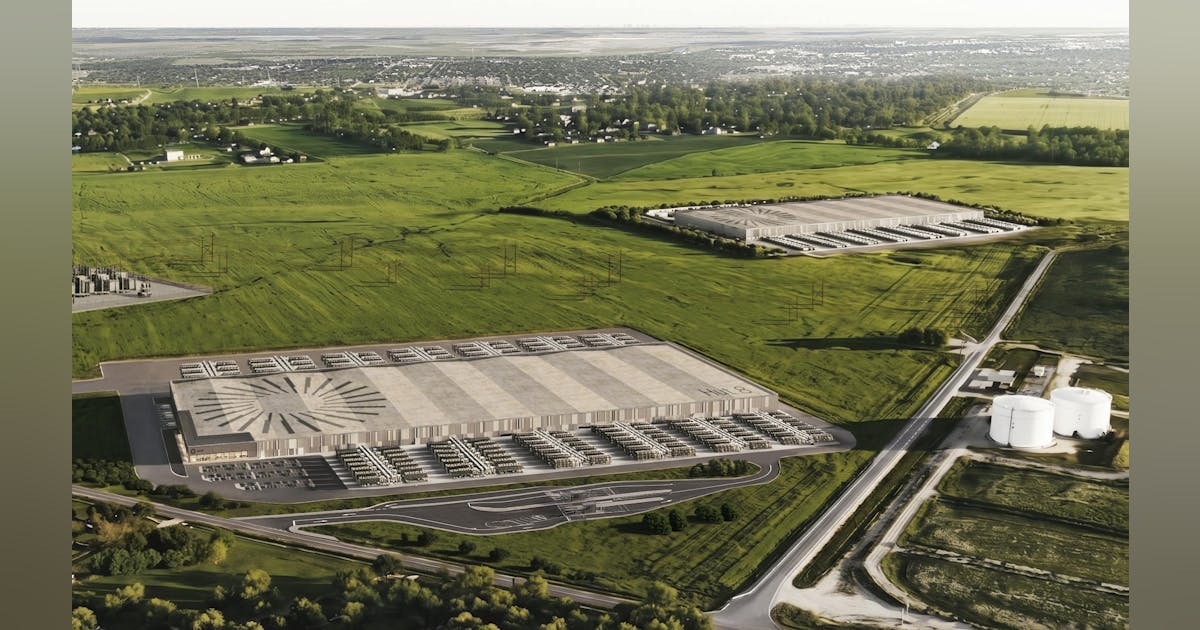
Aalo and Crusoe Pursue the Nuclear-Powered AI Factory
The Aalo-Crusoe partnership addresses the industry’s power problem by bringing power generation directly to the compute. In this case, skipping intermediary power stages such as minimal grid or custom BTM gas turbine solutions and going straight to nuclear.
Aalo Atomics and Crusoe said they plan to deploy a Crusoe Spark modular data center running Crusoe Cloud at Idaho National Laboratory in 2027. The proof-of-concept project is intended to demonstrate an AI workload operating on power from an Aalo advanced reactor. Crusoe continues to expand their other data center campus projects.
The companies then intend to deploy Aalo Pods, Aalo’s 50-megawatt-electric nuclear power plants, at Crusoe data centers by the end of 2029. Aalo has already begun work on a second reactor beside its initial test unit at the Idaho site. That reactor is expected to produce electricity for the Crusoe installation.
On July 4, 2026, Aalo’s zero-power Critical Test Reactor reached criticality, sustaining a nuclear chain reaction without generating commercial electricity. The test reactor contains a full-scale core and components analogous to those planned for the 10-megawatt-electric Aalo-X power reactor being built next door, but it operates before sodium coolant and electricity-generating systems are added.
Aalo plans to continue experiments with the Critical Test Reactor to refine its reactor-physics models, characterize control behavior and generate data supporting development and licensing of the full-power Aalo-X system.
Advanced nuclear announcements sometimes blur the line between a successful test, an electricity-producing demonstration and a commercially licensed fleet. Aalo has achieved an important technical milestone, but substantial work remains before reactors can be manufactured, licensed, financed and operated at commercial data center sites.
The pairing with Crusoe should be noted because it connects a reactor developer with a company that can provide the data center load, the physical infrastructure and the cloud platform.
Crusoe Spark is a prefabricated AI data center, integrating power, cooling, remote monitoring, fire suppression and high-density racks. Crusoe says the modules can be deployed individually or combined into larger clusters, scaling from hundreds of kilowatts to tens or hundreds of megawatts. Crusoe says the factory lease and buildout, together with investment in an initial fleet of Spark modules, represents a commitment of more than $200 million.
That modularity aligns closely with Aalo’s product strategy. A 50-megawatt Aalo Pod could support a meaningful AI deployment without waiting for the transmission upgrades required by a conventional hyperscale campus. Multiple reactor and data center modules could theoretically be added as demand grows.
This creates a more incremental development model than building a one-gigawatt campus before the full load is ready. It also represents an effort to apply factory manufacturing to both halves of the project: Aalo manufactures the power plant while Crusoe manufactures the data center.
The obstacles for even a small reactor deployment outside a national laboratory are significant. Commercial deployments will require regulatory approvals, acceptable safety and security arrangements, fuel availability, waste-management plans, insurance, financing and community support. First-of-a-kind reactors also face construction and cost risks even when their designs emphasize factory manufacturing.
Aalo has secured more than $136 million in funding and is expanding toward a one-million-square-foot manufacturing operation. Nevertheless, the 2027 demonstration and 2029 commercial target should be viewed as ambitious milestones rather than guaranteed delivery dates.
Two Models for an Energy-Constrained Market
At Beacon Point, the reported model uses NVIDIA’s balance-sheet strength, DSX architecture and ecosystem relationships to support an enormous grid-connected AI campus. With Aalo and Crusoe, the model combines a manufactured reactor, a manufactured modular data center and an integrated cloud service.
One approach concentrates capacity at gigawatt scale. The other attempts to make nuclear generation and AI computing repeatable in smaller increments. Both are responses to the same constraint: obtaining power has become as important as obtaining GPUs.
NVIDIA’s reported Beacon Point commitment demonstrates how a dominant technology supplier can use its financial strength to accelerate the market surrounding its products. The Aalo-Crusoe partnership demonstrates how data center and energy systems may increasingly be designed as a single product.
Neither announcement eliminates the risks facing the AI infrastructure boom. One concentrates enormous financial commitments around future compute demand; the other depends on advanced nuclear technology progressing from demonstration to commercial operation. Both represent attempts to gain greater control over the increasingly interconnected data center, compute, power and financing stack.