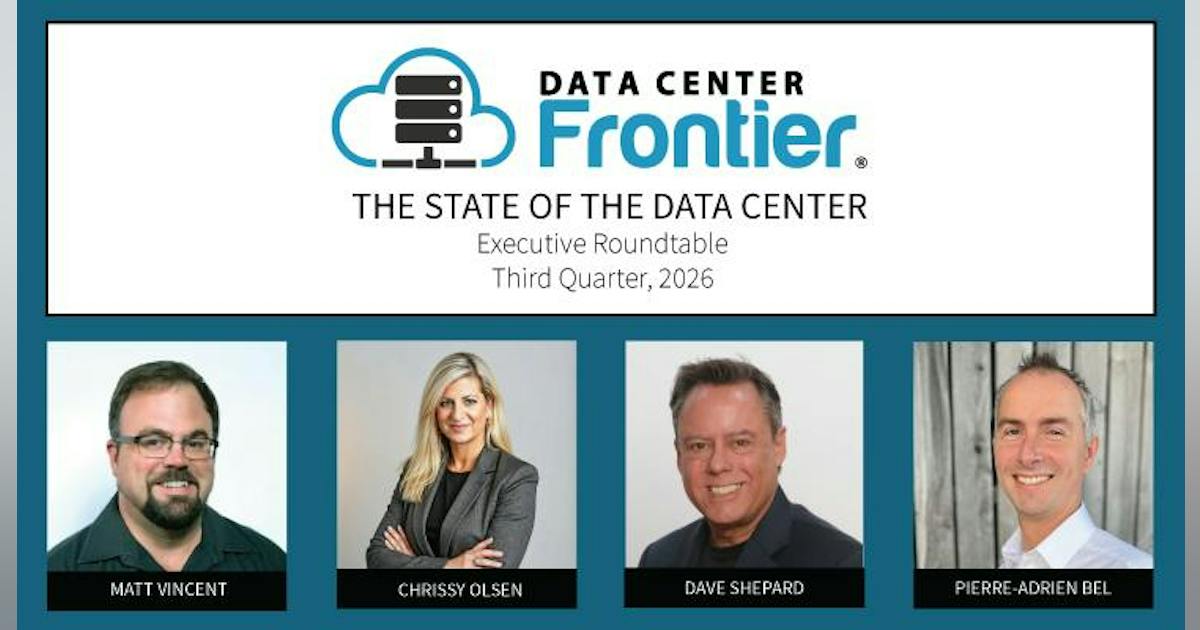
For Data Center Frontier’s Q3 2026 Executive Roundtable, three industry leaders examined a question increasingly central to the AI infrastructure buildout: What happens when data centers are asked to become larger, denser and faster at the same time?
Across three discussions, a consistent theme emerged. AI is not simply increasing the amount of infrastructure required to support the modern data center. It is exposing assumptions that were easier to tolerate at lower densities, expanding the boundaries of what operators must consider mission-critical, and making the interaction between systems increasingly important to overall resilience.
That begins with density. As the value and power concentrated in individual racks rises, traditional approaches to redundancy, monitoring and risk mitigation can leave less room for error. Resilience can no longer be measured simply by installed capacity or the presence of backup equipment. Operators increasingly need to understand how electrical, thermal and control systems behave together under dynamic AI workloads — and how quickly the facility can respond and recover when something goes wrong.
The same shift is broadening the definition of critical infrastructure. Power generation, UPS systems and network connectivity remain fundamental, but energy storage, liquid cooling, leak detection, controls, monitoring and the interfaces connecting them are becoming part of the same reliability equation. A component can perform exactly as designed while the larger system still fails if coordination, communications or control logic break down.
And all of this is happening while the market is demanding faster deployment. Standardization, modular construction, factory integration and earlier modeling can legitimately compress project schedules. But the Q3 panelists drew a clear distinction between eliminating unnecessary time and eliminating rigor. As infrastructure becomes more tightly coupled, commissioning, integrated systems testing, operational visibility and system-level validation may need to become more thorough precisely because projects are moving faster.
Taken together, the Q3 discussion points toward a broader change in how AI data center resilience must be understood. The challenge is no longer simply designing enough redundancy, specifying reliable equipment or reaching first power quickly. It is building an increasingly complex infrastructure system whose components, controls and operators can perform together — under load, under stress and at the speed the AI market now demands.
Here’s the full question-and-answer session, organized by topic:
Here are links to the individual Q&A summaries for each of our panelists:
The conversation is moderated by Data Center Frontier Editor in Chief Matt Vincent.
Thanks to all of our executive participants for sharing their time and insights!