The data center industry’s next development constraint may have less to do with megawatts than with the politics of where those megawatts are deployed.
The warning became difficult to ignore on November 3, when American voters approved 33 local ballot measures restricting data center development or expressing opposition to it, according to Ballotpedia’s analysis of the 2026 midterm elections. The results included outright bans, partial prohibitions, temporary moratoriums, and new requirements for community oversight. Voters also rejected 13 measures that would have favored development or expressed support for it. For an industry accustomed to evaluating prospective sites through the availability of power, land, fiber, capital, and construction resources, the election results reinforced another increasingly consequential consideration: whether the communities hosting digital infrastructure are willing to accept its growing physical and economic footprint.
As Data Center Frontier recently examined in its post-election assessment of the industry’s political future, the national push to accelerate AI infrastructure construction is colliding with a more complicated political reality at the state and local levels. Opposition crosses party lines, while questions surrounding utility rates, water, environmental impacts, and local economic benefits have moved from planning commission meetings into broader electoral debate.
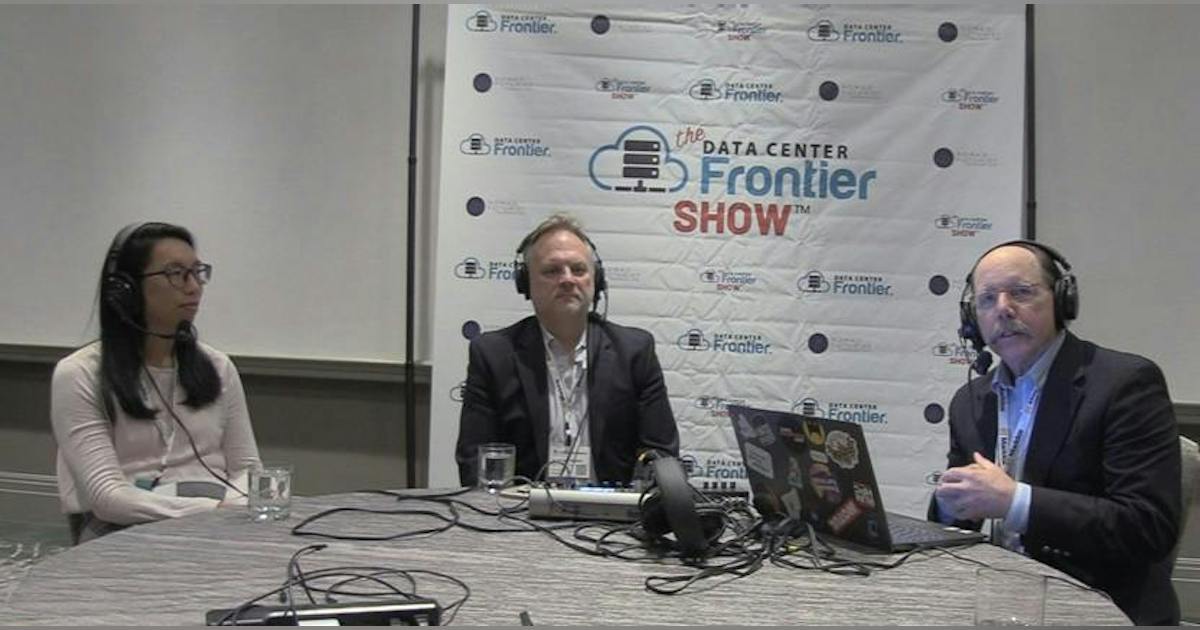
That changing environment was the subject of a conversation recorded at the DCF Trends Summit 2026 in Reston, Virginia, where DCF contributing editor Doug Black sat down with Adam Waitkunas, president of Milldam Public Relations, and Julia Chuang, founder of LocalQ Labs and an associate professor of sociology at the University of Maryland. Their discussion explored a fundamental shift in the development equation: community opposition is becoming more organized and politically consequential, but also more observable through data. The challenge for developers is to understand that risk early enough to influence site selection and project design, while recognizing that public trust cannot be manufactured through conventional public relations alone.
Community Intelligence Enters the Site-Selection Equation
Chuang approaches data center development through the lens of sociology and the study of political and social movements. Her work at LocalQ Labs focuses on the relationship between organized opposition, local governance, and the conditions under which data center proposals encounter regulatory resistance. The company’s platform tracks more than 1,300 U.S. facilities and projects, combining regulatory histories with information about local political conditions and opposition activity to identify patterns that may be difficult to recognize when examining individual sites.
“I do think there are a lot of things you can see in the aggregate that you can’t see when you go site by site,” Chuang said.
Among the relationships she identified are increased moratorium activity ahead of elections and greater exposure to permitting delays when projects enter rezoning or approval processes close to a local election. Chuang also described differences associated with state political control: in her analysis, states with Democratic trifectas tend to produce more regulatory activity without necessarily producing more outright bans, while some rural Republican jurisdictions have exhibited a stronger preference for prohibiting projects altogether. These are findings from Chuang’s research rather than universal rules governing development outcomes, but they point toward an important change in how prospective sites might be evaluated.
A project with available power and favorable industrial zoning may still face meaningful political exposure if an election is approaching, local officials are reconsidering development priorities, or opposition groups have successfully mobilized in neighboring jurisdictions. LocalQ Labs’ published research similarly examines how restrictions emerge across communities, with local organizations learning from one another and adapting regulatory approaches to their own circumstances.
Northern Virginia offers an instructive case. Despite the highly publicized controversy surrounding Prince William County’s Digital Gateway development, Chuang cautioned against assuming that opposition necessarily increases as additional facilities enter an established market. In her analysis, Northern Virginia has maintained a comparatively low share of canceled or delayed facilities relative to its development activity, suggesting that some communities may become more accepting once facilities, infrastructure, tax contributions, and operating regulations are established. That interpretation does not diminish the region’s continuing land-use disputes. Indeed, as DCF’s recent examination of Virginia’s changing data center policies detailed, the commonwealth is tightening the terms under which new development proceeds. What the Northern Virginia experience suggests is that opposition, regulation, and continued infrastructure growth can coexist.
When Local Opposition Becomes a National Movement
If political timing represents one part of the changing development equation, the organization of opposition represents another. Waitkunas, whose firm has worked extensively with data center operators and developers, described a growing distinction between concerns originating within individual communities and coordinated campaigns drawing upon broader political and environmental organizations. Localized opposition, he suggested, often has identifiable stakeholders and specific concerns that developers can address through direct engagement. Nationally coordinated campaigns can be more difficult to navigate because their organizing strategies, messaging, and political objectives may extend beyond the particular project under consideration.
Chuang’s analysis points in a similar direction. Before 2025, she said, differences in local and state regulatory structures were particularly important in explaining where projects encountered delays. Since then, she has observed a growing role for coalitions linking environmental advocacy groups, land-use organizations, and other opponents of data center development.
Independent reporting provides support for the broader trend. In June, Food & Water Watch announced a national coalition of more than 500 organizations calling for a moratorium on AI data center expansion, explicitly seeking to connect local organizing with state and federal policy efforts. Separately, a 2026 research working paper by University of Oslo researcher Jason Miklian identified 457 restrictions adopted across 348 U.S. counties between 2017 and August 2026. The study found evidence of restrictions spreading among jurisdictions connected through opposition organizations, including counties that did not share borders, although it did not establish that those organizational relationships directly caused the regulatory actions.
Taken together, the findings suggest that developers can no longer assume each zoning challenge or permitting dispute is an independent event. Strategies developed in one community can inform proceedings elsewhere, while organizations experienced in environmental litigation, utility regulation, or land-use disputes can bring specialized knowledge to local campaigns. Yet neither guest suggested that all opposition should be treated as illegitimate or politically manufactured. Waitkunas acknowledged that residents have every right to question projects entering their neighborhoods, while Chuang distinguished broader ideological resistance to artificial intelligence from potentially negotiable concerns about specific infrastructure proposals.
A community seeking to underground a transmission line or impose stronger environmental safeguards is presenting a different challenge from a movement fundamentally opposed to AI infrastructure growth. Recognizing that distinction may determine whether a dispute can be addressed through engineering changes, operating commitments, and negotiations—or whether it reflects a more enduring political disagreement.
The Industry’s Language Problem: Efficiency Versus Impact
One of the podcast’s more revealing exchanges concerned the disconnect between subjects dominating data center industry conferences and the issues occupying residents of prospective host communities. Chuang observed that sustainability discussions, which had been prominent at earlier industry events, appeared to be giving way to conversations about operational efficiency, cooling performance, and maximizing AI output relative to energy consumption. Those considerations are central to the economics and engineering of modern AI infrastructure, but they do not necessarily address what communities are asking.
“That’s not the language of the communities,” Chuang said. “Like, they don’t want to hear about efficiency. They want sustainability.”
For residents, the immediate questions may involve the potential effect of a large facility on household electricity bills, local water supplies, public health, groundwater quality, or the surrounding landscape. Technical improvements in server efficiency or liquid cooling do not, by themselves, explain whether those concerns have been adequately addressed. Waitkunas described an industry that remains too reactive in its communications, noting that his firm continues receiving calls from developers after a project has already become controversial—sometimes following the disclosure of a nondisclosure agreement or the discovery of a prospective site by a local business publication. By that stage, the public narrative may already be taking shape without meaningful participation from the developer.
He also questioned the effectiveness of public meetings organized around individual informational stations, where residents speak privately with company representatives. Such formats can offer technical detail, but they may fail to provide the public accountability communities expect. Residents, he argued, often want to hear their neighbors ask questions and witness the developer’s answers in an open forum. Transparency, in this context, means more than making information available. It means ensuring community members have a shared opportunity to scrutinize the promises being made.
The same problem extends to the industry’s economic development narrative. Data centers can generate significant construction activity, property-tax receipts, and demand for supporting services, but their permanent staffing requirements are typically modest relative to the scale of their buildings and capital investment. Waitkunas argued that operators need to explain indirect economic benefits and tax contributions more clearly, while also presenting the numbers in terms residents can understand. For communities concerned about electricity affordability or environmental exposure, however, promises of additional tax revenue may be necessary to the discussion without being sufficient to secure acceptance.
Beyond NIMBY: Who Bears the Costs of AI Infrastructure?
Chuang offered perhaps the conversation’s most important challenge to conventional industry thinking when she questioned the way the term NIMBY is frequently used. Opposition to locally unwanted infrastructure, she argued, can be a rational response to an unequal distribution of benefits and burdens.
Large infrastructure systems deliver advantages across society. Electricity transmission networks, power plants, and data centers support economic activity far beyond the communities in which they operate. Yet their immediate effects—land conversion, visual impacts, noise, resource consumption, and associated infrastructure—are concentrated geographically. From that perspective, residents who question a proposed facility are not necessarily rejecting technological progress. They may be asking why their community should absorb a disproportionate share of its consequences.
Chuang also suggested that developers must contend with the wider public image of the AI industry itself. Concerns about technological disruption, concentrated corporate wealth, private equity, and the economic power of large technology companies can become attached to infrastructure projects even when the local developer has limited control over those broader issues. She described the resulting political narrative in striking terms: “It’s billionaires versus everyone.”
The phrase was offered as a characterization of the public framing surrounding AI, rather than a literal description of every developer-community dispute. Nevertheless, it captures a problem that conventional economic development messaging may struggle to overcome. Chuang drew a historical comparison with nuclear power, whose development became entangled with broader anxieties about technology, safety, and public trust. Her point was not that data centers face identical risks, but that opposition to a particular form of infrastructure can become part of a larger political identity.
As DCF previously explored with Waitkunas and Loudoun County economic development director Buddy Rizer, the industry increasingly confronts a credibility problem that cannot be resolved by presenting facts alone. The practical question is whether developers can demonstrate that local communities have a meaningful role in shaping the terms of infrastructure growth—and that the benefits they receive justify the obligations they are being asked to accept.
Community Benefit Agreements With Operational Teeth
For Waitkunas, one answer lies in expanding the scope of community benefit agreements beyond conventional financial contributions. He proposed a two-part structure in which the first component would provide tangible economic benefits, such as funding for municipal projects or other locally negotiated priorities, while the second would establish operational commitments addressing impacts residents are most concerned about. Those commitments might involve noise limits, energy-related obligations, or operating standards exceeding local regulatory minimums. Rather than simply promising compliance with existing requirements, developers would identify measurable ways to demonstrate additional accountability.
Waitkunas also recommended involving residents directly through community task forces or advisory committees, allowing local stakeholders to help establish priorities instead of receiving predetermined benefits packages. This approach is gaining significance beyond individual developer negotiations. In September, Massachusetts Governor Maura Healey issued Executive Order 658, directing state permitting agencies not to authorize data center projects with peak electricity demand exceeding 25 megawatts unless applicants demonstrate compliance with the state’s responsible-development framework and submit a community benefits agreement aligned with state guidelines.
The order connects development expectations to environmental protection, public health, community engagement, and the costs of infrastructure expansion, illustrating how some of the commitments discussed at the August summit are becoming formal requirements. Similarly, the Federation of American Scientists has advocated for community benefit agreements establishing specific protections, public reporting, accountability mechanisms, and meaningful opportunities for residents to shape development terms.
For Waitkunas, however, securing the original approval is only the beginning. He recalled a data center in the Boston area that had been approved roughly a decade earlier with comparatively little neighborhood resistance. When the operator subsequently sought to expand, residents who had previously raised few objections became strongly opposed. The example illustrates an easily overlooked dimension of social license: a data center may operate for decades, undergo substantial upgrades, or require additional land, power, and infrastructure long after its first permitting hearings.
A developer that treats community engagement as a temporary approval exercise risks discovering that its original political support has eroded by the time expansion becomes necessary. Waitkunas said more developers and operators are beginning to recognize this, hiring internal community relations personnel and strengthening their local outreach capabilities.
Moving Engagement Upstream—and Keeping It There
Asked by Black to identify one action every developer should take before publicly announcing a project, Waitkunas returned to the importance of due diligence.
“Doing your due diligence ahead of time in lockstep with site selection,” he said.
That means examining the local history of development disputes, monitoring community concerns, reviewing newspapers and letters to the editor, and identifying stakeholders who should be involved before a project becomes a public controversy. It also means building relationships beyond the economic development organizations and public officials generally inclined to welcome new investment. Chuang argued that the industry should create more opportunities for municipal and county officials to participate directly in conferences and technical discussions, noting that developers and their critics too often operate in separate environments with limited meaningful contact.
Waitkunas added another practical recommendation: bring elected officials and community stakeholders on tours of operating data centers comparable in size, power consumption, and technical configuration to the facilities being proposed. Seeing an operating facility can help stakeholders evaluate noise, cooling equipment, building design, and other characteristics more concretely than renderings or presentations alone. Such tours cannot replace independent environmental analysis, but they can make the discussion more informed.
The larger implication is that community intelligence and community engagement must function together. Data analysis may identify political exposure and emerging patterns of resistance, while direct relationships help developers understand the circumstances, priorities, and concerns that aggregate models cannot fully capture. Neither can substitute for the other.
For an industry building infrastructure on an unprecedented scale, the lesson is becoming increasingly difficult to avoid. The availability of land and power may establish whether a project is technically possible, while financing and construction capacity determine whether it can be delivered on schedule. Community acceptance, meanwhile, increasingly influences whether it can proceed at all.
As Waitkunas and Chuang made clear at DCF Trends Summit 2026, earning that acceptance requires something more durable than a successful zoning hearing or a well-managed public relations campaign. It requires treating the communities surrounding data centers not simply as audiences to be persuaded, but as stakeholders whose interests will remain bound to the infrastructure long after construction crews have departed.