Stay Ahead, Stay ONMINE

TotalEnergies Completes Bonga Exit

TotalEnergies SE has completed the sale of its 12.5 percent stake in Oil Mining Lease (OML) 118, which contains the producing Bonga field, to partners Shell PLC and Eni SpA for $510 million. Shell Nigeria Exploration and Production Co Ltd got 10 percent, instead of 12.5 percent as initially intended. Eni through Nigeria Agip Exploration […]

TotalEnergies SE has completed the sale of its 12.5 percent stake in Oil Mining Lease (OML) 118, which contains the producing Bonga field, to partners Shell PLC and Eni SpA for $510 million.

Shell Nigeria Exploration and Production Co Ltd got 10 percent, instead of 12.5 percent as initially intended. Eni through Nigeria Agip Exploration Ltd exercised its preemption right for 2.5 percent, the parties confirmed in separate statements.

The transaction has raised operator Shell’s interest to 65 percent and Eni’s to 15 percent. Exxon Mobil Corp retains 20 percent through Esso Exploration and Production Nigeria Ltd.

OML118 contains the Bonga field, which started production 2005 and has a capacity of 225,000 barrels of oil per day (bopd), according to Shell.

“Following our final investment decision on Bonga North last year, this acquisition represents another significant investment in Nigeria deepwater, and is part of Shell’s strategy to further invest in competitive existing assets that contribute to sustained liquids production and growth in our upstream portfolio”, Britain’s Shell said.

Expected to start production by 2030, Bonga North will have a capacity of 110,000 bopd, according to Shell’s FID announcement December 16, 2024. Bonga North holds estimated recoverable resources of over 300 million barrels of oil equivalent. It will be a tieback to the Bonga floating production storage and offloading facility, according to Shell.

“This targeted investment contributes towards growing Shell’s combined Integrated Gas and Upstream total production by one percent per year to 2030 and contributes towards sustaining our 1.4 million barrels per day of liquids production”, Shell added about the acquisition from TotalEnergies.

Italy’s state-backed Eni said separately, “This acquisition is fully aligned with Eni’s strategy to optimize its upstream portfolio and further strengthens the company’s commitment to deepwater projects in the country”.

“Eni has been present in Nigeria since 1962, with an average equity production of 50 Kboed [50,000 barrels of oil equivalent per day] in 2025”, Eni added.

TotalEnergies said May 29, announcing the transaction agreement with Shell, that its OML118 exit was part of its efforts to refocus investment in the West African country to its operated gas and offshore oil assets.

However, TotalEnergies’ deal last year to sell its 10 percent stake in the SPDC Joint Venture to Chappal Energies Mauritius Ltd had collapsed, according to an online statement by the Nigerian Upstream Petroleum Regulatory Commission on September 25, 2025.

On March 13, 2025, Shell said it had completed the sale of Shell Petroleum Development Company of Nigeria Ltd (SPDC) as it also concentrates on deepwater and integrated gas assets. In the $1.3-billion transaction, the consortium Renaissance Africa took over SPDC and consequently acquired a 30 percent operating stake in the SPDC Joint Venture.

To contact the author, email [email protected]


WHAT DO YOU THINK?

Generated by readers, the comments included herein do not reflect the views and opinions of Rigzone. All comments are subject to editorial review. Off-topic, inappropriate or insulting comments will be removed.


MORE FROM THIS AUTHOR

Shape
Shape
Stay Ahead

Explore More Insights

Stay ahead with more perspectives on cutting-edge power, infrastructure, energy,  bitcoin and AI solutions. Explore these articles to uncover strategies and insights shaping the future of industries.

Shape

Fluent Bit vulnerabilities could enable full cloud takeover

Attackers could flood monitoring systems with false or misleading events, hide alerts in the noise, or even hijack the telemetry stream entirely, Katz said. The issue is now tracked as CVE-2025-12969 and awaits a severity valuation. Almost equally troubling are other flaws in the “tag” mechanism, which determines how the records are

Read More »

OPEC+ Reaffirms Decision to Pause Production Hikes

A statement posted on OPEC’s website on Sunday revealed that, in a meeting held that day, Saudi Arabia, Russia, Iraq, the United Arab Emirates (UAE), Kuwait, Kazakhstan, Algeria, and Oman “reaffirmed their decision on November 2, 2025, to pause production increments in January, February, and March 2026 due to seasonality”.  According to a table accompanying the statement, “required production” in January, February, and March next year is 10.103 million barrels per day for Saudi Arabia, 9.574 million barrels per day for Russia, 4.273 million barrels per day for Iraq, 3.411 million barrels per day for the UAE, 2.580 million barrels per day for Kuwait, 1.569 million barrels per day for Kazakhstan, 971,000 barrels per day for Algeria, and 811,000 barrels per day for Oman. That statement highlighted that the eight OPEC+ countries met virtually on November 30 “to review global market conditions and outlook”. It said the eight participating countries “reiterated that the 1.65 million barrels per day may be returned in part or in full subject to evolving market conditions and in a gradual manner”. “The countries will continue to closely monitor and assess market conditions, and in their continuous efforts to support market stability, they reaffirmed the importance of adopting a cautious approach and retaining full flexibility to continue pausing or reverse the additional voluntary production adjustments, including the previously implemented voluntary adjustments of the 2.2 million barrels per day announced in November 2023,” the statement noted. “The eight countries reiterated their collective commitment to achieve full conformity with the Declaration of Cooperation, including the additional voluntary production adjustments that will be monitored by the Joint Ministerial Monitoring Committee (JMMC),” it added. “They also confirmed their intention to fully compensate for any overproduced volume since January 2024,” it continued. The statement went on to note that the eight

Read More »

Ukraine Claims Hit on Russian ‘Shadow Fleet’ Tankers

(Update) November 29, 2025, 1:01 PM GMT: Article updated. Ukraine’s security service claimed strikes on two ocean-going tankers sanctioned for carrying Russian oil, which were hit by blasts off Turkey’s Black Sea coast over the past day.   Sea Baby naval drones operated by the Security Service of Ukraine, or SBU, carried out the attacks, a person familiar with the operation, who declined to be identified because the information isn’t public, told Bloomberg.  The attacks were aimed at crimping Russia’s ability to wage war against Ukraine, the person said, adding that the two tankers were able to carry about $70 million worth of oil. Both were sailing empty at the time of the strikes.  The first tanker, the 900-foot (274-meter) Kairos, took on water after an explosion late Friday, according to a local port agent report. The second, the Virat, was also struck near Turkey’s coastline and was billowing smoke after a near-simultaneous attack. The vessel was struck for a second time early Saturday.  The Kairos and Virat are among hundreds of vessels amassed to help keep Russian oil moving after it invaded Ukraine in February 2022. Kairos is sanctioned by the UK and European Union, while Virat has been designated by the US and EU.  T.C. Ulaştırma ve Altyapı Bakanlığı @UABakanligi BİLGİLENDİRME‼️ Rusya’ya seyir halindeyken Karadeniz açıklarında patlama ve yangın meydana gelen KAIROS isimli gemide devam eden yangına, NENE HATUN Acil Müdahale Gemimiz ve KURTARMA-12 Römorkörümüz ile @kiyiemniyet’e bağlı ekiplerimiz müdahale etmeye devam etmektedir.… Sent via Twitter for iPhone. View original tweet. It isn’t the first time ships linked to Moscow have suffered explosions this year; a spate of blasts in early 2025 hit merchant ships with a history of calling at Russian ports.  “Both ships were in our territorial waters,” CNNTurk cited Turkey’s Transportation Minister Abdulkadir Uraloglu as saying. “Initial information indicates an

Read More »

CPC Halts Black Sea Oil Loading amid Ukrainian Attacks

The Caspian Pipeline Consortium, which handles most of Kazakhstan’s crude exports through Russia to the Black Sea, halted loading after one of its three moorings was damaged amid overnight Ukrainian attacks in the region. “As a result of a targeted terrorist attack by unmanned boats” mooring 2 was “significantly damaged” and “its further operation isn’t possible,” the operator’s press office said in a statement.  All tankers were withdrawn from the CPC water area and shipments at the terminal will be carried out “in accordance with established rules once the threats from unmanned boats and drones have been eliminated,” CPC said. Kazakhstan “has urgently activated a plan” to re-direct exports to alternative routes as a way to maintain production rates and minimize the consequences, its energy ministry said in a statement. “The situation is under special control of the government.” Ukraine hasn’t commented on the incident at the CPC facility, although its General Staff confirmed a separate attack Saturday on the Afipsky oil refinery in southern Russian region of Krasnodar and on other sites. The CPC oil terminal has been the target of repeated attacks this month. It’s the single-largest conduit for crude exports from Kazakhstan’s largest fields, and ships some Russian volumes as well.  The joint venture’s shareholders include US oil majors Chevron and Exxon Mobil as well as Kazakhstan’s state oil producer KazMunayGas and Russia’s oil-pipeline operator Transneft PJSC, acting on behalf of Russian Federation.  The attack on civilian infrastructure is “unacceptable,” Kazakhstan’s energy ministry said. “The CPC pipeline system is an international energy project, and any forceful impact on its facilities creates direct risks to global energy security and causes significant damage to the economic interests of the consortium‘s participants.” Loading at CPC oil terminal usually occurs at two moorings simultaneously, with each point’s capacity at 800,000 barrels per day. With mooring 2 damaged

Read More »

TotalEnergies Completes Bonga Exit

TotalEnergies SE has completed the sale of its 12.5 percent stake in Oil Mining Lease (OML) 118, which contains the producing Bonga field, to partners Shell PLC and Eni SpA for $510 million. Shell Nigeria Exploration and Production Co Ltd got 10 percent, instead of 12.5 percent as initially intended. Eni through Nigeria Agip Exploration Ltd exercised its preemption right for 2.5 percent, the parties confirmed in separate statements. The transaction has raised operator Shell’s interest to 65 percent and Eni’s to 15 percent. Exxon Mobil Corp retains 20 percent through Esso Exploration and Production Nigeria Ltd. OML118 contains the Bonga field, which started production 2005 and has a capacity of 225,000 barrels of oil per day (bopd), according to Shell. “Following our final investment decision on Bonga North last year, this acquisition represents another significant investment in Nigeria deepwater, and is part of Shell’s strategy to further invest in competitive existing assets that contribute to sustained liquids production and growth in our upstream portfolio”, Britain’s Shell said. Expected to start production by 2030, Bonga North will have a capacity of 110,000 bopd, according to Shell’s FID announcement December 16, 2024. Bonga North holds estimated recoverable resources of over 300 million barrels of oil equivalent. It will be a tieback to the Bonga floating production storage and offloading facility, according to Shell. “This targeted investment contributes towards growing Shell’s combined Integrated Gas and Upstream total production by one percent per year to 2030 and contributes towards sustaining our 1.4 million barrels per day of liquids production”, Shell added about the acquisition from TotalEnergies. Italy’s state-backed Eni said separately, “This acquisition is fully aligned with Eni’s strategy to optimize its upstream portfolio and further strengthens the company’s commitment to deepwater projects in the country”. “Eni has been present in Nigeria since 1962,

Read More »

BP, Eni Start Up Angola Gas Treatment Plant

Azule Energy, a 50-50 venture between BP PLC and Eni SpA, and its New Gas Consortium (NGC) partners have put into service a natural gas treatment facility with a capacity of about 400 million standard cubic feet of gas a day and 20,000 barrels of condensate per day in Soyo, northern Angola. The plant processes output from the Quiluma and Maboqueiro shallow-water fields then sends the gas to the Angola LNG plant for export, the partners said in a joint statement. “This is the first non-associated natural gas treatment production project in Angola. We reached this milestone six months ahead of schedule”, Mineral Resources, Oil and Gas Minister Diamantino Azevedo was quoted as saying in the statement. “In 2018, with the approval of Presidential Legislative Decree No7/18, the Gas Law, Angola established a modern, competitive and attractive legal and fiscal regime for the development of gas not associated with oil, definitively opening the door to structuring projects like this”. Angolan President Joao Lourenco said in the statement, “We believe that other developments like this will come along, which is promising for the Angolan people and the national economy”. Azule Energy chief executive Adriano Mongini said, “Today, Angola takes a decisive step toward establishing itself as a strategic force in the global natural gas market. Azule Energy is proud to be the company leading this path with the NGC development completion and dedicated gas exploration activity”. The NGC partners completed the Quiluma and Maboqueiro offshore platforms early this year, as announced by Azule Energy February 11. Azule Energy operates the NGC with a 37.4 percent stake. Chevron Corp’s Cabinda Gulf Oil Co owns 31 percent. National oil and gas company Sociedade Nacional de Combustiveis de Angola EP (Sonangol) holds 19.8 percent. TotalEnergies SE has 11.8 percent. In Angola LNG, Azule Energy

Read More »

ADNOC Bags 20-Year Gas Supply Contract from Emsteel

ADNOC Gas PLC has signed a long-term deal worth $3.5-4.2 billion to supply natural gas to Emsteel. “The 20-year agreement, effective January 1, 2027, secures a stable and reliable supply of lower-carbon natural gas to power Emsteel’s operations and future growth”, a joint statement said. Emsteel chief executive Saeed Ghumran Al Remeithi said the contract “reinforces our shared commitment to maximizing In-Country Value and supporting national economic resilience”. “With ADNOC Gas as a key energy partner, EMSTEEL will continue advancing green steel production, enhancing efficiency across our value chain and contributing to the sustainable growth of the nation’s industrial ecosystem”, Al Remeithi added. Emsteel says it is the United Arab Emirates’ biggest publicly listed steel and building materials manufacturer. Domestic Demand Growth On the back of domestic gas demand, ADNOC Gas had reported an eight percent year-on-year increase in net profit to $1.34 billion for the third quarter, the company’s highest for the July-September period. The increase was driven by a four percent rise in domestic gas sales volumes, according to an online statement by the company November 13. Demand is supported by growth in the United Arab Emirates’ economy, the gas processing and sales arm of Abu Dhabi National Oil Co PJSC (ADNOC) said. ADNOC Gas said, “Year-to-date net income reached $3.99 billion, exceeding market expectations, even as oil prices averaged $71/barrel in the first nine months of 2025 compared to $83/barrel in 2024”. “Q3 2025 saw ADNOC Gas’ domestic gas business deliver record results, with EBITDA rising to $914 million, up 26 percent year-on-year”, ADNOC Gas said. On lower prices, revenue fell from $4.87 billion for Q3 2024 to $4.86 billion for Q3 2025. Operating profit landed at $1.74 billion, up from $1.69 billion for Q3 2024. Profit before tax was $1.72 billion, up from $1.68 billion for Q3

Read More »

Microsoft loses two senior AI infrastructure leaders as data center pressures mount

Microsoft did not immediately respond to a request for comment. Microsoft’s constraints Analysts say the twin departures mark a significant setback for Microsoft at a critical moment in the AI data center race, with pressure mounting from both OpenAI’s model demands and Google’s infrastructure scale. “Losing some of the best professionals working on this challenge could set Microsoft back,” said Neil Shah, partner and co-founder at Counterpoint Research. “Solving the energy wall is not trivial, and there may have been friction or strategic differences that contributed to their decision to move on, especially if they saw an opportunity to make a broader impact and do so more lucratively at a company like Nvidia.” Even so, Microsoft has the depth and ecosystem strength to continue doubling down on AI data centers, said Prabhu Ram, VP for industry research at Cybermedia Research. According to Sanchit Gogia, chief analyst at Greyhound Research, the departures come at a sensitive moment because Microsoft is trying to expand its AI infrastructure faster than physical constraints allow. “The executives who have left were central to GPU cluster design, data center engineering, energy procurement, and the experimental power and cooling approaches Microsoft has been pursuing to support dense AI workloads,” Gogia said. “Their exit coincides with pressures the company has already acknowledged publicly. GPUs are arriving faster than the company can energize the facilities that will house them, and power availability has overtaken chip availability as the real bottleneck.”

Read More »

What is Edge AI? When the cloud isn’t close enough

Many edge devices can periodically send summarized or selected inference output data back to a central system for model retraining or refinement. That feedback loop helps the model improve over time while still keeping most decisions local. And to run efficiently on constrained edge hardware, the AI model is often pre-processed by techniques such as quantization (which reduces precision), pruning (which removes redundant parameters), or knowledge distillation (which trains a smaller model to mimic a larger one). These optimizations reduce the model’s memory, compute, and power demands so it can run more easily on an edge device. What technologies make edge AI possible? The concept of the “edge” always assumes that edge devices are less computationally powerful than data centers and cloud platforms. While that remains true, overall improvements in computational hardware have made today’s edge devices much more capable than those designed just a few years ago. In fact, a whole host of technological developments have come together to make edge AI a reality. Specialized hardware acceleration. Edge devices now ship with dedicated AI-accelerators (NPUs, TPUs, GPU cores) and system-on-chip units tailored for on-device inference. For example, companies like Arm have integrated AI-acceleration libraries into standard frameworks so models can run efficiently on Arm-based CPUs. Connectivity and data architecture. Edge AI often depends on durable, low-latency links (e.g., 5G, WiFi 6, LPWAN) and architectures that move compute closer to data. Merging edge nodes, gateways, and local servers means less reliance on distant clouds. And technologies like Kubernetes can provide a consistent management plane from the data center to remote locations. Deployment, orchestration, and model lifecycle tooling. Edge AI deployments must support model-update delivery, device and fleet monitoring, versioning, rollback and secure inference — especially when orchestrated across hundreds or thousands of locations. VMware, for instance, is offering traffic management

Read More »

Networks, AI, and metaversing

Our first, conservative, view says that AI’s network impact is largely confined to the data center, to connect clusters of GPU servers and the data they use as they crunch large language models. It’s all “horizontal” traffic; one TikTok challenge would generate way more traffic in the wide area. WAN costs won’t rise for you as an enterprise, and if you’re a carrier you won’t be carrying much new, so you don’t have much service revenue upside. If you don’t host AI on premises, you can pretty much dismiss its impact on your network. Contrast that with the radical metaverse view, our third view. Metaverses and AR/VR transform AI missions, and network services, from transaction processing to event processing, because the real world is a bunch of events pushing on you. They also let you visualize the way that process control models (digital twins) relate to the real world, which is critical if the processes you’re modeling involve human workers who rely on their visual sense. Could it be that the reason Meta is willing to spend on AI, is that the most credible application of AI, and the most impactful for networks, is the metaverse concept? In any event, this model of AI, by driving the users’ experiences and activities directly, demands significant edge connectivity, so you could expect it to have a major impact on network requirements. In fact, just dipping your toes into a metaverse could require a major up-front network upgrade. Networks carry traffic. Traffic is messages. More messages, more traffic, more infrastructure, more service revenue…you get the picture. Door number one, to the AI giant future, leads to nothing much in terms of messages. Door number three, metaverses and AR/VR, leads to a message, traffic, and network revolution. I’ll bet that most enterprises would doubt

Read More »

Microsoft’s Fairwater Atlanta and the Rise of the Distributed AI Supercomputer

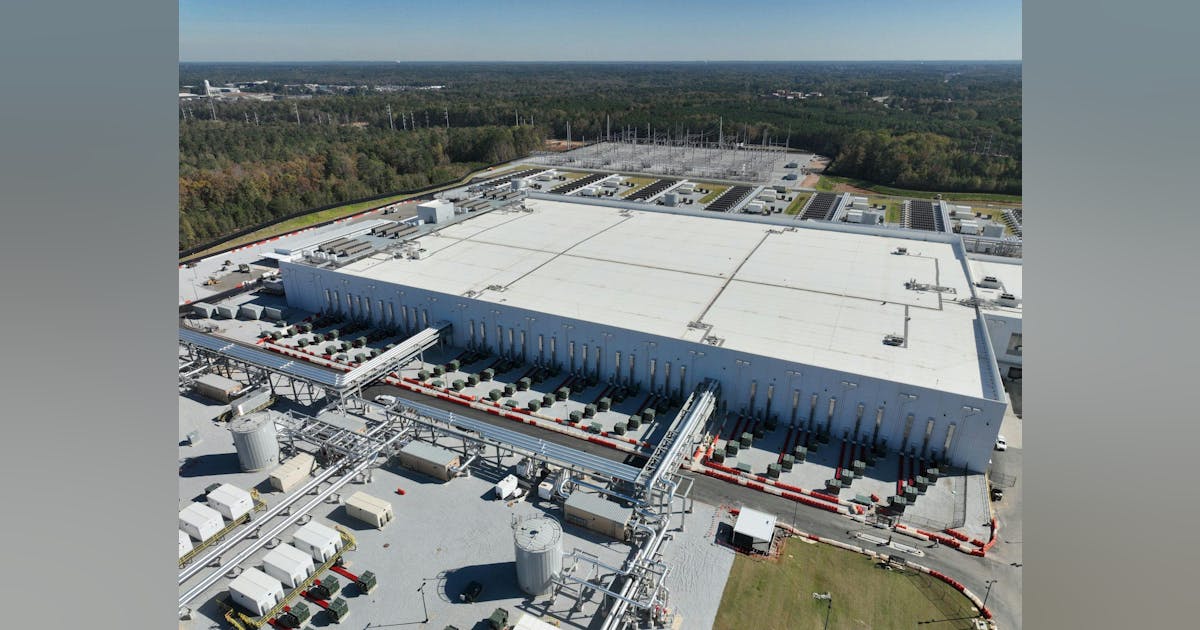
Microsoft’s second Fairwater data center in Atlanta isn’t just “another big GPU shed.” It represents the other half of a deliberate architectural experiment: proving that two massive AI campuses, separated by roughly 700 miles, can operate as one coherent, distributed supercomputer. The Atlanta installation is the latest expression of Microsoft’s AI-first data center design: purpose-built for training and serving frontier models rather than supporting mixed cloud workloads. It links directly to the original Fairwater campus in Wisconsin, as well as to earlier generations of Azure AI supercomputers, through a dedicated AI WAN backbone that Microsoft describes as the foundation of a “planet-scale AI superfactory.” Inside a Fairwater Site: Preparing for Multi-Site Distribution Efficient multi-site training only works if each individual site behaves as a clean, well-structured unit. Microsoft’s intra-site design is deliberately simplified so that cross-site coordination has a predictable abstraction boundary—essential for treating multiple campuses as one distributed AI system. Each Fairwater installation presents itself as a single, flat, high-regularity cluster: Up to 72 NVIDIA Blackwell GPUs per rack, using GB200 NVL72 rack-scale systems. NVLink provides the ultra-low-latency, high-bandwidth scale-up fabric within the rack, while the Spectrum-X Ethernet stack handles scale-out. Each rack delivers roughly 1.8 TB/s of GPU-to-GPU bandwidth and exposes a multi-terabyte pooled memory space addressable via NVLink—critical for large-model sharding, activation checkpointing, and parallelism strategies. Racks feed into a two-tier Ethernet scale-out network offering 800 Gbps GPU-to-GPU connectivity with very low hop counts, engineered to scale to hundreds of thousands of GPUs without encountering the classic port-count and topology constraints of traditional Clos fabrics. Microsoft confirms that the fabric relies heavily on: SONiC-based switching and a broad commodity Ethernet ecosystem to avoid vendor lock-in and accelerate architectural iteration. Custom network optimizations, such as packet trimming, packet spray, high-frequency telemetry, and advanced congestion-control mechanisms, to prevent collective

Read More »

Land & Expand: Hyperscale, AI Factory, Megascale

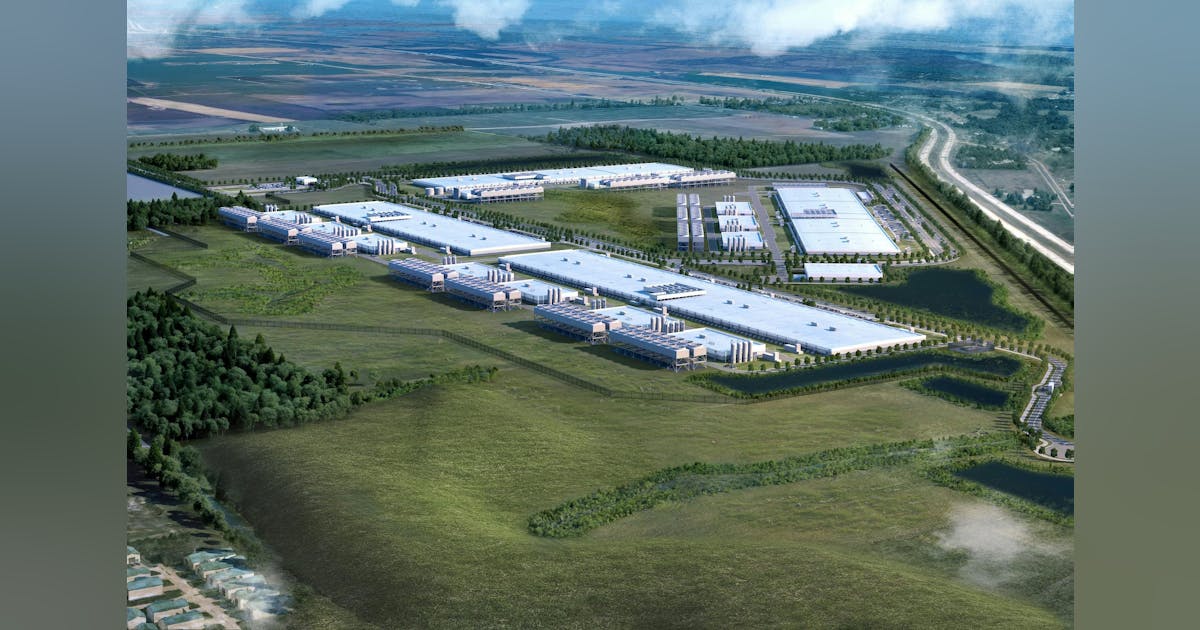
Land & Expand is Data Center Frontier’s periodic roundup of notable North American data center development activity, tracking the newest sites, land plays, retrofits, and hyperscale campus expansions shaping the industry’s build cycle. October delivered a steady cadence of announcements, with several megascale projects advancing from concept to commitment. The month was defined by continued momentum in OpenAI and Oracle’s Stargate initiative (now spanning multiple U.S. regions) as well as major new investments from Google, Meta, DataBank, and emerging AI cloud players accelerating high-density reuse strategies. The result is a clearer picture of how the next wave of AI-first infrastructure is taking shape across the country. Google Begins $4B West Memphis Hyperscale Buildout Google formally broke ground on its $4 billion hyperscale campus in West Memphis, Arkansas, marking the company’s first data center in the state and the anchor for a new Mid-South operational hub. The project spans just over 1,000 acres, with initial site preparation and utility coordination already underway. Google and Entergy Arkansas confirmed a 600 MW solar generation partnership, structured to add dedicated renewable supply to the regional grid. As part of the launch, Google announced a $25 million Energy Impact Fund for local community affordability programs and energy-resilience improvements—an unusually early community-benefit commitment for a first-phase hyperscale project. Cooling specifics have not yet been made public. Water sourcing—whether reclaimed, potable, or hybrid seasonal mode—remains under review, as the company finalizes environmental permits. Public filings reference a large-scale onsite water treatment facility, similar to Google’s deployments in The Dalles and Council Bluffs. Local governance documents show that prior to the October announcement, West Memphis approved a 30-year PILOT via Groot LLC (Google’s land assembly entity), with early filings referencing a typical placeholder of ~50 direct jobs. At launch, officials emphasized hundreds of full-time operations roles and thousands

Read More »

The New Digital Infrastructure Geography: Green Street’s David Guarino on AI Demand, Power Scarcity, and the Next Phase of Data Center Growth

As the global data center industry races through its most frenetic build cycle in history, one question continues to define the market’s mood: is this the peak of an AI-fueled supercycle, or the beginning of a structurally different era for digital infrastructure? For Green Street Managing Director and Head of Global Data Center and Tower Research David Guarino, the answer—based firmly on observable fundamentals—is increasingly clear. Demand remains blisteringly strong. Capital appetite is deepening. And the very definition of a “data center market” is shifting beneath the industry’s feet. In a wide-ranging discussion with Data Center Frontier, Guarino outlined why data centers continue to stand out in the commercial real estate landscape, how AI is reshaping underwriting and development models, why behind-the-meter power is quietly reorganizing the U.S. map, and what Green Street sees ahead for rents, REITs, and the next wave of hyperscale expansion. A ‘Safe’ Asset in an Uncertain CRE Landscape Among institutional investors, the post-COVID era was the moment data centers stepped decisively out of “niche” territory. Guarino notes that pandemic-era reliance on digital services crystallized a structural recognition: data centers deliver stable, predictable cash flows, anchored by the highest-credit tenants in global real estate. Hyperscalers today dominate new leasing and routinely sign 15-year (or longer) contracts, a duration largely unmatched across CRE categories. When compared with one-year apartment leases, five-year office leases, or mall anchor terms, the stability story becomes plain. “These are AAA-caliber companies signing the longest leases in the sector’s history,” Guarino said. “From a real estate point of view, that combination of tenant quality and lease duration continues to position the asset class as uniquely durable.” And development returns remain exceptional. Even without assuming endless AI growth, the math works: strong demand, rising rents, and high-credit tenants create unusually predictable performance relative to

Read More »

Microsoft will invest $80B in AI data centers in fiscal 2025

And Microsoft isn’t the only one that is ramping up its investments into AI-enabled data centers. Rival cloud service providers are all investing in either upgrading or opening new data centers to capture a larger chunk of business from developers and users of large language models (LLMs).  In a report published in October 2024, Bloomberg Intelligence estimated that demand for generative AI would push Microsoft, AWS, Google, Oracle, Meta, and Apple would between them devote $200 billion to capex in 2025, up from $110 billion in 2023. Microsoft is one of the biggest spenders, followed closely by Google and AWS, Bloomberg Intelligence said. Its estimate of Microsoft’s capital spending on AI, at $62.4 billion for calendar 2025, is lower than Smith’s claim that the company will invest $80 billion in the fiscal year to June 30, 2025. Both figures, though, are way higher than Microsoft’s 2020 capital expenditure of “just” $17.6 billion. The majority of the increased spending is tied to cloud services and the expansion of AI infrastructure needed to provide compute capacity for OpenAI workloads. Separately, last October Amazon CEO Andy Jassy said his company planned total capex spend of $75 billion in 2024 and even more in 2025, with much of it going to AWS, its cloud computing division.

Read More »

John Deere unveils more autonomous farm machines to address skill labor shortage

Join our daily and weekly newsletters for the latest updates and exclusive content on industry-leading AI coverage. Learn More Self-driving tractors might be the path to self-driving cars. John Deere has revealed a new line of autonomous machines and tech across agriculture, construction and commercial landscaping. The Moline, Illinois-based John Deere has been in business for 187 years, yet it’s been a regular as a non-tech company showing off technology at the big tech trade show in Las Vegas and is back at CES 2025 with more autonomous tractors and other vehicles. This is not something we usually cover, but John Deere has a lot of data that is interesting in the big picture of tech. The message from the company is that there aren’t enough skilled farm laborers to do the work that its customers need. It’s been a challenge for most of the last two decades, said Jahmy Hindman, CTO at John Deere, in a briefing. Much of the tech will come this fall and after that. He noted that the average farmer in the U.S. is over 58 and works 12 to 18 hours a day to grow food for us. And he said the American Farm Bureau Federation estimates there are roughly 2.4 million farm jobs that need to be filled annually; and the agricultural work force continues to shrink. (This is my hint to the anti-immigration crowd). John Deere’s autonomous 9RX Tractor. Farmers can oversee it using an app. While each of these industries experiences their own set of challenges, a commonality across all is skilled labor availability. In construction, about 80% percent of contractors struggle to find skilled labor. And in commercial landscaping, 86% of landscaping business owners can’t find labor to fill open positions, he said. “They have to figure out how to do

Read More »

2025 playbook for enterprise AI success, from agents to evals

Join our daily and weekly newsletters for the latest updates and exclusive content on industry-leading AI coverage. Learn More 2025 is poised to be a pivotal year for enterprise AI. The past year has seen rapid innovation, and this year will see the same. This has made it more critical than ever to revisit your AI strategy to stay competitive and create value for your customers. From scaling AI agents to optimizing costs, here are the five critical areas enterprises should prioritize for their AI strategy this year. 1. Agents: the next generation of automation AI agents are no longer theoretical. In 2025, they’re indispensable tools for enterprises looking to streamline operations and enhance customer interactions. Unlike traditional software, agents powered by large language models (LLMs) can make nuanced decisions, navigate complex multi-step tasks, and integrate seamlessly with tools and APIs. At the start of 2024, agents were not ready for prime time, making frustrating mistakes like hallucinating URLs. They started getting better as frontier large language models themselves improved. “Let me put it this way,” said Sam Witteveen, cofounder of Red Dragon, a company that develops agents for companies, and that recently reviewed the 48 agents it built last year. “Interestingly, the ones that we built at the start of the year, a lot of those worked way better at the end of the year just because the models got better.” Witteveen shared this in the video podcast we filmed to discuss these five big trends in detail. Models are getting better and hallucinating less, and they’re also being trained to do agentic tasks. Another feature that the model providers are researching is a way to use the LLM as a judge, and as models get cheaper (something we’ll cover below), companies can use three or more models to

Read More »

OpenAI’s red teaming innovations define new essentials for security leaders in the AI era

Join our daily and weekly newsletters for the latest updates and exclusive content on industry-leading AI coverage. Learn More OpenAI has taken a more aggressive approach to red teaming than its AI competitors, demonstrating its security teams’ advanced capabilities in two areas: multi-step reinforcement and external red teaming. OpenAI recently released two papers that set a new competitive standard for improving the quality, reliability and safety of AI models in these two techniques and more. The first paper, “OpenAI’s Approach to External Red Teaming for AI Models and Systems,” reports that specialized teams outside the company have proven effective in uncovering vulnerabilities that might otherwise have made it into a released model because in-house testing techniques may have missed them. In the second paper, “Diverse and Effective Red Teaming with Auto-Generated Rewards and Multi-Step Reinforcement Learning,” OpenAI introduces an automated framework that relies on iterative reinforcement learning to generate a broad spectrum of novel, wide-ranging attacks. Going all-in on red teaming pays practical, competitive dividends It’s encouraging to see competitive intensity in red teaming growing among AI companies. When Anthropic released its AI red team guidelines in June of last year, it joined AI providers including Google, Microsoft, Nvidia, OpenAI, and even the U.S.’s National Institute of Standards and Technology (NIST), which all had released red teaming frameworks. Investing heavily in red teaming yields tangible benefits for security leaders in any organization. OpenAI’s paper on external red teaming provides a detailed analysis of how the company strives to create specialized external teams that include cybersecurity and subject matter experts. The goal is to see if knowledgeable external teams can defeat models’ security perimeters and find gaps in their security, biases and controls that prompt-based testing couldn’t find. What makes OpenAI’s recent papers noteworthy is how well they define using human-in-the-middle

Read More »