Stay Ahead, Stay ONMINE

Tribal nations regroup after loss of federal funding for clean energy

Tribal nations looking to build clean energy projects are exploring new funding pathways after the Trump administration’s cuts to clean energy grants like Solar for All, which earmarked more than $500 million for solar development on tribal lands.  The Tribal Renewable Energy Coalition, an organization of 14 tribes which received a grant for more than […]

Tribal nations looking to build clean energy projects are exploring new funding pathways after the Trump administration’s cuts to clean energy grants like Solar for All, which earmarked more than $500 million for solar development on tribal lands. 

The Tribal Renewable Energy Coalition, an organization of 14 tribes which received a grant for more than $135 million in now-cancelled Solar for All funding, is continuing to use the solar project plans it developed but will seek funding sources like loans and philanthropy, Indigenized Energy CEO Cody Two Bears said during a November press call.

“I think that’s the positive side of what we get out of Solar for All, is we had over a year to plan this out, and now we have some things teed up for tribes to go after and start to leverage some of these dollars,” Two Bears said. “And I think that’s the plan for what we’re going to do moving forward.”

After the Trump administration took office and began to cancel grants associated with the Inflation Reduction Act, “the large utility scale projects that we were working on suddenly became a lot more difficult to finance,” said Chéri Smith, CEO of the Alliance for Tribal Clean Energy. “And yet, there are still opportunities there.”

Earlier this year, the alliance launched a suite of project finance and planning tools called the Weaver Platform, and is helping tribes “to use that tool to build their capital stacks,” at the same time that they’re “engaging with networks of investors of all flavors to try and take projects and fund them with private dollars instead of public,” Smith said.

The Trump administration’s grant clawback has rescinded a great deal of federal funding for clean energy from tribes, Smith said, noting that the alliance’s grant-writing team got $484 million in grants awarded to 46 tribes in 2024. 

That was “really exciting,” she said, “and the [Indigenous Power & Light Fund] was going to bridge the gap between those dollars and what the full project cost was. Well, 85% to 90% of that has been clawed back.”


Our goal is really simple, that we won’t let any tribal project die on our watch because funding was frozen.

Chéri Smith

CEO of the Alliance for Tribal Clean Energy


Connecting third-party investors with tribal nations to fund projects often isn’t straightforward, said Clara Pratte, founder of the solar company Navajo Power, during the November call. 

“There is money and there is appetite in the capital markets, but that money comes with a lot of maybe misconceptions or misunderstanding about how tribes work,” she said. “As developers and practitioners, it’s really our job to help demystify that for these markets, so that they feel comfortable investing their money.”

But the appetite for investment exists, Pratte said, as a lot of land in the Great Plains and further west “is under tribal control and tribal authority. So these markets would be remiss if they weren’t looking at how to develop on these lands, and we have to demystify it. We have to make it comfortable.”

A horse grazes in a field near the Kayenta Solar Plant on June 22, 2024 in Kayenta, Arizona.

Optional Caption

Brandon Bell via Getty Images

“There are so many blank canvases, essentially, from a developer’s point of view in Indian country,” said Todd Halvorsen, head of energy finance and structuring for the Alliance for Tribal Clean Energy. “The perceived credit risk that’s out there in the finance community is not a real concern, and we should be able to rally enough good folk together to be able to pull the capital required to get these systems built to provide the reliable power, get those projects cash flowing.”

The Alliance for Tribal Clean Energy and the Solar Energy Industries Association in October launched a curriculum for clean energy developers and service providers called Pathways To Trust, which “addresses common knowledge gaps that often undermine cross-cultural collaboration and equips participants with practical tools to build mutually beneficial partnerships,” SEIA said in a release.

However, one cultural disconnect between tribes and outside developers — the specifics of law and regulations on tribal land — is also an opportunity for tribes to shape their energy future, said Claudio Clini, a policy analyst with the Alliance for Tribal Clean Energy, during the November call.

“We’ve been talking to tribes about this idea of replacing federal rollbacks of environmental protections and other things like that with tribal laws and regulations where applicable,” Clini said. “And in this way, we can work towards a self-determined future where tribes are exercising the full strength of their regulatory abilities and jurisdiction.”

Pulling projects back together

The $220 million Tribal Energy Resilience and Sovereignty project, which aims to build a network of nested microgrids in northern California to benefit several tribes, lost an $88 million award through the Department of Energy’s Grid Resilience Innovations Program after it was cancelled by the Trump administration. 

The microgrids would be backed up by battery and solar to create more reliability for the tribes they serve, who sometimes lose power for up to 20 days in a row, said Halvorsen.


We know the demand for energy is only going to continue in the coming years. Our hunger and appetite for energy is not going away. And in terms of tribal communities, we have to be players in this world.

Clara Pratte

Founder of Navajo Power


The Alliance for Tribal Clean Energy has been working to help replace the lost federal funding with partnerships, philanthropy and other sources.

“It took about six months to go from hyper-depressed meetings where the vibe was just down, to slowly getting to, ‘Maybe we can do this, maybe we can get this back together,’” said Halvorsen, whose team is coordinating the capital raise and financial structuring for the project. “We’re out there talking with the vast majority of impact investors in the space, and building community — not just among industry in terms of supply chain and development talents, but with the financial communities, whether it be public or private.”

Though tribal nations are working to salvage many of the projects that were in progress, the disruption of suddenly losing funding is significant. Pratte said it has been “truly devastating for many of our communities” to not only lose the project itself but the jobs associated with it.

“It has this ripple effect — the hotels, the construction community, the utilities, all of these things, all of a sudden have the wind knocked out of them,” she said.

“The shift in administration, and policy, has certainly had a profound impact on the tribes,” Smith said. While multiple coalitions are suing the Trump administration over the cancellation of Solar for All funding, the alliance is choosing not to litigate the issue and instead help tribes “preserve the value of the work that they’ve already completed,” she said.

However, Clini said in November that the alliance is continuing to work with the Federal Energy Regulatory Commission to secure a waiver for tribes for the $5 million commercial readiness deposit required for projects to remain in an interconnection queue. The alliance has made the case to FERC that interconnection requests for tribal projects are not made speculatively, and that this deposit is impossible for the majority of tribes to make.
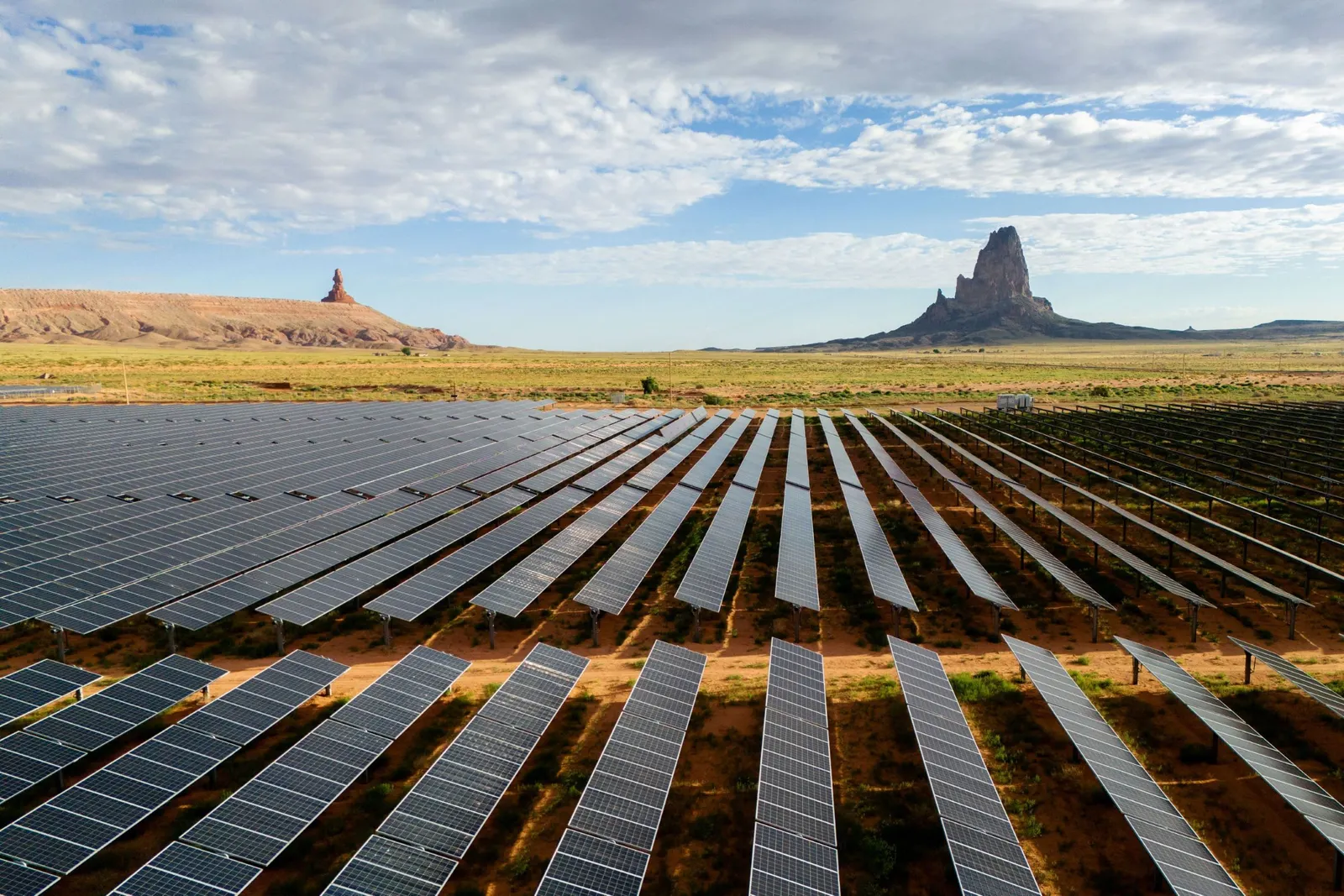
In an aerial view, the Kayenta Solar Plant is seen on June 23, 2024 in Kayenta, Arizona.

Optional Caption

Brandon Bell via Getty Images

And even before President Donald Trump won reelection and began to rescind IRA funding, the alliance anticipated the potential for this and launched a program called Solar for All TRIBES, “an initiative to try and ensure that the six tribal consortia that received awards don’t lose momentum because of political shifts,” said Smith. 

“We’re doing triage on a daily basis with the stalled projects, the stranded engineering work, and we see ourselves as here to protect that progress,” she said. “Our goal is really simple, that we won’t let any tribal project die on our watch because funding was frozen.”

The benefits of alternatives

Halvorsen said he was leery of the potential for issues with Solar for All grants before any of the funding was rescinded.

“I saw a number of flaws and was already thinking, how do we do something better? What’s going to be the replacement program for this?” he said. “I was already worried about unfriendly administration challenges and how some of the funding could get frozen or clawed back.”

He was particularly concerned about the requirement that every Solar for All project had to guarantee a 20% savings on electricity bills for a given end user — a requirement that he says made less sense for projects on tribal land.


Scale is huge in making these projects all pencil, because there’s so many intermediary costs with getting any deployment done in renewables.

Todd Halvorsen

Head of energy finance and structuring for the Alliance for Tribal Clean Energy


“Those calculations can be hard enough to pull together to begin with, so there’s a lot of room for challenges,” he said. “And why is 20% savings the most critical thing when there’s all these communities at the end of power lines that don’t have reliable power?”

Halvorsen said he’s seen a mentality shift from grant-funded projects to third-party financed projects, with tribes “retaining ownership from the get go” and being able to leverage the IRA’s direct pay mechanism — which allows tax-exempt tribal nations to still benefit from the legislation’s tax credits — as an underwriting mechanism for “bringing in construction and term financing.”

With many of the IRA’s clean energy tax credits expiring soon as a result of the One Big Beautiful Bill Act, and tribes being tax-exempt entities, “structuring these things in a way that makes sense for all parties, along with tribal ownership, is really crucial,” Pratte said. 

After the passage of the OBBBA, “I think one of the things that we’re beholden to is figuring out where we find that capital, where we continue the good work, because we know the demand for energy is only going to continue in the coming years,” Pratte said. “Our hunger and appetite for energy is not going away. And in terms of tribal communities, we have to be players in this world.”

One of the alliance’s goals is to take “all the good, the bad and the ugly lessons” from the residential and commercial solar industries and apply those on tribal land to “develop, finance, construct and operate projects with tribal developers and tribal asset owners as the core of the projects from the get go,” Halvorsen said.

“The more similar projects you can get per dollar spent, the more efficient the overall program becomes,” he said. “Scale is huge in making these projects all pencil, because there’s so many intermediary costs with getting any deployment done in renewables — whether it’s a single residential project, a hundred residential projects, an 100-kW project or 100-megawatt project.”

As tribal nations have accepted the formalized cancellation of Solar for All and other federal sources of clean energy funding, they’ve been able to pivot to new thinking about how to finance these projects, Halvorsen said. 

“Indian country has an aversion to debt, so it’s been the focus that if there’s free money coming from the federal government, let’s go there before we’re thinking about taking on any sort of liability through debt financing,” he said. “But now more increasingly we’re hearing, oh, yeah, we’re doing that in our casino. Why can’t we do it for our clean energy power plants, which are going to be economic engines — even more so, potentially, than the casinos?”

The timing “may just be right, for whatever reason,” that these conversations are happening now, Halvorsen said. “And I’m very encouraged that we’ll be seeing the first large scale portfolios of residential solar projects be developed and built in 2026.”


Shape
Shape
Stay Ahead

Explore More Insights

Stay ahead with more perspectives on cutting-edge power, infrastructure, energy,  bitcoin and AI solutions. Explore these articles to uncover strategies and insights shaping the future of industries.

Shape

ExxonMobil bumps up 2030 target for Permian production

ExxonMobil Corp., Houston, is looking to grow production in the Permian basin to about 2.5 MMboe/d by 2030, an increase of 200,000 boe/d from executives’ previous forecasts and a jump of more than 45% from this year’s output. Helping drive that higher target is an expected 2030 cost profile that

Read More »

Finnish Refiner Says It Won’t Meet 2035 Oil Exit Goal

Finland’s Neste Oyj is scaling back some of its climate targets and doesn’t expect to stop using crude at its only oil refinery by 2035 as previously guided.  Neste had pledged a “very ambitious” target for achieve carbon neutral production by that year, but it now expects to reduce greenhouse gas emissions in its own operations — known as Scope 1 and 2 — by 80% by 2040, according to a statement on its website. Neste’s share rose.  Reaching the original climate targets and schedule “would have required significant investments that are currently not realistic,” the company said. “The timeline for transitioning from crude oil to processing renewable and circular raw materials will be determined in line with the actual fuel market demand.” The bulk of Neste’s climate goals were put in place under the company’s previous chief executive officer. Heikki Malinen, who took over in 2024, had already said that a target on using waste plastics in the Porvoo refinery had been put on hold.  Neste’s share advanced as much as 3.9% to €19.03 as of 12:36 p.m. local time. Neste is set to benefit from decisions taken last week by the German government that are expected to boost demand for renewable diesel, one of its main products.  WHAT DO YOU THINK? Generated by readers, the comments included herein do not reflect the views and opinions of Rigzone. All comments are subject to editorial review. Off-topic, inappropriate or insulting comments will be removed.

Read More »

Tribal nations regroup after loss of federal funding for clean energy

Tribal nations looking to build clean energy projects are exploring new funding pathways after the Trump administration’s cuts to clean energy grants like Solar for All, which earmarked more than $500 million for solar development on tribal lands.  The Tribal Renewable Energy Coalition, an organization of 14 tribes which received a grant for more than $135 million in now-cancelled Solar for All funding, is continuing to use the solar project plans it developed but will seek funding sources like loans and philanthropy, Indigenized Energy CEO Cody Two Bears said during a November press call. “I think that’s the positive side of what we get out of Solar for All, is we had over a year to plan this out, and now we have some things teed up for tribes to go after and start to leverage some of these dollars,” Two Bears said. “And I think that’s the plan for what we’re going to do moving forward.” After the Trump administration took office and began to cancel grants associated with the Inflation Reduction Act, “the large utility scale projects that we were working on suddenly became a lot more difficult to finance,” said Chéri Smith, CEO of the Alliance for Tribal Clean Energy. “And yet, there are still opportunities there.” Earlier this year, the alliance launched a suite of project finance and planning tools called the Weaver Platform, and is helping tribes “to use that tool to build their capital stacks,” at the same time that they’re “engaging with networks of investors of all flavors to try and take projects and fund them with private dollars instead of public,” Smith said. The Trump administration’s grant clawback has rescinded a great deal of federal funding for clean energy from tribes, Smith said, noting that the alliance’s grant-writing team got $484 million

Read More »

Texas Oil, Gas Upstream Jobs Fall in September

Texas oil and gas upstream jobs fell by 1,300 in September, industry body the Texas Oil & Gas Association (TXOGA) said in a statement sent to Rigzone recently. “The Texas Workforce Commission, having skipped data releases during the federal shutdown that included the Bureau of Labor Statistics, has resumed job data publication,” TXOGA noted in the statement. “Today [December 11] the Commission released September 2025 data, indicating that upstream oil and gas employment fell by 1,300 in September compared to August,” it added. In the statement, TXOGA noted that, “despite recent flat performance”, growth for this year through September “remains a positive 3,900 upstream jobs”. “At 204,800 upstream jobs, compared to the same month in the prior year, September 2025 jobs were up by 1,900, or 0.9 percent,” TXOGA highlighted. A chart included in the statement, which displayed Texas oil and gas upstream job figures from January 2021 to September 2025, showed that, despite the monthly dip from August to September 2025, these job figures in September still stood well above the figures in January 2021.  “The recent downward cycle of the upstream job count confirms Texas is not immune to circumstances facing global oil markets,” TXOGA President Todd Staples warned in the statement. “As a major oil exporter for the United States, the Lone Star State must remain competitive on the worldwide stage,” he added. “To remain the global leader, our industry depends on Texas legislative, regulatory, and business climate certainty that is favorable to investment and job creation even when supply and demand factors present uncertainty and instability,” he continued. The White House website highlights that the U.S. government was recently shut down “for a record 43 days”. August Figures, 2025 Analysis In a statement posted on its site back in September, TXOGA stated that data from the

Read More »

Strategists Say Oil’s Fermi Paradox Nearing an End

In an oil and gas report sent to Rigzone recently by the Macquarie team, Macquarie strategists, including Vikas Dwivedi, noted that oil’s “Fermi Paradox [is] nearing an end”, adding that “onshore stocks [are] starting to build”. “We continue to expect a heavily oversupplied market,” the strategists said in the report. “We estimate a 1Q26 peak supply-demand surplus of over four million barrels per day. Signs of the surplus are showing with continued offshore builds, increasing onshore builds, and extremely strong freight rates,” they added. “We estimate that approximately one-third of the offshore build is long-haul shipments from the Americas to Asia,” they continued. In the report, the strategists revealed that they expect onshore builds to accelerate through year-end 2025 and into early 2026, a process which they said “should drive Brent towards the low $50 range, with a possibility of reaching $45 per barrel”. “Since the end of August, offshore inventories have increased by roughly 250 million barrels and onshore storage up by ~30 million barrels,” the strategists highlighted in the report. “In the past month, the trend has accelerated with onshore … [plus] offshore stocks building by ~ three million barrels per day. Yet, structure remains backwardated, as AB barrels continued clearing East,” they added. A separate report sent to Rigzone by the Macquarie team on December 5 showed that Macquarie was projecting that the Brent price will average $68.21 per barrel overall in 2025 and $60.75 per barrel overall in 2026. According to that report, Macquarie expects the Brent price to average $63.00 per barrel in the fourth quarter of this year, $57.00 per barrel in the first quarter of 2026, $59.00 per barrel in the second quarter, $60.00 per barrel in the third quarter, and $67.00 per barrel in the fourth quarter.   In that report, Macquarie

Read More »

Uniper Approves Its First Scottish Solar Project

Uniper SE said it has decided to proceed constructing its first solar project in Scotland, the 45-megawatt (MW) Berryhill Solar Farm just north of Dundee. The German power and gas utility expects to start construction “early 2026” and fire up the facility later in the year. Berryhill’s output, from about 150,000 solar panels, would be enough “to power the equivalent of over 12,500 UK households each year, 1/5th the population of Angus – contributing to the UK’s net zero targets”, Uniper said in an online statement. “The project has been developed jointly with partner Solar2 and Uniper plans to start the construction process as its sole owner”, Uniper said. Scottish and Southern Electricity Networks, the district network operator, is responsible for installing the nine-kilometer (5.59 miles) medium-voltage cable to connect the solar farm to the grid’s point of connection at the Charleston substation on the Kingsway in Dundee, according to Uniper. The project had obtained planning permission from the Angus Council in 2022, which was modified 2024, it said. “Once operational, there will be a community benefit fund associated with the project which will be agreed with the applicable local community council – Muirhead, Birkhill and Liff Council”, Uniper said. In another Scottish renewable project, Uniper earlier this year greenlighted the construction of a 46.2-MW wind farm in East Ayrshire. It expects to put the facility into production 2028 with enough generation for 66,000 United Kingdom homes each year, it said in a press release June 11. Uniper had announced two other UK renewable power projects in 2025: the Tamworth Solar Farm with a capacity of around 44.2 MWp and the 21.33-MWp Totmonslow Solar Farm. The two projects’ combined capacity can power about 23,300 homes a year, according to Uniper. Uniper aims to connect the projects, which received approval from local

Read More »

BP, Eni Exit Two Angola Producing Assets

A consortium between BW Energy Ltd and Maurel & Prom SA has signed an agreement with Azule Energy Holdings Ltd, a 50-50 venture between BP PLC and Eni SpA, to acquire Azule’s non-operating stakes in Block 14 and Block 14K offshore Angola. Chevron Corp-operated Block 14, a mature deepwater area, produces about 40,000 barrels of oil per day (bopd) gross from nine fields, while Block 14K is a tieback to Block 14 with current production of 2,000 bopd gross, BW Energy and Maurel & Prom noted in separate press releases. BW Energy, part of Singapore-based energy shipping operator BW Group Ltd, and Maurel & Prom, a Paris-based exploration and production company majority-owned by Indonesia’s national oil and gas company PT Pertamina (Persero), will each acquire 10 percent in Block 14 and five percent in Block 14K. Azule said separately its combined share from the blocks averaged 9,600 bopd in 2024. “This transaction is aligned with Azule Energy’s strategy to concentrate our efforts on our core assets in Angola”, said Azule chief executive Joseph Murphy. Last year in Angola, Azule sold its 12 percent interest in Block 3/05 and 16 percent stake in Lower Congo Basin to Afentra, as confirmed by Azule May 23, 2024. The transaction with BW Energy and Maurel & Prom is valued up to $310 million including up to $115 million of deferred payments, Azule said. BW Energy said of the assets, “Current producing reserves are estimated at 9.3 million barrels net to BW Energy, with several identified opportunities to further increase recoverable volumes”. It added, “Abandonment and decommissioning costs are covered by existing provisions”. BW Energy chief executive Carl K. Arnet said, “The entry to Angola is a key step in BW Energy’s West Africa growth strategy and provides further diversification of our resource base”. “Angola is a mature hydrocarbon basin

Read More »

Executive Roundtable: Converging Disciplines in the AI Buildout

At Data Center Frontier, we rely on industry leaders to help us understand the most urgent challenges facing digital infrastructure. And in the fourth quarter of 2025, the data center industry is adjusting to a new kind of complexity.  AI-scale infrastructure is redefining what “mission critical” means, from megawatt density and modular delivery to the chemistry of cooling fluids and the automation of energy systems. Every project has arguably in effect now become an ecosystem challenge, demanding that electrical, mechanical, construction, and environmental disciplines act as one.  For this quarter’s Executive Roundtable, DCF convened subject matter experts from Ecolab, EdgeConneX, Rehlko and Schneider Electric – leaders spanning the full chain of facilities design, deployment, and operation. Their insights illuminate how liquid cooling, energy management, and sustainable process design in data centers are now converging to set the pace for the AI era. Our distinguished executive panelists for this quarter include: Rob Lowe, Director RD&E – Global High Tech, Ecolab Phillip Marangella, Chief Marketing and Product Officer, EdgeConneX Ben Rapp, Manager, Strategic Project Development, Rehlko Joe Reele, Vice President, Datacenter Solution Architects, Schneider Electric Today: Engineering the New Normal – Liquid Cooling at Scale  Today’s kickoff article grapples with how, as liquid cooling technology transitions to default hyperscale design, the challenge is no longer if, but how to scale builds safely, repeatably, and globally.  Cold plates, immersion, dielectric fluids, and liquid-to-chip loops are converging into factory-integrated building blocks, yet variability in chemistry, serviceability, materials, commissioning practices, and long-term maintenance threatens to fragment adoption just as demand accelerates.  Success now hinges on shared standards and tighter collaboration across OEMs, builders, and process specialists worldwide. So how do developers coordinate across the ecosystem to make liquid cooling a safe, maintainable global default? What’s Ahead in the Roundtable Over the coming days, our panel

Read More »

DCF Trends Summit 2025: AI for Good – How Operators, Vendors and Cooling Specialists See the Next Phase of AI Data Centers

At the 2025 Data Center Frontier Trends Summit (Aug. 26-28) in Reston, Va., the conversation around AI and infrastructure moved well past the hype. In a panel sponsored by Schneider Electric—“AI for Good: Building for AI Workloads and Using AI for Smarter Data Centers”—three industry leaders explored what it really means to design, cool and operate the new class of AI “factories,” while also turning AI inward to run those facilities more intelligently. Moderated by Data Center Frontier Editor in Chief Matt Vincent, the session brought together: Steve Carlini, VP, Innovation and Data Center Energy Management Business, Schneider Electric Sudhir Kalra, Chief Data Center Operations Officer, Compass Datacenters Andrew Whitmore, VP of Sales, Motivair Together, they traced both sides of the “AI for Good” equation: building for AI workloads at densities that would have sounded impossible just a few years ago, and using AI itself to reduce risk, improve efficiency and minimize environmental impact. From Bubble Talk to “AI Factories” Carlini opened by acknowledging the volatility surrounding AI investments, citing recent headlines and even Sam Altman’s public use of the word “bubble” to describe the current phase of exuberance. “It’s moving at an incredible pace,” Carlini noted, pointing out that roughly half of all VC money this year has flowed into AI, with more already spent than in all of the previous year. Not every investor will win, he said, and some companies pouring in hundreds of billions may not recoup their capital. But for infrastructure, the signal is clear: the trajectory is up and to the right. GPU generations are cycling faster than ever. Densities are climbing from high double-digits per rack toward hundreds of kilowatts. The hyperscale “AI factories,” as NVIDIA calls them, are scaling to campus capacities measured in gigawatts. Carlini reminded the audience that in 2024,

Read More »

FinOps Foundation sharpens FOCUS to reduce cloud cost chaos

“The big change that’s really started to happen in late 2024 early 2025 is that the FinOps practice started to expand past the cloud,” Storment said. “A lot of organizations got really good at using FinOps to manage the value of cloud, and then their organizations went, ‘oh, hey, we’re living in this happily hybrid state now where we’ve got cloud, SaaS, data center. Can you also apply the FinOps practice to our SaaS? Or can you apply it to our Snowflake? Can you apply it to our data center?’” The FinOps Foundation’s community has grown to approximately 100,000 practitioners. The organization now includes major cloud vendors, hardware providers like Nvidia and AMD, data center operators and data cloud platforms like Snowflake and Databricks. Some 96 of the Fortune 100 now participate in FinOps Foundation programs. The practice itself has shifted in two directions. It has moved left into earlier architectural and design processes, becoming more proactive rather than reactive. It has also moved up organizationally, from director-level cloud management roles to SVP and COO positions managing converged technology portfolios spanning multiple infrastructure types. This expansion has driven the evolution of FOCUS beyond its original cloud billing focus. Enterprises are implementing FOCUS as an internal standard for chargeback reporting even when their providers don’t generate native FOCUS data. Some newer cloud providers, particularly those focused on AI infrastructure, are using the FOCUS specification to define their billing data structures from the ground up rather than retrofitting existing systems. The FOCUS 1.3 release reflects this maturation, addressing technical gaps that have emerged as organizations apply cost management practices across increasingly complex hybrid environments. FOCUS 1.3 exposes cost allocation logic for shared infrastructure The most significant technical enhancement in FOCUS 1.3 addresses a gap in how shared infrastructure costs are allocated and

Read More »

Aetherflux joins the race to launch orbital data centers by 2027

Enterprises will connect to and manage orbital workloads “the same way they manage cloud workloads today,” using optical links, the spokesperson added. The company’s approach is to “continuously launch new hardware and quickly integrate the latest architectures,” with older systems running lower-priority tasks to serve out the full useful lifetime of their high-end GPUs. The company declined to disclose pricing. Aetherflux plans to launch about 30 satellites at a time on SpaceX Falcon 9 rockets. Before the data center launch, the company will launch a power-beaming demonstration satellite in 2026 to test transmission of one kilowatt of energy from orbit to ground stations, using infrared lasers. Competition in the sector has intensified in recent months. In November, Starcloud launched its Starcloud-1 satellite carrying an Nvidia H100 GPU, which is 100 times more powerful than any previous GPU flown in space, according to the company, and demonstrated running Google’s Gemma AI model in orbit. In the same month, Google announced Project Suncatcher, with a 2027 demonstration mission planned. Analysts see limited near-term applications Despite the competitive activity, orbital data centers won’t replace terrestrial cloud regions for general hosting through 2030, said Ashish Banerjee, senior principal analyst at Gartner. Instead, they suit specific workloads, including meeting data sovereignty requirements for jurisdictionally complex scenarios, offering disaster recovery immune to terrestrial risks, and providing asynchronous high-performance computing, he said. “Orbital centers are ideal for high-compute, low-I/O batch jobs,” Banerjee said. “Think molecular folding simulations for pharma, massive Monte Carlo financial simulations, or training specific AI model weights. If the job takes 48 hours, the 500ms latency penalty of LEO is irrelevant.” One immediate application involves processing satellite-generated data in orbit, he said. Earth observation satellites using synthetic aperture radar generate roughly 10 gigabytes per second, but limited downlink bandwidth creates bottlenecks. Processing data in

Read More »

Here’s what Oracle’s soaring infrastructure spend could mean for enterprises

He said he had earlier told analysts in a separate call that margins for AI workloads in these data centers would be in the 30% to 40% range over the life of a customer contract. Kehring reassured that there would be demand for the data centers when they were completed, pointing to Oracle’s increasing remaining performance obligations, or services contracted but not yet delivered, up $68 billion on the previous quarter, saying that Oracle has been seeing unprecedented demand for AI workloads driven by the likes of Meta and Nvidia. Rising debt and margin risks raise flags for CIOs For analysts, though, the swelling debt load is hard to dismiss, even with Oracle’s attempts to de-risk its spend and squeeze more efficiency out of its buildouts. Gogia sees Oracle already under pressure, with the financial ecosystem around the company pricing the risk — one of the largest debts in corporate history, crossing $100 billion even before the capex spend this quarter — evident in the rising cost of insuring the debt and the shift in credit outlook. “The combination of heavy capex, negative free cash flow, increasing financing cost and long-dated revenue commitments forms a structural pressure that will invariably finds its way into the commercial posture of the vendor,” Gogia said, hinting at an “eventual” increase in pricing of the company’s offerings. He was equally unconvinced by Magouyrk’s assurances about the margin profile of AI workloads as he believes that AI infrastructure, particularly GPU-heavy clusters, delivers significantly lower margins in the early years because utilisation takes time to ramp.

Read More »

New Nvidia software gives data centers deeper visibility into GPU thermals and reliability

Addressing the challenge Modern AI accelerators now draw more than 700W per GPU, and multi-GPU nodes can reach 6kW, creating concentrated heat zones, rapid power swings, and a higher risk of interconnect degradation in dense racks, according to Manish Rawat, semiconductor analyst at TechInsights. Traditional cooling methods and static power planning increasingly struggle to keep pace with these loads. “Rich vendor telemetry covering real-time power draw, bandwidth behavior, interconnect health, and airflow patterns shifts operators from reactive monitoring to proactive design,” Rawat said. “It enables thermally aware workload placement, faster adoption of liquid or hybrid cooling, and smarter network layouts that reduce heat-dense traffic clusters.” Rawat added that the software’s fleet-level configuration insights can also help operators catch silent errors caused by mismatched firmware or driver versions. This can improve training reproducibility and strengthen overall fleet stability. “Real-time error and interconnect health data also significantly accelerates root-cause analysis, reducing MTTR and minimizing cluster fragmentation,” Rawat said. These operational pressures can shape budget decisions and infrastructure strategy at the enterprise level.

Read More »

Microsoft will invest $80B in AI data centers in fiscal 2025

And Microsoft isn’t the only one that is ramping up its investments into AI-enabled data centers. Rival cloud service providers are all investing in either upgrading or opening new data centers to capture a larger chunk of business from developers and users of large language models (LLMs).  In a report published in October 2024, Bloomberg Intelligence estimated that demand for generative AI would push Microsoft, AWS, Google, Oracle, Meta, and Apple would between them devote $200 billion to capex in 2025, up from $110 billion in 2023. Microsoft is one of the biggest spenders, followed closely by Google and AWS, Bloomberg Intelligence said. Its estimate of Microsoft’s capital spending on AI, at $62.4 billion for calendar 2025, is lower than Smith’s claim that the company will invest $80 billion in the fiscal year to June 30, 2025. Both figures, though, are way higher than Microsoft’s 2020 capital expenditure of “just” $17.6 billion. The majority of the increased spending is tied to cloud services and the expansion of AI infrastructure needed to provide compute capacity for OpenAI workloads. Separately, last October Amazon CEO Andy Jassy said his company planned total capex spend of $75 billion in 2024 and even more in 2025, with much of it going to AWS, its cloud computing division.

Read More »

John Deere unveils more autonomous farm machines to address skill labor shortage

Join our daily and weekly newsletters for the latest updates and exclusive content on industry-leading AI coverage. Learn More Self-driving tractors might be the path to self-driving cars. John Deere has revealed a new line of autonomous machines and tech across agriculture, construction and commercial landscaping. The Moline, Illinois-based John Deere has been in business for 187 years, yet it’s been a regular as a non-tech company showing off technology at the big tech trade show in Las Vegas and is back at CES 2025 with more autonomous tractors and other vehicles. This is not something we usually cover, but John Deere has a lot of data that is interesting in the big picture of tech. The message from the company is that there aren’t enough skilled farm laborers to do the work that its customers need. It’s been a challenge for most of the last two decades, said Jahmy Hindman, CTO at John Deere, in a briefing. Much of the tech will come this fall and after that. He noted that the average farmer in the U.S. is over 58 and works 12 to 18 hours a day to grow food for us. And he said the American Farm Bureau Federation estimates there are roughly 2.4 million farm jobs that need to be filled annually; and the agricultural work force continues to shrink. (This is my hint to the anti-immigration crowd). John Deere’s autonomous 9RX Tractor. Farmers can oversee it using an app. While each of these industries experiences their own set of challenges, a commonality across all is skilled labor availability. In construction, about 80% percent of contractors struggle to find skilled labor. And in commercial landscaping, 86% of landscaping business owners can’t find labor to fill open positions, he said. “They have to figure out how to do

Read More »

2025 playbook for enterprise AI success, from agents to evals

Join our daily and weekly newsletters for the latest updates and exclusive content on industry-leading AI coverage. Learn More 2025 is poised to be a pivotal year for enterprise AI. The past year has seen rapid innovation, and this year will see the same. This has made it more critical than ever to revisit your AI strategy to stay competitive and create value for your customers. From scaling AI agents to optimizing costs, here are the five critical areas enterprises should prioritize for their AI strategy this year. 1. Agents: the next generation of automation AI agents are no longer theoretical. In 2025, they’re indispensable tools for enterprises looking to streamline operations and enhance customer interactions. Unlike traditional software, agents powered by large language models (LLMs) can make nuanced decisions, navigate complex multi-step tasks, and integrate seamlessly with tools and APIs. At the start of 2024, agents were not ready for prime time, making frustrating mistakes like hallucinating URLs. They started getting better as frontier large language models themselves improved. “Let me put it this way,” said Sam Witteveen, cofounder of Red Dragon, a company that develops agents for companies, and that recently reviewed the 48 agents it built last year. “Interestingly, the ones that we built at the start of the year, a lot of those worked way better at the end of the year just because the models got better.” Witteveen shared this in the video podcast we filmed to discuss these five big trends in detail. Models are getting better and hallucinating less, and they’re also being trained to do agentic tasks. Another feature that the model providers are researching is a way to use the LLM as a judge, and as models get cheaper (something we’ll cover below), companies can use three or more models to

Read More »

OpenAI’s red teaming innovations define new essentials for security leaders in the AI era

Join our daily and weekly newsletters for the latest updates and exclusive content on industry-leading AI coverage. Learn More OpenAI has taken a more aggressive approach to red teaming than its AI competitors, demonstrating its security teams’ advanced capabilities in two areas: multi-step reinforcement and external red teaming. OpenAI recently released two papers that set a new competitive standard for improving the quality, reliability and safety of AI models in these two techniques and more. The first paper, “OpenAI’s Approach to External Red Teaming for AI Models and Systems,” reports that specialized teams outside the company have proven effective in uncovering vulnerabilities that might otherwise have made it into a released model because in-house testing techniques may have missed them. In the second paper, “Diverse and Effective Red Teaming with Auto-Generated Rewards and Multi-Step Reinforcement Learning,” OpenAI introduces an automated framework that relies on iterative reinforcement learning to generate a broad spectrum of novel, wide-ranging attacks. Going all-in on red teaming pays practical, competitive dividends It’s encouraging to see competitive intensity in red teaming growing among AI companies. When Anthropic released its AI red team guidelines in June of last year, it joined AI providers including Google, Microsoft, Nvidia, OpenAI, and even the U.S.’s National Institute of Standards and Technology (NIST), which all had released red teaming frameworks. Investing heavily in red teaming yields tangible benefits for security leaders in any organization. OpenAI’s paper on external red teaming provides a detailed analysis of how the company strives to create specialized external teams that include cybersecurity and subject matter experts. The goal is to see if knowledgeable external teams can defeat models’ security perimeters and find gaps in their security, biases and controls that prompt-based testing couldn’t find. What makes OpenAI’s recent papers noteworthy is how well they define using human-in-the-middle

Read More »