Stay Ahead, Stay ONMINE

10 years of grid modernization: Major progress, stubborn challenges

Bryce Yonker is the executive director and CEO for Grid Forward. In 10 years leading Grid Forward, I’ve witnessed utilities and energy organizations advancing today’s defining grid technologies, business models and markets. Some innovations such as artificial intelligence were almost unthinkable a decade ago. But for all the mind-bending progress, improving both energy affordability and […]

Bryce Yonker is the executive director and CEO for Grid Forward.

In 10 years leading Grid Forward, I’ve witnessed utilities and energy organizations advancing today’s defining grid technologies, business models and markets. Some innovations such as artificial intelligence were almost unthinkable a decade ago. But for all the mind-bending progress, improving both energy affordability and reliability remains a stubborn challenge. These dual objectives must guide the way forward as we continue to modernize the grid for tomorrow’s challenges.

The Smart Grid is here, now what?

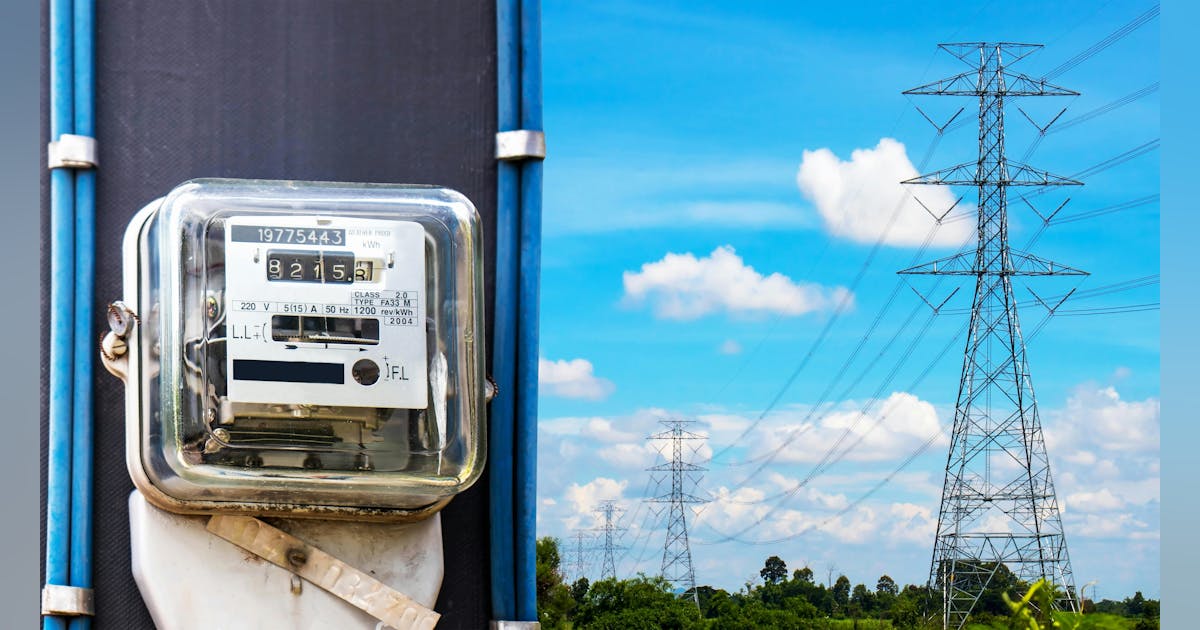
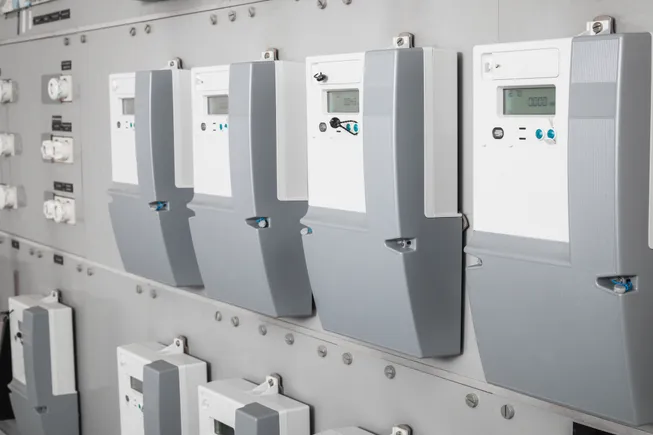
A decade ago the term “smart grid” was generally synonymous with automated meters. Remember the days when utilities sent a meter reader to every residence and business to record and bill them on their usage? At the end of 2023, more than 80% of utility meters (146 million) in North America are now smart meters. Utilities have faster, more accurate digital readings of energy usage and have started to leverage this information for various benefits.

In 2014, the electric grid industry was just experimenting with advanced monitoring solutions for critical grid infrastructure. There is now a wide deployment of a range of sensors and better situational awareness of critical electrical assets. Advanced forecasting is leveraged in many aspects of the energy systems from generation levels to demand forecasts. Management systems with a profusion of acronyms (ADMS, DERMS, OMS, SCADA…) are expanding into many parts of the system, pulling data in from various assets. Workforce automation is tracking all types of grid priorities. Utilities are even flying drones to collect grid data and using advanced imaging that was not possible just five years ago. 

But what are utilities doing with all this data? It is still rather rare to use predictive analytics for grid assets that can identify failures, faults or other issues before they happen. Many grid assets are still replaced on set schedules rather than based on their actual health or performance. Utilities still roll trucks with crews to identify the location of problems. And many customers still get a bill largely on flat rate usage at the end of the month. It is critical to deepen the network of meters, sensors, and monitoring solutions to automate controls on the grid and make data-informed investment decisions. Turning electric grid data into actionable information is something we have the tools to do. Now it’s time to make that happen.

The grid is digital but not digitized

How utilities store and process data has also advanced. A decade ago, many incumbent grid operators did not use cloud solutions for their operations. That reluctance has largely evaporated. Utilities are leveraging the benefits of scale and expertise offered by major cloud providers and even some of the application layers they make possible.

However, we have barely begun to leverage the potential of automated analysis for optimizing the grid. Grid system capacity runs much lower than necessary in most locations. And even where grid constraints exist, digital analytical tools are not being used to optimize the near-term alternatives — or even to streamline the difficult and costly build options.

There is much talk about the promise of AI for grid planning and operations. Streamlining complex processes (regulatory proceedings, permitting, compliance, interconnections, etc.) seems like an area of promise. It will be a costly endeavor to fully duplicate the complexities of the physical grid and model scenarios in a virtual environment, but taking those steps may prove to be prudent. Just look at the cost of impacts to the grid from recent wildfires, storms and other major disruptions. By leveraging digital simulations, utilities could have been better prepared for these inevitable events.

Changing generation mix, same old grid

Over the last decade, many areas of the country have seen significant shifts in how energy is generated. For example, non-hydro renewables accounted for 8.3% of the energy generation in 2014 and have since nearly doubled to 15.7% by the end of 2023. Energy storage is becoming economically viable and rapidly accelerating: since 2014 we’ve seen a 97-fold increase in capacity to 15.5 GW, with 70% found in California and Texas. At the same time, coal’s share of electricity generation has dropped from over 40% in the early 2010s to an estimated 16% this year. Natural gas generation has stepped in to help meet peak demand and balance the grid, growing from 29% in 2014 to 45% of generation last year.

In addition, consumers are getting into the game with new energy devices at home:

  • Millions of smart thermostats and other grid-interactive devices have been sold.
  • Rooftop solar is well into double digits of residences in many locations, with a growing share in home energy storage systems.
  • Sales of battery-only and plug-in EV sales in the U.S. have risen from less than 1% in 2014 to 9.1% in Q2 of 2024.

Still, the vast majority of our electrical generation comes from centralized sources. Aggregated distributed assets, scaled-up demand-side programs and other edge solutions are still small to nearly non-existent in most locations. For the requirements of our grid, we must significantly build out and leverage all these resources.

This new generation puzzle works best with a “two-way” grid that can dynamically integrate and optimize both supply and demand. We knew this 10 years ago, but that grid is not yet a reality. Even so, the grid keeps balancing supply and demand in near real-time, which seems like a modern miracle. We have better equipment for controlling energy flow (“switchgear”), smarter systems for integrating solar and batteries (“inverters”), hardened distribution systems and better organization of all these assets (“sectionalization”).

To succeed in the 21st century, we not only need to replace an aging grid but also build new infrastructure to orchestrate all the energy sources at our disposal. We need a grid that has orders of magnitude more automated flexibility than we have installed today. All these solutions are commercially available and ready to install.

Securing our grid remains just as important

In 2014, cybersecurity was already a priority. We witnessed attacks on digital infrastructure in other sectors (finance, retail, etc.) and I knew the critical infrastructure of the grid was an attractive target. In the war in Ukraine, both physical and cyber-attacks on the electric grid are a top strategy of the Russian aggressors. Physical attacks on the grid have been on the rise even in North America. As we continue to modernize, securing the grid from diverse physical and cyber threats midway through the 2020s is as important as it has ever been. We can never take our eye off the importance of best-in-class security. 

Scotty, we need more power!

There is one change over this decade that has caught many by surprise: energy demand is rising again. In the 2010s, the energy industry as a whole saw low or flat load growth due to energy efficiency programs, the impact of offshore manufacturing and lingering economic impacts from the Great Recession. With a resurgence of domestic industry, transportation electrification and data processing, the next decade looks poised for stronger power load growth than in previous decades. Much of the growth in power usage is being driven by the use of AI in data centers. Investing in all aspects of the grid now to meet the demand is critical to a future that will be ever more reliant on an always available, resilient electric grid.

The ultimate goals are still the same

The electric grid has been significantly modernized in the last ten years. Most meters are automated, and monitoring critical grid elements provides more accurate and useful forecasting. Energy markets are expanding in reach and economic impact. Technical standards are emerging to make it easier to integrate various distributed assets which helps break down silos across the industry. As Grid Forward has grown, we’ve witnessed different regions and stakeholders coming together in a multi-disciplinary approach to solve some of the grid’s biggest challenges.

However, in the past decade the average residential energy price in the U.S. has risen from 12.52 cents/kWh to 16 cents/kWh — an increase of 28%. While this is in line with overall inflation over that period, electricity costs are a big impact to the average American.

During that time, the average duration of electric power interruptions has also nearly doubled from under 4 hours in 2014 to over 7 hours in 2021. While there are more on-site resilience solutions from backup generators, storage, microgrids and other capabilities, these options are too expensive and out of reach for many.

It is critical that even as the grid is straining under the immense impacts of aging infrastructure, increasing climate disasters and surging load growth,  we must work to achieve affordability and reliability as a core outcome. Our grid is and will continue to be the backbone of not only our economy but modern society. Any resources that businesses and individuals don’t have to spend on their power can go right into other aspects of their work and lives. It’s the great responsibility of all who make and deliver power to humbly remember this.


Shape
Shape
Stay Ahead

Explore More Insights

Stay ahead with more perspectives on cutting-edge power, infrastructure, energy,  bitcoin and AI solutions. Explore these articles to uncover strategies and insights shaping the future of industries.

Shape

How AWS is reinventing the telco revenue model

Consider what that means for the mobile operator and its relationship with its customers. Instead of selling a generic 5G pipe with a static SLA, a telco can now sell a dynamic, guaranteed slice for a specific use case—say, a remote robotic surgery setup or a high-density, low-latency industrial IoT

Read More »

What’s the biggest barrier to AI success?

AI’s challenge starts with definition. We hear all the time about how AI raises productivity, and many have experienced that themselves. But what, exactly, does “productivity” mean? To the average person, it means they can do things with less effort, which they like, so it generates a lot of favorable

Read More »

IBM proposes unified architecture for hybrid quantum-classical computing

Quantum computers and classical HPC are traditionally “disparate systems [that] operate in isolation,” IBM researchers explain in a new paper. This can be “cumbersome,” because users have to manually orchestrate workflows, coordinate scheduling, and transfer data between systems, thus hindering productivity and “severely” limiting algorithmic exploration. But a hybrid approach

Read More »

Brent retreats from highs after Trump signals Iran war nearing end

@import url(‘https://fonts.googleapis.com/css2?family=Inter:[email protected]&display=swap’); a { color: var(–color-primary-main); } .ebm-page__main h1, .ebm-page__main h2, .ebm-page__main h3, .ebm-page__main h4, .ebm-page__main h5, .ebm-page__main h6 { font-family: Inter; } body { line-height: 150%; letter-spacing: 0.025em; font-family: Inter; } button, .ebm-button-wrapper { font-family: Inter; } .label-style { text-transform: uppercase; color: var(–color-grey); font-weight: 600; font-size: 0.75rem; } .caption-style { font-size: 0.75rem; opacity: .6; } #onetrust-pc-sdk [id*=btn-handler], #onetrust-pc-sdk [class*=btn-handler] { background-color: #c19a06 !important; border-color: #c19a06 !important; } #onetrust-policy a, #onetrust-pc-sdk a, #ot-pc-content a { color: #c19a06 !important; } #onetrust-consent-sdk #onetrust-pc-sdk .ot-active-menu { border-color: #c19a06 !important; } #onetrust-consent-sdk #onetrust-accept-btn-handler, #onetrust-banner-sdk #onetrust-reject-all-handler, #onetrust-consent-sdk #onetrust-pc-btn-handler.cookie-setting-link { background-color: #c19a06 !important; border-color: #c19a06 !important; } #onetrust-consent-sdk .onetrust-pc-btn-handler { color: #c19a06 !important; border-color: #c19a06 !important; } Oil futures eased from recent highs Tuesday as markets reacted to comments from US President Donald Trump suggesting the war with Iran may be nearing its conclusion, easing concerns about prolonged disruptions to Middle East crude supplies. Brent crude had climbed above $100/bbl amid escalating tensions in the region and fears that the war could prolong disruptions to shipments through the Strait of Hormuz—one of the world’s most critical energy chokepoints and a transit route for roughly one-fifth of global oil supply. Prices pulled back after Pres. Trump said the war was “almost done,” prompting traders to reassess the risk premium that had built into crude markets during the latest escalation. The earlier gains were driven by the fact that the war had disrupted tanker traffic in the Strait of Hormuz, raising concerns about wider supply disruptions from major Gulf oil producers. While the latest remarks helped calm markets, analysts note that geopolitical risks remain elevated and price volatility is likely to persist as traders monitor developments in the region. Any renewed escalation could quickly send crude prices higher again.

Read More »

Southwest Arkansas lithium project moves toward FID with 10-year offtake deal

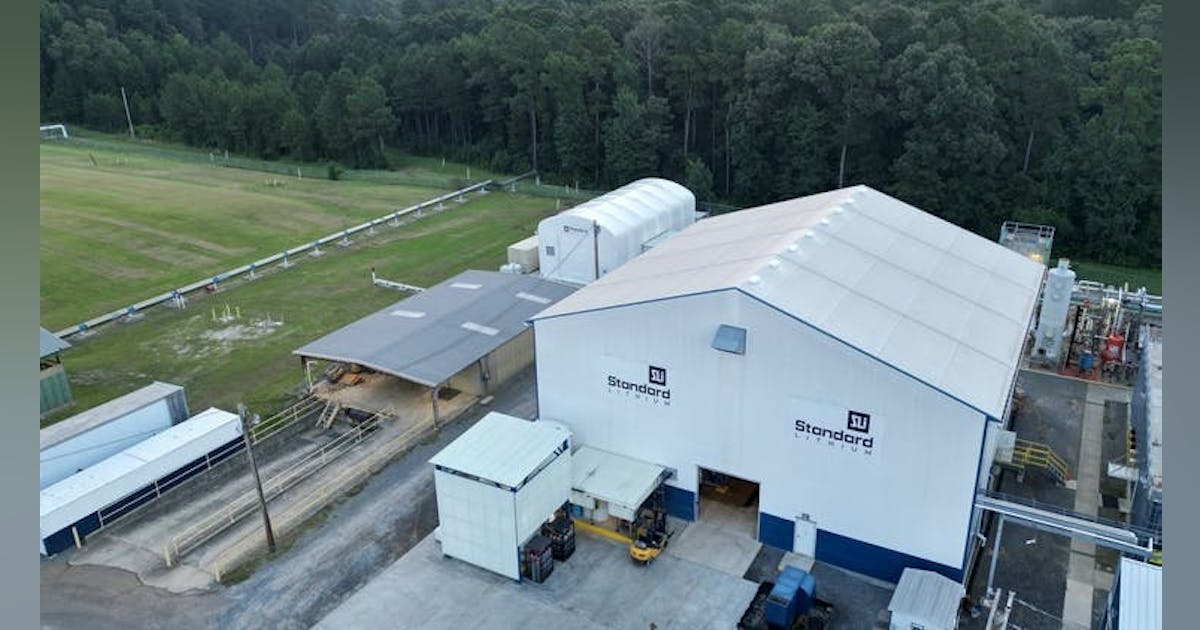
Smackover Lithium, a joint venture between Standard Lithium Ltd. and Equinor, through subsidiaries of Equinor ASA, signed the first commercial offtake agreement for the South West Arkansas Project (SWA Project) with commodities group Trafigura Trading LLC. Under the terms of a binding take-or-pay offtake agreement, the JV will supply Trafigura with 8,000 metric tonnes/year (tpy) of battery-quality lithium carbonate (Li2CO3) over a 10-year period, beginning at the start of commercial production. Smackover Lithium is expected to achieve final investment decision (FID) for the project, which aims to use direct lithium extraction technology to produce lithium from brine resources in the Smackover formation in southern Arkansas, in 2026, with first production anticipated in 2028. The project encompasses about 30,000 acres of brine leases in the region, with the initial phase of project development focused on production from the 20,854-acre Reynolds Brine Unit.   Front-end engineering design was completed in support of a definitive feasibility study with a principal recommendation that the project is ready to progress to FID.  While pricing terms of the Trafigura deal were kept confidential, Standard Lithium said they are “structured to support the anticipated financing for the project.” The JV is seeking to finalize customer offtake agreements for roughly 80% of the 22,500 tonnes of annual nameplate lithium carbonate capacity for the initial phase of the project. This agreement represents over 40% of the targeted offtake commitments. Formed in 2024, Smackover Lithium is developing multiple DLE projects in Southwest Arkansas and East Texas. Standard Lithium is operator of the projecs with 55% interest. Equinor holds the remaining 45% interest.

Read More »

Equinor makes oil and gas discoveries in the North Sea

Equinor Energy AS discovered oil in the Troll area and gas and condensate in the Sleipner area of the North Sea. Byrding C discovery well 35/11-32 S in production license (PL) 090 HS was made 5 km northwest of Fram field in Troll. The well was drilled by the COSL Innovator rig in 373 m of water to 3,517 m TVD subsea. It was terminated in the Heather formation from the Middle Jurassic. The primary exploration target was to prove petroleum in reservoir rocks from the Late Jurassic deep marine equivalent to the Sognefjord formation. The secondary target was to prove petroleum and investigate the presence of potential reservoir rocks in two prospective intervals from the Middle Jurassic in deep marine equivalents to the Fensfjord formation. The well encountered a 22-m oil column in sandstone layers in the Sognefjord formation with a total thickness of 82 m, of which 70 m was sandstone with moderate to good reservoir properties. The oil-water contact was encountered. The secondary exploration target in the Fensfjord formation did not prove reservoir rocks or hydrocarbons. The well was not formation-tested, but data and samples were collected. The well has been permanently plugged. Preliminary estimates indicate the size of the discovery is 4.4–8.2 MMboe. Oil discovered in Byrding C will be produced using existing or future infrastructure in the area. The Frida Kahlo discovery was drilled from the Sleipner B platform in production license PL 046 northwest of Sleipner Vest and is estimated to contain 5–9 MMboe of gas and condensate. The well will be brought on stream as early as April. The four most recent exploration wells in the Sleipner area, drilled over a 3-month period, include Lofn, Langemann, Sissel, and Frida Kahlo. All have all proven gas and condensate in the Hugin formation, with combined estimated

Read More »

IEA launches record strategic oil release as Middle East war disrupts supply

The International Energy Agency (IEA) on Mar. 11 approved the largest emergency oil stock release in its history, making 400 million bbl available from member-country reserves in response to market disruptions tied to the war in the Middle East. The coordinated action, agreed unanimously by the IEA’s 32 member countries, is intended to ease supply pressure and temper price volatility as crude markets react to disrupted flows through the Strait of Hormuz. “The conflict in the Middle East is having significant impacts on global oil and gas markets, with major implications for energy security, energy affordability and the global economy for oil,” IEA executive director Fatih Birol said. The release more than doubles the previous IEA record set in 2022, when member countries collectively made 182.7 million bbl available following Russia’s invasion of Ukraine. Under the IEA system, member countries are required to maintain emergency oil stocks equal to at least 90 days of net imports, giving the agency a mechanism to respond when severe disruptions threaten global supply. The move comes after crude prices surged amid concerns that the US-Iran war could lead to prolonged disruption of exports from the Gulf. Despite the planned stock release, traders remain uncertain about whether reserve barrels alone will be enough to offset losses if the disruption persists. IEA said the emergency barrels will be supplied to the market from government-controlled and obligated industry stocks held across member countries. The action marks the sixth coordinated stock release in the agency’s history and underscores the seriousness of the current supply shock. Earlier the day, Japanese Prime Minister Sanae Takaichi said that Japan might start using its strategic oil reserves as early as next week, citing Japan’s unusually high dependence on Middle Eastern crude oil.

Read More »

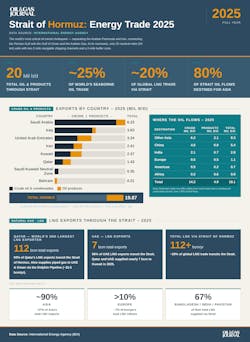
Infographic: Strait of Hormuz energy trade 2025

@import url(‘https://fonts.googleapis.com/css2?family=Inter:[email protected]&display=swap’); a { color: var(–color-primary-main); } .ebm-page__main h1, .ebm-page__main h2, .ebm-page__main h3, .ebm-page__main h4, .ebm-page__main h5, .ebm-page__main h6 { font-family: Inter; } body { line-height: 150%; letter-spacing: 0.025em; font-family: Inter; } button, .ebm-button-wrapper { font-family: Inter; } .label-style { text-transform: uppercase; color: var(–color-grey); font-weight: 600; font-size: 0.75rem; } .caption-style { font-size: 0.75rem; opacity: .6; } #onetrust-pc-sdk [id*=btn-handler], #onetrust-pc-sdk [class*=btn-handler] { background-color: #c19a06 !important; border-color: #c19a06 !important; } #onetrust-policy a, #onetrust-pc-sdk a, #ot-pc-content a { color: #c19a06 !important; } #onetrust-consent-sdk #onetrust-pc-sdk .ot-active-menu { border-color: #c19a06 !important; } #onetrust-consent-sdk #onetrust-accept-btn-handler, #onetrust-banner-sdk #onetrust-reject-all-handler, #onetrust-consent-sdk #onetrust-pc-btn-handler.cookie-setting-link { background-color: #c19a06 !important; border-color: #c19a06 !important; } #onetrust-consent-sdk .onetrust-pc-btn-handler { color: #c19a06 !important; border-color: #c19a06 !important; } Coordinated attacks Feb. 28 by the US and Israel on Iran and the since-escalated conflict have nearly halted shipping traffic through the Strait of Hormuz, which typically carries about 20% of the world’s crude oil and natural gas. OGJ Statistics Editor Laura Bell-Hammer compiled data to showcase 2025 energy trade through the critical transit chokepoint.   <!–> –> <!–> ]–> <!–> ]–>

Read More »

BOEM: US OCS holds 65.8 billion bbl of technically recoverable reserves

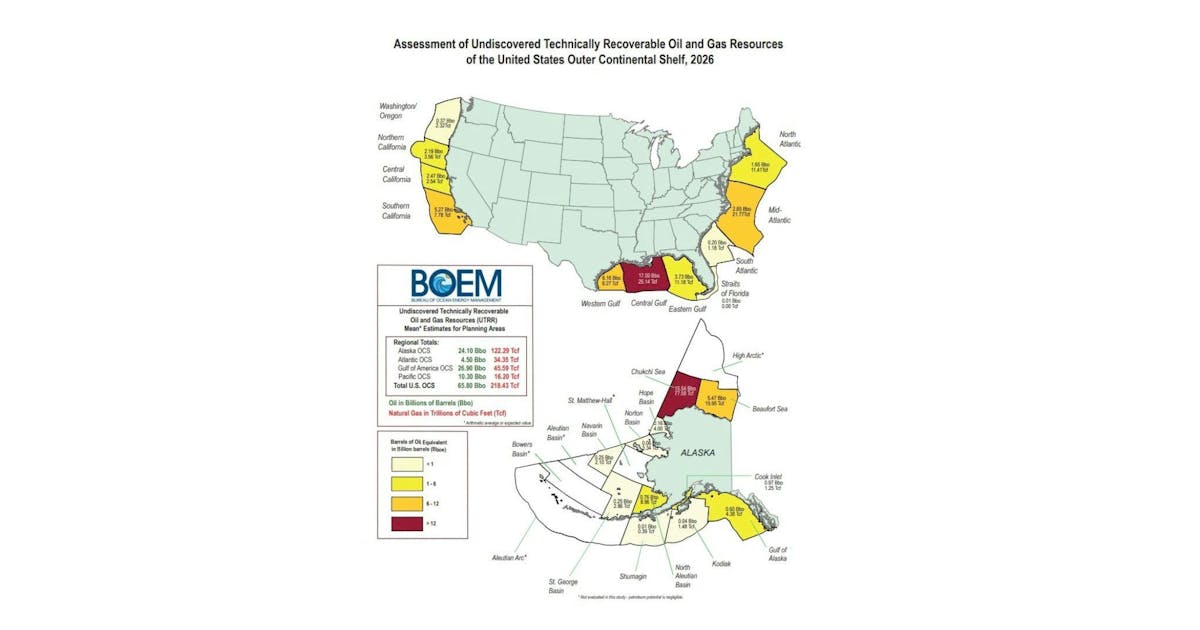
The US Outer Continental Shelf (OCS) holds mean undiscovered technically recoverable resources (UTRR) of 65.8 billion bbl of oil and 218.43 tcf of natural gas, the US Bureau of Ocean Energy Management (BOEM) said Mar. 9. Based on current production trends, these undiscovered resources represent the potential for 100 or more years of energy production from the US Outer Continental Shelf (OCS), BOEM said. A large portion of undiscovered OSC resources is located offshore the Gulf of Mexico and Alaska, according to the report. The offshore Gulf holds 26.9 million bbl of oil and 45.59 tcf of gas, while offshore Alaska holds an estimated mean 24.1 million bbl of oil and 122.29 tcf of gas. Offshore Pacific holds a mean UTRR of 10.3 million barrels of oil and 16.2 trillion cubic feet of gas, the report said. Offshore Atlantic holds a mean UTRR of 10.3 billion barrels of oil and 16.2 trillion cubic feet of gas. The assessment also evaluates the impact of prices on hydrocarbon recovery. Alaska is particularly price-sensitive, with mean undiscovered economically recoverable resources (UERR) negligible until prices average $100/bbl and $17.79/Mcf. At those levels, the mean UERR stands at 6.25 billion bbl and 13.25 tcf. At $160/bbl and $28.47/Mcf, recoverable resources jump to 14.67 billion bbl and 58.78 tcf. In the Gulf of Mexico, the mean UERR is 17.51 billion bbl of oil and 13.71 tcf at average prices of $60/bbl and $3.20/Mcf, increasing to 20.51 billion bbl and 17.49 tcf at average prices of $100/bbl and $5.34/Mcf, respectively. BOEM conducts a national resource assessment every 4 years to understand the “distribution of undiscovered oil and gas resources on the OCS” and identify opportunities for additional oil and gas exploration and development. “The Outer Continental Shelf holds tremendous resource potential,” said BOEM Acting Director Matt Giacona. “This

Read More »

Community Opposition Emerges as New Gatekeeper for AI Data Center Expansion

The rapid global buildout of AI infrastructure is colliding with a new constraint that hyperscalers cannot solve with capital or GPUs: local opposition. In the first months of 2026, community resistance has already begun reshaping the development pipeline. A February analysis by Sightline Climate estimates that 30–50 percent of the data center capacity expected to come online in 2026 may not be delivered on schedule, reflecting a growing set of constraints that now include power availability, permitting challenges, and increasingly organized local opposition. The financial stakes are already substantial. Recent reporting indicates that tens of billions of dollars in planned data center development have been delayed or halted amid community pushback, including an estimated $98 billion worth of projects delayed or blocked in a single quarter of 2025, according to research cited by Data Center Watch. What had been framed throughout 2024 and 2025 as an inevitable expansion of hyperscale campuses, gigawatt-scale power agreements, and AI “factory” clusters is now encountering a different kind of gatekeeper: the communities expected to host the infrastructure. The shift is already visible in project outcomes. Across the United States, multiple projects were canceled, blocked, or fundamentally reshaped in the opening months of 2026 due to organized local opposition. Reporting from The Guardian found that 26 data center projects were canceled in December and January, compared with just one cancellation in October, suggesting that community resistance campaigns are increasingly capable of stopping projects before construction begins. At the same time, local governments are responding to community pressure with moratoriums, zoning restrictions, and permitting delays that can stall projects long enough to jeopardize financing or push developers to seek more favorable jurisdictions. While opposition to data center development is not new, the scale, coordination, and success rate of these efforts suggest a structural shift in how

Read More »

From Real Estate to AI Factories: 7×24 Exchange’s Michael Siteman on Power, Politics, and the New Logic of Data Center Development

The data center industry’s explosive growth in the AI era is transforming how projects are conceived, financed, and built. What was once a real estate-driven business has become something far more complex: an engineering and infrastructure challenge defined by power availability, network topology, and local politics. That was one of the key themes in this recent episode of the Data Center Frontier Show podcast, where Editor-in-Chief Matt Vincent spoke with Michael Siteman, President of Prodigious Proclivities and a longtime leader and board member within 7×24 Exchange International. Drawing on decades of experience spanning brokerage, development, connectivity strategy, and infrastructure advisory, Siteman offered a field-level view of how the industry is adapting to the demands of AI-driven infrastructure. “The business used to be a pure real estate play,” Siteman said. “Now it’s a systems engineering problem. It’s power, network topology, the real estate itself, and political risk—all of these factors that have to work together.” Site Selection Becomes Systems Engineering For much of the early data center era, location decisions revolved around traditional real estate considerations: available buildings, proximity to customers, and nearby fiber connectivity. That logic has fundamentally changed. “Years ago, the question was: Is there a building? Are there carriers nearby?” Siteman recalled. “Now it’s completely different. Power availability, network topology, community acceptance—these are the variables that define whether a site works.” Utilities themselves have become gatekeepers in the process. “You go to a utility and ask if there’s power,” he explained. “They might say, ‘We might have power, but you have to pay us to study whether we actually have power.’” In many regions experiencing rapid digital infrastructure expansion, the answer increasingly comes back the same: there simply isn’t enough grid capacity available. Power Becomes the Project In the gigawatt-scale era of AI infrastructure, power strategy has moved

Read More »

Meta’s Expanded MTIA Roadmap Signals a New Phase in AI Data Center Architecture

Silicon as a Data Center Design Tool Custom silicon also allows hyperscale operators to shape the physical characteristics of the infrastructure around it. Traditional GPU platforms often arrive with fixed power envelopes and thermal constraints. But internally designed accelerators allow companies like Meta to tailor chips to the rack-level power and cooling budgets of their own data center architecture. That flexibility becomes increasingly important as AI infrastructure pushes power densities far beyond traditional enterprise deployments. Custom accelerators like MTIA can be engineered to fit within the liquid-to-chip cooling frameworks now emerging in hyperscale AI racks. These systems circulate coolant directly across cold plates attached to processors, removing heat far more efficiently than air cooling and enabling higher compute densities. For operators running thousands of racks across multiple campuses, small improvements in performance-per-watt can translate into enormous reductions in total power demand. Software-Defined Power One of the subtler advantages of custom silicon lies in how it interacts with data center power systems. By controlling chip-level power management features such as power capping and workload throttling, operators can fine-tune how servers consume electricity inside each rack. This creates opportunities to safely run racks closer to their electrical limits without triggering breaker trips or thermal overloads. In practice, that means data center operators can extract more useful compute from the same electrical infrastructure. At hyperscale, where campuses may draw hundreds of megawatts, these efficiencies have a direct impact on capital planning and grid interconnection requirements. The Interconnect Layer AI accelerators do not operate in isolation. Their effectiveness depends heavily on how they connect to memory, storage, and other compute nodes across the cluster. Industry analysts expect next-generation inference platforms to rely increasingly on high-speed interconnect technologies such as CXL (Compute Express Link) and advanced networking fabrics to support disaggregated memory architectures and low-latency

Read More »

PJM Moves to Redefine Behind-the-Meter Power for AI Data Centers

PJM Interconnection is moving to rewrite how behind-the-meter power is treated across its grid, signaling a major shift as AI-scale data centers push electricity demand into territory the current regulatory framework was never designed to handle. For years, PJM’s retail behind-the-meter generation rules allowed customers with onsite generation to “net” their load, reducing the amount of demand counted for transmission and other grid-related charges. The framework dates back to 2004, when behind-the-meter generation was typically associated with smaller industrial facilities or campus-style energy systems. PJM now argues that those assumptions no longer hold. The arrival of very large co-located loads, particularly hyperscale and AI data centers seeking hundreds of megawatts of power on accelerated timelines, has exposed gaps in how the system accounts for and plans around those facilities. In February 2026, PJM asked the Federal Energy Regulatory Commission to approve a tariff rewrite that would sharply limit how new large loads can rely on legacy netting rules. The move reflects a broader challenge facing grid operators as the rapid expansion of AI infrastructure begins to collide with planning frameworks built for a far slower era of demand growth. The proposal follows directly from a December 18, 2025 order from FERC finding that PJM’s existing tariff was “unjust and unreasonable” because it lacked clear rates, terms, and conditions governing co-location arrangements between large loads and generating facilities. Rather than prohibiting co-location, the commission directed PJM to create transparent rules allowing data centers and other large consumers to pair with generation while still protecting system reliability and other ratepayers. In essence, FERC told PJM not to shut the door on these arrangements, but to stop improvising and build a formal framework capable of supporting them. Why Behind-the-Meter Power Matters Behind-the-meter arrangements have become one of the most attractive strategies for hyperscale

Read More »

The Gigawatt Bottleneck: Power Constraints Define AI Data Center Growth

Power is rapidly becoming the defining constraint on the next phase of data center growth. Across the industry, developers and hyperscalers are discovering that the biggest obstacle to deploying AI infrastructure is no longer capital, land, or connectivity. It’s electricity. In major markets from Northern Virginia to Texas, grid interconnection timelines are stretching out for years as utilities struggle to keep pace with a surge in large-load requests from AI-driven infrastructure. A new industry analysis from Bloom Energy reinforces that emerging reality. The company’s 2026 Data Center Power Report finds that electricity availability has moved from a planning consideration to a defining boundary on data center expansion, transforming site selection, power strategies, and the design of next-generation AI campuses. Based on surveys of hyperscalers, colocation providers, utilities, and equipment suppliers conducted through 2025, the report concludes that the determinants of data center growth are changing in the AI era. Across the industry, the result is a structural shift in how data centers are planned, financed, and powered. Industry executives interviewed for the report say the shift is already visible in real-world development decisions. “We’re seeing a geographic shift as certain regions become more power-friendly and therefore more attractive for data center construction,” said a hyperscaler energy executive quoted in the report, noting that developers are increasingly prioritizing markets where large blocks of electricity can be secured quickly and predictably. AI Load Is Accelerating Faster Than the Grid Bloom’s analysis suggests that U.S. data center IT load could grow from roughly 80 gigawatts in 2025 to about 150 gigawatts by 2028, effectively doubling within three years as AI training clusters and inference infrastructure expand. That surge is already showing up in grid planning models. The Electric Reliability Council of Texas (ERCOT), which oversees the Texas power market, now forecasts that statewide

Read More »

Data mining? Old servers could become new source of rare earths

For decades, he said, “the retirement of data center equipment was treated almost entirely as a compliance and disposal issue. Enterprises focused on secure decommissioning, certified recycling, and documented destruction of sensitive hardware. Once equipment left production environments, its economic life was assumed to be largely finished.” That assumption, he pointed out, “is beginning to change, because the hardware inside modern data centres contains a wide range of strategically important materials. Servers, storage systems, networking equipment, and power components contain copper, aluminum, silver, gold, and increasingly small but significant quantities of rare earth elements and other critical minerals.” These materials play a vital role in the manufacturing of semiconductors, energy systems, defense electronics, and advanced computing infrastructure, he explained, noting, “as global demand for digital infrastructure continues to expand, the volume of retired hardware entering disposal channels is rising quickly.” Electronic waste has already become one of the fastest growing waste streams in the world. “Global volumes now exceed 60 million tonnes annually and are projected to move toward eighty million tonnes by the end of the decade if current trends continue,” he said. “Data center infrastructure represents only a portion of that total, but it is a particularly important portion because it is concentrated, professionally managed, and replaced in structured cycles.” For a metals producer, he said, data center infrastructure represents a highly attractive feedstock, because unlike consumer electronics, enterprise hardware is replaced in large batches and flows through professional asset management channels. That predictability, said Gogia, “allows recyclers to design specialized processes that target specific components and materials. Over time, this creates the foundation for an industrial scale circular supply chain in which retired electronics feed back into the production of new materials.”

Read More »

Microsoft will invest $80B in AI data centers in fiscal 2025

And Microsoft isn’t the only one that is ramping up its investments into AI-enabled data centers. Rival cloud service providers are all investing in either upgrading or opening new data centers to capture a larger chunk of business from developers and users of large language models (LLMs).  In a report published in October 2024, Bloomberg Intelligence estimated that demand for generative AI would push Microsoft, AWS, Google, Oracle, Meta, and Apple would between them devote $200 billion to capex in 2025, up from $110 billion in 2023. Microsoft is one of the biggest spenders, followed closely by Google and AWS, Bloomberg Intelligence said. Its estimate of Microsoft’s capital spending on AI, at $62.4 billion for calendar 2025, is lower than Smith’s claim that the company will invest $80 billion in the fiscal year to June 30, 2025. Both figures, though, are way higher than Microsoft’s 2020 capital expenditure of “just” $17.6 billion. The majority of the increased spending is tied to cloud services and the expansion of AI infrastructure needed to provide compute capacity for OpenAI workloads. Separately, last October Amazon CEO Andy Jassy said his company planned total capex spend of $75 billion in 2024 and even more in 2025, with much of it going to AWS, its cloud computing division.

Read More »

John Deere unveils more autonomous farm machines to address skill labor shortage

Join our daily and weekly newsletters for the latest updates and exclusive content on industry-leading AI coverage. Learn More Self-driving tractors might be the path to self-driving cars. John Deere has revealed a new line of autonomous machines and tech across agriculture, construction and commercial landscaping. The Moline, Illinois-based John Deere has been in business for 187 years, yet it’s been a regular as a non-tech company showing off technology at the big tech trade show in Las Vegas and is back at CES 2025 with more autonomous tractors and other vehicles. This is not something we usually cover, but John Deere has a lot of data that is interesting in the big picture of tech. The message from the company is that there aren’t enough skilled farm laborers to do the work that its customers need. It’s been a challenge for most of the last two decades, said Jahmy Hindman, CTO at John Deere, in a briefing. Much of the tech will come this fall and after that. He noted that the average farmer in the U.S. is over 58 and works 12 to 18 hours a day to grow food for us. And he said the American Farm Bureau Federation estimates there are roughly 2.4 million farm jobs that need to be filled annually; and the agricultural work force continues to shrink. (This is my hint to the anti-immigration crowd). John Deere’s autonomous 9RX Tractor. Farmers can oversee it using an app. While each of these industries experiences their own set of challenges, a commonality across all is skilled labor availability. In construction, about 80% percent of contractors struggle to find skilled labor. And in commercial landscaping, 86% of landscaping business owners can’t find labor to fill open positions, he said. “They have to figure out how to do

Read More »

2025 playbook for enterprise AI success, from agents to evals

Join our daily and weekly newsletters for the latest updates and exclusive content on industry-leading AI coverage. Learn More 2025 is poised to be a pivotal year for enterprise AI. The past year has seen rapid innovation, and this year will see the same. This has made it more critical than ever to revisit your AI strategy to stay competitive and create value for your customers. From scaling AI agents to optimizing costs, here are the five critical areas enterprises should prioritize for their AI strategy this year. 1. Agents: the next generation of automation AI agents are no longer theoretical. In 2025, they’re indispensable tools for enterprises looking to streamline operations and enhance customer interactions. Unlike traditional software, agents powered by large language models (LLMs) can make nuanced decisions, navigate complex multi-step tasks, and integrate seamlessly with tools and APIs. At the start of 2024, agents were not ready for prime time, making frustrating mistakes like hallucinating URLs. They started getting better as frontier large language models themselves improved. “Let me put it this way,” said Sam Witteveen, cofounder of Red Dragon, a company that develops agents for companies, and that recently reviewed the 48 agents it built last year. “Interestingly, the ones that we built at the start of the year, a lot of those worked way better at the end of the year just because the models got better.” Witteveen shared this in the video podcast we filmed to discuss these five big trends in detail. Models are getting better and hallucinating less, and they’re also being trained to do agentic tasks. Another feature that the model providers are researching is a way to use the LLM as a judge, and as models get cheaper (something we’ll cover below), companies can use three or more models to

Read More »

OpenAI’s red teaming innovations define new essentials for security leaders in the AI era

Join our daily and weekly newsletters for the latest updates and exclusive content on industry-leading AI coverage. Learn More OpenAI has taken a more aggressive approach to red teaming than its AI competitors, demonstrating its security teams’ advanced capabilities in two areas: multi-step reinforcement and external red teaming. OpenAI recently released two papers that set a new competitive standard for improving the quality, reliability and safety of AI models in these two techniques and more. The first paper, “OpenAI’s Approach to External Red Teaming for AI Models and Systems,” reports that specialized teams outside the company have proven effective in uncovering vulnerabilities that might otherwise have made it into a released model because in-house testing techniques may have missed them. In the second paper, “Diverse and Effective Red Teaming with Auto-Generated Rewards and Multi-Step Reinforcement Learning,” OpenAI introduces an automated framework that relies on iterative reinforcement learning to generate a broad spectrum of novel, wide-ranging attacks. Going all-in on red teaming pays practical, competitive dividends It’s encouraging to see competitive intensity in red teaming growing among AI companies. When Anthropic released its AI red team guidelines in June of last year, it joined AI providers including Google, Microsoft, Nvidia, OpenAI, and even the U.S.’s National Institute of Standards and Technology (NIST), which all had released red teaming frameworks. Investing heavily in red teaming yields tangible benefits for security leaders in any organization. OpenAI’s paper on external red teaming provides a detailed analysis of how the company strives to create specialized external teams that include cybersecurity and subject matter experts. The goal is to see if knowledgeable external teams can defeat models’ security perimeters and find gaps in their security, biases and controls that prompt-based testing couldn’t find. What makes OpenAI’s recent papers noteworthy is how well they define using human-in-the-middle

Read More »