Stay Ahead, Stay ONMINE

Bringing AI to the next generation of fusion energy

Science Published 16 October 2025 Authors The Fusion team We’re partnering with Commonwealth Fusion Systems (CFS) to bring clean, safe, limitless fusion energy closer to reality.Fusion, the process that powers the sun, promises clean, abundant energy without long-lived radioactive waste. Making it work here on Earth means keeping an ionized gas, known as plasma, stable at temperatures over 100 million degrees Celsius — all within a fusion energy machine’s limits. This is a highly complex physics problem that we’re working to solve with artificial intelligence (AI).Today, we’re announcing our research partnership with Commonwealth Fusion Systems (CFS), a global leader in fusion energy. CFS is pioneering a faster path to clean, safe and effectively limitless fusion energy with its compact, powerful tokamak machine called SPARC.SPARC leverages powerful high-temperature superconducting magnets and aims to be the first magnetic fusion machine in history to generate net fusion energy — more power from fusion than it takes to sustain it. That landmark achievement is known as crossing “breakeven,” and a critical milestone on the path to viable fusion energy.This partnership builds on our groundbreaking work using AI to successfully control a plasma. With academic partners at the Swiss Plasma Center at EPFL (École Polytechnique Fédérale de Lausanne), we showed that deep reinforcement learning can control the magnets of a tokamak to stabilize complex plasma shapes. To cover a wider range of physics, we developed TORAX, a fast and differentiable plasma simulator written in JAX.Now, we’re bringing that work to CFS to accelerate the timeline to deliver fusion energy to the grid. We’ve been collaborating on three key areas so far:Producing a fast, accurate, differentiable simulation of a fusion plasma.Finding the most efficient and robust path to maximizing fusion energy.Using reinforcement learning to discover novel real-time control strategies.The combination of our AI expertise with CFS’s cutting-edge hardware makes this the ideal partnership to advance foundational discoveries in fusion energy for the benefit of the worldwide research community, and ultimately, the whole world.Simulating fusion plasmaTo optimize the performance of a tokamak, we need to simulate how heat, electric current and matter flow through the core of a plasma and interact with the systems around it. Last year, we released TORAX, an open-source plasma simulator built for optimization and control, expanding the scope of physics questions we could address beyond magnetic simulation. TORAX is built in JAX, so it can run easily on both CPUs and GPUs and can smoothly integrate AI-powered models, including our own, to achieve even better performance.TORAX will help CFS teams test and refine their operating plans by running millions of virtual experiments before SPARC is even turned on. It also gives them flexibility to quickly adapt their plans once the first data arrives.This software has become a linchpin in CFS’s daily workflows, helping them understand how the plasma will behave under different conditions, saving precious time and resources. “ TORAX is a professional, open-source plasma simulator that saved us countless hours in setting up and running our simulation environments for SPARC. Devon Battaglia, Senior Manager of Physics Operations at CFS Finding the fastest path to maximum energyOperating a tokamak involves countless choices in how to tune the various “knobs” available, like magnetic coil currents, fuel injection and heating power. Manually finding a tokamak’s optimal settings to produce the most energy, while staying within operating limits, could be very inefficient.Using TORAX in combination with reinforcement learning or evolutionary search approaches like AlphaEvolve, our AI agents can explore vast numbers of potential operating scenarios in simulation, rapidly identifying the most efficient and robust paths to generating net energy. This can help CFS focus on the most promising strategies, increasing the probability of success from day one, even before SPARC is fully commissioned and operating at full power.We’ve been building the infrastructure to investigate various SPARC scenarios. We can look at maximizing fusion power produced under different constraints, or optimizing for robustness as we learn more about the machine.Here we illustrate examples of a standard SPARC pulse simulated in TORAX. Our AI system can assess many possible pulses to find the settings we expect to perform the best. Visualizations of a cross section through SPARC. On the left, we see the plasma in fuchsia. On the right, we see an example plasma pulse simulated in TORAX, showing changes in the plasma pressure. On the right side, we show that adjusting control commands changes the plasma performance, resulting in different plasma pulses. Through our growing network of collaborations within the fusion research community, we’ll be able to validate and calibrate TORAX against past tokamak data and high-fidelity simulations. This information will provide confidence in simulation accuracy and help us nimbly adapt as soon as SPARC begins operations.Developing an AI pilot for real-time controlIn our previous work, we showed reinforcement learning can control the magnetic configuration of a tokamak. We’re now increasing complexity by adding simultaneous optimization of more aspects of tokamak performance, such as maximizing fusion power or managing SPARC’s heat load, so it can run at high performance with a greater margin to machine limits.When running at full power, SPARC will release immense heat concentrated onto a small area that must be carefully managed to protect the solid materials closest to the plasma. One strategy SPARC could use is to magnetically sweep this exhaust energy along the wall, as illustrated below. Left: The location of the plasma-facing materials depicted on the right side of SPARC’s interior. Right: Three-dimensional animation of the rate at which energy is deposited on the plasma-facing materials, as the plasma configuration changes (not representative of an actual pulse on SPARC). Image rendered with HEAT (https://github.com/plasmapotential/HEAT), courtesy of Tom Looby at CFS. In the initial phase of our collaboration, we’re investigating how reinforcement learning agents can learn to dynamically control plasma to distribute this heat effectively. In the future, AI could learn adaptive strategies more complex than anything an engineer would craft, especially when balancing multiple constraints and objectives. We could also use reinforcement learning to quickly tune traditional control algorithms for a specific pulse. The combination of pulse optimization and optimal control could push SPARC further and faster to achieve its historic goals.Uniting AI and fusion to build a cleaner futureAlongside our research, Google has invested in CFS, supporting their work on promising scientific and engineering breakthroughs, and moving their technology toward commercialization.Looking ahead, our vision extends beyond optimizing SPARC operations. We’re building the foundations for AI to become an intelligent, adaptive system at the very heart of future fusion power plants. This is just the beginning of our journey together, and we hope to share more details about our collaboration as we reach new milestones.By uniting the revolutionary potential of AI and fusion, we’re building a cleaner and more sustainable energy future. Learn more about our work AcknowledgementsThis work is a collaboration between Google DeepMind and Commonwealth Fusion Systems.Google Deepmind contributors: David Pfau, Sarah Bechtle, Sebastian Bodenstein, Jonathan Citrin, Ian Davies, Bart De Vylder, Craig Donner, Tom Eccles, Federico Felici, Anushan Fernando, Ian Goodfellow, Philippe Hamel, Andrea Huber, Tyler Jackson, Amy Nommeots-Nomm, Tamara Norman, Uchechi Okereke, Francesca Pietra, Akhil Raju and Brendan Tracey.Commonwealth Fusion Systems contributors: Devon Battaglia, Tom Body, Dan Boyer, Alex Creely, Jaydeep Deshpande, Christoph Hasse, Peter Kaloyannis, Wil Koch, Tom Looby, Matthew Reinke, Josh Sulkin, Anna Teplukhina, Misha Veldhoen, Josiah Wai and Chris Woodall.We’d also like to thank Pushmeet Kohli and Bob Mumgaard for their support.Credits: The image of the SPARC Facility, the SPARC renderings and CAD rendering of the divertor tiles are copyright from 2025 Commonwealth Fusion Systems.


Science

Published
16 October 2025
Authors

The Fusion team

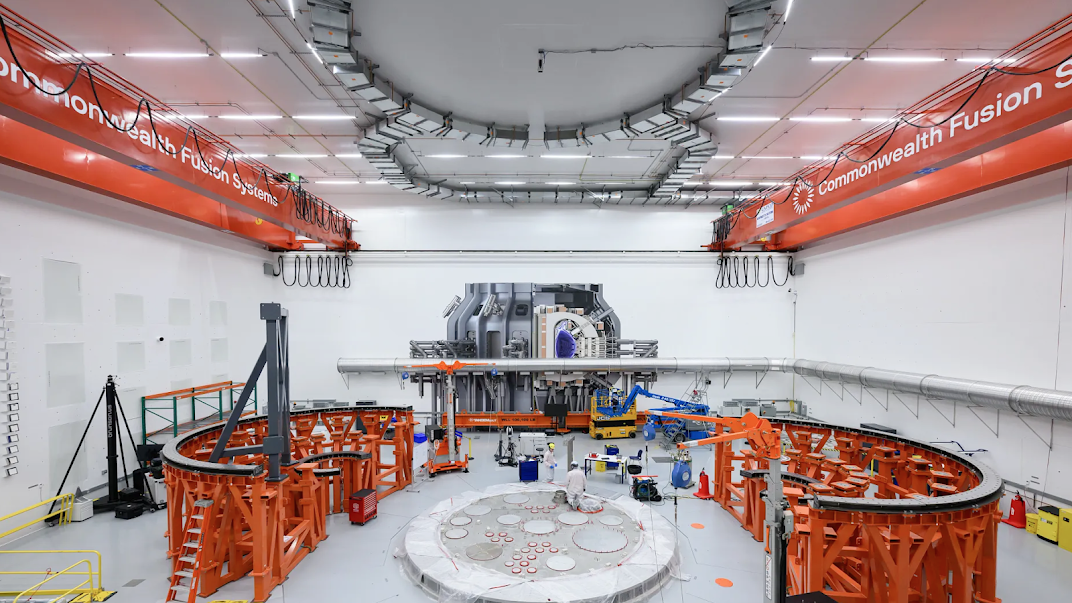
Photograph taken at the Commonwealth Fusion Systems headquarters in Devens, Massachusetts. The image shows construction in progress for SPARC, a compact, powerful tokamak machine called SPARC. A rendering of SPARC when completed is shown on the rear wall. Copyright 2025 Commonwealth Fusion Systems (CFS).

We’re partnering with Commonwealth Fusion Systems (CFS) to bring clean, safe, limitless fusion energy closer to reality.

Fusion, the process that powers the sun, promises clean, abundant energy without long-lived radioactive waste. Making it work here on Earth means keeping an ionized gas, known as plasma, stable at temperatures over 100 million degrees Celsius — all within a fusion energy machine’s limits. This is a highly complex physics problem that we’re working to solve with artificial intelligence (AI).

Today, we’re announcing our research partnership with Commonwealth Fusion Systems (CFS), a global leader in fusion energy. CFS is pioneering a faster path to clean, safe and effectively limitless fusion energy with its compact, powerful tokamak machine called SPARC.

SPARC leverages powerful high-temperature superconducting magnets and aims to be the first magnetic fusion machine in history to generate net fusion energy — more power from fusion than it takes to sustain it. That landmark achievement is known as crossing “breakeven,” and a critical milestone on the path to viable fusion energy.

This partnership builds on our groundbreaking work using AI to successfully control a plasma. With academic partners at the Swiss Plasma Center at EPFL (École Polytechnique Fédérale de Lausanne), we showed that deep reinforcement learning can control the magnets of a tokamak to stabilize complex plasma shapes. To cover a wider range of physics, we developed TORAX, a fast and differentiable plasma simulator written in JAX.

Now, we’re bringing that work to CFS to accelerate the timeline to deliver fusion energy to the grid. We’ve been collaborating on three key areas so far:

  • Producing a fast, accurate, differentiable simulation of a fusion plasma.
  • Finding the most efficient and robust path to maximizing fusion energy.
  • Using reinforcement learning to discover novel real-time control strategies.

The combination of our AI expertise with CFS’s cutting-edge hardware makes this the ideal partnership to advance foundational discoveries in fusion energy for the benefit of the worldwide research community, and ultimately, the whole world.

Simulating fusion plasma

To optimize the performance of a tokamak, we need to simulate how heat, electric current and matter flow through the core of a plasma and interact with the systems around it. Last year, we released TORAX, an open-source plasma simulator built for optimization and control, expanding the scope of physics questions we could address beyond magnetic simulation. TORAX is built in JAX, so it can run easily on both CPUs and GPUs and can smoothly integrate AI-powered models, including our own, to achieve even better performance.

TORAX will help CFS teams test and refine their operating plans by running millions of virtual experiments before SPARC is even turned on. It also gives them flexibility to quickly adapt their plans once the first data arrives.

This software has become a linchpin in CFS’s daily workflows, helping them understand how the plasma will behave under different conditions, saving precious time and resources.

“

TORAX is a professional, open-source plasma simulator that saved us countless hours in setting up and running our simulation environments for SPARC.

Devon Battaglia, Senior Manager of Physics Operations at CFS

Finding the fastest path to maximum energy

Operating a tokamak involves countless choices in how to tune the various “knobs” available, like magnetic coil currents, fuel injection and heating power. Manually finding a tokamak’s optimal settings to produce the most energy, while staying within operating limits, could be very inefficient.

Using TORAX in combination with reinforcement learning or evolutionary search approaches like AlphaEvolve, our AI agents can explore vast numbers of potential operating scenarios in simulation, rapidly identifying the most efficient and robust paths to generating net energy. This can help CFS focus on the most promising strategies, increasing the probability of success from day one, even before SPARC is fully commissioned and operating at full power.

We’ve been building the infrastructure to investigate various SPARC scenarios. We can look at maximizing fusion power produced under different constraints, or optimizing for robustness as we learn more about the machine.

Here we illustrate examples of a standard SPARC pulse simulated in TORAX. Our AI system can assess many possible pulses to find the settings we expect to perform the best.

Visualizations of a cross section through SPARC. On the left, we see the plasma in fuchsia. On the right, we see an example plasma pulse simulated in TORAX, showing changes in the plasma pressure. On the right side, we show that adjusting control commands changes the plasma performance, resulting in different plasma pulses.

Through our growing network of collaborations within the fusion research community, we’ll be able to validate and calibrate TORAX against past tokamak data and high-fidelity simulations. This information will provide confidence in simulation accuracy and help us nimbly adapt as soon as SPARC begins operations.

Developing an AI pilot for real-time control

In our previous work, we showed reinforcement learning can control the magnetic configuration of a tokamak. We’re now increasing complexity by adding simultaneous optimization of more aspects of tokamak performance, such as maximizing fusion power or managing SPARC’s heat load, so it can run at high performance with a greater margin to machine limits.

When running at full power, SPARC will release immense heat concentrated onto a small area that must be carefully managed to protect the solid materials closest to the plasma. One strategy SPARC could use is to magnetically sweep this exhaust energy along the wall, as illustrated below.

Left: The location of the plasma-facing materials depicted on the right side of SPARC’s interior. Right: Three-dimensional animation of the rate at which energy is deposited on the plasma-facing materials, as the plasma configuration changes (not representative of an actual pulse on SPARC). Image rendered with HEAT (https://github.com/plasmapotential/HEAT), courtesy of Tom Looby at CFS.

In the initial phase of our collaboration, we’re investigating how reinforcement learning agents can learn to dynamically control plasma to distribute this heat effectively. In the future, AI could learn adaptive strategies more complex than anything an engineer would craft, especially when balancing multiple constraints and objectives. We could also use reinforcement learning to quickly tune traditional control algorithms for a specific pulse. The combination of pulse optimization and optimal control could push SPARC further and faster to achieve its historic goals.

Uniting AI and fusion to build a cleaner future

Alongside our research, Google has invested in CFS, supporting their work on promising scientific and engineering breakthroughs, and moving their technology toward commercialization.

Looking ahead, our vision extends beyond optimizing SPARC operations. We’re building the foundations for AI to become an intelligent, adaptive system at the very heart of future fusion power plants. This is just the beginning of our journey together, and we hope to share more details about our collaboration as we reach new milestones.

By uniting the revolutionary potential of AI and fusion, we’re building a cleaner and more sustainable energy future.

Learn more about our work

Acknowledgements

This work is a collaboration between Google DeepMind and Commonwealth Fusion Systems.

Google Deepmind contributors: David Pfau, Sarah Bechtle, Sebastian Bodenstein, Jonathan Citrin, Ian Davies, Bart De Vylder, Craig Donner, Tom Eccles, Federico Felici, Anushan Fernando, Ian Goodfellow, Philippe Hamel, Andrea Huber, Tyler Jackson, Amy Nommeots-Nomm, Tamara Norman, Uchechi Okereke, Francesca Pietra, Akhil Raju and Brendan Tracey.

Commonwealth Fusion Systems contributors: Devon Battaglia, Tom Body, Dan Boyer, Alex Creely, Jaydeep Deshpande, Christoph Hasse, Peter Kaloyannis, Wil Koch, Tom Looby, Matthew Reinke, Josh Sulkin, Anna Teplukhina, Misha Veldhoen, Josiah Wai and Chris Woodall.

We’d also like to thank Pushmeet Kohli and Bob Mumgaard for their support.

Credits: The image of the SPARC Facility, the SPARC renderings and CAD rendering of the divertor tiles are copyright from 2025 Commonwealth Fusion Systems.

Shape
Shape
Stay Ahead

Explore More Insights

Stay ahead with more perspectives on cutting-edge power, infrastructure, energy,  bitcoin and AI solutions. Explore these articles to uncover strategies and insights shaping the future of industries.

Shape

AWS seeks to automate cloud optimization with new AI agent

There are limits to the agent’s ability to offer timely recommendations, though: “The Agent refreshes resource-and application-level recommendations weekly, while architecture-level recommendations are generated through on-demand reviews,” Bui said. That distinction could be particularly important for fast-changing workloads, including agentic applications, where infrastructure and resource usage can change between recommendation

Read More »

Energy Department Announces $4.2 Billion Investment to Boost Nuclear Power and Help Lower Energy Costs in Pennsylvania and Ohio

WASHINGTON—The U.S. Department of Energy’s (DOE) Office of Energy Dominance Financing (EDF) today announced a conditional loan commitment of up to $4.2 billion to finance nuclear uprates and modernization across Vistra’s nuclear fleet in Pennsylvania and Ohio. Today’s announcement will deliver more reliable American energy, strengthen the grid, lower costs, and meet growing power demand across the 13-state PJM Interconnection, L.L.C. (PJM) region. The investment advances President Trump’s Executive Order Reinvigorating the Nuclear Industrial Base, and marks another major step in restoring American nuclear leadership. “President Trump promised to unleash an American nuclear renaissance, and the Energy Department is delivering,” said U.S. Secretary of Energy Chris Wright. “By getting more power out of the nuclear plants we already have, we can deliver more affordable, reliable, around the-clock energy for American families and businesses.” The projects will preserve nearly 4 gigawatts (GW) of reliable baseload power—enough to power more than 3 million homes—and add 433 megawatts (MW) of new nuclear capacity, helping meet growing electricity demand in Pennsylvania, Ohio, and across the PJM region. The investments will support approximately 3,000 project-related jobs in engineering, construction, and planned outage work while preserving thousands of permanent, well-paying jobs. “President Trump and Secretary Wright have set a clear direction for America’s nuclear future, and EDF is financing the projects that advance that mission,” said EDF Director Gregory A. Beard. “These investments will extend the life of existing reactors, increase nuclear generation, and deliver abundant, around-the-clock power to lower costs and power American prosperity for decades to come.” Vistra’s planned investments at Beaver Valley in Pennsylvania and Davis-Besse and Perry in Ohio will produce more electricity from existing nuclear plants without requiring new transmission corridors or equivalent new generation resources, while supporting the plants’ operation for an additional 20 years beyond their existing licenses. EDF’s

Read More »

Energy Department Announces Alaska Railbelt Transmission Project to Receive Defense Production Act Funding, Securing Alaska Military Installations and Local Communities

WASHINGTON—The U.S. Department of Energy today announced its intent to deploy Defense Production Act (DPA) funding to develop a second high-voltage connection between Southcentral and Interior Alaska, strengthening grid infrastructure essential to national defense. The Alaska Energy Authority’s Beluga-Healy Transmission Project combines up to $150 million in DPA funding with $268 million in non-federal funding, representing a planned total investment of $418 million in Alaska’s grid.  Approximately 223 miles of new transmission line connecting Beluga and Healy will be built. Once complete, grid operators will have an additional pathway to move power between Alaska’s most densely populated communities and major military installations–lowering electricity costs and strengthening grid reliability for approximately 75% of Alaska’s population. Thanks to President Trump and the passage of the Working Families Tax Cut, $1 billion in federal funding has been appropriated for energy-related projects deemed critical to national security. Presidential Determination No. 2026-10 identifies transmission lines and conductors, substations, and power-control and protection equipment as essential to national defense. “Supporting improvements to Alaska’s transmission infrastructure with Defense Production Act funds reflects the Trump Administration’s commitment to strengthening national security, improving grid reliability, and lowering electricity costs,” U.S. Secretary of Energy Chris Wright said. “Thanks to Senator Sullivan, I received an extensive briefing from the Alaska Energy Authority during my recent visit to Anchorage in August. This meeting, combined with briefings from Alaska Command, confirmed the need to support an expansion of Alaska’s energy infrastructure. This project will not only support the major U.S. military expansion currently underway in Alaska, but also mining and other resource development critical to our national security.” “Alaska’s weather is unforgiving, and its grid needs another way to keep power moving,” said Office of Electricity Assistant Secretary Katie Jereza. “Beluga-Healy will provide that critical second route, helping protect communities from disruptions and

Read More »

Petrobras makes additional discovery offshore Amapá

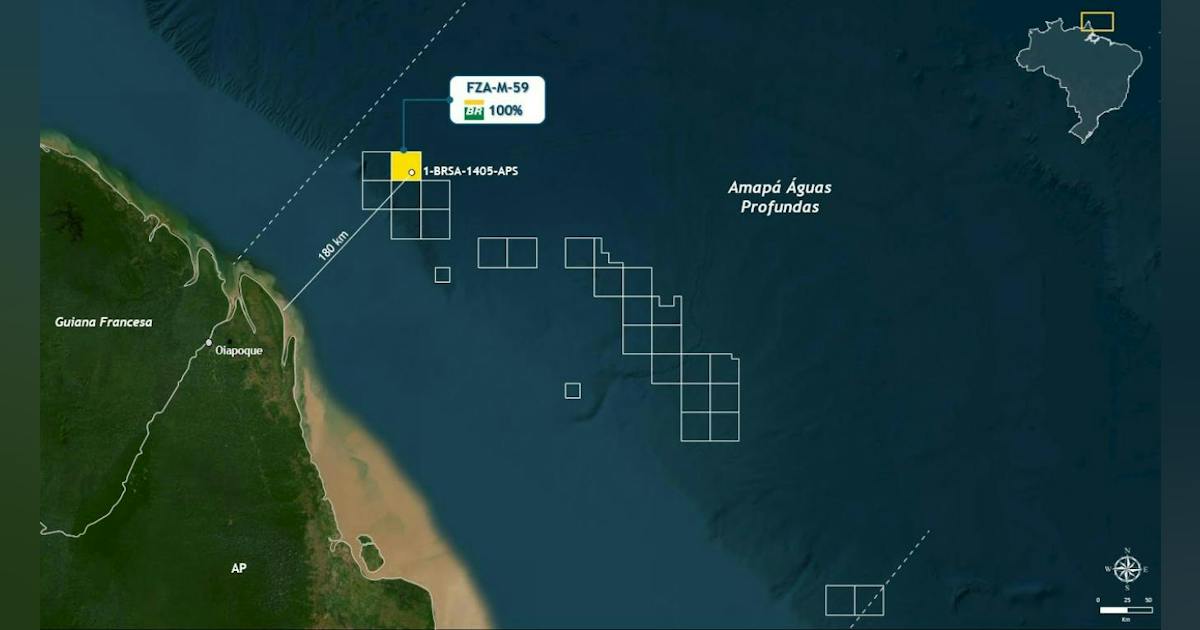
Petroleo Brasileiro SA (Petrobras) made a new discovery in block FZA-M-59 on the Brazilian Equatorial Margin, about 175 km off the coast of Amapá, in the Foz do Amazonas basin. The Morpho well (1-BRSA-1405-APS), drilled in 2,886 m of water off the coast of the state of Amapá, has reached another oil-bearing interval, the operator said on Oct. 2. Following announcement of the deepwater discovery in August, ongoing drilling of the well aimed to evaluate deeper exploratory intervals of the discovery, which was identified through electrical profiles, rock indications, and fluid samples obtained during the operations. Petrobras said the new discovery expands knowledge about the exploratory potential of the area and will provide additional information for the evaluation of the petroleum systems and resource potential of the Foz do Amazonas Sedimentary basin. With analyses still ongoing, information collected will later be characterized through laboratory analysis and integrated into the set of data acquired during drilling. Analysis already carried out, however, confirms good oil quality, according to the operator. Petrobras said it will conclude drilling activities of the well and continue the evaluation of the identified formations. Block FZA-M-59 is part of the company’s strategy to replenish oil and gas reserves through exploration in frontier areas. Petrobras is operator of the block and holds a 100% stake in the area.

Read More »

US BLM sets December California oil, gas lease sale

The US Bureau of Land Management’s (BLM) California field office Oct. 1 announced a Dec. 1 oil and gas lease sale covering 43 parcels and about 35,000 acres in California, advancing President Trump’s plan to restart federal leasing in the state after years of litigation and environmental review. While about 97% of the acreage offered lies in Kern County, BLM also plans to auction smaller, isolated parcels in Kings, Fresno, and San Luis Obispo counties. More than 95% of federal drilling operations in California currently take place in established fields in the Kern County area of the San Joaquin Valley, according to BLM. More than half of the proposed lease acreage involves a split estate, in which the federal government owns the underlying oil and gas minerals while a private party owns the surface land. The announcement opens a 30-day public protest period that will close Nov. 2. BLM completed initial scoping for the parcels in July and concluded a public comment period on the lease plan and environmental assessment in September. California Atty. Gen. Rob Bonta criticized BLM’s environmental analysis, released in August, saying the review relies on earlier planning documents and fails to adequately account for California’s restrictions on drilling near homes and schools and its phaseout of hydraulic fracturing.

Read More »

AFFO in Action: Powering Possibilities This October

H2 Walk AFFO staff are marking National Hydrogen and Fuel Cell Day with DOE’s annual 1.008-mile walk, a nod to hydrogen’s atomic weight of 1.008. Join the celebration from wherever you are by walking or running 1.008 miles on October 8.   FCHEA Circuits Webinar: Powering the Path Forward Tune in at 2 p.m. ET on October 8 for the Fuel Cell & Hydrogen Energy Association’s (FCHEA’s) National Hydrogen and Fuel Cell Day webinar. AFFO Director Valerie Sarisky-Reed will join industry speakers to discuss emerging areas across the hydrogen sector and share insights into AFFO’s strategic priorities. Register here to learn more.   Hydrogen on the Move Webinar Join the Center for Hydrogen Safety noon–1 p.m. ET on October 8 for Hydrogen on the Move: Lessons Learned for Safer High-Pressure Trailer Design and Operation. Explore lessons from real-world compressed hydrogen trailer incidents and best practices for safer, more reliable hydrogen transport. AFFO is a funder of the Hydrogen Safety Panel, a key partner in the Center for Hydrogen Safety. Register for the webinar.  Think You Know Bioenergy? Put Your Knowledge to the Test  From biomass resources to the technologies that transform them into useful products, there’s a lot to discover. Test your knowledge with AFFO’s Bioenergy Basics Game, and share it with colleagues, students, or others interested in learning more about bioenergy.   Events are only part of the celebration. Throughout October, we’ll also share stories and information highlighting AFFO’s research, priorities, partnerships, and impact. Follow along on the DOE Office of Energy Technologies (E-Tech) LinkedIn as we celebrate AFFO in Action: Powering Possibilities throughout the month. 

Read More »

Canada lists Pacific Link as Project of National Interest

The Government of Canada on Oct. 1 listed the Pacific Link project as a Project of National Interest under the Building Canada Act, advancing work to secure permissions needed to begin pipeline design and construction as early as Sept. 1, 2027. Pacific Link, formerly known as the West Coast oil pipeline, is a proposed 1 million-b/d crude oil pipeline that would transport Alberta oil to Canada’s west coast for export to Asia-Pacific and other global markets. With the Project of National Interest designation, Pembina Pipeline Corp., Calgary, along with the Governments of Alberta and Canada, and Trans Mountain Corp., will advance the project under a streamlined regulatory review process. Pembina said the listing “provides greater certainty through a clearer, more efficient and predictable federal review process that will maintain environmental standards and Indigenous consultation, which will be led by the Major Projects Office and supported by the Canada Energy Regulator.” Trans Mountain Corp. is responsible for the regulatory process, stakeholder and Indigenous engagement, construction of the project, and subsequent operation of the asset. Pembina’s economic interest through construction will be 10%, with the opportunity to acquire up to an additional 10% once the project enters commercial operation.

Read More »

AI Infrastructure’s Next Phase: Capital, Power and the Right to Build

Capital Is Becoming Infrastructure Samsung’s $1 billion commitment to Helix Digital Infrastructure offered one of the clearest examples yet of how the capital structure surrounding AI data centers is changing. Helix was formed by KKR as an AI infrastructure platform with more than $10 billion already committed by founding investors including KKR, the Kuwait Investment Authority, NVIDIA and Vistra. Samsung’s new commitment pushes that capital base still higher. But the composition of the partnership may be more significant than another billion dollars being added to the AI infrastructure ledger. Helix is intended to invest across hyperscale data centers, power generation and transmission, fiber and other connectivity infrastructure. Samsung, meanwhile, brings capabilities extending across advanced technology, construction, energy storage and cooling. This is not simply capital chasing data center returns. It increasingly resembles an attempt to assemble the data center, energy and technology supply chain inside a single investment ecosystem. That distinction is important, because one of the defining problems of the current buildout is that capital by itself does not produce capacity. Billions of dollars can be committed long before transformers arrive, transmission is constructed, generation is secured or a campus is commissioned. The increasingly valuable infrastructure platform is therefore the one capable of controlling more of those dependencies. Lambda demonstrated another side of that evolution last week with the closing of a $1.008 billion delayed-draw term loan supporting three committed customer deployments across multiple data centers. The financing received investment-grade ratings from Morningstar DBRS and Moody’s and carries a 6.78% fixed interest rate. More importantly, it is secured by both the GPU infrastructure being financed and contracted cash flows from two investment-grade customers. Capital is drawn as infrastructure reaches commissioning milestones rather than simply being handed to Lambda upfront. That begins to make AI compute look less like speculative

Read More »

Micro data center company rolls out stackable data center for edge and AI

Stack runs on Zella Sense, a monitoring, control, and automation layer built into every Zella DC cabinet. It tracks power, cooling, servers, and suspicious activity, while monitoring things like temperature, humidity, smoke, motion, water, and doors through sensors. The system runs over SNMP, Modbus, and a full API, with email alerting and local, LDAP, RADIUS, or TACACS+ authentication. That means an edge location can be remotely monitored without requiring local staff. It also comes with access control and fire protection. Zella Stack is an indoor-only offering. Zella DC sells Zella Outback as its standalone, ruggedized outdoor micro data center, and the company says an outdoor version of Stack is planned for the second half of 2027.

Read More »

Data Center Jobs: Engineering, Construction, Commissioning, Sales, Field Service and Facility Tech Jobs Available in Major Data Center Hotspots

Each month Data Center Frontier, in partnership with Pkaza, posts some of the hottest data center career opportunities in the market. Here’s a look at some of the latest data center jobs posted on the Data Center Frontier jobs board, powered by Pkaza Critical Facilities Recruiting. Looking for Data Center Candidates? Check out Pkaza’s Active Candidate / Featured Candidate Hotlist  Lead Mechanical Engineer – Data Center DesignNew York, NY/Remote This position is also available in: Denver, CO; Indianapolis, IN; Cedar Rapids, IA; Austin, TX; White Plains, NY; Dallas, TX; Richmond, VA; Ashburn, VA; Charlotte, NC; Atlanta, GA; Phoenix, AZ; Salt Lake City, UT; Kansas City, MO; Chicago, IL; Los Angeles, CA or San Jose, CA. Our client is a leading engineering design and commissioning company that is a subject matter expert in the data center space. They will provide design coordination and construction administration, consulting and management support for the data center / mission critical facilities space with the mindset to provide reliability, energy efficiency, and sustainable design expertise when providing these consulting services for enterprise, colocation and hyperscale companies. This career-growth minded opportunity offers exciting projects with leading-edge technology and innovation as well as competitive salaries and benefits. Electrical Commissioning Agent – Data Centers Austin, TX (limited travel) Non-Traveling CxA positions available in: Indianapolis, IN; Cedar Rapids, IA; Phoenix, AZ and Columbus, OH. Traveling CxA based near any major airport, otherwise traveling to: New York, NY; White Plains, NY; Dallas, TX; Richmond, VA; Montvale, NJ; Charlotte, NC; Salt Lake City, UT; Kansas City, MO; Chesterton, IN or Chicago, IL. ***Also looking for a Lead EE and ME CxA Agents and CxA PMs. *** This opportunity is with a leading EPC company of data center design / build / commissioning solutions. This company provides a complete life cycle of solutions that are custom-fit

Read More »

Startup doxx.net hands the network controls to AI

“The whole thing is run completely by AI, so behind the scenes, I mean, it’s a network with 31 locations around the world, and internally there’s a mesh network, and I can’t, as a human being, manage all of this by myself,” Lyon said. Lyon said the team modeled every site, down to the wire and the optic, in a virtual model before building. An infrastructure management system running the company’s own AI on its own hardware then ordered the installation. It orchestrated shipping and delivery through data center APIs. Human technicians performed the remote smart hands installations. The company also built tools for agents to work with users and with the network. An agent gateway gives an AI agent an identity in the doxx.net chat app. The user pastes a credential into the agent. The agent obtains its certificate and appears in the user’s chat. Users can create group chats with several agents. In one example, Lyon said one agent runs BGP while others handle other tasks.

Read More »

DCF Poll: What Must Data Centers Prove to Keep Building at AI Scale?

For years, the data center industry’s biggest constraints were largely physical, centered on power, transmission, land, water, equipment and labor. As the AI infrastructure buildout accelerates, however, another constraint is moving rapidly to the foreground. The constraint, and the concern, is whether host communities, regulators and policymakers believe the next generation of data centers is being built on terms that work for them, too. That question received a fresh exclamation point on Oct. 2, when Amazon Web Services announced it will invest more than $1 billion over five years in U.S. communities where it operates data centers, with funding aimed at areas including energy affordability, water and natural-resource protection, workforce development and education. The initiative arrives as electricity and water consumption associated with hyperscale infrastructure faces increasing scrutiny in communities across the country. And AWS is responding to a policy environment that is changing quickly. In Virginia, Loudoun County supervisors have begun a process that could pause action on certain new data center and substation applications for as long as 12 months while the county reviews its development policies. The board is scheduled to consider the proposed pause Oct. 20. Just next door, Prince William County voted Sept. 22 to dramatically shrink the area where data centers can be developed by right, largely shifting future projects outside the revised overlay into a case-by-case special-use permitting process. The issue is spreading well beyond Northern Virginia. On Sept. 23, Maryland Gov. Wes Moore signed an executive order creating a statewide framework for data center development centered on ratepayer protection, environmental impacts, community participation, transparency and accountability. Meanwhile, the U.S. House on Sept. 16 passed the Ratepayer Protection Act by a 417–3 vote, seeking to prevent data centers and other large loads from shifting the incremental costs of new generation and grid infrastructure onto

Read More »

$6T in annual AI revenue needed to pay off data center investments

Making the assumption that hyperscalers’ capital expenditure amounts to about 25% of revenue, they would need the AI market to be worth $6 trillion annually. But, said Bain, the current consumer and enterprise AI markets together could be worth up to $1.8 trillion by 2031, leaving a whopping $4.2 trillion still to find from new markets. Bain highlighted four potential areas: the use of AI in search; the development of more autonomous vehicles, including drones; physical AI, including digital twins and robotics; and new product development, for example, breakthroughs in pharmaceuticals.

Read More »

Microsoft will invest $80B in AI data centers in fiscal 2025

And Microsoft isn’t the only one that is ramping up its investments into AI-enabled data centers. Rival cloud service providers are all investing in either upgrading or opening new data centers to capture a larger chunk of business from developers and users of large language models (LLMs).  In a report published in October 2024, Bloomberg Intelligence estimated that demand for generative AI would push Microsoft, AWS, Google, Oracle, Meta, and Apple would between them devote $200 billion to capex in 2025, up from $110 billion in 2023. Microsoft is one of the biggest spenders, followed closely by Google and AWS, Bloomberg Intelligence said. Its estimate of Microsoft’s capital spending on AI, at $62.4 billion for calendar 2025, is lower than Smith’s claim that the company will invest $80 billion in the fiscal year to June 30, 2025. Both figures, though, are way higher than Microsoft’s 2020 capital expenditure of “just” $17.6 billion. The majority of the increased spending is tied to cloud services and the expansion of AI infrastructure needed to provide compute capacity for OpenAI workloads. Separately, last October Amazon CEO Andy Jassy said his company planned total capex spend of $75 billion in 2024 and even more in 2025, with much of it going to AWS, its cloud computing division.

Read More »

John Deere unveils more autonomous farm machines to address skill labor shortage

Join our daily and weekly newsletters for the latest updates and exclusive content on industry-leading AI coverage. Learn More Self-driving tractors might be the path to self-driving cars. John Deere has revealed a new line of autonomous machines and tech across agriculture, construction and commercial landscaping. The Moline, Illinois-based John Deere has been in business for 187 years, yet it’s been a regular as a non-tech company showing off technology at the big tech trade show in Las Vegas and is back at CES 2025 with more autonomous tractors and other vehicles. This is not something we usually cover, but John Deere has a lot of data that is interesting in the big picture of tech. The message from the company is that there aren’t enough skilled farm laborers to do the work that its customers need. It’s been a challenge for most of the last two decades, said Jahmy Hindman, CTO at John Deere, in a briefing. Much of the tech will come this fall and after that. He noted that the average farmer in the U.S. is over 58 and works 12 to 18 hours a day to grow food for us. And he said the American Farm Bureau Federation estimates there are roughly 2.4 million farm jobs that need to be filled annually; and the agricultural work force continues to shrink. (This is my hint to the anti-immigration crowd). John Deere’s autonomous 9RX Tractor. Farmers can oversee it using an app. While each of these industries experiences their own set of challenges, a commonality across all is skilled labor availability. In construction, about 80% percent of contractors struggle to find skilled labor. And in commercial landscaping, 86% of landscaping business owners can’t find labor to fill open positions, he said. “They have to figure out how to do

Read More »

2025 playbook for enterprise AI success, from agents to evals

Join our daily and weekly newsletters for the latest updates and exclusive content on industry-leading AI coverage. Learn More 2025 is poised to be a pivotal year for enterprise AI. The past year has seen rapid innovation, and this year will see the same. This has made it more critical than ever to revisit your AI strategy to stay competitive and create value for your customers. From scaling AI agents to optimizing costs, here are the five critical areas enterprises should prioritize for their AI strategy this year. 1. Agents: the next generation of automation AI agents are no longer theoretical. In 2025, they’re indispensable tools for enterprises looking to streamline operations and enhance customer interactions. Unlike traditional software, agents powered by large language models (LLMs) can make nuanced decisions, navigate complex multi-step tasks, and integrate seamlessly with tools and APIs. At the start of 2024, agents were not ready for prime time, making frustrating mistakes like hallucinating URLs. They started getting better as frontier large language models themselves improved. “Let me put it this way,” said Sam Witteveen, cofounder of Red Dragon, a company that develops agents for companies, and that recently reviewed the 48 agents it built last year. “Interestingly, the ones that we built at the start of the year, a lot of those worked way better at the end of the year just because the models got better.” Witteveen shared this in the video podcast we filmed to discuss these five big trends in detail. Models are getting better and hallucinating less, and they’re also being trained to do agentic tasks. Another feature that the model providers are researching is a way to use the LLM as a judge, and as models get cheaper (something we’ll cover below), companies can use three or more models to

Read More »

OpenAI’s red teaming innovations define new essentials for security leaders in the AI era

Join our daily and weekly newsletters for the latest updates and exclusive content on industry-leading AI coverage. Learn More OpenAI has taken a more aggressive approach to red teaming than its AI competitors, demonstrating its security teams’ advanced capabilities in two areas: multi-step reinforcement and external red teaming. OpenAI recently released two papers that set a new competitive standard for improving the quality, reliability and safety of AI models in these two techniques and more. The first paper, “OpenAI’s Approach to External Red Teaming for AI Models and Systems,” reports that specialized teams outside the company have proven effective in uncovering vulnerabilities that might otherwise have made it into a released model because in-house testing techniques may have missed them. In the second paper, “Diverse and Effective Red Teaming with Auto-Generated Rewards and Multi-Step Reinforcement Learning,” OpenAI introduces an automated framework that relies on iterative reinforcement learning to generate a broad spectrum of novel, wide-ranging attacks. Going all-in on red teaming pays practical, competitive dividends It’s encouraging to see competitive intensity in red teaming growing among AI companies. When Anthropic released its AI red team guidelines in June of last year, it joined AI providers including Google, Microsoft, Nvidia, OpenAI, and even the U.S.’s National Institute of Standards and Technology (NIST), which all had released red teaming frameworks. Investing heavily in red teaming yields tangible benefits for security leaders in any organization. OpenAI’s paper on external red teaming provides a detailed analysis of how the company strives to create specialized external teams that include cybersecurity and subject matter experts. The goal is to see if knowledgeable external teams can defeat models’ security perimeters and find gaps in their security, biases and controls that prompt-based testing couldn’t find. What makes OpenAI’s recent papers noteworthy is how well they define using human-in-the-middle

Read More »