The data center industry has no shortage of AI infrastructure ambition. What it lacks is certainty.
Power is harder to secure. Designs are advancing faster than facilities can be built. Supply chains remain vulnerable. Liquid cooling is adding operational demands. Projects that look viable on paper can still stall on permitting, commissioning or community opposition.
The question in 2026 is no longer how large the AI opportunity may become. It is what can actually be delivered, and who has learned how to deliver it.
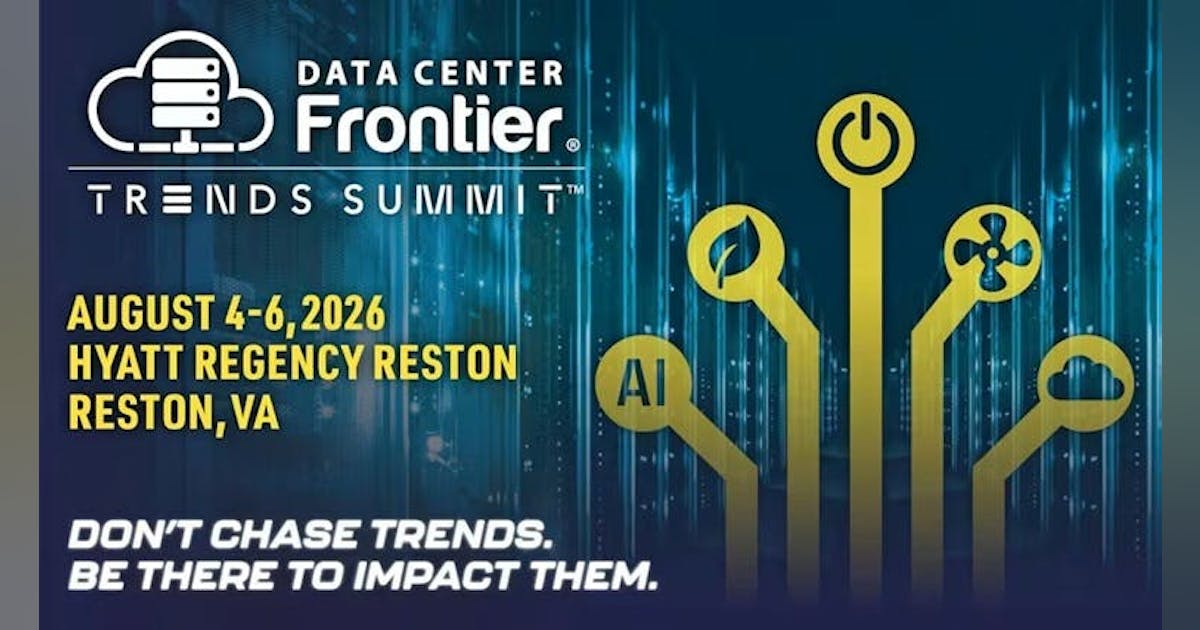
That question defines the 2026 Data Center Frontier Trends Summit, August 4–6 at the Hyatt Regency Reston. Across three days, the people building, powering, financing and operating next-generation infrastructure will examine what is working, where execution is failing and how the market is responding.
This is not a conference about whether AI will create demand. It is about who will be able to meet it.
The advantage will belong to those who join the conversation before its conclusions become market consensus.
Here are 10 reasons to be in the room.
1. The industry has entered the execution era
For several years, the market has been defined by projected demand, capacity, density and investment. The next phase will be defined by execution.
AI data center announcements remain abundant. Energized, commissioned and operational capacity is harder to find.
DCFTS begins with a live editorial calibration, followed by “The New Geography of AI,” featuring EdgeCore CEO Lee Kestler, Data Center Frontier founder Rich Miller and DCF Editor in Chief Matt Vincent.
The focus: how power, entitled land, utility partnerships and execution speed are determining where AI capacity can be built—and who can deliver it.
Demand creates opportunity. Execution determines who captures it.
2. Power will be treated as the foundation of AI strategy
Power is no longer one workstream within a project. It is the factor around which the project must increasingly be organized.
Grid congestion and interconnection delays are pushing developers toward utility service, onsite generation, fuel cells, batteries and behind-the-meter systems.
The question is no longer whether alternative power models will matter. It is which are financeable, permit-ready, repeatable and capable of supporting production infrastructure.
“Power First” and “The AI Power Stack: From Generation to GPU” will move beyond repeating that power is scarce to examine what credible developers and operators are doing about it.
3. Site selection is being rewritten around scarcity
A site may have land but no near-term power. It may have power but inadequate fiber, water or transmission capacity. A technically viable location may face zoning, permitting or community resistance.
“The New Site Selection Stack: Power, Fiber, Water—and Friction” will examine where projects are advancing, where they are stalling and which compromises developers can accept.
For developers, operators, utilities and investors, these variables determine whether a project exists beyond a planning document.
Companies can hear which assumptions are changing now—or discover which no longer apply after committing to a market.
4. The AI factory will be followed from model to production
Simulation and digital twins can show how power, cooling and compute should interact before construction. Turning that model into an operating AI environment remains one of the industry’s hardest problems.
“Design, Simulate, Build” will address integrated design, featuring leaders from Schneider Electric, Motivair, Digital Realty, Compass Datacenters and NVIDIA. “Designed vs. Deployed” will feature leaders from NVIDIA, Meta and the Open Compute Project. “The AI Factory in Practice” will move into commissioning, handoffs and day-two operations.
The gap between what can be designed and what can be reliably operated may be the most consequential gap in AI infrastructure. DCFTS lets attendees hear those conclusions take shape—and challenge them in real time.
5. The density debate will be grounded in production reality
AI roadmaps increasingly point toward 100-kilowatt, 300-kilowatt and potentially megawatt-scale racks. Those figures attract attention. Production environments remain more complicated.
Training, inference, enterprise, edge and hyperscale deployments do not create identical requirements. Some facilities can be retrofitted; others need purpose-built environments.
“One Density Doesn’t Fit All” will examine where density is actually landing and when extreme density is essential rather than an expensive over-optimization.
The question is where higher density creates value, where it adds disproportionate risk and whether today’s infrastructure will still make sense when the workload arrives.