Permission Joined the Critical Path
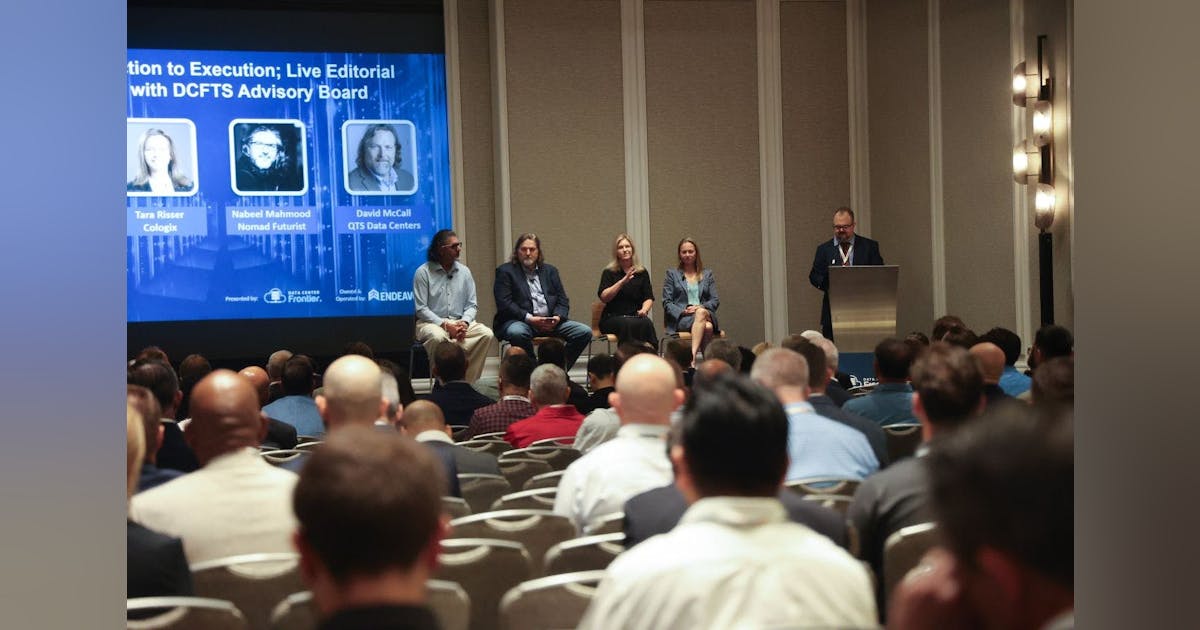
The closing panel, “Earning the Social License,” brought the summit’s execution theme back to the communities in which all this infrastructure must be built.
Buddy Rizer was the right moderator for that assignment. As executive director of Loudoun County Economic Development, he has worked from inside one of the industry’s most important host communities through extraordinary growth, changing expectations and a more complicated political environment.
Rizer was joined by Cologix Chief Business Officer Tara Risser, Nomad Futurist leaders Nabeel Mahmood and Phillip Koblence, Dominion Energy’s Stan Blackwell and Vantage Data Centers Vice President of Public Policy Misty Allen.
Together, they represented the operator, utility, policy, workforce and community-facing sides of the development equation.
The premise was not that data centers need better public relations.
It was that public acceptance has become an operating requirement.
The industry has often treated community engagement as something that follows the major project decisions. Developers select the land, define the power strategy, establish the design and begin moving through entitlement. The public conversation starts once much of the project has already taken shape.
By then, the decisions most likely to determine community reaction may already have been made.
A large campus brings questions about transmission, generation, water, construction traffic, noise, tax policy, land use and the cost of supporting infrastructure. Those concerns cannot be resolved by describing the economic benefits more forcefully. They must be addressed in the structure of the development.
That was the deeper meaning of the session’s title.
Social license is earned through what a company does before, during and after construction: how early it appears in the community, how clearly it explains the project, whether it acknowledges tradeoffs and whether the promised benefits remain visible after the groundbreaking.
For years, data centers could enter many markets with a relatively simple economic-development case. They brought major capital investment, a dependable tax base and comparatively limited demands on schools and other public services.
Those advantages remain substantial. They no longer settle the question by themselves.
AI campuses are larger. Their power requirements are more visible. Their supporting infrastructure can extend well beyond the property line. The public is therefore evaluating more than the data center. It is evaluating the system required to support it.
Rizer’s presence gave that issue particular weight. Loudoun County helped demonstrate how digital infrastructure can become an economic engine. Its experience also shows why success creates a higher standard for the next project.
Some objections will be ideological. Others will arise from incomplete information. But many reflect concrete concerns about energy costs, land, infrastructure and whether residents were treated as participants in the process or as an audience assembled after the important decisions had been made.
The companies best positioned to keep building will engage before a project reaches a public hearing. They will explain the load, the timeline and the supporting infrastructure in terms a community can evaluate. They will avoid promising certainty where power delivery, transmission or permitting remains unresolved.
They will also make workforce and economic-development commitments specific enough to be measured later.
The session’s core formulation connected the panel to everything that preceded it: social license is an outcome of execution rather than messaging.
A poorly selected site becomes a community problem. An unrealistic power claim becomes a credibility problem. A project that appears only when it needs approval begins the relationship from behind.
Demand may explain why the industry wants to build.
It does not confer permission.
The Conversation Continued Outside the Sessions
One of the most encouraging aspects of the LinkedIn response was its specificity.
Attendees did not merely report that they had heard a good panel. They carried arguments and questions into public view.
They debated whether behind-the-meter power should remain connected to the grid. They questioned how rack-density averages should be defined. They discussed transient AI loads, backup strategies, utility relationships, 800 VDC, waste heat and the difference between component availability and whole-system availability.
The structured roundtables reinforced that purpose.
Discussions around colocation economics, liquid cooling, onsite power, construction pressure and high-density deployment gave attendees space to examine the issues without reducing the exchange to stage-managed answers.
One attendee described the Power First panel as the rare session where the ideas were still competing when the hour ended.
The public posts also revealed which concepts proved portable: energy peninsulas, the density spectrum, announced power versus deliverable power, the AI factory extending beyond the fence, and social license as an operating result.
Those phrases moved because they gave people useful language for conditions they were already encountering.
What the Heatmap Says
Some LinkedIn activity surrounding any conference will always be promotional. Companies announce appearances. Sponsors photograph booths. Speakers post their session times.
The stronger DCFTS posts were different.
They contained numbers, technical distinctions, operating questions and arguments that remained unsettled after the sessions ended.
Taken together, they show that the program’s central theme held.
The market is no longer asking only whether AI infrastructure demand is real. It is asking which projects can secure power, survive permitting, integrate cooling, manage new electrical architectures, obtain equipment, reach commissioning, operate reliably and retain public support.
The conference did not resolve those issues. It did establish a clearer picture of the work in front of the industry—and gave the people doing that work room to challenge one another directly.