Stay Ahead, Stay ONMINE

Maurel & Prom to acquire Gran Tierra Energy’s assets in Colombia, Ecuador for $1.33 billion

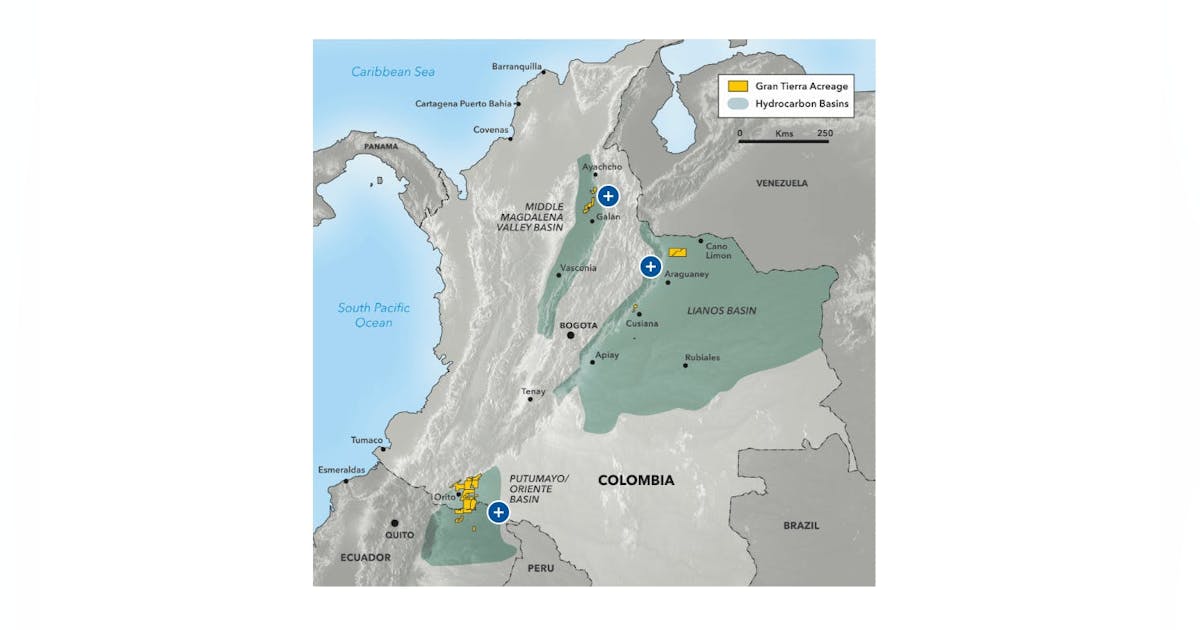
The company said the predominantly operated portfolio comprises producing assets, development projects, and exploration acreage across Colombia’s Middle Magdalena Valley, Putumayo, and Llanos basins and Ecuador’s Oriente basin. Production is entirely oil-weighted and benefits from established processing, storage, and transportation infrastructure as well as access to multiple export routes. The principal Colombian assets include Acordionero, […]

The company said the predominantly operated portfolio comprises producing assets, development projects, and exploration acreage across Colombia’s Middle Magdalena Valley, Putumayo, and Llanos basins and Ecuador’s Oriente basin. Production is entirely oil-weighted and benefits from established processing, storage, and transportation infrastructure as well as access to multiple export routes.

The principal Colombian assets include Acordionero, Costayaco, and Moqueta on the Chaza block, the Suroriente block centered on Cohembi, and the recently acquired interests in Tisquirama and San Roque. 

Growth opportunities in Colombia include continued development of Tisquirama, expansion of the Cohembi-Raju area, the Pegasus prospect, and longer-term potential associated with the La Luna formation.

In Ecuador, the Chanangue, Charapa, Conejo, Iguana, Perico, and Espejo assets provide a combination of producing fields, discovered resources, and appraisal and exploration opportunities. Maurel & Prom said the assets represent a growth platform supported by existing discoveries and additional potential through waterflood application across the portfolio.

For Gran Tierra Energy, the transaction serves as an exit from South America as part of the company’s plan to reduce debt and focus on growth opportunities in Canada and Azerbaijan.

Maurel & Prom is a Paris-listed international oil and natural gas exploration and production company majority owned by PT Pertamina Internasional Eksplorasi dan Produksi (PIEP), a subsidiary of Indonesia’s national energy company, PT Pertamina (Persero).

Closing, expected by yearend, is subject to shareholder approval, creditor consents, regulatory approvals, and other customary closing conditions. 

Shape
Shape
Stay Ahead

Explore More Insights

Stay ahead with more perspectives on cutting-edge power, infrastructure, energy,  bitcoin and AI solutions. Explore these articles to uncover strategies and insights shaping the future of industries.

Shape

ExxonMobil begins drilling wells in Guyana’s EEZ

@import url(‘https://fonts.googleapis.com/css2?family=Inter:wght@100..900&display=swap’); .ebm-page__main h1, .ebm-page__main h2, .ebm-page__main h3, .ebm-page__main h4, .ebm-page__main h5, .ebm-page__main h6 { font-family: Inter; } body { line-height: 150%; letter-spacing: 0.025em; } button, .ebm-button-wrapper { font-family: Inter; } .label-style { text-transform: uppercase; color: var(–color-grey); font-weight: 600; font-size: 0.75rem; } .caption-style { font-size: 0.75rem; opacity: .6; } #onetrust-pc-sdk

Read More »

bp completes sale of German refinery, associated assets

European independent refiner Klesch Group has completed its previously announced deal to acquire bp plc’s 265,000-b/d refinery and related assets in Gelsenkirchen and Horst and Scholven, Germany, which is operated as an integrated refining and petrochemical site. With the transaction finalized as of Aug. 3, Klesch has taken full ownership

Read More »

Samsung offers future AI memory roadmap

It is already being used now in NAND flash memory for 3D stacking. Rather than spread the memory circuits out, they are stacked on top of each other like stories on a high-rise building. The technique was first introduced in 2014, with 24-layer NAND flash period last year it broke

Read More »

TotalEnergies to acquire Shell’s European onshore renewables portfolio

TotalEnergies SE has agreed to acquire Shell’s 4-Gw onshore renewables portfolio in Europe. The portfolio includes 500 Mw of solar and wind assets in operation or under construction, primarily in Italy and the Netherlands, as well as a 3.5-Gw pipeline of solar, wind, and battery storage projects in Italy, the UK, and Spain, the company said Aug. 3. In the Netherlands, the assets include 254.2 Mw of installed peak capacity across the Moerdijk, Heerenveen-Zuid, and Emmen (GZI Next) solar parks; the Sas van Gent-Zuid and Koegorspolder solar parks in Terneuzen; and the Pottendijk combined solar and wind park in Emmen. TotalEnergies will assume full ownership of the portfolio upon closing. The transaction is subject to regulatory approvals and is expected to be completed by yearend 2026. “This agreement reflects Shell’s continued focus on actively managing and further strengthening its electricity portfolio, in line with the strategy outlined during Capital Markets Day 2025,” said Machteld de Haan, president, downstream, renewables and energy solutions, Shell. De Haan said Shell is prioritizing investment in areas where it has competitive advantages, including asset-backed power trading and customer-focused energy solutions. Shell said it will continue to buy and sell onshore solar and wind power in Europe and will retain interests in projects including Holland Hydrogen 1, Northern Lights CCS in Norway, LNG, and carbon capture and storage activities. KKR acquires 50% interest in European renewables portfolio In another deal, TotalEnergies agreed to farm out a 50% interest in a largely developed 1.2-Gw onshore solar and wind portfolio in Europe to KKR. The company said the transaction is consistent with its strategy of selling 50% interests in renewable assets once they have been developed. The portfolio includes assets in Germany, Spain, France, and Poland. Electricity generated by the assets has already been sold to third parties or

Read More »

Petrobras makes another gas discovery offshore Colombia

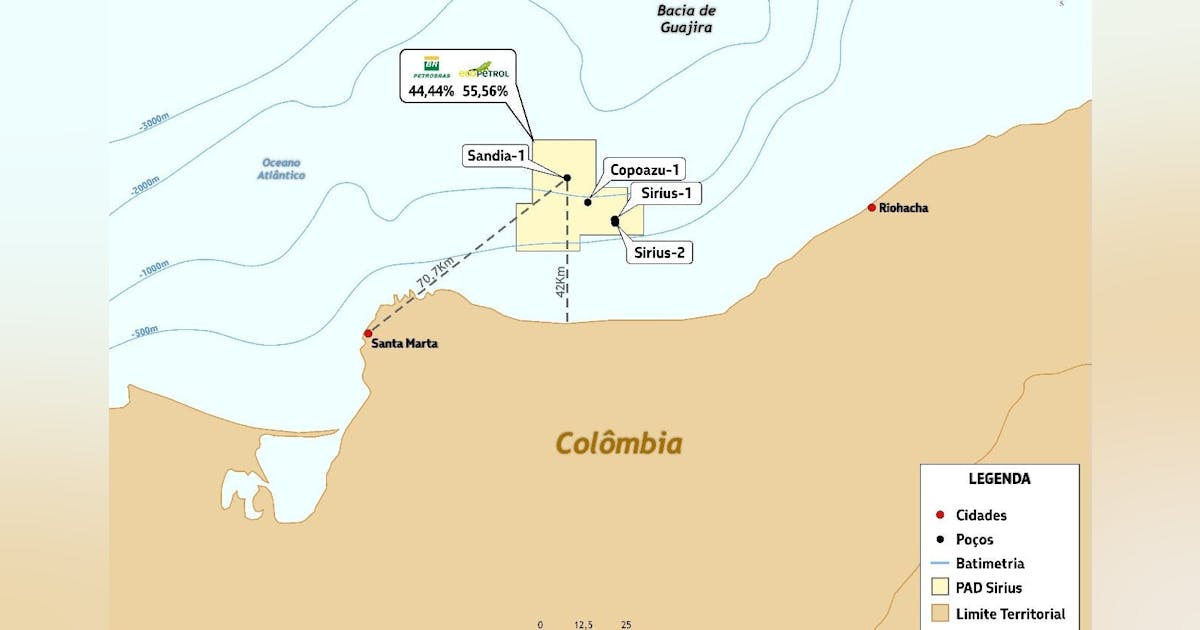
@import url(‘https://fonts.googleapis.com/css2?family=Inter:wght@100..900&display=swap’); .ebm-page__main h1, .ebm-page__main h2, .ebm-page__main h3, .ebm-page__main h4, .ebm-page__main h5, .ebm-page__main h6 { font-family: Inter; } body { line-height: 150%; letter-spacing: 0.025em; } button, .ebm-button-wrapper { font-family: Inter; } .label-style { text-transform: uppercase; color: var(–color-grey); font-weight: 600; font-size: 0.75rem; } .caption-style { font-size: 0.75rem; opacity: .6; } #onetrust-pc-sdk [id*=btn-handler], #onetrust-pc-sdk [class*=btn-handler] { background-color: #c19a06 !important; border-color: #c19a06 !important; } #onetrust-policy a, #onetrust-pc-sdk a, #ot-pc-content a { color: #c19a06 !important; } #onetrust-consent-sdk #onetrust-pc-sdk .ot-active-menu { border-color: #c19a06 !important; } #onetrust-consent-sdk #onetrust-accept-btn-handler, #onetrust-banner-sdk #onetrust-reject-all-handler, #onetrust-consent-sdk #onetrust-pc-btn-handler.cookie-setting-link { background-color: #c19a06 !important; border-color: #c19a06 !important; } #onetrust-consent-sdk .onetrust-pc-btn-handler { color: #c19a06 !important; border-color: #c19a06 !important; } Petroleo Brasileiro SA (Petrobras) discovered another new gas accumulation with the deepwater Sandia-1 exploratory well in GUA-OFF-0 block about 42 km offshore Colombia in 1,251 m of water. Sandia-1 spudded on June 12, 2026, reaching final depth on July 29, 2026. Proven gas intervals are being evaluated by means of well profiles and will later be characterized by laboratory analyses. The well is 18 km from the Sirius-1 (discoverer) and Sirius-2 (appraisal) wells and 9 km from the Copoazu-1 (discoverer) well, indicating that there is strong gas potential in this area of offshore Colombia, Petrobras said. Petrobras subsidiary Petrobras International Braspetro BV–Sucursal Colombia (PIB-COL; 44.44%) operates the GUA-OFF-0 block on behalf of partner Ecopetrol SA (55.56%).

Read More »

OPEC+ approves September output hike, completes 2023 cuts rollback

OPEC+ has approved a fresh increase in oil production quotas for September of roughly 188,000 b/d, completing the phased reversal of voluntary supply cuts first introduced in 2023. The decision, confirmed in an official OPEC statement following a virtual meeting on Aug. 2, 2026, marks the sixth consecutive monthly increase by the group this year. Seven core members of the alliance—Saudi Arabia, Russia, Iraq, Kuwait, Kazakhstan, Algeria, and Oman—agreed to raise output targets. The move completes the unwinding of the 1.65-million b/d voluntary supply cut originally agreed in 2023, back when the group still included the United Arab Emirates (UAE), which exited OPEC in May. The group said the adjustment would also give participating countries an opportunity to accelerate compensation for previous overproduction, and it reiterated commitment to the OPEC+ Declaration of Cooperation, with compliance to be monitored by the Joint Ministerial Monitoring Committee (JMMC). While the September hike is now finalized, OPEC+ is widely expected to pause further increases starting in the fourth quarter. Though the group’s official statement gave no explicit guidance on fourth-quarter policy, OPEC+ sources cited by Reuters and analysts—including Rystad Energy’s Jorge Leon—say a pause is likely as the alliance assesses market conditions after finishing the restoration of the 2023 cuts. A separate layer of roughly 2 million b/d in cuts, dating to 2022, remains in place and is expected to continue through the end of 2026. The steady stream of monthly increases comes against a backdrop of major market disruption. Ongoing Middle East tensions—including disruptions tied to the Iran conflict and the Strait of Hormuz—have complicated the group’s ability to translate higher quotas into actual barrels reaching the market. Russia, in particular, continues to produce below its OPEC+ target of about 9.8 million b/d, with output near 9 million b/d amid repeated Ukrainian drone

Read More »

Market Focus: Reading the oil market after the US-Iran MOU collapse

Drawing on nearly three decades of experience in energy trading and risk management, Kessler offers insight into the fallout from escalating Middle East tensions, the breakdown of US-Iran diplomatic efforts, and the critical role of the Strait of Hormuz, through which a significant share of global oil supplies traditionally flows. The discussion explores what it would take to achieve a meaningful de-escalation in the region and how market participants are assessing the risks. Kessler argues that restoring safe passage through the Strait of Hormuz will be central to any lasting stability, while Iran’s oil exports and broader economic pressures could influence future negotiations. He also shares his perspective on how OPEC+ is responding to disruptions, the alliance’s efforts to restore production, and the growing competitive pressure it faces from producers outside the Gulf region. Turning to North America, Kessler examines the outlook for US shale producers in a higher-price environment. With crude prices holding above $80/bbl, he discusses signs of increased drilling activity, stronger production growth potential, and the continued emphasis on hedging and capital discipline among operators. The conversation also highlights advances in drilling technology and efficiency that could enable US producers to respond more quickly to market opportunities while managing downside risk. Looking further ahead, the episode considers whether recent disruptions will accelerate a long-term shift away from traditional Middle East oil chokepoints. Kessler discusses the growing role of US, Canadian, African, and Latin American supplies, expanding export infrastructure, and the possibility that today’s high prices could ultimately lead to demand destruction, increased competition, and renewed market oversupply. For anyone following global crude markets, OPEC+ strategy, US shale growth, energy security, and future oil price trends, this conversation provides a timely and thought-provoking outlook on the evolving global energy landscape. About our guest Dennis Kissler, senior vice-president of

Read More »

Maurel & Prom to acquire Gran Tierra Energy’s assets in Colombia, Ecuador for $1.33 billion

The company said the predominantly operated portfolio comprises producing assets, development projects, and exploration acreage across Colombia’s Middle Magdalena Valley, Putumayo, and Llanos basins and Ecuador’s Oriente basin. Production is entirely oil-weighted and benefits from established processing, storage, and transportation infrastructure as well as access to multiple export routes. The principal Colombian assets include Acordionero, Costayaco, and Moqueta on the Chaza block, the Suroriente block centered on Cohembi, and the recently acquired interests in Tisquirama and San Roque.  Growth opportunities in Colombia include continued development of Tisquirama, expansion of the Cohembi-Raju area, the Pegasus prospect, and longer-term potential associated with the La Luna formation. In Ecuador, the Chanangue, Charapa, Conejo, Iguana, Perico, and Espejo assets provide a combination of producing fields, discovered resources, and appraisal and exploration opportunities. Maurel & Prom said the assets represent a growth platform supported by existing discoveries and additional potential through waterflood application across the portfolio. For Gran Tierra Energy, the transaction serves as an exit from South America as part of the company’s plan to reduce debt and focus on growth opportunities in Canada and Azerbaijan. Maurel & Prom is a Paris-listed international oil and natural gas exploration and production company majority owned by PT Pertamina Internasional Eksplorasi dan Produksi (PIEP), a subsidiary of Indonesia’s national energy company, PT Pertamina (Persero). Closing, expected by yearend, is subject to shareholder approval, creditor consents, regulatory approvals, and other customary closing conditions. 

Read More »

HF Sinclair inks supply deals amid pending segment spinoff, refinery closure

HF Sinclair Corp. has lined up long-term supply arrangements to support the transition of the company’s lubricants and specialties products business in parallel with its recently announced plan to retire its 15,600-b/d base oil refining plant in Mississauga, Ont. After revealing a downstream integration strategy on July 28 involving the proposed closure of its Canadian refining business and transformation of its lubricants and specialties products segment, HF Sinclair confirmed on Aug. 3 that it entered into strategic long-term commercial agreements with suppliers SK On Co. Ltd.’s SK Enmove and Chevron USA Inc.’s Chevron Products Co. to establish a diversified North American base oil supply network. As part of the August agreement that aims to support maintaining base oil coverage after the Canadian refining assets are retired, SK Enmove and Chevron Products will supply HF Sinclair with Group III and Group II base oils, respectively, according to the companies. In return, HF Sinclair said its lubricants and specialties business will serve as a distributor for SK Enmove’s YUBASE Group III base oils in key regional markets in North America, as well as distribute Chevron-branded Group II base oils in Canada and select US regions. The supply arrangements come as part of HF Sinclair’s transformation and separation of its lubricants and specialties segments via the capital markets to create “two independent public companies in a manner that is tax-efficient for HF Sinclair and its shareholders,” according to the operator’s July 28 presentation to investors. HF Sinclair said it expects the new lubricants-specialties company will to drive organic growth and consolidate a highly fragmented global lubricants and specialties market, leading to reduced earnings volatility supported by diversified end markets and a differentiated finished and specialty mix of products. Subject to customary conditions and final approvals, HF Sinclair said the separation of the lubricants-specialty

Read More »

Polish data center plans to send its waste heat to the neighbors

As Europe swelters in a heatwave, residents probably don’t want to hear about ways to make their homes even hotter, but that’s what Polish property developer Citylink is talking about, with plans to dump waste heat from a new data center in Wrocław into the municipal district heating network. Citylink is designing the data center so that heat from servers can be recovered instead of being dissipated via cooling systems — and as the data center grows, any increase in computing power will mean more energy available for recovery. The collaboration with local power company Kogeneracja will provide “valuable experience in designing and operating modern data centers, with a particular focus on infrastructure dedicated to AI nodes,” said Michał Starybrat, development director at Citylink.

Read More »

The Data Center Industry’s Permission to Build

The data center industry has spent the past several years announcing the future. Gigawatts. AI factories. New regions. New power architectures. Campuses at a scale that would have seemed extraordinary before generative AI reset the industry’s expectations. Now the public has entered the room. Communities are asking harder questions about who pays for electrical infrastructure, where the water comes from, how much noise reaches neighboring properties and what remains locally after construction crews leave. Utilities are being pressed to protect ratepayers from speculative load and costly system upgrades. Elected officials who once treated data centers primarily as economic-development wins are finding that the politics have changed. The defining question is no longer whether demand is real. It is whether the data center industry can keep earning the permission required to build at the scale it has promised. I mean permission in a broader sense than zoning approval, an environmental permit or a signed utility agreement. I mean the political and social room to develop infrastructure measured in hundreds of megawatts and billions of dollars—often in places whose residents have only recently begun to understand what is being proposed around them. That room is narrowing. A Different Kind of Constraint On July 18, opponents organized 142 demonstrations across 42 states in what Reuters described as the first coordinated national protest against the data center buildout. The movement crossed familiar political boundaries, bringing together environmental advocates, rural landowners and residents concerned about power prices, water, noise and the pace of development. A June Reuters/Ipsos poll found that 57% of respondents would oppose a data center in their community. Only 14% said they would be comfortable with one nearby. Those findings deserve the industry’s full attention. New York has imposed a one-year pause on certain environmental approvals for new hyperscale data centers while

Read More »

NVIDIA’s Reported $50B Lease and the Nuclear-Powered AI Factory

Aalo and Crusoe Pursue the Nuclear-Powered AI Factory The Aalo-Crusoe partnership addresses the industry’s power problem by bringing power generation directly to the compute. In this case, skipping intermediary power stages such as minimal grid or custom BTM gas turbine solutions and going straight to nuclear. Aalo Atomics and Crusoe said they plan to deploy a Crusoe Spark modular data center running Crusoe Cloud at Idaho National Laboratory in 2027. The proof-of-concept project is intended to demonstrate an AI workload operating on power from an Aalo advanced reactor. Crusoe continues to expand their other data center campus projects. The companies then intend to deploy Aalo Pods, Aalo’s 50-megawatt-electric nuclear power plants, at Crusoe data centers by the end of 2029. Aalo has already begun work on a second reactor beside its initial test unit at the Idaho site. That reactor is expected to produce electricity for the Crusoe installation. On July 4, 2026, Aalo’s zero-power Critical Test Reactor reached criticality, sustaining a nuclear chain reaction without generating commercial electricity. The test reactor contains a full-scale core and components analogous to those planned for the 10-megawatt-electric Aalo-X power reactor being built next door, but it operates before sodium coolant and electricity-generating systems are added. Aalo plans to continue experiments with the Critical Test Reactor to refine its reactor-physics models, characterize control behavior and generate data supporting development and licensing of the full-power Aalo-X system. Advanced nuclear announcements sometimes blur the line between a successful test, an electricity-producing demonstration and a commercially licensed fleet. Aalo has achieved an important technical milestone, but substantial work remains before reactors can be manufactured, licensed, financed and operated at commercial data center sites. The pairing with Crusoe should be noted because it connects a reactor developer with a company that can provide the data center load,

Read More »

Data Center Jobs: Engineering, Construction, Commissioning, Sales, Field Service and Facility Tech Jobs Available in Major Data Center Hotspots

Each month Data Center Frontier, in partnership with Pkaza, posts some of the hottest data center career opportunities in the market. Here’s a look at some of the latest data center jobs posted on the Data Center Frontier jobs board, powered by Pkaza Critical Facilities Recruiting. Looking for Data Center Candidates? Check out Pkaza’s Active Candidate / Featured Candidate Hotlist  CFD Engineer – Data Center Mechanical DesignNew York, NY (remote)This position is also available as a remote role anywhere in the US in addition to key markets such as Cedar Rapids, IA; Kansas City, CA or White Plains, NY. Our client is an engineering design and commissioning company that has a national footprint and specializes in MEP critical facilities design. They provide design, commissioning, consulting and management expertise in the critical facilities space. They have a mindset to provide reliability, energy efficiency, and sustainable design expertise when providing these consulting services for enterprise, colocation and hyperscale companies. This career-growth minded opportunity offers exciting projects with leading-edge technology and innovation as well as competitive salaries and benefits. Electrical Commissioning Agent – Data CentersColumbus, OH (limited travel) Non-traveling CxA positions available in: Indianapolis, IN; Cedar Rapids, IA; Phoenix, AZ; Atlanta, GA and Austin, TX. Traveling CxA based really near any major airport, otherwise traveling to: New York, NY; White Plains, NY; Dallas, TX; Richmond, VA; Montvale, NJ; Charlotte, NC; Salt Lake City, UT; Kansas City, MO; Chesterton, IN or Chicago, IL. ***Also looking for a lead EE and ME CxA Agents and CxA PMs.*** This opportunity is with a leading EPC company of data center design / build / commissioning solutions. This company provides a complete life cycle of solutions that are custom-fit to the requirements of their client’s mission-critical facilities. This opportunity provides a career-growth minded role with exciting projects with leading-edge technology

Read More »

Navigating Virginia’s Data Center Boom: Policy Shifts, Local Projects, and Future Challenges

Virginia’s newest high profile data center story is no longer the announcement of the next generation AI data center campus, it is now how the state is beginning to set the trend for legislative process to protect its communities while still encouraging the data center industry development. On August 3, state Senators Richard Stuart, a Republican, and Russet Perry, a Democrat, called on Gov. Abigail Spanberger to convene a special legislative session to address groundwater strain. Their request followed a state study warning that eastern Virginia’s groundwater supply is constrained and that large new industrial withdrawals may be difficult to sustain. The debate has expanded into calls for a broader pause: Senator Glen Sturtevant has asked for an immediate statewide moratorium on new data center development, while Senate President Pro Tempore Louise Lucas has said such a moratorium deserves serious consideration. Those proposals are not yet law, but they are the clearest indication that Virginia’s policy discussion has moved beyond incremental regulation. The Commonwealth spent years treating data centers primarily as an economic-development and tax-base success. It is now evaluating them simultaneously as power, water, land-use, air-quality and ratepayer issues. That shift is especially important for projects outside Northern Virginia, where developers are increasingly pursuing large sites in communities with less experience reviewing hyperscale infrastructure. The calls for a special session arrive only weeks after a significant package of data center laws and budget provisions took effect July 1. Virginia’s new budget established what the administration describes as a first-of-its-kind electricity consumption tax on data centers. The charge is 1.1 cents per kilowatt-hour, began July 1 and is capped at $600 million in annual collections, with excess revenue refunded to data center taxpayers. The compromise preserved Virginia’s sales-and-use-tax exemption for qualifying data center equipment, avoiding the abrupt repeal sought by

Read More »

Land and Expand: The Gigawatt Credibility Test

The midsummer wave of U.S. data center development is not defined by a single market, developer or technology company. It stretches from the Georgia coast to West Texas, from the industrial Midwest to the Mississippi River. What links the projects announced since early June is not just their scale, it is the realization that scale alone is not enough. Developers are still announcing multibillion-dollar campuses and gigawatt power requirements, but the language surrounding those announcements has changed. Companies are emphasizing who will pay for new generation and transmission, how cooling systems will limit water consumption, what communities will receive beyond temporary construction employment, and when contracted customers will begin occupying capacity. In several cases, the announcement is less about acquiring land than proving that a project has become commercially and electrically credible.  As we have seen progressing through the industry, the latest announcements point toward campuses that combine compute, power, financing and community agreements in one development package. OpenAI Goes Direct in Georgia OpenAI, on July 22 disclosed Project Camellia, a long-term data center development in Effingham County, Georgia. OpenAI said it is designing and developing the campus itself and has contracted with Georgia Power for 3.2 gigawatts of electricity, to be delivered in phases from 2028 through 2032. The project has been reported as a roughly $20 billion investment on approximately 1,400 acres, making it one of the largest individual data center proposals currently moving through the U.S. pipeline. Project Camellia is notable not only for its size but for OpenAI’s more direct role. The company has traditionally secured capacity through cloud providers and infrastructure partners. By taking responsibility for designing and developing the Georgia campus, OpenAI is signaling that control over power, schedule and facility design has become strategically important as AI companies compete for increasingly scarce large-scale

Read More »

Microsoft will invest $80B in AI data centers in fiscal 2025

And Microsoft isn’t the only one that is ramping up its investments into AI-enabled data centers. Rival cloud service providers are all investing in either upgrading or opening new data centers to capture a larger chunk of business from developers and users of large language models (LLMs).  In a report published in October 2024, Bloomberg Intelligence estimated that demand for generative AI would push Microsoft, AWS, Google, Oracle, Meta, and Apple would between them devote $200 billion to capex in 2025, up from $110 billion in 2023. Microsoft is one of the biggest spenders, followed closely by Google and AWS, Bloomberg Intelligence said. Its estimate of Microsoft’s capital spending on AI, at $62.4 billion for calendar 2025, is lower than Smith’s claim that the company will invest $80 billion in the fiscal year to June 30, 2025. Both figures, though, are way higher than Microsoft’s 2020 capital expenditure of “just” $17.6 billion. The majority of the increased spending is tied to cloud services and the expansion of AI infrastructure needed to provide compute capacity for OpenAI workloads. Separately, last October Amazon CEO Andy Jassy said his company planned total capex spend of $75 billion in 2024 and even more in 2025, with much of it going to AWS, its cloud computing division.

Read More »

John Deere unveils more autonomous farm machines to address skill labor shortage

Join our daily and weekly newsletters for the latest updates and exclusive content on industry-leading AI coverage. Learn More Self-driving tractors might be the path to self-driving cars. John Deere has revealed a new line of autonomous machines and tech across agriculture, construction and commercial landscaping. The Moline, Illinois-based John Deere has been in business for 187 years, yet it’s been a regular as a non-tech company showing off technology at the big tech trade show in Las Vegas and is back at CES 2025 with more autonomous tractors and other vehicles. This is not something we usually cover, but John Deere has a lot of data that is interesting in the big picture of tech. The message from the company is that there aren’t enough skilled farm laborers to do the work that its customers need. It’s been a challenge for most of the last two decades, said Jahmy Hindman, CTO at John Deere, in a briefing. Much of the tech will come this fall and after that. He noted that the average farmer in the U.S. is over 58 and works 12 to 18 hours a day to grow food for us. And he said the American Farm Bureau Federation estimates there are roughly 2.4 million farm jobs that need to be filled annually; and the agricultural work force continues to shrink. (This is my hint to the anti-immigration crowd). John Deere’s autonomous 9RX Tractor. Farmers can oversee it using an app. While each of these industries experiences their own set of challenges, a commonality across all is skilled labor availability. In construction, about 80% percent of contractors struggle to find skilled labor. And in commercial landscaping, 86% of landscaping business owners can’t find labor to fill open positions, he said. “They have to figure out how to do

Read More »

2025 playbook for enterprise AI success, from agents to evals

Join our daily and weekly newsletters for the latest updates and exclusive content on industry-leading AI coverage. Learn More 2025 is poised to be a pivotal year for enterprise AI. The past year has seen rapid innovation, and this year will see the same. This has made it more critical than ever to revisit your AI strategy to stay competitive and create value for your customers. From scaling AI agents to optimizing costs, here are the five critical areas enterprises should prioritize for their AI strategy this year. 1. Agents: the next generation of automation AI agents are no longer theoretical. In 2025, they’re indispensable tools for enterprises looking to streamline operations and enhance customer interactions. Unlike traditional software, agents powered by large language models (LLMs) can make nuanced decisions, navigate complex multi-step tasks, and integrate seamlessly with tools and APIs. At the start of 2024, agents were not ready for prime time, making frustrating mistakes like hallucinating URLs. They started getting better as frontier large language models themselves improved. “Let me put it this way,” said Sam Witteveen, cofounder of Red Dragon, a company that develops agents for companies, and that recently reviewed the 48 agents it built last year. “Interestingly, the ones that we built at the start of the year, a lot of those worked way better at the end of the year just because the models got better.” Witteveen shared this in the video podcast we filmed to discuss these five big trends in detail. Models are getting better and hallucinating less, and they’re also being trained to do agentic tasks. Another feature that the model providers are researching is a way to use the LLM as a judge, and as models get cheaper (something we’ll cover below), companies can use three or more models to

Read More »

OpenAI’s red teaming innovations define new essentials for security leaders in the AI era

Join our daily and weekly newsletters for the latest updates and exclusive content on industry-leading AI coverage. Learn More OpenAI has taken a more aggressive approach to red teaming than its AI competitors, demonstrating its security teams’ advanced capabilities in two areas: multi-step reinforcement and external red teaming. OpenAI recently released two papers that set a new competitive standard for improving the quality, reliability and safety of AI models in these two techniques and more. The first paper, “OpenAI’s Approach to External Red Teaming for AI Models and Systems,” reports that specialized teams outside the company have proven effective in uncovering vulnerabilities that might otherwise have made it into a released model because in-house testing techniques may have missed them. In the second paper, “Diverse and Effective Red Teaming with Auto-Generated Rewards and Multi-Step Reinforcement Learning,” OpenAI introduces an automated framework that relies on iterative reinforcement learning to generate a broad spectrum of novel, wide-ranging attacks. Going all-in on red teaming pays practical, competitive dividends It’s encouraging to see competitive intensity in red teaming growing among AI companies. When Anthropic released its AI red team guidelines in June of last year, it joined AI providers including Google, Microsoft, Nvidia, OpenAI, and even the U.S.’s National Institute of Standards and Technology (NIST), which all had released red teaming frameworks. Investing heavily in red teaming yields tangible benefits for security leaders in any organization. OpenAI’s paper on external red teaming provides a detailed analysis of how the company strives to create specialized external teams that include cybersecurity and subject matter experts. The goal is to see if knowledgeable external teams can defeat models’ security perimeters and find gaps in their security, biases and controls that prompt-based testing couldn’t find. What makes OpenAI’s recent papers noteworthy is how well they define using human-in-the-middle

Read More »