Stay Ahead, Stay ONMINE

The 50-Gigawatt Test: SemiAnalysis Sees a Historic Data Center Surge in 2027

The global data center industry is approaching a potentially historic test of its ability to turn artificial intelligence investment into operational infrastructure. In a provocative new forecast, semiconductor and AI infrastructure research firm SemiAnalysis predicts that approximately 51.2 gigawatts of net data center IT capacity will be added globally, excluding China, during 2027. That would […]

The global data center industry is approaching a potentially historic test of its ability to turn artificial intelligence investment into operational infrastructure.

In a provocative new forecast, semiconductor and AI infrastructure research firm SemiAnalysis predicts that approximately 51.2 gigawatts of net data center IT capacity will be added globally, excluding China, during 2027. That would represent more than double the 25 GW the firm expects to be added in 2026.

Published October 19, the report, Datacenters 2027: The Year of Acceleration, +50GW in a Single Year, makes a forceful argument that much of this unprecedented expansion is already visible in the industry’s construction pipeline.

Authored by Jeremie Eliahou Ontiveros, Reyk Knuhtsen and Dylan Patel, the analysis draws on SemiAnalysis’ proprietary tracking of construction starts, individual buildings, hyperscale leasing commitments, equipment procurement and project financing.

Its researchers identify more than 60 GW of data center capacity under construction. Among the 40 largest campuses they examined, more than 24 GW is reportedly in advanced stages of development, with much of that capacity expected to be delivered in 2027.

The forecast is not entirely composed of projects already under construction, however. SemiAnalysis’ capacity chart includes approximately 11.9 GW of 2027 additions associated with projects still classified as planned. The remainder is associated with facilities already operating or under construction, according to the model’s building-status categories.

SemiAnalysis argues that the volume and maturity of projects already underway make a dramatic acceleration increasingly likely, despite well-documented constraints involving electricity, construction labor, equipment and capital.

But the prediction has also become the subject of a revealing industry debate, with competing forecasts and new corporate disclosures raising questions about how much infrastructure can actually be delivered on schedule.

The disagreement is no longer principally about whether AI infrastructure demand is real. It is about whether the industrial systems supporting that demand can expand quickly enough to satisfy it.

The 50-Gigawatt Forecast Meets Its Skeptics

One of the most prominent public challenges came from Altimeter Capital founder Brad Gerstner, who questioned an earlier SemiAnalysis estimate of approximately 43 GW of capacity additions in 2027.

Speaking on the September 17 episode of the All-In podcast, Gerstner suggested that approximately 25 GW was a more realistic expectation.

“Atoms and energy are hard,” Gerstner observed, pointing to permitting delays, local opposition, grid interconnection requirements, skilled labor shortages and backlogs for power equipment.

His skepticism was directed at the physical limitations of the buildout, not necessarily at the underlying growth of AI demand.

There is also a geographic distinction worth recognizing. Gerstner discussed SemiAnalysis’ earlier projection in the context of U.S. computing capacity, while the firm’s latest published forecast covers global additions outside China. Those are not interchangeable measurements, and the precise geographic scope of Gerstner’s 25-GW counterestimate was not established in his remarks.

Nevertheless, the central disagreement is clear: Gerstner doubts that the industry can deliver computing infrastructure at the pace SemiAnalysis anticipates.

The researchers responded by increasing their forecast rather than reducing it.

Their October report emphasizes the distinction between broad infrastructure forecasts and models built from individual construction projects. SemiAnalysis contends that its forecasts already incorporate expected delays, financing difficulties and the gradual commissioning of new facilities.

In an October 20 episode of the SemiAnalysis Weekly podcast, the researchers elaborated on their methodology, describing building-level tracking of construction progress, power allocations, permits and delivery schedules.

Their argument is that applying another blanket discount to the resulting estimates risks counting execution delays that the underlying model has already incorporated. This is a consequential methodological distinction.

A campus under construction may represent substantial committed capital and a high probability of eventual completion. But its physical progress does not automatically establish when each phase will have permanent power, commissioned cooling infrastructure, installed computing equipment and operational capacity.

Whether those milestones can converge during 2027 is central to evaluating the forecast.

A Trillion-Dollar Leasing Boom Underwrites the Forecast

The financial foundation of SemiAnalysis’ projection is nearly as remarkable as its construction forecast.

The report’s subtitle cites approximately $1.3 trillion in data center lease contracts signed during 2026. In its introductory discussion, the firm separately identifies slightly less than $1 trillion in binding, noncancelable leases. Later, it describes more than $1 trillion in lease value signed and closed year to date.

These are not presented with a fully reconciled methodology in the publicly available report, and the different figures should not be treated as interchangeable. The larger point is the extraordinary value of long-term commitments now supporting the construction pipeline.

SemiAnalysis estimates that major hyperscale preleases commonly run 15 to 20 years, with total contract values of approximately $30 billion to $50 billion per gigawatt. These figures represent the aggregate value of multiyear obligations, not cash expenditures in a single year.

The researchers argue that such agreements provide critical support for project financing. Developers typically limit early capital exposure before securing an anchor customer, then use long-term contractual commitments to support debt financing and further construction. That mechanism helps explain why lease activity is an important leading indicator.

The expansion has also broadened beyond the traditional hyperscale cloud providers. SemiAnalysis identifies Meta, AWS, Microsoft, Google, NVIDIA, AMD, Anthropic and OpenAI among companies pursuing gigawatt-scale leasing commitments, alongside neocloud operators securing smaller but still substantial deployments.

The implications extend beyond construction demand. If these commitments are fulfilled, they will require enormous spending on electrical distribution, thermal management, networking, servers, accelerators and supporting power infrastructure.

But signed contracts are not equivalent to delivered megawatts. Their predictive value depends on the financial durability of counterparties, construction execution and the availability of the equipment and electricity necessary to fulfill them.

Vertiv and ABB Offer Evidence of an Infrastructure Supercycle

Some of the strongest independent evidence supporting the scale of SemiAnalysis’ forecast is emerging from the companies supplying the data center construction boom.

On October 28, Vertiv reported third-quarter 2026 revenue of $4.31 billion, a 61% increase from the corresponding period in 2025.

Organic orders grew more than 100% year over year, reflecting extraordinary demand for critical power, thermal management and integrated infrastructure systems.

“We are in the middle of the largest infrastructure buildout and it’s accelerating,” said CEO Giordano Albertazzi in the company’s earnings announcement.

Albertazzi also described how Vertiv is compressing product development schedules and industrializing increasingly integrated infrastructure systems to meet growing demand.

The company’s performance was accompanied by an increase in full-year revenue guidance.

ABB reported a similarly striking demand signal in its third-quarter results, with orders reaching approximately $12.1 billion, up 40% year over year.

CEO Morten Wierod identified data centers as a particularly strong contributor, reporting a triple-digit increase in orders from that market.

ABB also emphasized manufacturing capacity expansion, automation and new electrical architectures designed for the increasingly demanding power requirements of AI computing.

These disclosures do not independently validate SemiAnalysis’ 51.2-GW forecast. Equipment orders can support projects scheduled across multiple years, and manufacturers may accumulate substantial backlogs before customers receive or install equipment.

Nevertheless, the results provide concrete evidence that the industrial supply chain is experiencing the demand conditions on which the forecast depends.

The same pattern is visible in the financial commitments of major technology companies.

On October 21, Meta narrowed its expected 2026 capital expenditure range to $135 billion to $145 billion, including principal payments on finance leases. The company said it expected to continue investing aggressively in 2027, although its detailed budget and capacity plans remained under development.

For the infrastructure industry, these announcements reinforce the central reality behind the SemiAnalysis thesis.

Demand is translating into purchase orders, financing commitments and construction activity. What remains uncertain is how rapidly those investments can become operational capacity.

Microsoft’s Latest Results Expose the Delivery Gap

Microsoft’s October 28 earnings offer a particularly timely illustration of the execution risk underlying the debate.

During the company’s fiscal first-quarter 2027 earnings call, CFO Amy Hood reported capital expenditures of $45.2 billion, below the level previously anticipated because some third-party data center capacity deliveries had been delayed.

Microsoft continued to report strong demand, with Azure revenue increasing 48% year over year. The company expects the delayed capacity deliveries to move into the second half of its fiscal year, contributing to an acceleration in capital spending.

The distinction is important. Microsoft was not describing a deterioration in demand for computing capacity. It was describing a delay in the infrastructure needed to support that demand.

An even more concrete example emerged earlier in October, when Reuters reported that Microsoft had withdrawn from an agreement to anchor an Nscale data center project in Loughton, Essex.

Electricity grid connection delays had reportedly pushed expected power availability into the 2030s. The facility had been intended to support approximately 50 MW of Microsoft capacity.

Both companies emphasized that the decision was specific to the project and did not end their broader partnership.

Nevertheless, the setback demonstrates why development commitments cannot be treated as equivalent to operational capacity. The wider financial industry is reaching a similar conclusion.

In a May assessment, Goldman Sachs Research identified approximately 36.3 GW of U.S. data center capacity scheduled for addition in 2027, based on project-level development data.

But its researchers also estimated that only about 50% to 60% of capacity scheduled over the following one to two years would actually enter service on time.

Goldman Sachs subsequently revised its U.S. capacity forecast in October, raising its projected year-end 2026 total to 64 GW while reducing its year-end 2027 estimate to 90 GW.

That implies approximately 26 GW of additional U.S. capacity between those year-end estimates, although the methodology and capacity definitions differ from those used by SemiAnalysis.

The figures should not be presented as a direct apples-to-apples comparison with SemiAnalysis’ global IT-capacity forecast. They do, however, demonstrate the extent to which delivery assumptions influence the industry’s competing projections.

On October 23, S&P Global Ratings added a financing perspective, launching a North American data center dashboard covering 32 rated digital infrastructure transactions and $105.3 billion in debt issuance.

The agency continues to expect strong demand, but cautions that power availability, permitting challenges, public opposition and regulatory intervention could delay or constrain development.

The emerging industry picture is therefore not one of weak demand confronting excess construction. It is one of exceptional demand confronting the increasingly difficult mechanics of infrastructure delivery.

Modular Construction and Private Power Change the Equation

SemiAnalysis argues that conventional assumptions about construction timelines are becoming less relevant as hyperscalers and developers redesign data centers around standardization, prefabrication and simplified infrastructure.

Its report describes Google’s increasing use of prefabricated electrical modules, Meta’s alternative building structures and AWS initiatives to reduce the complexity of data center shells and installed infrastructure.

The researchers also highlight Singapore-based developer DayOne, which they say has reduced construction timelines from more than 18 months to approximately nine months through standardized approaches.

Some modular construction techniques can reduce portions of onsite mechanical, electrical and plumbing labor requirements by as much as 63%, according to the SemiAnalysis research.

These claims are consistent with a broader architectural transition already visible across the industry.

At the 2026 Open Compute Project Global Summit, Meta outlined the use of engineered fabric structures at its Prometheus AI campus in Ohio, while major technology vendors presented increasingly integrated approaches to racks, electrical systems, networking and facilities.

More recently, DCF examined NVIDIA’s DSX POD initiative and the movement toward factory-built AI infrastructure.

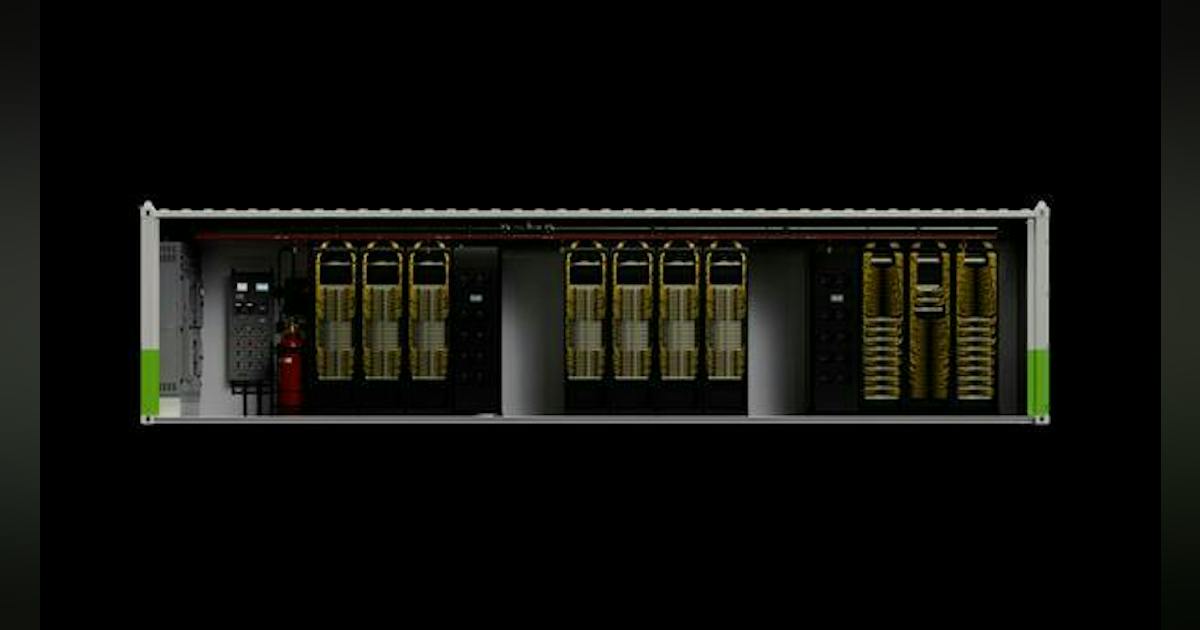
NVIDIA’s approach aims to move substantial portions of computing, networking, power and liquid-cooling integration into factories, reducing installation and validation work at prepared sites.

The company envisions deployment periods as short as 14 days under defined site-readiness conditions.Such approaches could materially alter how quickly new facilities become revenue-producing assets.

But they cannot eliminate the need for prepared sites, substations, generation capacity, high-voltage electrical connections and dependable cooling infrastructure.

The power question is especially consequential. SemiAnalysis takes the aggressive position that the expansion of behind-the-meter generation has broadly resolved the industry’s power-generation bottleneck, pointing to fuel cells, gas turbines, refurbished equipment and engine-based power solutions.

The underlying market shift is real. Developers are increasingly assuming responsibility for obtaining generation capacity rather than relying exclusively on conventional utility delivery.

But private generation does not eliminate the requirements for permits, fuel infrastructure, emissions compliance, operating reserves and, in many cases, continued utility support.

As DCF’s recent examination of behind-the-meter regulation explains, private power arrangements create a new set of engineering and regulatory responsibilities rather than simply bypassing the traditional grid.

The significance for the 2027 forecast is straightforward. The availability of new construction methods and alternative power supplies expands the number of projects that might be technically feasible within a compressed timeline. Whether those projects can be financed, permitted, completed and commissioned at the necessary pace is another matter.

Could Chips Become the Next Infrastructure Bottleneck?

Perhaps the most consequential argument in the SemiAnalysis report concerns what happens if its researchers are broadly correct.

For much of the AI infrastructure expansion, the dominant industry concern has been the inability to secure enough electricity and physical data center capacity to accommodate accelerating demand for computing equipment. SemiAnalysis suggests that relationship could begin to reverse during 2027 and 2028.

If data center development accelerates sharply, new buildings and associated power infrastructure might become available faster than semiconductor manufacturers can supply the accelerators, logic chips and memory required to populate them.

That would shift the limiting factor from facilities and electricity toward semiconductor manufacturing capacity, advanced packaging and high-bandwidth memory. The implications would extend throughout the investment chain.

Developers could find themselves with commissioned or nearly completed facilities awaiting computing equipment. Hyperscalers might face more complicated decisions about when to populate new sites, how to sequence hardware deployments and which workloads justify available infrastructure.

Conversely, additional computing supply could lower the cost of AI services and accelerate adoption, stimulating further infrastructure demand. This prospect makes the distinction between temporary mismatches and structural oversupply increasingly important.

JLL’s 2026 Global Data Center Market Outlook anticipates approximately 100 GW of additional data center capacity between 2026 and 2030, with AI inference becoming an increasingly important driver of demand.

SemiAnalysis’ latest forecast envisions a much more concentrated burst of near-term construction.

The estimates differ in geographic coverage, methodology, time horizon and potentially their treatment of IT versus facility capacity, limiting direct comparison. Nevertheless, their contrasting trajectories illustrate how much uncertainty remains over the timing and ultimate shape of the expansion.

The industry’s transition from training-dominated infrastructure toward increasingly diverse inference workloads adds another layer of complexity.

As DCF reported in its coverage of the 2026 OCP Global Summit, AI infrastructure is evolving toward coordinated chip-to-grid designs in which processors, networking, cooling, electrical distribution and facility architecture increasingly determine one another.

A shortage in any one part of that system can affect the practical value of capacity elsewhere.

Even if SemiAnalysis proves correct about the construction acceleration, the composition and utilization of the computing systems ultimately installed will help determine its economic consequences.

The Real Test Comes at Commissioning

The significance of SemiAnalysis’ latest forecast is not that it settles the question of how much data center capacity will be added in 2027. It is that the debate has moved beyond whether AI infrastructure demand is real.

The industry’s order books, financing commitments, construction activity and technology roadmaps provide substantial evidence of a buildout already operating on an extraordinary scale.

The disagreement now concerns the rate at which developers can translate that momentum into functioning facilities. And that is where the competing narratives will be tested.

A completed building is not necessarily an energized data hall. An energized data hall is not necessarily a populated AI cluster. And a populated AI cluster is not necessarily an economically productive computing asset.

Each transition carries its own requirements for capital, equipment, labor, electricity and operational readiness.

SemiAnalysis may ultimately prove correct that the acceleration underway is far larger than many observers anticipate. Its site-by-site methodology offers a substantial case for taking that possibility seriously.

But the next phase of the AI infrastructure boom will be measured less by announced gigawatts than by the pace of commissioning, actual power delivery, computing equipment installation and commercial utilization.

For an industry increasingly organized around the promise of speed, 2027 could establish just how much of that acceleration can be delivered in the physical world.

Shape
Shape
Stay Ahead

Explore More Insights

Stay ahead with more perspectives on cutting-edge power, infrastructure, energy,  bitcoin and AI solutions. Explore these articles to uncover strategies and insights shaping the future of industries.

Shape

Shell adds to Gulf of Mexico production with Silvertip Phase 3 startup

@import url(‘https://fonts.googleapis.com/css2?family=Inter:wght@100..900&display=swap’); .ebm-page__main h1, .ebm-page__main h2, .ebm-page__main h3, .ebm-page__main h4, .ebm-page__main h5, .ebm-page__main h6 { font-family: Inter; } body { line-height: 150%; letter-spacing: 0.025em; } button, .ebm-button-wrapper { font-family: Inter; } .label-style { text-transform: uppercase; color: var(–color-grey); font-weight: 600; font-size: 0.75rem; } .caption-style { font-size: 0.75rem; color: color-mix(in srgb, currentColor

Read More »

QatarEnergy continues LNG supply diversification effort with new Woodside deal

QatarEnergy has agreed to purchase up to 3 million tonnes/year (tpy) of LNG from Woodside Energy’s Louisiana LNG project under a 20-year contract, further expanding its US LNG portfolio as the export project advances toward first production. The agreement follows QatarEnergy’s recently signed LNG purchase deals with Cheniere and supports the company’s strategy of growing and diversifying its global LNG supply portfolio.  His Excellency Saad Sherida Al-Kaabi, Minister of State for Energy Affairs and president and chief executive officer of QatarEnergy, said the additional volumes make QatarEnergy “the largest buyer of LNG from the US” and strengthen the company’s ability to meet growing global LNG demand. Under the terms of the agreement, deliveries will be on an FOB basis and are expected to begin in 2030.  Woodside chief executive officer Meg O’Neill said the agreement, coupled with Woodside’s 2025 LNG supply agreement with Germany’s Uniper, help establish the project’s long-term customer base and provide revenue certainty for a portion of Louisiana LNG’s planned production. Louisiana LNG project update Louisiana LNG is under construction near Lake Charles, La., in Calcasieu Parish. The foundation project includes three trains with a combined capacity of 16.5 million tpy and is targeting first LNG in 2029. In its third-quarter report released Oct. 21, Woodside said the project is 32% complete and remains on budget. Train 1 is 41% complete with structural steel and above-ground piping installation progressed. Trains 2 and 3 were 27% and 22% complete respectively at the end of the quarter, with above-ground piping installation started for Train 2 and first concrete foundation poured for Train 3. Woodside said ongoing disruptions in the Middle East continue to affect structural steel supply, but the company is mitigating the impact through alternative logistics routes and fabrication sources.

Read More »

Shell’s third-quarter earnings rise on record refining margins, stronger gas results

Shell plc reported third-quarter 2026 adjusted earnings of $10.81 billion, up from $9.84 billion in the second quarter and nearly double the $5.43 billion reported a year earlier, as record refining margins and stronger Integrated Gas results more than offset lower upstream earnings. Income attributable to shareholders reached $12.06 billion, compared with $10.82 billion in the previous quarter. Higher refining margins, improved realized LNG prices, and increased gas production supported the results despite continued disruptions to Middle Eastern energy supplies. These gains were partly offset by weaker crude and oil products trading, lower realized liquids prices, and higher exploration well write-offs. Cash flow from operations reached $21.04 billion, compared with $21.43 billion in the previous quarter, while free cash flow was $16.32 billion, down from $17.52 billion. Net debt declined to $39.73 billion from $41.75 billion at end-June, reducing gearing to 16.6%. Chief executive officer Wael Sawan credited strong operational performance for the results amid continued disruptions to global energy markets. Shell announced a new $5-billion share buyback program and maintained its quarterly dividend at $0.3906/share. The company lowered its full-year 2026 cash capital expenditure guidance to $23-25 billion from $24-26 billion. Segment results Chemicals & Products adjusted earnings climbed to $3.86 billion from $2.88 billion in the second quarter, driven by record refining margins. Shell’s global indicative refining margin surged to $42/bbl from $24/bbl, while refinery utilization averaged 96%, down from 102%. Processing intake declined to 1.21 million b/d from 1.27 million b/d. Integrated Gas adjusted earnings increased to $3.04 billion from $2.69 billion, supported by higher realized prices and increased production. Production rose to 772,000 boe/d from 631,000 boe/d, mainly reflecting the completion of the ARC Resources acquisition in September. LNG liquefaction volumes declined to 7.4 million tonnes from 7.7 million tonnes due to planned maintenance, while LNG

Read More »

Expand curtailing some production ‘in direct acknowledgement that the market is weakening’

Expand Energy Corp., Spring, Tex., pulled back on some production during the third quarter, including by dropping a rig in Northeast Appalachia and a completion crew in the Haynesville, because of weaker prices for natural gas. Executives on Oct. 28 told analysts and investors that they’re prepared to curtail more work late this year and into 2027. “As we’ve come into the fourth quarter, we’ve ended up reducing some of our activity,” chief operating officer Josh Viets said on a conference call following the release of Expand’s third-quarter results. “That activity reduction, moving from around 12 rigs down to 10, is in direct acknowledgement that the market is weakening.” Viets was responding to a question from JPMorgan analyst Arun Jayaram, who neatly summed up the factors contributing to soft natural gas prices even though demand growth has been solid. The environment next year could be affected by Super El Niño weather patterns, more supply being transported out of the Permian basin and several LNG infrastructure owners being “a little bit more levered to the back end of the year.” Viets agreed with that assessment of the supply-demand picture for the coming quarters and later said Expand is prepared to revisit the strategy it employed 2 years ago, when it built up its inventory of drilled but uncompleted wells while waiting for prices to climb. “We pushed out about nine turn-in-lines out of Q3,” he added. “We are waiting on those still to think about the optimal time to bring them online.”

Read More »

Equinor nearly doubles third-quarter earnings on higher commodity prices, production gains

Equinor ASA reported adjusted operating income of $12.35 billion for third-quarter 2026, nearly double the $6.22 billion recorded a year earlier, supported by higher oil and natural gas prices, increased production, and stronger refining margins. The Norwegian energy major posted net income of $2.54 billion, compared with a net loss of $204 million in the year-earlier quarter. Adjusted net income reached $2.86 billion, or $1.20/share. Equinor realized an average liquids price of $92.30/bbl and a European natural gas price of $20/MMbtu during the quarter, reflecting tighter energy markets amid Middle East supply disruptions. Production, outlook Equinor’s equity oil and gas production averaged 2.166 MMboe/d in the quarter, up 2% year over year. Production on the Norwegian continental shelf remained broadly stable as contributions from new fields, including Halten East and Verdande, and new wells offset natural declines and unplanned losses at Johan Castberg and Troll. International production increased 21%, driven by higher volumes from Adura in the UK and Bacalhau offshore Brazil, as well as reduced maintenance activity. US production declined due to planned offshore downtime and natural field declines. Citing stronger operational performance, Equinor raised its full-year 2026 oil and gas production growth guidance to about 4% from 3%. “High production in the third quarter enabled us to capture additional value from higher prices,” said Anders Opedal, Equinor’s president and chief executive officer. Refining, financial performance Equinor’s Marketing, Midstream and Processing segment benefited from stronger refining margins, high utilization, and LNG trading activity. The Mongstad refinery in Norway delivered a record earnings contribution during the quarter. Cash flow from operations after taxes reached $8.14 billion. Organic capital expenditures totaled $3.28 billion, while the company’s adjusted net debt-to-capital-employed ratio declined to 3.8% at quarter-end from 10.4% in the previous quarter. Portfolio developments Equinor continued reshaping its upstream portfolio, including acquiring

Read More »

EIA: US crude oil inventories down 1.9 million bbl

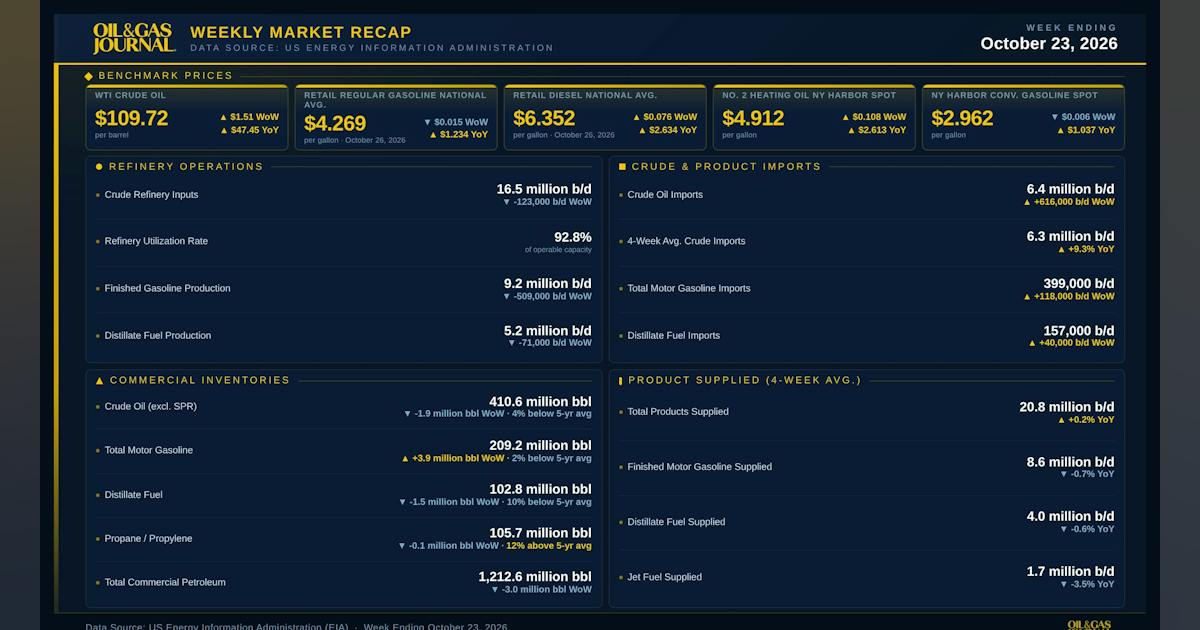
US crude oil inventories for the week ended Oct. 23, excluding the Strategic Petroleum Reserve, decreased by 1.9 million bbl from the previous week, according to data from the US Energy Information Administration (EIA). At 410.6 million bbl, US crude oil inventories are 4% below the 5-year average for this time of year, the EIA report indicated. Gasoline inventories increased 3.9 million bbl, 2% below the 5-year average. Propane-propylene inventories decreased 100,000 bbl, 12% above the 5-year average. Total commercial petroleum inventories decreased by 3.0 million bbl for the week. Distillate inventories decreased 1.5 million bbl, 10% below the 5-year average. US crude oil refinery inputs averaged 16.5 million b/d for the week ended Oct. 23, which was 123,000 b/d less than the previous week’s average. Refineries operated at 92.8% of capacity. Gasoline output averaged 9.2 million b/d, and distillate production decreased to 5.2 million b/d. Crude oil imports increased 616,000 b/d to 6.4 million b/d. The 4-week average of 6.3 million b/d is 9.3% above the year-ago level. Gasoline imports averaged 399,000 b/d; distillate imports averaged 157,000 b/d. Over the past four weeks, total product supplied averaged 20.8 million b/d, up 0.2% year over year. The 4-week average for gasoline product supplied decreased 0.7% year over year to 8.6 million b/d, while the 4-week average for distillate product supplied decreased 0.6% to 4.0 million b/d. The 4-week average for jet fuel product supplied decreased 3.5% year over year.

Read More »

Energy Department Closes $5.1 Billion Loan to Lower Electricity Costs and Strengthen Grid Reliability in Iowa and Wisconsin

WASHINGTON—The U.S. Department of Energy’s (DOE) Office of Energy Dominance Financing (EDF) today announced the financial close of a $5.1 billion loan package to Alliant Energy to lower electricity costs, expand firm power generation, and strengthen grid reliability in Iowa and Wisconsin. The investments will add more than 2.6 gigawatts (GW) of new or upgraded power generation capacity and deliver more than $1 billion in electricity cost savings for American families and businesses across both states. Today’s announcement advances President Trump’s Executive Order Strengthening the Reliability and Security of the United States Electric Grid by ensuring our nation has the dependable power needed to meet growing electricity demand and strengthen American energy security. “The Energy Department is delivering on President Trump’s promise to lower electricity costs and unleash the full potential of American energy,” said U.S. Secretary of Energy Chris Wright. “These investments will drive down energy costs for families and businesses in Iowa and Wisconsin, strengthen our nation’s electric grid, and fuel American prosperity for decades to come.” The projects will add enough electricity to power the equivalent of nearly 2 million homes—lowering costs and strengthening grid reliability in Iowa and Wisconsin. The investments will support new natural gas-fired power plants, energy storage systems, and upgrades to existing generation facilities, create hundreds of construction-related jobs, and deliver affordable, reliable energy for American families and businesses. “Thanks to President Trump and Secretary Wright’s leadership, EDF is putting capital to work to expand America’s reliable energy infrastructure,” said EDF Director Gregory A. Beard. “By bringing new, dependable power online, we are strengthening our nation’s energy security and lowering electricity costs for families and businesses across Iowa and Wisconsin.” This loan marks the Trump Administration’s tenth financial close, and the sixth and seventh utility financing completed through the Energy Dominance Financing Program.

Read More »

Gartner warns $3.5T in AI infrastructure spending could be at risk by 2030

Musk predicted that more than 200 neocloud companies could face significant financial distress, predicting that only a small number would survive the coming shakeout. He also said SpaceX would not acquire any of the companies, describing such purchases as “pointless.” The chickens are already coming home to roost on the neoclouds. CoreWeave, Nebius, Applied Digital and TeraWulf have reported quarterly losses over the past year, while IREN has failed to turn a profit in its past three quarters. Shares of CoreWeave, Nebius and IREN have fallen more than 30% during October, according to Reuters. Building AI data centers requires substantial upfront investment in GPUs, networking equipment, power systems, cooling infrastructure and facilities. Operators must then generate enough revenue from leasing computing capacity to cover operating expenses, interest payments and equipment replacement.

Read More »

The 50-Gigawatt Test: SemiAnalysis Sees a Historic Data Center Surge in 2027

The global data center industry is approaching a potentially historic test of its ability to turn artificial intelligence investment into operational infrastructure. In a provocative new forecast, semiconductor and AI infrastructure research firm SemiAnalysis predicts that approximately 51.2 gigawatts of net data center IT capacity will be added globally, excluding China, during 2027. That would represent more than double the 25 GW the firm expects to be added in 2026. Published October 19, the report, Datacenters 2027: The Year of Acceleration, +50GW in a Single Year, makes a forceful argument that much of this unprecedented expansion is already visible in the industry’s construction pipeline. Authored by Jeremie Eliahou Ontiveros, Reyk Knuhtsen and Dylan Patel, the analysis draws on SemiAnalysis’ proprietary tracking of construction starts, individual buildings, hyperscale leasing commitments, equipment procurement and project financing. Its researchers identify more than 60 GW of data center capacity under construction. Among the 40 largest campuses they examined, more than 24 GW is reportedly in advanced stages of development, with much of that capacity expected to be delivered in 2027. The forecast is not entirely composed of projects already under construction, however. SemiAnalysis’ capacity chart includes approximately 11.9 GW of 2027 additions associated with projects still classified as planned. The remainder is associated with facilities already operating or under construction, according to the model’s building-status categories. SemiAnalysis argues that the volume and maturity of projects already underway make a dramatic acceleration increasingly likely, despite well-documented constraints involving electricity, construction labor, equipment and capital. But the prediction has also become the subject of a revealing industry debate, with competing forecasts and new corporate disclosures raising questions about how much infrastructure can actually be delivered on schedule. The disagreement is no longer principally about whether AI infrastructure demand is real. It is about whether the industrial

Read More »

HPE’s Quantum Computing Bet: A Multi-Vendor Path to the Data Center

QuEra Deal Targets On-Premises Quantum Integration Under the expanded collaboration, HPE and QuEra intend to develop integrated testbeds, software interoperability, hybrid algorithms and performance benchmarks to support future quantum deployments alongside HPE Cray supercomputing infrastructure. The work is intended to address the practical requirements of coordinating quantum processors with the classical computing systems that prepare workloads, process results and support quantum error correction. QuEra Chief Commercial Officer Yuval Boger, who previously discussed the development of hybrid quantum-classical infrastructure on the DCF Show, emphasized that integrating quantum hardware into an HPC environment presents different engineering challenges than providing access through the cloud. Boger said, “HPE’s deep experience in supercomputing gives organizations the benefit of working with a partner who can solve that problem at the scale they need.” The collaboration envisions deploying future fault-tolerant quantum hardware at customer facilities rather than requiring organizations to rely exclusively on cloud-based quantum computing services. That option could appeal to national laboratories, defense organizations, pharmaceutical researchers and other institutions managing classified information, proprietary intellectual property or data subject to sovereignty requirements. QuEra’s neutral-atom architecture uses individual atoms as qubits, manipulating them with lasers and electromagnetic controls. Unlike superconducting quantum processors, which generally require dilution refrigerators operating at temperatures measured in millikelvin, neutral-atom systems can operate without extreme cryogenic refrigeration. They still require specialized laser systems, vacuum equipment, precision optics and environmental controls, presenting facility requirements substantially different from those of conventional servers. On-premises quantum-HPC integration is already being tested. In Japan, the National Institute of Advanced Industrial Science and Technology (AIST) operates QuEra’s 260-physical-qubit Gemini neutral-atom computer as part of its ABCI-Q research platform, which also incorporates an NVIDIA H100-based AI supercomputer. An October 26 case study published by QuEra describes Gemini operating in a separate building approximately 350 meters from the main GPU installation,

Read More »

At 7×24 Exchange, AI Data Center Growth Confronts New Realities of Power, Grid Reliability and Community Trust

DC BLOX: Community Engagement Must Go Beyond Public Relations The afternoon program shifted attention from electrical infrastructure to the growing challenges surrounding data center development and community acceptance. In a discussion moderated by Juli Ierulli, strategic account manager at Environmental Air Systems and vice president of 7×24 Exchange International, Michael Clark, senior vice president of data center construction at DC BLOX, described how the company has revised its approach to engaging communities as it expands into new markets. Clark acknowledged that DC BLOX had encountered significant opposition after entering markets where it lacked the established relationships that had supported earlier developments across the Southeast. “We made multiple stumbles in some of those new markets,” he said, describing how the company sometimes found itself responding to negative publicity rather than presenting a clear explanation of its plans and commitments. The experience led DC BLOX to develop a more systematic approach to community engagement, emphasizing early communication, site-specific websites, accessible explanations of resource consumption and written commitments that residents and officials can evaluate. Clark also pointed to what he called the industry’s “NDA hangover,” reflecting years of development activity conducted under confidentiality agreements that frequently left neighboring communities unaware of what was being planned. But perhaps the most revealing moment came when Clark recounted a conversation with residents near a DC BLOX development in Rockdale County, Georgia. After the company outlined the countywide economic and community benefits expected from the project, one neighbor challenged the distribution of those benefits. “So the rest of the county gets the benefit and we have to pay all the costs,” the resident observed, according to Clark. The question captured a fundamental tension in the industry’s community engagement efforts: tax revenues and economic development benefits may extend across a county, while nearby residents experience the immediate effects

Read More »

NVIDIA’s DSX POD Pushes AI Factory Construction Toward the Assembly Line

Crusoe Brings an Established Modular Model to DSX POD For Crusoe, NVIDIA’s announcement builds on a modular computing strategy already in operation. In its October 21 announcement, Crusoe confirmed that its Spark modular AI data center platform will support DSX POD, extending a manufacturing and deployment approach the company says it has pursued since 2020. Crusoe has expanded its manufacturing capabilities through the acquisition of electrical equipment specialist Easter-Owens Electric and the development of its 352,000-square-foot Crusoe Spark Factory in Brighton, Colorado. The company also introduced Crusoe Spark Liquid, a sixth-generation modular system engineered for ultra-high-density infrastructure, including NVIDIA Vera Rubin NVL72. Next-generation liquid-cooled units are planned for 2027. Crusoe’s vertically integrated model connects infrastructure design and manufacturing with deployment and cloud operations through Crusoe Cloud. The company says it can deliver productive AI capacity in as little as three months, although that timeline is distinct from NVIDIA’s narrower 14-day prepared-site deployment claim. “Modular isn’t a new strategy or pivot for us. It’s been in our DNA since our founding,” said Bryan Schramm, Crusoe’s head of Spark. Crusoe’s involvement demonstrates that the manufacturing model predates DSX POD. NVIDIA is not inventing modular data center infrastructure; it is attempting to establish a common architecture around capabilities that suppliers such as Crusoe have already spent years developing. That distinction matters as the industry evaluates whether standardized AI factory designs can deliver manufacturing efficiencies at a scale beyond individual suppliers’ existing operations. Vertiv and Polar Put the Deployment Model to Work in Norway The European dimension of NVIDIA’s announcement is reflected in a deployment involving Vertiv and Polar Data Centers at Herøya, Norway. According to Vertiv’s October 21 announcement, Polar is applying a factory-built infrastructure approach to the initial 41 MW phase of a multiphase AI data center campus designed to scale to

Read More »

Hyperscalers allow more scrutiny of controversial data center plans

Hyperscalers are getting decidedly twitchy about citizens’ reactions to their secretive data center construction plans, and are looking for ways to de-escalate some of the conflicts. Earlier this month, Amazon announced its Data Center Commitment which, among other things, would disclose more information about energy and water use and consider a moratorium asking government officials to sign non-disclosure agreements covering their planning applications. Amazon is not alone in this. Earlier this week, Meta said that it was reviewing its use of NDAs after the company was widely criticized for its secrecy in proposing Hyperion, a Louisiana data center in July.

Read More »

Microsoft will invest $80B in AI data centers in fiscal 2025

And Microsoft isn’t the only one that is ramping up its investments into AI-enabled data centers. Rival cloud service providers are all investing in either upgrading or opening new data centers to capture a larger chunk of business from developers and users of large language models (LLMs).  In a report published in October 2024, Bloomberg Intelligence estimated that demand for generative AI would push Microsoft, AWS, Google, Oracle, Meta, and Apple would between them devote $200 billion to capex in 2025, up from $110 billion in 2023. Microsoft is one of the biggest spenders, followed closely by Google and AWS, Bloomberg Intelligence said. Its estimate of Microsoft’s capital spending on AI, at $62.4 billion for calendar 2025, is lower than Smith’s claim that the company will invest $80 billion in the fiscal year to June 30, 2025. Both figures, though, are way higher than Microsoft’s 2020 capital expenditure of “just” $17.6 billion. The majority of the increased spending is tied to cloud services and the expansion of AI infrastructure needed to provide compute capacity for OpenAI workloads. Separately, last October Amazon CEO Andy Jassy said his company planned total capex spend of $75 billion in 2024 and even more in 2025, with much of it going to AWS, its cloud computing division.

Read More »

John Deere unveils more autonomous farm machines to address skill labor shortage

Join our daily and weekly newsletters for the latest updates and exclusive content on industry-leading AI coverage. Learn More Self-driving tractors might be the path to self-driving cars. John Deere has revealed a new line of autonomous machines and tech across agriculture, construction and commercial landscaping. The Moline, Illinois-based John Deere has been in business for 187 years, yet it’s been a regular as a non-tech company showing off technology at the big tech trade show in Las Vegas and is back at CES 2025 with more autonomous tractors and other vehicles. This is not something we usually cover, but John Deere has a lot of data that is interesting in the big picture of tech. The message from the company is that there aren’t enough skilled farm laborers to do the work that its customers need. It’s been a challenge for most of the last two decades, said Jahmy Hindman, CTO at John Deere, in a briefing. Much of the tech will come this fall and after that. He noted that the average farmer in the U.S. is over 58 and works 12 to 18 hours a day to grow food for us. And he said the American Farm Bureau Federation estimates there are roughly 2.4 million farm jobs that need to be filled annually; and the agricultural work force continues to shrink. (This is my hint to the anti-immigration crowd). John Deere’s autonomous 9RX Tractor. Farmers can oversee it using an app. While each of these industries experiences their own set of challenges, a commonality across all is skilled labor availability. In construction, about 80% percent of contractors struggle to find skilled labor. And in commercial landscaping, 86% of landscaping business owners can’t find labor to fill open positions, he said. “They have to figure out how to do

Read More »

2025 playbook for enterprise AI success, from agents to evals

Join our daily and weekly newsletters for the latest updates and exclusive content on industry-leading AI coverage. Learn More 2025 is poised to be a pivotal year for enterprise AI. The past year has seen rapid innovation, and this year will see the same. This has made it more critical than ever to revisit your AI strategy to stay competitive and create value for your customers. From scaling AI agents to optimizing costs, here are the five critical areas enterprises should prioritize for their AI strategy this year. 1. Agents: the next generation of automation AI agents are no longer theoretical. In 2025, they’re indispensable tools for enterprises looking to streamline operations and enhance customer interactions. Unlike traditional software, agents powered by large language models (LLMs) can make nuanced decisions, navigate complex multi-step tasks, and integrate seamlessly with tools and APIs. At the start of 2024, agents were not ready for prime time, making frustrating mistakes like hallucinating URLs. They started getting better as frontier large language models themselves improved. “Let me put it this way,” said Sam Witteveen, cofounder of Red Dragon, a company that develops agents for companies, and that recently reviewed the 48 agents it built last year. “Interestingly, the ones that we built at the start of the year, a lot of those worked way better at the end of the year just because the models got better.” Witteveen shared this in the video podcast we filmed to discuss these five big trends in detail. Models are getting better and hallucinating less, and they’re also being trained to do agentic tasks. Another feature that the model providers are researching is a way to use the LLM as a judge, and as models get cheaper (something we’ll cover below), companies can use three or more models to

Read More »

OpenAI’s red teaming innovations define new essentials for security leaders in the AI era

Join our daily and weekly newsletters for the latest updates and exclusive content on industry-leading AI coverage. Learn More OpenAI has taken a more aggressive approach to red teaming than its AI competitors, demonstrating its security teams’ advanced capabilities in two areas: multi-step reinforcement and external red teaming. OpenAI recently released two papers that set a new competitive standard for improving the quality, reliability and safety of AI models in these two techniques and more. The first paper, “OpenAI’s Approach to External Red Teaming for AI Models and Systems,” reports that specialized teams outside the company have proven effective in uncovering vulnerabilities that might otherwise have made it into a released model because in-house testing techniques may have missed them. In the second paper, “Diverse and Effective Red Teaming with Auto-Generated Rewards and Multi-Step Reinforcement Learning,” OpenAI introduces an automated framework that relies on iterative reinforcement learning to generate a broad spectrum of novel, wide-ranging attacks. Going all-in on red teaming pays practical, competitive dividends It’s encouraging to see competitive intensity in red teaming growing among AI companies. When Anthropic released its AI red team guidelines in June of last year, it joined AI providers including Google, Microsoft, Nvidia, OpenAI, and even the U.S.’s National Institute of Standards and Technology (NIST), which all had released red teaming frameworks. Investing heavily in red teaming yields tangible benefits for security leaders in any organization. OpenAI’s paper on external red teaming provides a detailed analysis of how the company strives to create specialized external teams that include cybersecurity and subject matter experts. The goal is to see if knowledgeable external teams can defeat models’ security perimeters and find gaps in their security, biases and controls that prompt-based testing couldn’t find. What makes OpenAI’s recent papers noteworthy is how well they define using human-in-the-middle

Read More »