Stay Ahead, Stay ONMINE

Trump ban on foreign grid components sparks industry concern over practicality, cost

Listen to the article 8 min This audio is auto-generated. Please let us know if you have feedback. President Donald Trump’s recent executive order seeking to protect the bulk power system from foreign threats correctly identifies the risk of U.S. reliance on outside suppliers, but mitigating those risks without stalling the grid’s buildout or saddling […]

President Donald Trump’s recent executive order seeking to protect the bulk power system from foreign threats correctly identifies the risk of U.S. reliance on outside suppliers, but mitigating those risks without stalling the grid’s buildout or saddling ratepayers with even more costs will be tricky, stakeholders told Utility Dive.

Executive Order 14421, issued Aug. 26, gives Secretary of Energy Chris Wright the power to block the installation of foreign-produced equipment – “or any critical component, software, firmware, digital service, maintenance service, or remote-access capability associated with such equipment” – that poses an “undue risk” to national security, either through intentional sabotage or supply chain disruption. 

It also gave the secretary the authority to order the removal and replacement of previously installed equipment.

The Department of Energy has until Dec. 24 to publish rules and regulations implementing the order. In September, DOE asked industry and other stakeholders to weigh in. 

Their responses to DOE’s request show broad support for the intent of the order, but concern over how it will be implemented. A number pointed out that security standards, especially for software that would enable remote access, can be more important than country of origin since flaws in any system can be exploited by anyone, anywhere.

The vast majority of stakeholder responses that took a position on the “function over origin” question favored DOE emphasizing functional controls as opposed to a software product’s origin, according to data compiled by industry analyst Brendon Shank.

Many respondents also said they wanted DOE to take a phased approach to introducing new compliance rules and allow some vendors to “prequalify” as trustworthy. Utilities are projected to spend more than a trillion dollars on grid upgrades through 2030 and are racing to secure contracts for equipment amid rising manufacturer backlogs. 

“Supply chains are already approaching a breaking point for many categories of electrical industry products,” said the National Electrical Manufacturers Association, which represents more than 300 electrical equipment manufacturers. 

“[W]e strongly encourage the DOE to consider the time, money and resources it takes to evaluate, redesign, develop and produce equipment that is made for the electrical system,” it said. “At a time of high demand and longer lead times than during periods of more stable electricity growth, that is only further complicated by balancing timeliness with retooling or restructuring of production lines to meet new changes.”

Until DOE releases its determinations, the industry faces a lot of uncertainty and big questions, said Alice Wu, a manager of federal policy at the clean energy nonprofit RMI. 

Even though the order instructs DOE to focus on transmission-related equipment and components of 69 kV or higher — not on the distribution system — it also puts distribution system components linked to the bulk system with questionably sourced software under scrutiny, she said.

“It is not feasible for generation, transmission and distribution providers to rip-and-replace every piece of equipment and for DOE to check it,” Wu told Utility Dive in an interview. “What is the secure proxy for that? … And what will the potential cost impacts to ratepayers be?”

U.S. imports billions of dollars in grid components every year

The U.S. has imported more than $22 billion in bulk-power equipment since 2025, particularly from China, which would likely be the country most impacted by the order, according to a recent Wood Mackenzie analysis.

Transformers and substations are already in an estimated market shortage of 15% and 8%, respectively, in 2026, and “restrictions on the use of Chinese built units is going to further exacerbate the supply chain challenges,” WoodMac said.

The market for 100 MVA power transformers is particularly exposed, it said, adding that the market for power transformers greater than 10 MVA has expanded nearly 300% since 2020.

A different analysis by RMI and BloombergNEF said the value of grid imports in 2025 was more than $30 billion. Together, Mexico, Southeast Asia and the European Union made up more than half of that, while China accounted for $3.5 billion and “other” countries for $7.4 billion. 
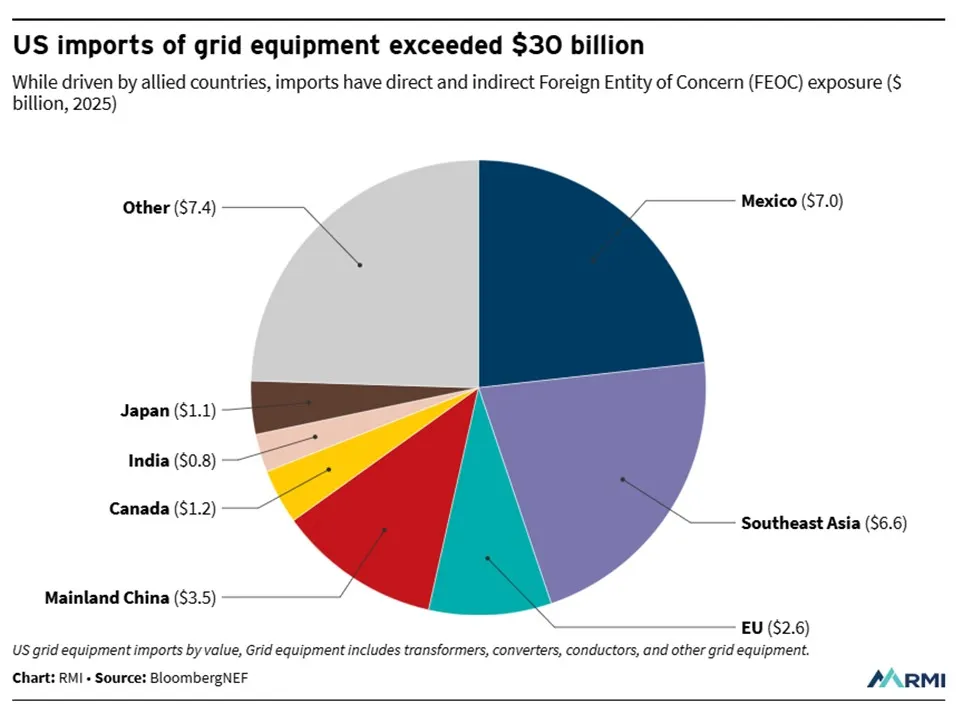
U.S. power system supply chain

U.S. power system supply chain imports

Permission granted by RMI

Cybersecurity a key vulnerability

NEMA and other stakeholders and experts applauded the order’s emphasis on software, maintenance support and other services that introduce remote-access capabilities. They also pointed to existing security standards DOE could apply from the North American Electric Reliability Corp., the National Institute of Standards and Technology, the Institute of Electrical and Electronics Engineers and others.

“Overall, this executive order focuses on the right security areas because it makes those who deploy critical infrastructure accountable for their software,” said Aaron Rose, a security architect manager with Check Point Software Technologies, which assesses security for utilities and other companies.

Check Point sees an average of about 3,000 cyberattacks per large organization per week, he said in an interview with Utility Dive. 

DOE software determinations will be complicated, because “almost everything on the power system is software defined, controlled and driven,” he added.

DOE could ask for a software’s source, who maintains it, who has remote access to it, and where updates originate, Rose said. But updates for most firmware, cloud control systems, substation systems and customer-owned devices are from open-source libraries or code already written for other uses, making their countries of origin difficult to identify, and eliminating all software of uncertain origin is impractical, he said. 

Power system software may also be sub-contracted to a third-party, Rose continued. Hardware manufacturers may or may not have documentation on that software’s developer or on who has remote access for updates, or be able to trace them, even with AI tools.

To avoid a complicated decompiling by a security team and still ensure critical needs are met, DOE could require future updates and remote access to be from secure sources, he added.

Rose said it is unclear whether the costs for such measures will fall on software vendors, infrastructure owners or their consumers.

 An analysis of the order by the Rainey Center, a policy think tank, also questioned the logic of restrictions based on geography rather than capability and function. 

“The risks the order names travel through code, connections, and control, and they work the same whether a device is built abroad or at home,” it said. “A ban governs geography; a standard governs the risk, on every device.”

The report recommended DOE define risk by “a verifiable, technology-neutral standard” built on existing controls, as well as a system for vendors to prequalify through independent U.S. testing.
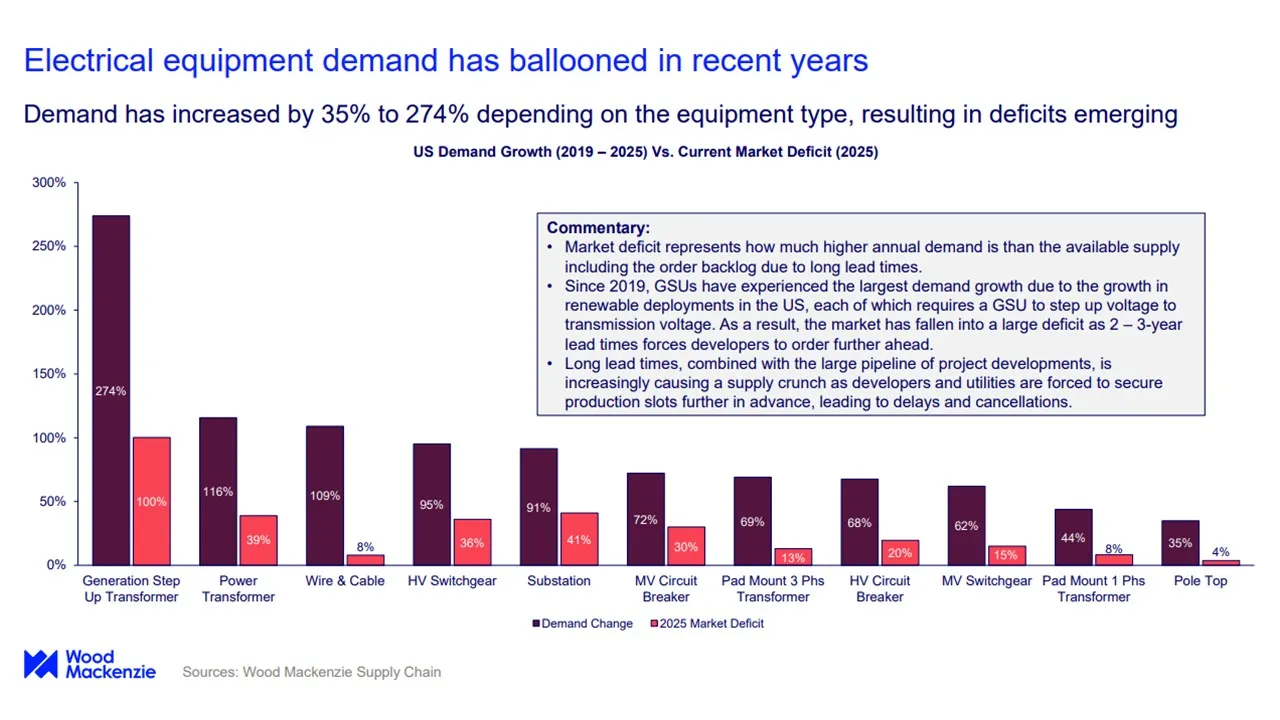
power system supply chain

U.S. power system supply chain demand

Permission granted by WoodMac

Protecting investments in growth

The order’s flexibilities, like phased compliance, can allow determinations that avoid negative economic impacts, said Danielle Russo, executive director of  SAFE, a nonprofit advocacy group focused on U.S. national and economic security. 

DOE can provide power system manufacturers and developers the clarity they need with lists of the specific supply chain equipment and components that are secure, Russo said. That will avoid slowing manufacturing investment and project development needed to meet load growth, she added.

In today’s complex investment environment, uncertainties from tariffs to changing political leadership can threaten investors with stranded assets, Russo said, adding: “It is hard to blame them for being challenged by that.”

DOE’s security restrictions should be balanced with legislated incentives that provide long-term certainty, Russo said.


Shape
Shape
Stay Ahead

Explore More Insights

Stay ahead with more perspectives on cutting-edge power, infrastructure, energy,  bitcoin and AI solutions. Explore these articles to uncover strategies and insights shaping the future of industries.

Shape

IBM aims to simplify mainframe modernization with AI-powered insight

“IBM Z Atlas’ system intelligence is built on a foundation of automated discovery, topology modeling, dependency analysis, natural-language interactions, and AI-powered workflows to create impact assessments and change evidence. Together, these capabilities are intended to create a continuously updated understanding of the IBM Z environment and the relationships between its

Read More »

Trump ban on foreign grid components sparks industry concern over practicality, cost

Listen to the article 8 min This audio is auto-generated. Please let us know if you have feedback. President Donald Trump’s recent executive order seeking to protect the bulk power system from foreign threats correctly identifies the risk of U.S. reliance on outside suppliers, but mitigating those risks without stalling the grid’s buildout or saddling ratepayers with even more costs will be tricky, stakeholders told Utility Dive. Executive Order 14421, issued Aug. 26, gives Secretary of Energy Chris Wright the power to block the installation of foreign-produced equipment – “or any critical component, software, firmware, digital service, maintenance service, or remote-access capability associated with such equipment” – that poses an “undue risk” to national security, either through intentional sabotage or supply chain disruption.  It also gave the secretary the authority to order the removal and replacement of previously installed equipment. The Department of Energy has until Dec. 24 to publish rules and regulations implementing the order. In September, DOE asked industry and other stakeholders to weigh in.  Their responses to DOE’s request show broad support for the intent of the order, but concern over how it will be implemented. A number pointed out that security standards, especially for software that would enable remote access, can be more important than country of origin since flaws in any system can be exploited by anyone, anywhere. The vast majority of stakeholder responses that took a position on the “function over origin” question favored DOE emphasizing functional controls as opposed to a software product’s origin, according to data compiled by industry analyst Brendon Shank. Many respondents also said they wanted DOE to take a phased approach to introducing new compliance rules and allow some vendors to “prequalify” as trustworthy. Utilities are projected to spend more than a trillion dollars on grid upgrades through 2030

Read More »

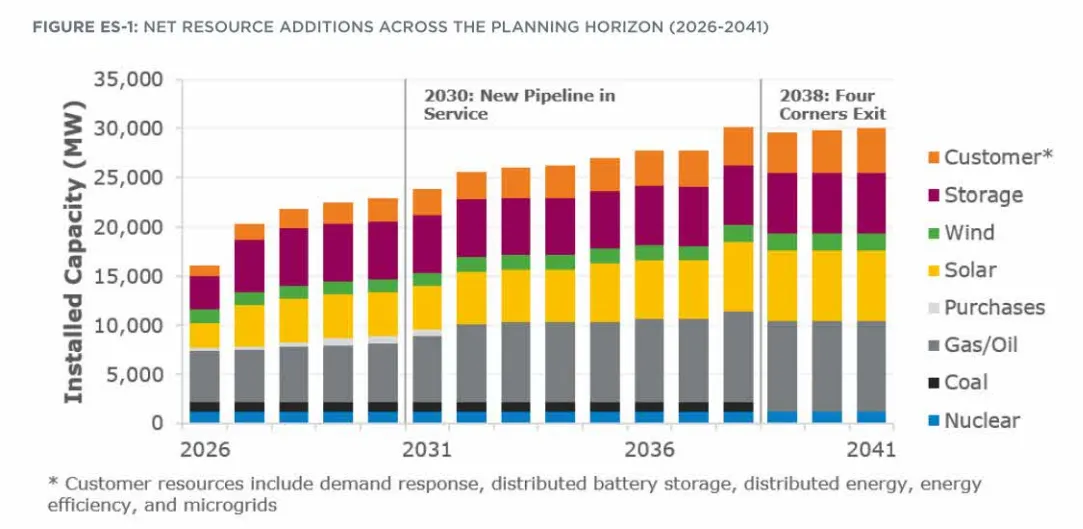
APS expects sales to double by 2041, plans extending coal use to 2038

Listen to the article 6 min This audio is auto-generated. Please let us know if you have feedback. Dive Brief: The largest electric utility in Arizona projects retail sales to double in the next 15 years and peak demand to grow 3.4% annually, after accounting for customer resources like demand-side management, driven by large-load industrial and data center customers. Arizona Public Service filed in an integrated resource plan with state regulators on Friday indicating it will extend the life of its Four Corners coal plant seven years past a planned 2031 retirement, in addition to bringing 2,000 MW of solar and 2,500 MW of storage resources online by 2029 and adding 4,000 MW of gas generation through 2036. APS also said it expects customer adoption of electric vehicles and behind-the-meter solar resources to be 18% and 30% lower than previous forecasts, respectively; customer-sited storage, however, could reach 1.2 GW by 2045, almost doubling the last storage forecast developed in 2023. Dive Insight: APS projects peak demand of more than 14.5 GW in 2041, almost 60% higher than its current record peak of about 9.2 GW, set in August. And the utility expects annual retail sales to grow to about 80,600 GWh in 2041, up from about 34,200 GWh in 2025. There is some uncertainty behind APS’ load projections, but the utility said it has taken steps to protect customers. Despite refinements to APS’ large-load interconnection process, the “sustained record levels of interest” from large customers poses “a risk in increased potential for unrealized loads,” APS said in its resource plan, which it files every three years with the Arizona Corporation Commission. To mitigate the risk, APS said it adopted strategies such as having customers commit to “minimum demand and energy-based contract terms, providing collateral in case of default, and instituting early exit fees.” As a

Read More »

Energy Department Awards Contracts from Northeast Home Heating Oil Reserve

WASHINGTON—The U.S. Department of Energy (DOE) today announced contract awards for the exchange of 300,000 barrels of ultra-low sulfur distillate (fuel oil) from the Northeast Home Heating Oil Reserve (NEHHOR), with fuel supplied from storage sites in Boston, Massachusetts, and New Haven, Connecticut. Today’s awards follow DOE’s October 21, 2026, Request for Proposal (RFP). Fuel transfers or deliveries are scheduled to be completed by November 6, 2026.  “Under President Trump’s leadership, the Energy Department is continuing to do everything in our power to lower energy costs for the American people,” said DOE Under Secretary of Energy Kyle Haustveit. “These actions will help address supply chain disruptions and ensure Americans in the Northeast region stay warm while protecting the long-term readiness of the Northeast Home Heating Oil Reserve.” The contracts were awarded through a competitive process established under DOE’s emergency exchange authority and reinforce the Trump Administration’s commitment to reliable energy access and lowering costs. Under the awarded contracts, exchange recipients will return the same volume of fuel oil plus a premium, ensuring that NEHHOR is refilled ahead of the 2027–2028 heating season and maintains its long-term operational readiness. Because NEHHOR contains refined petroleum products that can be distributed directly to consumers without additional processing, these awards will help address near-term market pressures and support the availability of heating fuel across the Northeast. For more information on NEHHOR, please visit the NEHHOR website.

Read More »

Diamondback shifting to full-field development of Barnett holdings

Teams at Diamondback Energy Inc., Midland, have made enough progress on costs in the Barnett shale to encourage chief executive officer (CEO) Kaes Van’t Hof to shift to full-field development in the play. Diamondback executives unveiled a 200,000-acre Barnett position in February and have since added 24,000 net acres there. The company’s costs in the area started the year around $1,000 per lateral ft drilled but have since moved nicely in the direction of Van’t Hof’s goal of $800. And with “nothing that scares me or scares the team from continuing to push on,” the CEO said Nov. 3 that plans now call for the development of up to five section developments by the end of February. “What was once a geologic success is now turning into meaningful value for the company, and we’re moving into kind of full-field development,” Van’t Hof said on Diamondback’s third-quarter earnings conference call. Al Barkmann, Diamondback’s chief engineer, told analysts some of the upcoming drilling will focus on lease obligations the company has and added that those will focus on an area near where teams already have drilled some wells. Some areas, he said, are competing for capital today thanks in part to Diamondback’s 40% ownership of mineral- and royalty-focused Viper Energy Inc.

Read More »

ADNOC’s XRG expands into Australian LNG in $1.45-billion deal with Shell

XRG, ADNOC’s international investment company, has agreed to acquire Shell plc subsidiary Shell Australia Pty Ltd.’s 16.67% interest in the Woodside Energy-operated North West Shelf (NWS) project in Western Australia for $1.45 billion plus a milestone-linked contingent payment. The acquisition includes associated upstream interests and pipeline and midstream infrastructure. Shell’s stake also comprises varying participating interests in related petroleum and pipeline titles, project agreements, offtake arrangements, NWS project companies, and CNOOC-related joint ventures. The NWS project is an LNG and domestic gas development in Western Australia comprising interconnected joint ventures involving Woodside, Chevron, BP, Shell, MIMI, and CNOOC. The project has liquefaction capacity of 14.3 million tonnes/year (tpy) and 4.4 tcfe of remaining resources, XRG said. The transaction marks XRG’s first investment in Australian LNG and supports the company’s strategy to expand its international gas portfolio and establish a position closer to demand growth in the Asia-Pacific region, XRG said. In a separate release, Shell said declining production from the original NWS fields has created capacity at the project’s Karratha Gas Plant and that the venture is transitioning to a mixed resource-production and third-party toll-processing business. Shell in 2023 sold its interest in the Browse project, a proposed offshore gas development that would transport gas from the Browse basin to Karratha for processing and export through existing NWS infrastructure. XRG said it believes the North West Shelf will continue to play a “key role in supporting both domestic and export gas supply for decades to come.” Shell will retain a substantial Australian position through its operated Shell QGC and Prelude FLNG projects, the Crux development, and joint venture interests in Arrow Energy and Gorgon. The transaction is expected to close in 2027, subject to customary conditions and regulatory approvals.

Read More »

CVR Energy to acquire Midcontinent refineries from Marathon Petroleum in $4.2-billion deal

CVR Energy Inc., Sugar Land, Tex., has agreed to acquire from Marathon Petroleum Corp. (MPC) and MPLX LP two Midcontinent refineries, related logistics assets, and a fuels marketing business for about $4.2 billion, plus inventory value. Upon closing, CVR Energy’s total crude throughput capacity will increase to about 384,000 b/d from 207,000 b/d, extending the company’s refining footprint into the Upper Midwest and Northern Great Plains and broadening its exposure to regional transportation-fuels demand. The 105,000-b/d St. Paul Park refinery in Minnesota processes sweet and heavy sour crude and manufactures gasoline, distillates, asphalt, propane, heavy fuel oil, and natural gas liquids and petrochemicals. Products are delivered from the refinery by truck, rail and barge. The 72,000-b/d Mandan refinery in North Dakota processes primarily sweet domestic crude oil from North Dakota and manufactures gasoline, distillates, propane, heavy fuel oil, and natural gas liquids and petrochemicals. Refined products are shipped via truck and rail. The acquired refineries have an average Nelson complexity index of about 7.8 and achieved an average utilization rate of 98% during 2023-25, excluding turnaround periods, CVR Energy said. Supporting midstream assets owned by MPLX include interests in a crude oil pipeline, storage infrastructure, and three terminals serving the refineries. “We are acquiring 2 well-maintained, highly productive refineries from Marathon that have generated more than $1.1 billion of EBITDA for the first 9 months of 2026,” said Dane Neumann, president and chief executive officer of CVR Energy. “In light of current favorable market conditions, we expect the acquired business to continue to generate substantial cash flows over at least the next 12 months.” CVR Energy said it expects to realize about $70 million/year of run-rate synergies, primarily from reductions in selling, general, and administrative costs as well as commercial and operational improvements across the combined system. The transaction also

Read More »

DCF Show: Can AI Unlock Data Centers’ Stranded Megawatts?

The data center industry’s race for power has become a contest against time. Developers are pursuing new generating capacity, transmission upgrades, utility interconnections, and increasingly elaborate behind-the-meter strategies to satisfy an AI infrastructure market whose demand keeps outrunning delivery schedules. Yet another possibility is emerging alongside the construction boom: Some of the power needed to expand AI computing may already be available inside operational facilities, committed to customers but not consistently consumed. That is the proposition behind Hammerhead AI, a Redwood City, California-based company developing software to coordinate electrical infrastructure, cooling systems, and computing workloads. Rather than treating a data center’s power allocation as a fixed ceiling that can only be raised through construction, Hammerhead argues that more compute can be accommodated by managing existing resources dynamically. In a new episode of the Data Center Frontier Show, Hammerhead AI founder and CEO Rahul Kar discussed the company’s approach with DCF Editor-in-Chief Matt Vincent, examining how reinforcement learning and workload orchestration could convert otherwise idle electrical capacity into revenue-producing AI infrastructure. The idea arrives at a consequential moment for the colocation market. DCF’s analysis of CBRE’s first-half 2026 data center market report found North American primary-market vacancy at just 1.4%, even as new construction reached record levels. Power commitments, delivery timelines, and access to ready infrastructure continue to determine where and when additional compute can be deployed. Hammerhead’s central argument is that the industry should examine how much of its already allocated capacity can be made productive before assuming that every increment of computing demand requires another increment of physical infrastructure. The commercial opportunity is substantial. Whether it can be realized without undermining the reliability expectations of mission-critical facilities is the harder question. A Power Shortage, or a Utilization Problem? Kar begins with a distinction between the electricity infrastructure available to

Read More »

Data Center Jobs: Engineering, Construction, Commissioning, Sales, Field Service and Facility Tech Jobs Available in Major Data Center Hotspots

Each month Data Center Frontier, in partnership with Pkaza, posts some of the hottest data center career opportunities in the market. Here’s a look at some of the latest data center jobs posted on the Data Center Frontier jobs board, powered by Pkaza Critical Facilities Recruiting. Looking for Data Center Candidates? Check out Pkaza’s Active Candidate / Featured Candidate Hotlist  Lead Mechanical Engineer – Data Center Design Dallas, TX / Remote This position is also available in: Denver, CO; Indianapolis, IN; Cedar Rapids, IA; Austin, TX; White Plains, NY; New York, NY; Richmond, VA; Ashburn, VA; Charlotte, NC; Atlanta, GA; Phoenix, AZ; Salt Lake City, UT; Kansas City, MO; Chicago, IL; Los Angeles, CA; Seattle, WA or San Jose, CA. Our client is a leading engineering design and commissioning company that is a subject matter expert in the data center space. They will provide design coordination and construction administration, consulting and management support for the data center / mission critical facilities space with the mindset to provide reliability, energy efficiency, and sustainable design expertise when providing these consulting services for enterprise, colocation and hyperscale companies. This career-growth minded opportunity offers exciting projects with leading-edge technology and innovation as well as competitive salaries and benefits. Electrical Commissioning Agent – Data Centers Phoenix, AZ (limited travel) Non-traveling CxA positions available in: Indianapolis, IN; Cedar Rapids, IA; Atlanta, GA and Columbus, OH. Traveling CxA based near any major airport, otherwise traveling to: New York, NY; White Plains, NY; Montvale, NJ; Richmond, VA; Boydton, VA; York, SC; Charlotte, NC; Salt Lake City, UT; Kansas City, MO; Chesterton, IN or Chicago, IL. *** Also looking for a lead EE and ME CxA agents and CxA PMs *** This opportunity is with a leading EPC company of data center design / build / commissioning solutions. This company provides a

Read More »

OCP 2026: Cooler Master Scales Liquid Cooling from Cold Plates to 2.5 MW CDUs

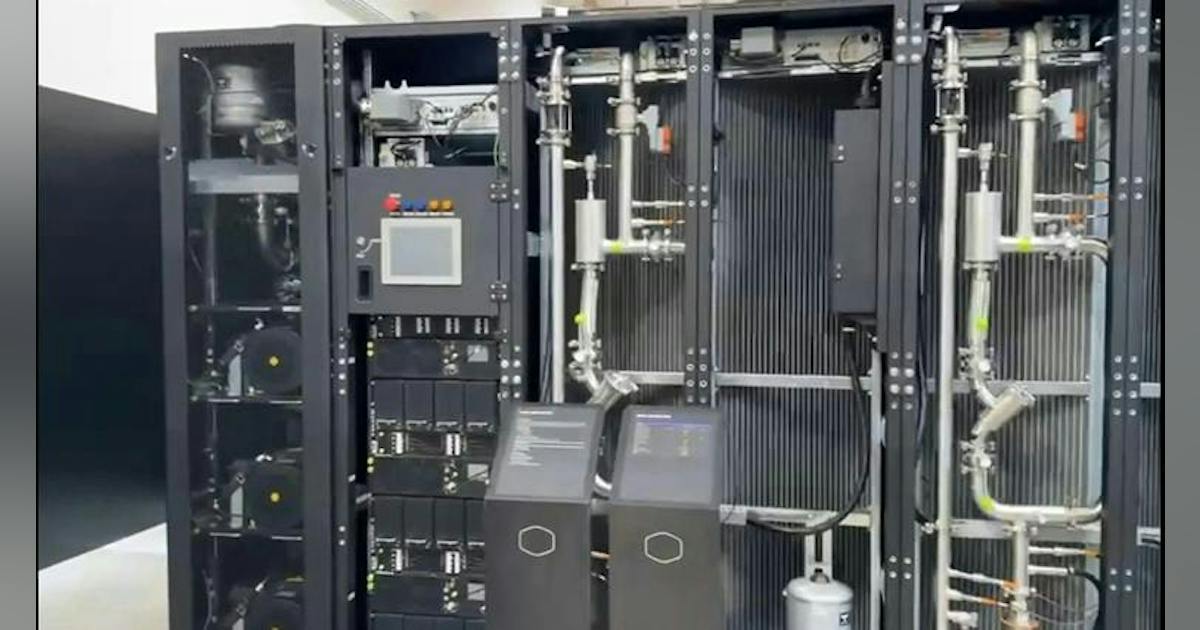
Modular Air-Assisted Cooling Targets Existing Data Centers One of the most instructive systems examined during the tour was Cooler Master’s 300 kW Air-Assisted Liquid Cooling (AALC) CDU, a modular liquid-to-air design intended for data centers without an existing facility water distribution system. Rather than transferring server heat into a building’s chilled-water or facility-water loop, the AALC system circulates coolant through the IT equipment and rejects the captured heat through fan-driven radiators. The distinction matters for operators seeking to introduce liquid-cooled AI racks into facilities that were not built with dedicated liquid cooling infrastructure. Although air-assisted systems still require sufficient facility airflow and heat rejection capacity, they offer an alternative to extending a new water distribution network throughout the data hall. The approach is already finding applications in the field. As DCF recently reported, Corvex deployed liquid-cooled NVIDIA Blackwell infrastructure inside an existing air-cooled data center, using Lenovo Neptune technology to avoid a conventional facility-wide liquid cooling conversion. Cooler Master’s 300 kW design separates the pumping equipment from its radiator assemblies. During the tour, a company representative explained that the system can be configured with a central pump rack and either one or two radiator racks, each providing a nominal 150 kW of cooling capacity. This modular arrangement allows cooling capacity to be matched more closely to the installation, rather than requiring every deployment to use the full 300 kW configuration. Serviceability is a major feature of the design. The system uses redundant pumps in a 2+1 arrangement, with two pumps supporting normal operation and a third providing standby capacity. Pump modules are designed for replacement without interrupting cooling operations. Other field-replaceable components include fans, filters, expansion tanks, and power-related assemblies. The product also incorporates redundant filtration and monitoring capabilities intended to help operators identify faults and maintain cooling performance. The

Read More »

7×24 Fall 2026: AI Frontier Futurist Meets Data Center OG

A 1988 Data Center Becomes a 20 MW AI Asset The second presentation, Converting a 1990 Enterprise Data Center to 20MW AI Workloads, featured Coe alongside Ari Chernikoff, vice president of development at Legacy Investing, and Dan Amundson, project manager at Gardner Builders. The project centered on 1001 Third Avenue South in downtown Minneapolis, a financial-services computing facility originally constructed in 1988. The building had supported earlier generations of enterprise computing before portions were converted to commercial office space and smaller colocation operations. Although its remaining operating data center load had declined to approximately 500 kilowatts by the time the AI redevelopment began, the property retained substantial infrastructure inherited from its original mission-critical design. Tall ceilings, robust floor loading, raised access floors, existing medium-voltage substations, and established utility connections made the building an unusually strong candidate for conversion. These characteristics, Chernikoff explained, can determine whether an existing building offers a practical path to high-density computing or proves economically unsuitable for redevelopment. Legacy Investing had identified a market opportunity in what Chernikoff called the industry’s “missing middle”: facilities generally ranging from 20 MW to 80 MW, rather than the 100 MW-plus campuses increasingly associated with hyperscale and frontier AI development. The company viewed existing buildings with available power and favorable infrastructure characteristics as potential shortcuts to deployment, particularly where demand for AI inference and other latency-sensitive workloads favored proximity to major urban markets. Following an AI tenant commitment in summer 2024, the development team faced an aggressive initial requirement: Deliver the first 5 MW of capacity by the end of that year. The first phase was ready for service approximately four months after Gardner’s involvement became formalized, followed by another 5 MW in 2025 and an expansion program ultimately reaching 20 MW over roughly 20 months. All of this had to

Read More »

Gartner warns $3.5T in AI infrastructure spending could be at risk by 2030

Musk predicted that more than 200 neocloud companies could face significant financial distress, predicting that only a small number would survive the coming shakeout. He also said SpaceX would not acquire any of the companies, describing such purchases as “pointless.” The chickens are already coming home to roost on the neoclouds. CoreWeave, Nebius, Applied Digital and TeraWulf have reported quarterly losses over the past year, while IREN has failed to turn a profit in its past three quarters. Shares of CoreWeave, Nebius and IREN have fallen more than 30% during October, according to Reuters. Building AI data centers requires substantial upfront investment in GPUs, networking equipment, power systems, cooling infrastructure and facilities. Operators must then generate enough revenue from leasing computing capacity to cover operating expenses, interest payments and equipment replacement.

Read More »

The 50-Gigawatt Test: SemiAnalysis Sees a Historic Data Center Surge in 2027

The global data center industry is approaching a potentially historic test of its ability to turn artificial intelligence investment into operational infrastructure. In a provocative new forecast, semiconductor and AI infrastructure research firm SemiAnalysis predicts that approximately 51.2 gigawatts of net data center IT capacity will be added globally, excluding China, during 2027. That would represent more than double the 25 GW the firm expects to be added in 2026. Published October 19, the report, Datacenters 2027: The Year of Acceleration, +50GW in a Single Year, makes a forceful argument that much of this unprecedented expansion is already visible in the industry’s construction pipeline. Authored by Jeremie Eliahou Ontiveros, Reyk Knuhtsen and Dylan Patel, the analysis draws on SemiAnalysis’ proprietary tracking of construction starts, individual buildings, hyperscale leasing commitments, equipment procurement and project financing. Its researchers identify more than 60 GW of data center capacity under construction. Among the 40 largest campuses they examined, more than 24 GW is reportedly in advanced stages of development, with much of that capacity expected to be delivered in 2027. The forecast is not entirely composed of projects already under construction, however. SemiAnalysis’ capacity chart includes approximately 11.9 GW of 2027 additions associated with projects still classified as planned. The remainder is associated with facilities already operating or under construction, according to the model’s building-status categories. SemiAnalysis argues that the volume and maturity of projects already underway make a dramatic acceleration increasingly likely, despite well-documented constraints involving electricity, construction labor, equipment and capital. But the prediction has also become the subject of a revealing industry debate, with competing forecasts and new corporate disclosures raising questions about how much infrastructure can actually be delivered on schedule. The disagreement is no longer principally about whether AI infrastructure demand is real. It is about whether the industrial

Read More »

Microsoft will invest $80B in AI data centers in fiscal 2025

And Microsoft isn’t the only one that is ramping up its investments into AI-enabled data centers. Rival cloud service providers are all investing in either upgrading or opening new data centers to capture a larger chunk of business from developers and users of large language models (LLMs).  In a report published in October 2024, Bloomberg Intelligence estimated that demand for generative AI would push Microsoft, AWS, Google, Oracle, Meta, and Apple would between them devote $200 billion to capex in 2025, up from $110 billion in 2023. Microsoft is one of the biggest spenders, followed closely by Google and AWS, Bloomberg Intelligence said. Its estimate of Microsoft’s capital spending on AI, at $62.4 billion for calendar 2025, is lower than Smith’s claim that the company will invest $80 billion in the fiscal year to June 30, 2025. Both figures, though, are way higher than Microsoft’s 2020 capital expenditure of “just” $17.6 billion. The majority of the increased spending is tied to cloud services and the expansion of AI infrastructure needed to provide compute capacity for OpenAI workloads. Separately, last October Amazon CEO Andy Jassy said his company planned total capex spend of $75 billion in 2024 and even more in 2025, with much of it going to AWS, its cloud computing division.

Read More »

John Deere unveils more autonomous farm machines to address skill labor shortage

Join our daily and weekly newsletters for the latest updates and exclusive content on industry-leading AI coverage. Learn More Self-driving tractors might be the path to self-driving cars. John Deere has revealed a new line of autonomous machines and tech across agriculture, construction and commercial landscaping. The Moline, Illinois-based John Deere has been in business for 187 years, yet it’s been a regular as a non-tech company showing off technology at the big tech trade show in Las Vegas and is back at CES 2025 with more autonomous tractors and other vehicles. This is not something we usually cover, but John Deere has a lot of data that is interesting in the big picture of tech. The message from the company is that there aren’t enough skilled farm laborers to do the work that its customers need. It’s been a challenge for most of the last two decades, said Jahmy Hindman, CTO at John Deere, in a briefing. Much of the tech will come this fall and after that. He noted that the average farmer in the U.S. is over 58 and works 12 to 18 hours a day to grow food for us. And he said the American Farm Bureau Federation estimates there are roughly 2.4 million farm jobs that need to be filled annually; and the agricultural work force continues to shrink. (This is my hint to the anti-immigration crowd). John Deere’s autonomous 9RX Tractor. Farmers can oversee it using an app. While each of these industries experiences their own set of challenges, a commonality across all is skilled labor availability. In construction, about 80% percent of contractors struggle to find skilled labor. And in commercial landscaping, 86% of landscaping business owners can’t find labor to fill open positions, he said. “They have to figure out how to do

Read More »

2025 playbook for enterprise AI success, from agents to evals

Join our daily and weekly newsletters for the latest updates and exclusive content on industry-leading AI coverage. Learn More 2025 is poised to be a pivotal year for enterprise AI. The past year has seen rapid innovation, and this year will see the same. This has made it more critical than ever to revisit your AI strategy to stay competitive and create value for your customers. From scaling AI agents to optimizing costs, here are the five critical areas enterprises should prioritize for their AI strategy this year. 1. Agents: the next generation of automation AI agents are no longer theoretical. In 2025, they’re indispensable tools for enterprises looking to streamline operations and enhance customer interactions. Unlike traditional software, agents powered by large language models (LLMs) can make nuanced decisions, navigate complex multi-step tasks, and integrate seamlessly with tools and APIs. At the start of 2024, agents were not ready for prime time, making frustrating mistakes like hallucinating URLs. They started getting better as frontier large language models themselves improved. “Let me put it this way,” said Sam Witteveen, cofounder of Red Dragon, a company that develops agents for companies, and that recently reviewed the 48 agents it built last year. “Interestingly, the ones that we built at the start of the year, a lot of those worked way better at the end of the year just because the models got better.” Witteveen shared this in the video podcast we filmed to discuss these five big trends in detail. Models are getting better and hallucinating less, and they’re also being trained to do agentic tasks. Another feature that the model providers are researching is a way to use the LLM as a judge, and as models get cheaper (something we’ll cover below), companies can use three or more models to

Read More »

OpenAI’s red teaming innovations define new essentials for security leaders in the AI era

Join our daily and weekly newsletters for the latest updates and exclusive content on industry-leading AI coverage. Learn More OpenAI has taken a more aggressive approach to red teaming than its AI competitors, demonstrating its security teams’ advanced capabilities in two areas: multi-step reinforcement and external red teaming. OpenAI recently released two papers that set a new competitive standard for improving the quality, reliability and safety of AI models in these two techniques and more. The first paper, “OpenAI’s Approach to External Red Teaming for AI Models and Systems,” reports that specialized teams outside the company have proven effective in uncovering vulnerabilities that might otherwise have made it into a released model because in-house testing techniques may have missed them. In the second paper, “Diverse and Effective Red Teaming with Auto-Generated Rewards and Multi-Step Reinforcement Learning,” OpenAI introduces an automated framework that relies on iterative reinforcement learning to generate a broad spectrum of novel, wide-ranging attacks. Going all-in on red teaming pays practical, competitive dividends It’s encouraging to see competitive intensity in red teaming growing among AI companies. When Anthropic released its AI red team guidelines in June of last year, it joined AI providers including Google, Microsoft, Nvidia, OpenAI, and even the U.S.’s National Institute of Standards and Technology (NIST), which all had released red teaming frameworks. Investing heavily in red teaming yields tangible benefits for security leaders in any organization. OpenAI’s paper on external red teaming provides a detailed analysis of how the company strives to create specialized external teams that include cybersecurity and subject matter experts. The goal is to see if knowledgeable external teams can defeat models’ security perimeters and find gaps in their security, biases and controls that prompt-based testing couldn’t find. What makes OpenAI’s recent papers noteworthy is how well they define using human-in-the-middle

Read More »