Modular Air-Assisted Cooling Targets Existing Data Centers
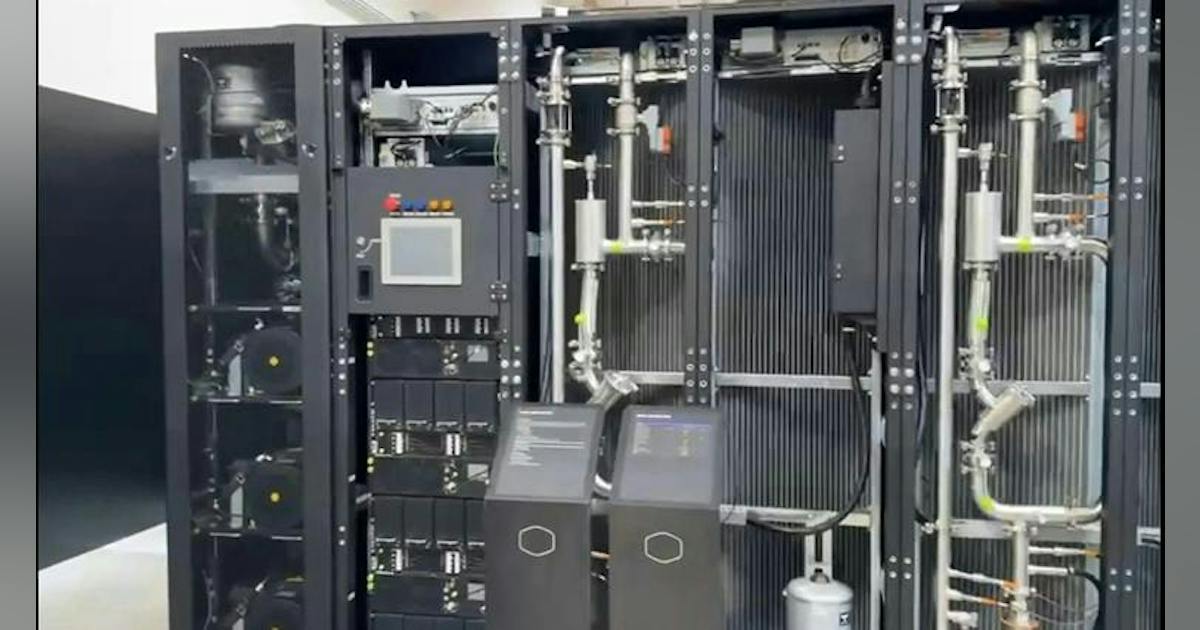
One of the most instructive systems examined during the tour was Cooler Master’s 300 kW Air-Assisted Liquid Cooling (AALC) CDU, a modular liquid-to-air design intended for data centers without an existing facility water distribution system.
Rather than transferring server heat into a building’s chilled-water or facility-water loop, the AALC system circulates coolant through the IT equipment and rejects the captured heat through fan-driven radiators.
The distinction matters for operators seeking to introduce liquid-cooled AI racks into facilities that were not built with dedicated liquid cooling infrastructure. Although air-assisted systems still require sufficient facility airflow and heat rejection capacity, they offer an alternative to extending a new water distribution network throughout the data hall.
The approach is already finding applications in the field. As DCF recently reported, Corvex deployed liquid-cooled NVIDIA Blackwell infrastructure inside an existing air-cooled data center, using Lenovo Neptune technology to avoid a conventional facility-wide liquid cooling conversion.
Cooler Master’s 300 kW design separates the pumping equipment from its radiator assemblies. During the tour, a company representative explained that the system can be configured with a central pump rack and either one or two radiator racks, each providing a nominal 150 kW of cooling capacity.
This modular arrangement allows cooling capacity to be matched more closely to the installation, rather than requiring every deployment to use the full 300 kW configuration.
Serviceability is a major feature of the design. The system uses redundant pumps in a 2+1 arrangement, with two pumps supporting normal operation and a third providing standby capacity. Pump modules are designed for replacement without interrupting cooling operations.
Other field-replaceable components include fans, filters, expansion tanks, and power-related assemblies. The product also incorporates redundant filtration and monitoring capabilities intended to help operators identify faults and maintain cooling performance.
The company specifies UPS support for up to 90 seconds, providing a limited bridge during a power interruption or transfer to another available power source. It is an availability feature rather than a substitute for the facility’s broader backup power infrastructure.
The modular construction also addresses the physical handling of increasingly substantial cooling equipment. During the tour, Cooler Master demonstrated how an automated guided vehicle could move beneath a rack assembly to assist with positioning and transportation.
Together, these features reflect a design philosophy familiar to mission-critical infrastructure operators: isolate failures where possible, simplify component replacement, and reduce the operational disruption associated with maintenance.
Cooler Master says the 300 kW AALC platform is already in production.
The same retrofit-oriented strategy extends to the company’s smaller 75 kW liquid-to-air in-row CDU. That system uses V-pattern radiator assemblies, redundant pumping, and 16 replaceable fans within a rack-sized enclosure. Cooler Master also displayed 150 kW and 230 kW in-rack CDU configurations during the tour, illustrating the range of capacities the company is developing for high-density computing environments.
At the smaller end of its liquid-to-air portfolio, a 30 kW in-rack CDU is aimed at more limited cooling loads, including enterprise and edge-oriented applications. Production of that model was targeted for the fourth quarter of 2026.
The range provides operators with different approaches to liquid cooling deployment depending on rack density, available mechanical infrastructure, and the amount of heat that must ultimately be rejected.