Stay Ahead, Stay ONMINE

A human liver has been kept alive outside the body for a record seven weeks

EXECUTIVE SUMMARY Researchers in Australia claim they’ve kept a human liver alive, on life support, outside the body for seven weeks, opening up speculative new possibilities in biomedical engineering. The feat, whose details are pending publication, was carried out in Sydney after a team led by surgeon and inventor Carlo Pulitano connected a donated liver to a system of automated pumps and sensors that fed the organ nutrients, supplied it with blood, and whisked away waste.  In an interview, Pulitano, a transplant surgeon at the Royal Prince Alfred Hospital and a professor at the University of Sydney, likened the life support system to “an artificial body.” Its official name is the Extended Organ Perfusion System. “Our group is the only one in the world to have maintained a human liver under fully normothermic, physiological conditions for seven weeks,” he says.    Normothermic means body temperature, or about 37 °C. The previous record for keeping an internal organ alive outside the body was set in Switzerland several years ago. That organ—also a liver—lasted around two weeks.  Most organs destined for transplant survive only a few hours in special ice buckets and need to be raced to their destination. Over the last decade, however, surgeons have been switching to perfusion systems, which pump warm or cold fluids into an organ. This can double the time it can be held before it must be transplanted.  Pulitano says the key to breaking the record was to automate the systems used to keep the organ thriving. During a meeting in Switzerland earlier this year, the Sydney team described perfusing 55 human livers, one after the other. Some were connected to a system that needed to be adjusted manually, but for those placed on the automated system—which produced the seven-week survivor—the average survival time tripled, to about four weeks.   Perfusion has already enabled doctors to restart hearts from dead people and keep them beating outside the body. Paulo Martins, a transplant doctor at the University of Oklahoma, says about half the kidneys he transplants are now perfused, even though the process can add $100,000 to the cost of a transplant.   While the research awaits formal publication, the eventual goal is what Pulitano and colleagues call “time-unlimited liver preservation.” Scientists have already discovered possible medical benefits to keeping organs on life support longer than usual. One, they say, is that perfused organs apparently start to repair themselves and become stronger after a day or so. That’s what led a Swiss team, in 2022, to transplant a damaged liver that had been kept on perfusion for three days—the longest time any internal organ had remained outside the body before a successful transplant, says Waldemar Hoffmann, the CEO and cofounder of Apersys, a startup formed to commercialize the technology. Pulitano says his own startup, Aeternum Life Technologies, will be helping with a planned trial in Sydney to transplant low-quality livers kept on perfusion for four days. What’s less clear, says Hoffmann, is whether any transplant surgeon would ever want, or need, to use an organ kept alive for nearly two months. He says people in the field believe Pulitano’s record is real, but they don’t know how healthy the organ was at the end or even what so much extra time is likely to achieve. “The key question is what the purpose for a seven-week perfusion would be,” he says.   Yet that’s where things could start to get interesting, says Martins, the Oklahoma surgeon. Long-term life support could enable far-out concepts like artificial wombs, new types of organ manufacturing, and the chance to experiment directly on human organs outside the body for extended periods. For his part, Pulitano says long-term machine perfusion could help grow new organs. In living donations, surgeons commonly take half of a person’s liver to give someone else. After about two months, both parts will have grown back almost to their full volume. Pulitano says he’s tried dividing a liver and then attaching the sections to the machine. If that works, he says, it could be a way to multiply one donor liver into several full-size organs. “It’s important to have people thinking outside the box and pushing the limits and creating possibilities for things that, right now, sometimes we don’t even have a need for but are going to be needed in the future,” says Martins. “That’s how science moves.”   He’s not the only one who thinks so. For instance, a US company, Bexorg, has been reanimating human brains using perfusion pumps. The idea is to study what effects experimental drugs have on them. That company perfuses brains for about a day but has said it wants to extend the time to two weeks. Similar experiments can be done on livers, says Pulitano, who has already tried adding gene therapies to the organs. “It gives us a living human organ model for translational research that no animal system can match, because the biology, the immunology, and the drug responses are human from the outset,” he says. Meanwhile, in Silicon Valley, patents filed by Altos Labs, a billionaire-backed longevity startup, describe attempts to introduce reprogramming genes into animal livers maintained outside the body. Eventually, Altos scientists have speculated, they might temporarily disconnect a failing organ while it’s still in a person’s body, connecting it to a perfusion machine in order to douse it with ultra-powerful genetic treatments without risking the rest of the body. Doctors probing the limits of organ life support have now formed two new scientific societies to explore the concept. One, founded by Martins and called the International Society for Organ Preservation and Perfusion Therapy, will hold its inaugural meeting this year in Italy. The other, based in China, was launched in August to advance what doctors at the First Affiliated Hospital of Sun Yat-Sen University have termed “organ medicine”: research at the level of whole organs kept alive by “bionic maintenance.”   “What is exploding is the idea of this technology that clearly goes beyond simply organ preservation,” says Pulitano. “Basically, that’s a concept that’s entirely new.”


Researchers in Australia claim they’ve kept a human liver alive, on life support, outside the body for seven weeks, opening up speculative new possibilities in biomedical engineering.

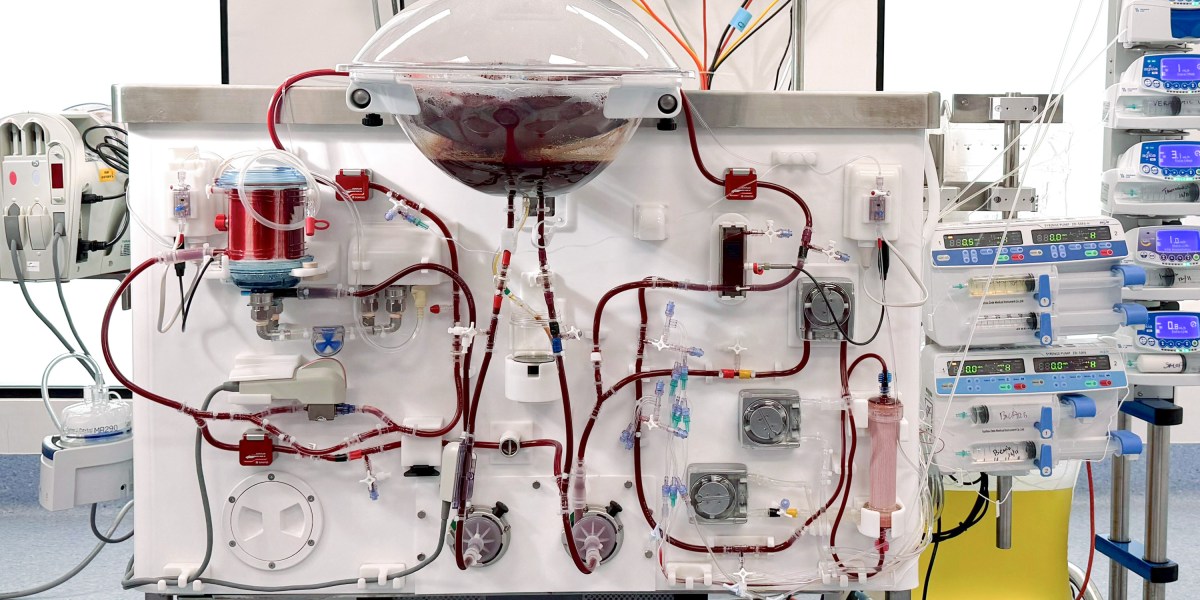
The feat, whose details are pending publication, was carried out in Sydney after a team led by surgeon and inventor Carlo Pulitano connected a donated liver to a system of automated pumps and sensors that fed the organ nutrients, supplied it with blood, and whisked away waste. 

In an interview, Pulitano, a transplant surgeon at the Royal Prince Alfred Hospital and a professor at the University of Sydney, likened the life support system to “an artificial body.” Its official name is the Extended Organ Perfusion System.

“Our group is the only one in the world to have maintained a human liver under fully normothermic, physiological conditions for seven weeks,” he says.   

Normothermic means body temperature, or about 37 °C. The previous record for keeping an internal organ alive outside the body was set in Switzerland several years ago. That organ—also a liver—lasted around two weeks. 

Most organs destined for transplant survive only a few hours in special ice buckets and need to be raced to their destination. Over the last decade, however, surgeons have been switching to perfusion systems, which pump warm or cold fluids into an organ. This can double the time it can be held before it must be transplanted. 

Pulitano says the key to breaking the record was to automate the systems used to keep the organ thriving. During a meeting in Switzerland earlier this year, the Sydney team described perfusing 55 human livers, one after the other. Some were connected to a system that needed to be adjusted manually, but for those placed on the automated system—which produced the seven-week survivor—the average survival time tripled, to about four weeks.  

Perfusion has already enabled doctors to restart hearts from dead people and keep them beating outside the body. Paulo Martins, a transplant doctor at the University of Oklahoma, says about half the kidneys he transplants are now perfused, even though the process can add $100,000 to the cost of a transplant.  

While the research awaits formal publication, the eventual goal is what Pulitano and colleagues call “time-unlimited liver preservation.”

Scientists have already discovered possible medical benefits to keeping organs on life support longer than usual. One, they say, is that perfused organs apparently start to repair themselves and become stronger after a day or so. That’s what led a Swiss team, in 2022, to transplant a damaged liver that had been kept on perfusion for three days—the longest time any internal organ had remained outside the body before a successful transplant, says Waldemar Hoffmann, the CEO and cofounder of Apersys, a startup formed to commercialize the technology.

Pulitano says his own startup, Aeternum Life Technologies, will be helping with a planned trial in Sydney to transplant low-quality livers kept on perfusion for four days.

What’s less clear, says Hoffmann, is whether any transplant surgeon would ever want, or need, to use an organ kept alive for nearly two months. He says people in the field believe Pulitano’s record is real, but they don’t know how healthy the organ was at the end or even what so much extra time is likely to achieve. “The key question is what the purpose for a seven-week perfusion would be,” he says.  

Yet that’s where things could start to get interesting, says Martins, the Oklahoma surgeon. Long-term life support could enable far-out concepts like artificial wombs, new types of organ manufacturing, and the chance to experiment directly on human organs outside the body for extended periods.

For his part, Pulitano says long-term machine perfusion could help grow new organs. In living donations, surgeons commonly take half of a person’s liver to give someone else. After about two months, both parts will have grown back almost to their full volume. Pulitano says he’s tried dividing a liver and then attaching the sections to the machine. If that works, he says, it could be a way to multiply one donor liver into several full-size organs.

“It’s important to have people thinking outside the box and pushing the limits and creating possibilities for things that, right now, sometimes we don’t even have a need for but are going to be needed in the future,” says Martins. “That’s how science moves.”  

He’s not the only one who thinks so. For instance, a US company, Bexorg, has been reanimating human brains using perfusion pumps. The idea is to study what effects experimental drugs have on them. That company perfuses brains for about a day but has said it wants to extend the time to two weeks.

Similar experiments can be done on livers, says Pulitano, who has already tried adding gene therapies to the organs. “It gives us a living human organ model for translational research that no animal system can match, because the biology, the immunology, and the drug responses are human from the outset,” he says.

Meanwhile, in Silicon Valley, patents filed by Altos Labs, a billionaire-backed longevity startup, describe attempts to introduce reprogramming genes into animal livers maintained outside the body. Eventually, Altos scientists have speculated, they might temporarily disconnect a failing organ while it’s still in a person’s body, connecting it to a perfusion machine in order to douse it with ultra-powerful genetic treatments without risking the rest of the body.

Doctors probing the limits of organ life support have now formed two new scientific societies to explore the concept. One, founded by Martins and called the International Society for Organ Preservation and Perfusion Therapy, will hold its inaugural meeting this year in Italy. The other, based in China, was launched in August to advance what doctors at the First Affiliated Hospital of Sun Yat-Sen University have termed “organ medicine”: research at the level of whole organs kept alive by “bionic maintenance.”  

“What is exploding is the idea of this technology that clearly goes beyond simply organ preservation,” says Pulitano. “Basically, that’s a concept that’s entirely new.”

Shape
Shape
Stay Ahead

Explore More Insights

Stay ahead with more perspectives on cutting-edge power, infrastructure, energy,  bitcoin and AI solutions. Explore these articles to uncover strategies and insights shaping the future of industries.

Shape

Energy Secretary Acts to Protect Mid-Atlantic Grid

WASHINGTON—U.S. Secretary of Energy Chris Wright issued an emergency order to reduce the risk of power outages and strengthen grid reliability across the mid-Atlantic region. The order permits PJM Interconnection, L.L.C. (PJM), in coordination with Talen Energy Corporation, to run Unit 4 at the Wagner Generating Station in Anne Arundel County, Maryland, to meet anticipated electricity demand. The order follows an application from PJM submitted on October 23, 2026.  “Energy shortfalls for 65 million Americans are simply unacceptable,” said U.S. Secretary of Energy Chris Wright.  “Previous orders in the mid-Atlantic region have helped keep the lights on and I’m confident this order will help do so in the coming months as well. Today’s order helps temporarily address the urgent need to strengthen grid reliability and ensure Americans across the mid-Atlantic region have access to affordable, reliable, and secure power, regardless of whether the sun shines or the wind blows.”   Secretary Wright previously granted PJM’s requests to operate Wagner Unit 4 beyond its operating limit to help maintain grid reliability.  PJM relied on Wagner Unit 4 during periods of unusually high temperatures earlier this summer, using the unit’s remaining operating hours. PJM has since reaffirmed to the Department of Energy (DOE) the continued need for Wagner Unit 4 to meet high electricity demand, strengthen grid reliability, and reduce the risk of power outages across the mid-Atlantic region.   The renewed order is effective from November 18, 2026, through December 31, 2026. 

Read More »

EIA: US crude oil inventories up 3.4 million bbl

US crude oil inventories for the week ended Nov. 13, excluding the Strategic Petroleum Reserve, increased by 3.4 million bbl from the previous week, according to data from the US Energy Information Administration (EIA). At 417.8 million bbl, US crude oil inventories are 3% below the 5-year average for this time of year, the EIA report indicated. Gasoline inventories increased 5.2 million bbl, 3% above the 5-year average. Propane-propylene inventories remained unchanged, 12% above the 5-year average. Total commercial petroleum inventories increased by 9.2 million bbl for the week. Distillate inventories increased 1.6 million bbl, 7% below the 5-year average. US crude oil refinery inputs averaged 16.9 million b/d for the week ended Nov. 13, which was 129,000 b/d less than the previous week’s average. Refineries operated at 95.7% of capacity. Gasoline output averaged 9.4 million b/d, and distillate production increased to 5.2 million b/d. Crude oil imports decreased 1.1 million b/d to 5.6 million b/d. The 4-week average of 6.3 million b/d is 13% above the year-ago level. Gasoline imports increased and averaged 533,000 b/d; distillate imports also increased and averaged 133,000 b/d. Over the past four weeks, total product supplied averaged 20.6 million b/d, down 0.3% year over year. The 4-week average for gasoline product supplied decreased 1.8% year over year to 8.7 million b/d, while the 4-week average for distillate product supplied increased 4.3% to 4.0 million b/d. The 4-week average for jet fuel product supplied increased 0.3% year over year.

Read More »

Sonangol discovers hydrocarbons offshore Kwanza basin

Sonangol’s Burututu-1 well has identified hydrocarbons in pre-salt reservoirs for the first time in Angola’s Block 5/06. <!–> Nov. 18, 2026 –> Key Highlights Burututu-1 is the first well to identify hydrocarbons in presalt reservoirs in Block 5/06. The discovery lies in the maritime portion of Angola’s Kwanza basin. The exploration identified 25 m of reservoir containing hydrocarbon deposits.

Read More »

The grid will fall short of AI’s power needs. These 6 resources can close the gap.

Listen to the article 7 min This audio is auto-generated. Please let us know if you have feedback. Simon Irish is CEO of Terrestrial Energy, a developer of small modular nuclear reactors. Most planning for artificial intelligence’s electricity demand starts with a forecast and asks whether it is right. I would start somewhere else: Assume the grid will fall short, then ask how to close the gap — and how fast. Simon Irish The evidence supports that starting point. McKinsey & Company estimates the U.S. will need 30 GW to 55 GW of additional capacity by 2030 as data center demand grows and aging plants retire. PJM Interconnection, the largest U.S. grid operator, has already seen the impacts of this trend. Its latest capacity auction fell about 6.6 GW short of its reliability requirement and cleared at the price cap. Forecasts can be wrong, and requested load can be speculative or duplicative. But the PJM result is a market outcome, not a forecast. The useful question is which tools can close the gap, by when and at what cost. 6 ways to close the gap, and where each runs out The first four options below address serving data centers through the grid. The final two consider generation at or near the data center, with an optional grid connection. These categories overlap; on-site generation is a delivery strategy, not a generation technology, and can use multiple technologies. Flexible demand. Duke University’s Nicholas Institute estimates the grid could absorb 76 GW of new load if that load accepted curtailment averaging 0.25% of annual consumption, in events of about 1.7 hours. It is the fastest option because it needs no new generation. It makes better use of capacity already on the grid. But that capacity is finite, and beyond it, further load growth

Read More »

NEO Next+ to acquire UK upstream business from EnQuest for up to $960 million

NEO Next+ Energy Upstream UK Ltd. has agreed to acquire EnQuest plc’s UK upstream oil and gas business and associated infrastructure for up to $960 million. The acquisition includes all issued shares of EnQuest Britain Ltd., which through subsidiaries holds EnQuest’s UK upstream interests, including the operated Magnus, Kraken, and Greater Kittiwake Area fields (Kittiwake, Mallard, Gadwall, Goosander and Grouse), the non-operated Golden Eagle field, and the undeveloped Bressay field and Bentley discovery. The assets averaged net production of 31,100 boe/d in 2025, comprising 92% liquids and 8% gas. As of Dec. 31, 2025, the portfolio contained 122 MMboe of 2P reserves and 308 MMboe of 2C resources, according to EnQuest. The deal also includes EnQuest’s UK decommissioning liabilities and midstream interests, including its operating stake in the Sullom Voe Terminal, the Northern Leg gas pipeline, and the Ninian pipeline system. EnQuest is divesting the assets as part of a broader strategy to become a Southeast Asia-focused operator with production, development, and exploration assets in Malaysia, Vietnam, Brunei, and Indonesia, as well as its Veri Energy subsidiary and associated carbon capture, utilization, and storage interests. The company cited an uncertain UK investment environment. For NEO Next+, the deal is the latest step in its North Sea consolidation strategy. In December 2025, TotalEnergies agreed to combine its UK offshore upstream business with NEO NEXT Energy Ltd., creating what the companies described as the largest independent oil and gas producer in the UK. Consideration comprises an upfront cash payment of $840 million at closing, subject to customary adjustments, and contingent payments of up to $120 million tied to future oil prices and potential changes to the UK fiscal regime, including repeal or reduction of the Energy Profits Levy between January 2027 and yearend 2029. Completion remains subject to customary conditions and regulatory approvals. The

Read More »

Energy Department Announces $2.8 Billion Loan to Strengthen Grid Reliability and Help Lower Costs in Wyoming

WASHINGTON—The U.S. Department of Energy’s (DOE) Office of Energy Dominance Financing (EDF) today announced a conditional loan commitment of up to $2.8 billion for Grid United’s Wyoming Intertie project to lower electricity costs and strengthen grid reliability in Wyoming. The project will add approximately 1.8 gigawatts (GW) of electricity transfer capacity and is estimated to deliver up to $39 billion in electricity cost savings for American families and businesses across 17 states within the Western Electricity Coordinating Council (WECC) and Southwest Power Pool (SPP) regions. The loan advances President Trump’s Executive Order Strengthening the Reliability and Security of the U.S. Electric Grid and builds on DOE’s recent Speed to Power through Accelerated Reconductoring and other Key Advanced Transmission Technology Upgrades (SPARK) announcement. “The Energy Department is delivering on President Trump’s promise to strengthen America’s electric grid and unleash American energy dominance,” said U.S. Secretary of Energy Chris Wright. “Projects like Wyoming Intertie will help move more American energy where it’s needed most to support our nation’s growing energy needs and power American prosperity for decades to come.” Wyoming Intertie will double existing transfer capacity between the SPP and WECC regions, allowing more electricity to flow across Wyoming to meet growing demand and improve grid resilience during periods of high demand and extreme weather. The project will also create hundreds of construction-related jobs and long-term operations jobs, supporting local economic growth over the 30-year life of the project. “Thanks to President Trump and Secretary Wright, EDF is financing projects that deliver real benefits to American families and businesses,” said EDF Director Gregory A. Beard. “Wyoming Intertie is a prime example of how EDF’s financing can help lower electricity costs, create American jobs, and support long-term economic growth in Wyoming and across the nation.” While this conditional commitment indicates DOE’s intent to

Read More »

App developers turn to QVAC for AI tooling without the cloud  

In most instances today, adding AI to an app means sending user data to a third-party API, paying per request, and hoping the connection holds.    Tether’sQVAC is built on the opposite premise. It runs AI models directly on the user’s device. Data never leaves the hardware, there are no per-request costs, no rate limits, and no need for an internet connection once a model is downloaded.   QVAC SDK: the next milestone in cloud-free AI  While open-source tools and standards like llama.cpp, GGML, and ONNX have made local AI much more accessible in recent years, creating new possibilities for consumer devices, the edge AI ecosystem remains fragmented.    Against this backdrop, in 2026, Tether released a software development kit (SDK) that pulls together the best open tooling from across different domains of machine learning.    The centerpiece of Tether’sQVACSDK isFabric. Built on llama.cpp, it expands the engine to enable on-device fine tuning and additional AI capabilities—opening access to memory-intensive workloads previously only possible with expensive hardware or cloud services.    Building on GGML’s modular framework, QVAC Fabric is primarily oriented toward three backends: Vulkan, which covers most consumer-grade desktop and mobile chips; Metal and Core ML for Apple Silicon; and CUDA for higher-end NVIDIA GPU setups.   The QVAC SDK empowers developers with a unified interface for building multiplatformAIappsthatrunon-device. But although significant progress has been made in bringing inference to consumer devices, text generation alone is only one part of the pipeline that makes modern AI useful.    Bringing search to edge AI   RAG (retrieval-augmented generation) is what equips AI to import and process contextual information to enhance its output. Instead of language models relying solely on their training  data to answer questions, RAG lets them answer using a specific set of documents.    Implementing RAG into an AI app incurs significant memory overhead versus running a

Read More »

DCF Video: CoolIT’s 3 MW CDU Brings Smart Monitoring and Fanless Cooling to AI Infrastructure

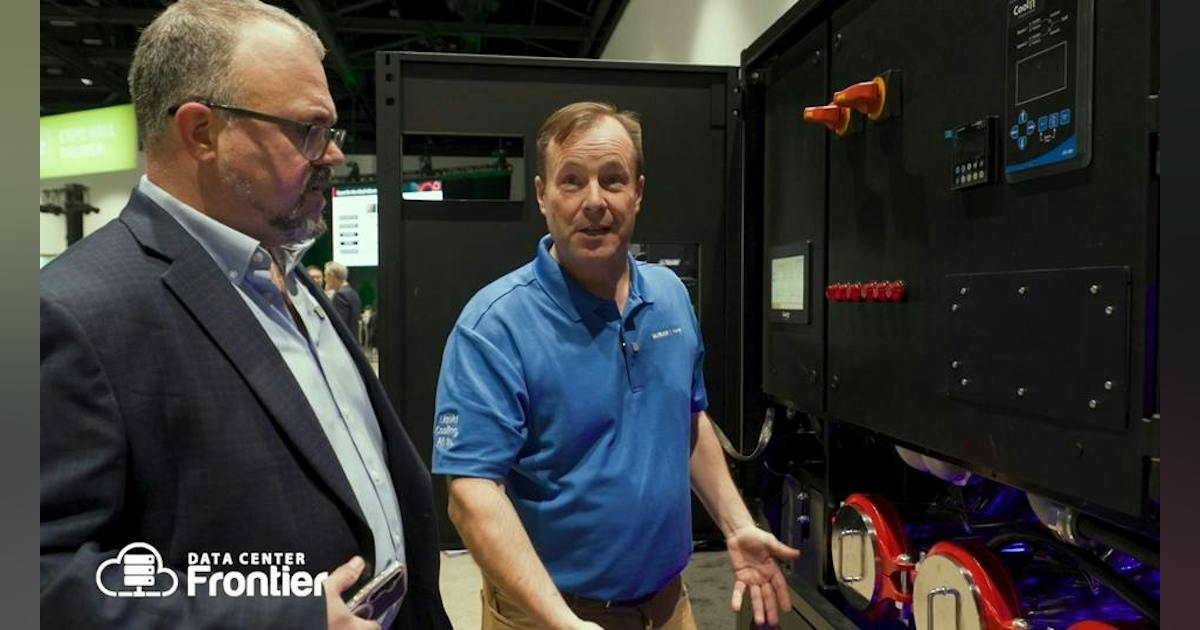
As AI infrastructure moves toward higher rack densities and increasingly liquid-cooled architectures, the next challenge is not simply removing more heat. It’s ensuring that the cooling systems themselves remain reliable, efficient, and capable of protecting increasingly valuable computing hardware. At the 2026 OCP Global Summit in San Jose, CoolIT Systems Director of Marketing Charles Robison gave Data Center Frontier a close-up look at several technologies addressing that challenge, including the company’s new 3-megawatt CHx 3000 coolant distribution unit (CDU), integrated coolant health monitoring, and a fifth-generation cold plate loop designed for fanless servers. The demonstration comes at a significant moment for CoolIT, which was acquired by Ecolab for approximately $4.75 billion in July 2026. On November 16, Ecolab formally introduced its new integrated AI cooling platform at SC26 in Chicago, placing the CHx 3000 and its embedded 3D TRASAR technology at the center of a broader strategy combining liquid cooling hardware, fluid management, and digital monitoring. Looking Inside the CHx 3000 The CoolIT CHx 3000 is a liquid-to-liquid CDU rated for 3 MW of cooling capacity at a 3°C approach temperature difference, with a specified flow rate of 4,500 liters per minute. Designed for high-density AI deployments, the unit incorporates Ecolab’s 3D TRASAR technology to continuously monitor the condition of the circulating coolant. In the video, Robison points directly to the sensor array that makes the integration possible. “3D TRASAR, and you can see the array of sensors here, allows coolant health monitoring,” Robison explains. “It allows people to see real-time what’s going on with the coolant. So before it goes out of spec, they know what’s happening and they can address it.” The distinction is important. Traditional cooling monitoring typically emphasizes temperature, pressure, and flow. Ecolab’s technology adds visibility into fluid chemistry and contamination, allowing operators to identify deteriorating

Read More »

Beyond Announced Megawatts: Metlen’s Lillian Kasa on Delivering AI Infrastructure

For an industry racing to build infrastructure at unprecedented scale, the most consequential question may no longer be how many megawatts can be announced. It is how many can actually be delivered—and which projects deserve the investment required to get there. As hyperscalers, neoclouds, and data center developers assemble increasingly ambitious capacity pipelines, the distinction between potential and execution has become central to the economics of AI infrastructure. Announcements routinely involve hundreds of megawatts or gigawatts. But behind those numbers lie unresolved questions about power availability, equipment procurement, customer commitments, construction schedules, and financing. For Lillian Kasa, Head of Energy and Data Center Infrastructure Origination for North America at Metlen, these are not simply obstacles to be overcome in pursuit of speed. They are the fundamental questions that determine whether an infrastructure opportunity is worth developing in the first place. In a new episode of the Data Center Frontier Show, Kasa joined DCF Editor in Chief Matt Vincent to examine how developers can distinguish viable projects from speculative pipelines, allocate capital under uncertainty, and build commercial structures capable of supporting the next generation of AI computing infrastructure. The conversation follows Kasa’s participation at September’s Data Centre West conference in Calgary, where she moderated a panel on Solving for Power. As DCF reported in its Data Centre West 2026 conference analysis, the industry is increasingly discovering that power availability and delivery certainty—not simply land or market demand—determine which projects can proceed. Kasa brings an additional perspective to that conversation: years spent in offshore oil and gas exploration, where capital-intensive investment decisions must routinely be made with incomplete information. Her argument is that AI infrastructure development can benefit from much the same discipline. The Difference Between Announcing Power and Delivering It “When I hear an announcement involving hundreds of megawatts or gigawatts,

Read More »

Arista expands its routing options to support secure AI inferencing

Arista is unveiling a portfolio of networking devices designed to secure and improve the performance and resiliency of connections serving AI compute and storage infrastructure. Four new Etherlink R4 high-performance routing switches are aimed at large-scale distributed data center, AI back-end, and service provider environments where high route scale, deep packet buffering, and 400G connectivity are required. In addition, the new R4s integrate line-rate encryption into every port via TunnelSec, including MACsec, IPsec, VXLANsec, and hardware-based Segment Routing over IPv6, according to a blog post co-authored by Brendan Gibbs, Arista vice president, product line management, and Tyson Lamoreaux, senior vice president, Cloud/AI. All run Arista’s Extensible Operating System, or EOS. “The initial phase of artificial intelligence (AI) buildouts concentrated compute nodes in massive, centralized clusters, but the need for greater scale has led operators to span training clusters across multiple data centers with AI scale-across solutions. Now, the operational reality of centralized inferencing has emerged as the new frontier requiring a distributed solution,” Gibbs and Lamoreaux wrote. “Training can tolerate being tucked away near remote power grids, while inferencing cannot. As AI transitions from static prompts to real-time interaction, intelligence must be distributed across front-end networks spanning distinct geographies, regional hubs, and enterprise perimeters.”

Read More »

You’ve decided to repatriate cloud workloads. Now what?

Advice for IT Pros Repatriation is the market correcting a decade of poor placement decisions. That’s healthy, but the burden of getting it right falls on network, I&O, and data center teams. If you’re facing a repatriation project, here’s where I would focus. Lock down capacity first. The single biggest mistake I see is treating space and power as a procurement detail to be sorted out after the business case is approved. With vacancy at historic lows in the major markets and most new construction spoken for before it’s finished, that order of operations no longer works. Engage colocation providers and your own facilities team as early as possible, and be prepared to consider secondary markets, smaller footprints spread across multiple sites, or upgrading an existing owned facility. Get firm answers on power per rack, cooling options, cross-connect availability, and delivery dates before committing to a migration timeline. In many markets, the lead time for space and power can be longer than the migration itself. Design the network for a hybrid end state. Repatriation doesn’t end with a clean break from the cloud; it ends with more locations that must work as one. Treat interconnects, cloud on-ramps, WAN, data center fabric, segmentation, and security policy as a single architecture spanning on-prem, colo, and multiple clouds. That means sizing interconnect bandwidth for actual data flows rather than estimates, enforcing consistent policy regardless of where a workload runs, and building in visibility to troubleshoot an application path that spans three environments. If the network is designed as an afterthought, latency and integration problems that already plague many organizations will worsen. Plan AI infrastructure explicitly. If AI inference or fine-tuning is part of the repatriation plan, treat it as a separate project. GPU clusters introduce power density, cooling, and networking requirements that are

Read More »

Data center boom faces challenges beyond water and power

According to a report published by BBC Science Focus, the United States had more than 4,000 data centers by the end of 2025, representing approximately 50 gigawatts of capacity. Meanwhile, U.S. data centers consumed approximately 66 billion liters of water in 2023, highlighting the substantial environmental footprint of the industry. These resource requirements have driven considerable opposition to new developments. A recent NBC News poll cited by the publication found that 69% of respondents would oppose construction of an AI data center in their neighborhoods. This is reflected in the recent elections, where pro-data center candidates lost badly while those who publicly opposed for the construction of data centers did well at the ballot box. Data centers can provide economic benefits to the communities where they operate, including increased property tax revenues, permanent employment and infrastructure improvements. Developers sometimes finance upgrades to electrical substations, roads and emergency services to accommodate their facilities.

Read More »

Microsoft will invest $80B in AI data centers in fiscal 2025

And Microsoft isn’t the only one that is ramping up its investments into AI-enabled data centers. Rival cloud service providers are all investing in either upgrading or opening new data centers to capture a larger chunk of business from developers and users of large language models (LLMs).  In a report published in October 2024, Bloomberg Intelligence estimated that demand for generative AI would push Microsoft, AWS, Google, Oracle, Meta, and Apple would between them devote $200 billion to capex in 2025, up from $110 billion in 2023. Microsoft is one of the biggest spenders, followed closely by Google and AWS, Bloomberg Intelligence said. Its estimate of Microsoft’s capital spending on AI, at $62.4 billion for calendar 2025, is lower than Smith’s claim that the company will invest $80 billion in the fiscal year to June 30, 2025. Both figures, though, are way higher than Microsoft’s 2020 capital expenditure of “just” $17.6 billion. The majority of the increased spending is tied to cloud services and the expansion of AI infrastructure needed to provide compute capacity for OpenAI workloads. Separately, last October Amazon CEO Andy Jassy said his company planned total capex spend of $75 billion in 2024 and even more in 2025, with much of it going to AWS, its cloud computing division.

Read More »

John Deere unveils more autonomous farm machines to address skill labor shortage

Join our daily and weekly newsletters for the latest updates and exclusive content on industry-leading AI coverage. Learn More Self-driving tractors might be the path to self-driving cars. John Deere has revealed a new line of autonomous machines and tech across agriculture, construction and commercial landscaping. The Moline, Illinois-based John Deere has been in business for 187 years, yet it’s been a regular as a non-tech company showing off technology at the big tech trade show in Las Vegas and is back at CES 2025 with more autonomous tractors and other vehicles. This is not something we usually cover, but John Deere has a lot of data that is interesting in the big picture of tech. The message from the company is that there aren’t enough skilled farm laborers to do the work that its customers need. It’s been a challenge for most of the last two decades, said Jahmy Hindman, CTO at John Deere, in a briefing. Much of the tech will come this fall and after that. He noted that the average farmer in the U.S. is over 58 and works 12 to 18 hours a day to grow food for us. And he said the American Farm Bureau Federation estimates there are roughly 2.4 million farm jobs that need to be filled annually; and the agricultural work force continues to shrink. (This is my hint to the anti-immigration crowd). John Deere’s autonomous 9RX Tractor. Farmers can oversee it using an app. While each of these industries experiences their own set of challenges, a commonality across all is skilled labor availability. In construction, about 80% percent of contractors struggle to find skilled labor. And in commercial landscaping, 86% of landscaping business owners can’t find labor to fill open positions, he said. “They have to figure out how to do

Read More »

2025 playbook for enterprise AI success, from agents to evals

Join our daily and weekly newsletters for the latest updates and exclusive content on industry-leading AI coverage. Learn More 2025 is poised to be a pivotal year for enterprise AI. The past year has seen rapid innovation, and this year will see the same. This has made it more critical than ever to revisit your AI strategy to stay competitive and create value for your customers. From scaling AI agents to optimizing costs, here are the five critical areas enterprises should prioritize for their AI strategy this year. 1. Agents: the next generation of automation AI agents are no longer theoretical. In 2025, they’re indispensable tools for enterprises looking to streamline operations and enhance customer interactions. Unlike traditional software, agents powered by large language models (LLMs) can make nuanced decisions, navigate complex multi-step tasks, and integrate seamlessly with tools and APIs. At the start of 2024, agents were not ready for prime time, making frustrating mistakes like hallucinating URLs. They started getting better as frontier large language models themselves improved. “Let me put it this way,” said Sam Witteveen, cofounder of Red Dragon, a company that develops agents for companies, and that recently reviewed the 48 agents it built last year. “Interestingly, the ones that we built at the start of the year, a lot of those worked way better at the end of the year just because the models got better.” Witteveen shared this in the video podcast we filmed to discuss these five big trends in detail. Models are getting better and hallucinating less, and they’re also being trained to do agentic tasks. Another feature that the model providers are researching is a way to use the LLM as a judge, and as models get cheaper (something we’ll cover below), companies can use three or more models to

Read More »

OpenAI’s red teaming innovations define new essentials for security leaders in the AI era

Join our daily and weekly newsletters for the latest updates and exclusive content on industry-leading AI coverage. Learn More OpenAI has taken a more aggressive approach to red teaming than its AI competitors, demonstrating its security teams’ advanced capabilities in two areas: multi-step reinforcement and external red teaming. OpenAI recently released two papers that set a new competitive standard for improving the quality, reliability and safety of AI models in these two techniques and more. The first paper, “OpenAI’s Approach to External Red Teaming for AI Models and Systems,” reports that specialized teams outside the company have proven effective in uncovering vulnerabilities that might otherwise have made it into a released model because in-house testing techniques may have missed them. In the second paper, “Diverse and Effective Red Teaming with Auto-Generated Rewards and Multi-Step Reinforcement Learning,” OpenAI introduces an automated framework that relies on iterative reinforcement learning to generate a broad spectrum of novel, wide-ranging attacks. Going all-in on red teaming pays practical, competitive dividends It’s encouraging to see competitive intensity in red teaming growing among AI companies. When Anthropic released its AI red team guidelines in June of last year, it joined AI providers including Google, Microsoft, Nvidia, OpenAI, and even the U.S.’s National Institute of Standards and Technology (NIST), which all had released red teaming frameworks. Investing heavily in red teaming yields tangible benefits for security leaders in any organization. OpenAI’s paper on external red teaming provides a detailed analysis of how the company strives to create specialized external teams that include cybersecurity and subject matter experts. The goal is to see if knowledgeable external teams can defeat models’ security perimeters and find gaps in their security, biases and controls that prompt-based testing couldn’t find. What makes OpenAI’s recent papers noteworthy is how well they define using human-in-the-middle

Read More »

Introducing Gemini 4 Neon

Delivers across enterprise, analytical, and scientific workEnterprise work lives in spreadsheets, PDFs, charts, audio, and video. Neon can synthesize across all of these inputs in

Read More »

Genie 4 is now available

The gallery also showcases inspiring collaborations with pioneering creators who had early access to these tools. Teaming up with creative technologist Will aka BLVCKL!GHT, we

Read More »