Stay Ahead, Stay ONMINE

Global VC investments rose 5.4% to $368.5B in 2024, but deals fell 17% | NVCA/Pitchbook

Join our daily and weekly newsletters for the latest updates and exclusive content on industry-leading AI coverage. Learn More Global venture capital investments rose to $368.5 billion in 2024, up 5.4% from $349.4 billion a year earlier, according to the first look at the Q4 2024 Pitchbook-NVCA Venture Monitor report. But the number of global […]

Join our daily and weekly newsletters for the latest updates and exclusive content on industry-leading AI coverage. Learn More


Global venture capital investments rose to $368.5 billion in 2024, up 5.4% from $349.4 billion a year earlier, according to the first look at the Q4 2024 Pitchbook-NVCA Venture Monitor report.

But the number of global deals in 2024 fell 17% to 35,686 from 43,320 a year earlier in 2023. AI deals as a percentage of all deals rose for the year, as you can see in the chart below.

The 2024 global deals are down 50.9% from $751.5 billion in the peak year of 2021 and down 37% from 57,068 in deal count in 2021.

AI deals are big part of the picture now. There were 8,343 global AI deals in 2024, down 3.6% from 8,661 in 2023 and down 16.6% from 10,007 in 2021.
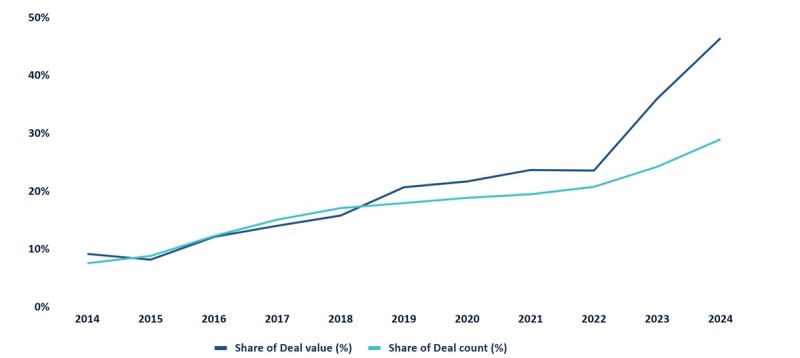
AI’s share of all global VC deals is at a new high.

The value of those global AI deals in 2024 was $131.5 billion, up from 52% from $86.3 billion in 2023 and down 6% from $140.2 billion in 2021.

AI and machine learning were 35.7% of global deal value in 2024, up from 24.7% in 2023. And AI and machine learning were 23.4% of the global deal count in 2024, up from 20% in 2023. In 2021, AI was 18.7% of global deal value and 17.5% of global deal count.

Q4 global numbers

On the global level in Q4, Asia Pacific’s venture market has struggled through the last few years, something that didn’t change in 2024, Pitchbook lead VC analyst Kyle Stanford said.

Compared with Europe and the U.S., the amount of dry powder built up within the various markets across APAC was much smaller, further pressuring dealmaking over the past year. China, which has driven around half of the annual deal activity for APAC, has seen a material decline in activity, due to both economic challenges within the country, as well as the tensions with the U.S. government, which has curtailed activity by U.S.-headquartered firms. Just 20.4% of deal count occurred in Asia, the lowest proportion in the past decade.

Globally, AI has continued to dominate the headlines and investment focus of investors despite some noting that the investment activity is not sustainable long-term. Whether or not that true is trivial in the current moment.

Just over half of all VC invested globally during Q4 went to an AI-focused company. Its true that amount was heavily influenced by the likes of OpenAI, Databricks, xAI, and other well-known companies raising for share buybacks and investment into chips and computing energy needs, but the most important factors is the level of capital availability for AI compared with other sectors, Stanford said.

The proportion of total deals going to AI companies has consistently increased over the past couple years as large corporates and investors alike move to harness the expected efficiencies of the next tech wave, he said.
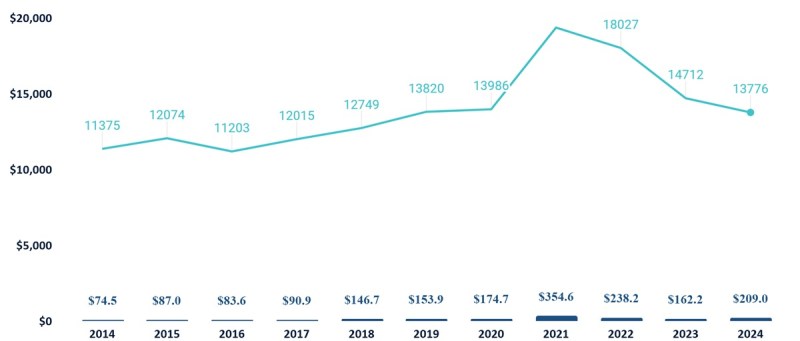
Global VC investments and deal counts by year.

“VC-backed exits have not been strong historically for APAC, though many markets are still too young to develop a healthy exit environment,” he said. “The lack of exits across many of the regions has kept many foreign investors weary of increased activity during the market slowdown. Japan has been an outlier in terms of count, as many IPOs within the country have helped drive returns to investors. In 2024, 19% of the global VC-backed exits originated in Asia-based companies.”

Fundraising has been slow globally, as new commitments dropped just over 20% YoY. The lack of exits has had a large impact on fundraising for Asia as LPs have been less inclined to reup commitments at this time. 2024 marked the lowest year for new commitments since 2018, and was the lowest year for closed funds in the market in the past decade. North America and Europe similarly struggled to secure new commitments to venture funds.

Q4 U.S. deals

U.S. Dealmaking remained relatively robust in the fourth quarter of 2024 from a count perspective, and increased slightly by 3.7% compared to a year earlier, Pitchbook and the NVCA said. In the quarter, AI deals accounted for nearly half (46.4%) of total US deal value.

Stanford said it seems counterintuitive to the narrative in the market over the past few years, but is indicative of holdover of certain mechanics of venture from a few years ago.

“What has happened is that the excess of dry powder from the high fundraising years of 2021 and 2022 have kept many investors active in the market despite the lack of returns,” Stanford said. “With the slow fundraising years of 2023 and 2024, we should likely see this relative robustness start to deteriorate as fund run through their available capital and aren’t able to raise a subsequent fund.”
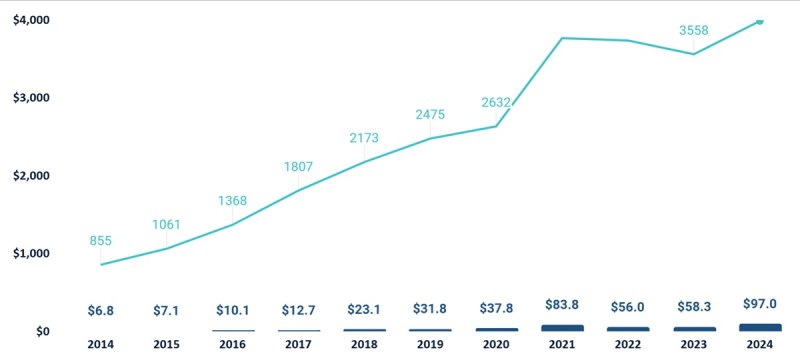
AI deals by year has been rising sharply.

Artificial intelligence continues to be the story of the market, and drove a near majority of dollars for VC in 2024, he said. OpenAI, xAI, Anthropic, and others have become synonymous with outsized deals in venture, and seemingly operate in a different funding environment than most VC-backed companies who continue to struggle with lower capital availability, Stanford said.

But the lack of exits remains the story of the venture market, even as the outlook is more hopeful, he said. Just $149.2 billion in exit value was created during 2024, largely coming from a handful of IPOs. Unicorns, which hold around two-thirds of the U.S. VC market value, have held tight as private companies, creating pressure on investors and limited partners with the lack of distributions.

Merges and acquisitions were was also “silent in 2024,” with few large deals to note, Stanford said. A more acquisition-friendly environment in 2025 could set the stage for a renewed M&A market, especially if a soft-landing for the economy can be fully engineered, he said.

In the U.S., fundraising was dominated by large, established firms. Thirty firms accounted for more than 68% of total fundraising value in 2024. This is a trend that has been developing over the past few years, but hit a forefront last year, Stanford said.

Many of the emerging managers that raised funds during the ZIRP-era boom in the VC market have been unable to generate returns, and have portfolios troubled from the valuation changes that have occurred during the market shift. Without a track record to speak to, many firms are finding a very challenging market to raise new commitments from LPs, Stanford said.

European VC market

In Europe, VC deal value reflected a slight decline, while deal counts dropped by roughly 16% compared to year ago, said Pitchbook analyst Nalin Patel, as a more cautious environment was on display in 2024.

European deal activity was down across earlier financing stages, the majority of verticals, and several regions as tougher market for funding was evident.

He said AI drove just over a quarter of deal value to the region during 2024, on just more than 23% of completed financings. The large, outsized deals attributable to other venture markets did not materialize in the same amount in Europe, keeping the proportion of deal value in line with count.

And he said exit value picked up in 2024, largely driven by the listing of Puif. Otherwise it was a quiet year for European VC-backed exits, particularly on the listings front as companies avoided exits.

“We expect exits to pick up in 2025 as market conditions improve,” Patel said.

Capital raised by European-based VC funds was flat YoY in 2024 and remained below the peak set in 2022. Fund counts also dipped in 2024 dropping by approximately by a fifth compared to 2023. Lower fund counts and flat capital raised figures indicate fewer, but larger funds closed in 2024.

The outlook?

One way to look at how much dry powder the industry has and whether VCs are successful themselves is to look how well they have done raising money themselves. That’s where the news looks fairly bleak, or at least is corrected now compared to the overhyped days of 2021.

In 2024, 1,344 funds raised capital, down from 2,333 in 2023 and a record 4,283 in 2021. In terms of capital raised, the 1,344 VCs raised $169.7 billion in 2024, down from $213.8 billion in 2023 and down from the record $404.4 billion in 2021.


Shape
Shape
Stay Ahead

Explore More Insights

Stay ahead with more perspectives on cutting-edge power, infrastructure, energy,  bitcoin and AI solutions. Explore these articles to uncover strategies and insights shaping the future of industries.

Shape

Cisco details Live Protect’s real-time threat mitigation capabilities

“Live Protect uses extended Berkeley Packet Filter (eBPF) technology, a powerful Linux kernel feature, through the Tetragon agent embedded in NX-OS. This allows deep visibility and enforcement directly within the kernel, monitoring system calls, file operations, process control, and network traffic to detect and prevent privilege escalation, control-plane attacks, and

Read More »

Kyndryl: AI success hinges on workforce readiness

Nearly 80% of respondents said the pace of AI adoption is likely to outstrip their organization’s ability to adapt its workforce, governance structures, and operating model. As Kyndryl notes in the report, most leaders believe addressing those challenges “will prove more arduous than those involving code and compute.” Organizations are

Read More »

Energy Dominance Financing Office Celebrates One Year Since Passage of the Working Families Tax Cuts Act

WASHINGTON—The U.S. Department of Energy’s (DOE) Office of Energy Dominance Financing (EDF) celebrates the one-year anniversary of President Trump’s historic Working Families Tax Cuts. Made possible by the Working Families Tax Cuts, EDF has tallied several vital wins to rebuild supply chains, lower household energy bills, and strengthen U.S. energy and industrial leadership. The Working Families Tax Cuts expanded the scope of EDF’s more than $250 billion available loan authority to support reliable and affordable energy-related investments through the revamped and renamed Energy Dominance Financing Program (EDFP). “The prior administration had policies that undermined our grid with intermittent and expensive technologies that didn’t deliver the affordable, reliable and secure energy that Americans need,” EDF Director Gregory A. Beard said. “The Working Families Tax Cuts empowered the nation with a common-sense approach to increasing the nation’s energy supply through ensuring baseload power goes to a secure and reliable grid, securing critical mineral supply chains, winning the global AI race and launching the American nuclear renaissance.” EDF is working to rapidly implement and deploy the EDFP. Over the past year, these accomplishments include: Financing America’s nuclear renaissance EDF has financed nuclear restarts and reestablished domestic manufacturing capabilities central to the Administration’s goal of reinvigorating the U.S. nuclear industrial base. As part of a national nuclear renaissance strategy, EDF recently announced a $17.5 billion conditional loan to finance long-lead time items needed to rebuild America’s commercial nuclear supply chain. This investment will accelerate the deployment of 10 large-scale commercial nuclear reactors across the United States by up to three years. The project marks a major step toward advancing President Trump’s Executive Order, Reinvigorating the Nuclear Industrial Base, by supporting the objective of having 10 new large nuclear reactors with complete designs under construction by 2030, representing over 11 GW of secure, reliable generation. EDF

Read More »

Trump Administration Moves to Permanently End Green New Scam Appliance Mandates

WASHINGTON—U.S. Secretary of Energy Chris Wright today announced the Department of Energy (DOE) has issued a Notice of Proposed Rulemaking to permanently end home appliance and equipment mandates that raise costs and disrupt consumer choice. The proposal will update the Department’s Process Rule used to establish energy conservation standards for household appliances and equipment, including air conditioning units, gas stoves, washing and drying machines, water heaters, refrigerators, and other products Americans rely on every day. In accordance with President Donald Trump’s Executive Order, “Unleashing Prosperity through Deregulation,” the proposal will preserve consumer choice and lower costs.  “In America, you should be able to choose a dryer that dries clothes on the first try rather than one that takes multiple cycles—unfortunately, past administrations thought otherwise,” Secretary Wright said. “For too long, the American people paid the price for mandates that restricted consumer choice and drove up costs. President Trump promised to end thisnonsense and that is exactly what we are doing. This proposed rule will preserve the American people’s ability to choose home appliances and equipment that actually work — at prices they can afford. It’s called common sense.”  “From day one, the Trump Administration has offered relief to consumers, businesses, and industries through bold deregulatory action,” said Assistant Secretary of Energy (EERE) Audrey Robertson. “This proposal is about the future. It will ensure that new regulations promote affordability, preserve consumer choice, and meet the highest standards for transparency and due diligence.”   For further details, read the full text of the Notice of Proposed Rulemaking. Comments will be accepted for 30 days after publication in the Federal Register.  DOE also issued a Request for Information seeking public input on the methodologies used in developing energy conservation standards for covered products and equipment. Comments will be accepted for 60 days after

Read More »

Secretary Wright Applauds End of New Federal Wind and Solar Subsidies

WASHINGTON—U.S. Secretary of Energy Chris Wright today released the following statement regarding the Working Families Tax Cut July 4, 2026 deadline ending federal tax credit subsidies for new wind and solar projects not currently under construction. For more than three decades, the federal government has subsidized wind and solar energy generation. In 2025, wind and solar accounted for approximately three percent of total U.S. primary energy consumption. “I’m thrilled to report that after about 35 years, on July 4th, we will end the subsidies for wind and solar, thanks to the Working Families Tax Cut. “Wind and solar take a lot of land, 100 times more land for a similar amount of energy. They take an enormous amount of materials, energy intensive materials like steel and cement and polysilicon. “They take an enormous amount of additional transmission lines to connect their large land, far flung production back to where there’s demand centers. “And what do we get for all that is a relatively small amount of low value energy. It’s low value because the wind doesn’t always blow and the sun doesn’t always shine. “So they drive up the system costs and increase Americans’ electricity prices. “Enough of raising electricity prices. We’re going to drive them down. Thank you.” ###

Read More »

U.S. Department of Energy Meets President Trump’s Goal, Delivers Third Advanced Reactor Criticality

WASHINGTON—As part of the U.S. Department of Energy (DOE) Nuclear Energy Launch Pad initiative, Deployable Energy’s demonstration reactor, Unity, successfully completed a zero-power fueled criticality demonstration at Idaho National Laboratory. Unity, which achieved criticality late yesterday, is the third DOE-authorized advanced reactor to go critical by the July 4th deadline set by President Trump in his May 2025 executive order. This criticality marks DOE’s fulfillment of a precedent-setting directive to reignite nuclear energy innovation in the United States. Earlier this month, Antares Nuclear’s Mark-0 and Valar Atomics’ Ward 250 reactors achieved criticality under DOE’s Reactor Pilot Program, making the United States the first country in history to achieve criticality in three unique advanced microreactor designs in a single month. “Last week, I had the opportunity to see the Unity demonstration reactor firsthand and meet with the talented teams from Deployable Energy, INL and DOE whose work made this historic moment possible on the eve of our nation’s 250th anniversary,” Secretary of Energy Chris Wright said. “America’s nuclear renaissance is underway because of President Trump’s bold vision and ambitious goals. Yesterday, we accomplished a significant milestone on a timeline many thought was unachievable. Advanced nuclear technologies like Unity will help power the next generation of American industry, strengthen our energy security, and ensure the United States remains the world’s nuclear innovation leader.” Deployable Energy completed the Unity criticality experiment under the Nuclear Energy Launch Pad initiative, managed by the National Reactor Innovation Center at Idaho National Laboratory. The next evolution of the Reactor Pilot Program, Nuclear Energy Launch Pad leverages DOE authorization to expeditiously certify and construct first-of-a-kind advanced nuclear technologies for demonstration. “We are proud to be a part of this historic achievement and I want to express Deployable Energy’s gratitude to the administration for setting an audacious goal to

Read More »

Energy Secretary Secures Mid-Atlantic Grid Ahead of Period of Hot Weather

WASHINGTON—The U.S. Department of Energy (DOE) today issued two emergency orders to mitigate blackout risks in the Mid-Atlantic ahead of the region’s predicted record-breaking peak loads brought on by the forecasted hot weather conditions. The first order directs PJM Interconnection, LLC (PJM) to dispatch specified units and to order their operation as needed to maintain reliability. The second order authorizes PJM, in collaboration with its Transmission Owners and Electric Distribution Companies, to direct backup generation resources to operate as a last resort before declaring an Energy Emergency Alert (EEA) 3 or during an EEA 3. The orders were issued pursuant to applications from PJM submitted on June 27 and 29, 2026. “Maintaining affordable, reliable, and secure power in the PJM service territory is non-negotiable,” said U.S. Secretary of Energy Chris Wright. “The previous administration’s energy subtraction policies weakened the grid, leaving Americans more vulnerable during events like this. Thanks to President Trump’s leadership, we are reversing those failures and using every available tool ensuring Americans in the Mid-Atlantic have continued access to affordable, reliable, and secure energy to power and cool their homes.” DOE estimates more than 35 GW of unused backup generation remains available nationwide. On day one, President Trump declared a national energy emergency after the Biden administration’s energy subtraction agenda left behind a grid increasingly vulnerable to blackouts. According to the North American Electric Reliability Corporation’s (NERC) 2026 Summer Reliability Assessment, the peak electricity demand in PJM occurs during the summer season. It further notes that “if extreme high temperatures are experienced, PJM anticipates the need for demand-response resources to help reduce load.” Power outages cost the American people $44 billion per year, according to data from DOE’s National Laboratories. These orders will mitigate the possibility of power outages in the Mid-Atlantic and highlight the commonsense policies of the Trump Administration to ensure Americans have access to

Read More »

Equinor to invest in additional Troll development to boost European gas supply

Equinor Energy AS and partners will invest more than 4 billion krone ($400 million) in a new subsea development to increase gas production from Troll field in the North Sea. The Troll West Increased gas recovery North (TWIN) expansion—the third step of Troll Phase 3, which produces gas from the Troll West reservoir—could come online as early as 2028, said Gunnar Nakken, Equinor’s senior vice-president for projects and subsea Norway. TWIN is expected to contribute around 11 billion standard cu m of gas. “By simplifying, increasing standardization and reusing existing infrastructure and equipment, we are reducing costs and enabling faster production,” he said. Equinor aims to produce 1.3 million b/d from the Norwegian Continental Shelf (NCS) in 2035 to meet a portion of Europe’s energy needs. Troll field contains about 40% of NCS total gas reserves, with gas from Troll meeting around 10% of Europe’s gas needs. The TWIN project consists of two wells in a template and a pipeline connected to existing subsea infrastructure. The umbilical and MEG line will be extended to the new development. The second step of Troll Phase 3 is expected to come online this year, continuing production from Troll A platform, 80 km northwest of Bergen, Norway, and the Gassco-operated Kollsnes processing plant towards 2030, Equinor said. Equinor is operator of the project with 30.55% interest. Partners are Petoro AS (55.93%), A/S Norske Shell (8.19%), TotalEnergies EP Norge AS (3.69%), and ConocoPhillips Skandinavia AS (1.64%).

Read More »

Cloud sovereignty: First four providers sign up to CISPE certification program

“Public bodies, hospitals and industrial operators are today seeking concrete guarantees of digital sovereignty. The CISPE Sovereignty Badge provides that guarantee. It is a natural complement to European standards such as Gaia-X Level 3, strengthening transparency, compliance and digital trust. It is this ability to provide concrete proof, beyond rhetoric, that underpins genuine European digital autonomy.” said Antoine Fournier, CEO of Thésée Datacenter The EU is keen to guard against ‘sovereignty washing’ — claims by foreign-owned cloud providers that they meet local control criteria. Last month, CISPE warned about Broadcom’s claim it complied with EU conditions. It probably won’t be the last to make such claims.

Read More »

What Meta, Oracle moves say about data center economics

Meta, meanwhile, is continuing its spending spree on AI infrastructure, anonymous sources told Bloomberg. The company is purportedly developing plans for new cloud infrastructure business lines that would sell access to AI computing power and models, putting it in competition with other data center giants. One potential scenario would have Meta selling access to models, including its new Muse Spark, hosted on its own AI infrastructure, as well as running the underlying data centers. This model is similar to AWS’ Bedrock offering. Another possibility is Meta selling access to “raw” computing capacity, as do neocloud businesses such as CoreWeave. This move is part of the company’s internal Meta Compute initiative, the sources said. Like Oracle, Meta has been investing hundreds of billions of dollars in data centers and expensive AI chips. And, according to its latest 10-K: “We plan to continue to significantly expand the size of our infrastructure primarily through data centers, subsea and terrestrial fiber optic cable systems, and other projects.”

Read More »

Executive Roundtable: The Rise of Integrated Infrastructure

Steve Altizer, Compu Dynamics: Integration has to be foundational. It has to start at the first planning conversation, not after the equipment is selected or once the building is already designed. In previous generations of data center development, mechanical, electrical, IT, and operations teams could often work in parallel and bring the pieces together later. That worked when the load profile was more predictable and the facility had more room to absorb change. Before the introduction of ChatGPT, there was very little change to absorb. AI removes that tolerance. A change in rack density can affect electrical distribution, structural requirements, thermal strategy, commissioning, service access, and the way the site is operated. These are no longer independent decisions. They are all part of one performance system. As AI systems move toward POD-scale platforms, the boundary between IT and facility infrastructure becomes much harder to separate. The challenge is that AI workloads are too varied for a one-size-fits-all approach. Training clusters, inference nodes, enterprise AI environments, and edge sites can all have different requirements for density, cooling architecture, network connectivity, security, site conditions, and serviceability. That is why many companies are adopting a modular approach, while others are embracing hybrid models where turnkey modular AI capacity is integrated into larger campus environments.  At the campus level, that means standardizing the backbone infrastructure that serves the site (utility power feeds, central cooling capacity, and network pathways), while allowing the IT environment and the integrated critical infrastructure components to evolve as workload requirements change. The goal is not modularity for its own sake. The goal is to support the next generation of AI deployments without forcing every hardware change to become a major redesign. AI infrastructure cannot be planned as a collection of disparate systems. It has to be designed as one coordinated

Read More »

Data Center Insights 2026 Brings Industry Leaders Together for a Two-Day Look at the AI Infrastructure Era

The data center industry has never been more visible, more vital, or more challenged. Support for AI and its overall industry impact has pushed digital infrastructure into the public conversation. It has become clear that the sector is confronting unprecedented demands for everything from power to basic infrastructure. That convergence is the focus of Data Center Insights 2026, a two-day virtual event taking place July 15–16, 2026, produced by Endeavor B2B’s Data Center Frontier, Cabling Installation & Maintenance, ISE, Lightwave, and SecurityInfoWatch. Designed for data center owners, operators, engineers, IT leaders, and the people supporting the next generation of data center development, the event offers a concentrated look at the technologies and strategies shaping the future of digital infrastructure. The program arrives at a crucial moment. AI workloads are changing almost every assumption behind data center design. Rack densities are rising, liquid cooling is becoming mainstream, and fiber networks are being rethought for 400G and beyond. Power constraints are now central to site selection. Security is becoming highlighted and operators are being asked to build faster, scale larger, be more resource efficient and maintain resilience in an environment where downtime carries higher consequences than ever. Data Center Insights 2026 is structured to help attendees make sense of this moment. Rather than treating data center infrastructure as a set of separate disciplines, the event brings together experts across cooling, cabling, fiber, power distribution, modular design, AI infrastructure, and operational strategy. The result is a practical, cross-functional program built around the real-world questions now facing the industry. What will I learn at this event? The event opens with “Expert Roundup: The State of the Data Center Industry,” featuring perspectives from Steven Carlini of Schneider Electric.This session sets the stage by examining the forces driving change across the data center landscape in 2026.

Read More »

Executive Roundtable: Scaling Beyond the Prototype Phase

Steve Altizer, Compu Dynamics: The defining challenge is keeping pace with the rate of change in the IT environment. It takes time to design, permit, build, and commission a data center. AI hardware operates on a completely different timeline. New GPU families are being introduced every 12 to 18 months, and from one generation to the next, rack power densities can double or even triple. At prototype scale, you can design around a single cluster or a specific density profile. At production scale, that approach becomes a real liability. The facility has to support today’s deployment while remaining adaptable for the next compute profile. We are not just talking about adding more power. We are preparing for major architectural shifts, including the move toward DC power delivery or cooling systems that may rely on two-phase liquid to remove heat at scale. That is what becomes materially harder. You are no longer solving for a single, static deployment. You are solving for a moving target inside a live operating environment. This is where strategic modularity proves its value. It helps decouple the lifecycle of the building from the lifecycle of the IT hardware. Instead of treating the data center as one monolithic design, modularity creates a more agile framework that can absorb new power and cooling architectures without requiring a full facility retrofit every time the IT roadmap shifts. At Compu Dynamics Modular, we are seeing this play out in real time. The value of a turnkey modular approach is not simply speed. It is the agility owners need to keep pace with ever-evolving rack densities, power delivery requirements, and cooling architectures.

Read More »

Q2 Executive Roundtable Recap

Matt Vincent is Editor in Chief of Data Center Frontier, where he leads editorial strategy and coverage focused on the infrastructure powering cloud computing, artificial intelligence, and the digital economy. A veteran B2B technology journalist with more than two decades of experience, Vincent specializes in the intersection of data centers, power, cooling, and emerging AI-era infrastructure. Since assuming the EIC role in 2023, he has helped guide Data Center Frontier’s coverage of the industry’s transition into the gigawatt-scale AI era, with a focus on hyperscale development, behind-the-meter power strategies, liquid cooling architectures, and the evolving energy demands of high-density compute, while working closely with the Digital Infrastructure Group at Endeavor Business Media to expand the brand’s analytical and multimedia footprint. Vincent also hosts The Data Center Frontier Show podcast, where he interviews industry leaders across hyperscale, colocation, utilities, and the data center supply chain to examine the technologies and business models reshaping digital infrastructure. Since its inception he serves as Head of Content for the Data Center Frontier Trends Summit. Before becoming Editor in Chief, he served in multiple senior editorial roles across Endeavor Business Media’s digital infrastructure portfolio, with coverage spanning data centers and hyperscale infrastructure, structured cabling and networking, telecom and datacom, IP physical security, and wireless and Pro AV markets. He began his career in 2005 within PennWell’s Advanced Technology Division and later held senior editorial positions supporting brands such as Cabling Installation & Maintenance, Lightwave Online, Broadband Technology Report, and Smart Buildings Technology. Vincent is a frequent moderator, interviewer, and keynote speaker at industry events including the HPC Forum, where he delivers forward-looking analysis on how AI and high-performance computing are reshaping digital infrastructure. He graduated with honors from Indiana University Bloomington with a B.A. in English Literature and Creative Writing and lives in southern New Hampshire with

Read More »

Microsoft will invest $80B in AI data centers in fiscal 2025

And Microsoft isn’t the only one that is ramping up its investments into AI-enabled data centers. Rival cloud service providers are all investing in either upgrading or opening new data centers to capture a larger chunk of business from developers and users of large language models (LLMs).  In a report published in October 2024, Bloomberg Intelligence estimated that demand for generative AI would push Microsoft, AWS, Google, Oracle, Meta, and Apple would between them devote $200 billion to capex in 2025, up from $110 billion in 2023. Microsoft is one of the biggest spenders, followed closely by Google and AWS, Bloomberg Intelligence said. Its estimate of Microsoft’s capital spending on AI, at $62.4 billion for calendar 2025, is lower than Smith’s claim that the company will invest $80 billion in the fiscal year to June 30, 2025. Both figures, though, are way higher than Microsoft’s 2020 capital expenditure of “just” $17.6 billion. The majority of the increased spending is tied to cloud services and the expansion of AI infrastructure needed to provide compute capacity for OpenAI workloads. Separately, last October Amazon CEO Andy Jassy said his company planned total capex spend of $75 billion in 2024 and even more in 2025, with much of it going to AWS, its cloud computing division.

Read More »

John Deere unveils more autonomous farm machines to address skill labor shortage

Join our daily and weekly newsletters for the latest updates and exclusive content on industry-leading AI coverage. Learn More Self-driving tractors might be the path to self-driving cars. John Deere has revealed a new line of autonomous machines and tech across agriculture, construction and commercial landscaping. The Moline, Illinois-based John Deere has been in business for 187 years, yet it’s been a regular as a non-tech company showing off technology at the big tech trade show in Las Vegas and is back at CES 2025 with more autonomous tractors and other vehicles. This is not something we usually cover, but John Deere has a lot of data that is interesting in the big picture of tech. The message from the company is that there aren’t enough skilled farm laborers to do the work that its customers need. It’s been a challenge for most of the last two decades, said Jahmy Hindman, CTO at John Deere, in a briefing. Much of the tech will come this fall and after that. He noted that the average farmer in the U.S. is over 58 and works 12 to 18 hours a day to grow food for us. And he said the American Farm Bureau Federation estimates there are roughly 2.4 million farm jobs that need to be filled annually; and the agricultural work force continues to shrink. (This is my hint to the anti-immigration crowd). John Deere’s autonomous 9RX Tractor. Farmers can oversee it using an app. While each of these industries experiences their own set of challenges, a commonality across all is skilled labor availability. In construction, about 80% percent of contractors struggle to find skilled labor. And in commercial landscaping, 86% of landscaping business owners can’t find labor to fill open positions, he said. “They have to figure out how to do

Read More »

2025 playbook for enterprise AI success, from agents to evals

Join our daily and weekly newsletters for the latest updates and exclusive content on industry-leading AI coverage. Learn More 2025 is poised to be a pivotal year for enterprise AI. The past year has seen rapid innovation, and this year will see the same. This has made it more critical than ever to revisit your AI strategy to stay competitive and create value for your customers. From scaling AI agents to optimizing costs, here are the five critical areas enterprises should prioritize for their AI strategy this year. 1. Agents: the next generation of automation AI agents are no longer theoretical. In 2025, they’re indispensable tools for enterprises looking to streamline operations and enhance customer interactions. Unlike traditional software, agents powered by large language models (LLMs) can make nuanced decisions, navigate complex multi-step tasks, and integrate seamlessly with tools and APIs. At the start of 2024, agents were not ready for prime time, making frustrating mistakes like hallucinating URLs. They started getting better as frontier large language models themselves improved. “Let me put it this way,” said Sam Witteveen, cofounder of Red Dragon, a company that develops agents for companies, and that recently reviewed the 48 agents it built last year. “Interestingly, the ones that we built at the start of the year, a lot of those worked way better at the end of the year just because the models got better.” Witteveen shared this in the video podcast we filmed to discuss these five big trends in detail. Models are getting better and hallucinating less, and they’re also being trained to do agentic tasks. Another feature that the model providers are researching is a way to use the LLM as a judge, and as models get cheaper (something we’ll cover below), companies can use three or more models to

Read More »

OpenAI’s red teaming innovations define new essentials for security leaders in the AI era

Join our daily and weekly newsletters for the latest updates and exclusive content on industry-leading AI coverage. Learn More OpenAI has taken a more aggressive approach to red teaming than its AI competitors, demonstrating its security teams’ advanced capabilities in two areas: multi-step reinforcement and external red teaming. OpenAI recently released two papers that set a new competitive standard for improving the quality, reliability and safety of AI models in these two techniques and more. The first paper, “OpenAI’s Approach to External Red Teaming for AI Models and Systems,” reports that specialized teams outside the company have proven effective in uncovering vulnerabilities that might otherwise have made it into a released model because in-house testing techniques may have missed them. In the second paper, “Diverse and Effective Red Teaming with Auto-Generated Rewards and Multi-Step Reinforcement Learning,” OpenAI introduces an automated framework that relies on iterative reinforcement learning to generate a broad spectrum of novel, wide-ranging attacks. Going all-in on red teaming pays practical, competitive dividends It’s encouraging to see competitive intensity in red teaming growing among AI companies. When Anthropic released its AI red team guidelines in June of last year, it joined AI providers including Google, Microsoft, Nvidia, OpenAI, and even the U.S.’s National Institute of Standards and Technology (NIST), which all had released red teaming frameworks. Investing heavily in red teaming yields tangible benefits for security leaders in any organization. OpenAI’s paper on external red teaming provides a detailed analysis of how the company strives to create specialized external teams that include cybersecurity and subject matter experts. The goal is to see if knowledgeable external teams can defeat models’ security perimeters and find gaps in their security, biases and controls that prompt-based testing couldn’t find. What makes OpenAI’s recent papers noteworthy is how well they define using human-in-the-middle

Read More »