Stay Ahead, Stay ONMINE

This giant microwave may change the future of war

Imagine: China deploys hundreds of thousands of autonomous drones in the air, on the sea, and under the water—all armed with explosive warheads or small missiles. These machines descend in a swarm toward military installations on Taiwan and nearby US bases, and over the course of a few hours, a single robotic blitzkrieg overwhelms the US Pacific force before it can even begin to fight back.  Maybe it sounds like a new Michael Bay movie, but it’s the scenario that keeps the chief technology officer of the US Army up at night. “I’m hesitant to say it out loud so I don’t manifest it,” says Alex Miller, a longtime Army intelligence officer who became the CTO to the Army’s chief of staff in 2023. Even if World War III doesn’t break out in the South China Sea, every US military installation around the world is vulnerable to the same tactics—as are the militaries of every other country around the world. The proliferation of cheap drones means just about any group with the wherewithal to assemble and launch a swarm could wreak havoc, no expensive jets or massive missile installations required.  While the US has precision missiles that can shoot these drones down, they don’t always succeed: A drone attack killed three US soldiers and injured dozens more at a base in the Jordanian desert last year. And each American missile costs orders of magnitude more than its targets, which limits their supply; countering thousand-dollar drones with missiles that cost hundreds of thousands, or even millions, of dollars per shot can only work for so long, even with a defense budget that could reach a trillion dollars next year. The US armed forces are now hunting for a solution—and they want it fast. Every branch of the service and a host of defense tech startups are testing out new weapons that promise to disable drones en masse. There are drones that slam into other drones like battering rams; drones that shoot out nets to ensnare quadcopter propellers; precision-guided Gatling guns that simply shoot drones out of the sky; electronic approaches, like GPS jammers and direct hacking tools; and lasers that melt holes clear through a target’s side. Then there are the microwaves: high-powered electronic devices that push out kilowatts of power to zap the circuits of a drone as if it were the tinfoil you forgot to take off your leftovers when you heated them up.  That’s where Epirus comes in.  When I went to visit the HQ of this 185-person startup in Torrance, California, earlier this year, I got a behind-the-scenes look at its massive microwave, called Leonidas, which the US Army is already betting on as a cutting-edge anti-drone weapon. The Army awarded Epirus a $66 million contract in early 2023, topped that up with another $17 million last fall, and is currently deploying a handful of the systems for testing with US troops in the Middle East and the Pacific. (The Army won’t get into specifics on the location of the weapons in the Middle East but published a report of a live-fire test in the Philippines in early May.)  Up close, the Leonidas that Epirus built for the Army looks like a two-foot-thick slab of metal the size of a garage door stuck on a swivel mount. Pop the back cover, and you can see that the slab is filled with dozens of individual microwave amplifier units in a grid. Each is about the size of a safe-deposit box and built around a chip made of gallium nitride, a semiconductor that can survive much higher voltages and temperatures than the typical silicon.  Leonidas sits on top of a trailer that a standard-issue Army truck can tow, and when it is powered on, the company’s software tells the grid of amps and antennas to shape the electromagnetic waves they’re blasting out with a phased array, precisely overlapping the microwave signals to mold the energy into a focused beam. Instead of needing to physically point a gun or parabolic dish at each of a thousand incoming drones, the Leonidas can flick between them at the speed of software. The Leonidas contains dozens of microwave amplifier units and can pivot to direct waves at incoming swarms of drones. Of course, this isn’t magic—there are practical limits on how much damage one array can do, and at what range—but the total effect could be described as an electromagnetic pulse emitter, a death ray for electronics, or a force field that could set up a protective barrier around military installations and drop drones the way a bug zapper fizzles a mob of mosquitoes. I walked through the nonclassified sections of the Leonidas factory floor, where a cluster of engineers working on weaponeering—the military term for figuring out exactly how much of a weapon, be it high explosive or microwave beam, is necessary to achieve a desired effect—ran tests in a warren of smaller anechoic rooms. Inside, they shot individual microwave units at a broad range of commercial and military drones, cycling through waveforms and power levels to try to find the signal that could fry each one with maximum efficiency.  On a live video feed from inside one of these foam-padded rooms, I watched a quadcopter drone spin its propellers and then, once the microwave emitter turned on, instantly stop short—first the propeller on the front left and then the rest. A drone hit with a Leonidas beam doesn’t explode—it just falls. Compared with the blast of a missile or the sizzle of a laser, it doesn’t look like much. But it could force enemies to come up with costlier ways of attacking that reduce the advantage of the drone swarm, and it could get around the inherent limitations of purely electronic or strictly physical defense systems. It could save lives. Epirus CEO Andy Lowery, a tall guy with sparkplug energy and a rapid-fire southern Illinois twang, doesn’t shy away from talking big about his product. As he told me during my visit, Leonidas is intended to lead a last stand, like the Spartan from whom the microwave takes its name—in this case, against hordes of unmanned aerial vehicles, or UAVs. While the actual range of the Leonidas system is kept secret, Lowery says the Army is looking for a solution that can reliably stop drones within a few kilometers. He told me, “They would like our system to be the owner of that final layer—to get any squeakers, any leakers, anything like that.” Now that they’ve told the world they “invented a force field,” Lowery added, the focus is on manufacturing at scale—before the drone swarms really start to descend or a nation with a major military decides to launch a new war. Before, in other words, Miller’s nightmare scenario becomes reality.  Why zap? Miller remembers well when the danger of small weaponized drones first appeared on his radar. Reports of Islamic State fighters strapping grenades to the bottom of commercial DJI Phantom quadcopters first emerged in late 2016 during the Battle of Mosul. “I went, ‘Oh, this is going to be bad,’ because basically it’s an airborne IED at that point,” he says. He’s tracked the danger as it’s built steadily since then, with advances in machine vision, AI coordination software, and suicide drone tactics only accelerating.  Then the war in Ukraine showed the world that cheap technology has fundamentally changed how warfare happens. We have watched in high-definition video how a cheap, off-the-shelf drone modified to carry a small bomb can be piloted directly into a faraway truck, tank, or group of troops to devastating effect. And larger suicide drones, also known as “loitering munitions,” can be produced for just tens of thousands of dollars and launched in massive salvos to hit soft targets or overwhelm more advanced military defenses through sheer numbers.  As a result, Miller, along with large swaths of the Pentagon and DC policy circles, believes that the current US arsenal for defending against these weapons is just too expensive and the tools in too short supply to truly match the threat. Just look at Yemen, a poor country where the Houthi military group has been under constant attack for the past decade. Armed with this new low-tech arsenal, in the past 18 months the rebel group has been able to bomb cargo ships and effectively disrupt global shipping in the Red Sea—part of an effort to apply pressure on Israel to stop its war in Gaza. The Houthis have also used missiles, suicide drones, and even drone boats to launch powerful attacks on US Navy ships sent to stop them. The most successful defense tech firm selling anti-drone weapons to the US military right now is Anduril, the company started by Palmer Luckey, the inventor of the Oculus VR headset, and a crew of cofounders from Oculus and defense data giant Palantir. In just the past few months, the Marines have chosen Anduril for counter-drone contracts that could be worth nearly $850 million over the next decade, and the company has been working with Special Operations Command since 2022 on a counter-drone contract that could be worth nearly a billion dollars over a similar time frame. It’s unclear from the contracts what, exactly, Anduril is selling to each organization, but its weapons include electronic warfare jammers, jet-powered drone bombs, and propeller-driven Anvil drones designed to simply smash into enemy drones. In this arsenal, the cheapest way to stop a swarm of drones is electronic warfare: jamming the GPS or radio signals used to pilot the machines. But the intense drone battles in Ukraine have advanced the art of jamming and counter-jamming close to the point of stalemate. As a result, a new state of the art is emerging: unjammable drones that operate autonomously by using onboard processors to navigate via internal maps and computer vision, or even drones connected with 20-kilometer-long filaments of fiber-optic cable for tethered control. But unjammable doesn’t mean unzappable. Instead of using the scrambling method of a jammer, which employs an antenna to block the drone’s connection to a pilot or remote guidance system, the Leonidas microwave beam hits a drone body broadside. The energy finds its way into something electrical, whether the central flight controller or a tiny wire controlling a flap on a wing, to short-circuit whatever’s available. (The company also says that this targeted hit of energy allows birds and other wildlife to continue to move safely.) Tyler Miller, a senior systems engineer on Epirus’s weaponeering team, told me that they never know exactly which part of the target drone is going to go down first, but they’ve reliably seen the microwave signal get in somewhere to overload a circuit. “Based on the geometry and the way the wires are laid out,” he said, one of those wires is going to be the best path in. “Sometimes if we rotate the drone 90 degrees, you have a different motor go down first,” he added. The team has even tried wrapping target drones in copper tape, which would theoretically provide shielding, only to find that the microwave still finds a way in through moving propeller shafts or antennas that need to remain exposed for the drone to fly.  Leonidas also has an edge when it comes to downing a mass of drones at once. Physically hitting a drone out of the sky or lighting it up with a laser can be effective in situations where electronic warfare fails, but anti-drone drones can only take out one at a time, and lasers need to precisely aim and shoot. Epirus’s microwaves can damage everything in a roughly 60-degree arc from the Leonidas emitter simultaneously and keep on zapping and zapping; directed energy systems like this one never run out of ammo. As for cost, each Army Leonidas unit currently runs in the “low eight figures,” Lowery told me. Defense contract pricing can be opaque, but Epirus delivered four units for its $66 million initial contract, giving a back-of-napkin price around $16.5 million each. For comparison, Stinger missiles from Raytheon, which soldiers shoot at enemy aircraft or drones from a shoulder-mounted launcher, cost hundreds of thousands of dollars a pop, meaning the Leonidas could start costing less (and keep shooting) after it downs the first wave of a swarm. Raytheon’s radar, reversed Epirus is part of a new wave of venture-capital-backed defense companies trying to change the way weapons are created—and the way the Pentagon buys them. The largest defense companies, firms like Raytheon, Boeing, Northrop Grumman, and Lockheed Martin, typically develop new weapons in response to research grants and cost-plus contracts, in which the US Department of Defense guarantees a certain profit margin to firms building products that match their laundry list of technical specifications. These programs have kept the military supplied with cutting-edge weapons for decades, but the results may be exquisite pieces of military machinery delivered years late and billions of dollars over budget. Rather than building to minutely detailed specs, the new crop of military contractors aim to produce products on a quick time frame to solve a problem and then fine-tune them as they pitch to the military. The model, pioneered by Palantir and SpaceX, has since propelled companies like Anduril, Shield AI, and dozens of other smaller startups into the business of war as venture capital piles tens of billions of dollars into defense. Like Anduril, Epirus has direct Palantir roots; it was cofounded by Joe Lonsdale, who also cofounded Palantir, and John Tenet, Lonsdale’s colleague at the time at his venture fund, 8VC. (Tenet, the son of former CIA director George Tenet, may have inspired the company’s name—the elder Tenet’s parents were born in the Epirus region in the northwest of Greece. But the company more often says it’s a reference to the pseudo-mythological Epirus Bow from the 2011 fantasy action movie Immortals, which never runs out of arrows.)  While Epirus is doing business in the new mode, its roots are in the old—specifically in Raytheon, a pioneer in the field of microwave technology. Cofounded by MIT professor Vannevar Bush in 1922, it manufactured vacuum tubes, like those found in old radios. But the company became synonymous with electronic defense during World War II, when Bush spun up a lab to develop early microwave radar technology invented by the British into a workable product, and Raytheon then began mass-producing microwave tubes—known as magnetrons—for the US war effort. By the end of the war in 1945, Raytheon was making 80% of the magnetrons powering Allied radar across the world. From padded foam chambers at the Epirus HQ, Leonidas devices can be safely tested on drones. Large tubes remained the best way to emit high-power microwaves for more than half a century, handily outperforming silicon-based solid-state amplifiers. They’re still around—the microwave on your kitchen counter runs on a vacuum tube magnetron. But tubes have downsides: They’re hot, they’re big, and they require upkeep. (In fact, the other microwave drone zapper currently in the Pentagon pipeline, the Tactical High-power Operational Responder, or THOR, still relies on a physical vacuum tube. It’s reported to be effective at downing drones in tests but takes up a whole shipping container and needs a dish antenna to zap its targets.) By the 2000s, new methods of building solid-state amplifiers out of materials like gallium nitride started to mature and were able to handle more power than silicon without melting or shorting out. The US Navy spent hundreds of millions of dollars on cutting-edge microwave contracts, one for a project at Raytheon called Next Generation Jammer—geared specifically toward designing a new way to make high-powered microwaves that work at extremely long distances. Lowery, the Epirus CEO, began his career working on nuclear reactors on Navy aircraft carriers before he became the chief engineer for Next Generation Jammer at Raytheon in 2010. There, he and his team worked on a system that relied on many of the same fundamentals that now power the Leonidas—using the same type of amplifier material and antenna setup to fry the electronics of a small target at much closer range rather than disrupting the radar of a target hundreds of miles away.  The similarity is not a coincidence: Two engineers from Next Generation Jammer helped launch Epirus in 2018. Lowery—who by then was working at the augmented-reality startup RealWear, which makes industrial smart glasses—joined Epirus in 2021 to run product development and was asked to take the top spot as CEO in 2023, as Leonidas became a fully formed machine. Much of the founding team has since departed for other projects, but Raytheon still runs through the company’s collective CV: ex-Raytheon radar engineer Matt Markel started in January as the new CTO, and Epirus’s chief engineer for defense, its VP of engineering, its VP of operations, and a number of employees all have Raytheon roots as well. Markel tells me that the Epirus way of working wouldn’t have flown at one of the big defense contractors: “They never would have tried spinning off the technology into a new application without a contract lined up.” The Epirus engineers saw the use case, raised money to start building Leonidas, and already had prototypes in the works before any military branch started awarding money to work on the project. Waiting for the starting gun On the wall of Lowery’s office are two mementos from testing days at an Army proving ground: a trophy wing from a larger drone, signed by the whole testing team, and a framed photo documenting the Leonidas’s carnage—a stack of dozens of inoperative drones piled up in a heap.  Despite what seems to have been an impressive test show, it’s still impossible from the outside to determine whether Epirus’s tech is ready to fully deliver if the swarms descend.  The Army would not comment specifically on the efficacy of any new weapons in testing or early deployment, including the Leonidas system. A spokesperson for the Army’s Rapid Capabilities and Critical Technologies Office, or RCCTO, which is the subsection responsible for contracting with Epirus to date, would only say in a statement that it is “committed to developing and fielding innovative Directed Energy solutions to address evolving threats.”  But various high-ranking officers appear to be giving Epirus a public vote of confidence. The three-star general who runs RCCTO and oversaw the Leonidas testing last summer told Breaking Defense that “the system actually worked very well,” even if there was work to be done on “how the weapon system fits into the larger kill chain.” And when former secretary of the Army Christine Wormuth, then the service’s highest-ranking civilian, gave a parting interview this past January, she mentioned Epirus in all but name, citing “one company” that is “using high-powered microwaves to basically be able to kill swarms of drones.” She called that kind of capability “critical for the Army.”  The Army isn’t the only branch interested in the microwave weapon. On Epirus’s factory floor when I visited, alongside the big beige Leonidases commissioned by the Army, engineers were building a smaller expeditionary version for the Marines, painted green, which it delivered in late April. Videos show that when it put some of its microwave emitters on a dock and tested them out for the Navy last summer, the microwaves left their targets dead in the water—successfully frying the circuits of outboard motors like the ones propelling Houthi drone boats.  Epirus is also currently working on an even smaller version of the Leonidas that can mount on top of the Army’s Stryker combat vehicles, and it’s testing out attaching a single microwave unit to a small airborne drone, which could work as a highly focused zapper to disable cars, data centers, or single enemy drones.  Epirus’s microwave technology is also being tested in devices smaller than the traditional Leonidas. While neither the Army nor the Navy has yet to announce a contract to start buying Epirus’s systems at scale, the company and its investors are actively preparing for the big orders to start rolling in. It raised $250 million in a funding round in early March to get ready to make as many Leonidases as possible in the coming years, adding to the more than $300 million it’s raised since opening its doors in 2018. “If you invent a force field that works,” Lowery boasts, “you really get a lot of attention.” The task for Epirus now, assuming that its main customers pull the trigger and start buying more Leonidases, is ramping up production while advancing the tech in its systems. Then there are the more prosaic problems of staffing, assembly, and testing at scale. For future generations, Lowery told me, the goal is refining the antenna design and integrating higher-powered microwave amplifiers to push the output into the tens of kilowatts, allowing for increased range and efficacy.  While this could be made harder by Trump’s global trade war, Lowery says he’s not worried about their supply chain; while China produces 98% of the world’s gallium, according to the US Geological Survey, and has choked off exports to the US, Epirus’s chip supplier uses recycled gallium from Japan.  The other outside challenge may be that Epirus isn’t the only company building a drone zapper. One of China’s state-owned defense companies has been working on its own anti-drone high-powered microwave weapon called the Hurricane, which it displayed at a major military show in late 2024.  It may be a sign that anti-electronics force fields will become common among the world’s militaries—and if so, the future of war is unlikely to go back to the status quo ante, and it might zag in a different direction yet again. But military planners believe it’s crucial for the US not to be left behind. So if it works as promised, Epirus could very well change the way that war will play out in the coming decade.  While Miller, the Army CTO, can’t speak directly to Epirus or any specific system, he will say that he believes anti-drone measures are going to have to become ubiquitous for US soldiers. “Counter-UAS [Unmanned Aircraft System] unfortunately is going to be like counter-IED,” he says. “It’s going to be every soldier’s job to think about UAS threats the same way it was to think about IEDs.”  And, he adds, it’s his job and his colleagues’ to make sure that tech so effective it works like “almost magic” is in the hands of the average rifleman. To that end, Lowery told me, Epirus is designing the Leonidas control system to work simply for troops, allowing them to identify a cluster of targets and start zapping with just a click of a button—but only extensive use in the field can prove that out. Epirus CEO Andy Lowery sees the Leonidas as providing a last line of defense against UAVs. In the not-too-distant future, Lowery says, this could mean setting up along the US-Mexico border. But the grandest vision for Epirus’s tech that he says he’s heard is for a city-scale Leonidas along the lines of a ballistic missile defense radar system called PAVE PAWS, which takes up an entire 105-foot-tall building and can detect distant nuclear missile launches. The US set up four in the 1980s, and Taiwan currently has one up on a mountain south of Taipei. Fill a similar-size building full of microwave emitters, and the beam could reach out “10 or 15 miles,” Lowery told me, with one sitting sentinel over Taipei in the north and another over Kaohsiung in the south of Taiwan. Riffing in Greek mythological mode, Lowery said of drones, “I call all these mischief makers. Whether they’re doing drugs or guns across the border or they’re flying over Langley [or] they’re spying on F-35s, they’re all like Icarus. You remember Icarus, with his wax wings? Flying all around—‘Nobody’s going to touch me, nobody’s going to ever hurt me.’” “We built one hell of a wax-wing melter.”  Sam Dean is a reporter focusing on business, tech, and defense. He is writing a book about the recent history of Silicon Valley returning to work with the Pentagon for Viking Press and covering the defense tech industry for a number of publications. Previously, he was a business reporter at the Los Angeles Times.

Imagine: China deploys hundreds of thousands of autonomous drones in the air, on the sea, and under the water—all armed with explosive warheads or small missiles. These machines descend in a swarm toward military installations on Taiwan and nearby US bases, and over the course of a few hours, a single robotic blitzkrieg overwhelms the US Pacific force before it can even begin to fight back. 

Maybe it sounds like a new Michael Bay movie, but it’s the scenario that keeps the chief technology officer of the US Army up at night.

“I’m hesitant to say it out loud so I don’t manifest it,” says Alex Miller, a longtime Army intelligence officer who became the CTO to the Army’s chief of staff in 2023.

Even if World War III doesn’t break out in the South China Sea, every US military installation around the world is vulnerable to the same tactics—as are the militaries of every other country around the world. The proliferation of cheap drones means just about any group with the wherewithal to assemble and launch a swarm could wreak havoc, no expensive jets or massive missile installations required. 

While the US has precision missiles that can shoot these drones down, they don’t always succeed: A drone attack killed three US soldiers and injured dozens more at a base in the Jordanian desert last year. And each American missile costs orders of magnitude more than its targets, which limits their supply; countering thousand-dollar drones with missiles that cost hundreds of thousands, or even millions, of dollars per shot can only work for so long, even with a defense budget that could reach a trillion dollars next year.

The US armed forces are now hunting for a solution—and they want it fast. Every branch of the service and a host of defense tech startups are testing out new weapons that promise to disable drones en masse. There are drones that slam into other drones like battering rams; drones that shoot out nets to ensnare quadcopter propellers; precision-guided Gatling guns that simply shoot drones out of the sky; electronic approaches, like GPS jammers and direct hacking tools; and lasers that melt holes clear through a target’s side.

Then there are the microwaves: high-powered electronic devices that push out kilowatts of power to zap the circuits of a drone as if it were the tinfoil you forgot to take off your leftovers when you heated them up. 

That’s where Epirus comes in. 

When I went to visit the HQ of this 185-person startup in Torrance, California, earlier this year, I got a behind-the-scenes look at its massive microwave, called Leonidas, which the US Army is already betting on as a cutting-edge anti-drone weapon. The Army awarded Epirus a $66 million contract in early 2023, topped that up with another $17 million last fall, and is currently deploying a handful of the systems for testing with US troops in the Middle East and the Pacific. (The Army won’t get into specifics on the location of the weapons in the Middle East but published a report of a live-fire test in the Philippines in early May.) 

Up close, the Leonidas that Epirus built for the Army looks like a two-foot-thick slab of metal the size of a garage door stuck on a swivel mount. Pop the back cover, and you can see that the slab is filled with dozens of individual microwave amplifier units in a grid. Each is about the size of a safe-deposit box and built around a chip made of gallium nitride, a semiconductor that can survive much higher voltages and temperatures than the typical silicon. 

Leonidas sits on top of a trailer that a standard-issue Army truck can tow, and when it is powered on, the company’s software tells the grid of amps and antennas to shape the electromagnetic waves they’re blasting out with a phased array, precisely overlapping the microwave signals to mold the energy into a focused beam. Instead of needing to physically point a gun or parabolic dish at each of a thousand incoming drones, the Leonidas can flick between them at the speed of software.

Leonidas device in a warehouse with the United States flag
The Leonidas contains dozens of microwave amplifier units and can pivot to direct waves at incoming swarms of drones.

Of course, this isn’t magic—there are practical limits on how much damage one array can do, and at what range—but the total effect could be described as an electromagnetic pulse emitter, a death ray for electronics, or a force field that could set up a protective barrier around military installations and drop drones the way a bug zapper fizzles a mob of mosquitoes.

I walked through the nonclassified sections of the Leonidas factory floor, where a cluster of engineers working on weaponeering—the military term for figuring out exactly how much of a weapon, be it high explosive or microwave beam, is necessary to achieve a desired effect—ran tests in a warren of smaller anechoic rooms. Inside, they shot individual microwave units at a broad range of commercial and military drones, cycling through waveforms and power levels to try to find the signal that could fry each one with maximum efficiency. 

On a live video feed from inside one of these foam-padded rooms, I watched a quadcopter drone spin its propellers and then, once the microwave emitter turned on, instantly stop short—first the propeller on the front left and then the rest. A drone hit with a Leonidas beam doesn’t explode—it just falls.

Compared with the blast of a missile or the sizzle of a laser, it doesn’t look like much. But it could force enemies to come up with costlier ways of attacking that reduce the advantage of the drone swarm, and it could get around the inherent limitations of purely electronic or strictly physical defense systems. It could save lives.

Epirus CEO Andy Lowery, a tall guy with sparkplug energy and a rapid-fire southern Illinois twang, doesn’t shy away from talking big about his product. As he told me during my visit, Leonidas is intended to lead a last stand, like the Spartan from whom the microwave takes its name—in this case, against hordes of unmanned aerial vehicles, or UAVs. While the actual range of the Leonidas system is kept secret, Lowery says the Army is looking for a solution that can reliably stop drones within a few kilometers. He told me, “They would like our system to be the owner of that final layer—to get any squeakers, any leakers, anything like that.”

Now that they’ve told the world they “invented a force field,” Lowery added, the focus is on manufacturing at scale—before the drone swarms really start to descend or a nation with a major military decides to launch a new war. Before, in other words, Miller’s nightmare scenario becomes reality. 

Why zap?

Miller remembers well when the danger of small weaponized drones first appeared on his radar. Reports of Islamic State fighters strapping grenades to the bottom of commercial DJI Phantom quadcopters first emerged in late 2016 during the Battle of Mosul. “I went, ‘Oh, this is going to be bad,’ because basically it’s an airborne IED at that point,” he says.

He’s tracked the danger as it’s built steadily since then, with advances in machine vision, AI coordination software, and suicide drone tactics only accelerating. 

Then the war in Ukraine showed the world that cheap technology has fundamentally changed how warfare happens. We have watched in high-definition video how a cheap, off-the-shelf drone modified to carry a small bomb can be piloted directly into a faraway truck, tank, or group of troops to devastating effect. And larger suicide drones, also known as “loitering munitions,” can be produced for just tens of thousands of dollars and launched in massive salvos to hit soft targets or overwhelm more advanced military defenses through sheer numbers. 

As a result, Miller, along with large swaths of the Pentagon and DC policy circles, believes that the current US arsenal for defending against these weapons is just too expensive and the tools in too short supply to truly match the threat.

Just look at Yemen, a poor country where the Houthi military group has been under constant attack for the past decade. Armed with this new low-tech arsenal, in the past 18 months the rebel group has been able to bomb cargo ships and effectively disrupt global shipping in the Red Sea—part of an effort to apply pressure on Israel to stop its war in Gaza. The Houthis have also used missiles, suicide drones, and even drone boats to launch powerful attacks on US Navy ships sent to stop them.

The most successful defense tech firm selling anti-drone weapons to the US military right now is Anduril, the company started by Palmer Luckey, the inventor of the Oculus VR headset, and a crew of cofounders from Oculus and defense data giant Palantir. In just the past few months, the Marines have chosen Anduril for counter-drone contracts that could be worth nearly $850 million over the next decade, and the company has been working with Special Operations Command since 2022 on a counter-drone contract that could be worth nearly a billion dollars over a similar time frame. It’s unclear from the contracts what, exactly, Anduril is selling to each organization, but its weapons include electronic warfare jammers, jet-powered drone bombs, and propeller-driven Anvil drones designed to simply smash into enemy drones.

In this arsenal, the cheapest way to stop a swarm of drones is electronic warfare: jamming the GPS or radio signals used to pilot the machines. But the intense drone battles in Ukraine have advanced the art of jamming and counter-jamming close to the point of stalemate. As a result, a new state of the art is emerging: unjammable drones that operate autonomously by using onboard processors to navigate via internal maps and computer vision, or even drones connected with 20-kilometer-long filaments of fiber-optic cable for tethered control.

But unjammable doesn’t mean unzappable. Instead of using the scrambling method of a jammer, which employs an antenna to block the drone’s connection to a pilot or remote guidance system, the Leonidas microwave beam hits a drone body broadside. The energy finds its way into something electrical, whether the central flight controller or a tiny wire controlling a flap on a wing, to short-circuit whatever’s available. (The company also says that this targeted hit of energy allows birds and other wildlife to continue to move safely.)

Tyler Miller, a senior systems engineer on Epirus’s weaponeering team, told me that they never know exactly which part of the target drone is going to go down first, but they’ve reliably seen the microwave signal get in somewhere to overload a circuit. “Based on the geometry and the way the wires are laid out,” he said, one of those wires is going to be the best path in. “Sometimes if we rotate the drone 90 degrees, you have a different motor go down first,” he added.

The team has even tried wrapping target drones in copper tape, which would theoretically provide shielding, only to find that the microwave still finds a way in through moving propeller shafts or antennas that need to remain exposed for the drone to fly. 

Leonidas also has an edge when it comes to downing a mass of drones at once. Physically hitting a drone out of the sky or lighting it up with a laser can be effective in situations where electronic warfare fails, but anti-drone drones can only take out one at a time, and lasers need to precisely aim and shoot. Epirus’s microwaves can damage everything in a roughly 60-degree arc from the Leonidas emitter simultaneously and keep on zapping and zapping; directed energy systems like this one never run out of ammo.

As for cost, each Army Leonidas unit currently runs in the “low eight figures,” Lowery told me. Defense contract pricing can be opaque, but Epirus delivered four units for its $66 million initial contract, giving a back-of-napkin price around $16.5 million each. For comparison, Stinger missiles from Raytheon, which soldiers shoot at enemy aircraft or drones from a shoulder-mounted launcher, cost hundreds of thousands of dollars a pop, meaning the Leonidas could start costing less (and keep shooting) after it downs the first wave of a swarm.

Raytheon’s radar, reversed

Epirus is part of a new wave of venture-capital-backed defense companies trying to change the way weapons are created—and the way the Pentagon buys them. The largest defense companies, firms like Raytheon, Boeing, Northrop Grumman, and Lockheed Martin, typically develop new weapons in response to research grants and cost-plus contracts, in which the US Department of Defense guarantees a certain profit margin to firms building products that match their laundry list of technical specifications. These programs have kept the military supplied with cutting-edge weapons for decades, but the results may be exquisite pieces of military machinery delivered years late and billions of dollars over budget.

Rather than building to minutely detailed specs, the new crop of military contractors aim to produce products on a quick time frame to solve a problem and then fine-tune them as they pitch to the military. The model, pioneered by Palantir and SpaceX, has since propelled companies like Anduril, Shield AI, and dozens of other smaller startups into the business of war as venture capital piles tens of billions of dollars into defense.

Like Anduril, Epirus has direct Palantir roots; it was cofounded by Joe Lonsdale, who also cofounded Palantir, and John Tenet, Lonsdale’s colleague at the time at his venture fund, 8VC. (Tenet, the son of former CIA director George Tenet, may have inspired the company’s name—the elder Tenet’s parents were born in the Epirus region in the northwest of Greece. But the company more often says it’s a reference to the pseudo-mythological Epirus Bow from the 2011 fantasy action movie Immortals, which never runs out of arrows.) 

While Epirus is doing business in the new mode, its roots are in the old—specifically in Raytheon, a pioneer in the field of microwave technology. Cofounded by MIT professor Vannevar Bush in 1922, it manufactured vacuum tubes, like those found in old radios. But the company became synonymous with electronic defense during World War II, when Bush spun up a lab to develop early microwave radar technology invented by the British into a workable product, and Raytheon then began mass-producing microwave tubes—known as magnetrons—for the US war effort. By the end of the war in 1945, Raytheon was making 80% of the magnetrons powering Allied radar across the world.
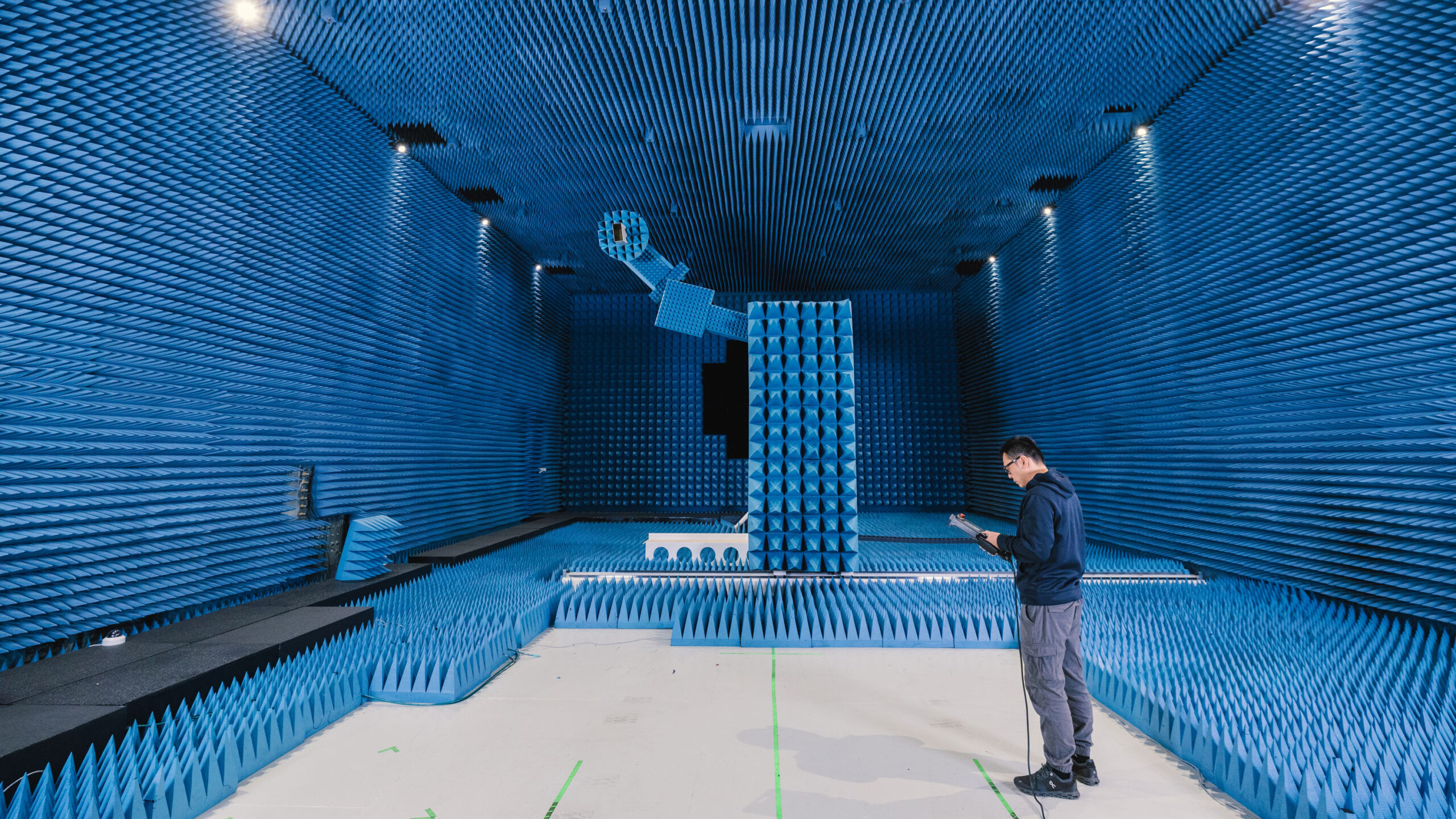
From padded foam chambers at the Epirus HQ, Leonidas devices can be safely tested on drones.

Large tubes remained the best way to emit high-power microwaves for more than half a century, handily outperforming silicon-based solid-state amplifiers. They’re still around—the microwave on your kitchen counter runs on a vacuum tube magnetron. But tubes have downsides: They’re hot, they’re big, and they require upkeep. (In fact, the other microwave drone zapper currently in the Pentagon pipeline, the Tactical High-power Operational Responder, or THOR, still relies on a physical vacuum tube. It’s reported to be effective at downing drones in tests but takes up a whole shipping container and needs a dish antenna to zap its targets.)

By the 2000s, new methods of building solid-state amplifiers out of materials like gallium nitride started to mature and were able to handle more power than silicon without melting or shorting out. The US Navy spent hundreds of millions of dollars on cutting-edge microwave contracts, one for a project at Raytheon called Next Generation Jammer—geared specifically toward designing a new way to make high-powered microwaves that work at extremely long distances.

Lowery, the Epirus CEO, began his career working on nuclear reactors on Navy aircraft carriers before he became the chief engineer for Next Generation Jammer at Raytheon in 2010. There, he and his team worked on a system that relied on many of the same fundamentals that now power the Leonidas—using the same type of amplifier material and antenna setup to fry the electronics of a small target at much closer range rather than disrupting the radar of a target hundreds of miles away. 

The similarity is not a coincidence: Two engineers from Next Generation Jammer helped launch Epirus in 2018. Lowery—who by then was working at the augmented-reality startup RealWear, which makes industrial smart glasses—joined Epirus in 2021 to run product development and was asked to take the top spot as CEO in 2023, as Leonidas became a fully formed machine. Much of the founding team has since departed for other projects, but Raytheon still runs through the company’s collective CV: ex-Raytheon radar engineer Matt Markel started in January as the new CTO, and Epirus’s chief engineer for defense, its VP of engineering, its VP of operations, and a number of employees all have Raytheon roots as well.

Markel tells me that the Epirus way of working wouldn’t have flown at one of the big defense contractors: “They never would have tried spinning off the technology into a new application without a contract lined up.” The Epirus engineers saw the use case, raised money to start building Leonidas, and already had prototypes in the works before any military branch started awarding money to work on the project.

Waiting for the starting gun

On the wall of Lowery’s office are two mementos from testing days at an Army proving ground: a trophy wing from a larger drone, signed by the whole testing team, and a framed photo documenting the Leonidas’s carnage—a stack of dozens of inoperative drones piled up in a heap. 

Despite what seems to have been an impressive test show, it’s still impossible from the outside to determine whether Epirus’s tech is ready to fully deliver if the swarms descend. 

The Army would not comment specifically on the efficacy of any new weapons in testing or early deployment, including the Leonidas system. A spokesperson for the Army’s Rapid Capabilities and Critical Technologies Office, or RCCTO, which is the subsection responsible for contracting with Epirus to date, would only say in a statement that it is “committed to developing and fielding innovative Directed Energy solutions to address evolving threats.” 

But various high-ranking officers appear to be giving Epirus a public vote of confidence. The three-star general who runs RCCTO and oversaw the Leonidas testing last summer told Breaking Defense that “the system actually worked very well,” even if there was work to be done on “how the weapon system fits into the larger kill chain.”

And when former secretary of the Army Christine Wormuth, then the service’s highest-ranking civilian, gave a parting interview this past January, she mentioned Epirus in all but name, citing “one company” that is “using high-powered microwaves to basically be able to kill swarms of drones.” She called that kind of capability “critical for the Army.” 

The Army isn’t the only branch interested in the microwave weapon. On Epirus’s factory floor when I visited, alongside the big beige Leonidases commissioned by the Army, engineers were building a smaller expeditionary version for the Marines, painted green, which it delivered in late April. Videos show that when it put some of its microwave emitters on a dock and tested them out for the Navy last summer, the microwaves left their targets dead in the water—successfully frying the circuits of outboard motors like the ones propelling Houthi drone boats. 

Epirus is also currently working on an even smaller version of the Leonidas that can mount on top of the Army’s Stryker combat vehicles, and it’s testing out attaching a single microwave unit to a small airborne drone, which could work as a highly focused zapper to disable cars, data centers, or single enemy drones. 

Epirus' drone defense unit
Epirus’s microwave technology is also being tested in devices smaller than the traditional Leonidas.

While neither the Army nor the Navy has yet to announce a contract to start buying Epirus’s systems at scale, the company and its investors are actively preparing for the big orders to start rolling in. It raised $250 million in a funding round in early March to get ready to make as many Leonidases as possible in the coming years, adding to the more than $300 million it’s raised since opening its doors in 2018.

“If you invent a force field that works,” Lowery boasts, “you really get a lot of attention.”

The task for Epirus now, assuming that its main customers pull the trigger and start buying more Leonidases, is ramping up production while advancing the tech in its systems. Then there are the more prosaic problems of staffing, assembly, and testing at scale. For future generations, Lowery told me, the goal is refining the antenna design and integrating higher-powered microwave amplifiers to push the output into the tens of kilowatts, allowing for increased range and efficacy. 

While this could be made harder by Trump’s global trade war, Lowery says he’s not worried about their supply chain; while China produces 98% of the world’s gallium, according to the US Geological Survey, and has choked off exports to the US, Epirus’s chip supplier uses recycled gallium from Japan. 

The other outside challenge may be that Epirus isn’t the only company building a drone zapper. One of China’s state-owned defense companies has been working on its own anti-drone high-powered microwave weapon called the Hurricane, which it displayed at a major military show in late 2024. 

It may be a sign that anti-electronics force fields will become common among the world’s militaries—and if so, the future of war is unlikely to go back to the status quo ante, and it might zag in a different direction yet again. But military planners believe it’s crucial for the US not to be left behind. So if it works as promised, Epirus could very well change the way that war will play out in the coming decade. 

While Miller, the Army CTO, can’t speak directly to Epirus or any specific system, he will say that he believes anti-drone measures are going to have to become ubiquitous for US soldiers. “Counter-UAS [Unmanned Aircraft System] unfortunately is going to be like counter-IED,” he says. “It’s going to be every soldier’s job to think about UAS threats the same way it was to think about IEDs.” 

And, he adds, it’s his job and his colleagues’ to make sure that tech so effective it works like “almost magic” is in the hands of the average rifleman. To that end, Lowery told me, Epirus is designing the Leonidas control system to work simply for troops, allowing them to identify a cluster of targets and start zapping with just a click of a button—but only extensive use in the field can prove that out.

Epirus CEO Andy Lowery sees the Leonidas as providing a last line of defense against UAVs.

In the not-too-distant future, Lowery says, this could mean setting up along the US-Mexico border. But the grandest vision for Epirus’s tech that he says he’s heard is for a city-scale Leonidas along the lines of a ballistic missile defense radar system called PAVE PAWS, which takes up an entire 105-foot-tall building and can detect distant nuclear missile launches. The US set up four in the 1980s, and Taiwan currently has one up on a mountain south of Taipei. Fill a similar-size building full of microwave emitters, and the beam could reach out “10 or 15 miles,” Lowery told me, with one sitting sentinel over Taipei in the north and another over Kaohsiung in the south of Taiwan.

Riffing in Greek mythological mode, Lowery said of drones, “I call all these mischief makers. Whether they’re doing drugs or guns across the border or they’re flying over Langley [or] they’re spying on F-35s, they’re all like Icarus. You remember Icarus, with his wax wings? Flying all around—‘Nobody’s going to touch me, nobody’s going to ever hurt me.’”

“We built one hell of a wax-wing melter.” 

Sam Dean is a reporter focusing on business, tech, and defense. He is writing a book about the recent history of Silicon Valley returning to work with the Pentagon for Viking Press and covering the defense tech industry for a number of publications. Previously, he was a business reporter at the Los Angeles Times.


Shape
Shape
Stay Ahead

Explore More Insights

Stay ahead with more perspectives on cutting-edge power, infrastructure, energy,  bitcoin and AI solutions. Explore these articles to uncover strategies and insights shaping the future of industries.

Shape

AI data boom gives tape storage a new lease on life

“We are seeing unprecedented data growth combined with increasing cost, energy, and cyber resilience pressures across the industry,” said Hugues Meyrath, CEO of Quantum in a statement. “As organizations adapt to this new reality, tape is increasingly viewed as a strategic component of modern data infrastructure, delivering predictable economics and

Read More »

DOE’s Alternative Fuels and Feedstocks Office Announces up to $58 Million to Promote Chemical Innovation

WASHINGTON—The U.S. Department of Energy’s (DOE) Alternative Fuels and Feedstocks Office (AFFO) today announced up to $58 million in funding to advance novel, high-impact chemical technologies that use domestically sourced alternative and waste feedstocks. Projects funded through this initiative will advance new methods of chemical production that maximize the use of America’s vast biomass and waste resources. This funding supports President Trump’s Executive Order, Unleashing American Energy, which calls for targeted federal investment in technology innovation that strengthens the U.S. chemical sector.  “By investing in projects that use our abundant domestic resources and build strong industry partnerships, DOE will bolster American chemical manufacturing,” said AFFO Director Valerie Sarisky-Reed. “This funding will turn cutting-edge research into market-ready industrial solutions, strengthening our chemical supply chain, lowering costs for U.S. businesses and consumers, and securing America’s economic future.” The Accelerating Scale-up and Pre-piloting of Emerging Chemical Technologies (ASPECT) funding opportunity promotes the development and commercialization of chemical technologies that lower costs, enhance performance, reduce reliance on imports, and unlock strong market growth potential. ASPECT seeks to reduce time to market by moving projects from laboratory research to pre-pilot scale testing. It includes two main topic areas:  Topic Area 1: Bench ASPECT Proposals should support the development and adoption of new technologies for producing chemicals from alternative feedstocks, moving beyond proof-of-concept to bench and pre-pilot scale. Topic Area 2: Pre-pilot ASPECT Proposals should aim to accelerate the development and market entry of strategically valuable, domestically produced chemicals. AFFO will host an informational webinar for potential applicants on September 11, 2026, to explain the streamlined application and review process.  Applicants must submit concept papers by October 9, 2026, at 5:00 p.m. ET, to be eligible to submit a Stage 1 full application. To learn more about topic areas, registration requirements, applicant eligibility, webinar registration, and the Teaming Partner list, visit the

Read More »

Energy Secretary Secures Carolinas’ Grid Ahead of Holiday Weekend

WASHINGTON—The U.S. Department of Energy (DOE) today issued an emergency order to mitigate the risk of blackouts in the Carolinas amid hot weather conditions. Issued pursuant to Section 202(c) of the Federal Power Act, the order authorizes Duke Energy Carolinas, LLC (Duke) to dispatch specified units and to order their operation as needed to maintain reliability. The order also authorizes Duke, in collaboration with its Transmission Owners, to direct backup generation resources to operate as a last resort before declaring an Energy Emergency Alert (EEA) 3 or during an EEA 3. This order was issued pursuant to an application from Duke submitted on September 3, 2026. “Thanks to this emergency order, Americans will not have to worry about losing access to affordable power this Labor Day weekend,” said U.S. Secretary of Energy Chris Wright. “The previous administration’s energy subtraction policies weakened the grid, leaving Americans more vulnerable during events like this. Under President Trump’s leadership, we are ensuring that hardworking American families and businesses in the Carolinas’ have continued access energy to power and cool their homes.” On day one, President Trump declared a national energy emergency after the Biden administration’s energy subtraction agenda left behind a grid increasingly vulnerable to the risk of blackouts. The order is in effect beginning on September 3, 2026, through September 8, 2026. 

Read More »

President Trump’s Energy Dominance Agenda is Delivering for American Energy Workers

WASHINGTON—This Labor Day, the U.S. Department of Energy (DOE) is celebrating the hardworking men and women who power America with the release of the 2026 U.S. Energy and Employment Report (USEER). The annual report highlights strong job growth across critical energy sectors at the heart of President Trump’s Energy Dominance agenda. America’s most reliable energy sectors are adding jobs and powering industries across the country. These critical sectors deliver the affordable, reliable, and secure energy that American families, businesses, and industries depend on. After years of decline under the previous administration, America’s coal and nuclear power workforces are growing again under President Trump’s leadership. “Energy is the sector that enables every other sector of our economy, and America’s energy workers make it all possible,” said U.S. Secretary of Energy Chris Wright. “These hardworking men and women keep our lights on, our factories running, and our economy growing. President Trump’s Energy Dominance agenda is putting them first and delivering the affordable, reliable, and secure energy America needs.” Energy careers are also delivering bigger paychecks for American workers. The median energy-sector salary reached $63,000—24% higher than the U.S. median salary. America’s growing energy needs are creating the jobs of the future. The 2026 USEER’s new Future Outlook chapter highlights rising demand for skilled energy workers and growing competition for talent across energy and other expanding industries. These trends are opening new pathways to high-paying, skilled careers for American workers. As energy demand grows, America’s energy workforce will power the next generation of American industry, innovation, and economic growth. Highlights from the report include:  •    The median energy-sector salary was $63,000, 24% higher than the national median salary of $51,000. •    Natural gas transmission and distribution added 12,500 workers, growing employment by 5%. •    Nuclear power added 2,300 workers, growing employment by 4%. •    Coal power generation added 2,800 workers, growing

Read More »

Hydrocarbons and Geothermal Energy Office Issues Request for Information to Advance Private Investment in Innovative American Energy Technologies

WASHINGTON — The U.S. Department of Energy’s (DOE) Hydrocarbons and Geothermal Energy Office (HGEO), in collaboration with the Office of Technology Commercialization, today announced a Request for Information (RFI) seeking stakeholder input on opportunities to better connect private capital and public-private partnership programs with coal, oil and gas, and geothermal energy technologies.  The RFI supports President Trump’s American Energy Dominance agenda by strengthening connections among American energy innovators, industry and private capital to accelerate commercialization, lower energy costs, strengthen reliability and energy security, and power American prosperity. This effort builds on the recently announced Small Business Investment Company-Energy (SBIC-E) Initiative, announced by U.S. Energy Secretary Chris Wright and SBA Administrator Kelly Loeffler to mobilize private capital for American energy technologies and businesses.  “President Trump has made American energy innovation and dominance a priority, and connecting promising technologies with the right technical expertise, industry partners and sources of capital is critical to delivering on that vision,” said DOE Acting Assistant Secretary for the Hydrocarbons and Geothermal Energy Office Curt Coccodrilli. “Through this Request for Information, we would like to hear directly from investors, innovators and industry about the opportunities and challenges they see in commercializing coal, oil and gas, and geothermal energy technologies.” “Too often, promising American technologies face barriers between development and commercial deployment,” said Anthony Pugliese, DOE Chief Commercialization Officer and Director of the Office of Technology Commercialization. “We want to better understand where those barriers exist and how DOE can work with the private sector to create stronger pathways to market, helping more American energy technologies scale, compete, and succeed.”  DOE is soliciting feedback from investors, industry, academia, research laboratories, government agencies and other stakeholders to better understand investor interest, barriers and opportunities related to the development and commercialization of subsurface energy technologies.   Areas of interest include, but are not

Read More »

Energy Department Announces Geothermal Center of Excellence to Advance Geothermal Technology Innovation and Development

WASHINGTON — The U.S. Department of Energy’s (DOE) Hydrocarbons and Geothermal Energy Office today established a Geothermal Center of Excellence (CoE) to advance President Trump and Secretary Wright’s commitment to delivering affordable, reliable, and secure energy.  The Center will unite expertise and world-class capabilities from across DOE’s National Laboratories to accelerate the discovery and development of gigawatt-scale geothermal energy, resource discovery, and commercial development.  The National Laboratory of the Rockies (NLR) will lead the consortium, with support from the National Energy Technology Laboratory (NETL).  “America has vast geothermal resources beneath our feet that can provide reliable, around-the-clock energy while strengthening our energy dominance,” said DOE Under Secretary for Energy Kyle Haustveit. “Under President Trump’s leadership, the Geothermal Center of Excellence will leverage the world-class scientific and engineering expertise of our national laboratories in partnership with industry to unlock gigawatt-scale power generation, expand American energy production, and deliver more affordable, reliable, and secure energy to the American people.” DOE formally launched the Center at NLR’s campus in Golden, Colorado, bringing together DOE leadership, elected officials, NLR and NETL leadership, laboratory staff, and industry representatives to advance the Center’s vision and priorities.  “The Geothermal Center of Excellence marks an important step in our work to accelerate gigawatt-scale geothermal energy on the U.S. grid,” said DOE Acting Assistant Secretary for the Hydrocarbons and Geothermal Energy Office Curt Coccodrilli. “By driving innovation and enhancing lab-industry collaboration, the Center will help us achieve our goals to enhance reliable baseload power, strengthen grid reliability, and improve long-term energy security.” The Center will also serve as industry’s main entry point to DOE’s National Laboratories. An Industry Advisory Board will provide objective insight into industry-relevant geothermal research needs, accelerate industry-lab partnerships, and advise on Center priorities.  For more information, contact geo.centerofexcellence@nlr.gov.

Read More »

San Matías Pipeline secures $900 million for Vaca Muerta-to-LNG gas pipeline

The remaining $400 million will be contributed by the consortium’s shareholders: Pan American Energy, YPF, Pampa Energía, Harbour Energy, and Golar LNG. The 472-km, 36-in. OD San Matías Pipeline, which will originate at Tratayén, one of Vaca Muerta’s main gas hubs, is designed to transport 27 million cu m/d (MMcmd) of natural gas, aligned with the gas requirements of the two FLNG units. Hilli Episeyo will have LNG production capacity of 2.45 million tonnes/year (tpy) and will require about 11.5 MMcmd of feed gas. Esperanza, previously known as MKII, will add another 3.5 million tpy and require close to 16 MMcmd of feed gas. Hilli Episeyo is expected to begin operations in 2027, followed by Esperanza in 2028. The project also will include a compressor station with about 46,000 hp of installed capacity to maintain required pressure and flow across the system. Pipeline construction has been awarded to the SICIM-Víctor Contreras consortium, while OPS will be responsible for the Allen compressor station. IEB Construcciones was selected to manage and coordinate the project’s different construction fronts. In August, the first 36-in. line pipe manufactured in India began arriving at the Port of San Antonio Este. Construction is scheduled to begin in August 2026, with completion targeted for mid-2028. The project was admitted to Argentina’s Large Investment Incentive Regime (RIGI) in June and has environmental impact approvals from Neuquén and Río Negro provinces.

Read More »

ERCOT Puts Texas AI Megawatts to the Test

Texas has no shortage of proposed data center megawatts. The harder question is how many of them are real. That distinction is becoming central to the Electric Reliability Council of Texas (ERCOT) as the state works through an unprecedented wave of AI, hyperscale and other large-load requests. In June, ERCOT said it was tracking more than 438 GW of proposed large loads, nearly 89% associated with data centers. By Aug. 3, Gov. Greg Abbott said ERCOT was considering approximately 474 GW of connection requests, roughly 90% from data centers and more than five times the system’s record peak demand. Neither figure represents a forecast of what will actually get built. And that is increasingly the point. ERCOT’s new Batch Zero process is beginning to put harder boundaries around Texas’ enormous development pipeline, asking which projects have enough maturity, technical information and commitment to warrant space in the transmission plan. At the same time, new requirements surrounding voltage ride-through and dynamic modeling are forcing another realization on the AI infrastructure industry: at hundreds of megawatts, a data center is no longer simply a customer at the edge of the grid. Its behavior can affect the grid itself. For developers, utilities and investors, Texas is becoming a large-scale test of what separates an announced AI campus from executable infrastructure. The Queue Is Not the Grid The sheer scale of ERCOT’s large-load queue can obscure how early many projects remain. ERCOT’s April 2026 monthly report offered a revealing snapshot. Large-load applications totaled 445.8 GW through 2033, but 321 GW had no studies submitted to ERCOT. Another 93.7 GW was under ERCOT review, while 22 GW had met the applicable Section 9.5 requirements. Against that enormous development funnel, ERCOT reported just 5.9 GW of observed energized large loads, with another 3.2 GW approved to

Read More »

DCF Trends Summit: AI Compresses the Data Center Hardware Lifecycle and Raises the Stakes for ITAD

The AI infrastructure race is largely a story about getting more computing into data centers faster. But the accelerated hardware cycle is creating an equally consequential problem at the other end of the rack: getting yesterday’s equipment back out while it is still valuable. GPU systems built around increasingly dense and specialized AI architectures are beginning to challenge traditional assumptions about IT asset disposition, or ITAD. Where conventional enterprise infrastructure might remain in service for three to five years, newer GPU platforms can face refresh cycles of 18 to 24 months, according to Josh Humm, Data Center Solutions Manager at Dynamic Lifecycle Innovations. That compression changes the economics as well as the mechanics of decommissioning. “The faster we can get the materials out of your building, the more it’s worth, the more we can return to your program,” Humm said. Humm joined DCF Contributing Editor Doug Black for a DCF Show podcast recorded at the third annual Data Center Frontier Trends Summit, held Aug. 4-6 in Reston, Virginia. Their conversation focused on a less visible part of the AI infrastructure buildout: what happens to servers, accelerators, memory, storage and networking gear when the next generation arrives. The answer increasingly touches facility operations, data security, logistics, sustainability and potentially millions of dollars in recoverable hardware value. AI Hardware Changes the Exit Path AI systems create some obvious physical challenges for decommissioning. Traditional ITAD teams accustomed to pulling 1U and 2U servers out of air-cooled racks may instead encounter liquid-cooling manifolds, substantially heavier systems and equipment requiring specialized rigging and handling procedures. Humm said some systems can weigh between 5,000 and 6,000 pounds. “We’re not pulling out just 1U, 2U servers out of racks anymore,” he said. Liquid cooling adds another layer. Removing infrastructure designed around direct-to-chip or other liquid-cooling architectures can

Read More »

Data Center Jobs: Engineering, Construction, Commissioning, Sales, Field Service and Facility Tech Jobs Available in Major Data Center Hotspots

Each month Data Center Frontier, in partnership with Pkaza, posts some of the hottest data center career opportunities in the market. Here’s a look at some of the latest data center jobs posted on the Data Center Frontier jobs board, powered by Pkaza Critical Facilities Recruiting. Looking for Data Center Candidates? Check out Pkaza’s Active Candidate / Featured Candidate Hotlist  CFD Engineer – Data Center Mechanical Design New York, NY (remote)This position is also available as a remote role anywhere in the U.S. in addition to key markets such as Cedar Rapids, IA; Kansas City, CA or White Plains, NY. Our client is an engineering design and commissioning company that has a national footprint and specializes in MEP critical facilities design. They provide design, commissioning, consulting and management expertise in the critical facilities space. They have a mindset to provide reliability, energy efficiency, and sustainable design expertise when providing these consulting services for enterprise, colocation and hyperscale companies. This career-growth minded opportunity offers exciting projects with leading-edge technology and innovation as well as competitive salaries and benefits.  Electrical Commissioning Agent – Data Centers Columbus, OH (limited travel) Non-traveling CxA positions available in: Indianapolis, IN; Cedar Rapids, IA; Phoenix, AZ; Atlanta, GA and Austin, TX. Traveling CxA based near any major airport, otherwise traveling to: New York, NY; White Plains, NY; Dallas, TX; Richmond, VA; Montvale, NJ; Charlotte, NC; Salt Lake City, UT; Kansas City, MO; Chesterton, IN or Chicago, IL. *** Also looking for a lead EE, ME CxA agents and CxA PMs. *** This opportunity is with a leading EPC company of data center design / build / commissioning solutions. This company provides a complete life cycle of solutions that are custom-fit to the requirements of their client’s mission-critical facilities. This opportunity provides a career-growth minded role with exciting projects with

Read More »

DCFTS 2026: Data Center Development Moves From Projection to Execution

The Data Center Map Gets More Selective For EdgeCore, finding viable development locations has become an exercise in aggressive filtering. Kestler said the company evaluated 172 sites during the previous 12 months to narrow the field to seven locations it wanted to actively manage. Its requirements include roughly 100 acres or more, the ability to support a 300-MVA-or-larger substation, credible utility development timelines and sufficient network proximity to support what Kestler called “interdependent compute” locations. The distinction matters. Not every AI workload needs the same geography, and not every site marketed as available for AI infrastructure can support the combination of land, network, power and timing required to make a project real. Miller placed that process in the context of a data center map already being redrawn by power availability. Northern Virginia’s power constraints in 2022 provided an early warning, redirecting capacity into markets including Atlanta and driving developers farther afield in search of large blocks of electricity. AI has intensified the process. As campus requirements move toward hundreds of megawatts and, in some cases, gigawatt scale, Miller said, fewer locations can satisfy all of the requirements simultaneously. Community acceptance is narrowing the map further. At the same time, Miller pointed to a potential countertrend: the growth of AI inference could create another layer of data center geography. Some inference architectures may favor smaller, distributed facilities rather than concentrating every workload inside enormous campuses. The result could be a more stratified infrastructure market. “Everything everywhere all at once,” Miller said. Build Where Data Centers Are Wanted For large campus development, Kestler offered another increasingly important filter. EdgeCore wants to build where it is wanted. In practical terms, that means targeting municipalities and jurisdictions that have already made deliberate decisions about where data center or other light industrial development belongs. Kestler

Read More »

How States Are Rewriting the Rules for Data Center Growth

Pennsylvania has moved from courting data center investment to setting much stricter terms for how the industry grows. Governor Josh Shapiro’s August 18 executive order creates one of the country’s most comprehensive state-level frameworks for large data centers, linking a more favorable environmental permitting process and state tax treatment to requirements covering power supply, grid costs, local approval, workforce commitments, water use and environmental performance. The order is the latest stage of Shapiro’s Governor’s Responsible Infrastructure Development, or GRID, initiative. GRID was announced in February, detailed in May and partially reinforced through Pennsylvania’s 2026-27 budget in July. The Pennsylvania House also passed legislation intended to codify the standards, but the Senate did not act. Shapiro has now used existing executive and agency authority to put much of the framework into effect immediately. Pennsylvania’s debate has also produced more direct proposals to slow development. Senate Bill 1359 would impose a statewide moratorium on hyperscale data center development and permitting, although the measure remains in the Senate Local Government Committee. A separate measure, Senate Bill 1345, would authorize municipalities to temporarily stop accepting or considering new applications for high-impact data centers for up to 18 months. SB 1345 advanced to second consideration in the Senate in July. Neither measure has become law. What is the Impact on Data Center Development? For data center projects with peak demand exceeding 25 MW, Pennsylvania’s template GRID Consent Order and Agreement provides the mechanism for binding developers to the requirements while allowing the states Department of Environmental Protection (DEP) to review qualifying permit applications on a rolling basis. Developers that decline to sign can still seek permits, but DEP will not begin reviewing their applications until local approvals and required water or wastewater authorizations are secured, and permits will not be handled on a rolling basis.

Read More »

PwC Maps $31.6 Trillion AI Data Center Buildout Through 2050

The scale of the AI infrastructure buildout is becoming easier to describe in trillions than billions. PwC’s inaugural Global Data Centre Outlook 2026–50 projects $31.6 trillion in cumulative global data center capital expenditure through 2050 under its central scenario, with annual spending rising from roughly $800 billion in 2026 to $1.1 trillion in 2030 and $1.8 trillion by 2050. There is also an enormous range around that central case. PwC, working with Oxford Economics, puts plausible cumulative investment at roughly $22 trillion to nearly $50 trillion, depending primarily on how quickly AI adoption progresses. But the most important finding may not be the $31.6 trillion headline. PwC argues that the economics of AI infrastructure are creating a fundamentally different capital cycle from previous infrastructure booms. Data centers are long-lived assets, but the increasingly expensive computing equipment inside them is not. Servers, GPUs, networking systems and other information and communications technology equipment are expected to require replacement on roughly four- to six-year cycles. PwC calculates that every $1 of construction spending can effectively commit the market to approximately $12 of subsequent ICT investment. ICT equipment accounts for about 70% of total data center CapEx in 2026 under its model, rising to 93% by 2050. That creates something closer to a continuously renewing technology platform than a conventional construction cycle. Over a 20-year data center asset life, PwC estimates that a facility could undergo three to five rounds of ICT investment. Increasing rack densities can force corresponding power and cooling upgrades, but the largest recurring expense remains the compute hardware itself. For data center developers and operators, that distinction matters. The economic life of the building increasingly diverges from the technical and financial life of the infrastructure filling it. AI Fragments the Data Center Demand Model The report also sees AI broadening

Read More »

Microsoft will invest $80B in AI data centers in fiscal 2025

And Microsoft isn’t the only one that is ramping up its investments into AI-enabled data centers. Rival cloud service providers are all investing in either upgrading or opening new data centers to capture a larger chunk of business from developers and users of large language models (LLMs).  In a report published in October 2024, Bloomberg Intelligence estimated that demand for generative AI would push Microsoft, AWS, Google, Oracle, Meta, and Apple would between them devote $200 billion to capex in 2025, up from $110 billion in 2023. Microsoft is one of the biggest spenders, followed closely by Google and AWS, Bloomberg Intelligence said. Its estimate of Microsoft’s capital spending on AI, at $62.4 billion for calendar 2025, is lower than Smith’s claim that the company will invest $80 billion in the fiscal year to June 30, 2025. Both figures, though, are way higher than Microsoft’s 2020 capital expenditure of “just” $17.6 billion. The majority of the increased spending is tied to cloud services and the expansion of AI infrastructure needed to provide compute capacity for OpenAI workloads. Separately, last October Amazon CEO Andy Jassy said his company planned total capex spend of $75 billion in 2024 and even more in 2025, with much of it going to AWS, its cloud computing division.

Read More »

John Deere unveils more autonomous farm machines to address skill labor shortage

Join our daily and weekly newsletters for the latest updates and exclusive content on industry-leading AI coverage. Learn More Self-driving tractors might be the path to self-driving cars. John Deere has revealed a new line of autonomous machines and tech across agriculture, construction and commercial landscaping. The Moline, Illinois-based John Deere has been in business for 187 years, yet it’s been a regular as a non-tech company showing off technology at the big tech trade show in Las Vegas and is back at CES 2025 with more autonomous tractors and other vehicles. This is not something we usually cover, but John Deere has a lot of data that is interesting in the big picture of tech. The message from the company is that there aren’t enough skilled farm laborers to do the work that its customers need. It’s been a challenge for most of the last two decades, said Jahmy Hindman, CTO at John Deere, in a briefing. Much of the tech will come this fall and after that. He noted that the average farmer in the U.S. is over 58 and works 12 to 18 hours a day to grow food for us. And he said the American Farm Bureau Federation estimates there are roughly 2.4 million farm jobs that need to be filled annually; and the agricultural work force continues to shrink. (This is my hint to the anti-immigration crowd). John Deere’s autonomous 9RX Tractor. Farmers can oversee it using an app. While each of these industries experiences their own set of challenges, a commonality across all is skilled labor availability. In construction, about 80% percent of contractors struggle to find skilled labor. And in commercial landscaping, 86% of landscaping business owners can’t find labor to fill open positions, he said. “They have to figure out how to do

Read More »

2025 playbook for enterprise AI success, from agents to evals

Join our daily and weekly newsletters for the latest updates and exclusive content on industry-leading AI coverage. Learn More 2025 is poised to be a pivotal year for enterprise AI. The past year has seen rapid innovation, and this year will see the same. This has made it more critical than ever to revisit your AI strategy to stay competitive and create value for your customers. From scaling AI agents to optimizing costs, here are the five critical areas enterprises should prioritize for their AI strategy this year. 1. Agents: the next generation of automation AI agents are no longer theoretical. In 2025, they’re indispensable tools for enterprises looking to streamline operations and enhance customer interactions. Unlike traditional software, agents powered by large language models (LLMs) can make nuanced decisions, navigate complex multi-step tasks, and integrate seamlessly with tools and APIs. At the start of 2024, agents were not ready for prime time, making frustrating mistakes like hallucinating URLs. They started getting better as frontier large language models themselves improved. “Let me put it this way,” said Sam Witteveen, cofounder of Red Dragon, a company that develops agents for companies, and that recently reviewed the 48 agents it built last year. “Interestingly, the ones that we built at the start of the year, a lot of those worked way better at the end of the year just because the models got better.” Witteveen shared this in the video podcast we filmed to discuss these five big trends in detail. Models are getting better and hallucinating less, and they’re also being trained to do agentic tasks. Another feature that the model providers are researching is a way to use the LLM as a judge, and as models get cheaper (something we’ll cover below), companies can use three or more models to

Read More »

OpenAI’s red teaming innovations define new essentials for security leaders in the AI era

Join our daily and weekly newsletters for the latest updates and exclusive content on industry-leading AI coverage. Learn More OpenAI has taken a more aggressive approach to red teaming than its AI competitors, demonstrating its security teams’ advanced capabilities in two areas: multi-step reinforcement and external red teaming. OpenAI recently released two papers that set a new competitive standard for improving the quality, reliability and safety of AI models in these two techniques and more. The first paper, “OpenAI’s Approach to External Red Teaming for AI Models and Systems,” reports that specialized teams outside the company have proven effective in uncovering vulnerabilities that might otherwise have made it into a released model because in-house testing techniques may have missed them. In the second paper, “Diverse and Effective Red Teaming with Auto-Generated Rewards and Multi-Step Reinforcement Learning,” OpenAI introduces an automated framework that relies on iterative reinforcement learning to generate a broad spectrum of novel, wide-ranging attacks. Going all-in on red teaming pays practical, competitive dividends It’s encouraging to see competitive intensity in red teaming growing among AI companies. When Anthropic released its AI red team guidelines in June of last year, it joined AI providers including Google, Microsoft, Nvidia, OpenAI, and even the U.S.’s National Institute of Standards and Technology (NIST), which all had released red teaming frameworks. Investing heavily in red teaming yields tangible benefits for security leaders in any organization. OpenAI’s paper on external red teaming provides a detailed analysis of how the company strives to create specialized external teams that include cybersecurity and subject matter experts. The goal is to see if knowledgeable external teams can defeat models’ security perimeters and find gaps in their security, biases and controls that prompt-based testing couldn’t find. What makes OpenAI’s recent papers noteworthy is how well they define using human-in-the-middle

Read More »