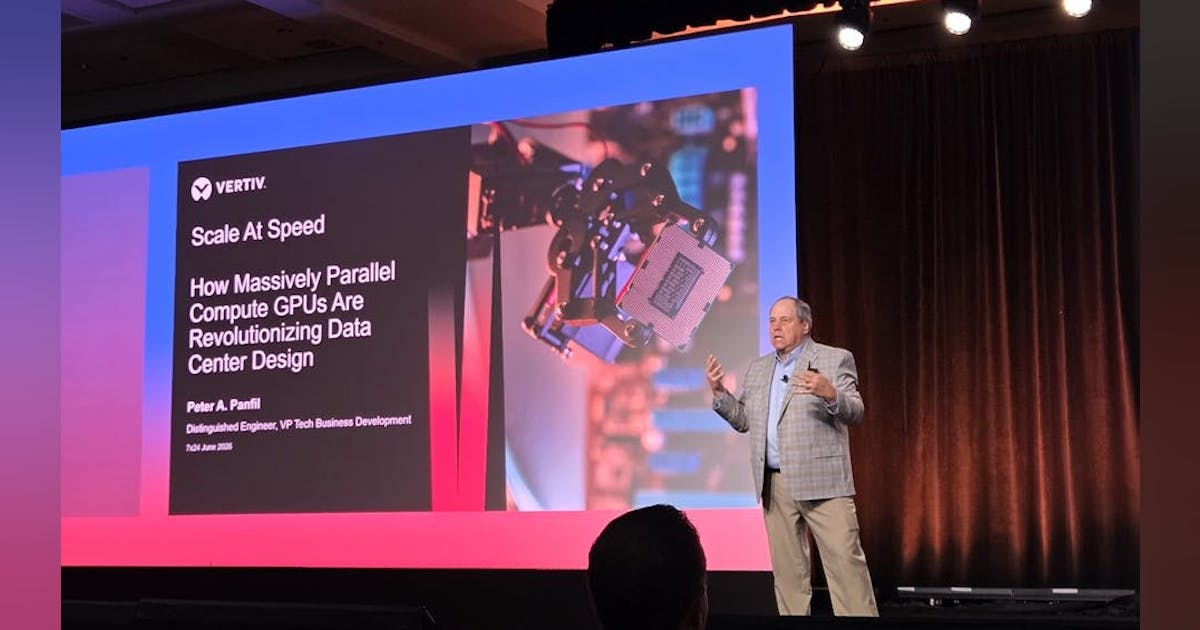
ORLANDO, Fla. — For years, the data center industry optimized individual systems: power distribution, cooling, racks, UPS equipment, and mechanical infrastructure. In the AI era, according to Vertiv Distinguished Engineer and Vice President of Technical Business Development Peter Panfil, that approach is no longer sufficient.
Speaking during Wednesday morning’s keynote at the 2026 7×24 Exchange Spring Conference, Panfil presented a vision in which the data center itself becomes a single, tightly orchestrated computing appliance—truly an “AI factory” whose success depends less on standalone components than on the seamless interaction between them.
Throughout his presentation, titled “Scale at Speed: How Massively Parallel Compute GPUs Are Revolutionizing Data Center Design,” Panfil repeatedly returned to a single imperative: the AI infrastructure race is increasingly defined by execution velocity.
“If you think you’re going big enough, go bigger,” he told attendees. “If you think you’re going fast enough, you’re going to have to go faster.”
For an industry gathered under the conference’s overarching theme of future-proofing AI infrastructure, Panfil’s message suggested something subtly different. Rather than trying to predict the future, operators should build systems capable of adapting to it.
“I would much rather be future ready,” he said, “than future proof.”
Speed Becomes the New Competitive Metric
One of the keynote’s recurring themes was that deployment speed has become an economic variable in its own right.
Panfil argued that hyperscalers and AI providers increasingly view time-to-capacity as directly tied to business value, making delays in construction or commissioning far more expensive than traditional infrastructure inefficiencies.
“The cost of speeding up has real benefits right now,” he observed.
That urgency is changing the way facilities are assembled. Rather than coordinating numerous independent contractors and subsystem vendors on-site, Panfil described an emerging model built around highly standardized, factory-produced HAC [hot aisle containment] modules—or “hacks”—that arrive largely complete and require only connection rather than construction.
“These days of disconnected pieces are over,” he said. “The systems now have to be tightly woven together because they are all dependent on each other.”
He emphasized that failures often occur not within products themselves but “at the seams,” where equipment, organizations, or project phases intersect. Eliminating those seams through repeatable building blocks and integrated design, he argued, is becoming a prerequisite for scaling AI deployments.
From 1.5 MW Pods to 6 MW—and Soon 12 MW
Among the most striking examples Panfil shared was the rapid evolution of AI infrastructure modules.
Just a year ago, he said, Vertiv was designing approximately 1.5-megawatt integrated compute units. Following NVIDIA’s updated GPU roadmap, those designs have expanded dramatically.
“We’re putting into a hack what we used to put into an entire room,” he said.
Current deployments now reach approximately 6 megawatts per integrated module, with discussions already underway around 12-megawatt configurations.
These modules are increasingly assembled and tested in factories—including full fluid charging and capacity validation—before being transported to site, craned into place, connected to power and liquid, and rapidly commissioned.
The shift reflects a broader manufacturing philosophy Panfil repeatedly described as normalization rather than standardization: performing the same operations repeatedly to improve speed, quality, and scalability.
AI Changes the Infrastructure Equation
Panfil argued that one of AI’s least appreciated effects is how dramatically it changes the composition of the modern data center itself.
“In the cloud world, we were 20% infrastructure and 80% compute because we were dealing with 10-kilowatt racks,” he told the audience. “Now that we’re dealing with 100-plus-kilowatt racks, it’s completely flipped. Twenty percent of the data center now is the compute. Eighty percent is the physical infrastructure.”
That inversion carries profound design implications. As rack densities continue climbing toward several hundred kilowatts and eventually beyond, the supporting ecosystem of electrical distribution, liquid cooling, coolant distribution units, pumping, heat rejection, and power conversion increasingly dictates facility architecture.
For Panfil, this shift explains why thermal management and power delivery can no longer be treated as supporting systems. They have become the primary engineering challenge around which next-generation AI facilities must be designed.