Stay Ahead, Stay ONMINE

Ghana’s TOR proposes expanding Tema refinery to 200,000 b/sd by 2029

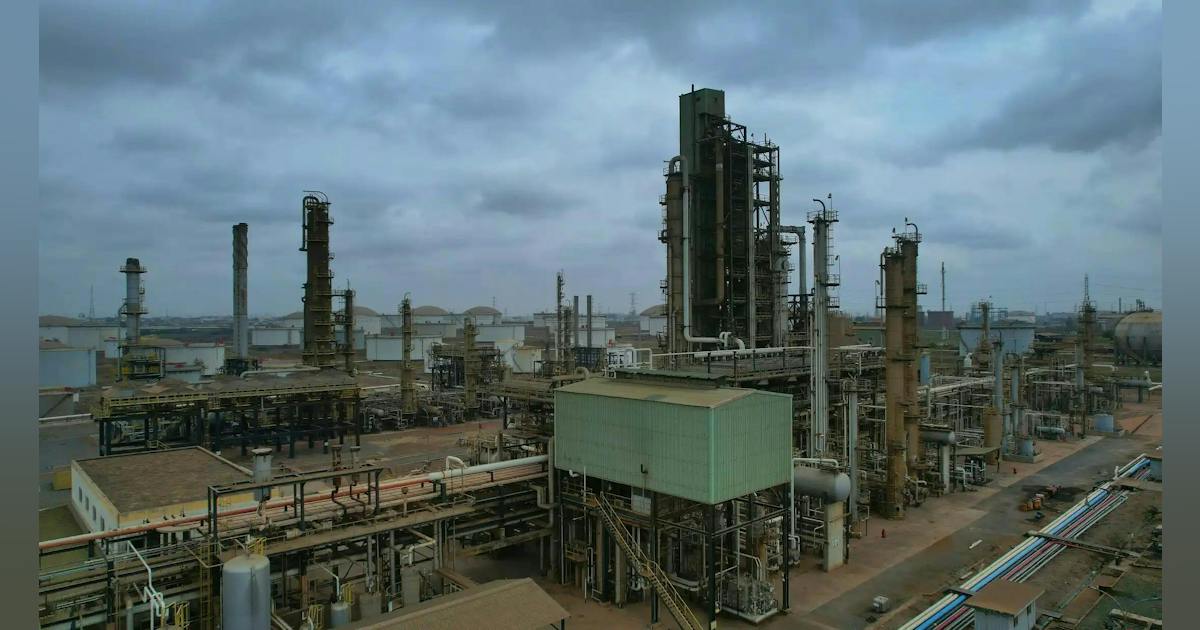
Tema Oil Refinery (TOR) Ltd. has revealed a proposed 4-year plan involving expanding its existing 45,000-b/sd refinery in Heavy Industrial Area, Tema, Ghana, and building a second plant at the site to raise combined crude-processing capacity up to 200,000 b/sd. TOR’s managing director Edmond Kombat announced the Restoration and Legacy Projects (RLP) program for 2026-29 […]

Tema Oil Refinery (TOR) Ltd. has revealed a proposed 4-year plan involving expanding its existing 45,000-b/sd refinery in Heavy Industrial Area, Tema, Ghana, and building a second plant at the site to raise combined crude-processing capacity up to 200,000 b/sd.

TOR’s managing director Edmond Kombat announced the Restoration and Legacy Projects (RLP) program for 2026-29 at a Government Accountability Series press conference on Oct. 26 in Accra, Ghana, the government’s Ghana News Agency reported.

As proposed, the RLP program would include a brownfield project to increase the existing refinery’s capacity by 40,000 b/sd to 85,000 b/sd alongside grassroots construction of a new refinery presumably co-located at the site with a design processing capacity of 115,000 b/sd.

TOR did not provide any details related to project costs, financing details, construction schedules, or anticipated production yields.

The operator said the planned expansion comes as part of a plan to address Ghana’s petroleum-product demand and create opportunities for exports as a value-addition measure to help support the country’s economy.

In addition to the proposed refining installations, RLP program will involve construction of social infrastructure in and around Tema, including a planned specialty hospital with a burn and trauma center to serve the Tema industrial enclave and the wider Greater Accra region with specialized care for industrial accidents and thermal injuries.

For staff housing, the refinery said it is also working with the Ghana Home Ownership Fund on a domicile project to be built on existing TOR land. The company, however, did not specify the number of homes or a construction timeline involved in the development.

Refinery restart prompts proposed expansion

The newly announced RLP program follows TOR’s confirmation of the refinery’s return to crude processing in December 2025 after multiple years of inactivity.

The late-2025 restart occurred after TOR’s completion of major turnaround maintenance between Aug. 1-Oct. 30, 2025, on the complex’s crude distillation unit (CDU), subsequent to which the refiner received clearance from Ghana’s National Petroleum Authority to resume operations.

Crude processing officially resumed on Dec. 19, 2025, the company said, with petroleum products transferred to storage. At the time, TOR described operations as undergoing a phased transition to stabilize systems and improve reliability.

Additional works completed during the scheduled turnaround included installation of a new furnace, F-61, which TOR said would enable returning the refinery to its original 45,000-b/sd nameplate capacity when commissioned and integrated into the CDU.

While TOR’s late-December 2025 statement also identified a medium-term pathway to 60,000 b/sd following installation of a new air cooler, neither the company’s Oct. 26 nor Feb. 27 statements regarding operations at the site did not address whether those milestones had been completed.

Long in its making amid the refinery’s periods of ongoing inoperability, TOR’s newly unveiled program would substantially increase the state-owned refinery’s planned processing capacity as fellow state-mandated company Petroleum Hub Development Corp. (PHDC) moves into the proposed $28-billion second phase of Ghana’s $60-billion multiphased petroleum hub to be built in the Jomoro municipal district of the country’s Western Region.


Shape
Shape
Stay Ahead

Explore More Insights

Stay ahead with more perspectives on cutting-edge power, infrastructure, energy,  bitcoin and AI solutions. Explore these articles to uncover strategies and insights shaping the future of industries.

Shape

HPE extends AI-driven networking to SD-WAN and SASE

In a blog post explaining how the system works, Gabriel Gomane, HPE senior product marketing manager, wrote: “In HPE Mist, HPE Mist Networking WAN Assurance aggregates telemetry from HPE Networking EdgeConnect to measure end-user experience using service level expectations (SLEs) and simplify troubleshooting. WAN Insights provides visibility into device status,

Read More »

Is it time to retire VPNs?

To get a sense of the architectural question, I reached out to Zscaler, an early pioneer of zero trust. Adam Geller, the company’s chief product officer, said, “The recurring vulnerabilities in legacy VPNs aren’t isolated software bugs. They are an architectural limitation.” Geller added, “Legacy VPNs expose perimeter gateways to

Read More »

Neuquén awards eight blocks to expand Vaca Muerta exploration

Argentina’s Neuquén province awarded eight blocks to PCR, Patagonia Energy, GeoPark, JPM Energía, the Phoenix–Continental Resources partnership, and Selva María Oil in a round intended to expand exploration of Vaca Muerta. Committed work programs include 11 horizontal wells to assess acreage outside the formation’s main commercial developments. The awards were made Oct. 21 under Round 1/2026 of the Neuquén Exploration Plan, organized by Gas y Petróleo del Neuquén (GyP). The provincial company will retain an interest in all the blocks. The round attracted 20 bids from 10 bidders for eight of the 15 areas offered. Petrolera Comodoro Rivadavia (PCR) secured three blocks: La Tropilla I, Águila Mora Noreste, and Santo Domingo II. Its program includes one horizontal well per block, each with a 1,500-m lateral and 25 hydraulic fracturing stages. The company will also acquire and process 3D seismic data covering a total of 380 sq km. Patagonia Energy secured Corralera Noroeste, where it will drill three horizontal wells with 3,000-m laterals and a combined 150 fracturing stages. Its commitment also includes 85 sq km of 3D seismic. GeoPark will add Corralera Noreste to its portfolio. The initial program comprises two horizontal wells, each with a 2,000-m lateral and 30 fracturing stages, during a 4-year exploration period. The company will hold a 90% working interest, with GyP retaining 10%. JPM Energía secured Pampa de las Yeguas II NE. Its proposal includes one horizontal well with a 3,000-m lateral and 53 fracturing stages. The Phoenix–Continental Resources partnership was selected for Corralera Sur, with a program comprising one horizontal well with a 1,500-m lateral and 14 fracturing stages. Seismic work includes 150 sq km of acquisition and 105 sq km of specialized processing. Selva María Oil secured Chasquivil Sur, where it will drill one horizontal well with a 1,500-m lateral and 30

Read More »

Ghana’s TOR proposes expanding Tema refinery to 200,000 b/sd by 2029

Tema Oil Refinery (TOR) Ltd. has revealed a proposed 4-year plan involving expanding its existing 45,000-b/sd refinery in Heavy Industrial Area, Tema, Ghana, and building a second plant at the site to raise combined crude-processing capacity up to 200,000 b/sd. TOR’s managing director Edmond Kombat announced the Restoration and Legacy Projects (RLP) program for 2026-29 at a Government Accountability Series press conference on Oct. 26 in Accra, Ghana, the government’s Ghana News Agency reported. As proposed, the RLP program would include a brownfield project to increase the existing refinery’s capacity by 40,000 b/sd to 85,000 b/sd alongside grassroots construction of a new refinery presumably co-located at the site with a design processing capacity of 115,000 b/sd. TOR did not provide any details related to project costs, financing details, construction schedules, or anticipated production yields. The operator said the planned expansion comes as part of a plan to address Ghana’s petroleum-product demand and create opportunities for exports as a value-addition measure to help support the country’s economy. In addition to the proposed refining installations, RLP program will involve construction of social infrastructure in and around Tema, including a planned specialty hospital with a burn and trauma center to serve the Tema industrial enclave and the wider Greater Accra region with specialized care for industrial accidents and thermal injuries. For staff housing, the refinery said it is also working with the Ghana Home Ownership Fund on a domicile project to be built on existing TOR land. The company, however, did not specify the number of homes or a construction timeline involved in the development. Refinery restart prompts proposed expansion The newly announced RLP program follows TOR’s confirmation of the refinery’s return to crude processing in December 2025 after multiple years of inactivity. The late-2025 restart occurred after TOR’s completion of major turnaround

Read More »

Howard Energy Partners expands Anadarko position with Iron Horse Midstream acquisition

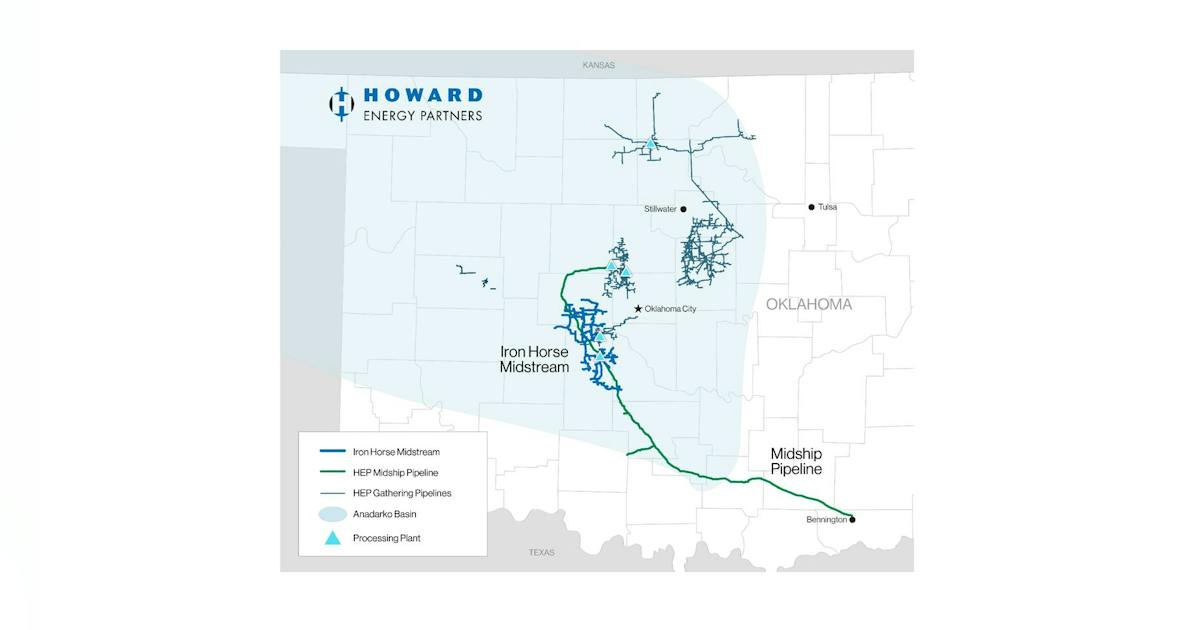
Howard Energy Partners (HEP), San Antonio, Tex., has agreed to acquire Iron Horse Midstream, a portfolio company of Sixth Street, expanding its position in the Anadarko Basin. Financial details were not disclosed. The acquisition includes about 400 miles of high- and low-pressure natural gas pipelines in Canadian, Caddo, and Grady counties in Oklahoma, multiple compressor stations, and the 120-acre Iron Horse processing complex with a capacity of 425 MMcfd of natural gas. The acquisition is supported by multi-decade customer contracts covering about 167,000 dedicated acres, the company said in a release Oct. 27. Herbie Goldstein, HEP’s chief financial officer and head of corporate development, said the company aims to “further develop the infrastructure needed to connect this prolific basin with growing natural gas markets across Oklahoma, Texas, and the Gulf Coast.” With this deal, the private energy infrastructure company will have invested about $2.5 billion in US Midcontinent acquisitions over the past 2 years. Earlier this year, HEP bought the remaining ownership interest in the Midship natural gas pipeline and acquired Superior Midstream, a Tulsa-based natural gas gathering and processing company. With all three deals, HEP’s footprint in Oklahoma will include nearly 2,000 miles of pipelines with about 2 bcfd of capacity, 580 MMcfd of natural gas processing capacity, and 540,000 compression horsepower. The deal to acquire Iron Horse Midstream is scheduled to close by yearend, subject to customary closing conditions and regulatory approvals.

Read More »

Capacity, clarity, cash and compliance: the 4 C’s of electric co-op funding success

Listen to the article 8 min This audio is auto-generated. Please let us know if you have feedback. Aalap Shah is president and CEO of Fedsprout, which helps electric cooperatives and utilities manage federal and state awards. If you ask a lineman what it takes for a storm restoration to go well, the answer is usually not about having the right tools or truck. Quick restoration relies on good training, a plan before getting to the first pole and adequate back-office support. Federal funding works the same way and the latest federal programs are demanding even more. Aalap Shah I’ve worked with electric cooperatives across 14 states and I’ve come to realize there is a pattern. Cooperative utilities do not have an eligibility problem, and most qualify for federal and state funding programs. Yet some co-ops never apply for funding. Others win an award and lose part of it because of disallowed costs.  In its October outlook, the U.S. Energy Information Administration expects record electricity demand this year and next, and projects the average U.S. residential electricity price at 18.2 cents/kWh this year, up from 16.5 in cents/kWh in 2024. Co-ops need funding to support load growth and reliability improvements while keeping rates affordable for members.  In my experience, co-ops that win federal and state funding stand apart in four areas, before and after the award: capacity, clarity, cash and compliance. The capacity gap is clearly visible across most rural and small co-ops. At a typical co-op, the person who writes the funding application is the same person who runs finance and human resources. They often manage the award, too. Clarity is not as apparent. Hundreds of federal and state programs are published each year and knowing which one fits the co-op’s needs and what sways the funder needs a

Read More »

BNEF ups US energy storage deployment forecast by 30%

Dive Brief: Despite trade barriers and project cost inflation, the U.S. is set to deploy 30% more energy storage capacity over the next 10 years than expected just six months ago, BloombergNEF said Thursday. BNEF forecasts cumulative U.S. deployments of 213.9 GW by 2030 and 434.4 GW by 2036, BNEF senior energy storage analyst Isshu Kikuma told Utility Dive. The latest edition of the energy consultancy’s semiannual energy storage outlook sees global deployments reaching 3,098 GW/11,106 GWh in 2036, roughly 10 times today’s levels. In the U.S., near-term drivers include favorable economics for colocated storage and renewables and data centers’ growing appetite for both behind-the-meter and front-of-meter capacity, BNEF said. BNEF’s report landed amid signs of continued momentum for the U.S. energy storage industry. On Thursday, Google said it would expand by a factor of 10 the battery-supported virtual power plant it plans to deploy with Voltus in the PJM Interconnection, to more than 1 GW. The same day, the sodium-ion battery manufacturer Peak Energy said it closed $108 million in financing from General Motors and other backers as it works to deploy nearly 5 GWh of capacity by 2030. Dive Insight: Energy storage deployments have far outpaced solar capacity additions in recent years, with the global cumulative installed solar-to-storage ratio falling from 94:1 in 2016 to 7:1 in 2026, BNEF said Thursday.  BNEF sees the capacity ratio stabilizing at 4:1 in 2030, and annual deployments remaining steady at 3:1 thereafter, as the energy storage industry matures. Much of the new solar and storage capacity is colocated. The United States had installed 20.7 GW/66.4 GWh of energy storage projects colocated with 41.3 GW of solar by the end of 2025, about 30% of total colocated solar-plus-storage capacity, according to BNEF. Some 4 GW of storage was colocated with solar in

Read More »

Timor GAP to acquire Woodside stake in Greater Sunrise project

Timor Gás & Petróleo EP (Timor GAP) agreed to acquire Woodside Energy Ltd.’s entire 33.44% participating interest in the Sunrise joint venture, including interests covering Greater Sunrise fields in the Timor Sea, for $200 million. The acquisition would once again increase Timor GAP’s interest in the project, following its previously announced agreement to acquire Osaka Gas’ 10% interest in the joint venture.  Upon closing of the two transactions, Timor GAP would hold 100% interest in Greater Sunrise, allowing the company to progress toward development via pipeline to Natarbora on Timor-Leste’s south coast. The development concept is enabled under the Maritime Boundaries Treaty between Timor-Leste and Australia. The Sunrise and Troubadour gas-condensate fields, collectively known as Greater Sunrise, lie about 150 km southeast of Timor-Leste and 450 km northwest of Darwin in Australia’s Northern Territory. The complex is estimated to hold 5.1 tcf of gas and 226 million bbl of condensate.  The transaction is targeted to close in first-half 2027, subject to government, regulatory, and joint-venture approvals. At closing, Timor GAP will pay base consideration of $13.71 million. A further $11.29 million will be payable within 30 days of a final investment decision, while a production-contingent payment of $175 million will be due within 365 days of first-cargo loading for customer sale.

Read More »

At 7×24 Exchange, AI Data Center Growth Confronts New Realities of Power, Grid Reliability and Community Trust

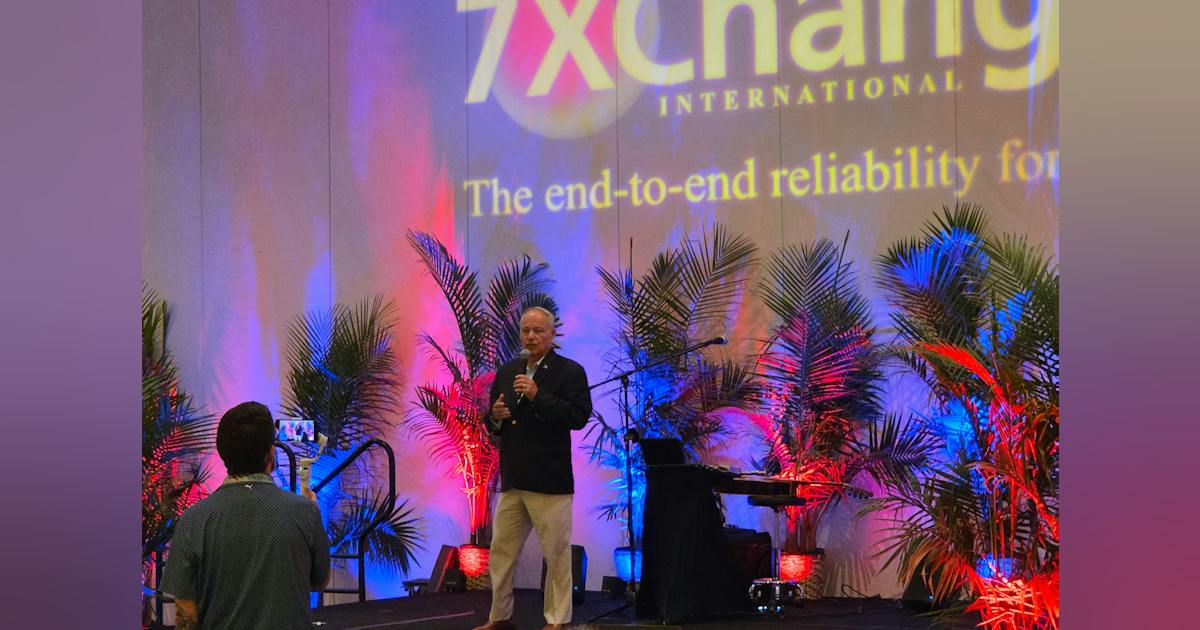
DC BLOX: Community Engagement Must Go Beyond Public Relations The afternoon program shifted attention from electrical infrastructure to the growing challenges surrounding data center development and community acceptance. In a discussion moderated by Juli Ierulli, strategic account manager at Environmental Air Systems and vice president of 7×24 Exchange International, Michael Clark, senior vice president of data center construction at DC BLOX, described how the company has revised its approach to engaging communities as it expands into new markets. Clark acknowledged that DC BLOX had encountered significant opposition after entering markets where it lacked the established relationships that had supported earlier developments across the Southeast. “We made multiple stumbles in some of those new markets,” he said, describing how the company sometimes found itself responding to negative publicity rather than presenting a clear explanation of its plans and commitments. The experience led DC BLOX to develop a more systematic approach to community engagement, emphasizing early communication, site-specific websites, accessible explanations of resource consumption and written commitments that residents and officials can evaluate. Clark also pointed to what he called the industry’s “NDA hangover,” reflecting years of development activity conducted under confidentiality agreements that frequently left neighboring communities unaware of what was being planned. But perhaps the most revealing moment came when Clark recounted a conversation with residents near a DC BLOX development in Rockdale County, Georgia. After the company outlined the countywide economic and community benefits expected from the project, one neighbor challenged the distribution of those benefits. “So the rest of the county gets the benefit and we have to pay all the costs,” the resident observed, according to Clark. The question captured a fundamental tension in the industry’s community engagement efforts: tax revenues and economic development benefits may extend across a county, while nearby residents experience the immediate effects

Read More »

NVIDIA’s DSX POD Pushes AI Factory Construction Toward the Assembly Line

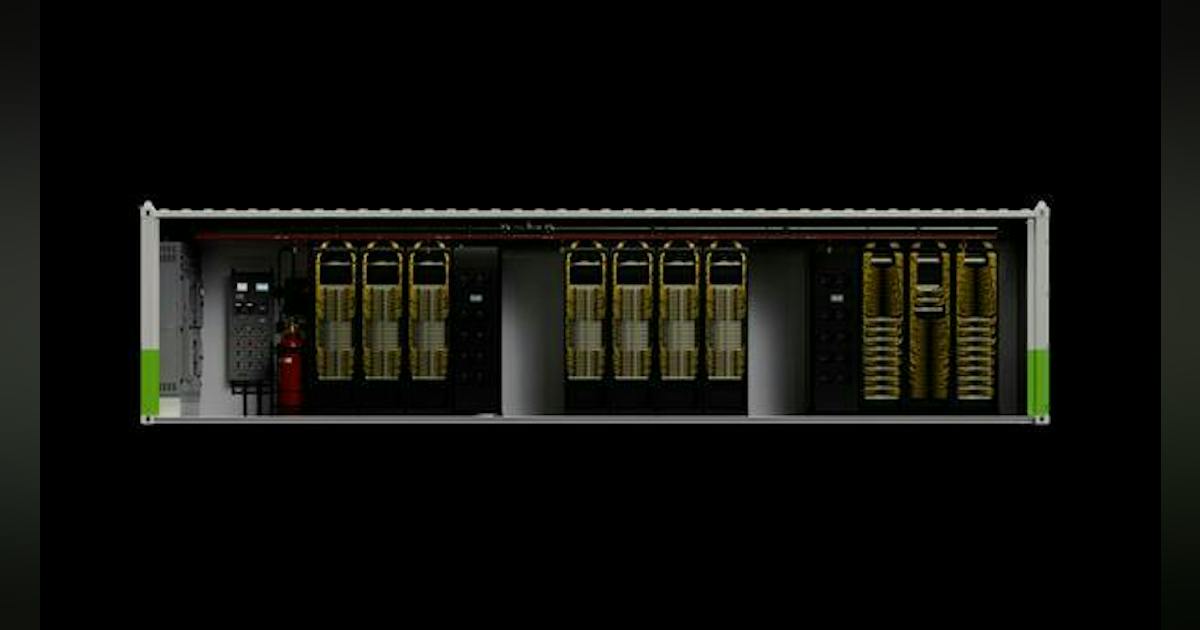
Crusoe Brings an Established Modular Model to DSX POD For Crusoe, NVIDIA’s announcement builds on a modular computing strategy already in operation. In its October 21 announcement, Crusoe confirmed that its Spark modular AI data center platform will support DSX POD, extending a manufacturing and deployment approach the company says it has pursued since 2020. Crusoe has expanded its manufacturing capabilities through the acquisition of electrical equipment specialist Easter-Owens Electric and the development of its 352,000-square-foot Crusoe Spark Factory in Brighton, Colorado. The company also introduced Crusoe Spark Liquid, a sixth-generation modular system engineered for ultra-high-density infrastructure, including NVIDIA Vera Rubin NVL72. Next-generation liquid-cooled units are planned for 2027. Crusoe’s vertically integrated model connects infrastructure design and manufacturing with deployment and cloud operations through Crusoe Cloud. The company says it can deliver productive AI capacity in as little as three months, although that timeline is distinct from NVIDIA’s narrower 14-day prepared-site deployment claim. “Modular isn’t a new strategy or pivot for us. It’s been in our DNA since our founding,” said Bryan Schramm, Crusoe’s head of Spark. Crusoe’s involvement demonstrates that the manufacturing model predates DSX POD. NVIDIA is not inventing modular data center infrastructure; it is attempting to establish a common architecture around capabilities that suppliers such as Crusoe have already spent years developing. That distinction matters as the industry evaluates whether standardized AI factory designs can deliver manufacturing efficiencies at a scale beyond individual suppliers’ existing operations. Vertiv and Polar Put the Deployment Model to Work in Norway The European dimension of NVIDIA’s announcement is reflected in a deployment involving Vertiv and Polar Data Centers at Herøya, Norway. According to Vertiv’s October 21 announcement, Polar is applying a factory-built infrastructure approach to the initial 41 MW phase of a multiphase AI data center campus designed to scale to

Read More »

Hyperscalers allow more scrutiny of controversial data center plans

Hyperscalers are getting decidedly twitchy about citizens’ reactions to their secretive data center construction plans, and are looking for ways to de-escalate some of the conflicts. Earlier this month, Amazon announced its Data Center Commitment which, among other things, would disclose more information about energy and water use and consider a moratorium asking government officials to sign non-disclosure agreements covering their planning applications. Amazon is not alone in this. Earlier this week, Meta said that it was reviewing its use of NDAs after the company was widely criticized for its secrecy in proposing Hyperion, a Louisiana data center in July.

Read More »

Google will pay people to use less electricity so its data centers can use more

Google has an answer to some of the electricity supply problems that data center construction is causing: It has signed an agreement with energy supplier Voltus to build what it’s calling a 1-gigawatt virtual power plant, expanding on an earlier 100 megawatt deal the two signed earlier this year. This power plant is virtual in the sense that it doesn’t generate any electricity itself, but aggregates so-called flexible grid capacity into one central resource that can be deployed at times of peak demand. This flexible capacity can be in the form of batteries or of load-shedding: asking others to temporarily stop consuming electricity by shutting down industrial processes or adjusting tens of thousands of smart thermostats at once, effectively moving their electricity usage to a time when there is less demand. Voltus operates by offering incentives to companies to reduce their power consumption temporarily, and also offers inducements to electricity resellers that they can pass on to their customers.

Read More »

Big Tech’s Next Nuclear Bet: More Power From Reactors Already Running

The next wave of nuclear power for AI data centers may come not from new reactors, but from generating stations that have been operating for decades. In a pair of agreements announced just a week apart, Google and Amazon committed to long-term electricity purchases supporting approximately 1,080 MW of additional nuclear generating capacity from Constellation Energy’s existing fleet. The transactions follow earlier commitments by Meta to support reactor upgrades at operating nuclear facilities in Ohio, Pennsylvania and Illinois, establishing a broader commercial model in which hyperscale technology companies help finance increases in nuclear output. Under its October 6 agreement with Google, Constellation plans to invest more than $4.3 billion in equipment and technology upgrades at 11 operating reactor units across Illinois, Pennsylvania and New Jersey. The 20-year power purchase agreement supports 890 MW of new generating capacity, with the first upgrades expected to begin delivering additional electricity in 2028. A separate 15-year agreement covers 2,700 MW of existing nuclear generation, underscoring the distinction between securing today’s electricity supply and financing additional capacity. Amazon’s September 30 agreement similarly supports 190 MW of new generation at Maryland’s Calvert Cliffs nuclear station, alongside purchases of existing output. Together, the two arrangements underpin more than $7 billion in planned infrastructure investment. Unlike proposed advanced reactors, these facilities already have operating licenses, grid connections, established workforces and decades of operating experience. Increasing their output avoids some of the cost, permitting and construction challenges associated with building entirely new nuclear plants, although significant upgrades still require extensive engineering, equipment modifications and regulatory approval. The potential scale is substantial. According to the Nuclear Regulatory Commission’s current application schedule, the agency anticipates 31 applications for reactor power uprates through 2032, representing approximately 2,421 MW of potential additional electrical generating capacity. That is roughly equivalent to the output of

Read More »

AMD Helion Puts CPU Density at the Center of Agentic AI Infrastructure

AMD expects the growth of agentic applications to substantially increase demand for server CPUs alongside GPU infrastructure. During her October 12 OCP keynote, CEO Lisa Su said the company now projects the server CPU market will exceed $200 billion by 2030, a significant upward revision from its earlier $120 billion estimate. While that remains AMD’s market forecast rather than an independent measure of future demand, it underscores the company’s conviction that general-purpose computing will play a much larger role in AI infrastructure. Two Rack Designs for Different Markets Helion’s two principal configurations reflect different approaches to deploying and managing agentic workloads. For hyperscale operators, the architecture emphasizes high-density CPU infrastructure dedicated to agent execution, with model inference handled by separate GPU-accelerated systems. This separation allows operators to expand CPU and GPU capacity independently, potentially improving resource utilization as the balance between agent activity and inference demand changes. The approach also introduces infrastructure considerations. Agents may communicate repeatedly with models hosted elsewhere in a data center or across distributed environments, making network performance, latency and workload orchestration important factors in overall system efficiency. The ability to scale computing resources independently is an architectural advantage, but realizing that benefit will depend on how effectively those resources are connected and managed. For enterprise deployments, Helion takes a more integrated approach, combining EPYC CPU blades, Instinct MI350P GPU blades and general-purpose computing resources within the same rack. The reference design accommodates up to 16 MI350P accelerators in two independent eight-GPU servers, each occupying five rack units. These GPU nodes operate separately rather than through a common rack-level scale-up fabric, reflecting the architecture’s emphasis on enterprise inference rather than the tightly coupled accelerator environments used for frontier-model training. The enterprise configuration also accommodates dedicated resources for databases, storage and technical computing, supporting the broader range

Read More »

Microsoft will invest $80B in AI data centers in fiscal 2025

And Microsoft isn’t the only one that is ramping up its investments into AI-enabled data centers. Rival cloud service providers are all investing in either upgrading or opening new data centers to capture a larger chunk of business from developers and users of large language models (LLMs).  In a report published in October 2024, Bloomberg Intelligence estimated that demand for generative AI would push Microsoft, AWS, Google, Oracle, Meta, and Apple would between them devote $200 billion to capex in 2025, up from $110 billion in 2023. Microsoft is one of the biggest spenders, followed closely by Google and AWS, Bloomberg Intelligence said. Its estimate of Microsoft’s capital spending on AI, at $62.4 billion for calendar 2025, is lower than Smith’s claim that the company will invest $80 billion in the fiscal year to June 30, 2025. Both figures, though, are way higher than Microsoft’s 2020 capital expenditure of “just” $17.6 billion. The majority of the increased spending is tied to cloud services and the expansion of AI infrastructure needed to provide compute capacity for OpenAI workloads. Separately, last October Amazon CEO Andy Jassy said his company planned total capex spend of $75 billion in 2024 and even more in 2025, with much of it going to AWS, its cloud computing division.

Read More »

John Deere unveils more autonomous farm machines to address skill labor shortage

Join our daily and weekly newsletters for the latest updates and exclusive content on industry-leading AI coverage. Learn More Self-driving tractors might be the path to self-driving cars. John Deere has revealed a new line of autonomous machines and tech across agriculture, construction and commercial landscaping. The Moline, Illinois-based John Deere has been in business for 187 years, yet it’s been a regular as a non-tech company showing off technology at the big tech trade show in Las Vegas and is back at CES 2025 with more autonomous tractors and other vehicles. This is not something we usually cover, but John Deere has a lot of data that is interesting in the big picture of tech. The message from the company is that there aren’t enough skilled farm laborers to do the work that its customers need. It’s been a challenge for most of the last two decades, said Jahmy Hindman, CTO at John Deere, in a briefing. Much of the tech will come this fall and after that. He noted that the average farmer in the U.S. is over 58 and works 12 to 18 hours a day to grow food for us. And he said the American Farm Bureau Federation estimates there are roughly 2.4 million farm jobs that need to be filled annually; and the agricultural work force continues to shrink. (This is my hint to the anti-immigration crowd). John Deere’s autonomous 9RX Tractor. Farmers can oversee it using an app. While each of these industries experiences their own set of challenges, a commonality across all is skilled labor availability. In construction, about 80% percent of contractors struggle to find skilled labor. And in commercial landscaping, 86% of landscaping business owners can’t find labor to fill open positions, he said. “They have to figure out how to do

Read More »

2025 playbook for enterprise AI success, from agents to evals

Join our daily and weekly newsletters for the latest updates and exclusive content on industry-leading AI coverage. Learn More 2025 is poised to be a pivotal year for enterprise AI. The past year has seen rapid innovation, and this year will see the same. This has made it more critical than ever to revisit your AI strategy to stay competitive and create value for your customers. From scaling AI agents to optimizing costs, here are the five critical areas enterprises should prioritize for their AI strategy this year. 1. Agents: the next generation of automation AI agents are no longer theoretical. In 2025, they’re indispensable tools for enterprises looking to streamline operations and enhance customer interactions. Unlike traditional software, agents powered by large language models (LLMs) can make nuanced decisions, navigate complex multi-step tasks, and integrate seamlessly with tools and APIs. At the start of 2024, agents were not ready for prime time, making frustrating mistakes like hallucinating URLs. They started getting better as frontier large language models themselves improved. “Let me put it this way,” said Sam Witteveen, cofounder of Red Dragon, a company that develops agents for companies, and that recently reviewed the 48 agents it built last year. “Interestingly, the ones that we built at the start of the year, a lot of those worked way better at the end of the year just because the models got better.” Witteveen shared this in the video podcast we filmed to discuss these five big trends in detail. Models are getting better and hallucinating less, and they’re also being trained to do agentic tasks. Another feature that the model providers are researching is a way to use the LLM as a judge, and as models get cheaper (something we’ll cover below), companies can use three or more models to

Read More »

OpenAI’s red teaming innovations define new essentials for security leaders in the AI era

Join our daily and weekly newsletters for the latest updates and exclusive content on industry-leading AI coverage. Learn More OpenAI has taken a more aggressive approach to red teaming than its AI competitors, demonstrating its security teams’ advanced capabilities in two areas: multi-step reinforcement and external red teaming. OpenAI recently released two papers that set a new competitive standard for improving the quality, reliability and safety of AI models in these two techniques and more. The first paper, “OpenAI’s Approach to External Red Teaming for AI Models and Systems,” reports that specialized teams outside the company have proven effective in uncovering vulnerabilities that might otherwise have made it into a released model because in-house testing techniques may have missed them. In the second paper, “Diverse and Effective Red Teaming with Auto-Generated Rewards and Multi-Step Reinforcement Learning,” OpenAI introduces an automated framework that relies on iterative reinforcement learning to generate a broad spectrum of novel, wide-ranging attacks. Going all-in on red teaming pays practical, competitive dividends It’s encouraging to see competitive intensity in red teaming growing among AI companies. When Anthropic released its AI red team guidelines in June of last year, it joined AI providers including Google, Microsoft, Nvidia, OpenAI, and even the U.S.’s National Institute of Standards and Technology (NIST), which all had released red teaming frameworks. Investing heavily in red teaming yields tangible benefits for security leaders in any organization. OpenAI’s paper on external red teaming provides a detailed analysis of how the company strives to create specialized external teams that include cybersecurity and subject matter experts. The goal is to see if knowledgeable external teams can defeat models’ security perimeters and find gaps in their security, biases and controls that prompt-based testing couldn’t find. What makes OpenAI’s recent papers noteworthy is how well they define using human-in-the-middle

Read More »