Stay Ahead, Stay ONMINE

How robots learn: A brief, contemporary history

Roboticists used to dream big but build small. They’d hope to match or exceed the extraordinary complexity of the human body, and then they’d spend their career refining robotic arms for auto plants. Aim for C-3P0; end up with the Roomba.  The real ambition for many of these researchers was the robot of science fiction—one that could move through the world, adapt to different environments, and interact safely and helpfully with people. For the socially minded, such a machine could help those with mobility issues, ease loneliness, or do work too dangerous for humans. For the more financially inclined, it would mean a bottomless source of wage-free labor. Either way, a long history of failure left most of Silicon Valley hesitant to bet on helpful robots. That has changed. The machines are yet unbuilt, but the money is flowing: Companies and investors put $6.1 billion into humanoid robots in 2025 alone, four times what was invested in 2024.  What happened? A revolution in how machines have learned to interact with the world.  Imagine you’d like a pair of robot arms installed in your home purely to do one thing: fold clothes. How would it learn to do that? You could start by writing rules. Check the fabric to figure out how much deformation it can tolerate before tearing. Identify a shirt’s collar. Move the gripper to the left sleeve, lift it, and fold it inward by exactly this distance. Repeat for the right sleeve. If the shirt is rotated, turn the plan accordingly. If the sleeve is twisted, correct it. Very quickly the number of rules explodes, but a complete accounting of them could produce reliable results. This was the original craft of robotics: anticipating every possibility and encoding it in advance. Around 2015, the cutting edge started to do things differently: Build a digital simulation of the robotic arms and the clothes, and give the program a reward signal every time it folds successfully and a ding every time it fails. This way, it gets better by trying all sorts of techniques through trial and error, with millions of iterations—the same way AI got good at playing games. The arrival of ChatGPT in 2022 catalyzed the current boom. Trained on vast amounts of text, large language models work not through trial and error but by learning to predict what word should come next in a sentence. Similar models adapted to robotics were soon able to absorb pictures, sensor readings, and the position of a robot’s joints and predict the next action the machine should take, issuing dozens of motor commands every second. This conceptual shift—to reliance on AI models that ingest large amounts of data—seems to work whether that helpful robot is supposed to talk to people, move through an environment, or even do complicated tasks. And it was paired with other ideas about how to accomplish this new way of learning, like deploying robots even if they aren’t yet perfect so they can learn from the environment they’re meant to work in. Today, Silicon Valley roboticists are dreaming big again. Here’s how that happened.  Jibo Jibo A movable social robot carried out conversations long before the age of LLMs. An MIT robotics researcher named Cynthia Breazeal introduced an armless, legless, faceless robot called Jibo to the world in 2014. It looked, in fact, like a lamp. Breazeal’s aim was to create a social robot for families, and the idea pulled in $3.7 million in a crowdsourced funding campaign. Early preorders cost $749. The early Jibo could introduce itself and dance to entertain kids, but that was about it. The vision was always for it to become a sort of embodied assistant that could handle everything from scheduling and emails to telling stories. It earned a number of devoted users, but ultimately the company shut down in 2019. A crowdfunding campaign started in 2014 and drew 4,800 Jibo preorders.COURTESY OF MIT MEDIA LAB In retrospect, one thing that Jibo really needed was better language capabilities. It was competing against Apple’s Siri and Amazon’s Alexa, and all those technologies at the time relied on heavy scripting. In broad terms, when you spoke to them, software would translate your speech into text, analyze what you wanted, and create a response pulled from preapproved snippets. Those snippets could be charming, but they were also repetitive and simply boring—downright robotic. That was especially a challenge for a robot that was supposed to be social and family oriented.  What has happened since, of course, is a revolution in how machines can generate language. Voice mode from any leading AI provider is now engaging and impressive, and multiple hardware startups are trying (and failing) to build products that take advantage of it.  But that comes with a new risk: While scripted conversations can’t really go off the rails, ones generated by AI certainly can. Some popular AI toys have, for example, talked to kids about how to find matches and knives.  OpenAI Dactyl A robot hand trained with simulations tries to model the unpredictability and variation of the real world. By 2018, every leading robotics lab was trying to scrap the old scripted rules and train robots through trial and error. OpenAI tried to train its robotic hand, Dactyl, virtually—with digital models of the hand and of the palm-size cubes Dactyl was supposed to manipulate. The cubes had letters and numbers on their faces; the model might set a task like “Rotate the cube so the red side with the letter O faces upward.” Here’s the problem: A robotic hand might get really good at doing this in its simulated world, but when you take that program and ask it to work on a real version in the real world, the slight differences between the two can cause things to go awry. Colors might be slightly different, or the deformable rubber in the robot’s fingertips could turn out to be stretchier than it was in simulation. Dactyl, part of OpenAI’s first attempt at robotics, was trained in simulation to solve Rubik’s Cubes.COURTESY OF OPENAI The solution is called domain randomization. You essentially create millions of simulated worlds that all vary slightly and randomly from one another. In each one the friction might be less, or the lighting more harsh, or the colors darkened. Exposure to enough of this variation means the robots will be better able to manipulate the cube in the real world. The approach worked on Dactyl, and one year later it was able to use the same core techniques to do something harder: solving Rubik’s Cubes (though it worked only 60% of the time, and just 20% when the scrambles were particularly hard).  Still, the limits of simulation mean that this technique plays a far smaller role today than it did in 2018. OpenAI shuttered its robotics effort in 2021 but has recently started the division up again—reportedly focusing on humanoids.  Google DeepMind RT-2 Training on images from across the internet helps robots translate language into action. Around 2022, Google’s robotics team was up to some strange things. It spent 17 months handing people robot controllers and filming them doing everything from picking up bags of chips to opening jars. The team ended up cataloguing 700 different tasks. The point was to build and test one of the first large-scale foundation models for robotics. As with large language models, the idea was to input lots of text, tokenize it into a format an algorithm could work with, and then generate an output. Google’s RT-1 received input about what the robot was looking at and how the many parts of the robotic arm were positioned; then it took an instruction and translated it into motor commands to move the robot. When it had seen tasks before, it carried out 97% of them successfully; it succeeded at 76% of the instructions it hadn’t seen before.  The model RT-2, for Robotic Transformer 2, incorporated internet data to help robots process what they were seeing.COURTESY OF GOOGLE DEEPMIND The second iteration, RT-2, came out the following year and went even further. Instead of training on data specific to robotics, it went broad: It trained on more general images from across the internet, like the vision-language models lots of researchers were working on at the time. That allowed the robot to interpret where certain objects were in the scene. “All these other things were unlocked,” says Kanishka Rao, a roboticist at Google DeepMind who led work on both iterations. “We could do things now like ‘Put the Coke can near the picture of Taylor Swift.’”  In 2025, Google DeepMind further fused the worlds of large language models and robotics, releasing a Gemini Robotics model with improved ability to understand commands in natural language.  Covariant RFM-1 An AI model that allows robotic arms to act like coworkers. In 2017, before OpenAI shuttered its first robotics team, a group of its engineers spun out a project called Covariant, aiming to build not sci-fi humanoids but the most pragmatic of all robots: an arm that could pick up and move things in warehouses. After building a system based on foundation models similar to Google’s, Covariant deployed this platform in warehouses like those operated by Crate & Barrel and treated it as a data collection pipeline.  By 2024, Covariant had released a robotics model, RFM-1, that you could interact with like a coworker. If you showed an arm many sleeves of tennis balls, for example, you could then instruct it to move each sleeve to a separate area. And the robot could respond—perhaps predicting that it wouldn’t be able to get a good grip on the item and then asking for advice on which particular suction cups it should use.  This sort of thing had been done in experiments, but Covariant was launching it at significant scale. The company now had cameras and data collection machines in every customer location, feeding back even more data for the model to train on. A Covariant robot demonstrates “induction”—the common warehouse task of placing objects on sorters or conveyors.COURTESY OF COVARIANT It wasn’t perfect. In a demo in March 2024 with an array of kitchen items, the robot struggled when it was asked to “return the banana” to its original location. It picked up a sponge, then an apple, then a host of other items before it finally accomplished the task.  It “doesn’t understand the new concept” of retracing its steps, cofounder Peter Chen told me at the time. “But it’s a good example—it might not work well yet in the places where you don’t have good training data.” Chen and fellow founder Pieter Abbeel were soon hired by Amazon, which is currently licensing Covariant’s robotics model (Amazon did not respond to questions about how it’s being used, but the company runs an estimated 1,300 warehouses in the US alone).  Agility Robotics Digit Companies are putting this humanoid to the test in real-world settings. The new investment dollars flowing to robotics startups are aimed largely at robots shaped not like lamps or arms but like people. Humanoid robots are supposed to be able to seamlessly enter the spaces and jobs where humans currently work, avoiding the need to retool assembly lines to accommodate new shapes such as giant arms.  It’s easier said than done. In the rare cases where humanoids appear in real warehouses, they’re often confined to test zones and pilot programs.  Amazon and other companies are using Digit to help move shipping totes.COURTESY OF AGILITY ROBOTICS That said, Agility’s humanoid Digit appears to be doing some real work. The design—with exposed joints and a distinctly unhuman head—is driven more by function than by sci-fi aesthetics. Amazon, Toyota, and GXO (a logistics giant with customers like Apple and Nike) have all deployed it—making it one of the first examples of a humanoid robot that companies see as providing actual cost savings rather than novelty. Their Digits spend their days picking up, moving, and stacking shipping totes. The current Digit is still a long way from the humanlike helper Silicon Valley is betting on, though. It can lift only 35 pounds, for example—and every time Agility makes Digit stronger, its battery gets heavier and it has to recharge more often. And standards organizations say humanoids need stricter safety rules than most industrial robots, because they’re designed to be mobile and spend time in proximity to people.  But Digit shows that this revolution in robot training isn’t converging on a single method. Agility relies on simulation techniques like those OpenAI used to train its hand, and the company has worked with Google’s Gemini models to help its robots adapt to new environments. That’s where more than a decade of experiments have gotten the industry: Now it’s building big.

Roboticists used to dream big but build small. They’d hope to match or exceed the extraordinary complexity of the human body, and then they’d spend their career refining robotic arms for auto plants. Aim for C-3P0; end up with the Roomba. 

The real ambition for many of these researchers was the robot of science fiction—one that could move through the world, adapt to different environments, and interact safely and helpfully with people. For the socially minded, such a machine could help those with mobility issues, ease loneliness, or do work too dangerous for humans. For the more financially inclined, it would mean a bottomless source of wage-free labor. Either way, a long history of failure left most of Silicon Valley hesitant to bet on helpful robots.

That has changed. The machines are yet unbuilt, but the money is flowing: Companies and investors put $6.1 billion into humanoid robots in 2025 alone, four times what was invested in 2024. 

What happened? A revolution in how machines have learned to interact with the world. 

Imagine you’d like a pair of robot arms installed in your home purely to do one thing: fold clothes. How would it learn to do that? You could start by writing rules. Check the fabric to figure out how much deformation it can tolerate before tearing. Identify a shirt’s collar. Move the gripper to the left sleeve, lift it, and fold it inward by exactly this distance. Repeat for the right sleeve. If the shirt is rotated, turn the plan accordingly. If the sleeve is twisted, correct it. Very quickly the number of rules explodes, but a complete accounting of them could produce reliable results. This was the original craft of robotics: anticipating every possibility and encoding it in advance.

Around 2015, the cutting edge started to do things differently: Build a digital simulation of the robotic arms and the clothes, and give the program a reward signal every time it folds successfully and a ding every time it fails. This way, it gets better by trying all sorts of techniques through trial and error, with millions of iterations—the same way AI got good at playing games.

The arrival of ChatGPT in 2022 catalyzed the current boom. Trained on vast amounts of text, large language models work not through trial and error but by learning to predict what word should come next in a sentence. Similar models adapted to robotics were soon able to absorb pictures, sensor readings, and the position of a robot’s joints and predict the next action the machine should take, issuing dozens of motor commands every second.

This conceptual shift—to reliance on AI models that ingest large amounts of data—seems to work whether that helpful robot is supposed to talk to people, move through an environment, or even do complicated tasks. And it was paired with other ideas about how to accomplish this new way of learning, like deploying robots even if they aren’t yet perfect so they can learn from the environment they’re meant to work in. Today, Silicon Valley roboticists are dreaming big again. Here’s how that happened. 


Jibo

A movable social robot carried out conversations long before the age of LLMs.

An MIT robotics researcher named Cynthia Breazeal introduced an armless, legless, faceless robot called Jibo to the world in 2014. It looked, in fact, like a lamp. Breazeal’s aim was to create a social robot for families, and the idea pulled in $3.7 million in a crowdsourced funding campaign. Early preorders cost $749.

The early Jibo could introduce itself and dance to entertain kids, but that was about it. The vision was always for it to become a sort of embodied assistant that could handle everything from scheduling and emails to telling stories. It earned a number of devoted users, but ultimately the company shut down in 2019.
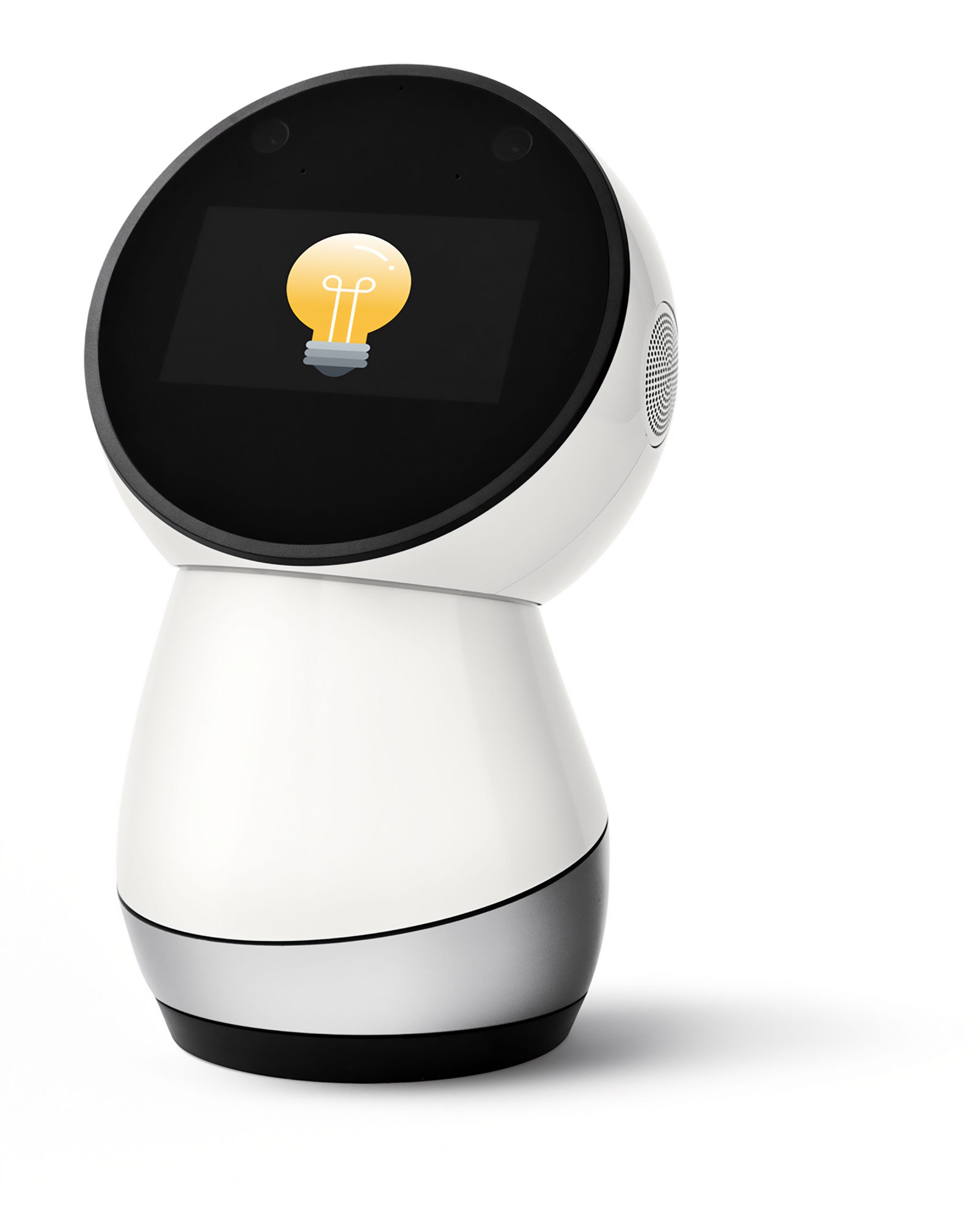
A robot with a shape vaguely like a lowercase letter
A crowdfunding campaign started in 2014 and drew 4,800 Jibo preorders.
COURTESY OF MIT MEDIA LAB

In retrospect, one thing that Jibo really needed was better language capabilities. It was competing against Apple’s Siri and Amazon’s Alexa, and all those technologies at the time relied on heavy scripting. In broad terms, when you spoke to them, software would translate your speech into text, analyze what you wanted, and create a response pulled from preapproved snippets. Those snippets could be charming, but they were also repetitive and simply boringdownright robotic. That was especially a challenge for a robot that was supposed to be social and family oriented. 

What has happened since, of course, is a revolution in how machines can generate language. Voice mode from any leading AI provider is now engaging and impressive, and multiple hardware startups are trying (and failing) to build products that take advantage of it. 

But that comes with a new risk: While scripted conversations can’t really go off the rails, ones generated by AI certainly can. Some popular AI toys have, for example, talked to kids about how to find matches and knives. 


Dactyl

A robot hand trained with simulations tries to model the unpredictability and variation of the real world.

By 2018, every leading robotics lab was trying to scrap the old scripted rules and train robots through trial and error. OpenAI tried to train its robotic hand, Dactyl, virtuallywith digital models of the hand and of the palm-size cubes Dactyl was supposed to manipulate. The cubes had letters and numbers on their faces; the model might set a task like “Rotate the cube so the red side with the letter O faces upward.”

Here’s the problem: A robotic hand might get really good at doing this in its simulated world, but when you take that program and ask it to work on a real version in the real world, the slight differences between the two can cause things to go awry. Colors might be slightly different, or the deformable rubber in the robot’s fingertips could turn out to be stretchier than it was in simulation.
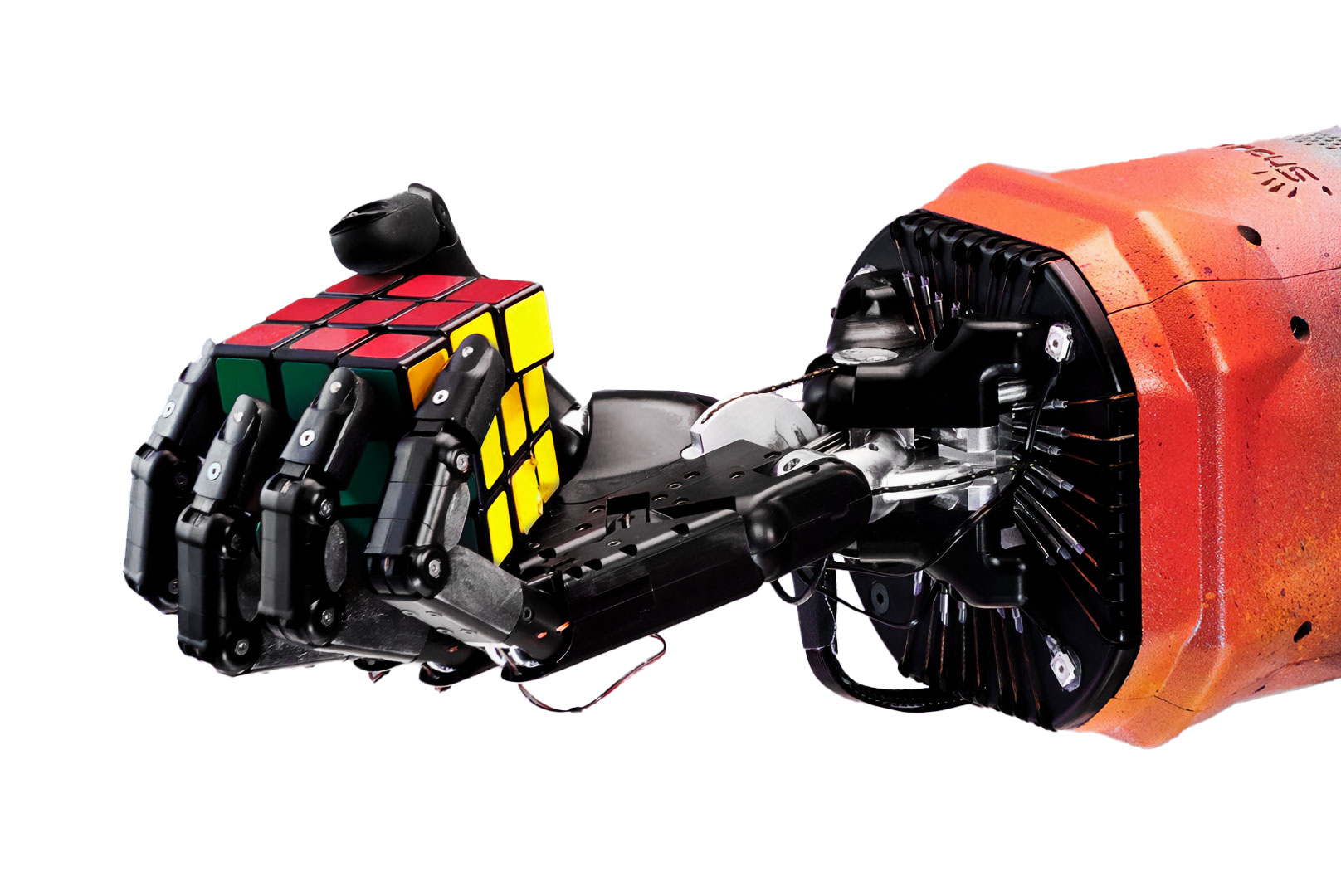
a Dactyl robot hand holds a Rubix cube
Dactyl, part of OpenAI’s first attempt at robotics, was trained in simulation to solve Rubik’s Cubes.
COURTESY OF OPENAI

The solution is called domain randomization. You essentially create millions of simulated worlds that all vary slightly and randomly from one another. In each one the friction might be less, or the lighting more harsh, or the colors darkened. Exposure to enough of this variation means the robots will be better able to manipulate the cube in the real world. The approach worked on Dactyl, and one year later it was able to use the same core techniques to do something harder: solving Rubik’s Cubes (though it worked only 60% of the time, and just 20% when the scrambles were particularly hard). 

Still, the limits of simulation mean that this technique plays a far smaller role today than it did in 2018. OpenAI shuttered its robotics effort in 2021 but has recently started the division up againreportedly focusing on humanoids. 


RT-2

Training on images from across the internet helps robots translate language into action.

Around 2022, Google’s robotics team was up to some strange things. It spent 17 months handing people robot controllers and filming them doing everything from picking up bags of chips to opening jars. The team ended up cataloguing 700 different tasks.

The point was to build and test one of the first large-scale foundation models for robotics. As with large language models, the idea was to input lots of text, tokenize it into a format an algorithm could work with, and then generate an output. Google’s RT-1 received input about what the robot was looking at and how the many parts of the robotic arm were positioned; then it took an instruction and translated it into motor commands to move the robot. When it had seen tasks before, it carried out 97% of them successfully; it succeeded at 76% of the instructions it hadn’t seen before. 
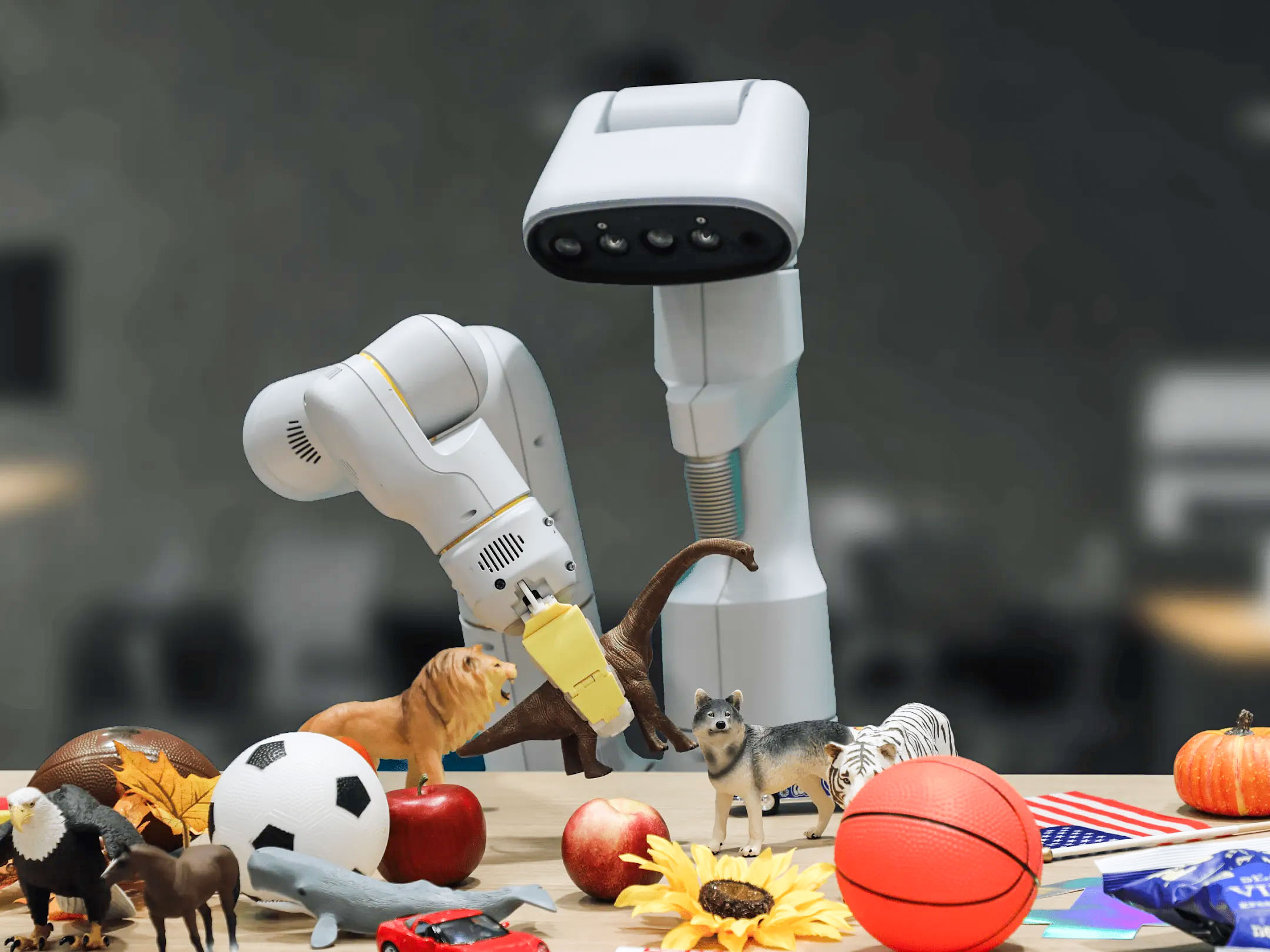
a robot at a table of small toys
The model RT-2, for Robotic Transformer 2, incorporated internet data to help robots process what they were seeing.
COURTESY OF GOOGLE DEEPMIND

The second iteration, RT-2, came out the following year and went even further. Instead of training on data specific to robotics, it went broad: It trained on more general images from across the internet, like the vision-language models lots of researchers were working on at the time. That allowed the robot to interpret where certain objects were in the scene.

“All these other things were unlocked,” says Kanishka Rao, a roboticist at Google DeepMind who led work on both iterations. “We could do things now like ‘Put the Coke can near the picture of Taylor Swift.’” 

In 2025, Google DeepMind further fused the worlds of large language models and robotics, releasing a Gemini Robotics model with improved ability to understand commands in natural language. 


RFM-1

An AI model that allows robotic arms to act like coworkers.

In 2017, before OpenAI shuttered its first robotics team, a group of its engineers spun out a project called Covariant, aiming to build not sci-fi humanoids but the most pragmatic of all robots: an arm that could pick up and move things in warehouses. After building a system based on foundation models similar to Google’s, Covariant deployed this platform in warehouses like those operated by Crate & Barrel and treated it as a data collection pipeline. 

By 2024, Covariant had released a robotics model, RFM-1, that you could interact with like a coworker. If you showed an arm many sleeves of tennis balls, for example, you could then instruct it to move each sleeve to a separate area. And the robot could respondperhaps predicting that it wouldn’t be able to get a good grip on the item and then asking for advice on which particular suction cups it should use. 

This sort of thing had been done in experiments, but Covariant was launching it at significant scale. The company now had cameras and data collection machines in every customer location, feeding back even more data for the model to train on.
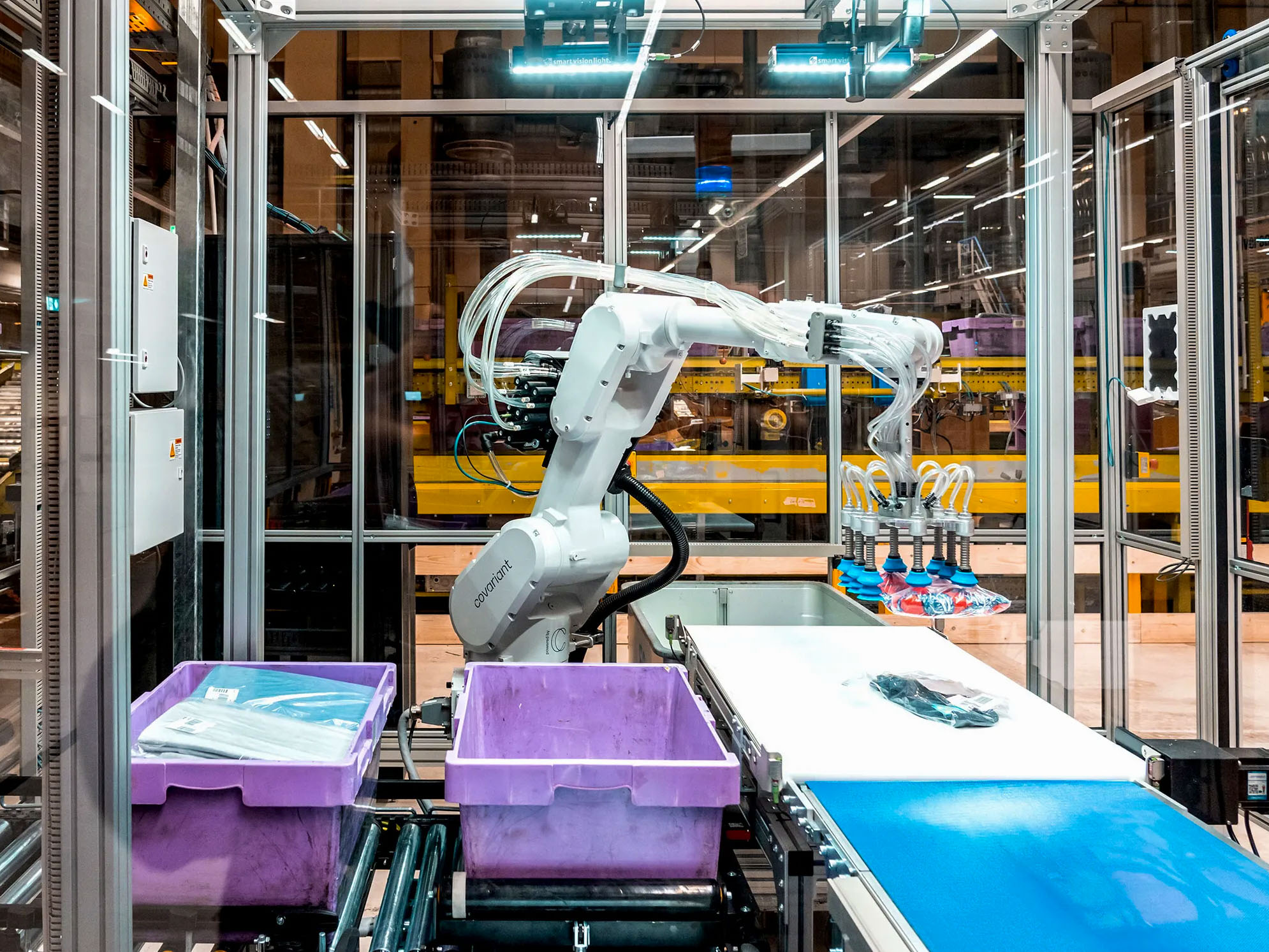
a warehouse robot arm lifts object with many suckers to place in a bin
A Covariant robot demonstrates “induction”—the common warehouse task of placing objects on sorters or conveyors.
COURTESY OF COVARIANT

It wasn’t perfect. In a demo in March 2024 with an array of kitchen items, the robot struggled when it was asked to “return the banana” to its original location. It picked up a sponge, then an apple, then a host of other items before it finally accomplished the task. 

It “doesn’t understand the new concept” of retracing its steps, cofounder Peter Chen told me at the time. “But it’s a good exampleit might not work well yet in the places where you don’t have good training data.”

Chen and fellow founder Pieter Abbeel were soon hired by Amazon, which is currently licensing Covariant’s robotics model (Amazon did not respond to questions about how it’s being used, but the company runs an estimated 1,300 warehouses in the US alone). 


Digit

Companies are putting this humanoid to the test in real-world settings.

The new investment dollars flowing to robotics startups are aimed largely at robots shaped not like lamps or arms but like people. Humanoid robots are supposed to be able to seamlessly enter the spaces and jobs where humans currently work, avoiding the need to retool assembly lines to accommodate new shapes such as giant arms. 

It’s easier said than done. In the rare cases where humanoids appear in real warehouses, they’re often confined to test zones and pilot programs. 
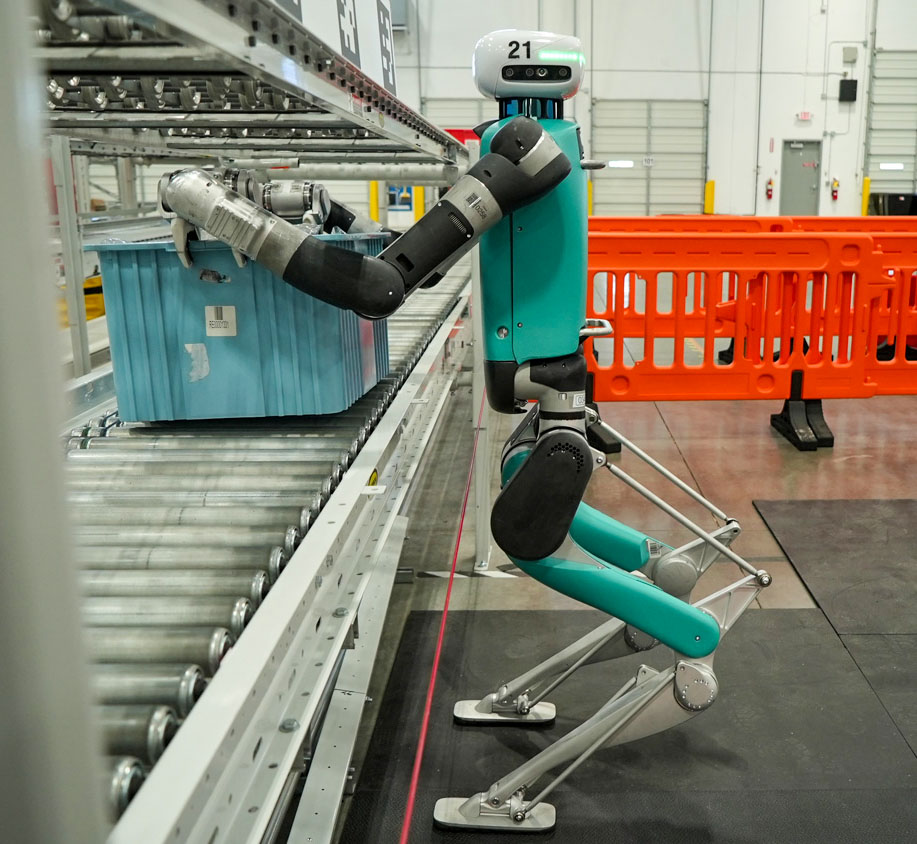
Digit humanoid robot putting a plastic bin on a conveyor belt
Amazon and other companies are using Digit to help move shipping totes.
COURTESY OF AGILITY ROBOTICS

That said, Agility’s humanoid Digit appears to be doing some real work. The designwith exposed joints and a distinctly unhuman headis driven more by function than by sci-fi aesthetics. Amazon, Toyota, and GXO (a logistics giant with customers like Apple and Nike) have all deployed itmaking it one of the first examples of a humanoid robot that companies see as providing actual cost savings rather than novelty. Their Digits spend their days picking up, moving, and stacking shipping totes.

The current Digit is still a long way from the humanlike helper Silicon Valley is betting on, though. It can lift only 35 pounds, for exampleand every time Agility makes Digit stronger, its battery gets heavier and it has to recharge more often. And standards organizations say humanoids need stricter safety rules than most industrial robots, because they’re designed to be mobile and spend time in proximity to people. 

But Digit shows that this revolution in robot training isn’t converging on a single method. Agility relies on simulation techniques like those OpenAI used to train its hand, and the company has worked with Google’s Gemini models to help its robots adapt to new environments. That’s where more than a decade of experiments have gotten the industry: Now it’s building big.

Shape
Shape
Stay Ahead

Explore More Insights

Stay ahead with more perspectives on cutting-edge power, infrastructure, energy,  bitcoin and AI solutions. Explore these articles to uncover strategies and insights shaping the future of industries.

Shape

AI shifts IT roles from operator to orchestrator

The report indicates that IT roles are becoming more strategic and automation-driven, with 52% of respondents citing increases in both areas. Roles are also becoming more cross-functional (47%) and complex (41%), reflecting the integration of AI into broader business processes. AI is also affecting how IT teams allocate time. Respondents

Read More »

Apply Now: 2026 Waste to Energy and Materials Technical Assistance for State, Local, and Tribal Governments

The U.S. Department of Energy’s Alternative Fuels and Feedstocks Office (AFFO), formerly known as the Bioenergy Technologies Office, and the National Laboratory of the Rockies (NLR) are launching the 2026 Waste to Energy and Materials Technical Assistance Program for state, local, and Tribal governments. The scope of this year’s program has been expanded to include additional municipal solid waste materials such as electronics, industrial wastewater, and other byproducts.  U.S. waste streams present significant logistical and economic challenges for states, counties, municipalities, and Tribal governments. However, waste is also a resource that can be used as an unconventional additional source of energy, advanced materials, and critical minerals. This program provides no-cost technical assistance to states, counties, municipalities, and Tribal governments with the most relevant data to guide decision-making—providing local solutions to the various aspects of waste management, taking into consideration current handling practices, costs, and infrastructure. It is designed to help officials evaluate the most sensible end uses for their waste, whether repurposing it for on-site heat and power, upgrading it into transportation fuels, or using it for material and mineral recovery. Program technical assistance includes: Waste resource information Infrastructure considerations Techno-economic comparison of energy, material, and mineral recovery options Evaluation and sharing of case studies (to the extent possible) from similar communities/projects The 2026 Waste to Energy and Materials Technical Assistance application portal is now open and applications will be accepted through May 30, 2026. For information on applicant eligibility and how to apply, please visit NLR’s technical assistance webpage. Timeline for Technical Assistance Opportunity Date Action April 15, 2026 Application Portal Opens May 30, 2026 Application Portal Closes  July – August 2026 Selections Made and Recipients Informed  Learn more about AFFO-supported waste to energy and materials technical assistance. If you have further questions, please see frequently asked questions or contact the Waste to

Read More »

Energy Deputy Secretary Danly Commends FERC Action on Large Load Interconnection Reform

WASHINGTON—U.S. Deputy Secretary of Energy James P. Danly issued the following statement after the Federal Energy Regulatory Commission (FERC or Commission) announced it will take action by June 2026 on the large load interconnection proceeding initiated at the direction of U.S. Secretary of Energy Chris Wright: “FERC’s announcement today demonstrates Chairman Swett’s commitment to implement Secretary Wright’s directive that the Commission ensure the timely and orderly integration of large electric loads that deliver on President Trump’s goal of American energy dominance. “I expect that the Commission will act quickly and decisively to improve interconnection processes, support the co-location of load and generation, and accelerate the addition of new generation to ensure that supply is built alongside demand—delivering affordable, reliable, and secure energy for all Americans. “Having served at FERC as commissioner and chairman, I understand FERC’s role in ensuring the reliability of the nation’s bulk power system, and I commend Chairman Swett for focusing on affordability and reliability.”                                                                                               ###  

Read More »

Petrobras discovers hydrocarbons in Campos basin presalt offshore Brazil

@import url(‘https://fonts.googleapis.com/css2?family=Inter:[email protected]&display=swap’); .ebm-page__main h1, .ebm-page__main h2, .ebm-page__main h3, .ebm-page__main h4, .ebm-page__main h5, .ebm-page__main h6 { font-family: Inter; } body { line-height: 150%; letter-spacing: 0.025em; } button, .ebm-button-wrapper { font-family: Inter; } .label-style { text-transform: uppercase; color: var(–color-grey); font-weight: 600; font-size: 0.75rem; } .caption-style { font-size: 0.75rem; opacity: .6; } #onetrust-pc-sdk [id*=btn-handler], #onetrust-pc-sdk [class*=btn-handler] { background-color: #c19a06 !important; border-color: #c19a06 !important; } #onetrust-policy a, #onetrust-pc-sdk a, #ot-pc-content a { color: #c19a06 !important; } #onetrust-consent-sdk #onetrust-pc-sdk .ot-active-menu { border-color: #c19a06 !important; } #onetrust-consent-sdk #onetrust-accept-btn-handler, #onetrust-banner-sdk #onetrust-reject-all-handler, #onetrust-consent-sdk #onetrust-pc-btn-handler.cookie-setting-link { background-color: #c19a06 !important; border-color: #c19a06 !important; } #onetrust-consent-sdk .onetrust-pc-btn-handler { color: #c19a06 !important; border-color: #c19a06 !important; } Petrobras has discovered presence in the Campos basin presalt offshore Brazil during exploration in sector SC-AP4, block CM-477. Samples taken from the well, 1-BRSA-1404DC-RJS, will be sent for laboratory analysis with the aim of characterizing the conditions of the reservoirs and fluids found to enable continued evaluation of the area’s potential, the company said in a release Apr. 13. The discovery well was drilled 201 km off the coast of the state of Rio de Janeiro in water depth of 2,984 m. The hydrocarbon-bearing interval was confirmed through electrical profiles, gas evidence, and fluid sampling. Petrobras is the operator of block CM-477 with 70% interest. bp plc holds the remaining 30%.

Read More »

bp to operate blocks offshore Namibia through acquisition

@import url(‘https://fonts.googleapis.com/css2?family=Inter:[email protected]&display=swap’); .ebm-page__main h1, .ebm-page__main h2, .ebm-page__main h3, .ebm-page__main h4, .ebm-page__main h5, .ebm-page__main h6 { font-family: Inter; } body { line-height: 150%; letter-spacing: 0.025em; } button, .ebm-button-wrapper { font-family: Inter; } .label-style { text-transform: uppercase; color: var(–color-grey); font-weight: 600; font-size: 0.75rem; } .caption-style { font-size: 0.75rem; opacity: .6; } #onetrust-pc-sdk [id*=btn-handler], #onetrust-pc-sdk [class*=btn-handler] { background-color: #c19a06 !important; border-color: #c19a06 !important; } #onetrust-policy a, #onetrust-pc-sdk a, #ot-pc-content a { color: #c19a06 !important; } #onetrust-consent-sdk #onetrust-pc-sdk .ot-active-menu { border-color: #c19a06 !important; } #onetrust-consent-sdk #onetrust-accept-btn-handler, #onetrust-banner-sdk #onetrust-reject-all-handler, #onetrust-consent-sdk #onetrust-pc-btn-handler.cookie-setting-link { background-color: #c19a06 !important; border-color: #c19a06 !important; } #onetrust-consent-sdk .onetrust-pc-btn-handler { color: #c19a06 !important; border-color: #c19a06 !important; } Map from bp plc <!–> –> bp plc aims to become operator of three exploration blocks offshore Namibia through acquisition of a 60% interest from Eco Atlantic Oil & Gas. Subject to Namibian government and joint venture partner approvals, bp will operate blocks PEL97, PEL99, and PEL100 in Walvis basin.   In a release Apr. 13, bp said entering the blocks builds on its recent exploration successes in Namibia through Azule Energy, a 50-50 joint venture between bp and Eni. Eco Atlantic will remain a partner, along with Namibia’s national oil company NAMCOR, following the deal’s closing, which is subject to closing conditions.

Read More »

ConocoPhillips sends team to Venezuela to evaluate oil, gas opportunities

ConocoPhillips sent a team to Venezuela to evaluate oil and gas opportunities, the company confirmed to Oil & Gas Journal Apr. 13. In an email to OGJ, a company spokesperson said “ConocoPhillips can confirm that we sent a small evaluation team to Venezuela during the week of Apr. 6 to better understand the potential for in-country oil and gas opportunities.” Asked what clarity the company seeks, the spokesperson said the team “will evaluate Venezuela against other international opportunities as part of our disciplined investment framework.” The operator left Venezuela in 2007 after then-President Hugo Chavez’s government reverted privately run oil fields to state control. ConocoPhillips, along with ExxonMobil, refused the government’s terms and took claims to the World Bank’s International Centre for the Settlement of Investment Disputes (ICSID). ConocoPhillips is owed about $12 billion following two judgements, an amount still sought by the company, which, prior to the expropriation of its interests, held a 50.1% interest in Petrozuata, a 40% interest in Hamaca, and a 32.5% interest in Corocoro heavy oil projects in Venezuela. In January, following the removal of Venezuela’s leader Nicolas Maduro, US President Donald Trump urged oil and gas companies to spend billions to rebuild Venezuela’s energy sector. ExxonMobil, which also exited the country in 2007, ​sent a technical team to Venezuela in March to ⁠evaluate the infrastructure and investment opportunities. In a discussion at CERAWeek by S&P Global in Houston in March, ConocoPhillips’ chief executive officer, Ryan Lance, said Venezuela needs to “completely rewire” ​its fiscal system to attract new ‌investment. The South American country holds a large cache of proven oil reserves, but has faced decades of production challenges due to mismanagement, underinvestment, and sanctions.

Read More »

TotalEnergies, TPAO sign MoU to assess exploration opportunities

@import url(‘https://fonts.googleapis.com/css2?family=Inter:[email protected]&display=swap’); .ebm-page__main h1, .ebm-page__main h2, .ebm-page__main h3, .ebm-page__main h4, .ebm-page__main h5, .ebm-page__main h6 { font-family: Inter; } body { line-height: 150%; letter-spacing: 0.025em; } button, .ebm-button-wrapper { font-family: Inter; } .label-style { text-transform: uppercase; color: var(–color-grey); font-weight: 600; font-size: 0.75rem; } .caption-style { font-size: 0.75rem; opacity: .6; } #onetrust-pc-sdk [id*=btn-handler], #onetrust-pc-sdk [class*=btn-handler] { background-color: #c19a06 !important; border-color: #c19a06 !important; } #onetrust-policy a, #onetrust-pc-sdk a, #ot-pc-content a { color: #c19a06 !important; } #onetrust-consent-sdk #onetrust-pc-sdk .ot-active-menu { border-color: #c19a06 !important; } #onetrust-consent-sdk #onetrust-accept-btn-handler, #onetrust-banner-sdk #onetrust-reject-all-handler, #onetrust-consent-sdk #onetrust-pc-btn-handler.cookie-setting-link { background-color: #c19a06 !important; border-color: #c19a06 !important; } #onetrust-consent-sdk .onetrust-pc-btn-handler { color: #c19a06 !important; border-color: #c19a06 !important; } TotalEnergies EP New Ventures SA has signed a memorandum of understanding (MoU) with Türkiye Petrolleri Anonim Ortaklığı (TPAO) for potential collaboration. The MoU provides a framework for technical collaboration, including a joint assessment of hydrocarbon exploration opportunities in the Black Sea region of Türkiye as well as internationally. In February of this year, TPAO signed an MoU with Chevron Business Development EMEA Ltd., a subsidiary of Chevron, providing an opportunity to “identify and evaluate cooperation opportunities that may arise in international projects and in oil exploration and production license areas in onshore and offshore fields in Türkiye.”

Read More »

Blue Owl Builds a Capital Platform for the Hyperscale AI Era

Capital as a Service: The Hyperscaler Shift This is not just another project financing. It points to a model in which hyperscalers can externalize a significant portion of the capital required for AI campuses while retaining operational control. Under the Hyperion structure, Meta provides construction and property management, while Blue Owl supplies capital at scale alongside infrastructure expertise. Reuters described the transaction as Meta’s largest private capital deal to date, with the campus projected to exceed 2 gigawatts of capacity. For Blue Owl, it marks a shift in role: from backing developers serving hyperscalers to working directly with a hyperscaler to structure ownership more efficiently at scale. Hyperion also helps explain why this model is gaining traction. Hyperscalers are now deploying capital at a pace that makes flexibility a strategic priority. Structures like the Meta–Blue Owl JV allow them to continue expanding infrastructure without fully absorbing the balance-sheet impact of each new campus. Analyst commentary cited by Reuters suggested the arrangement could help Meta mitigate risk and avoid concentrating too much capital in land, buildings, and long-lived infrastructure, preserving capacity for additional facilities and ongoing AI investment. That is the service Blue Owl is effectively providing. Not just capital, but balance-sheet flexibility at a time when AI infrastructure demand is stretching even the largest technology companies. With major tech firms projected to spend hundreds of billions annually on AI infrastructure, that capability is becoming central to how the next generation of campuses gets built. The Capital Baseline Resets In early 2026, hyperscalers effectively reset the capital baseline for the sector. Alphabet projected $175 billion to $185 billion in annual capex, citing continued constraints across servers, data centers, and networking. Amazon pointed to roughly $200 billion, up from $131 billion the prior year, while noting persistent demand pressure in AWS. Meta

Read More »

OpenAI pulls out of a second Stargate data center deal

“OpenAI is embattled on several fronts. Anthropic has been doing very well in the enterprise, and OpenAI’s cash burn might be a problem if it wants to go public at an astronomical $800 billion+ valuation. This is especially true with higher energy prices due to geopolitics, and the public and regulators increasingly skeptical of AI companies, especially outside of the United States,” Roberts said. “I see these moves as OpenAI tightening its belt a bit and being more deliberate about spending as it moves past the interesting tech demo stage of its existence and is expected to provide a real return for investors.” He added, “I expect it’s a symptom of a broader problem, which is that OpenAI has thrown some good money after bad in bets that didn’t work out, like the Sora platform it just shut down, and it’s under increasing pressure to translate its first-mover advantage into real upside for its investors. Spending operational money instead of capital money might give it some flexibility in the short term, and perhaps that’s what this is about.” All in all, he noted, “on a scale of business-ending event to nothingburger, I would put it somewhere in the middle, maybe a little closer to nothingburger.” Acceligence CIO Yuri Goryunov agreed with Roberts, and said, “OpenAI has a problem with commercialization and runaway operating costs, for sure. They are trying to rightsize their commitments and make sure that they deliver on their core products before they run out of money.” Goryunov described OpenAI’s arrangement with Microsoft in Norway as “prudent financial engineering” that allows it to access the data center resources without having to tie up too much capital. “It’s financial discipline. OpenAI [executives] are starting to behave like grownups.” Forrester senior analyst Alvin Nguyen echoed those thoughts. 

Read More »

DCF Tours: SDC Manhattan, 375 Pearl St.

Power: Redundant utility design in a power-constrained market The tour made equally clear that in Manhattan, power is still the central gating factor. The brochure describes SDC Manhattan as offering 18MW of aggregate power delivered to the building, backed by redundant electrical and mechanical systems, backup generators, and Tier III-type concurrent maintainability. The December 2025 press release updated that picture in a more market-facing way, noting that Sabey is one of the only colocation providers in Manhattan with available power, including nearly a megawatt of turnkey power and 7MW of utility power across two powered shell spaces. Bajrushi’s explanation of the electrical topology helped show how Sabey has made that possible. Standing on the third floor, he described a ring bus tying together four Con Edison feeds. Bajrushi said the feeds all originate from the same substation but take different paths into the building, creating redundancy outside the building as well as within it. He added that if one feed fails, the ring bus remains unaffected, and that only one feed is needed to power everything currently in operation. He also noted that Sabey has the ability to add two more feeds in the future if expansion calls for it. That matters in a city where available utility capacity is hard to come by and where many data center conversations end not with square footage but with a megawatt number. Bajrushi also noted that physical space is not the core constraint at 375 Pearl. He said the building still has plenty of room for future buildouts, including open areas that could become additional white space, chiller capacity, or other infrastructure. The bigger question, he suggested, is how and when power and supporting systems get installed. That observation aligns neatly with Sabey’s press release. The company is effectively arguing that SDC

Read More »

Maine to put brakes on big data centers as AI expansion collides with power limits

Mills has pushed for an exemption protecting a proposed $550 million project at the former Androscoggin paper mill in Jay, arguing it would reuse existing infrastructure without straining the grid. Lawmakers rejected that exemption. Mills’ office did not immediately respond to a request for comment. A national wave, an unanswered federal question Maine is one of at least 12 states now weighing moratorium or restraint legislation, alongside more than 300 data center bills filed across 30-plus states in the current session, according to legislative tracking firm MultiState. The shared concern is energy cost. Data centers could consume up to 12% of total US electricity by 2028, according to the US Department of Energy. On March 25, Senator Bernie Sanders and Alexandria Ocasio-Cortez introduced the AI Data Center Moratorium Act in Congress, which would impose a nationwide freeze on all new data center construction until Congress passes AI safety legislation. The Trump administration has pursued a different path from the legislative approach being taken in states. On March 4, Amazon, Google, Meta, Microsoft, OpenAI, Oracle, and xAI signed the White House’s Ratepayer Protection Pledge, a voluntary commitment by hyperscalers to fund their own power generation rather than pass grid costs to ratepayers. The pledge, published in the Federal Register on March 9, carries no penalties for noncompliance or auditing requirements.

Read More »

Cisco just made two moves to own the AI infrastructure stack

In a world of autonomous agents, identity and access become the de facto safety rails. Astrix is designed to inventory these non-human identities, map their permissions, detect toxic combinations, and remediate overprivileged access before it becomes an exploit or a data leak. That capability integrates directly with Cisco’s broader zero-trust and identity-centric security strategy, in which the network enforces policy based on who or what the entity is, not on which subnet it resides in. How this strengthens Cisco’s secure networking story Cisco has positioned itself as the vendor that can deliver “AI-ready, secure networks” spanning campus, data center, cloud, and edge. Galileo and Astrix extend that narrative from infrastructure into AI behavior and identity governance: The network becomes the high‑performance, policy‑enforcing substrate for AI traffic and data. Splunk plus Galileo becomes the observability plane for AI agents, linking AI incidents to network and application signals. Security plus Astrix becomes the identity and permission-control layer that constrains what AI agents can actually do within the environment. This is the core of Cisco’s emerging “Secure AI” posture: not just using AI to improve security but securing AI itself as it is embedded across every workflow, API, and device. For customers, that means AI initiatives can be brought under the same operational and compliance disciplines already used for networks and apps, rather than existing as unmanaged risk islands. Why this matters to Cisco customers Most large Cisco accounts are exactly the enterprises now experimenting with AI agents in contact centers, IT operations, and business workflows. They face three practical problems: They cannot see what agents are doing end‑to‑end, or measure quality beyond offline benchmarks. They lack a coherent model for managing the identities, secrets, and permissions those agents depend on. Their security and networking teams are often disconnected from AI projects happening in lines of business.

Read More »

From Buildings to Token Factories: Compu Dynamics CEO Steve Altizer On Why AI Is Rewriting the Data Center Design Playbook

Not Falling Short—Just Not Optimized Altizer drew a clear distinction. Traditional data centers can run AI workloads, but they weren’t built for them. “We’re not falling short much, we’re just not optimizing.” The gap shows up most clearly in density. Legacy facilities were designed for roughly 300 to 400 watts per square foot. AI pushes that to 2,000 to 4,000 watts per square foot—changing not just rack design, but the logic of the entire facility. For Altizer, AI-ready infrastructure starts with fundamentals: access to water for heat rejection, significantly higher power density, and in some cases specific redundancy topologies favored by chip makers. It also requires liquid cooling loops extended to the rack and, critically, flexibility in the white space. That last point is the hardest to reconcile with traditional design. “The GPUs change… your power requirements change… your liquid cooling requirements change. The data center needs to change with it.” Buildings are static. AI is not. Rethinking Modular: From Containers to Systems “Modular” has been part of the data center vocabulary for years, but Altizer argues most of the industry is still thinking about it the wrong way. The old model centered on ISO containers. The emerging model focuses on modularizing the white space itself. “We’re not building buildings—we’re building assemblies of equipment.” Compu Dynamics is pushing toward factory-built IT modules that can be delivered and assembled on-site. A standard 5 MW block consists of 10 modules, stacked into a two-story configuration and designed for transport by trailer across the U.S. From there, scale becomes repeatable. Blocks can be placed adjacent or connected to create larger deployments, moving from 5 MW to 10 MW and beyond. The point is not just scalability; it’s repeatability and speed. Altizer ties this directly to a broader shift in how data centers are

Read More »

Microsoft will invest $80B in AI data centers in fiscal 2025

And Microsoft isn’t the only one that is ramping up its investments into AI-enabled data centers. Rival cloud service providers are all investing in either upgrading or opening new data centers to capture a larger chunk of business from developers and users of large language models (LLMs).  In a report published in October 2024, Bloomberg Intelligence estimated that demand for generative AI would push Microsoft, AWS, Google, Oracle, Meta, and Apple would between them devote $200 billion to capex in 2025, up from $110 billion in 2023. Microsoft is one of the biggest spenders, followed closely by Google and AWS, Bloomberg Intelligence said. Its estimate of Microsoft’s capital spending on AI, at $62.4 billion for calendar 2025, is lower than Smith’s claim that the company will invest $80 billion in the fiscal year to June 30, 2025. Both figures, though, are way higher than Microsoft’s 2020 capital expenditure of “just” $17.6 billion. The majority of the increased spending is tied to cloud services and the expansion of AI infrastructure needed to provide compute capacity for OpenAI workloads. Separately, last October Amazon CEO Andy Jassy said his company planned total capex spend of $75 billion in 2024 and even more in 2025, with much of it going to AWS, its cloud computing division.

Read More »

John Deere unveils more autonomous farm machines to address skill labor shortage

Join our daily and weekly newsletters for the latest updates and exclusive content on industry-leading AI coverage. Learn More Self-driving tractors might be the path to self-driving cars. John Deere has revealed a new line of autonomous machines and tech across agriculture, construction and commercial landscaping. The Moline, Illinois-based John Deere has been in business for 187 years, yet it’s been a regular as a non-tech company showing off technology at the big tech trade show in Las Vegas and is back at CES 2025 with more autonomous tractors and other vehicles. This is not something we usually cover, but John Deere has a lot of data that is interesting in the big picture of tech. The message from the company is that there aren’t enough skilled farm laborers to do the work that its customers need. It’s been a challenge for most of the last two decades, said Jahmy Hindman, CTO at John Deere, in a briefing. Much of the tech will come this fall and after that. He noted that the average farmer in the U.S. is over 58 and works 12 to 18 hours a day to grow food for us. And he said the American Farm Bureau Federation estimates there are roughly 2.4 million farm jobs that need to be filled annually; and the agricultural work force continues to shrink. (This is my hint to the anti-immigration crowd). John Deere’s autonomous 9RX Tractor. Farmers can oversee it using an app. While each of these industries experiences their own set of challenges, a commonality across all is skilled labor availability. In construction, about 80% percent of contractors struggle to find skilled labor. And in commercial landscaping, 86% of landscaping business owners can’t find labor to fill open positions, he said. “They have to figure out how to do

Read More »

2025 playbook for enterprise AI success, from agents to evals

Join our daily and weekly newsletters for the latest updates and exclusive content on industry-leading AI coverage. Learn More 2025 is poised to be a pivotal year for enterprise AI. The past year has seen rapid innovation, and this year will see the same. This has made it more critical than ever to revisit your AI strategy to stay competitive and create value for your customers. From scaling AI agents to optimizing costs, here are the five critical areas enterprises should prioritize for their AI strategy this year. 1. Agents: the next generation of automation AI agents are no longer theoretical. In 2025, they’re indispensable tools for enterprises looking to streamline operations and enhance customer interactions. Unlike traditional software, agents powered by large language models (LLMs) can make nuanced decisions, navigate complex multi-step tasks, and integrate seamlessly with tools and APIs. At the start of 2024, agents were not ready for prime time, making frustrating mistakes like hallucinating URLs. They started getting better as frontier large language models themselves improved. “Let me put it this way,” said Sam Witteveen, cofounder of Red Dragon, a company that develops agents for companies, and that recently reviewed the 48 agents it built last year. “Interestingly, the ones that we built at the start of the year, a lot of those worked way better at the end of the year just because the models got better.” Witteveen shared this in the video podcast we filmed to discuss these five big trends in detail. Models are getting better and hallucinating less, and they’re also being trained to do agentic tasks. Another feature that the model providers are researching is a way to use the LLM as a judge, and as models get cheaper (something we’ll cover below), companies can use three or more models to

Read More »

OpenAI’s red teaming innovations define new essentials for security leaders in the AI era

Join our daily and weekly newsletters for the latest updates and exclusive content on industry-leading AI coverage. Learn More OpenAI has taken a more aggressive approach to red teaming than its AI competitors, demonstrating its security teams’ advanced capabilities in two areas: multi-step reinforcement and external red teaming. OpenAI recently released two papers that set a new competitive standard for improving the quality, reliability and safety of AI models in these two techniques and more. The first paper, “OpenAI’s Approach to External Red Teaming for AI Models and Systems,” reports that specialized teams outside the company have proven effective in uncovering vulnerabilities that might otherwise have made it into a released model because in-house testing techniques may have missed them. In the second paper, “Diverse and Effective Red Teaming with Auto-Generated Rewards and Multi-Step Reinforcement Learning,” OpenAI introduces an automated framework that relies on iterative reinforcement learning to generate a broad spectrum of novel, wide-ranging attacks. Going all-in on red teaming pays practical, competitive dividends It’s encouraging to see competitive intensity in red teaming growing among AI companies. When Anthropic released its AI red team guidelines in June of last year, it joined AI providers including Google, Microsoft, Nvidia, OpenAI, and even the U.S.’s National Institute of Standards and Technology (NIST), which all had released red teaming frameworks. Investing heavily in red teaming yields tangible benefits for security leaders in any organization. OpenAI’s paper on external red teaming provides a detailed analysis of how the company strives to create specialized external teams that include cybersecurity and subject matter experts. The goal is to see if knowledgeable external teams can defeat models’ security perimeters and find gaps in their security, biases and controls that prompt-based testing couldn’t find. What makes OpenAI’s recent papers noteworthy is how well they define using human-in-the-middle

Read More »