Stay Ahead, Stay ONMINE

Introducing Gemma 3n: The developer guide

The first Gemma model launched early last year and has since grown into a thriving Gemmaverse of over 160 million collective downloads. This ecosystem includes our family of over a dozen specialized models for everything from safeguarding to medical applications and, most inspiringly, the countless innovations from the community. From innovators like Roboflow building enterprise computer vision to the Institute of Science Tokyo creating highly-capable Japanese Gemma variants, your work has shown us the path forward.Building on this incredible momentum, we’re excited to announce the full release of Gemma 3n. While last month’s preview offered a glimpse, today unlocks the full power of this mobile-first architecture. Gemma 3n is designed for the developer community that helped shape Gemma. It’s supported by your favorite tools including Hugging Face Transformers, llama.cpp, Google AI Edge, Ollama, MLX, and many others, enabling you to fine-tune and deploy for your specific on-device applications with ease. This post is the developer deep dive: we’ll explore some of the innovations behind Gemma 3n, share new benchmark results, and show you how to start building today.What’s new in Gemma 3n?Gemma 3n represents a major advancement for on-device AI, bringing powerful multimodal capabilities to edge devices with performance previously only seen in last year’s cloud-based frontier models. Achieving this leap in on-device performance required rethinking the model from the ground up. The foundation is Gemma 3n’s unique mobile-first architecture, and it all starts with MatFormer.MatFormer: One model, many sizesAt the core of Gemma 3n is the MatFormer (🪆Matryoshka Transformer) architecture, a novel nested transformer built for elastic inference. Think of it like Matryoshka dolls: a larger model contains smaller, fully functional versions of itself. This approach extends the concept of Matryoshka Representation Learning from just embeddings to all transformer components. During the MatFormer training of the 4B effective parameter (E4B) model, a 2B effective parameter (E2B) sub-model is simultaneously optimized within it, as shown in the figure above. This provides developers two powerful capabilities and use cases today:1: Pre-extracted models: You can directly download and use either the main E4B model for the highest capabilities, or the standalone E2B sub-model which we have already extracted for you, offering up to 2x faster inference.2: Custom sizes with Mix-n-Match: For more granular control tailored to specific hardware constraints, you can create a spectrum of custom-sized models between E2B and E4B using a method we call Mix-n-Match. This technique allows you to precisely slice the E4B model’s parameters, primarily by adjusting the feed forward network hidden dimension per layer (from 8192 to 16384) and selectively skipping some layers. We are releasing the MatFormer Lab, a tool that shows how to retrieve these optimal models, which were identified by evaluating various settings on benchmarks like MMLU. MMLU scores for the pre-trained Gemma 3n checkpoints at different model sizes (using Mix-n-Match) Looking ahead, the MatFormer architecture also paves the way for elastic execution. While not part of today’s launched implementations, this capability allows a single deployed E4B model to dynamically switch between E4B and E2B inference paths on the fly, enabling real-time optimization of performance and memory usage based on the current task and device load.Per-Layer Embeddings (PLE): Unlocking more memory efficiencyGemma 3n models incorporate Per-Layer Embeddings (PLE). This innovation is tailored for on-device deployment as it dramatically improves model quality without increasing the high-speed memory footprint required on your device’s accelerator (GPU/TPU).While the Gemma 3n E2B and E4B models have a total parameter count of 5B and 8B respectively, PLE allows a significant portion of these parameters (the embeddings associated with each layer) to be loaded and computed efficiently on the CPU. This means only the core transformer weights (approximately 2B for E2B and 4B for E4B) need to sit in the typically more constrained accelerator memory (VRAM). With Per-Layer Embeddings, you can use Gemma 3n E2B while only having ~2B parameters loaded in your accelerator. KV Cache sharing: Faster long-context processingProcessing long inputs, such as the sequences derived from audio and video streams, is essential for many advanced on-device multimodal applications. Gemma 3n introduces KV Cache Sharing, a feature designed to significantly accelerate time-to-first-token for streaming response applications.KV Cache Sharing optimizes how the model handles the initial input processing stage (often called the “prefill” phase). The keys and values of the middle layer from local and global attention are directly shared with all the top layers, delivering a notable 2x improvement on prefill performance compared to Gemma 3 4B. This means the model can ingest and understand lengthy prompt sequences much faster than before.Audio understanding: Introducing speech to text and translationGemma 3n uses an advanced audio encoder based on the Universal Speech Model (USM). The encoder generates a token for every 160ms of audio (about 6 tokens per second), which are then integrated as input to the language model, providing a granular representation of the sound context.This integrated audio capability unlocks key features for on-device development, including:Automatic Speech Recognition (ASR): Enable high-quality speech-to-text transcription directly on the device.Automatic Speech Translation (AST): Translate spoken language into text in another language.We’ve observed particularly strong AST results for translation between English and Spanish, French, Italian, and Portuguese, offering great potential for developers targeting applications in these languages. For tasks like speech translation, leveraging Chain-of-Thought prompting can significantly enhance results. Here’s an example: user Transcribe the following speech segment in Spanish, then translate it into English: model Plain text At launch time, the Gemma 3n encoder is implemented to process audio clips up to 30 seconds. However, this is not a fundamental limitation. The underlying audio encoder is a streaming encoder, capable of processing arbitrarily long audios with additional long form audio training. Follow-up implementations will unlock low-latency, long streaming applications.MobileNet-V5: New state-of-the-art vision encoderAlongside its integrated audio capabilities, Gemma 3n features a new, highly efficient vision encoder, MobileNet-V5-300M, delivering state-of-the-art performance for multimodal tasks on edge devices.Designed for flexibility and power on constrained hardware, MobileNet-V5 gives developers:Multiple input resolutions: Natively supports resolutions of 256×256, 512×512, and 768×768 pixels, allowing you to balance performance and detail for your specific applications.Broad visual understanding: Co-trained on extensive multimodal datasets, it excels at a wide range of image and video comprehension tasks.High throughput: Processes up to 60 frames per second on a Google Pixel, enabling real-time, on-device video analysis and interactive experiences.This level of performance is achieved with multiple architectural innovations, including:An advanced foundation of MobileNet-V4 blocks (including Universal Inverted Bottlenecks and Mobile MQA).A significantly scaled up architecture, featuring a hybrid, deep pyramid model that is 10x larger than the biggest MobileNet-V4 variant.A novel Multi-Scale Fusion VLM adapter that enhances the quality of tokens for better accuracy and efficiency.Benefiting from novel architectural designs and advanced distillation techniques, MobileNet-V5-300M substantially outperforms the baseline SoViT in Gemma 3 (trained with SigLip, no distillation). On a Google Pixel Edge TPU, it delivers a 13x speedup with quantization (6.5x without), requires 46% fewer parameters, and has a 4x smaller memory footprint, all while providing significantly higher accuracy on vision-language tasksWe’re excited to share more about the work behind this model. Look out for our upcoming MobileNet-V5 technical report, which will deep dive into the model architecture, data scaling strategies, and advanced distillation techniques.Making Gemma 3n accessible from day one has been a priority. We’re proud to partner with many incredible open source developers to ensure broad support across popular tools and platforms, including contributions from teams behind AMD, Axolotl, Docker, Hugging Face, llama.cpp, LMStudio, MLX, NVIDIA, Ollama, RedHat, SGLang, Unsloth, and vLLM.But this ecosystem is just the beginning. The true power of this technology is in what you will build with it. That’s why we’re launching the Gemma 3n Impact Challenge. Your mission: use Gemma 3n’s unique on-device, offline, and multimodal capabilities to build a product for a better world. With $150,000 in prizes, we’re looking for a compelling video story and a “wow” factor demo that shows real-world impact. Join the challenge and help build a better future.Get started with Gemma 3n todayReady to explore the potential of Gemma 3n today? Here’s how:Experiment directly: Use Google AI Studio to try Gemma 3n in just a couple of clicks. Gemma models can also be deployed directly to Cloud Run from AI Studio.Learn & integrate: Dive into our comprehensive documentation to quickly integrate Gemma into your projects or start with our inference and fine-tuning guides.

The first Gemma model launched early last year and has since grown into a thriving Gemmaverse of over 160 million collective downloads. This ecosystem includes our family of over a dozen specialized models for everything from safeguarding to medical applications and, most inspiringly, the countless innovations from the community. From innovators like Roboflow building enterprise computer vision to the Institute of Science Tokyo creating highly-capable Japanese Gemma variants, your work has shown us the path forward.

Building on this incredible momentum, we’re excited to announce the full release of Gemma 3n. While last month’s preview offered a glimpse, today unlocks the full power of this mobile-first architecture. Gemma 3n is designed for the developer community that helped shape Gemma. It’s supported by your favorite tools including Hugging Face Transformers, llama.cpp, Google AI Edge, Ollama, MLX, and many others, enabling you to fine-tune and deploy for your specific on-device applications with ease. This post is the developer deep dive: we’ll explore some of the innovations behind Gemma 3n, share new benchmark results, and show you how to start building today.


What’s new in Gemma 3n?

Gemma 3n represents a major advancement for on-device AI, bringing powerful multimodal capabilities to edge devices with performance previously only seen in last year’s cloud-based frontier models.

Achieving this leap in on-device performance required rethinking the model from the ground up. The foundation is Gemma 3n’s unique mobile-first architecture, and it all starts with MatFormer.

MatFormer: One model, many sizes

At the core of Gemma 3n is the MatFormer (🪆Matryoshka Transformer) architecture, a novel nested transformer built for elastic inference. Think of it like Matryoshka dolls: a larger model contains smaller, fully functional versions of itself. This approach extends the concept of Matryoshka Representation Learning from just embeddings to all transformer components.

During the MatFormer training of the 4B effective parameter (E4B) model, a 2B effective parameter (E2B) sub-model is simultaneously optimized within it, as shown in the figure above. This provides developers two powerful capabilities and use cases today:

1: Pre-extracted models: You can directly download and use either the main E4B model for the highest capabilities, or the standalone E2B sub-model which we have already extracted for you, offering up to 2x faster inference.

2: Custom sizes with Mix-n-Match: For more granular control tailored to specific hardware constraints, you can create a spectrum of custom-sized models between E2B and E4B using a method we call Mix-n-Match. This technique allows you to precisely slice the E4B model’s parameters, primarily by adjusting the feed forward network hidden dimension per layer (from 8192 to 16384) and selectively skipping some layers. We are releasing the MatFormer Lab, a tool that shows how to retrieve these optimal models, which were identified by evaluating various settings on benchmarks like MMLU.
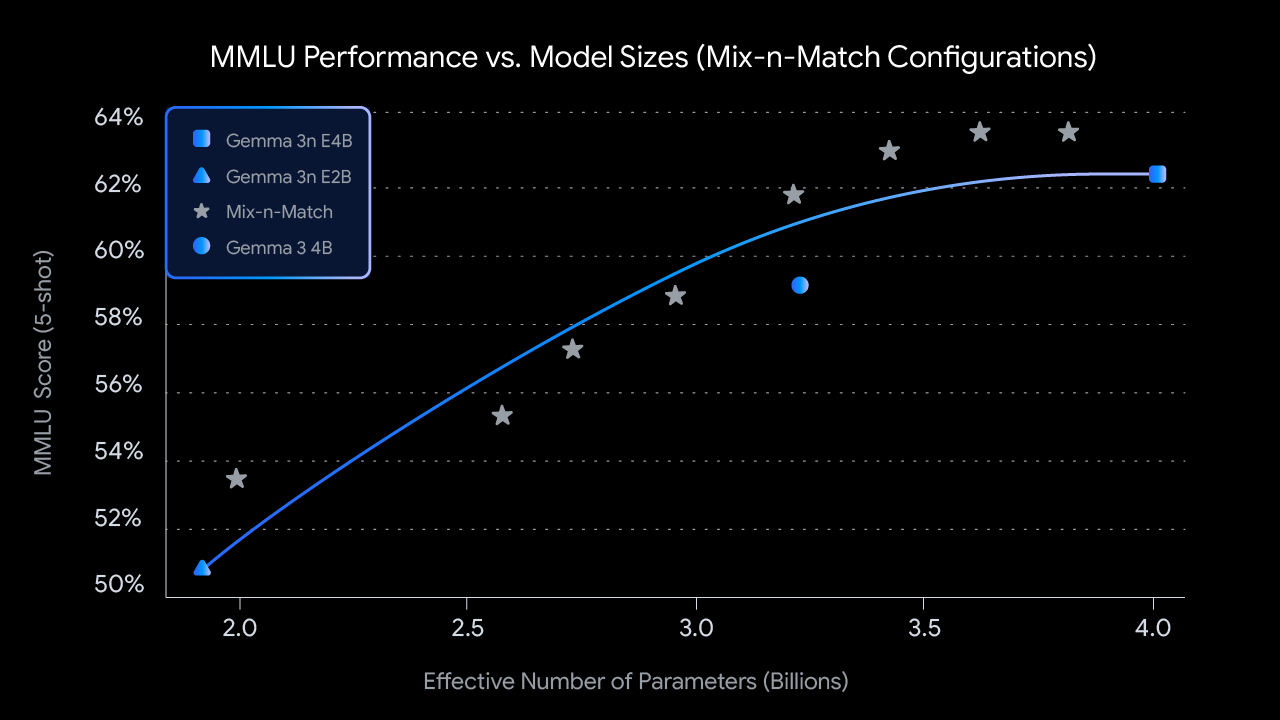
Custom Sizes with Mix-n-Match

MMLU scores for the pre-trained Gemma 3n checkpoints at different model sizes (using Mix-n-Match)

Looking ahead, the MatFormer architecture also paves the way for elastic execution. While not part of today’s launched implementations, this capability allows a single deployed E4B model to dynamically switch between E4B and E2B inference paths on the fly, enabling real-time optimization of performance and memory usage based on the current task and device load.

Per-Layer Embeddings (PLE): Unlocking more memory efficiency

Gemma 3n models incorporate Per-Layer Embeddings (PLE). This innovation is tailored for on-device deployment as it dramatically improves model quality without increasing the high-speed memory footprint required on your device’s accelerator (GPU/TPU).

While the Gemma 3n E2B and E4B models have a total parameter count of 5B and 8B respectively, PLE allows a significant portion of these parameters (the embeddings associated with each layer) to be loaded and computed efficiently on the CPU. This means only the core transformer weights (approximately 2B for E2B and 4B for E4B) need to sit in the typically more constrained accelerator memory (VRAM).
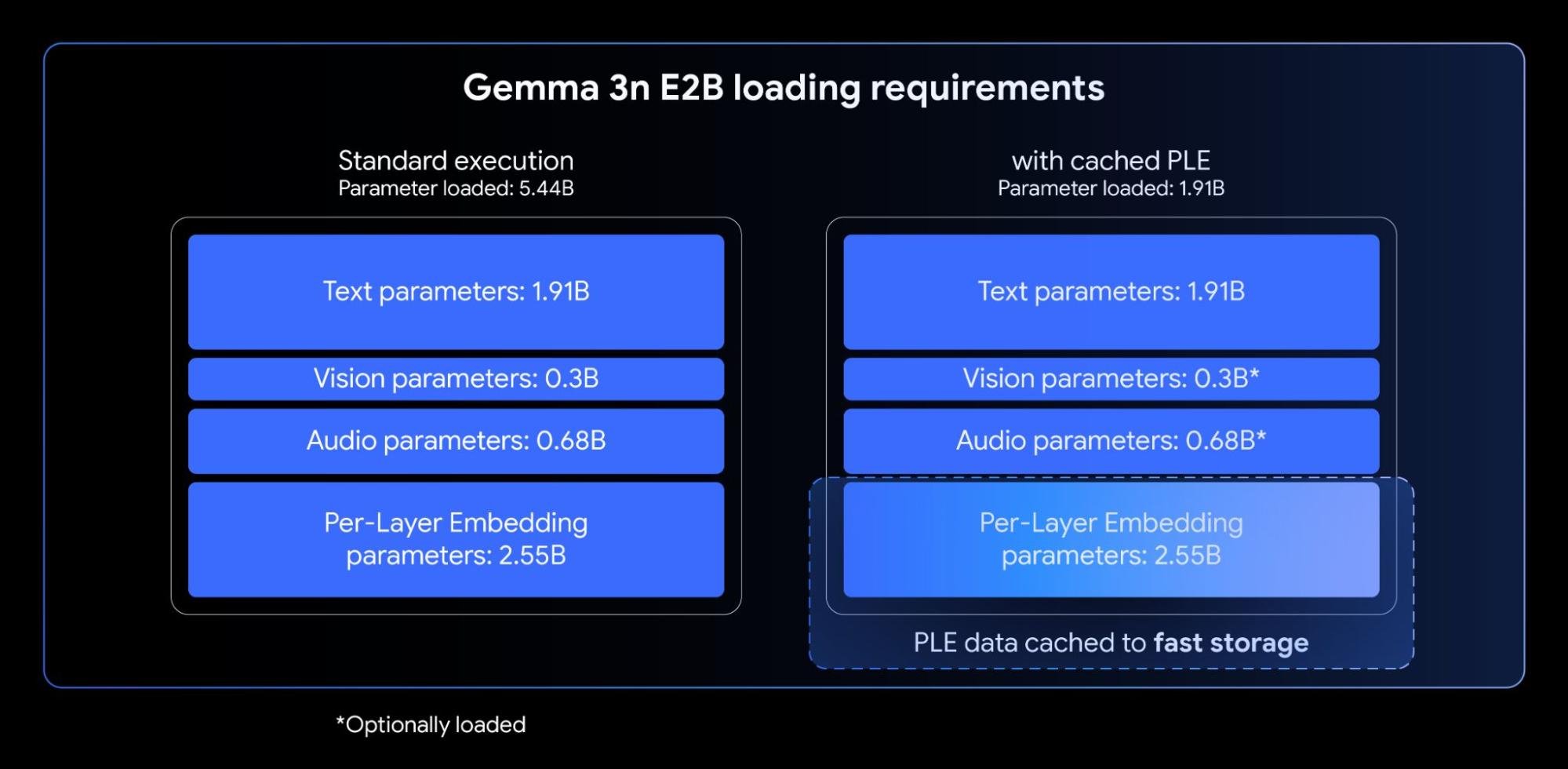
Per-Layer Embeddings

With Per-Layer Embeddings, you can use Gemma 3n E2B while only having ~2B parameters loaded in your accelerator.

KV Cache sharing: Faster long-context processing

Processing long inputs, such as the sequences derived from audio and video streams, is essential for many advanced on-device multimodal applications. Gemma 3n introduces KV Cache Sharing, a feature designed to significantly accelerate time-to-first-token for streaming response applications.

KV Cache Sharing optimizes how the model handles the initial input processing stage (often called the “prefill” phase). The keys and values of the middle layer from local and global attention are directly shared with all the top layers, delivering a notable 2x improvement on prefill performance compared to Gemma 3 4B. This means the model can ingest and understand lengthy prompt sequences much faster than before.

Audio understanding: Introducing speech to text and translation

Gemma 3n uses an advanced audio encoder based on the Universal Speech Model (USM). The encoder generates a token for every 160ms of audio (about 6 tokens per second), which are then integrated as input to the language model, providing a granular representation of the sound context.

This integrated audio capability unlocks key features for on-device development, including:

  • Automatic Speech Recognition (ASR): Enable high-quality speech-to-text transcription directly on the device.
  • Automatic Speech Translation (AST): Translate spoken language into text in another language.

We’ve observed particularly strong AST results for translation between English and Spanish, French, Italian, and Portuguese, offering great potential for developers targeting applications in these languages. For tasks like speech translation, leveraging Chain-of-Thought prompting can significantly enhance results. Here’s an example:

user
Transcribe the following speech segment in Spanish, then translate it into English: 

model

Plain text

At launch time, the Gemma 3n encoder is implemented to process audio clips up to 30 seconds. However, this is not a fundamental limitation. The underlying audio encoder is a streaming encoder, capable of processing arbitrarily long audios with additional long form audio training. Follow-up implementations will unlock low-latency, long streaming applications.


MobileNet-V5: New state-of-the-art vision encoder

Alongside its integrated audio capabilities, Gemma 3n features a new, highly efficient vision encoder, MobileNet-V5-300M, delivering state-of-the-art performance for multimodal tasks on edge devices.

Designed for flexibility and power on constrained hardware, MobileNet-V5 gives developers:

  • Multiple input resolutions: Natively supports resolutions of 256×256, 512×512, and 768×768 pixels, allowing you to balance performance and detail for your specific applications.
  • Broad visual understanding: Co-trained on extensive multimodal datasets, it excels at a wide range of image and video comprehension tasks.
  • High throughput: Processes up to 60 frames per second on a Google Pixel, enabling real-time, on-device video analysis and interactive experiences.

This level of performance is achieved with multiple architectural innovations, including:

  • An advanced foundation of MobileNet-V4 blocks (including Universal Inverted Bottlenecks and Mobile MQA).
  • A significantly scaled up architecture, featuring a hybrid, deep pyramid model that is 10x larger than the biggest MobileNet-V4 variant.
  • A novel Multi-Scale Fusion VLM adapter that enhances the quality of tokens for better accuracy and efficiency.

Benefiting from novel architectural designs and advanced distillation techniques, MobileNet-V5-300M substantially outperforms the baseline SoViT in Gemma 3 (trained with SigLip, no distillation). On a Google Pixel Edge TPU, it delivers a 13x speedup with quantization (6.5x without), requires 46% fewer parameters, and has a 4x smaller memory footprint, all while providing significantly higher accuracy on vision-language tasks

We’re excited to share more about the work behind this model. Look out for our upcoming MobileNet-V5 technical report, which will deep dive into the model architecture, data scaling strategies, and advanced distillation techniques.

Making Gemma 3n accessible from day one has been a priority. We’re proud to partner with many incredible open source developers to ensure broad support across popular tools and platforms, including contributions from teams behind AMD, Axolotl, Docker, Hugging Face, llama.cpp, LMStudio, MLX, NVIDIA, Ollama, RedHat, SGLang, Unsloth, and vLLM.

But this ecosystem is just the beginning. The true power of this technology is in what you will build with it. That’s why we’re launching the Gemma 3n Impact Challenge. Your mission: use Gemma 3n’s unique on-device, offline, and multimodal capabilities to build a product for a better world. With $150,000 in prizes, we’re looking for a compelling video story and a “wow” factor demo that shows real-world impact. Join the challenge and help build a better future.

Get started with Gemma 3n today

Ready to explore the potential of Gemma 3n today? Here’s how:

  • Experiment directly: Use Google AI Studio to try Gemma 3n in just a couple of clicks. Gemma models can also be deployed directly to Cloud Run from AI Studio.
  • Learn & integrate: Dive into our comprehensive documentation to quickly integrate Gemma into your projects or start with our inference and fine-tuning guides.

Shape
Shape
Stay Ahead

Explore More Insights

Stay ahead with more perspectives on cutting-edge power, infrastructure, energy,  bitcoin and AI solutions. Explore these articles to uncover strategies and insights shaping the future of industries.

Shape

Kyndryl: AI success hinges on workforce readiness

Nearly 80% of respondents said the pace of AI adoption is likely to outstrip their organization’s ability to adapt its workforce, governance structures, and operating model. As Kyndryl notes in the report, most leaders believe addressing those challenges “will prove more arduous than those involving code and compute.” Organizations are

Read More »

Netgear brings AI-driven network management to SMEs and MSPs

AI-powered operations Contextual insights to help identify issues faster Proactive recommendations for troubleshooting and optimization AI-assisted workflows designed to reduce manual effort Support for more predictive network operations Unified visibility and network intelligence Centralized visibility into network performance Monitoring of device health, connectivity, and user experience Actionable intelligence derived from

Read More »

Aggressive federal PQE timeline prompts warnings for enterprises

“The U.S. government’s EOs will likely spur accelerated intervention from all major governments and regional political blocs,” the firm said. “CISOs should be prepared for regulations to conflict and contain sovereignty requirements, which will complicate compliance.” Gartner recommends that companies build a PQC inventory and remediation program in 2026 and

Read More »

Presidential order addresses quantum computing gaps

By comparison, in AI, there are a number of benchmarks comparing AI models on everything from how well they do at math, to their ability to generate images, to whether they can find bugs in computer code. Benchmarks are important so that people can do fair comparisons of quantum systems,

Read More »

Energy Secretary Secures Mid-Atlantic Grid Ahead of Period of Hot Weather

WASHINGTON—The U.S. Department of Energy (DOE) today issued two emergency orders to mitigate blackout risks in the Mid-Atlantic ahead of the region’s predicted record-breaking peak loads brought on by the forecasted hot weather conditions. The first order directs PJM Interconnection, LLC (PJM) to dispatch specified units and to order their operation as needed to maintain reliability. The second order authorizes PJM, in collaboration with its Transmission Owners and Electric Distribution Companies, to direct backup generation resources to operate as a last resort before declaring an Energy Emergency Alert (EEA) 3 or during an EEA 3. The orders were issued pursuant to applications from PJM submitted on June 27 and 29, 2026. “Maintaining affordable, reliable, and secure power in the PJM service territory is non-negotiable,” said U.S. Secretary of Energy Chris Wright. “The previous administration’s energy subtraction policies weakened the grid, leaving Americans more vulnerable during events like this. Thanks to President Trump’s leadership, we are reversing those failures and using every available tool ensuring Americans in the Mid-Atlantic have continued access to affordable, reliable, and secure energy to power and cool their homes.” DOE estimates more than 35 GW of unused backup generation remains available nationwide. On day one, President Trump declared a national energy emergency after the Biden administration’s energy subtraction agenda left behind a grid increasingly vulnerable to blackouts. According to the North American Electric Reliability Corporation’s (NERC) 2026 Summer Reliability Assessment, the peak electricity demand in PJM occurs during the summer season. It further notes that “if extreme high temperatures are experienced, PJM anticipates the need for demand-response resources to help reduce load.” Power outages cost the American people $44 billion per year, according to data from DOE’s National Laboratories. These orders will mitigate the possibility of power outages in the Mid-Atlantic and highlight the commonsense policies of the Trump Administration to ensure Americans have access to

Read More »

Equinor to invest in additional Troll development to boost European gas supply

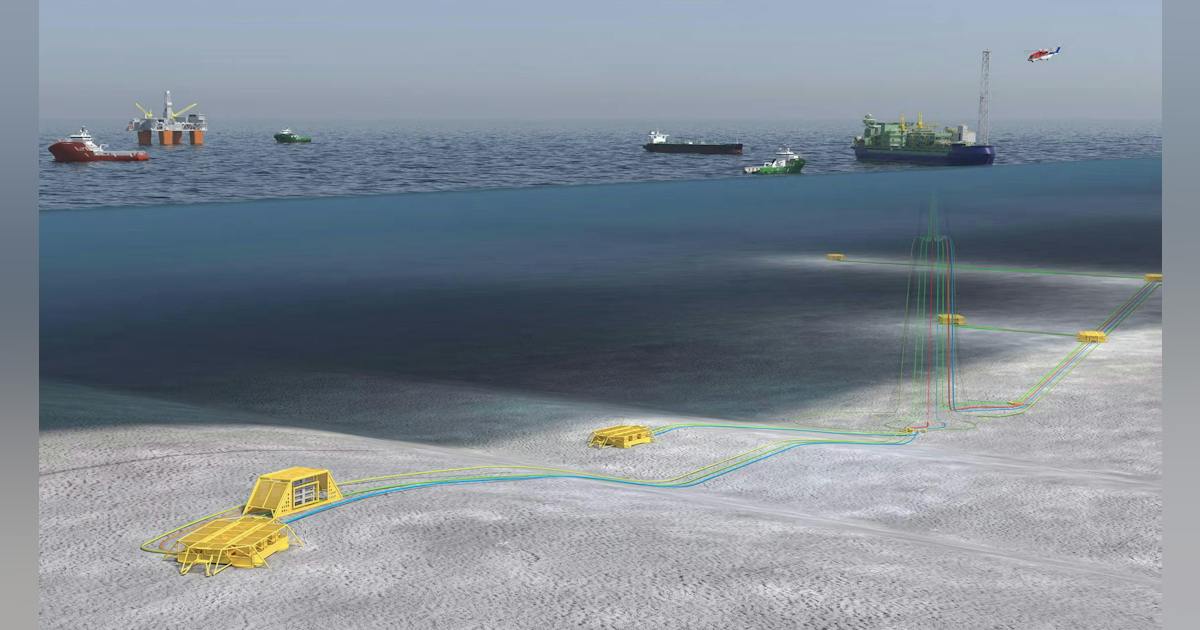
Equinor Energy AS and partners will invest more than 4 billion krone ($400 million) in a new subsea development to increase gas production from Troll field in the North Sea. The Troll West Increased gas recovery North (TWIN) expansion—the third step of Troll Phase 3, which produces gas from the Troll West reservoir—could come online as early as 2028, said Gunnar Nakken, Equinor’s senior vice-president for projects and subsea Norway. TWIN is expected to contribute around 11 billion standard cu m of gas. “By simplifying, increasing standardization and reusing existing infrastructure and equipment, we are reducing costs and enabling faster production,” he said. Equinor aims to produce 1.3 million b/d from the Norwegian Continental Shelf (NCS) in 2035 to meet a portion of Europe’s energy needs. Troll field contains about 40% of NCS total gas reserves, with gas from Troll meeting around 10% of Europe’s gas needs. The TWIN project consists of two wells in a template and a pipeline connected to existing subsea infrastructure. The umbilical and MEG line will be extended to the new development. The second step of Troll Phase 3 is expected to come online this year, continuing production from Troll A platform, 80 km northwest of Bergen, Norway, and the Gassco-operated Kollsnes processing plant towards 2030, Equinor said. Equinor is operator of the project with 30.55% interest. Partners are Petoro AS (55.93%), A/S Norske Shell (8.19%), TotalEnergies EP Norge AS (3.69%), and ConocoPhillips Skandinavia AS (1.64%).

Read More »

Zululand Energy Terminal invites EPC expressions of interest

The proposed 7.5-million tonne/year (tpy) Zululand Energy Terminal (ZET) at the Port of Richards Bay, South Africa, has invited expressions of interest (EOI) from engineering, procurement and construction (EPC) contractors for development of planned LNG regasification infrastructure. Imported natural gas is expected to supply both industry and power generation. Phase 1 of the project will use a 170,000-cu m floating storage unit attached to 3 million tpy of onshore regasification capacity. Phase 2 will add 220,000 cu m of onshore storage (potentially replacing the FSU) and 4.5 million tpy of regasification.  ZET hopes to complete detailed engineering during 2027 to reach final investment decision in 2028 and start operations in 2030. Reuters reported last week that ExxonMobil Corp. had signed a preliminary deal to supply LNG to ZET. Developed as a joint between Vopak Terminal Durban and Transnet Pipelines, ZET project is expected to be South Africa’s first LNG terminal. The consortium will design, develop, construct, finance, operate, and maintain the terminal in the South Dunes Precinct at the Port of Richards Bay over a 25-year concession. EPC execution will be subject to ZET’s localization and economic development objectives. Successful contractors will be expected to support local supplier participation, skills development, and the use of local labor. Qualifying parties will be included in the project’s vendor database and may be shortlisted for subsequent phases as potential preferred contractors or subcontractors. The EOI submission window closes July 9, 2026. Interested contractors are invited to access the full EOI documentation here. South African utility Eskom and ZET earlier this month signed a head of agreement (HOA) establishing the framework for a long-term strategic partnership to support South Africa’s gas-to-power program, underpinning a planned 3-Gw power plant near the terminal in KwaZulu-Natal. Vopak Terminal Durban is owned by Royal Vopak and Reatile Group

Read More »

Petrobras greenlights renewables plant for RPBC refinery

REDUC’s fist soybean oil-based SAF sale Announcement of FID on the RPBC renewables plant followed Petrobras’ June 17 confirmation that its 239,000-b/d Duque de Caxias (REDUC) refinery in the Baixada Fluminense area of Rio de Janeiro had completed first production and sale of a first 3,800-cu m batch of SAF made from soybean oil certified under the CORSIA low Land Use Change (ILUC) risk standard, which verifies sustainability criteria and a lower risk of impact on new land areas. Produced via co-processing and featuring 1% renewable content, the SAF batch marked “commercialization of the world’s first SAF made from certified low-ILUC-risk soy [to demonstrate] Petrobras’s commitment to sustainability, the energy transition, and the development of products aligned with market and societal demands [for lower-carbon solutions],” said Angélica Laureano, Petrobras’ director of logistics, sales, and markets. In October 2025, the REDUC refinery secured Brazil’s first international approval to advance commercial-scale production of SAF via the hydroprocessed esters and fatty acids (HEFA) co-processing route complying with ISCC System GmbH’s International Sustainability Carbon Certification (ISCC) standards, validating that SAF produced at the site meets the highest international sustainability and lifecycle carbon emission standards. Developed under ICAO’s CORSIA, the ISCC CORSIA certification was a prerequisite for commercial-scale SAF production following rigorous assessment of the production’s lifecycle carbon emissions and traceability. Equipped to produce as much as 10,000 b/d of SAF using a blend of conventional petroleum and up to 1.2% renewable feedstock, REDUC’s integration of bio-based oils—such as vegetable oil—into existing refining infrastructure via the HEFA co-processing method allows the refinery to produce SAF alongside conventional jet fuel with minimal investment, Petrobras previously said.

Read More »

Equinor to expand Troll with TWIN subsea development

Equinor Energy AS and partners will invest about NOK 4 billion ($410 million) in the new Troll West increased gas recovery north (TWIN) subsea development in Troll field in the North Sea. The TWIN project consists of two wells in a template and a pipeline connected to existing subsea infrastructure. The umbilical and monoethylene glycol line will be extended to the new development. The project is expected to contribute about 11 billion std cu m of gas to Troll. It is the third step of Troll Phase 3, which produces gas from the Troll West reservoir. Recoverable reserves from Troll Phase 3, mainly gas, are estimated at 2.2 billion boe. In accordance with the Petroleum Act, the partnership will now send an announcement to the Ministry of Energy concerning the development. An environmental impact assessment has been carried out. Troll, which supplies as much as 10% of Europe’s daily demand for gas, contains about 40% of the total gas reserves on the Norwegian continental shelf and was developed in phases, with gas extraction from Troll Øst in Phase 1 and oil from Troll West in Phase 2. The oil in Troll West is produced from multiple subsea templates tied into Troll B and Troll C via pipelines. Production from the Troll C installation started in 1999. Troll C is also used for production from Fram, Fram H-Nord, and Byrding. Several amended development plans were approved in connection with installing multiple subsea templates on Troll West. Equinor Energy AS is operator of TWIN (30.55%) with partners Petoro AS (55.93%), A/S Norske Shell (8.19%), TotalEnergies EP Norge AS (3.69%), and ConocoPhillips Skandinavia AS (1.64%).

Read More »

ICYMI: Upstream M&A slows on pricing gaps while deal appetite holds

Despite a slowdown in headline deal values this spring, upstream mergers and acquisitions remain active beneath the surface. In this ICYMI episode of the Oil & Gas Journal ReEnterprised podcast, Mikaila Adams, managing editor, examines data from Enverus and Rystad Energy detailing international and North American upstream deal markets in 2025 and into 2026. The discussion explores how pricing uncertainty widened the gap between buyers and sellers, creating a temporary pause rather than a collapse in market activity. The episode also looks at where capital continues to flow and what those trends reveal about the industry’s direction. From North American consolidation led by the Devon Energy–Coterra Energy merger to continued interest in gas-weighted assets tied to Gulf Coast LNG exports, the analysis highlights the forces shaping today’s upstream M&A landscape. It also considers the likelihood of additional divestitures, private equity activity, and asset sales as companies refine their portfolios, pointing to continued dealmaking momentum even in a more volatile market. References Devon, Coterra joining forces to create 1.6 million boe/d shale titan https://www.ogj.com/general-interest/companies/news/55354563/devon-coterra-joining-forces-to-create-16-million-boe-d-shale-titan Ovintiv to divest Anadarko assets for $3 billion https://www.ogj.com/general-interest/companies/news/55358241/ovintiv-to-divest-anadarko-assets-for-3-billion Insights: Vaca Muerta’s scale, productivity—and why it has more to give https://www.ogj.com/home/podcast/55370296/insights-vaca-muertas-scale-productivityand-why-it-has-more-to-give Mitsubishi to enter US shale gas business through Haynesville asset acquisition https://www.ogj.com/general-interest/companies/news/55344199/mitsubishi-to-enter-us-shale-gas-business-through-haynesville-shale-acquisition Shell to expand Canadian operations with $16.4-billion acquisition of ARC Resources https://www.ogj.com/general-interest/companies/news/55373597/shell-to-expand-canadian-operations-with-164-billion-acquisition-of-arc-resources US upstream M&A hits $38 billion in 1Q26 before volatility temporarily pauses the market https://www.enverus.com/newsroom/u-s-upstream-ma-hits-38-billion-in-1q26-before-volatility-temporarily-pauses-the-market/ International upstream M&A stuck at historic low https://www.enverus.com/newsroom/international-upstream-ma-stuck-at-historic-low/ Upstream deal value falls 83% as oil price uncertainty widens the buyer-seller gap https://www.rystadenergy.com/insights/upstream-deal-value-falls Iran war impact on global oil markets https://www.ogj.com/IranWar

Read More »

Executive Roundtable: The Rise of Integrated Infrastructure

Steve Altizer, Compu Dynamics: Integration has to be foundational. It has to start at the first planning conversation, not after the equipment is selected or once the building is already designed. In previous generations of data center development, mechanical, electrical, IT, and operations teams could often work in parallel and bring the pieces together later. That worked when the load profile was more predictable and the facility had more room to absorb change. Before the introduction of ChatGPT, there was very little change to absorb. AI removes that tolerance. A change in rack density can affect electrical distribution, structural requirements, thermal strategy, commissioning, service access, and the way the site is operated. These are no longer independent decisions. They are all part of one performance system. As AI systems move toward POD-scale platforms, the boundary between IT and facility infrastructure becomes much harder to separate. The challenge is that AI workloads are too varied for a one-size-fits-all approach. Training clusters, inference nodes, enterprise AI environments, and edge sites can all have different requirements for density, cooling architecture, network connectivity, security, site conditions, and serviceability. That is why many companies are adopting a modular approach, while others are embracing hybrid models where turnkey modular AI capacity is integrated into larger campus environments.  At the campus level, that means standardizing the backbone infrastructure that serves the site (utility power feeds, central cooling capacity, and network pathways), while allowing the IT environment and the integrated critical infrastructure components to evolve as workload requirements change. The goal is not modularity for its own sake. The goal is to support the next generation of AI deployments without forcing every hardware change to become a major redesign. AI infrastructure cannot be planned as a collection of disparate systems. It has to be designed as one coordinated

Read More »

Data Center Insights 2026 Brings Industry Leaders Together for a Two-Day Look at the AI Infrastructure Era

The data center industry has never been more visible, more vital, or more challenged. Support for AI and its overall industry impact has pushed digital infrastructure into the public conversation. It has become clear that the sector is confronting unprecedented demands for everything from power to basic infrastructure. That convergence is the focus of Data Center Insights 2026, a two-day virtual event taking place July 15–16, 2026, produced by Endeavor B2B’s Data Center Frontier, Cabling Installation & Maintenance, ISE, Lightwave, and SecurityInfoWatch. Designed for data center owners, operators, engineers, IT leaders, and the people supporting the next generation of data center development, the event offers a concentrated look at the technologies and strategies shaping the future of digital infrastructure. The program arrives at a crucial moment. AI workloads are changing almost every assumption behind data center design. Rack densities are rising, liquid cooling is becoming mainstream, and fiber networks are being rethought for 400G and beyond. Power constraints are now central to site selection. Security is becoming highlighted and operators are being asked to build faster, scale larger, be more resource efficient and maintain resilience in an environment where downtime carries higher consequences than ever. Data Center Insights 2026 is structured to help attendees make sense of this moment. Rather than treating data center infrastructure as a set of separate disciplines, the event brings together experts across cooling, cabling, fiber, power distribution, modular design, AI infrastructure, and operational strategy. The result is a practical, cross-functional program built around the real-world questions now facing the industry. What will I learn at this event? The event opens with “Expert Roundup: The State of the Data Center Industry,” featuring perspectives from Steven Carlini of Schneider Electric.This session sets the stage by examining the forces driving change across the data center landscape in 2026.

Read More »

Executive Roundtable: Scaling Beyond the Prototype Phase

Steve Altizer, Compu Dynamics: The defining challenge is keeping pace with the rate of change in the IT environment. It takes time to design, permit, build, and commission a data center. AI hardware operates on a completely different timeline. New GPU families are being introduced every 12 to 18 months, and from one generation to the next, rack power densities can double or even triple. At prototype scale, you can design around a single cluster or a specific density profile. At production scale, that approach becomes a real liability. The facility has to support today’s deployment while remaining adaptable for the next compute profile. We are not just talking about adding more power. We are preparing for major architectural shifts, including the move toward DC power delivery or cooling systems that may rely on two-phase liquid to remove heat at scale. That is what becomes materially harder. You are no longer solving for a single, static deployment. You are solving for a moving target inside a live operating environment. This is where strategic modularity proves its value. It helps decouple the lifecycle of the building from the lifecycle of the IT hardware. Instead of treating the data center as one monolithic design, modularity creates a more agile framework that can absorb new power and cooling architectures without requiring a full facility retrofit every time the IT roadmap shifts. At Compu Dynamics Modular, we are seeing this play out in real time. The value of a turnkey modular approach is not simply speed. It is the agility owners need to keep pace with ever-evolving rack densities, power delivery requirements, and cooling architectures.

Read More »

Q2 Executive Roundtable Recap

Matt Vincent is Editor in Chief of Data Center Frontier, where he leads editorial strategy and coverage focused on the infrastructure powering cloud computing, artificial intelligence, and the digital economy. A veteran B2B technology journalist with more than two decades of experience, Vincent specializes in the intersection of data centers, power, cooling, and emerging AI-era infrastructure. Since assuming the EIC role in 2023, he has helped guide Data Center Frontier’s coverage of the industry’s transition into the gigawatt-scale AI era, with a focus on hyperscale development, behind-the-meter power strategies, liquid cooling architectures, and the evolving energy demands of high-density compute, while working closely with the Digital Infrastructure Group at Endeavor Business Media to expand the brand’s analytical and multimedia footprint. Vincent also hosts The Data Center Frontier Show podcast, where he interviews industry leaders across hyperscale, colocation, utilities, and the data center supply chain to examine the technologies and business models reshaping digital infrastructure. Since its inception he serves as Head of Content for the Data Center Frontier Trends Summit. Before becoming Editor in Chief, he served in multiple senior editorial roles across Endeavor Business Media’s digital infrastructure portfolio, with coverage spanning data centers and hyperscale infrastructure, structured cabling and networking, telecom and datacom, IP physical security, and wireless and Pro AV markets. He began his career in 2005 within PennWell’s Advanced Technology Division and later held senior editorial positions supporting brands such as Cabling Installation & Maintenance, Lightwave Online, Broadband Technology Report, and Smart Buildings Technology. Vincent is a frequent moderator, interviewer, and keynote speaker at industry events including the HPC Forum, where he delivers forward-looking analysis on how AI and high-performance computing are reshaping digital infrastructure. He graduated with honors from Indiana University Bloomington with a B.A. in English Literature and Creative Writing and lives in southern New Hampshire with

Read More »

Emergence Water and Nimbus: Water Joins Power as AI Infrastructure’s Next Critical Constraint

For much of the past decade, the conversation surrounding AI infrastructure has been dominated by one resource above all others: power. Utilities have become strategic partners. Natural gas generation, small modular reactors, microgrids and behind-the-meter power have become central themes across virtually every major data center conference. Developers increasingly speak about securing megawatts years before they discuss servers. But another infrastructure constraint is quietly following the same trajectory: Water. According to executives from Emergence Water and Nimbus Advanced Process Cooling Systems, water is rapidly evolving beyond its traditional role as a sustainability metric and becoming one of the primary determinants of where AI campuses can be built, how they are cooled, and how efficiently they will operate over the coming decade. Speaking with Data Center Frontier Editor in Chief Matt Vincent on the latest DCF Show podcast, Emergence Water Chief Product Officer Leif Percifield and Nimbus Technical Director Vamsi Mokkapati described an industry where water has effectively joined power and fiber as foundational infrastructure for AI development. “From a community perspective, water is absolutely the number one priority about where and why a data center gets built,” Percifield said. “From the developer, it’s pretty binary. They either have water available to them—or they don’t.” Water Is Becoming a Site Selection Constraint The shift reflects the changing realities of AI infrastructure. Traditional enterprise data centers often viewed water primarily through sustainability reporting or Power Usage Effectiveness (PUE) discussions. AI facilities operating at unprecedented rack densities have fundamentally altered that equation. Liquid cooling, hybrid cooling architectures and increasingly sophisticated thermal management strategies all place new emphasis on reliable long-term water availability. Equally important, communities are beginning to scrutinize water usage with the same intensity previously reserved for electrical demand. Percifield says those conversations are increasingly determining whether projects move forward at all.

Read More »

U.S. Open powers up AI-ready network in challenging environment

Environmental conditions add another layer of complexity. Anthony Santora, managing director of IT for the USGA, describes the championship network as a data center without the usual comforts. There’s dust, rain, wind, and wide temperature swings instead of clean, controlled air. Hardware resides in trailers and weatherproof enclosures, not in racks behind raised floor tiles. For network engineers who spend most of their time on office campuses and in colos, that’s an important reminder: Critical infrastructure increasingly sits in places that look nothing like a traditional wiring closet. User behavior is just as hostile. The U.S. Open has its own term — the “Tiger effect” (though one could argue it’s now the Scottie effect) — for what happens when tens of thousands of fans follow a single golfer. The hot spot moves with the group, and the RF design must cope with a dense, moving cluster of devices. That pattern should sound familiar to anyone who supports large conferences or festivals; it’s the same phenomenon, just under a different name. Building an AI‑ready, fault‑tolerant course network Cisco’s answer to this environment is a fully redundant, mobile core design. Instead of a single large core in a building, the network collapses into dual trailers that serve as cores on the go, typically anchored at the NBC broadcast compound and another central location. Each core hosts Cisco Secure Firewall appliances, FMCs, core Catalyst switches, DHCP, UPS, and generators, all in pairs. Rodriguez was matter-of-fact about the philosophy: “We do everything in pairs as much as we can.” If one fails, its twin picks up the load.

Read More »

Microsoft will invest $80B in AI data centers in fiscal 2025

And Microsoft isn’t the only one that is ramping up its investments into AI-enabled data centers. Rival cloud service providers are all investing in either upgrading or opening new data centers to capture a larger chunk of business from developers and users of large language models (LLMs).  In a report published in October 2024, Bloomberg Intelligence estimated that demand for generative AI would push Microsoft, AWS, Google, Oracle, Meta, and Apple would between them devote $200 billion to capex in 2025, up from $110 billion in 2023. Microsoft is one of the biggest spenders, followed closely by Google and AWS, Bloomberg Intelligence said. Its estimate of Microsoft’s capital spending on AI, at $62.4 billion for calendar 2025, is lower than Smith’s claim that the company will invest $80 billion in the fiscal year to June 30, 2025. Both figures, though, are way higher than Microsoft’s 2020 capital expenditure of “just” $17.6 billion. The majority of the increased spending is tied to cloud services and the expansion of AI infrastructure needed to provide compute capacity for OpenAI workloads. Separately, last October Amazon CEO Andy Jassy said his company planned total capex spend of $75 billion in 2024 and even more in 2025, with much of it going to AWS, its cloud computing division.

Read More »

John Deere unveils more autonomous farm machines to address skill labor shortage

Join our daily and weekly newsletters for the latest updates and exclusive content on industry-leading AI coverage. Learn More Self-driving tractors might be the path to self-driving cars. John Deere has revealed a new line of autonomous machines and tech across agriculture, construction and commercial landscaping. The Moline, Illinois-based John Deere has been in business for 187 years, yet it’s been a regular as a non-tech company showing off technology at the big tech trade show in Las Vegas and is back at CES 2025 with more autonomous tractors and other vehicles. This is not something we usually cover, but John Deere has a lot of data that is interesting in the big picture of tech. The message from the company is that there aren’t enough skilled farm laborers to do the work that its customers need. It’s been a challenge for most of the last two decades, said Jahmy Hindman, CTO at John Deere, in a briefing. Much of the tech will come this fall and after that. He noted that the average farmer in the U.S. is over 58 and works 12 to 18 hours a day to grow food for us. And he said the American Farm Bureau Federation estimates there are roughly 2.4 million farm jobs that need to be filled annually; and the agricultural work force continues to shrink. (This is my hint to the anti-immigration crowd). John Deere’s autonomous 9RX Tractor. Farmers can oversee it using an app. While each of these industries experiences their own set of challenges, a commonality across all is skilled labor availability. In construction, about 80% percent of contractors struggle to find skilled labor. And in commercial landscaping, 86% of landscaping business owners can’t find labor to fill open positions, he said. “They have to figure out how to do

Read More »

2025 playbook for enterprise AI success, from agents to evals

Join our daily and weekly newsletters for the latest updates and exclusive content on industry-leading AI coverage. Learn More 2025 is poised to be a pivotal year for enterprise AI. The past year has seen rapid innovation, and this year will see the same. This has made it more critical than ever to revisit your AI strategy to stay competitive and create value for your customers. From scaling AI agents to optimizing costs, here are the five critical areas enterprises should prioritize for their AI strategy this year. 1. Agents: the next generation of automation AI agents are no longer theoretical. In 2025, they’re indispensable tools for enterprises looking to streamline operations and enhance customer interactions. Unlike traditional software, agents powered by large language models (LLMs) can make nuanced decisions, navigate complex multi-step tasks, and integrate seamlessly with tools and APIs. At the start of 2024, agents were not ready for prime time, making frustrating mistakes like hallucinating URLs. They started getting better as frontier large language models themselves improved. “Let me put it this way,” said Sam Witteveen, cofounder of Red Dragon, a company that develops agents for companies, and that recently reviewed the 48 agents it built last year. “Interestingly, the ones that we built at the start of the year, a lot of those worked way better at the end of the year just because the models got better.” Witteveen shared this in the video podcast we filmed to discuss these five big trends in detail. Models are getting better and hallucinating less, and they’re also being trained to do agentic tasks. Another feature that the model providers are researching is a way to use the LLM as a judge, and as models get cheaper (something we’ll cover below), companies can use three or more models to

Read More »

OpenAI’s red teaming innovations define new essentials for security leaders in the AI era

Join our daily and weekly newsletters for the latest updates and exclusive content on industry-leading AI coverage. Learn More OpenAI has taken a more aggressive approach to red teaming than its AI competitors, demonstrating its security teams’ advanced capabilities in two areas: multi-step reinforcement and external red teaming. OpenAI recently released two papers that set a new competitive standard for improving the quality, reliability and safety of AI models in these two techniques and more. The first paper, “OpenAI’s Approach to External Red Teaming for AI Models and Systems,” reports that specialized teams outside the company have proven effective in uncovering vulnerabilities that might otherwise have made it into a released model because in-house testing techniques may have missed them. In the second paper, “Diverse and Effective Red Teaming with Auto-Generated Rewards and Multi-Step Reinforcement Learning,” OpenAI introduces an automated framework that relies on iterative reinforcement learning to generate a broad spectrum of novel, wide-ranging attacks. Going all-in on red teaming pays practical, competitive dividends It’s encouraging to see competitive intensity in red teaming growing among AI companies. When Anthropic released its AI red team guidelines in June of last year, it joined AI providers including Google, Microsoft, Nvidia, OpenAI, and even the U.S.’s National Institute of Standards and Technology (NIST), which all had released red teaming frameworks. Investing heavily in red teaming yields tangible benefits for security leaders in any organization. OpenAI’s paper on external red teaming provides a detailed analysis of how the company strives to create specialized external teams that include cybersecurity and subject matter experts. The goal is to see if knowledgeable external teams can defeat models’ security perimeters and find gaps in their security, biases and controls that prompt-based testing couldn’t find. What makes OpenAI’s recent papers noteworthy is how well they define using human-in-the-middle

Read More »