NVIDIA co-founder Jensen Huang resigned Thursday morning (November 12) as president, CEO and board member of the world’s dominant AI chipmaker, a stunning leadership change that introduces new uncertainty into the global artificial intelligence infrastructure boom.
In an official announcement, NVIDIA confirmed that Chief Financial Officer Colette Kress will serve as interim CEO while the board conducts a search for Huang’s permanent successor. The company also appointed longtime director Harvey C. Jones as its first board chairman.
The departure ends Huang’s 33-year leadership of the company he co-founded in 1993 and comes amid a rapidly escalating controversy involving his reported personal relationships, potential Chinese intelligence activity and questions about corporate governance.
According to Reuters, NVIDIA shares fell more than 10% in premarket trading Thursday as investors weighed the implications for the approximately $4 trillion company and the wider AI technology sector.
The company’s announcement did not specify a reason for Huang’s resignation.
National Security Investigation Precedes Leadership Change
The leadership shakeup follows several days of increasing scrutiny over Huang’s reported relationship with a businesswoman whom U.S. authorities suspect of connections to Chinese intelligence, alongside separate reporting concerning a relationship with a senior NVIDIA executive.
On November 8, NVIDIA’s board announced an independent investigation into whether Huang had been targeted by a foreign intelligence operation. At the time, directors stated that they had no reason to believe company secrets or national security had been compromised.
The controversy subsequently attracted congressional attention, including calls for Huang’s resignation and questions about semiconductor export controls and the security of advanced AI technology.
The espionage allegations remain contested, and no compromise of NVIDIA technology has been publicly established.
For the data center industry, however, the immediate question extends beyond the circumstances of Huang’s departure.
It concerns the potential disruption of an infrastructure ecosystem increasingly organized around NVIDIA’s computing architecture, commercial partnerships and capital investment strategies.
NVIDIA’s AI Factory Ecosystem Faces a Leadership Test
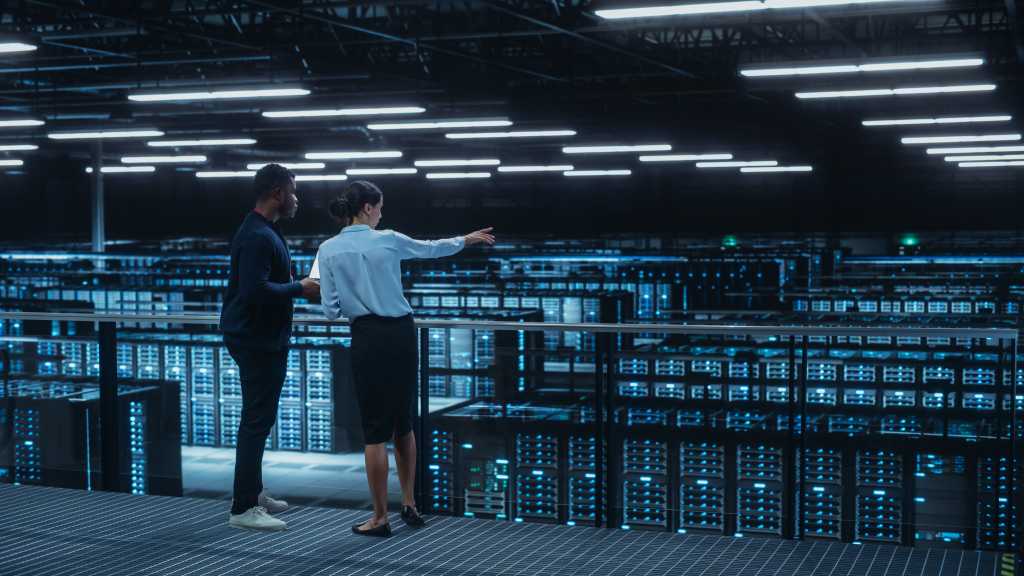
Under Huang, NVIDIA evolved from a semiconductor supplier into a central architect of the AI data center buildout, influencing not only computing platforms but also facility design, networking, cooling, electrical distribution and project financing.
As Data Center Frontier previously reported, NVIDIA announced agreements in August with Apollo, BlackRock, Blackstone, Brookfield, Goldman Sachs and KKR aimed at mobilizing more than $500 billion in potential third-party financing for AI infrastructure.
That figure represents prospective capital mobilization, not committed NVIDIA spending. Nevertheless, the initiative illustrates the company’s growing influence over how AI infrastructure projects are structured and financed.
The company has also been extending its DSX reference architecture deeper into physical infrastructure. Its DSX Ready program establishes technical requirements for battery energy storage and liquid cooling, while the recently announced DSX POD initiative targets factory-integrated AI computing infrastructure designed for deployment at prepared sites in as little as 14 days.
These initiatives involve extensive coordination among data center operators, equipment manufacturers, utilities, construction firms and financial institutions.
NVIDIA insists that the work will continue.
In Thursday’s announcement, Jones expressed confidence in Kress and NVIDIA’s leadership team, stating that the company expects its operations, customer commitments and product roadmap to proceed without interruption.
Kress, who joined NVIDIA in 2013, has overseen the company’s finances throughout its emergence as the dominant supplier of accelerated computing platforms. She will retain her CFO responsibilities during the transition.
Still, Huang’s unusually prominent role in assembling NVIDIA’s ecosystem raises legitimate questions about strategic continuity, capital allocation and coordination across its expanding infrastructure partnerships.
There is presently no indication that the leadership change has interrupted chip deliveries or delayed announced AI factory projects.
An AI Market Already Under Pressure
The upheaval arrives amid increasing scrutiny of AI infrastructure financing and development timelines, even as demand for accelerated computing remains strong.
On November 10, CoreWeave reported third-quarter revenue of $3.66 billion, up approximately 168% year over year, alongside a $132.5 billion contracted revenue backlog. But the NVIDIA-backed AI cloud provider also reported a $709 million quarterly net loss, underscoring the enormous capital requirements of scaling AI computing infrastructure.
Meanwhile, neocloud provider Nebius reported Thursday that delays in bringing third-party capacity online had pushed some expected deployments into the first half of 2027, even as it raised its capital spending outlook.
Together, these developments highlight the distinction between sustained AI demand and the industry’s capacity to finance, construct and energize the infrastructure required to meet it.
NVIDIA’s leadership transition introduces an additional uncertainty at the very center of that equation.
The company’s next major financial disclosure is scheduled for November 17, when NVIDIA plans to release third-quarter fiscal 2027 results and hold its earnings call.
For investors, infrastructure developers and technology partners alike, that presentation will be an early opportunity to assess how the company intends to maintain continuity following the departure of the executive who helped define the modern AI factory.
The immediate risk is not that AI infrastructure demand disappears with Huang’s departure. It is whether NVIDIA can preserve the pace and coordination of an increasingly complex global buildout without the leader who brought much of that ecosystem together.