Stay Ahead, Stay ONMINE

Kids outlearn AI—and we still don’t know why

People have been talking to each other for at least 100,000 years, as best we can tell. And in all that time, there has been only one thing in the world that could learn a human language to perfect fluency: a human child.  Now there are two.  Four short years after the release of ChatGPT, many of us now take it for granted that we can converse naturally with our phones or computers. LLMs like Claude, DeepSeek, and OpenAI’s GPT models are fluent and flexible enough to masquerade convincingly as humans. But peek behind the computational curtain, and there’s a catch: Teaching a computer to use human language still requires an inhuman amount of data. An LLM can easily churn through a hundred thousand times more words than a person will experience in the process of mastering their mother tongue—and way more than children might hear by their first birthday, when they typically start to grab hold of language. “The progress recently has been amazing,” Michael C. Frank, a cognitive scientist at Stanford University, says of LLMs. “But we still have to burn down a forest and scrape the entire sum of all human knowledge to re-create this milestone that happens in our living rooms over the course of a year.” This yawning divide between children and machines is called the data efficiency gap. And it raises a tantalizing question for cognitive scientists and a challenge for the architects of AI models: How is it that kids can still outperform the most linguistically sophisticated machines ever built?  Finding answers has stakes for both AI research and cognitive science. For the past decade, language models have mostly gotten better by getting bigger. Meta’s open-weight LLM Llama 3.1, released two years ago, chewed through 15 trillion tokens (word-like chunks of language) in pretraining—the main step of training a model that happens before it is fine-tuned for a specific task, like being a chatbot. Frontier models could be pretraining on 10 times more data, says Ethan Gotlieb Wilcox, a cognitive scientist and linguist at Georgetown University. But there’s only so much internet to train on, and eventually—perhaps as early as the 2030s—the well of easily available data could run dry.  Kids show that it could be possible to learn more with less. Far less. A preteen raised in a linguistically rich home may have heard something in the vicinity of 100 million words. Add literacy to the mix and you can boost that word count to maybe 300 million words by age 20.  The difference in scale is something that can only really be gestured at in analogy. “Claude has seen the amount of language that an entire city will experience in one generation,” says Wilcox. If you were to print out on paper all the words used to train a modern LLM, you could make a stack that would reach past the International Space Station. The human preteen’s 100 million words, meanwhile, would stack up just 20 meters. And we can make do with far less than that.  By reverse-engineering the way kids learn, scientists hope to be able to create more data-efficient AI models, which could be useful for everything from training AI effectively on video to creating chatbots that serve minority language communities. Testing hypotheses about human learning in machine models could also settle enduring questions about language and children’s developing minds. Are we born with a language instinct, or would it be possible, even in principle, for a child to learn language purely from experience? Is the way we process language a quirk of our biology, or might at least some of it reflect universal constraints on how languages can be used and learned?  The essential elements Most of us realize language is hard only when we try to learn a new one after childhood. The past perfect tense, rolled rs and nasal vowels, the genitive case, phrasal verbs, grammatically masculine tables and feminine spoons—many are the instruments of linguistic torment for the adult language learner. It’s typically effortless to learn our mother tongues, however. Toddlers usually start producing grammatically correct sentences after hearing something like 10 million words, or 30 million on the high end.  “It’s just totally miraculous,” says Frank. “If you train GPT-2 on 30 million words, you get a nonsense generator; you don’t get a kid.”  Exactly how babies pull this off is a mystery. Researchers know a lot about what kids learn and how they use language at different stages in development, but there’s still a lot we don’t know. Perhaps the most enduring question is why babies can learn language at all. The syntax of human language—the rules for combining words into sentences—includes recursive, nested structures that allow us to express virtually infinite ideas with a finite lexicon of words and pieces of words. This seems like something that should be a problem for babies. They only splash about in the shallows of a fathomless ocean of language. And yet, somehow, that’s enough. From a drop, they infer the depths. One solution, put forward in the 1950s by the MIT linguist Noam Chomsky, is that babies are born with hardwired knowledge of grammar. Chomsky was reacting to a rival view, championed by the psychologist B.F. Skinner, that language acquisition is entirely environmental. Skinner thought language was learned through conditioning and reinforcement, the way a dog figures out how to sit or shake for treats. Chomsky countered by citing the “poverty of the stimulus”—the idea that language, especially syntax, is too complex and children’s exposure to it too “impoverished” for them to learn entirely from experience. “His signature argument was, essentially, that language cannot be learned on the basis purely of statistics,” says Richard Futrell, a linguist and cognitive scientist at the University of California, Irvine. Instead, Chomsky posited that language is based on a set of logical rules and argued that children needed innate knowledge of those rules to deduce the grammar of their language from scraps of speech. “It’s just totally miraculous … If you train GPT-2 on 30 million words, you get a nonsense generator; you don’t get a kid.” Michael C. Frank, cognitive scientist, Stanford University The Chomskyan view of language dominated linguistics in the US for decades under the moniker of generative grammar. And it was a major influence on computer science in the 1950s and ’60s, when AI was enjoying its first boom time and the lines between linguistics and natural-language processing dissolved in a flood of military funding; the Pentagon wanted computers that could understand English and translate Russian.  Despite early successes of simple neural networks, which learn to recognize and reproduce statistical patterns, AI researchers in the United States largely adopted a rule-based framework influenced by Chomsky’s theories. They tried to teach language to computers by explicitly coding the rules into programs—think less immersion experience, more grammar class. This approach, part of a broader trend called symbolic AI, prevailed for decades. It also largely failed to produce models actually capable of handling human language at scale. Interest in natural-­language processing chilled in the “AI winter” that began in the 1970s.  In the aftermath, neural networks started to make a comeback. But it wasn’t until the 2010s, when computer hardware was getting cheap and capable and the internet was getting big, that their performance began turning heads. By 2018 and 2019, the models BERT and GPT-2, which were built on a new architecture—the transformer—and trained on billions of tokens, made it clear to insiders that learning from a massive glut of data could work for language. In 2022, with the breakout success of OpenAI’s chatbot ChatGPT, it was clear to everyone. LLMs are not brains. What they are is powerful statistical learners—naïve pattern-learning machines without any of the evolved biological quirks folded into the human cortex. In other words, they are exactly the kind of thing a generative linguist two decades ago would have thought could not learn language. And yet here they were, writing believable sonnets and passing grammar tests. “No matter how skeptical you are about AI, the thing that everyone has been really impressed with is: These things learn syntax,” says Alison Gopnik, a developmental psychologist at the University of California, Berkeley. “I didn’t think that was going to turn out to be true. And I think most people didn’t think that you could just look at the statistics of a large sample of language and figure out grammar.” But what about learning from a small sample of language—a child-size one, say? Is it possible to build a baby-scale model that’s anything more than a nonsense generator? Baby talk Alex Warstadt, a linguist and data scientist at the University of California, San Diego, remembers the years around the release of BERT and GPT-2 as a heady time. Back in 2019, he was still a PhD student in linguistics at New York University, watching his field change before his eyes. The mere fact that language models could learn English by churning through text was a challenge to prevailing Chomskyan ideas. But many linguists remained skeptical that LLMs could tell us anything about how humans acquire language.  “I always got pushback on one issue in particular. And that was the size of the data sets of the model,” says Warstadt. “There was never a time when people were training language models at human scale where we were impressed by them.” But Warstadt saw promise in LLMs: A scientific model doesn’t have to be perfect to be informative, and LLMs were clearly powerful simulations of human language use. By building hypotheses about how children learn into models and measuring their performance—how close they came to closing the data gap—might scientists be able to put their ideas to the test? In August 2022, Warstadt posted a Twitter thread laying out an argument that neural networks could be useful models of language acquisition. After some back-and-forth in the comments with AI researcher Leshem Choshen, Warstadt floated the idea for what would become BabyLM, an annual competition organized by Warstadt, Choshen, and several other researchers to train models on small data sets. That was four years ago. Since then, BabyLM has added workshops and inspired spin-offs including a competition for baby models trained on Chinese. The main event challenges researchers to train language models on a “developmentally plausible” corpus of just 100 million words (for the toddler-scale track, 10 million) drawn from storybooks, dialogue, movie subtitles, Simple English Wikipedia, normal Wikipedia, and actual transcripts of speech directed at children. The models are evaluated on the kinds of grammar benchmarks that psycholinguists use with humans, says Georgetown’s Wilcox, one of the organizers. SELMAN DESIGN One kind of task involves presenting test subjects—human or machine—with sentences and looking for indications of confusion or surprise at ungrammatical features. For instance, a test might compare the sentences The keys to the cabinet are on the table and The keys to the cabinet is on the table. “When humans see ‘is,’ they’re like: What? That’s not supposed to be ‘is,’ ” says Wilcox. For a human, that surprise might be measured by tracking eye movements. For language models, researchers use a measure called surprisal, which assesses how unlikely the model predicts a sentence or part of a sentence to be. The competition has already challenged some assumptions, such as the effectiveness of curriculum learning. Curriculum learning starts with simple training data and works up to more complex inputs—a bit like starting with baby talk and getting more sophisticated over time. And it was by far the most popular approach taken in the first round of BabyLM, says Warstadt. But it didn’t work as well as expected. “The appeal is just kind of hard to resist, you know. [Curriculum learning] seems to really line up with ways that we believe humans are learning,” says Aaron Mueller, a computer scientist at Boston University and one of the BabyLM organizers. “But it seems like these transformers don’t really need to have their data ordered in such a way to learn effectively.”  Perhaps a touch ironically, the best BabyLM models aren’t inspired by babies at all. The 2024 champ, GPT-BERT, is a transformer trained partly to predict the next token in a sequence, like modern LLMs, and partly to act like BERT, a “masked language model” that fills in the blanks in sequences of tokens Mad Libs style. Impressively, when GPT-BERT was pretrained on about 100 million words, it was able to beat the performance of Meta’s Llama 2 70B—an LLM pretrained roughly 15,000 times that amount—on one of the BabyLM benchmarks. Still, BabyLM models are not on the same level as LLMs. Many can’t produce text at all, and even GPT-BERT would seem clunky next to a modern commercial model. Ultimately, while they are “baby”-size, the way these models learn isn’t very baby-like. Kids are not disembodied computer programs whose only “experience” of the world comes through written text. They take in the world via their senses—especially vision and hearing. To close the data gap, some researchers think, machines will need to start learning through the eyes and ears of children. Taking it all in When Michael Frank started his lab at Stanford about 15 years ago, scientists didn’t really know how babies experience the world. Developmental psychologists were just beginning to glimpse babies’ lives through headcams. “The insights that came out from that early research were that kids’ experience looks really radically different than we thought,” says Frank. “It’s much more focused: They’ve got these little short arms, so the objects are, like, right in front of them. And they live in a forest of knees.”  Frank was excited to use headcam footage to train machine-learning models to test hypotheses about how kids learn language, but he needed more data. So he and four colleagues recruited three babies—all the children of psychologist mothers who knew what they were getting themselves into—to don headcams for science. The project, called SAYCam, recorded two hours a week of each child’s life between six months and two and a half years of age. “[The families] were willing to release that video, and that’s critical,” says Frank. “So we released it, and people started training models on it.”  One of those people was Brenden Lake, a cognitive scientist and AI researcher at Princeton. In 2024, when he was working out of New York University, he and his colleagues presented a model trained on 61 hours of raw SAYCam data that learned to identify objects and associate them with words. Many theories in developmental psychology propose that children need some biases to help them pick out particular parts of their raw sensory experience and associate them with bits of language. For instance, it’s thought babies assume that a new word like “shoe” refers to a whole object rather than a part of it (like a shoelace), says Lake. But the model Lake’s team built was able to learn to identify objects in the video footage and associate them with words without any such biases. “It turns out you can get a real start on language learning using a lot less than what a number of theories suggested,” says Lake. Still, he adds, “we don’t get a two-year-old out of [training] when we’re done.” But perhaps it’s not surprising that such models can’t replicate childlike capabilities by working with a few dozen hours of footage cobbled together from short snapshots over several years of a child’s life. It could be that the shortfalls just indicate a lack of realistic data. After all, babies can’t wear a headcam 24-7; efforts like SAYCam and its successor, BabyView, record at best a few hours a week. So researchers have the choice between working with a tiny slice of the life of a single child or with larger data sets of footage pooled from many kids. Either way, a model’s training data is still a far cry from the lived experience of a child. That could be changing. Uri Hasson, a neuroscientist and psychologist at Princeton, spent the last five years on a project to record the first 1,000 days of 17 children’s lives. The participating families wired every living area in their homes (except bedrooms and bathrooms) with cameras and microphones and recorded 12 hours a day, almost every day. The resulting data set, described for the first time in a recent preprint, is of a scale that would have simply been impossible to work with absent new AI tools for transcription and video analysis, says Hasson. “For the first time, we have the input,” he says. “It’s really only the beginning.”  Missing ingredients So far, training models on video has proved difficult. While text-based models emerge fully fluent (after ingesting huge training data sets), multimodal models trained on video from kids are far from that. Lake’s model, for instance, learned simple words, like “ball” and “cat.” Attempts to supplement text with visual data haven’t worked for BabyLM participants, says Warstadt. Gopnik thinks the issue could be that kids do not simply sit and watch the world go by. “Children are actively exploring, which means that they’re actively choosing their own data,” she says. “Kids are constantly experimenting.” Maybe that’s the missing ingredient.  Research by Gopnik’s group—including studies of grade schoolers exploring a Minecraft-inspired game—shows that what looks like child’s play is in fact an effective way to learn cause and effect. Kids seek out experiences and take actions that maximize their “empowerment,” or the ability to make a predictable impact on the world.  Unlike models, children are aware of what they don’t know and have a drive to fill their knowledge gaps, says Elizabeth Bonawitz, a developmental cognitive scientist at Harvard. And children’s social lives also help them learn, she says. Her research has shown that children interpret information differently when they know an adult is trying to teach them something. “Children are not only reasoning about the evidence they’re being told,” says Bonawitz. “They’re reasoning about the teacher, about the teacher’s knowledge, and about why the teacher is telling [them] this particular information.” That’s very different from how models learn: passively and in isolation. Perhaps if models were built to seek out information to fill in their own blind spots, experiment with language and observe how other language users react to their babbling, and reason about some kind of simulated social world, they’d learn better. Last year’s BabyLM actually opened the competition to models that could learn by interacting with other models. But the social models didn’t outperform standard ones. Of the leading industry labs, Meta seems the most interested in taking inspiration from kids—specifically for training models from video. Two Meta researchers were involved in BabyLM’s multimodal branch, and Meta scientists—together with academic researchers, including Frank—recently announced a benchmark and challenge for training models on baby headcam footage. Frank also says a stealth-mode AI startup called Flapping Airplanes has taken interest in his research. Neither Meta, Google DeepMind, OpenAI, nor Flapping Airplanes agreed to an interview.  For now, frontier labs aren’t exactly racing to borrow tricks from children, says Gopnik. She thinks it’ll be the next generation of AI—whatever replaces the transformer—that will take lessons from developmental psychology. Perhaps the most enticing reason to close the data gap is that it could help us understand ourselves. In general, the machine-learning community is less interested in mimicking the brain than in just building something that works, says Mueller. But he thinks awareness of—and interest in—the data efficiency gap is growing. An example is the NanoGPT Slowrun benchmark, launched by Q Labs in March 2026. “They have very similar goals to BabyLM,” says Mueller. “But they’ve dropped the motivation from human language learning and really just focused on the data efficiency angle.” One reason Warstadt wants to close the data gap is to democratize AI so that universities and others without the resources to hyperscale can train good models and stay relevant in AI research. David Samuel, a machine-­learning researcher at the University of Oslo and one of GPT-BERT’s architects, has a more personal reason to work on this problem. He’s Czech and works in Norway, and there’s a lot less data in Czech and Norwegian available for training LLMs than there is in English. Minority languages like Sami might have just tens of millions of tokens available, says Samuel—about the scale of a toddler’s exposure. “The question was,” he says, “how can we develop language models that are just as capable as the English ones for small languages?” SELMAN DESIGN But perhaps the most enticing reason to close the data gap is that it could help us understand ourselves. Bonawitz says she was initially skeptical that large language models could reveal anything about cognition. LLMs and brains are, after all, very different. Brains are embodied. Our neurons are not tidy lines of code but living cells. And our brains grow and change as we learn and age—LLMs pretrain once and never again. But as different as the two systems are, says Bonawitz, “I’m sort of revising my beliefs.” She’s been won over by the idea of studying models the way comparative psychologists might study animal minds to illuminate our own. Researchers like Warstadt, Frank, Wilcox, Lake, and Hasson are already using language models as a kind of linguistic lab rat, an imperfect but informative stand-in for a real human language user—especially for questions that are more about learning and language and information processing than anything specific to our brains or biology. When models can do things with language we thought were impossible, it challenges old assumptions. And researchers can build hypotheses about language learning into models—say, by simulating different degrees of bilingualism or depriving models of exposure to certain grammatical forms—and test those hypotheses in a way that would be impossible to do with real children. Futrell compares the situation to teaching language to an alien and then opening up its brain to see what happened.  While other animals communicate, only humans converse. Now there’s something neither animal nor human that can talk, too. LLMs open up the possibility for comparative studies, even if models and minds are vastly different. “For the last 100,000 years or however long human language has existed, humans have been the only entities in the universe that use language. Now there’s this other linguistic entity,” says Warstadt. “Finally we have a model; not in the sense of a language model, but in the sense of a model organism.”  Elise Cutts is a science writer based in Austria.

People have been talking to each other for at least 100,000 years, as best we can tell. And in all that time, there has been only one thing in the world that could learn a human language to perfect fluency: a human child. 

Now there are two. 

Four short years after the release of ChatGPT, many of us now take it for granted that we can converse naturally with our phones or computers. LLMs like Claude, DeepSeek, and OpenAI’s GPT models are fluent and flexible enough to masquerade convincingly as humans. But peek behind the computational curtain, and there’s a catch: Teaching a computer to use human language still requires an inhuman amount of data. An LLM can easily churn through a hundred thousand times more words than a person will experience in the process of mastering their mother tongue—and way more than children might hear by their first birthday, when they typically start to grab hold of language.

“The progress recently has been amazing,” Michael C. Frank, a cognitive scientist at Stanford University, says of LLMs. “But we still have to burn down a forest and scrape the entire sum of all human knowledge to re-create this milestone that happens in our living rooms over the course of a year.”

This yawning divide between children and machines is called the data efficiency gap. And it raises a tantalizing question for cognitive scientists and a challenge for the architects of AI models: How is it that kids can still outperform the most linguistically sophisticated machines ever built? 

Finding answers has stakes for both AI research and cognitive science. For the past decade, language models have mostly gotten better by getting bigger. Meta’s open-weight LLM Llama 3.1, released two years ago, chewed through 15 trillion tokens (word-like chunks of language) in pretraining—the main step of training a model that happens before it is fine-tuned for a specific task, like being a chatbot. Frontier models could be pretraining on 10 times more data, says Ethan Gotlieb Wilcox, a cognitive scientist and linguist at Georgetown University. But there’s only so much internet to train on, and eventually—perhaps as early as the 2030s—the well of easily available data could run dry. 

Kids show that it could be possible to learn more with less. Far less. A preteen raised in a linguistically rich home may have heard something in the vicinity of 100 million words. Add literacy to the mix and you can boost that word count to maybe 300 million words by age 20. 

The difference in scale is something that can only really be gestured at in analogy. “Claude has seen the amount of language that an entire city will experience in one generation,” says Wilcox. If you were to print out on paper all the words used to train a modern LLM, you could make a stack that would reach past the International Space Station. The human preteen’s 100 million words, meanwhile, would stack up just 20 meters. And we can make do with far less than that. 

By reverse-engineering the way kids learn, scientists hope to be able to create more data-efficient AI models, which could be useful for everything from training AI effectively on video to creating chatbots that serve minority language communities. Testing hypotheses about human learning in machine models could also settle enduring questions about language and children’s developing minds. Are we born with a language instinct, or would it be possible, even in principle, for a child to learn language purely from experience? Is the way we process language a quirk of our biology, or might at least some of it reflect universal constraints on how languages can be used and learned? 

The essential elements

Most of us realize language is hard only when we try to learn a new one after childhood. The past perfect tense, rolled rs and nasal vowels, the genitive case, phrasal verbs, grammatically masculine tables and feminine spoons—many are the instruments of linguistic torment for the adult language learner. It’s typically effortless to learn our mother tongues, however. Toddlers usually start producing grammatically correct sentences after hearing something like 10 million words, or 30 million on the high end. 

“It’s just totally miraculous,” says Frank. “If you train GPT-2 on 30 million words, you get a nonsense generator; you don’t get a kid.” 

Exactly how babies pull this off is a mystery. Researchers know a lot about what kids learn and how they use language at different stages in development, but there’s still a lot we don’t know. Perhaps the most enduring question is why babies can learn language at all. The syntax of human language—the rules for combining words into sentences—includes recursive, nested structures that allow us to express virtually infinite ideas with a finite lexicon of words and pieces of words. This seems like something that should be a problem for babies. They only splash about in the shallows of a fathomless ocean of language. And yet, somehow, that’s enough. From a drop, they infer the depths.

One solution, put forward in the 1950s by the MIT linguist Noam Chomsky, is that babies are born with hardwired knowledge of grammar. Chomsky was reacting to a rival view, championed by the psychologist B.F. Skinner, that language acquisition is entirely environmental. Skinner thought language was learned through conditioning and reinforcement, the way a dog figures out how to sit or shake for treats. Chomsky countered by citing the “poverty of the stimulus”—the idea that language, especially syntax, is too complex and children’s exposure to it too “impoverished” for them to learn entirely from experience. “His signature argument was, essentially, that language cannot be learned on the basis purely of statistics,” says Richard Futrell, a linguist and cognitive scientist at the University of California, Irvine. Instead, Chomsky posited that language is based on a set of logical rules and argued that children needed innate knowledge of those rules to deduce the grammar of their language from scraps of speech.

“It’s just totally miraculous … If you train GPT-2 on 30 million words, you get a nonsense generator; you don’t get a kid.”

Michael C. Frank, cognitive scientist, Stanford University

The Chomskyan view of language dominated linguistics in the US for decades under the moniker of generative grammar. And it was a major influence on computer science in the 1950s and ’60s, when AI was enjoying its first boom time and the lines between linguistics and natural-language processing dissolved in a flood of military funding; the Pentagon wanted computers that could understand English and translate Russian. 

Despite early successes of simple neural networks, which learn to recognize and reproduce statistical patterns, AI researchers in the United States largely adopted a rule-based framework influenced by Chomsky’s theories. They tried to teach language to computers by explicitly coding the rules into programs—think less immersion experience, more grammar class. This approach, part of a broader trend called symbolic AI, prevailed for decades. It also largely failed to produce models actually capable of handling human language at scale. Interest in natural-­language processing chilled in the “AI winter” that began in the 1970s. 

In the aftermath, neural networks started to make a comeback. But it wasn’t until the 2010s, when computer hardware was getting cheap and capable and the internet was getting big, that their performance began turning heads. By 2018 and 2019, the models BERT and GPT-2, which were built on a new architecture—the transformer—and trained on billions of tokens, made it clear to insiders that learning from a massive glut of data could work for language. In 2022, with the breakout success of OpenAI’s chatbot ChatGPT, it was clear to everyone.

LLMs are not brains. What they are is powerful statistical learners—naïve pattern-learning machines without any of the evolved biological quirks folded into the human cortex. In other words, they are exactly the kind of thing a generative linguist two decades ago would have thought could not learn language. And yet here they were, writing believable sonnets and passing grammar tests.

“No matter how skeptical you are about AI, the thing that everyone has been really impressed with is: These things learn syntax,” says Alison Gopnik, a developmental psychologist at the University of California, Berkeley. “I didn’t think that was going to turn out to be true. And I think most people didn’t think that you could just look at the statistics of a large sample of language and figure out grammar.”

But what about learning from a small sample of language—a child-size one, say? Is it possible to build a baby-scale model that’s anything more than a nonsense generator?

Baby talk

Alex Warstadt, a linguist and data scientist at the University of California, San Diego, remembers the years around the release of BERT and GPT-2 as a heady time. Back in 2019, he was still a PhD student in linguistics at New York University, watching his field change before his eyes. The mere fact that language models could learn English by churning through text was a challenge to prevailing Chomskyan ideas. But many linguists remained skeptical that LLMs could tell us anything about how humans acquire language. 

“I always got pushback on one issue in particular. And that was the size of the data sets of the model,” says Warstadt. “There was never a time when people were training language models at human scale where we were impressed by them.”

But Warstadt saw promise in LLMs: A scientific model doesn’t have to be perfect to be informative, and LLMs were clearly powerful simulations of human language use. By building hypotheses about how children learn into models and measuring their performance—how close they came to closing the data gap—might scientists be able to put their ideas to the test? In August 2022, Warstadt posted a Twitter thread laying out an argument that neural networks could be useful models of language acquisition. After some back-and-forth in the comments with AI researcher Leshem Choshen, Warstadt floated the idea for what would become BabyLM, an annual competition organized by Warstadt, Choshen, and several other researchers to train models on small data sets.

That was four years ago. Since then, BabyLM has added workshops and inspired spin-offs including a competition for baby models trained on Chinese. The main event challenges researchers to train language models on a “developmentally plausible” corpus of just 100 million words (for the toddler-scale track, 10 million) drawn from storybooks, dialogue, movie subtitles, Simple English Wikipedia, normal Wikipedia, and actual transcripts of speech directed at children. The models are evaluated on the kinds of grammar benchmarks that psycholinguists use with humans, says Georgetown’s Wilcox, one of the organizers.
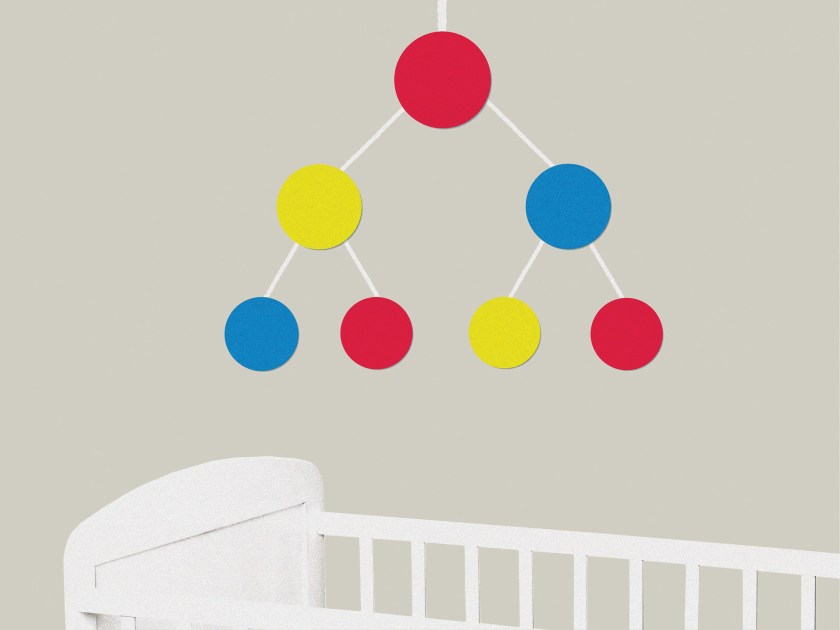
a cradle with an LLM model hanging like a mobile over it

SELMAN DESIGN

One kind of task involves presenting test subjects—human or machine—with sentences and looking for indications of confusion or surprise at ungrammatical features. For instance, a test might compare the sentences The keys to the cabinet are on the table and The keys to the cabinet is on the table. “When humans see ‘is,’ they’re like: What? That’s not supposed to be ‘is,’ ” says Wilcox. For a human, that surprise might be measured by tracking eye movements. For language models, researchers use a measure called surprisal, which assesses how unlikely the model predicts a sentence or part of a sentence to be.

The competition has already challenged some assumptions, such as the effectiveness of curriculum learning. Curriculum learning starts with simple training data and works up to more complex inputs—a bit like starting with baby talk and getting more sophisticated over time. And it was by far the most popular approach taken in the first round of BabyLM, says Warstadt. But it didn’t work as well as expected.

“The appeal is just kind of hard to resist, you know. [Curriculum learning] seems to really line up with ways that we believe humans are learning,” says Aaron Mueller, a computer scientist at Boston University and one of the BabyLM organizers. “But it seems like these transformers don’t really need to have their data ordered in such a way to learn effectively.” 

Perhaps a touch ironically, the best BabyLM models aren’t inspired by babies at all. The 2024 champ, GPT-BERT, is a transformer trained partly to predict the next token in a sequence, like modern LLMs, and partly to act like BERT, a “masked language model” that fills in the blanks in sequences of tokens Mad Libs style. Impressively, when GPT-BERT was pretrained on about 100 million words, it was able to beat the performance of Meta’s Llama 2 70B—an LLM pretrained roughly 15,000 times that amount—on one of the BabyLM benchmarks.

Still, BabyLM models are not on the same level as LLMs. Many can’t produce text at all, and even GPT-BERT would seem clunky next to a modern commercial model. Ultimately, while they are “baby”-size, the way these models learn isn’t very baby-like. Kids are not disembodied computer programs whose only “experience” of the world comes through written text. They take in the world via their senses—especially vision and hearing. To close the data gap, some researchers think, machines will need to start learning through the eyes and ears of children.

Taking it all in

When Michael Frank started his lab at Stanford about 15 years ago, scientists didn’t really know how babies experience the world. Developmental psychologists were just beginning to glimpse babies’ lives through headcams.

“The insights that came out from that early research were that kids’ experience looks really radically different than we thought,” says Frank. “It’s much more focused: They’ve got these little short arms, so the objects are, like, right in front of them. And they live in a forest of knees.” 

Frank was excited to use headcam footage to train machine-learning models to test hypotheses about how kids learn language, but he needed more data. So he and four colleagues recruited three babies—all the children of psychologist mothers who knew what they were getting themselves into—to don headcams for science. The project, called SAYCam, recorded two hours a week of each child’s life between six months and two and a half years of age.

“[The families] were willing to release that video, and that’s critical,” says Frank. “So we released it, and people started training models on it.” 

One of those people was Brenden Lake, a cognitive scientist and AI researcher at Princeton. In 2024, when he was working out of New York University, he and his colleagues presented a model trained on 61 hours of raw SAYCam data that learned to identify objects and associate them with words. Many theories in developmental psychology propose that children need some biases to help them pick out particular parts of their raw sensory experience and associate them with bits of language. For instance, it’s thought babies assume that a new word like “shoe” refers to a whole object rather than a part of it (like a shoelace), says Lake. But the model Lake’s team built was able to learn to identify objects in the video footage and associate them with words without any such biases. “It turns out you can get a real start on language learning using a lot less than what a number of theories suggested,” says Lake. Still, he adds, “we don’t get a two-year-old out of [training] when we’re done.”

But perhaps it’s not surprising that such models can’t replicate childlike capabilities by working with a few dozen hours of footage cobbled together from short snapshots over several years of a child’s life. It could be that the shortfalls just indicate a lack of realistic data. After all, babies can’t wear a headcam 24-7; efforts like SAYCam and its successor, BabyView, record at best a few hours a week. So researchers have the choice between working with a tiny slice of the life of a single child or with larger data sets of footage pooled from many kids. Either way, a model’s training data is still a far cry from the lived experience of a child.

That could be changing. Uri Hasson, a neuroscientist and psychologist at Princeton, spent the last five years on a project to record the first 1,000 days of 17 children’s lives. The participating families wired every living area in their homes (except bedrooms and bathrooms) with cameras and microphones and recorded 12 hours a day, almost every day. The resulting data set, described for the first time in a recent preprint, is of a scale that would have simply been impossible to work with absent new AI tools for transcription and video analysis, says Hasson. “For the first time, we have the input,” he says. “It’s really only the beginning.” 

Missing ingredients

So far, training models on video has proved difficult. While text-based models emerge fully fluent (after ingesting huge training data sets), multimodal models trained on video from kids are far from that. Lake’s model, for instance, learned simple words, like “ball” and “cat.” Attempts to supplement text with visual data haven’t worked for BabyLM participants, says Warstadt. Gopnik thinks the issue could be that kids do not simply sit and watch the world go by. “Children are actively exploring, which means that they’re actively choosing their own data,” she says. “Kids are constantly experimenting.” Maybe that’s the missing ingredient. 

Research by Gopnik’s group—including studies of grade schoolers exploring a Minecraft-inspired game—shows that what looks like child’s play is in fact an effective way to learn cause and effect. Kids seek out experiences and take actions that maximize their “empowerment,” or the ability to make a predictable impact on the world. 

Unlike models, children are aware of what they don’t know and have a drive to fill their knowledge gaps, says Elizabeth Bonawitz, a developmental cognitive scientist at Harvard. And children’s social lives also help them learn, she says. Her research has shown that children interpret information differently when they know an adult is trying to teach them something. “Children are not only reasoning about the evidence they’re being told,” says Bonawitz. “They’re reasoning about the teacher, about the teacher’s knowledge, and about why the teacher is telling [them] this particular information.”

That’s very different from how models learn: passively and in isolation. Perhaps if models were built to seek out information to fill in their own blind spots, experiment with language and observe how other language users react to their babbling, and reason about some kind of simulated social world, they’d learn better. Last year’s BabyLM actually opened the competition to models that could learn by interacting with other models. But the social models didn’t outperform standard ones.

Of the leading industry labs, Meta seems the most interested in taking inspiration from kids—specifically for training models from video. Two Meta researchers were involved in BabyLM’s multimodal branch, and Meta scientists—together with academic researchers, including Frank—recently announced a benchmark and challenge for training models on baby headcam footage. Frank also says a stealth-mode AI startup called Flapping Airplanes has taken interest in his research. Neither Meta, Google DeepMind, OpenAI, nor Flapping Airplanes agreed to an interview. 

For now, frontier labs aren’t exactly racing to borrow tricks from children, says Gopnik. She thinks it’ll be the next generation of AI—whatever replaces the transformer—that will take lessons from developmental psychology.

Perhaps the most enticing reason to close the data gap is that it could help us understand ourselves.

In general, the machine-learning community is less interested in mimicking the brain than in just building something that works, says Mueller. But he thinks awareness of—and interest in—the data efficiency gap is growing. An example is the NanoGPT Slowrun benchmark, launched by Q Labs in March 2026. “They have very similar goals to BabyLM,” says Mueller. “But they’ve dropped the motivation from human language learning and really just focused on the data efficiency angle.”

One reason Warstadt wants to close the data gap is to democratize AI so that universities and others without the resources to hyperscale can train good models and stay relevant in AI research. David Samuel, a machine-­learning researcher at the University of Oslo and one of GPT-BERT’s architects, has a more personal reason to work on this problem. He’s Czech and works in Norway, and there’s a lot less data in Czech and Norwegian available for training LLMs than there is in English. Minority languages like Sami might have just tens of millions of tokens available, says Samuel—about the scale of a toddler’s exposure. “The question was,” he says, “how can we develop language models that are just as capable as the English ones for small languages?”

a retro computer with the word hello in script on the screen sits in a child's high chair

SELMAN DESIGN

But perhaps the most enticing reason to close the data gap is that it could help us understand ourselves.

Bonawitz says she was initially skeptical that large language models could reveal anything about cognition. LLMs and brains are, after all, very different. Brains are embodied. Our neurons are not tidy lines of code but living cells. And our brains grow and change as we learn and age—LLMs pretrain once and never again. But as different as the two systems are, says Bonawitz, “I’m sort of revising my beliefs.” She’s been won over by the idea of studying models the way comparative psychologists might study animal minds to illuminate our own.

Researchers like Warstadt, Frank, Wilcox, Lake, and Hasson are already using language models as a kind of linguistic lab rat, an imperfect but informative stand-in for a real human language user—especially for questions that are more about learning and language and information processing than anything specific to our brains or biology. When models can do things with language we thought were impossible, it challenges old assumptions. And researchers can build hypotheses about language learning into models—say, by simulating different degrees of bilingualism or depriving models of exposure to certain grammatical forms—and test those hypotheses in a way that would be impossible to do with real children. Futrell compares the situation to teaching language to an alien and then opening up its brain to see what happened. 

While other animals communicate, only humans converse. Now there’s something neither animal nor human that can talk, too. LLMs open up the possibility for comparative studies, even if models and minds are vastly different. “For the last 100,000 years or however long human language has existed, humans have been the only entities in the universe that use language. Now there’s this other linguistic entity,” says Warstadt. “Finally we have a model; not in the sense of a language model, but in the sense of a model organism.” 

Elise Cutts is a science writer based in Austria.

Shape
Shape
Stay Ahead

Explore More Insights

Stay ahead with more perspectives on cutting-edge power, infrastructure, energy,  bitcoin and AI solutions. Explore these articles to uncover strategies and insights shaping the future of industries.

Shape

Network architecture pay climbs amid AI shift

Network architects today must make decisions that involve multiple technologies. From topology to WAN and SD-WAN to segmentation and security, the scope of networking skills continues to evolve. Those networking decisions become more complicated as enterprises incorporate AI workloads, edge computing, Wi-Fi 7, private 5G, and more. AI and automation

Read More »

Golar contracts CIMC Raffles for fourth FLNG

Golar LNG Ltd. last week executed an engineering, procurement, and construction (EPC) contract with Yantai CIMC Raffles Offshore Ltd. (CIMC Raffles) for its fourth floating LNG (FLNG) and second MKII design FLNG vessel with an annual liquefaction capacity of 3.5 million tonnes/year (tpy). Golar’s fourth FLNG is expected to be

Read More »

Cerebras reimagines AI cluster design with switchless CS-4 architecture

Inside the Cerebras fabric, the trade-off is different. Direct Wafer Links are proprietary, so third-party accelerators cannot be added to the fabric. Scaling it requires additional Cerebras systems, Shah said. Faruqui said the operational divide may be more significant than the physical networking challenge. Existing orchestration environments are generally designed

Read More »

Energy Department Announces $500 Million Award to Revitalize American Steelmaking

WASHINGTON—The U.S. Department of Energy (DOE) today announced a $500 million award to support a $1 billion investment at Cleveland-Cliffs’ Middletown Works facility in Middletown, Ohio. Vice President JD Vance and U.S. Energy Secretary Chris Wright visited Middletown Works today to highlight the Trump Administration’s commitment to American steelworkers and the resurgence of American manufacturing. The investment will modernize American steelmaking, protect 2,300 American jobs, and strengthen the domestic steel supply chain. The project advances President Trump’s commitment to put American workers first, bring investment back to American communities, and strengthen the industries critical to America’s economic and national security. Cleveland-Cliffs determined that the business case for the original project scope no longer made sense given customers’ unwillingness to pay a “green premium” for steel. Working with DOE, Cleveland-Cliffs identified a viable alternative that will upgrade and improve the efficiency of the existing coal-fired blast furnace while also capturing and commercializing co-product blast furnace gas (BFG). “President Trump is rebuilding America’s industrial base,” said Secretary Wright. “This investment puts American workers and American manufacturing first. It will modernize one of our nation’s critical steelmaking facilities, protect thousands of jobs, and strengthen our domestic steel production—keeping Ohio at the heart of American manufacturing and strengthening our national security.” The investment will modernize critical steelmaking operations at Middletown Works by rebuilding and upgrading the plant’s main coal-fired ironmaking furnace, deploying AI to optimize furnace operations and improve energy efficiency, and building an on-site facility to convert steel mill process gases into electricity. Follow-on investments will turn industrial byproducts into materials for concrete used in regional infrastructure. “This landmark investment at Middletown Works will secure a reliable domestic supply of high-purity steel while protecting thousands of quality jobs in Ohio,” said Assistant Secretary of Energy Audrey Robertson. “DOE is proud to partner with Cleveland-Cliffs to reduce America’s dependence on foreign products

Read More »

Energy Secretary Keeps Critical Generation Available in Mid-Atlantic

WASHINGTON—U.S. Secretary of Energy Chris Wright today issued an emergency order to address critical grid reliability issues facing the Mid-Atlantic region of the United States. The emergency order directs PJM Interconnection L.L.C. (PJM), in coordination with Constellation Energy Corporation, to ensure Units 3 and 4 of the Eddystone Generating Station in Pennsylvania remain available to operate and to employ economic dispatch to minimize costs for the American people. The units were originally slated to shut down on May 31, 2025. “The energy sources that perform when you need them most are the most valuable,” Secretary Wright said. “During recent Mid-Atlantic heat waves, coal, natural gas, and nuclear kept the lights and air conditioners on. President Trump and the Energy Department are committed to keeping critical generation available when demand is highest, reducing the risk of blackouts and ensuring Americans have affordable, reliable, and secure power—regardless of whether the wind is blowing or the sun is shining.” As outlined in DOE’s Resource Adequacy Report, power outages could increase by 100 times in 2030 if the U.S. continues to take reliable power offline. This order is in effect beginning on August 23, 2026, through November 20, 2026.                                                                                             ###

Read More »

Energy Department Announces $500 Million to Secure America’s Critical Mineral and Battery Supply Chains

WASHINGTON—The U.S. Department of Energy’s (DOE) Office of Critical Minerals and Energy Innovation (CMEI) today announced $500 million for seven selected projects to expand critical mineral and material processing, battery manufacturing, and recycling capacity in the United States. In accordance with President Trump’s Executive Order, Unleashing American Energy, the selected projects advance the President’s agenda to strengthen America’s domestic critical minerals and materials supply chains, reduce reliance on foreign sources, bolster national security, and advance American energy dominance. “For too long, America has depended on foreign actors for critical materials essential to modern life that underpin our economy, energy security, and national security,” said U.S. Secretary of Energy Chris Wright. “President Trump is reversing that dependence by securing our critical supply chains, unleashing American industry, and bringing critical materials production and processing back to the United States.” “DOE is taking decisive action to secure the critical supply chains necessary to power our nation,” said Assistant Secretary of Energy Audrey Robertson. “These projects underscore DOE’s commitment to driving innovation, reducing reliance on foreign sources, and promoting American energy dominance.” This is the third round of funding from DOE’s Battery Materials Processing and Battery Manufacturing and Recycling programs, which support battery materials processing, recycling, and manufacturing projects. These include demonstration projects, construction of commercial-scale facilities, and retrofitting or retooling existing facilities.  Critical minerals and materials are essential to American industry, energy production, and national security. Expanding domestic capacity will help ensure the resources America needs are processed, manufactured, and recycled in the United States.  Information on the selected projects is available here and here.

Read More »

bp lets Shah Deniz compression automation contract

bp has let a contract to Emerson to deliver automation technologies for the Shah Deniz Compression project offshore Azerbaijan. Emerson will provide integrated control and safety systems aimed at enhancing production, safety, and reliability on the new offshore compression platform. The contract includes systems to provide process control, safety shutdown, fire and gas detection, and power management. Together, these systems deliver real-time visibility and remote control of critical operations, Emerson said. The $2.9 billion Shah Deniz Compression project, which includes an electrically powered, normally unattended offshore production platform, is a next stage development of the Caspian Sea Shah Deniz field. Designed to access low-pressure gas reserves and maximize overall recovery, the platform will be equipped with four 11 Mw compressors and serve as the central compression hub for gas from the Shah Deniz Alpha and Bravo platforms. The platform will operate remotely from bp’s onshore Sangachal terminal 55 km south of Baku. The project is expected to enable about 50 billion cu m of additional gas and about 25 million bbl of condensate production and export. Construction is scheduled to be completed in 2029, with first gas compression expected from the Shah Deniz Alpha platform in 2029 and from the Shah Deniz Bravo platform in 2030. The agreement follows a previous automation contract bp signed with Emerson for the Azeri Central East and Shah Deniz Stage 2 developments. bp is operator at Shah Deniz (29.99%) with partners Lukoil (19.99%), TPAO (19%), Cenub Qaz Dehlizi (16.02%), NICO (10%), and MVM (5%).

Read More »

Federal court voids Texas GulfLink license over agency’s ‘serious procedural errors’

The ruling voids the license, halting all construction or progress. Sentinel Midstream declined comment on the ruling and would not answer questions about the status of construction. GulfLink, sited about 30 miles offshore Freeport, Tex., is designed to export up to 1 million b/d via Very Large Crude Carriers (VLCCs) to the government of Japan and Freeport Commodities. The project involves a 44-mile, 42-in. OD pipeline and was scheduled to begin operations around 2028. The estimated $2.1 billion investment was funded as part of a broader trade agreement between the US and Japan. The legal battle stems from a specific rule in the Deepwater Port Act of 1974 that dictates that the federal government can only permit one crude oil deepwater port, including any supporting infrastructure, within a single designated “application area.” Because the competing SPOT project’s pipeline route physically overlaps and intersects GulfLink’s lines, the plaintiff—Citizens for Clean Air & Clean Water in Brazoria County (Better Brazoria), represented by Earthjustice—successfully argued that MARAD violated the “one port” rule when issuing GulfLink’s license in February. The three-judge panel found that MARAD “improperly drew” the map designing the project’s official boundaries to exclude the pipelines and approved two overlapping projects in the same zone instead of only licensing one. The court wrote that the scope of the error made vacatur, not the less serious remand without vacatur, the appropriate remedy. Vacatur deems the license invalid and is used when the court finds “serious procedural errors” that cannot be easily explained or fixed with minor changes. Remand without vacatur sends the decision back to the agency for corrections but leaves the current license in place in the meantime. SPOT project status The $2.5-3-billion SPOT project, developed by Enterprise Products Partners in partnership with Enbridge Inc., also lies about 30 miles from Freeport. Designed to handle VLCCs,

Read More »

IEA: Emergency reserve withdrawals slow

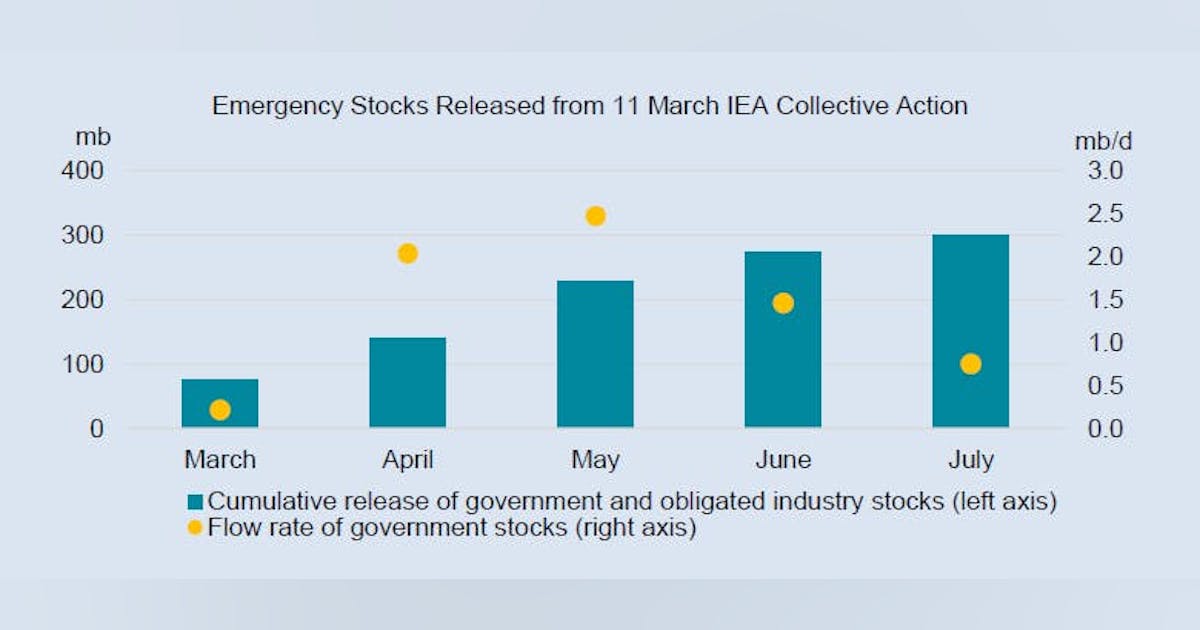
The International Energy Agency (IEA) member countries continued to release emergency oil stocks in July, but the pace of withdrawals slowed sharply as crude supply availability improved in parts of the Asia Pacific and the market faced increasing product tightness. IEA countries released 26 million bbl of emergency stocks in July, bringing cumulative releases to 300 million bbl since the agency announced a coordinated 400-million bbl action on Mar. 11. Government stock draws averaged 750,000 b/d in July, down from 1.5 million b/d in June and 2.5 million b/d in May. The slowdown was particularly pronounced among IEA members in Asia Oceania, which released 4 million bbl from emergency stocks in July, compared with 8 million bbl in June and 44 million bbl in May. The decline reflected improved crude oil supply availability in Japan and Korea. The US also reduced the pace of emergency stock releases. Withdrawals from the Strategic Petroleum Reserve totaled 17 million bbl in July, roughly half the volume released in June. More than 100 million bbl of the emergency stocks committed under the IEA’s 400-million bbl coordinated action has yet to reach the market. The timing of the remaining releases will depend on market developments and broader oil supply security considerations in coming months, according to the agency. Most of the remaining emergency stocks consist of crude oil, however, limiting their ability to ease increasingly tight oil product markets, IEA said. At the same time, global observed oil inventories fell sharply in July amid severely constrained shipping through the Strait of Hormuz. Stocks declined by 69 million bbl, equivalent to 2.2 million b/d, with oil on water accounting for more than 90% of the decline. Oil on water fell by 63 million bbl, or about 2 million b/d, reflecting higher arrivals and lower exports amid

Read More »

PJM’s New Data Center Power Equation

PJM Interconnection has now filed one of the most consequential proposed changes yet in the relationship between data centers and the electric grid. Rather than simply treating a new hyperscale or AI facility like any other customer whose demand will be backed through regional capacity procurement, PJM is proposing a framework under which the largest new loads would need to be supported by new capacity, have their needs covered through the Reliability Backstop Procurement, or face potential curtailment when the regional power system is short of supply. The approach has been developing since PJM launched its Critical Issue Fast Path process for large loads in 2025, but it became substantially more concrete in late July and August 2026. PJM filed its proposed Reliability Backstop Procurement with FERC on July 31 and began accepting applications that day for its FERC-approved Expedited Interconnection Track. On Aug. 13, PJM filed its proposed Interim Resource Adequacy Service, or IRAS, along with the Large Load Registry that would support it. The immediate numbers explain the urgency. PJM’s July 2026 capacity auction for the 2028/2029 delivery year procured 138,318 MW of unforced capacity through the centralized auction. Even after including Fixed Resource Requirement resources, however, PJM came up 6,831 MW short of its reliability requirement. The auction cleared at the FERC-approved $325/MW-day price cap. It was the second consecutive auction in which the PJM region failed to procure its full reliability requirement, something that had not happened before these two auctions. That gap is occurring while demand continues to accelerate. PJM’s 2026 long-term forecast projects summer peak demand growing at an average 3.6% annually over the next decade, compared with just 0.3% in the comparable forecast issued in 2021. Summer peak demand is projected to rise by nearly 66 GW over 10 years. Data centers are

Read More »

Zayo, NVIDIA Build the Long-Haul Backbone for Distributed AI

The data center industry’s increasingly power-first approach to site selection has created a follow-on question: Once the megawatts are found, is there enough network infrastructure to make the site useful at AI scale? Zayo and NVIDIA are putting real infrastructure behind that question. Zayo said it is working with NVIDIA to expand network capacity supporting AI factories across North America, including an 8,000-route-mile program targeting some of the fastest-growing AI corridors in the United States. The project encompasses six new long-haul routes along with overbuilds of existing network across 10 high-demand corridors. The announcement arrives as AI data center development moves beyond the largest established hubs toward markets where power and land may be more readily available, but fiber capacity cannot necessarily be taken for granted. That geography is increasingly important. NVIDIA has separately developed “scale-across” networking technology designed to allow AI infrastructure distributed among different buildings — or even data centers separated by hundreds of kilometers — to operate as a more unified computing environment. Put together, the developments suggest that networking is becoming inseparable from the AI factory buildout itself. Power may determine where the next generation of AI infrastructure can be built. Fiber will increasingly determine how effectively those sites can participate in the larger AI ecosystem. Fiber Follows the Power Zayo CEO Steve Smith said AI demand is changing both where network infrastructure is needed and how aggressively capacity must be deployed ahead of development. “AI is fundamentally reshaping where and how network infrastructure needs to be built across the U.S.,” Smith said. The company’s 8,000-mile program is more nuanced than that top-line number might suggest. Zayo disclosed in April that the expansion includes approximately 3,000 route miles across six new long-haul routes, plus more than 5,000 route miles of overbuilds across 10 existing corridors. Zayo

Read More »

Southern’s 17 GW Pipeline Puts AI Power Demand Into Utility Math

The headline number from Southern Company’s latest earnings report is hard to miss: electricity use by data centers across the utility’s system increased 55% in the second quarter compared with a year earlier. But the more consequential numbers may be the ones sitting behind it. Southern now has more than 1.2 GW of operating data center load, up by more than 500 MW from a year ago. At the same time, its electric utilities have signed contracts and large-load agreements totaling more than 17 GW by the mid-2030s, with another 8 GW in late-stage development and a prospective pipeline of large industrial and data center projects exceeding 75 GW. That leaves an enormous gap between the data center megawatts consuming electricity today and the load Southern has contractually positioned itself to serve during the next decade. For the data center industry, that gap may be the most important part of Southern’s second-quarter story. It offers a look at how utilities are beginning to convert the AI infrastructure boom from forecasts and campus announcements into contracts, generation procurement, transmission investment and eventually energized capacity. From Contracts to Megawatts Southern added roughly 6 GW of contracted large load during the quarter alone. Alabama Power signed three projects representing about 3 GW, while Georgia Power reached a 25-year agreement to serve OpenAI’s planned project in Effingham County near Savannah. That facility is expected to require approximately 3.2 GW and begin taking electric service in phases in 2028. The numbers nevertheless require an important distinction. Seventeen gigawatts contracted does not mean 17 GW will suddenly appear on Southern’s grid. Large data center campuses ramp gradually, often over several years, and Southern executives acknowledged that actual customer ramp schedules do not always match the assumptions made when projects are first approved. CEO Chris Womack said

Read More »

PORTS-Pike Takes Shape as an 8-GW AI Infrastructure Model

Back on March 31, 2026, we discussed we discussed SoftBank and SB Energy’s plans to redevelop the former Portsmouth Gaseous Diffusion Plant site near Piketon as a 10-GW artificial intelligence data center campus supported by almost an equal amount of new power generation. At the time, the plan called for as much as 10 GW of new generation, including 9.2 GW of natural gas capacity, along with approximately $4.2 billion of high-voltage transmission infrastructure developed with AEP Ohio. An initial 800-MW data center phase was targeted for service in 2028. The March story was notable because Pike County appeared to offer a preview of a new model for building hyperscale infrastructure: develop the generation, transmission and data center simultaneously rather than wait for an increasingly congested regional grid to deliver multiple gigawatts of capacity. Not to mention the reuse of a brownfield site with the encouragement of the federal government. Since then, almost every important part of the project has moved forward, and on August 17, the most consequential missing pieces fell into place. NVIDIA announced that it will become the exclusive AI compute infrastructure provider for the PORTS-Pike Technology Campus. OpenAI will be the data center customer, signing a 20-year lease with SB Energy for approximately 8 GW of IT capacity. NVIDIA will invest another $1.5 billion in SB Energy and provide credit support for the land, power and shell infrastructure behind an initial 4.25 GW of IT load, with an option covering approximately another 3.75 GW. The Securities and Exchange Commission filing accompanying the announcement makes the financial commitment even more significant. NVIDIA disclosed that its aggregate payment obligation associated with its initial commitment is capped at $105 billion. That is not a conventional capital commitment to spend $105 billion building the campus, nor is it simply a

Read More »

Nvidia scales back financing guarantee for OpenAI data center

Nvidia is scaling back a proposed financial guarantee tied to a massive OpenAI data center project in Ohio, reducing its initial commitment from as much as $250 billion to less than $120 billion, according to report in the Wall Street Journal. Earlier this month, Nvidia announced partnerships with major financial firms including Apollo Global Management, BlackRock, Blackstone, Brookfield Asset Management, Goldman Sachs and KKR, aimed at mobilizing more than $500 billion in capital for AI computing infrastructure. The change represents a significant restructuring of Nvidia’s role in financing the planned facility, which is being developed by SB Energy, a subsidiary of SoftBank. Under the revised arrangement, Nvidia would guarantee financing for the project’s first phase, representing roughly 5 gigawatts of capacity, or half of the total proposed capacity. Financing for the remaining capacity would be considered separately at a later stage.

Read More »

Texas Tightens Oversight of Data Center Development

Texas has spent the past decade building one of the most data center-friendly policy environments in the United States. But the state’s political posture is tightening. The emerging message from Austin is that continued data center growth will face greater scrutiny over grid costs, water use, tax incentives and community impacts. What is interesting about this policy conversation is that the Texas Legislature is not in regular session. The 89th regular session ended June 2, 2025, and the 90th Legislature does not convene until January 12, 2027. What has occurred instead is a concentrated period of interim committee work, gubernatorial recommendations, implementation of Senate Bill 6, calls for a special session, and regulatory action by the Public Utility Commission of Texas and the Electric Reliability Council of Texas. Together, those efforts are creating the framework for a broader legislative debate in 2027 while already affecting projects seeking ERCOT interconnection, infrastructure costs and site-selection decisions. Abbott Sets Out a New Policy Framework The policy shift accelerated June 10, when Gov. Greg Abbott directed the PUCT to require data centers to fully fund the electric infrastructure needed to serve their operations and directed PUCT and ERCOT to identify additional actions available under existing authority. Separately, Abbott pledged to work with lawmakers in 2027 on legislation requiring data centers to add electric capacity, use water-efficient cooling systems, report electricity and water use, phase out outdated tax incentives and adopt additional protections for neighboring communities. The most consequential shift began June 10, when Gov. Greg Abbott sent state electricity regulators a sweeping list of data center policy priorities. Abbott called for future legislation requiring new facilities to add generation to the Texas grid, pay the full cost of their interconnection and related infrastructure, use closed-loop or similarly water-efficient cooling systems, and file annual reports

Read More »

Microsoft will invest $80B in AI data centers in fiscal 2025

And Microsoft isn’t the only one that is ramping up its investments into AI-enabled data centers. Rival cloud service providers are all investing in either upgrading or opening new data centers to capture a larger chunk of business from developers and users of large language models (LLMs).  In a report published in October 2024, Bloomberg Intelligence estimated that demand for generative AI would push Microsoft, AWS, Google, Oracle, Meta, and Apple would between them devote $200 billion to capex in 2025, up from $110 billion in 2023. Microsoft is one of the biggest spenders, followed closely by Google and AWS, Bloomberg Intelligence said. Its estimate of Microsoft’s capital spending on AI, at $62.4 billion for calendar 2025, is lower than Smith’s claim that the company will invest $80 billion in the fiscal year to June 30, 2025. Both figures, though, are way higher than Microsoft’s 2020 capital expenditure of “just” $17.6 billion. The majority of the increased spending is tied to cloud services and the expansion of AI infrastructure needed to provide compute capacity for OpenAI workloads. Separately, last October Amazon CEO Andy Jassy said his company planned total capex spend of $75 billion in 2024 and even more in 2025, with much of it going to AWS, its cloud computing division.

Read More »

John Deere unveils more autonomous farm machines to address skill labor shortage

Join our daily and weekly newsletters for the latest updates and exclusive content on industry-leading AI coverage. Learn More Self-driving tractors might be the path to self-driving cars. John Deere has revealed a new line of autonomous machines and tech across agriculture, construction and commercial landscaping. The Moline, Illinois-based John Deere has been in business for 187 years, yet it’s been a regular as a non-tech company showing off technology at the big tech trade show in Las Vegas and is back at CES 2025 with more autonomous tractors and other vehicles. This is not something we usually cover, but John Deere has a lot of data that is interesting in the big picture of tech. The message from the company is that there aren’t enough skilled farm laborers to do the work that its customers need. It’s been a challenge for most of the last two decades, said Jahmy Hindman, CTO at John Deere, in a briefing. Much of the tech will come this fall and after that. He noted that the average farmer in the U.S. is over 58 and works 12 to 18 hours a day to grow food for us. And he said the American Farm Bureau Federation estimates there are roughly 2.4 million farm jobs that need to be filled annually; and the agricultural work force continues to shrink. (This is my hint to the anti-immigration crowd). John Deere’s autonomous 9RX Tractor. Farmers can oversee it using an app. While each of these industries experiences their own set of challenges, a commonality across all is skilled labor availability. In construction, about 80% percent of contractors struggle to find skilled labor. And in commercial landscaping, 86% of landscaping business owners can’t find labor to fill open positions, he said. “They have to figure out how to do

Read More »

2025 playbook for enterprise AI success, from agents to evals

Join our daily and weekly newsletters for the latest updates and exclusive content on industry-leading AI coverage. Learn More 2025 is poised to be a pivotal year for enterprise AI. The past year has seen rapid innovation, and this year will see the same. This has made it more critical than ever to revisit your AI strategy to stay competitive and create value for your customers. From scaling AI agents to optimizing costs, here are the five critical areas enterprises should prioritize for their AI strategy this year. 1. Agents: the next generation of automation AI agents are no longer theoretical. In 2025, they’re indispensable tools for enterprises looking to streamline operations and enhance customer interactions. Unlike traditional software, agents powered by large language models (LLMs) can make nuanced decisions, navigate complex multi-step tasks, and integrate seamlessly with tools and APIs. At the start of 2024, agents were not ready for prime time, making frustrating mistakes like hallucinating URLs. They started getting better as frontier large language models themselves improved. “Let me put it this way,” said Sam Witteveen, cofounder of Red Dragon, a company that develops agents for companies, and that recently reviewed the 48 agents it built last year. “Interestingly, the ones that we built at the start of the year, a lot of those worked way better at the end of the year just because the models got better.” Witteveen shared this in the video podcast we filmed to discuss these five big trends in detail. Models are getting better and hallucinating less, and they’re also being trained to do agentic tasks. Another feature that the model providers are researching is a way to use the LLM as a judge, and as models get cheaper (something we’ll cover below), companies can use three or more models to

Read More »

OpenAI’s red teaming innovations define new essentials for security leaders in the AI era

Join our daily and weekly newsletters for the latest updates and exclusive content on industry-leading AI coverage. Learn More OpenAI has taken a more aggressive approach to red teaming than its AI competitors, demonstrating its security teams’ advanced capabilities in two areas: multi-step reinforcement and external red teaming. OpenAI recently released two papers that set a new competitive standard for improving the quality, reliability and safety of AI models in these two techniques and more. The first paper, “OpenAI’s Approach to External Red Teaming for AI Models and Systems,” reports that specialized teams outside the company have proven effective in uncovering vulnerabilities that might otherwise have made it into a released model because in-house testing techniques may have missed them. In the second paper, “Diverse and Effective Red Teaming with Auto-Generated Rewards and Multi-Step Reinforcement Learning,” OpenAI introduces an automated framework that relies on iterative reinforcement learning to generate a broad spectrum of novel, wide-ranging attacks. Going all-in on red teaming pays practical, competitive dividends It’s encouraging to see competitive intensity in red teaming growing among AI companies. When Anthropic released its AI red team guidelines in June of last year, it joined AI providers including Google, Microsoft, Nvidia, OpenAI, and even the U.S.’s National Institute of Standards and Technology (NIST), which all had released red teaming frameworks. Investing heavily in red teaming yields tangible benefits for security leaders in any organization. OpenAI’s paper on external red teaming provides a detailed analysis of how the company strives to create specialized external teams that include cybersecurity and subject matter experts. The goal is to see if knowledgeable external teams can defeat models’ security perimeters and find gaps in their security, biases and controls that prompt-based testing couldn’t find. What makes OpenAI’s recent papers noteworthy is how well they define using human-in-the-middle

Read More »

Mother tongue

“Daddy?” Theo curled against my side in bed. “Where do words go when they die?” I’d orchestrated the bedtime routine flawlessly: bath (taken), teeth (brushed),

Read More »