Stay Ahead, Stay ONMINE

PsiQuantum has a plan to make a massive quantum computer out of light

The machine that could change the world will be housed in a room that looks like a data center crossed with an ice cream factory. Inside will be some 100 stainless-steel cabinets, each about six feet tall and connected to a supply of liquid helium that keeps them only a few degrees above absolute zero. Inside those cabinets will be hundreds of chips, and on those, thousands of particles of light flying through a maze of optical switches and beam splitters. Each photon must be accounted for, because precisely measuring where it ends up will help answer questions that current computers might take millions of years to solve. This computer, as described, does not exist. It’s the brainchild of a company called PsiQuantum, founded in 2016 by four physicists from UK universities. In a crowded field of deep-pocketed competitors with similarly fantastical visions, the company aims to be first to fulfill its promise. In the years since the physicist Richard Feynman first envisioned them in 1981, quantum computers have promised to speed up everything from medical research to AI by harnessing the qualities of quantum particles. Unlike normal computer bits, which can be either a 1 or 0, quantum bits can exist in multiple states at once. And combining enough of those quantum bits together could produce a computer capable of tasks well beyond the reach of today’s conventional machines. But even today’s best quantum prototypes are too small and error-prone to do anything useful. That makes PsiQuantum’s promises for what its computers will ultimately do all the more bold. Consider the company’s hopes for predicting the effects of cytochrome P450 enzymes, which often break down drugs in the body. If pharma companies knew more precisely how they would work on a particular molecule, they could design more effective medications faster. Estimating this for a specific drug can take over 10 years with today’s methods, says Philipp Ernst, vice president of quantum applications for PsiQuantum, but “we aim to get it down to four minutes.” The company’s chips will be contained in large cabinets. A quantum computer powerful enough to be commercially useful is expected to require roughly 100 of these cabinets connected together.COURTESY OF PSIQUANTUM In a field full of such claims, PsiQuantum has attracted unusual investment and scrutiny for two reasons: It is one of the few companies aiming directly at building a large and useful machine, and it is already working with a major chip manufacturer to build its systems using existing semiconductor fabs. Its vision has attracted momentum: Last year, PsiQuantum raised $1 billion in funding and broke ground in Chicago on a site it’s building in partnership with local governments. It also has a second site in the works in Australia, which it promises will be operational—meaning hardware-ready—in 2027. And it’s one of just two companies (along with Microsoft) to reach the third stage of an intensive government evaluation program to see which quantum companies might succeed. Evaluating whether PsiQuantum will do what it says is harder than, say, judging a drugmaker by its clinical trial results: Advances in quantum computing are incremental, opaque, and tough to verify from the outside. But the company is now approaching its prove-it moment, when years of closed-door work and hundreds of millions in investment will either culminate in a useful quantum computer or fall short. We could start to know which as soon as next year. A new kind of machine Terry Rudolph, one of PsiQuantum’s four founders, is soft-spoken and shaggy-haired. He was born in Malawi and learned only after earning his first physics degree that he is a grandson of the famed physicist Erwin Schrödinger. He later self-published a 150-page book to explain quantum computing to teenagers (my PR contact gave me a signed copy with a wink that said “We never expect anyone to actually read this,” but I can report that it is a funny and helpful book).  Around 2014, Rudolph and his cofounders became increasingly convinced that the quantum breakthroughs they were finding to be possible in theory might also be possible in a real machine. They eventually left their academic positions and divided the tasks before them: Rudolph worked on theory, Mark Thompson on engineering, Pete Shadbolt on scaling the technology up, and Jeremy O’Brien on articulating the vision and finding investors (O’Brien served as CEO until February; he’s been replaced by Victor Peng, a veteran of the semiconductor industry).  To understand why the quantum computer the company is building would be a big deal, consider how imprecise much of modern science remains. We cannot reliably predict, for example, which lithium-ion battery will catch fire or how quickly a critical aircraft component will corrode. This isn’t just because these systems are complex, though they are. It’s that, at their core, they are governed by quantum mechanics. Subatomic particles don’t have well-defined properties—this location and that velocity—but instead occupy quantum states spread across many possibilities. And that in turn influences a range of atomic and molecular behavior. Schrödinger (Rudolph’s grandfather, remember) showed how to describe this haziness mathematically a century ago this year, but precisely carrying out the calculations on real-world systems quickly becomes unfeasible even for the best computers. Scientists cope with this gap using approximations, imperfect simulations, or experiments on animals. WINNI WINTERMEYER WINNI WINTERMEYER PsiQuantum co-founder and chief scientific officer Pete Shadbolt (left), and machinery the company has built to manufacture its own barium titanate, a material with the perfect qualities for routing light particles (right). Feynman, David Deutsch, and other physicists in the 1980s wondered if we could do better. Maybe such complexity could instead be modeled using a new kind of machine. Rather than using transistors that are only ever on or off, this one would use particles held in quantum states, manipulate them to perform calculations, and then measure them at the end for an answer. Using quantum systems to simulate quantum systems would for the first time allow a simulation of physics and chemistry that directly reflected reality. It would be an invaluable tool for designing new drugs, materials, or really anything affected by quantum mechanics. Revolutionary, in other words. Humankind’s leaps in understanding how nature works have often resulted in the invention of powerful new tools, Rudolph told me. “I don’t think it’s a coincidence that the Industrial Revolution coincided with our ability to calculate and simulate the laws of Newtonian mechanics, the laws of thermodynamics,…the laws of classical electromagnetism,” he says. “Whenever we have more power to calculate and simulate and understand things, we build incredible machines that come from it.” He sees something similar coming with quantum computers.   Chasing photons One mystery has always been which quantum thing—ions, atoms, or something entirely new engineered with quantum properties—could be made stable and controllable enough to use as a qubit, the basic unit in the quantum computing world. Quantum systems are delicate, and observing any particular particle causes it to collapse into one state rather than a superposition of multiple states. If this happens during the computation rather than at the end, it produces an error that must be corrected for. Too many of these means the computer fails to produce a useful answer.  Just as engineers in the early days of aviation weren’t sure whether airplane wings would be fixed or flap like a bird’s, we’re not yet sure which of these quantum things will work best. Google and IBM are betting on superconducting qubits, superconducting circuits made of aluminum or other metals. Intel is using electrons. PsiQuantum is using photons, the particles that make up light. “Photons have lots of nice things going for them,” Rudolph says. They can maintain quantum states for a long time; indeed, the photons in the universe’s cosmic microwave background may have done so for billions of years. But photons also move fast and scatter easily. More importantly, two photons are more likely to pass through one other than interact. That makes them a challenging candidate for quantum computation, in which qubits need ways to influence one another.  For a while, this last flaw seemed to doom the idea of quantum computing with light. But in 2001, researchers from the Los Alamos National Laboratory and the University of Queensland found a loophole. They discovered they could essentially fake interactions between photons by sending the light particles through a network of beam splitters and detectors. Their paper changed everything. PsiQuantum was created to make the theory a reality. Size was the first problem; previous plans would have required a computer as large as California. Mercedes Gimeno-Segovia, who was a PhD student of Rudolph’s in the early 2010s (after almost becoming a professional violinist instead), thought of a way for the machine to be smaller.  The basic process since then has been this: First create photons with lasers and then “entangle” them, exploiting a quantum phenomenon in which the particles no longer have individual states but instead share one. Next, route them through a maze of gates that perform computations, and finally read out details of their quantum state at the end, all while tracking and correcting for the errors that occur. Succeeding at each of these steps millions of times is not so much an engineering hurdle as a brick wall. And building the supply chain—like manufacturing new materials with the qualities to route individual photons around—is arduous. A sizable chunk of PsiQuantum’s funding is being spent on custom cooling machinery that uses tanks of liquid helium to cool the company’s chips. Shown here is part of the PsiQuantum’s cooling system at a facility in Milpitas, California.COURTESY OF PSIQUANTUM To get a sense of it all, last year I joined Shadbolt at the SLAC National Accelerator Laboratory, in Menlo Park, California. The center has helped produce several Nobel Prizes and played a role in the 1968 discovery of quarks, fundamental building blocks of matter that make up protons and neutrons. But PsiQuantum set up shop there essentially to siphon liquid helium from SLAC’s giant cryoplant. This is what the company uses to cool its computing cabinets down to deep-space temperatures. Right now the cabinets operate at 2 K, or -456 °F, but the goal is to be able to run them slightly warmer—at a balmy -452 °F. Most quantum approaches require the whole machine to be cooled to superconducting temperatures, so that much of the expense in running it will actually be spent on refrigeration. But photonic computers require only one piece to be this cold—the detectors that measure single photons at the end of the computation. And the required temperature can be a bit higher. (PsiQuantum said in May that it will spend some of the $100 million award in CHIPS Act funding it’s slated to get on these detectors).  The siphoning setup was a temporary solution; PsiQuantum now has its own cooling system at its testing facility in Milpitas, California, and is setting up a larger one at its production site in Australia next year. These helium systems represent some of the biggest capital expenditures for any quantum company and will consume a significant chunk of PsiQuantum’s $1 billion funding round. In the afternoon we drove to a lab in San Jose, where I donned a cleanroom suit—a head-to-toe covering that keeps dust at bay—to watch the manufacture of a blueish crystal called barium titanate.  It’s prized by PsiQuantum because it quickly and reliably routes light particles with very little electrical input, keeping the precious photons undisturbed as they move through the circuit. But for all barium titanate’s theoretical value to the company, its structure makes it a pain to manufacture, and the material wasn’t available at scale when PsiQuantum got its start. The company, in what Rudolph told me was an agonizing decision, opted to make it in-house, requiring a massive investment. I saw a technician—operating at what looked like a giant pressure cooker—adding the base elements to several hoppers; then I watched through a porthole as the elements got heated, vaporized, and finally crystallized into a thin layer on a wafer disc. At that time each disc took about 12 hours to make; the company now says several are produced each day. The discs then get shipped to the chipmaker GlobalFoundries in Malta, New York, where PsiQuantum’s chips are made. WINNI WINTERMEYER WINNI WINTERMEYER The company has invested heavily in making its own barium titanate, a material whose delicate crystalline structure is tedious to manufacture. PsiQuantum’s bet is that this entire supply chain, byzantine as it might sound, will make the company more efficient than its competitors. That’s because, if you squint, it looks like a souped-up and high-precision version of the existing supply chain for silicon photonic chips, another type of technology that transmits information with light—one that’s already used in data centers. If PsiQuantum produces its chips at scale, it can take advantage of tools and infrastructure that already exist. But it’s not a given that one working chip can easily be wired up to thousands more. That’s why the company is testing in phases: Its Milpitas site has connected three cabinets together, with 250 chips in each, but the next step is to scale the systems up and see whether the company’s techniques for correcting errors can keep up. Once the cooling system arrives at the Australian site late next year, the company says, it aims to connect about 100 cabinets together. Then PsiQuantum will work up to running the world-changing algorithms it has promised. The timeline for this, it’s worth noting, is up for debate. News articles have said that 2027 is the year that PsiQuantum aims to have its first full-scale quantum computer come online at its Australian site, but the company insists the deadline has been misread, and that it only intends for its facility to be “operational” by the end of next year. That means cooling systems in place and ready for hardware to be installed, but no promises about what size computer will be ready. In an industry where timelines are perpetually in flux yet central to how companies are judged, that distinction isn’t trivial. Into the unknown The outsider with perhaps the best guess of whether PsiQuantum will succeed is the Pentagon. The US Defense Advanced Research Projects Agency—the Pentagon’s research and development arm—has been running an initiative to determine which of the boastful quantum companies might actually deliver. In the last year and a half, the heads of the program have been sounding more confident. Joe Altepeter, who ran the program until last year and proudly described himself as a “quantum skeptic,” told me in March 2025: “I am more optimistic now than I have been at any point in the past 10 years.” And in a statement earlier this year, his successor, Micah Stoutimore, said “it now seems likely that someone will build a utility-scale quantum computer by 2033,” referring to a machine that generates more value from its calculations than it costs to build and operate.  The program has been scrutinizing PsiQuantum’s systems for over a year and putting them through the third stage of a benchmarking initiative meant to determine whether the technology will actually work. But to the rest of the industry, PsiQuantum is sort of a black box. PsiQuantum has broken ground at the Illinois Quantum and Microelectronics Park outside Chicago, pictured here, and on another site in Moreton Bay, Australia. It aims to build large-scale quantum computers at each site.COURTESY OF PSIQUANTUM “It is very hard for an outsider to evaluate,” says Scott Aaronson, a theoretical computer scientist at the University of Texas at Austin who runs a popular blog that often covers the industry. Other companies, like Google and Quantinuum, have regularly published results over the years demonstrating chips and systems with incremental improvement, publicly laying the engineering groundwork needed to eventually build large machines. PsiQuantum has instead focused squarely on a commercial goal—a computer with one million qubits, which is the scale that researchers expect to unlock research currently not possible on normal computers. PsiQuantum often differentiates itself with this industrial-scale goal, but IBM, which debuted a development road map in 2020, has been progressively building bigger and bigger systems. It initially targeted 2028 for a large-scale, error-corrected system, a deadline that now appears to have been pushed out to 2030. Making it useful On top of actually building the machine, a major focus for PsiQuantum is getting the rest of the world to develop a plan for how to use it. PsiQuantum has announced partnerships with customers including the defense giant Lockheed Martin, which intends to use it for materials design; the automaker Mercedes, which wants it for battery design; and the aerospace manufacturer Airbus. That these companies don’t have a computer to experiment with is not a problem, according to Ernst at PsiQuantum. “There’s a PlayStation 6 probably coming up from Sony next year or the year after, and people are programming those games right now,” he says. “This is, in principle, very similar.” (It’s a glib analogy but not an entirely empty one; the quantum algorithms for solving a research problem can be cracked even if there is not yet hardware to run them on.)  The idea is that experts in quantum information from both PsiQuantum and its customers will be able to translate design problems—say, the requirements for a battery in a Mercedes electric vehicle—into algorithms the computer could solve. The company offers a software package called Construct, which companies can use to design their own algorithms that might one day run on the computer. The future of quantum computing hinges on these algorithms. Quantum computers get painted as a speedup for everything, but in reality, they’re suited to a subset of problems, and answering a question with this sort of machine requires the question to be formulated with very specific types of algorithms. People spend entire careers working on such algorithms, even if the computers to run them don’t exist yet. At their core, they use the rules of quantum mechanics to manipulate probabilities in ways that ordinary computers can’t.  The most famous example, and a reason the government is so interested in quantum computers, is Shor’s algorithm. It was developed in 1994 by the theoretical computer scientist Peter Shor and could effectively break many forms of encryption used online, for everything from credit card numbers to military intelligence. The thing keeping the world together, for now, is that nobody has a computer to run the algorithm on (and security experts are already launching new encryption methods that could withstand attacks from a quantum computer). PsiQuantum is researching how long its systems might take to run Shor’s algorithm. WINNI WINTERMEYER WINNI WINTERMEYER PsiQuantum’s chips are manufactured at GlobalFoundries in Malta, New York, and tested at company headquarters in California. Both PsiQuantum and GlobalFoundries have been awarded federal CHIPS Act funding. The company also published a paper in December in collaboration with Airbus, essentially seeing if a new algorithm developed by the authors could beat a classical computer in modeling fluid dynamics, like the turbulence around an airplane wing. Andrew Childs, an expert in quantum simulation, told me PsiQuantum achieved only a moderate speed increase over what today’s computers can do. “It’s probably unlikely that speedups like this will have a significant practical impact until we have very large-scale quantum computers,” he said in an email. (When I asked Ernst, he agreed the improvement was modest.) Some of the algorithms PsiQuantum is working on are not expected to be perfected or even used in the first applications of its computer. Instead, its initial tasks might be more along the lines that Feynman envisioned way back in 1981: simulating the smallest particles of our world.  The company’s most significant research in this realm is in modeling quantum chemistry. Take those pesky P450 enzymes. More precisely understanding how they operate, PsiQuantum says, would allow for faster drug development and testing. Last year, PsiQuantum published methods for doing these sorts of chemistry calculations on a quantum computer, along with another paper demonstrating an algorithm that can simulate the collision of two molecules and estimate the likelihood of different outcomes femtosecond by femtosecond (there are one quadrillion femtoseconds in a second). It’s a remarkable amount of detail not currently possible with today’s technology, and it would allow drug and materials researchers to simulate new chemical interactions.  Dominic Berry, who developed some of the core techniques used in the collision paper but isn’t involved in PsiQuantum, says the company made impressive improvements, but to do the simulations scientists are most curious about would require the algorithm to be made even faster and PsiQuantum’s early computer to have fewer errors than currently expected. Until PsiQuantum’s computers are up and running, the breakthroughs that these research papers tease remain in the realm of theory. It’s a space where Rudolph operates quite comfortably. He told me that Alan Turing created the theory of classical computing with pen and paper, imagining how the 1s and 0s would be represented in the machine, and how with the right approach to logic you could compute almost anything.  “But there is no way that by hand, with a pen and paper, Turing was ever going to produce—you know—Minecraft and Facebook,” he says. That took more than 70 years of tinkering (during which we fortunately created more useful things than Minecraft and Facebook). For all the time Rudolph spends dreaming up things quantum computers might do, in other words, people working on those problems are still stuck with pen and paper for now: “Until you have the actual machine in hand, you don’t have the opportunity to really explore its potential.”

The machine that could change the world will be housed in a room that looks like a data center crossed with an ice cream factory. Inside will be some 100 stainless-steel cabinets, each about six feet tall and connected to a supply of liquid helium that keeps them only a few degrees above absolute zero. Inside those cabinets will be hundreds of chips, and on those, thousands of particles of light flying through a maze of optical switches and beam splitters. Each photon must be accounted for, because precisely measuring where it ends up will help answer questions that current computers might take millions of years to solve.

This computer, as described, does not exist. It’s the brainchild of a company called PsiQuantum, founded in 2016 by four physicists from UK universities. In a crowded field of deep-pocketed competitors with similarly fantastical visions, the company aims to be first to fulfill its promise.

In the years since the physicist Richard Feynman first envisioned them in 1981, quantum computers have promised to speed up everything from medical research to AI by harnessing the qualities of quantum particles. Unlike normal computer bits, which can be either a 1 or 0, quantum bits can exist in multiple states at once. And combining enough of those quantum bits together could produce a computer capable of tasks well beyond the reach of today’s conventional machines. But even today’s best quantum prototypes are too small and error-prone to do anything useful.

That makes PsiQuantum’s promises for what its computers will ultimately do all the more bold. Consider the company’s hopes for predicting the effects of cytochrome P450 enzymes, which often break down drugs in the body. If pharma companies knew more precisely how they would work on a particular molecule, they could design more effective medications faster. Estimating this for a specific drug can take over 10 years with today’s methods, says Philipp Ernst, vice president of quantum applications for PsiQuantum, but “we aim to get it down to four minutes.”
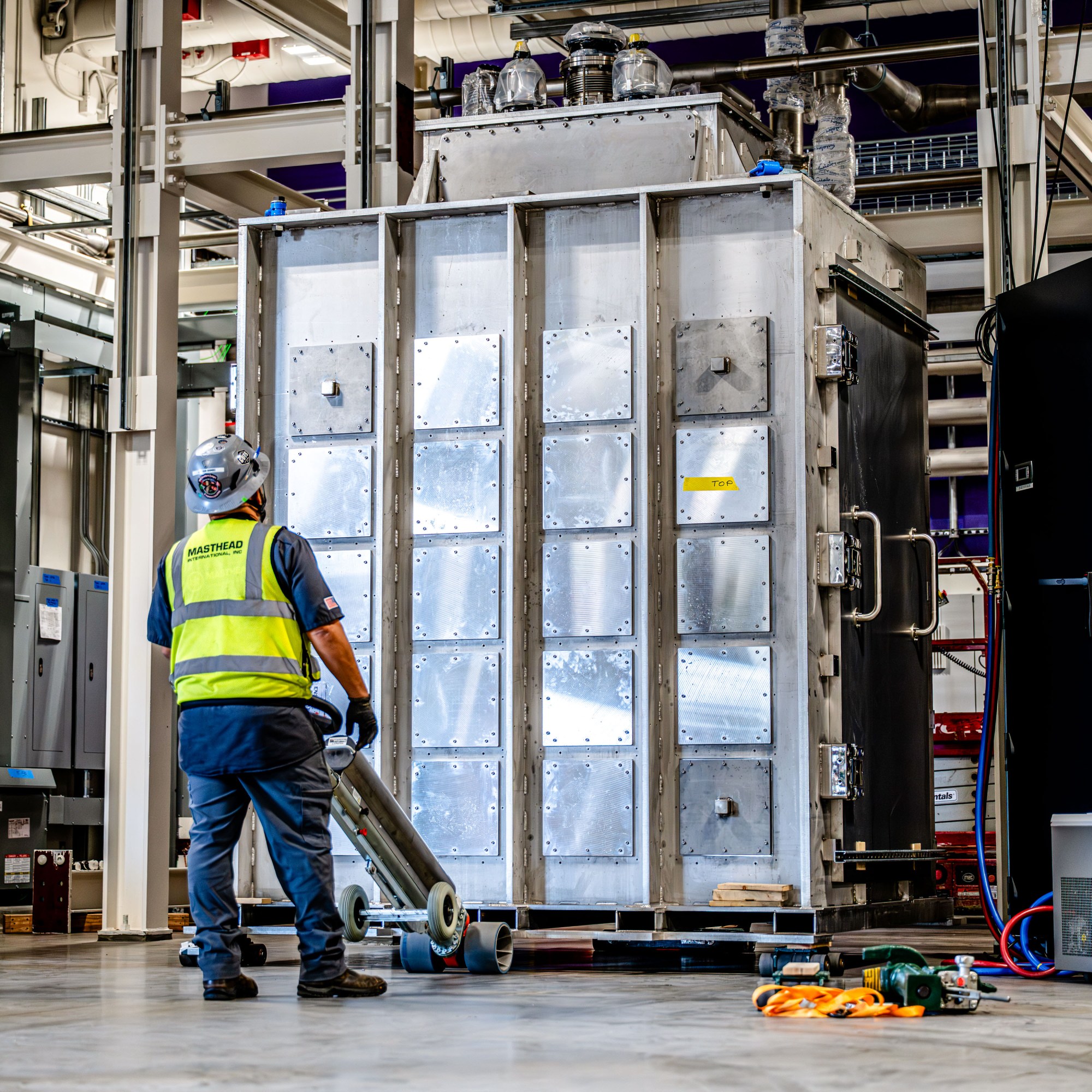
construction worker installing the Mk2.1 cabinet
The company’s chips will be contained in large cabinets. A quantum computer powerful enough to be commercially useful is expected to require roughly 100 of these cabinets connected together.
COURTESY OF PSIQUANTUM

In a field full of such claims, PsiQuantum has attracted unusual investment and scrutiny for two reasons: It is one of the few companies aiming directly at building a large and useful machine, and it is already working with a major chip manufacturer to build its systems using existing semiconductor fabs. Its vision has attracted momentum: Last year, PsiQuantum raised $1 billion in funding and broke ground in Chicago on a site it’s building in partnership with local governments. It also has a second site in the works in Australia, which it promises will be operational—meaning hardware-ready—in 2027. And it’s one of just two companies (along with Microsoft) to reach the third stage of an intensive government evaluation program to see which quantum companies might succeed.

Evaluating whether PsiQuantum will do what it says is harder than, say, judging a drugmaker by its clinical trial results: Advances in quantum computing are incremental, opaque, and tough to verify from the outside. But the company is now approaching its prove-it moment, when years of closed-door work and hundreds of millions in investment will either culminate in a useful quantum computer or fall short. We could start to know which as soon as next year.

A new kind of machine

Terry Rudolph, one of PsiQuantum’s four founders, is soft-spoken and shaggy-haired. He was born in Malawi and learned only after earning his first physics degree that he is a grandson of the famed physicist Erwin Schrödinger. He later self-published a 150-page book to explain quantum computing to teenagers (my PR contact gave me a signed copy with a wink that said “We never expect anyone to actually read this,” but I can report that it is a funny and helpful book). 

Around 2014, Rudolph and his cofounders became increasingly convinced that the quantum breakthroughs they were finding to be possible in theory might also be possible in a real machine. They eventually left their academic positions and divided the tasks before them: Rudolph worked on theory, Mark Thompson on engineering, Pete Shadbolt on scaling the technology up, and Jeremy O’Brien on articulating the vision and finding investors (O’Brien served as CEO until February; he’s been replaced by Victor Peng, a veteran of the semiconductor industry). 

To understand why the quantum computer the company is building would be a big deal, consider how imprecise much of modern science remains. We cannot reliably predict, for example, which lithium-ion battery will catch fire or how quickly a critical aircraft component will corrode.

This isn’t just because these systems are complex, though they are. It’s that, at their core, they are governed by quantum mechanics. Subatomic particles don’t have well-defined properties—this location and that velocity—but instead occupy quantum states spread across many possibilities. And that in turn influences a range of atomic and molecular behavior. Schrödinger (Rudolph’s grandfather, remember) showed how to describe this haziness mathematically a century ago this year, but precisely carrying out the calculations on real-world systems quickly becomes unfeasible even for the best computers. Scientists cope with this gap using approximations, imperfect simulations, or experiments on animals.

WINNI WINTERMEYER

WINNI WINTERMEYER

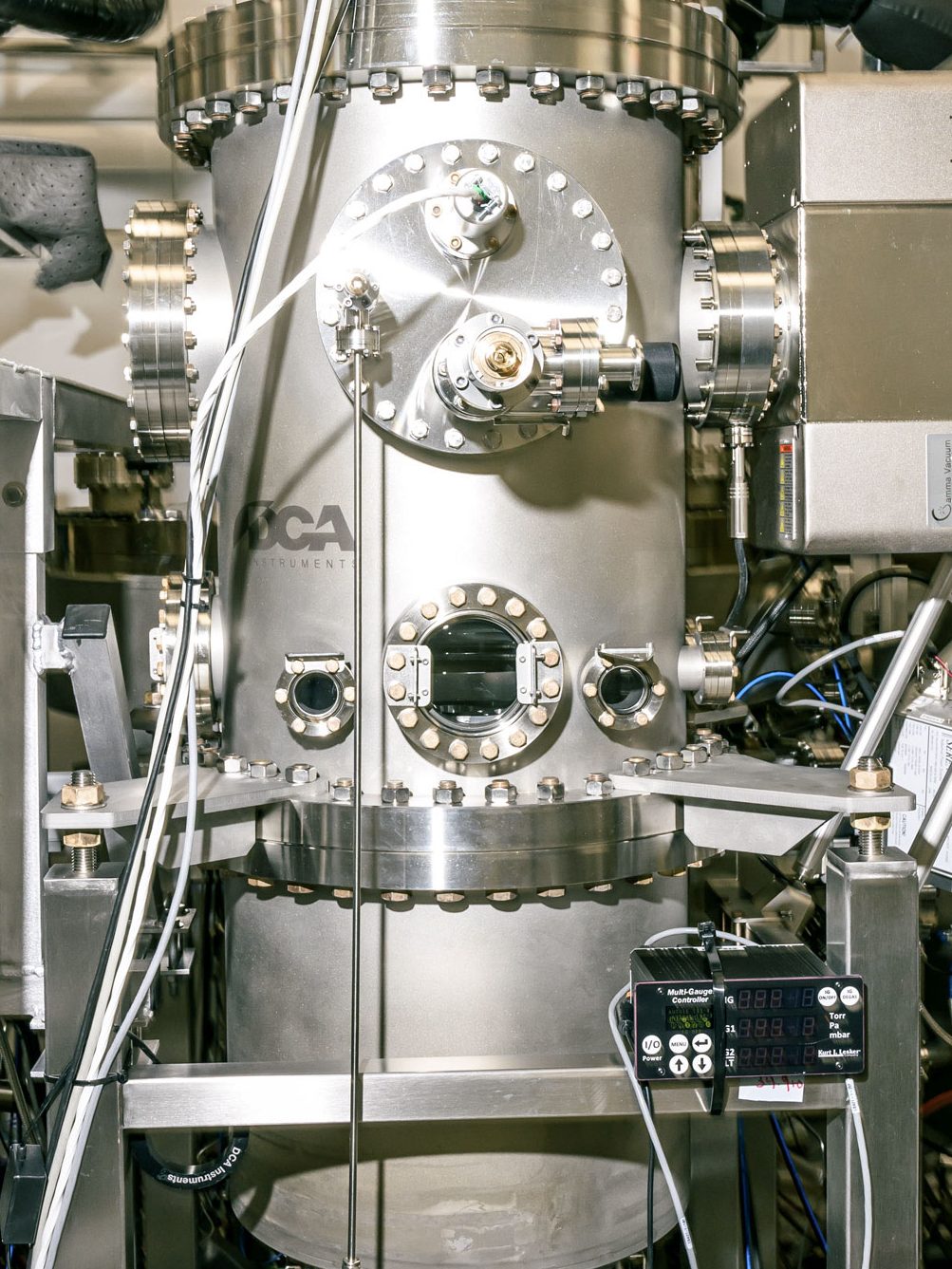
PsiQuantum co-founder and chief scientific officer Pete Shadbolt (left), and machinery the company has built to manufacture its own barium titanate, a material with the perfect qualities for routing light particles (right).

Feynman, David Deutsch, and other physicists in the 1980s wondered if we could do better. Maybe such complexity could instead be modeled using a new kind of machine. Rather than using transistors that are only ever on or off, this one would use particles held in quantum states, manipulate them to perform calculations, and then measure them at the end for an answer. Using quantum systems to simulate quantum systems would for the first time allow a simulation of physics and chemistry that directly reflected reality. It would be an invaluable tool for designing new drugs, materials, or really anything affected by quantum mechanics. Revolutionary, in other words.

Humankind’s leaps in understanding how nature works have often resulted in the invention of powerful new tools, Rudolph told me. “I don’t think it’s a coincidence that the Industrial Revolution coincided with our ability to calculate and simulate the laws of Newtonian mechanics, the laws of thermodynamics,…the laws of classical electromagnetism,” he says. “Whenever we have more power to calculate and simulate and understand things, we build incredible machines that come from it.” He sees something similar coming with quantum computers.  

Chasing photons

One mystery has always been which quantum thing—ions, atoms, or something entirely new engineered with quantum properties—could be made stable and controllable enough to use as a qubit, the basic unit in the quantum computing world. Quantum systems are delicate, and observing any particular particle causes it to collapse into one state rather than a superposition of multiple states. If this happens during the computation rather than at the end, it produces an error that must be corrected for. Too many of these means the computer fails to produce a useful answer. 

Just as engineers in the early days of aviation weren’t sure whether airplane wings would be fixed or flap like a bird’s, we’re not yet sure which of these quantum things will work best. Google and IBM are betting on superconducting qubits, superconducting circuits made of aluminum or other metals. Intel is using electrons. PsiQuantum is using photons, the particles that make up light.

“Photons have lots of nice things going for them,” Rudolph says. They can maintain quantum states for a long time; indeed, the photons in the universe’s cosmic microwave background may have done so for billions of years. But photons also move fast and scatter easily. More importantly, two photons are more likely to pass through one other than interact. That makes them a challenging candidate for quantum computation, in which qubits need ways to influence one another. 

For a while, this last flaw seemed to doom the idea of quantum computing with light. But in 2001, researchers from the Los Alamos National Laboratory and the University of Queensland found a loophole. They discovered they could essentially fake interactions between photons by sending the light particles through a network of beam splitters and detectors. Their paper changed everything. PsiQuantum was created to make the theory a reality.

Size was the first problem; previous plans would have required a computer as large as California. Mercedes Gimeno-Segovia, who was a PhD student of Rudolph’s in the early 2010s (after almost becoming a professional violinist instead), thought of a way for the machine to be smaller. 

The basic process since then has been this: First create photons with lasers and then “entangle” them, exploiting a quantum phenomenon in which the particles no longer have individual states but instead share one. Next, route them through a maze of gates that perform computations, and finally read out details of their quantum state at the end, all while tracking and correcting for the errors that occur. Succeeding at each of these steps millions of times is not so much an engineering hurdle as a brick wall. And building the supply chain—like manufacturing new materials with the qualities to route individual photons around—is arduous.
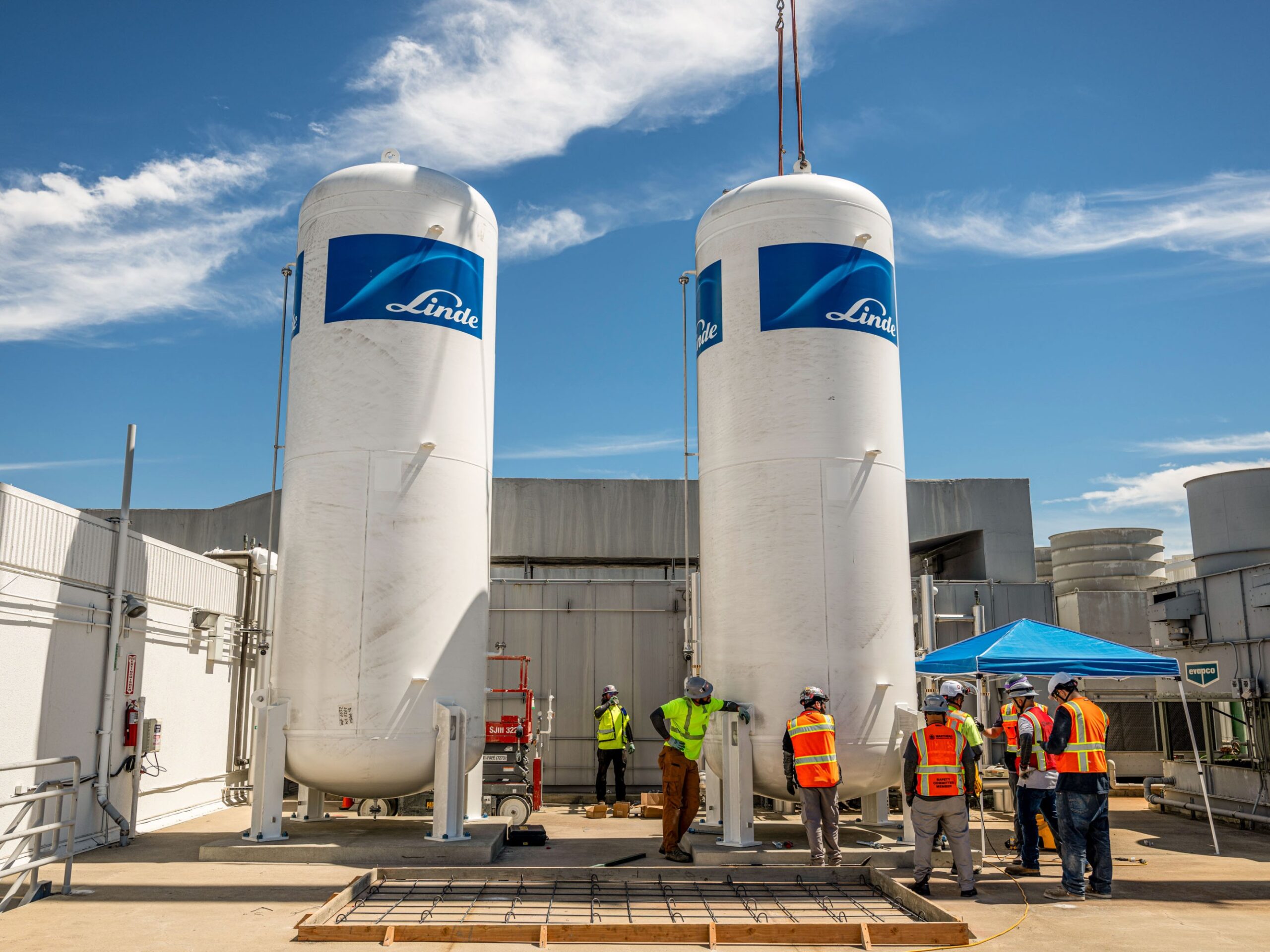
A sizable chunk of PsiQuantum’s funding is being spent on custom cooling machinery that uses tanks of liquid helium to cool the company’s chips. Shown here is part of the PsiQuantum’s cooling system at a facility in Milpitas, California.
COURTESY OF PSIQUANTUM

To get a sense of it all, last year I joined Shadbolt at the SLAC National Accelerator Laboratory, in Menlo Park, California. The center has helped produce several Nobel Prizes and played a role in the 1968 discovery of quarks, fundamental building blocks of matter that make up protons and neutrons. But PsiQuantum set up shop there essentially to siphon liquid helium from SLAC’s giant cryoplant. This is what the company uses to cool its computing cabinets down to deep-space temperatures.

Right now the cabinets operate at 2 K, or -456 °F, but the goal is to be able to run them slightly warmer—at a balmy -452 °F. Most quantum approaches require the whole machine to be cooled to superconducting temperatures, so that much of the expense in running it will actually be spent on refrigeration. But photonic computers require only one piece to be this cold—the detectors that measure single photons at the end of the computation. And the required temperature can be a bit higher. (PsiQuantum said in May that it will spend some of the $100 million award in CHIPS Act funding it’s slated to get on these detectors). 

The siphoning setup was a temporary solution; PsiQuantum now has its own cooling system at its testing facility in Milpitas, California, and is setting up a larger one at its production site in Australia next year. These helium systems represent some of the biggest capital expenditures for any quantum company and will consume a significant chunk of PsiQuantum’s $1 billion funding round.

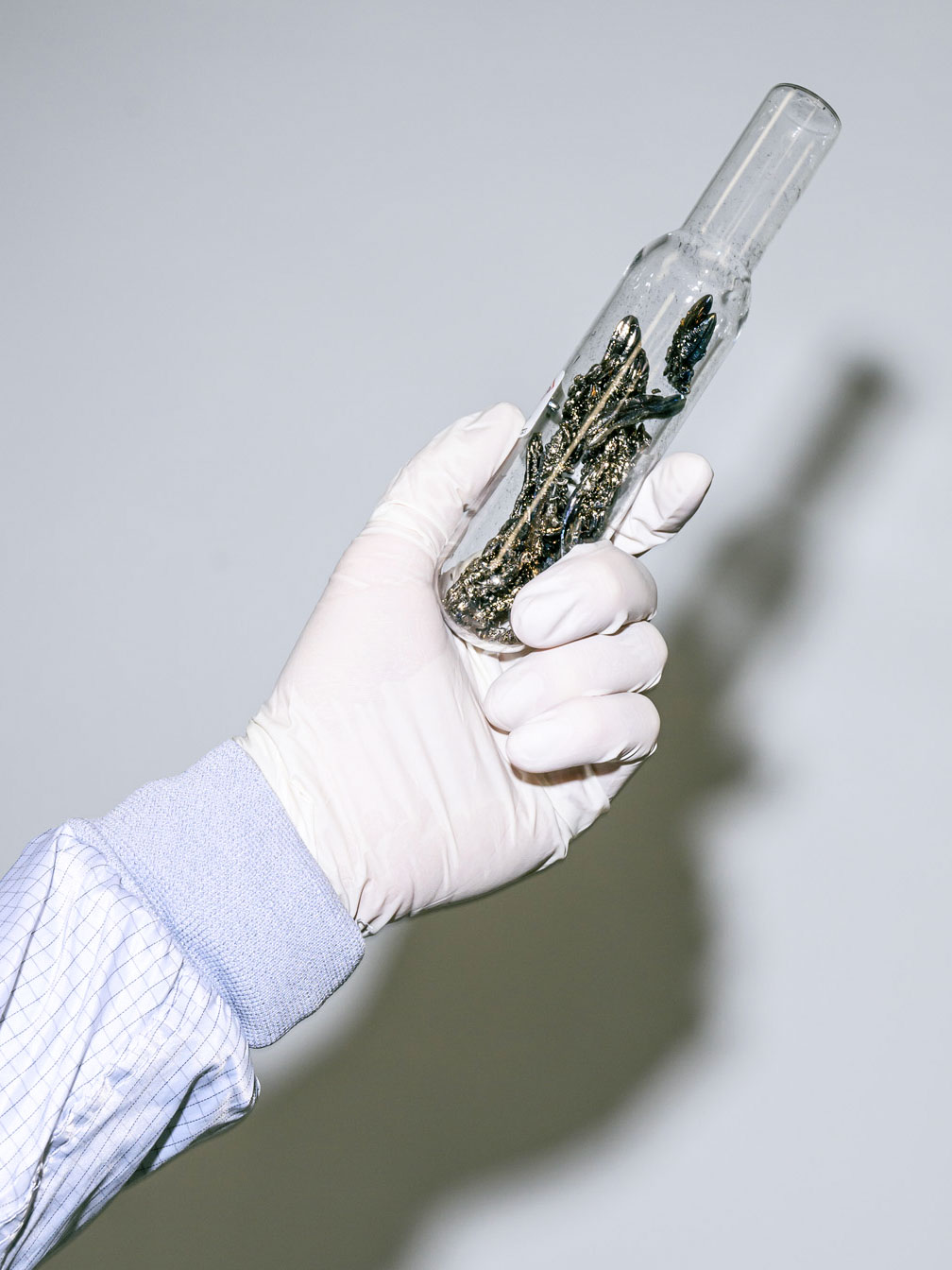
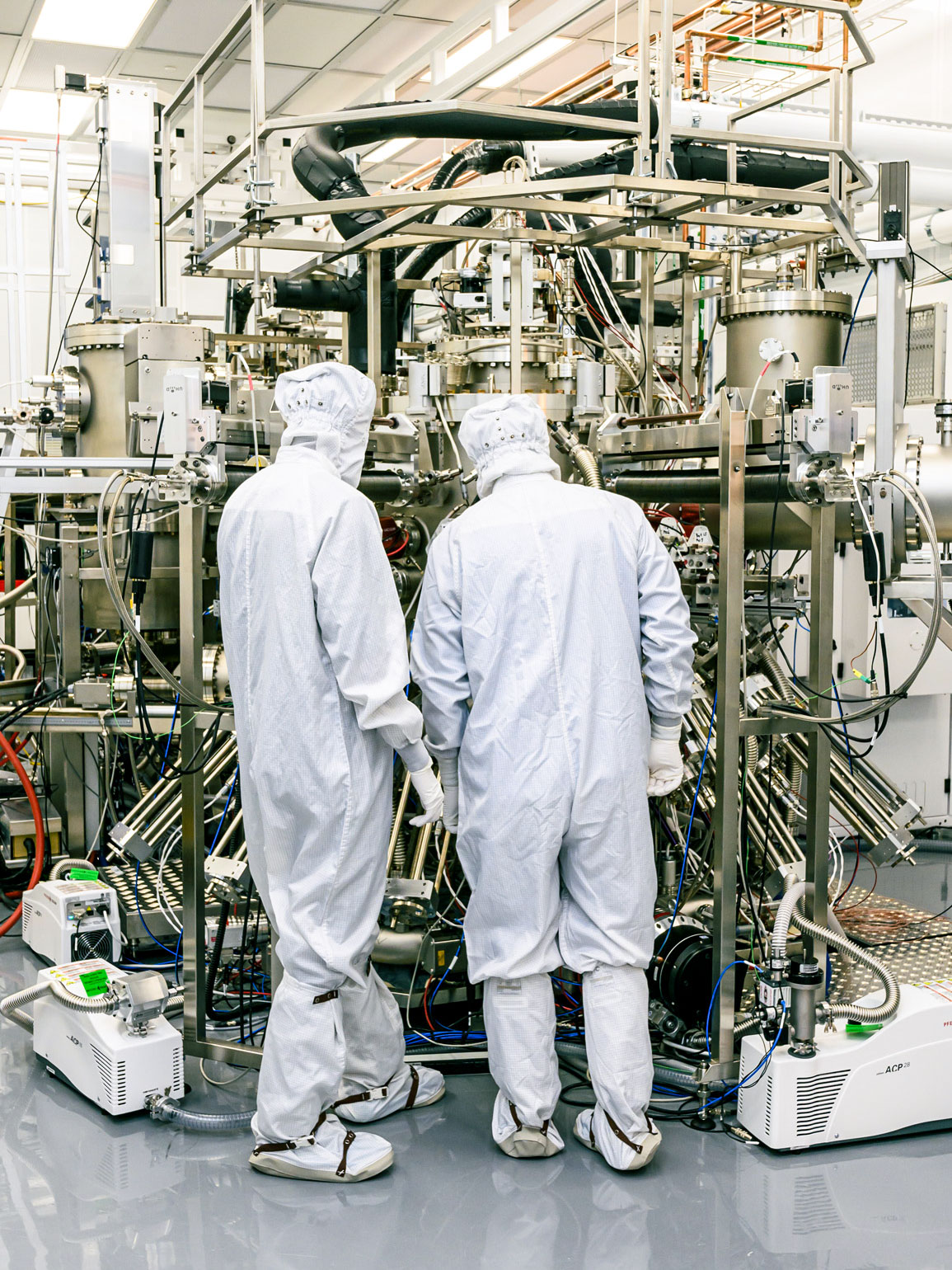
In the afternoon we drove to a lab in San Jose, where I donned a cleanroom suit—a head-to-toe covering that keeps dust at bay—to watch the manufacture of a blueish crystal called barium titanate. 

It’s prized by PsiQuantum because it quickly and reliably routes light particles with very little electrical input, keeping the precious photons undisturbed as they move through the circuit. But for all barium titanate’s theoretical value to the company, its structure makes it a pain to manufacture, and the material wasn’t available at scale when PsiQuantum got its start. The company, in what Rudolph told me was an agonizing decision, opted to make it in-house, requiring a massive investment. I saw a technician—operating at what looked like a giant pressure cooker—adding the base elements to several hoppers; then I watched through a porthole as the elements got heated, vaporized, and finally crystallized into a thin layer on a wafer disc. At that time each disc took about 12 hours to make; the company now says several are produced each day. The discs then get shipped to the chipmaker GlobalFoundries in Malta, New York, where PsiQuantum’s chips are made.
WINNI WINTERMEYER

WINNI WINTERMEYER

The company has invested heavily in making its own barium titanate, a material whose delicate crystalline structure is tedious to manufacture.

PsiQuantum’s bet is that this entire supply chain, byzantine as it might sound, will make the company more efficient than its competitors. That’s because, if you squint, it looks like a souped-up and high-precision version of the existing supply chain for silicon photonic chips, another type of technology that transmits information with light—one that’s already used in data centers. If PsiQuantum produces its chips at scale, it can take advantage of tools and infrastructure that already exist.

But it’s not a given that one working chip can easily be wired up to thousands more. That’s why the company is testing in phases: Its Milpitas site has connected three cabinets together, with 250 chips in each, but the next step is to scale the systems up and see whether the company’s techniques for correcting errors can keep up. Once the cooling system arrives at the Australian site late next year, the company says, it aims to connect about 100 cabinets together. Then PsiQuantum will work up to running the world-changing algorithms it has promised.

The timeline for this, it’s worth noting, is up for debate. News articles have said that 2027 is the year that PsiQuantum aims to have its first full-scale quantum computer come online at its Australian site, but the company insists the deadline has been misread, and that it only intends for its facility to be “operational” by the end of next year. That means cooling systems in place and ready for hardware to be installed, but no promises about what size computer will be ready. In an industry where timelines are perpetually in flux yet central to how companies are judged, that distinction isn’t trivial.

Into the unknown

The outsider with perhaps the best guess of whether PsiQuantum will succeed is the Pentagon. The US Defense Advanced Research Projects Agency—the Pentagon’s research and development arm—has been running an initiative to determine which of the boastful quantum companies might actually deliver. In the last year and a half, the heads of the program have been sounding more confident. Joe Altepeter, who ran the program until last year and proudly described himself as a “quantum skeptic,” told me in March 2025: “I am more optimistic now than I have been at any point in the past 10 years.” And in a statement earlier this year, his successor, Micah Stoutimore, said “it now seems likely that someone will build a utility-scale quantum computer by 2033,” referring to a machine that generates more value from its calculations than it costs to build and operate. 

The program has been scrutinizing PsiQuantum’s systems for over a year and putting them through the third stage of a benchmarking initiative meant to determine whether the technology will actually work. But to the rest of the industry, PsiQuantum is sort of a black box.

PsiQuantum has broken ground at the Illinois Quantum and Microelectronics Park outside Chicago, pictured here, and on another site in Moreton Bay, Australia. It aims to build large-scale quantum computers at each site.
COURTESY OF PSIQUANTUM

“It is very hard for an outsider to evaluate,” says Scott Aaronson, a theoretical computer scientist at the University of Texas at Austin who runs a popular blog that often covers the industry. Other companies, like Google and Quantinuum, have regularly published results over the years demonstrating chips and systems with incremental improvement, publicly laying the engineering groundwork needed to eventually build large machines.

PsiQuantum has instead focused squarely on a commercial goal—a computer with one million qubits, which is the scale that researchers expect to unlock research currently not possible on normal computers. PsiQuantum often differentiates itself with this industrial-scale goal, but IBM, which debuted a development road map in 2020, has been progressively building bigger and bigger systems. It initially targeted 2028 for a large-scale, error-corrected system, a deadline that now appears to have been pushed out to 2030.

Making it useful

On top of actually building the machine, a major focus for PsiQuantum is getting the rest of the world to develop a plan for how to use it. PsiQuantum has announced partnerships with customers including the defense giant Lockheed Martin, which intends to use it for materials design; the automaker Mercedes, which wants it for battery design; and the aerospace manufacturer Airbus.

That these companies don’t have a computer to experiment with is not a problem, according to Ernst at PsiQuantum. “There’s a PlayStation 6 probably coming up from Sony next year or the year after, and people are programming those games right now,” he says. “This is, in principle, very similar.” (It’s a glib analogy but not an entirely empty one; the quantum algorithms for solving a research problem can be cracked even if there is not yet hardware to run them on.) 

The idea is that experts in quantum information from both PsiQuantum and its customers will be able to translate design problems—say, the requirements for a battery in a Mercedes electric vehicle—into algorithms the computer could solve. The company offers a software package called Construct, which companies can use to design their own algorithms that might one day run on the computer.

The future of quantum computing hinges on these algorithms. Quantum computers get painted as a speedup for everything, but in reality, they’re suited to a subset of problems, and answering a question with this sort of machine requires the question to be formulated with very specific types of algorithms. People spend entire careers working on such algorithms, even if the computers to run them don’t exist yet. At their core, they use the rules of quantum mechanics to manipulate probabilities in ways that ordinary computers can’t. 

The most famous example, and a reason the government is so interested in quantum computers, is Shor’s algorithm. It was developed in 1994 by the theoretical computer scientist Peter Shor and could effectively break many forms of encryption used online, for everything from credit card numbers to military intelligence. The thing keeping the world together, for now, is that nobody has a computer to run the algorithm on (and security experts are already launching new encryption methods that could withstand attacks from a quantum computer). PsiQuantum is researching how long its systems might take to run Shor’s algorithm.
WINNI WINTERMEYER

WINNI WINTERMEYER

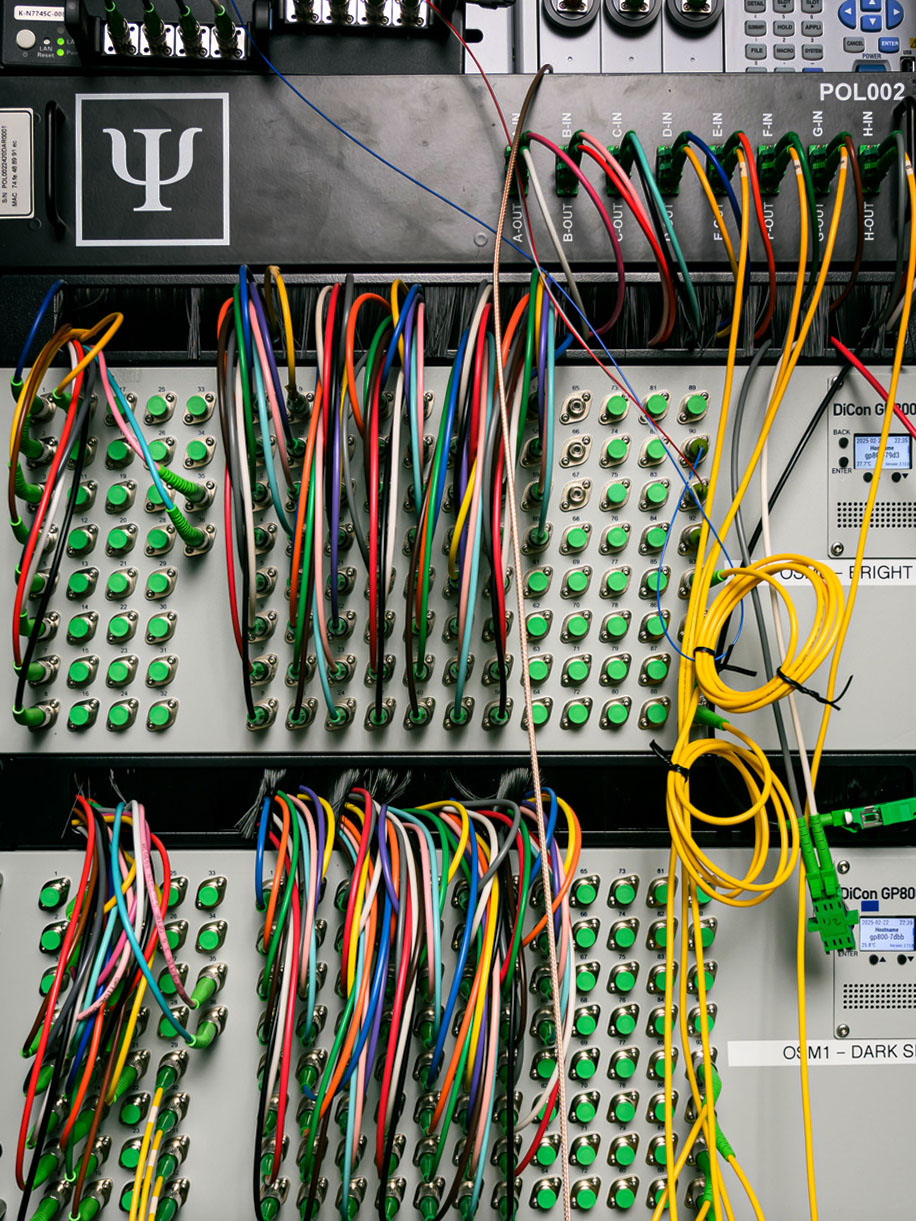
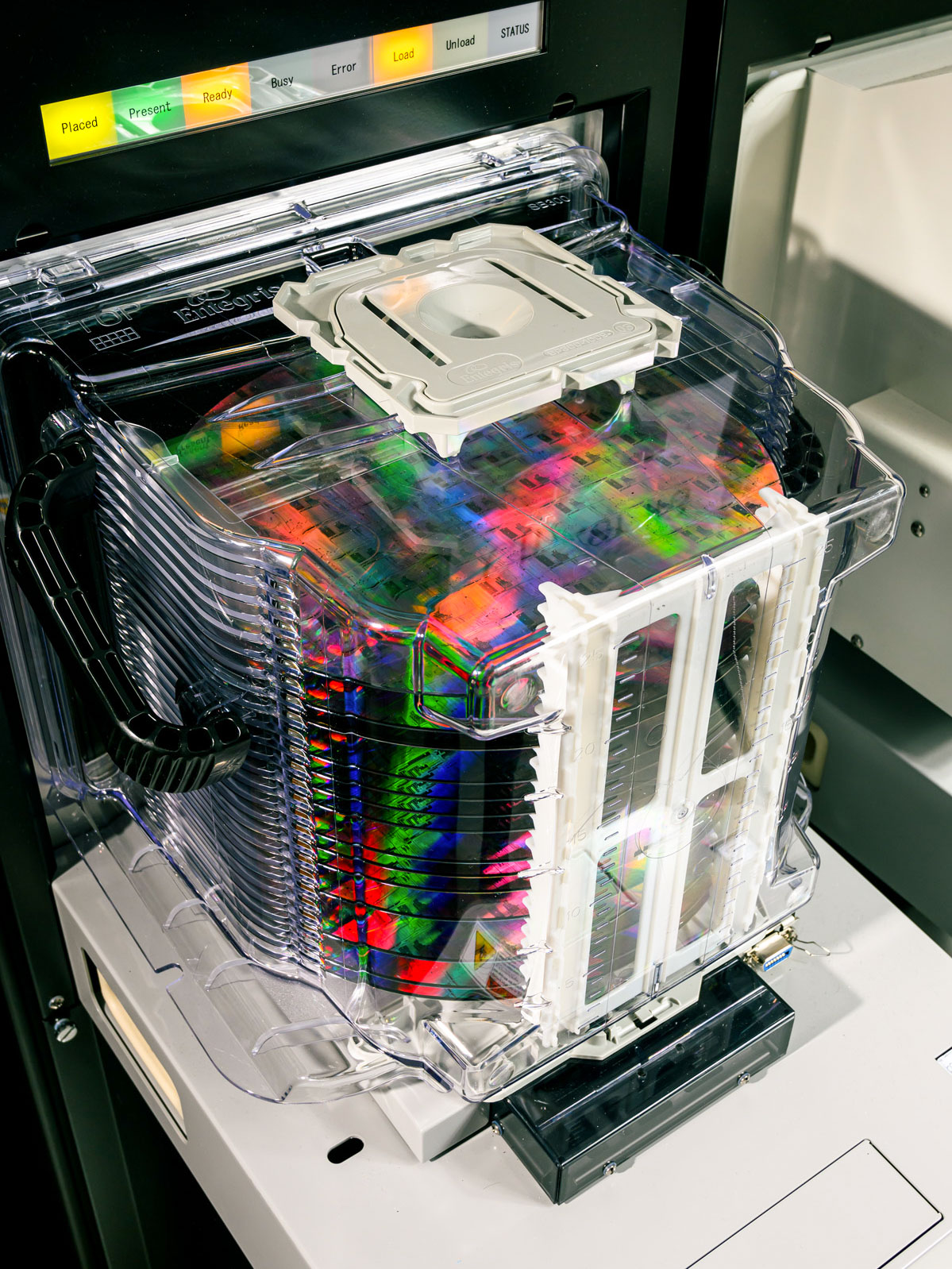
PsiQuantum’s chips are manufactured at GlobalFoundries in Malta, New York, and tested at company headquarters in California. Both PsiQuantum and GlobalFoundries have been awarded federal CHIPS Act funding.

The company also published a paper in December in collaboration with Airbus, essentially seeing if a new algorithm developed by the authors could beat a classical computer in modeling fluid dynamics, like the turbulence around an airplane wing. Andrew Childs, an expert in quantum simulation, told me PsiQuantum achieved only a moderate speed increase over what today’s computers can do. “It’s probably unlikely that speedups like this will have a significant practical impact until we have very large-scale quantum computers,” he said in an email. (When I asked Ernst, he agreed the improvement was modest.)

Some of the algorithms PsiQuantum is working on are not expected to be perfected or even used in the first applications of its computer. Instead, its initial tasks might be more along the lines that Feynman envisioned way back in 1981: simulating the smallest particles of our world. 

The company’s most significant research in this realm is in modeling quantum chemistry. Take those pesky P450 enzymes. More precisely understanding how they operate, PsiQuantum says, would allow for faster drug development and testing.

Last year, PsiQuantum published methods for doing these sorts of chemistry calculations on a quantum computer, along with another paper demonstrating an algorithm that can simulate the collision of two molecules and estimate the likelihood of different outcomes femtosecond by femtosecond (there are one quadrillion femtoseconds in a second). It’s a remarkable amount of detail not currently possible with today’s technology, and it would allow drug and materials researchers to simulate new chemical interactions. 

Dominic Berry, who developed some of the core techniques used in the collision paper but isn’t involved in PsiQuantum, says the company made impressive improvements, but to do the simulations scientists are most curious about would require the algorithm to be made even faster and PsiQuantum’s early computer to have fewer errors than currently expected.

Until PsiQuantum’s computers are up and running, the breakthroughs that these research papers tease remain in the realm of theory. It’s a space where Rudolph operates quite comfortably. He told me that Alan Turing created the theory of classical computing with pen and paper, imagining how the 1s and 0s would be represented in the machine, and how with the right approach to logic you could compute almost anything. 

“But there is no way that by hand, with a pen and paper, Turing was ever going to produce—you know—Minecraft and Facebook,” he says. That took more than 70 years of tinkering (during which we fortunately created more useful things than Minecraft and Facebook).

For all the time Rudolph spends dreaming up things quantum computers might do, in other words, people working on those problems are still stuck with pen and paper for now: “Until you have the actual machine in hand, you don’t have the opportunity to really explore its potential.”


Shape
Shape
Stay Ahead

Explore More Insights

Stay ahead with more perspectives on cutting-edge power, infrastructure, energy,  bitcoin and AI solutions. Explore these articles to uncover strategies and insights shaping the future of industries.

Shape

Governments to enterprises: Improve your router security hygiene

Actors have exploited, at the very least, CVE-2018-0171 (published in 2018) and CVE-2008-4128 (published in 2008), according to the bulletin. Both of these targeted Cisco routers, giving remote, unauthenticated attackers the ability to execute arbitrary code, take unauthorized actions, or cause a denial of service (DoS). Notable groups using this

Read More »

Routine maintenance as a failure vector in modern networks

Pre-checks should include both control-plane and data-plane evidence. Control-plane checks confirm configuration, synchronization, device health, routing tables, interface status and object availability. Data-plane checks validate real traffic movement: TCP handshakes, TLS negotiation, HTTP status codes, API responses, session persistence, source NAT behavior and return-path consistency. During the change, monitoring should

Read More »

AI job titles expand beyond tech as IT hiring remains strong

Separately, according to CompTIA’s latest Tech Jobs Report, employers posted more than 280,000 new technology job postings in June, marking the sixth consecutive month of growth. Active technology job postings approached 600,000, while employment in tech occupations increased by 47,000 positions. The unemployment rate for tech occupations fell to 2.9%,

Read More »

PTTEP achieves Thailand’s first wellhead platform reuse in Gulf of Thailand

PTT Exploration and Production Public Co. Ltd. (PTTEP) has completed Thailand’s first total wellhead platform reuse project by redeploying an entire decommissioned petroleum wellhead platform as a complete structure in Funan field in the Gulf of Thailand. The reuse project comes as part of PTTEP’s program to maximize value and extend utilization of wellhead platforms that remain structurally sound and safe after depleting resources at a location by redeploying the platform as a complete structure. The first implementation was carried out at the Jakrawan K wellhead platform (JKWK), in Funan field under the G1/61 Project. As part of the project, PTTEP adopted the wet-tow method to relocate the jacket, helping curb energy consumption and minimize impacts on marine life attached to the platform structure, supporting a balance between energy production and marine environmental stewardship. The topside, jacket, and selected pile sections were relocated and reinstalled for use within the same field, reducing the overall construction and installation period to only 6 months, down from about 20 months for a newly built platform.  Additionally, the approach cut construction costs by about 35–50% compared with construction of an entirely new wellhead platform. PTTEP said it expects the initiative to also reduce greenhouse gas emissions by about 3,270 tonnes of CO2e/platform by limiting the use of steel and other equipment required for construction of new platforms. PTTEP is operator of the G1/61 project (60%) with partner Mubadala Investment Co. (40%).

Read More »

Trump declares Iran ceasefire over; oil surges on renewed supply risk

US President Donald Trump said the ceasefire and memorandum of understanding (MOU) reached with Iran last month is effectively over following a fresh exchange of strikes, reigniting supply concerns and sending crude prices sharply higher. Speaking alongside NATO Secretary-General Mark Rutte at the alliance’s summit in Ankara, Pres. Trump said Washington no longer sees value in maintaining the ceasefire framework with Tehran, though he left open the possibility of continued talks. He added that further US military action against Iran remains likely after strikes overnight. Stay updated on oil price volatility, shipping disruptions, LNG market analysis, and production output at OGJ’s Iran war content hub. The escalation was triggered by alleged Iranian attacks on three commercial vessels transiting the Strait of Hormuz on July 7. US Central Command said it responded with strikes on more than 80 Iranian targets, including air defense systems, command-and-control infrastructure, anti-ship missile capabilities, and over 60 Islamic Revolutionary Guard Corps (IRGC) fast boats operating in and near the strait. US Central Command described the tanker attacks as a clear violation of the June 17 agreement. Iran’s Foreign Ministry called the US strikes a breach of the MOU and said Tehran would continue to defend its sovereignty. The IRGC said it retaliated with drone and missile strikes targeting US military facilities in Bahrain and Kuwait. Authorities in both countries reported intercepting incoming projectiles, with no material damage confirmed. Trump said on July 8 the US is considering reinstating a naval blockade targeting Iranian ports and vessels. He also raised the possibility of strikes on civilian infrastructure, including electric plants and desalination facilities, as well as a potential move to take control of Kharg Island, home to the bulk of Iran’s crude export infrastructure. He said Tuesday’s strikes had reached the island but had not targeted its

Read More »

US EIA forecasts declining oil prices as supply disruptions ease

In its July 7 Short-Term Energy Outlook (STEO) report, the US Energy Information Administration (EIA) said it expects global oil prices to decline as supply disruptions linked to the Strait of Hormuz ease and production recovers.  On June 18, the US and Iran signed a memorandum of understanding to end the conflict and reopen the strait, which had been largely closed since Feb. 28. The disruption to this critical oil transit chokepoint constrained global flows, driving major price volatility. Brent crude averaged $85/bbl in June, down $22/bbl from May and $32/bbl below its April peak. Prices fell below $70/bbl on July 1 as tanker traffic through the strait increased sharply, easing supply concerns. EIA now expects most shut-in crude production to return to near pre-conflict levels by yearend, with full restoration largely to be completed by first-quarter 2027.  Despite the recovery in flows, global inventories remain significantly depleted following earlier draws. EIA estimates oil inventories declined by an average of 5.1 million b/d in second-quarter 2026 and will fall by a further 2.2 million b/d in third-quarter 2026, as much of the recent tanker movement reflects previously stranded cargoes. As a result, the market is expected to remain relatively tight through most of third-quarter 2026 before shifting back into oversupply. EIA forecasts global oil consumption will decline by 1.2 million b/d in 2026, led by a 0.8 million b/d drop in non-OECD demand, particularly in the Asia Pacific. Demand is expected to rebound in 2027 as prices ease and supply normalizes, with consumption rising by 2.0 million b/d to 104.8 million b/d.  As supply growth outpaces demand, inventories are projected to build by 2.7 million b/d in fourth-quarter 2026 and by 5.0 million b/d in 2027. This shift is expected to place sustained downward pressure on prices. EIA forecasts Brent

Read More »

Eni lets EPCI contract for Kutei North Hub field FPSO

Eni North Ganal has let an engineering, procurement, construction, and installation (EPCI) contract to a joint venture between PT Saipem Indonesia and PT Tripatra Engineers and Constructors for a floating production, storage, and offloading (FPSO) unit for the Kutei North Hub Field Development Project in Kutei basin, offshore Indonesia, about 70 km off East Kalimantan. The project execution, with an estimated duration of 48 months, includes project management, engineering, procurement of materials, fabrication, construction and installation activities, as well as commissioning and start-up of the FPSO unit. The contract is valued at about $2 billion for Saipem’s share. The Kutei FPSO project is part of the Kutei North Hub Development, which comprises a subsea development tied back to the new FPSO, a dedicated gas export pipeline to the Bontang LNG plant, and domestic gas users via the existing East Kalimantan System. Eni North Ganal is controlled by Searah Ltd., which was formed through a strategic partnership between Eni and Petronas.

Read More »

EIA: US crude inventories up 3.0 million bbl

US crude oil inventories for the week ended July 3, excluding the Strategic Petroleum Reserve, increased by 3.0 million bbl from the previous week, according to data from the US Energy Information Administration (EIA). At 411.4 million bbl, US crude oil inventories are about 6% below the 5-year average for this time of year, the EIA report indicated. EIA said total motor gasoline inventories decreased by 1.9 million bbl from last week and are about 6% below the 5-year average for this time of year. Finished gasoline inventories and blending components inventories both decreased last week. Distillate fuel inventories decreased by 5.0 million bbl last week and are about 12% below the 5-year average for this time of year. Propane-propylene inventories decreased by 800,000 bbl from last week and are 29% above the 5-year average for this time of year, EIA said. US crude oil refinery inputs averaged 17.0 million b/d for the week ended July 3, which was 173,000 b/d less than the previous week’s average. Refineries operated at 95.8% of capacity. Gasoline production decreased, averaging 9.7 million b/d. Distillate fuel production decreased, averaging 5.2 million b/d. US crude oil imports averaged 5.6 million b/d, up 351,000 b/d from the previous week. Over the last 4 weeks, crude oil imports averaged about 5.4 million b/d, 11.4% less than the same 4-week period last year. Total motor gasoline imports averaged 423,000 b/d. Distillate fuel imports averaged 87,000 b/d.

Read More »

Marubeni closes deal to acquire Barnett-focused EagleRidge Energy

Marubeni Corp. has closed a deal to acquire EagleRidge Energy II LLC, a natural gas operator based in Dallas, Tex., advancing its effort to expand energy operations and natural gas assets in North America. EagleRidge, now a wholly owned subsidiary of Marubeni, has focused its operations on the Barnett shale in North Texas. The company operates over 3,500 wells and produces 300 MMcfed over 450,000 gross acres across 16 counties. The deal, which was announced in June, increases Marubeni’s production capacity in the Barnett shale to about 170 MMcfed. With the transaction closed, Marubeni said in a July 6 update, the EagleRidge management and operational team remains in place, with updates to executive leadership. Tom Ashton and Sam Miller will share the role of co-presidents. Hiroki Shima has been appointed chairman, and Michael Ronca transitions to vice-chairman.

Read More »

Weather grows as one of data center growth’s greatest risks

They include West Texas, Tennessee, Wisconsin and Ohio, where tornadoes, hailstorms and high winds present new hazards. Zurich says severe weather has become the largest source of losses in its U.S. builders-risk portfolio over the past three years, surpassing fire as the industry’s dominant construction threat. Weather accounts for 32% of losses in Zurich’s data center portfolio, followed by fire and equipment damage. The second issue is compressed construction schedules. Operators are increasingly beginning operating portions of a campus where construction is complete and while construction continues elsewhere. That means welding and other, heavy equipment plus incomplete fire protection coexist with active server halls containing sensitive computing equipment. Beyond construction and to absolutely no surprise, Zurich identifies energy infrastructure as one of the defining challenges facing AI expansion. The report notes that U.S. data center electricity demand increased roughly 22% in a single year and is expected to nearly triple to approximately 134 gigawatts by 2030.

Read More »

Infoblox acquires Kentik, adding network observability to its DNS and DDI platform

Infoblox announced today that it has entered into a definitive agreement to acquire Kentik, combining Infoblox’s authoritative DNS, DHCP, and IP address management (IPAM) data with Kentik’s network observability platform. Financial terms were not disclosed. Kentik was founded in 2014, originally as CloudHelix before rebranding the following year, and has raised more than $100 million in venture funding to date. The platform provides real-time visibility into network traffic and ingests flow data, routing intelligence, and device telemetry across data centers, cloud environments, WANs, and the public internet. In recent years, the company has enhanced its platform with an AI advisor that helps to accelerate investigations. Infoblox has spent more than two decades managing the DNS, DHCP, and IPAM services enterprises rely on to stay connected. In 2024, it first launched its Universal DDI SaaS platform for managing DNS, DHCP, and IP addresses from a single place, expanding in 2025 to more providers. DDI refers to the trio of core network services in IP networks: DNS, which turns domain names into IP addresses; DHCP, which assigns IP addresses to resources; and IPAM, which manages the network’s IP address infrastructure.

Read More »

Building the AI Optical Layer: Connectivity, Standards, and the Future of AI Infrastructure

As AI data centers push past the limits of traditional compute architecture, the industry’s attention is moving deeper into the physical layer. GPUs, accelerators, power systems and cooling platforms still dominate the headlines, but the network fabric that connects those systems is becoming just as critical. A wave of recent announcements points to the same conclusion: future growth will depend not only on more compute, but on faster, denser, more efficient and more scalable optical connectivity. A new multi-source agreement is bringing together major technology companies to standardize expanded beam optical connectivity for AI data centers. University of Arizona research is powering a new optical switching technology designed to reduce the energy consumed by data center networks. STL is planning to invest up to $100 million in U.S. manufacturing capacity to support AI data center and telecom customers with optical connectivity products. Those developments are now being reinforced by a broader series of moves across the optical ecosystem: Corning’s major AI infrastructure partnerships with NVIDIA and Amazon, GlobalFoundries’ push into co-packaged optics, Sivers’ laser-array collaboration with GlobalFoundries, Wiwynn’s co-packaged optics demonstration at Computex, Credo’s acquisition of DustPhotonics, and emerging near-packaged optical interconnect designs from LightSpeed Photonics. Taken together, these announcements highlight a maturing market around the optical layer of AI infrastructure. The value is not simply faster data movement. It is about reducing deployment complexity, lowering operating overhead, supporting higher-density clusters, improving energy efficiency and strengthening the domestic supply chain behind AI-ready networks. Let’s drill down into what these announcements mean. Standards for the AI Optical Layer The launch of a new coalition focused on expanded beam optical, or EBO, connectivity reflects a practical challenge facing AI deployments: as clusters grow larger and more bandwidth-intensive, physical connections become harder to deploy, maintain and scale. 3M announced that it has joined

Read More »

Data Center Jobs: Engineering, Construction, Commissioning, Sales, Field Service and Facility Tech Jobs Available in Major Data Center Hotspots

Each month Data Center Frontier, in partnership with Pkaza, posts some of the hottest data center career opportunities in the market. Here’s a look at some of the latest data center jobs posted on the Data Center Frontier jobs board, powered by Pkaza Critical Facilities Recruiting. Looking for Data Center Candidates? Check out Pkaza’s Active Candidate / Featured Candidate Hotlist CFD Engineer – Data Center Mechanical DesignNew York, NY (remote)This position is also available as a remote role anywhere in the US, in addition to key markets such as Cedar Rapids, IA; Kansas City, MO or White Plains, NY. Our client is an engineering design and commissioning company that has a national footprint and specializes in MEP critical facilities design. They provide design, commissioning, consulting and management expertise in the critical facilities space. They have a mindset to provide reliability, energy efficiency, and sustainable design expertise when providing these consulting services for enterprise, colocation and hyperscale companies. This career-growth minded opportunity offers exciting projects with leading-edge technology and innovation as well as competitive salaries and benefits. Electrical Commissioning Engineer New Albany, OH (limited travel)Non-Traveling CxA positions available in: Indianapolis, IN; Cedar Rapids, IA and Austin, TX. Traveling CxA Roles: New York, NY; White Plain, NY; Morristown, NJ; Dallas, TX; Richmond, VA; Ashburn, VA; Montvale, NJ; Charlotte, NC; Atlanta, GA; Phoenix, AZ; Salt Lake City, UT;  Kansas City, MO; Omaha, NE; Chesterton, IN or Chicago, IL. *** ALSO looking for a LEAD EE and ME CxA Agents and CxA PMs. *** Our client is an engineering design and commissioning company that has a national footprint and specializes in MEP critical facilities design. They provide design, commissioning, consulting and management expertise in the critical facilities space. They have a mindset to provide reliability, energy efficiency, sustainable design and LEED expertise when providing these consulting services

Read More »

H5 Data Centers’ 325 Hudson: A Manhattan Carrier Hotel with SoHo DNA – DCF Tours

A Carrier Hotel Reimagined for Modern Colocation H5 formally announced its expansion into 325 Hudson, a 225,000 square-foot mixed-use building comprised of office, lab and data center uses, in 2021 through a partnership with real estate investment firm DivcoWest, describing its new location as a data center and carrier hotel in one of the world’s largest communications markets. At the time, H5 founder and CEO Josh Simms framed the move as an opportunity to expand an already-established interconnection ecosystem while supporting growing demand from cloud providers, content delivery networks, and communications carriers. That vision now appears fully realized inside the building. The facility today operates as both a traditional carrier hotel and a modern enterprise colocation environment. H5’s infrastructure footprint supports high-density deployments, A/B UPS power architecture, N+1 emergency generators, N+1 CRAC systems, and energy-efficient in-row cooling with cold aisle containment. The building also reflects the physical realities of Manhattan infrastructure engineering. Operators work within vertical constraints rather than sprawling horizontal campuses. Freight access, riser strategy, structured cabling pathways, and efficient floor utilization become critical operational variables. H5 highlighted several features tailored for those realities, including 13-foot slab-to-slab heights, 150 pounds-per-square-foot floor loading capability, secure loading access, and extensive pre-built conduit infrastructure.

Read More »

AI Infrastructure Demands a New Operating System for Project Delivery

For much of the data center industry’s history, project management has largely been viewed as an execution discipline: a collection of schedules, milestones, spreadsheets, and status meetings designed to shepherd individual facilities from groundbreaking to commissioning. The AI era is rapidly rendering that model obsolete. As hyperscalers, developers, utilities, EPC firms, telecom providers, equipment suppliers, and local governments converge around increasingly complex AI campuses, the challenge is no longer simply delivering projects on time. Rather, it is orchestrating an infrastructure manufacturing process that stretches from land acquisition and permitting through construction, operations, and ultimately asset modernization years later. That changing reality was a central theme during Data Center Frontier’s conversation with Sitetracker at Fiber Connect 2026. The company’s perspective reflects a broader shift underway across digital infrastructure: project management is evolving into lifecycle management, where financial planning, regulatory coordination, supply chain visibility, and operational readiness become inseparable parts of the same platform. Complexity Begins Before Construction Much of the attention surrounding AI infrastructure focuses on GPU deployments, liquid cooling, and power availability. Yet Sitetracker argues that many of today’s greatest operational headaches begin much earlier in the development process. According to Reilly McClure, Sr. Product Marketing Manager – Digital Infrastructure with Sitetracker, operators are increasingly seeking help with land acquisition, parcel management, and site identification as AI infrastructure expands into new markets. “There are so many variables that we need to track,” he explained. “The demand and the growth and the build-out for where all that infrastructure is going is becoming increasingly complex. They’re finding it just cannot be done on a spreadsheet.” That observation resonates across the industry. Finding suitable sites now requires simultaneously evaluating power availability, transmission timelines, fiber access, permitting requirements, environmental studies, municipal approvals, and community considerations; all while competing developers race to secure the same

Read More »

Microsoft will invest $80B in AI data centers in fiscal 2025

And Microsoft isn’t the only one that is ramping up its investments into AI-enabled data centers. Rival cloud service providers are all investing in either upgrading or opening new data centers to capture a larger chunk of business from developers and users of large language models (LLMs).  In a report published in October 2024, Bloomberg Intelligence estimated that demand for generative AI would push Microsoft, AWS, Google, Oracle, Meta, and Apple would between them devote $200 billion to capex in 2025, up from $110 billion in 2023. Microsoft is one of the biggest spenders, followed closely by Google and AWS, Bloomberg Intelligence said. Its estimate of Microsoft’s capital spending on AI, at $62.4 billion for calendar 2025, is lower than Smith’s claim that the company will invest $80 billion in the fiscal year to June 30, 2025. Both figures, though, are way higher than Microsoft’s 2020 capital expenditure of “just” $17.6 billion. The majority of the increased spending is tied to cloud services and the expansion of AI infrastructure needed to provide compute capacity for OpenAI workloads. Separately, last October Amazon CEO Andy Jassy said his company planned total capex spend of $75 billion in 2024 and even more in 2025, with much of it going to AWS, its cloud computing division.

Read More »

John Deere unveils more autonomous farm machines to address skill labor shortage

Join our daily and weekly newsletters for the latest updates and exclusive content on industry-leading AI coverage. Learn More Self-driving tractors might be the path to self-driving cars. John Deere has revealed a new line of autonomous machines and tech across agriculture, construction and commercial landscaping. The Moline, Illinois-based John Deere has been in business for 187 years, yet it’s been a regular as a non-tech company showing off technology at the big tech trade show in Las Vegas and is back at CES 2025 with more autonomous tractors and other vehicles. This is not something we usually cover, but John Deere has a lot of data that is interesting in the big picture of tech. The message from the company is that there aren’t enough skilled farm laborers to do the work that its customers need. It’s been a challenge for most of the last two decades, said Jahmy Hindman, CTO at John Deere, in a briefing. Much of the tech will come this fall and after that. He noted that the average farmer in the U.S. is over 58 and works 12 to 18 hours a day to grow food for us. And he said the American Farm Bureau Federation estimates there are roughly 2.4 million farm jobs that need to be filled annually; and the agricultural work force continues to shrink. (This is my hint to the anti-immigration crowd). John Deere’s autonomous 9RX Tractor. Farmers can oversee it using an app. While each of these industries experiences their own set of challenges, a commonality across all is skilled labor availability. In construction, about 80% percent of contractors struggle to find skilled labor. And in commercial landscaping, 86% of landscaping business owners can’t find labor to fill open positions, he said. “They have to figure out how to do

Read More »

2025 playbook for enterprise AI success, from agents to evals

Join our daily and weekly newsletters for the latest updates and exclusive content on industry-leading AI coverage. Learn More 2025 is poised to be a pivotal year for enterprise AI. The past year has seen rapid innovation, and this year will see the same. This has made it more critical than ever to revisit your AI strategy to stay competitive and create value for your customers. From scaling AI agents to optimizing costs, here are the five critical areas enterprises should prioritize for their AI strategy this year. 1. Agents: the next generation of automation AI agents are no longer theoretical. In 2025, they’re indispensable tools for enterprises looking to streamline operations and enhance customer interactions. Unlike traditional software, agents powered by large language models (LLMs) can make nuanced decisions, navigate complex multi-step tasks, and integrate seamlessly with tools and APIs. At the start of 2024, agents were not ready for prime time, making frustrating mistakes like hallucinating URLs. They started getting better as frontier large language models themselves improved. “Let me put it this way,” said Sam Witteveen, cofounder of Red Dragon, a company that develops agents for companies, and that recently reviewed the 48 agents it built last year. “Interestingly, the ones that we built at the start of the year, a lot of those worked way better at the end of the year just because the models got better.” Witteveen shared this in the video podcast we filmed to discuss these five big trends in detail. Models are getting better and hallucinating less, and they’re also being trained to do agentic tasks. Another feature that the model providers are researching is a way to use the LLM as a judge, and as models get cheaper (something we’ll cover below), companies can use three or more models to

Read More »

OpenAI’s red teaming innovations define new essentials for security leaders in the AI era

Join our daily and weekly newsletters for the latest updates and exclusive content on industry-leading AI coverage. Learn More OpenAI has taken a more aggressive approach to red teaming than its AI competitors, demonstrating its security teams’ advanced capabilities in two areas: multi-step reinforcement and external red teaming. OpenAI recently released two papers that set a new competitive standard for improving the quality, reliability and safety of AI models in these two techniques and more. The first paper, “OpenAI’s Approach to External Red Teaming for AI Models and Systems,” reports that specialized teams outside the company have proven effective in uncovering vulnerabilities that might otherwise have made it into a released model because in-house testing techniques may have missed them. In the second paper, “Diverse and Effective Red Teaming with Auto-Generated Rewards and Multi-Step Reinforcement Learning,” OpenAI introduces an automated framework that relies on iterative reinforcement learning to generate a broad spectrum of novel, wide-ranging attacks. Going all-in on red teaming pays practical, competitive dividends It’s encouraging to see competitive intensity in red teaming growing among AI companies. When Anthropic released its AI red team guidelines in June of last year, it joined AI providers including Google, Microsoft, Nvidia, OpenAI, and even the U.S.’s National Institute of Standards and Technology (NIST), which all had released red teaming frameworks. Investing heavily in red teaming yields tangible benefits for security leaders in any organization. OpenAI’s paper on external red teaming provides a detailed analysis of how the company strives to create specialized external teams that include cybersecurity and subject matter experts. The goal is to see if knowledgeable external teams can defeat models’ security perimeters and find gaps in their security, biases and controls that prompt-based testing couldn’t find. What makes OpenAI’s recent papers noteworthy is how well they define using human-in-the-middle

Read More »