Stay Ahead, Stay ONMINE

US EIA forecasts declining oil prices as supply disruptions ease

In its July 7 Short-Term Energy Outlook (STEO) report, the US Energy Information Administration (EIA) said it expects global oil prices to decline as supply disruptions linked to the Strait of Hormuz ease and production recovers.  On June 18, the US and Iran signed a memorandum of understanding to end the conflict and reopen the […]

In its July 7 Short-Term Energy Outlook (STEO) report, the US Energy Information Administration (EIA) said it expects global oil prices to decline as supply disruptions linked to the Strait of Hormuz ease and production recovers. 

On June 18, the US and Iran signed a memorandum of understanding to end the conflict and reopen the strait, which had been largely closed since Feb. 28. The disruption to this critical oil transit chokepoint constrained global flows, driving major price volatility.

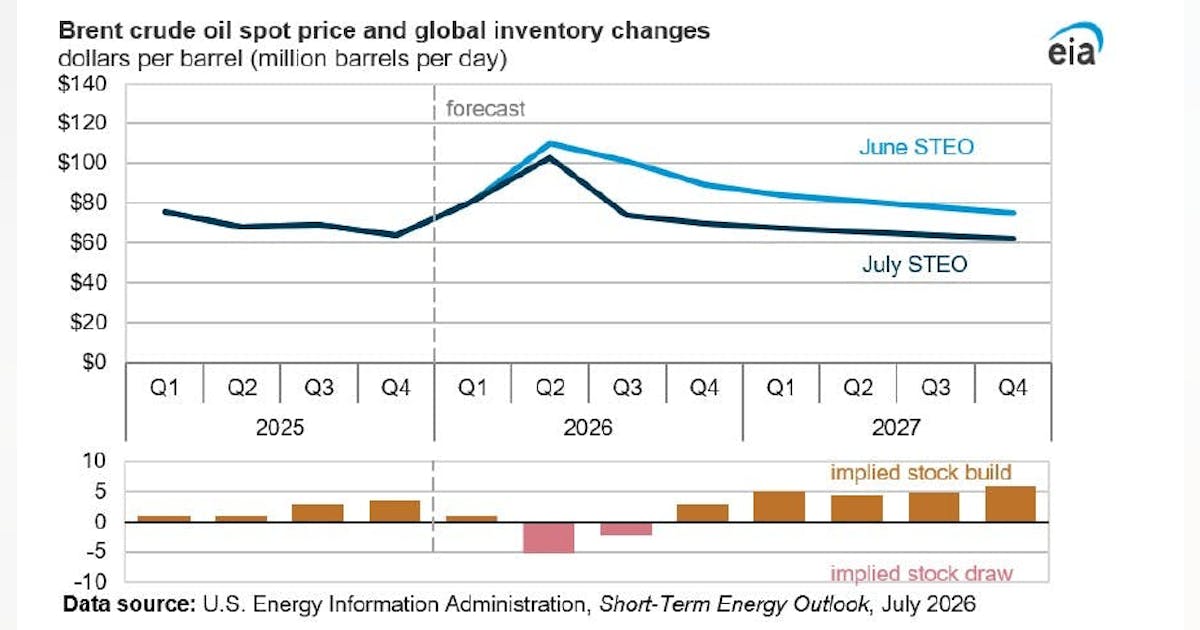
Brent crude averaged $85/bbl in June, down $22/bbl from May and $32/bbl below its April peak. Prices fell below $70/bbl on July 1 as tanker traffic through the strait increased sharply, easing supply concerns. EIA now expects most shut-in crude production to return to near pre-conflict levels by yearend, with full restoration largely to be completed by first-quarter 2027. 

Despite the recovery in flows, global inventories remain significantly depleted following earlier draws. EIA estimates oil inventories declined by an average of 5.1 million b/d in second-quarter 2026 and will fall by a further 2.2 million b/d in third-quarter 2026, as much of the recent tanker movement reflects previously stranded cargoes. As a result, the market is expected to remain relatively tight through most of third-quarter 2026 before shifting back into oversupply.

EIA forecasts global oil consumption will decline by 1.2 million b/d in 2026, led by a 0.8 million b/d drop in non-OECD demand, particularly in the Asia Pacific. Demand is expected to rebound in 2027 as prices ease and supply normalizes, with consumption rising by 2.0 million b/d to 104.8 million b/d. 

As supply growth outpaces demand, inventories are projected to build by 2.7 million b/d in fourth-quarter 2026 and by 5.0 million b/d in 2027. This shift is expected to place sustained downward pressure on prices.

EIA forecasts Brent crude will average $70/bbl in fourth-quarter 2026, $19/bbl lower than in its June outlook, and $65/bbl in 2027, down $15/bbl from the prior forecast. Strategic and commercial stock replenishment is expected to partially offset the price decline.


Shape
Shape
Stay Ahead

Explore More Insights

Stay ahead with more perspectives on cutting-edge power, infrastructure, energy,  bitcoin and AI solutions. Explore these articles to uncover strategies and insights shaping the future of industries.

Shape

AI job titles expand beyond tech as IT hiring remains strong

Separately, according to CompTIA’s latest Tech Jobs Report, employers posted more than 280,000 new technology job postings in June, marking the sixth consecutive month of growth. Active technology job postings approached 600,000, while employment in tech occupations increased by 47,000 positions. The unemployment rate for tech occupations fell to 2.9%,

Read More »

Broadcom will sell more US-made components to Apple

Apple has agreed to buy up to $30 billion-worth of additional chips and other wireless components from Broadcom over the next few years. The new agreement could lead to Broadcom making up to 15 billion more chips in the US, and enable it to modernize its manufacturing facilities in Fort

Read More »

AI tie-in accelerates quantum usefulness, early adopters say

The Quantum Tech World conference showcases this ecosystem, she says. According to conference organizers, more than 1,300 people attended this year, and there were more than one hundred sponsors. Among them were multiple quantum computer makers, including Quantum Computing Inc., a maker of room-temperature photonic computers, which ran a real-time

Read More »

PTTEP achieves Thailand’s first wellhead platform reuse in Gulf of Thailand

PTT Exploration and Production Public Co. Ltd. (PTTEP) has completed Thailand’s first total wellhead platform reuse project by redeploying an entire decommissioned petroleum wellhead platform as a complete structure in Funan field in the Gulf of Thailand. The reuse project comes as part of PTTEP’s program to maximize value and extend utilization of wellhead platforms that remain structurally sound and safe after depleting resources at a location by redeploying the platform as a complete structure. The first implementation was carried out at the Jakrawan K wellhead platform (JKWK), in Funan field under the G1/61 Project. As part of the project, PTTEP adopted the wet-tow method to relocate the jacket, helping curb energy consumption and minimize impacts on marine life attached to the platform structure, supporting a balance between energy production and marine environmental stewardship. The topside, jacket, and selected pile sections were relocated and reinstalled for use within the same field, reducing the overall construction and installation period to only 6 months, down from about 20 months for a newly built platform.  Additionally, the approach cut construction costs by about 35–50% compared with construction of an entirely new wellhead platform. PTTEP said it expects the initiative to also reduce greenhouse gas emissions by about 3,270 tonnes of CO2e/platform by limiting the use of steel and other equipment required for construction of new platforms. PTTEP is operator of the G1/61 project (60%) with partner Mubadala Investment Co. (40%).

Read More »

Trump declares Iran ceasefire over; oil surges on renewed supply risk

US President Donald Trump said the ceasefire and memorandum of understanding (MOU) reached with Iran last month is effectively over following a fresh exchange of strikes, reigniting supply concerns and sending crude prices sharply higher. Speaking alongside NATO Secretary-General Mark Rutte at the alliance’s summit in Ankara, Pres. Trump said Washington no longer sees value in maintaining the ceasefire framework with Tehran, though he left open the possibility of continued talks. He added that further US military action against Iran remains likely after strikes overnight. Stay updated on oil price volatility, shipping disruptions, LNG market analysis, and production output at OGJ’s Iran war content hub. The escalation was triggered by alleged Iranian attacks on three commercial vessels transiting the Strait of Hormuz on July 7. US Central Command said it responded with strikes on more than 80 Iranian targets, including air defense systems, command-and-control infrastructure, anti-ship missile capabilities, and over 60 Islamic Revolutionary Guard Corps (IRGC) fast boats operating in and near the strait. US Central Command described the tanker attacks as a clear violation of the June 17 agreement. Iran’s Foreign Ministry called the US strikes a breach of the MOU and said Tehran would continue to defend its sovereignty. The IRGC said it retaliated with drone and missile strikes targeting US military facilities in Bahrain and Kuwait. Authorities in both countries reported intercepting incoming projectiles, with no material damage confirmed. Trump said on July 8 the US is considering reinstating a naval blockade targeting Iranian ports and vessels. He also raised the possibility of strikes on civilian infrastructure, including electric plants and desalination facilities, as well as a potential move to take control of Kharg Island, home to the bulk of Iran’s crude export infrastructure. He said Tuesday’s strikes had reached the island but had not targeted its

Read More »

US EIA forecasts declining oil prices as supply disruptions ease

In its July 7 Short-Term Energy Outlook (STEO) report, the US Energy Information Administration (EIA) said it expects global oil prices to decline as supply disruptions linked to the Strait of Hormuz ease and production recovers.  On June 18, the US and Iran signed a memorandum of understanding to end the conflict and reopen the strait, which had been largely closed since Feb. 28. The disruption to this critical oil transit chokepoint constrained global flows, driving major price volatility. Brent crude averaged $85/bbl in June, down $22/bbl from May and $32/bbl below its April peak. Prices fell below $70/bbl on July 1 as tanker traffic through the strait increased sharply, easing supply concerns. EIA now expects most shut-in crude production to return to near pre-conflict levels by yearend, with full restoration largely to be completed by first-quarter 2027.  Despite the recovery in flows, global inventories remain significantly depleted following earlier draws. EIA estimates oil inventories declined by an average of 5.1 million b/d in second-quarter 2026 and will fall by a further 2.2 million b/d in third-quarter 2026, as much of the recent tanker movement reflects previously stranded cargoes. As a result, the market is expected to remain relatively tight through most of third-quarter 2026 before shifting back into oversupply. EIA forecasts global oil consumption will decline by 1.2 million b/d in 2026, led by a 0.8 million b/d drop in non-OECD demand, particularly in the Asia Pacific. Demand is expected to rebound in 2027 as prices ease and supply normalizes, with consumption rising by 2.0 million b/d to 104.8 million b/d.  As supply growth outpaces demand, inventories are projected to build by 2.7 million b/d in fourth-quarter 2026 and by 5.0 million b/d in 2027. This shift is expected to place sustained downward pressure on prices. EIA forecasts Brent

Read More »

Eni lets EPCI contract for Kutei North Hub field FPSO

Eni North Ganal has let an engineering, procurement, construction, and installation (EPCI) contract to a joint venture between PT Saipem Indonesia and PT Tripatra Engineers and Constructors for a floating production, storage, and offloading (FPSO) unit for the Kutei North Hub Field Development Project in Kutei basin, offshore Indonesia, about 70 km off East Kalimantan. The project execution, with an estimated duration of 48 months, includes project management, engineering, procurement of materials, fabrication, construction and installation activities, as well as commissioning and start-up of the FPSO unit. The contract is valued at about $2 billion for Saipem’s share. The Kutei FPSO project is part of the Kutei North Hub Development, which comprises a subsea development tied back to the new FPSO, a dedicated gas export pipeline to the Bontang LNG plant, and domestic gas users via the existing East Kalimantan System. Eni North Ganal is controlled by Searah Ltd., which was formed through a strategic partnership between Eni and Petronas.

Read More »

EIA: US crude inventories up 3.0 million bbl

US crude oil inventories for the week ended July 3, excluding the Strategic Petroleum Reserve, increased by 3.0 million bbl from the previous week, according to data from the US Energy Information Administration (EIA). At 411.4 million bbl, US crude oil inventories are about 6% below the 5-year average for this time of year, the EIA report indicated. EIA said total motor gasoline inventories decreased by 1.9 million bbl from last week and are about 6% below the 5-year average for this time of year. Finished gasoline inventories and blending components inventories both decreased last week. Distillate fuel inventories decreased by 5.0 million bbl last week and are about 12% below the 5-year average for this time of year. Propane-propylene inventories decreased by 800,000 bbl from last week and are 29% above the 5-year average for this time of year, EIA said. US crude oil refinery inputs averaged 17.0 million b/d for the week ended July 3, which was 173,000 b/d less than the previous week’s average. Refineries operated at 95.8% of capacity. Gasoline production decreased, averaging 9.7 million b/d. Distillate fuel production decreased, averaging 5.2 million b/d. US crude oil imports averaged 5.6 million b/d, up 351,000 b/d from the previous week. Over the last 4 weeks, crude oil imports averaged about 5.4 million b/d, 11.4% less than the same 4-week period last year. Total motor gasoline imports averaged 423,000 b/d. Distillate fuel imports averaged 87,000 b/d.

Read More »

Marubeni closes deal to acquire Barnett-focused EagleRidge Energy

Marubeni Corp. has closed a deal to acquire EagleRidge Energy II LLC, a natural gas operator based in Dallas, Tex., advancing its effort to expand energy operations and natural gas assets in North America. EagleRidge, now a wholly owned subsidiary of Marubeni, has focused its operations on the Barnett shale in North Texas. The company operates over 3,500 wells and produces 300 MMcfed over 450,000 gross acres across 16 counties. The deal, which was announced in June, increases Marubeni’s production capacity in the Barnett shale to about 170 MMcfed. With the transaction closed, Marubeni said in a July 6 update, the EagleRidge management and operational team remains in place, with updates to executive leadership. Tom Ashton and Sam Miller will share the role of co-presidents. Hiroki Shima has been appointed chairman, and Michael Ronca transitions to vice-chairman.

Read More »

Infoblox acquires Kentik, adding network observability to its DNS and DDI platform

Infoblox announced today that it has entered into a definitive agreement to acquire Kentik, combining Infoblox’s authoritative DNS, DHCP, and IP address management (IPAM) data with Kentik’s network observability platform. Financial terms were not disclosed. Kentik was founded in 2014, originally as CloudHelix before rebranding the following year, and has raised more than $100 million in venture funding to date. The platform provides real-time visibility into network traffic and ingests flow data, routing intelligence, and device telemetry across data centers, cloud environments, WANs, and the public internet. In recent years, the company has enhanced its platform with an AI advisor that helps to accelerate investigations. Infoblox has spent more than two decades managing the DNS, DHCP, and IPAM services enterprises rely on to stay connected. In 2024, it first launched its Universal DDI SaaS platform for managing DNS, DHCP, and IP addresses from a single place, expanding in 2025 to more providers. DDI refers to the trio of core network services in IP networks: DNS, which turns domain names into IP addresses; DHCP, which assigns IP addresses to resources; and IPAM, which manages the network’s IP address infrastructure.

Read More »

Building the AI Optical Layer: Connectivity, Standards, and the Future of AI Infrastructure

As AI data centers push past the limits of traditional compute architecture, the industry’s attention is moving deeper into the physical layer. GPUs, accelerators, power systems and cooling platforms still dominate the headlines, but the network fabric that connects those systems is becoming just as critical. A wave of recent announcements points to the same conclusion: future growth will depend not only on more compute, but on faster, denser, more efficient and more scalable optical connectivity. A new multi-source agreement is bringing together major technology companies to standardize expanded beam optical connectivity for AI data centers. University of Arizona research is powering a new optical switching technology designed to reduce the energy consumed by data center networks. STL is planning to invest up to $100 million in U.S. manufacturing capacity to support AI data center and telecom customers with optical connectivity products. Those developments are now being reinforced by a broader series of moves across the optical ecosystem: Corning’s major AI infrastructure partnerships with NVIDIA and Amazon, GlobalFoundries’ push into co-packaged optics, Sivers’ laser-array collaboration with GlobalFoundries, Wiwynn’s co-packaged optics demonstration at Computex, Credo’s acquisition of DustPhotonics, and emerging near-packaged optical interconnect designs from LightSpeed Photonics. Taken together, these announcements highlight a maturing market around the optical layer of AI infrastructure. The value is not simply faster data movement. It is about reducing deployment complexity, lowering operating overhead, supporting higher-density clusters, improving energy efficiency and strengthening the domestic supply chain behind AI-ready networks. Let’s drill down into what these announcements mean. Standards for the AI Optical Layer The launch of a new coalition focused on expanded beam optical, or EBO, connectivity reflects a practical challenge facing AI deployments: as clusters grow larger and more bandwidth-intensive, physical connections become harder to deploy, maintain and scale. 3M announced that it has joined

Read More »

Data Center Jobs: Engineering, Construction, Commissioning, Sales, Field Service and Facility Tech Jobs Available in Major Data Center Hotspots

Each month Data Center Frontier, in partnership with Pkaza, posts some of the hottest data center career opportunities in the market. Here’s a look at some of the latest data center jobs posted on the Data Center Frontier jobs board, powered by Pkaza Critical Facilities Recruiting. Looking for Data Center Candidates? Check out Pkaza’s Active Candidate / Featured Candidate Hotlist CFD Engineer – Data Center Mechanical DesignNew York, NY (remote)This position is also available as a remote role anywhere in the US, in addition to key markets such as Cedar Rapids, IA; Kansas City, MO or White Plains, NY. Our client is an engineering design and commissioning company that has a national footprint and specializes in MEP critical facilities design. They provide design, commissioning, consulting and management expertise in the critical facilities space. They have a mindset to provide reliability, energy efficiency, and sustainable design expertise when providing these consulting services for enterprise, colocation and hyperscale companies. This career-growth minded opportunity offers exciting projects with leading-edge technology and innovation as well as competitive salaries and benefits. Electrical Commissioning Engineer New Albany, OH (limited travel)Non-Traveling CxA positions available in: Indianapolis, IN; Cedar Rapids, IA and Austin, TX. Traveling CxA Roles: New York, NY; White Plain, NY; Morristown, NJ; Dallas, TX; Richmond, VA; Ashburn, VA; Montvale, NJ; Charlotte, NC; Atlanta, GA; Phoenix, AZ; Salt Lake City, UT;  Kansas City, MO; Omaha, NE; Chesterton, IN or Chicago, IL. *** ALSO looking for a LEAD EE and ME CxA Agents and CxA PMs. *** Our client is an engineering design and commissioning company that has a national footprint and specializes in MEP critical facilities design. They provide design, commissioning, consulting and management expertise in the critical facilities space. They have a mindset to provide reliability, energy efficiency, sustainable design and LEED expertise when providing these consulting services

Read More »

H5 Data Centers’ 325 Hudson: A Manhattan Carrier Hotel with SoHo DNA – DCF Tours

A Carrier Hotel Reimagined for Modern Colocation H5 formally announced its expansion into 325 Hudson, a 225,000 square-foot mixed-use building comprised of office, lab and data center uses, in 2021 through a partnership with real estate investment firm DivcoWest, describing its new location as a data center and carrier hotel in one of the world’s largest communications markets. At the time, H5 founder and CEO Josh Simms framed the move as an opportunity to expand an already-established interconnection ecosystem while supporting growing demand from cloud providers, content delivery networks, and communications carriers. That vision now appears fully realized inside the building. The facility today operates as both a traditional carrier hotel and a modern enterprise colocation environment. H5’s infrastructure footprint supports high-density deployments, A/B UPS power architecture, N+1 emergency generators, N+1 CRAC systems, and energy-efficient in-row cooling with cold aisle containment. The building also reflects the physical realities of Manhattan infrastructure engineering. Operators work within vertical constraints rather than sprawling horizontal campuses. Freight access, riser strategy, structured cabling pathways, and efficient floor utilization become critical operational variables. H5 highlighted several features tailored for those realities, including 13-foot slab-to-slab heights, 150 pounds-per-square-foot floor loading capability, secure loading access, and extensive pre-built conduit infrastructure.

Read More »

AI Infrastructure Demands a New Operating System for Project Delivery

For much of the data center industry’s history, project management has largely been viewed as an execution discipline: a collection of schedules, milestones, spreadsheets, and status meetings designed to shepherd individual facilities from groundbreaking to commissioning. The AI era is rapidly rendering that model obsolete. As hyperscalers, developers, utilities, EPC firms, telecom providers, equipment suppliers, and local governments converge around increasingly complex AI campuses, the challenge is no longer simply delivering projects on time. Rather, it is orchestrating an infrastructure manufacturing process that stretches from land acquisition and permitting through construction, operations, and ultimately asset modernization years later. That changing reality was a central theme during Data Center Frontier’s conversation with Sitetracker at Fiber Connect 2026. The company’s perspective reflects a broader shift underway across digital infrastructure: project management is evolving into lifecycle management, where financial planning, regulatory coordination, supply chain visibility, and operational readiness become inseparable parts of the same platform. Complexity Begins Before Construction Much of the attention surrounding AI infrastructure focuses on GPU deployments, liquid cooling, and power availability. Yet Sitetracker argues that many of today’s greatest operational headaches begin much earlier in the development process. According to Reilly McClure, Sr. Product Marketing Manager – Digital Infrastructure with Sitetracker, operators are increasingly seeking help with land acquisition, parcel management, and site identification as AI infrastructure expands into new markets. “There are so many variables that we need to track,” he explained. “The demand and the growth and the build-out for where all that infrastructure is going is becoming increasingly complex. They’re finding it just cannot be done on a spreadsheet.” That observation resonates across the industry. Finding suitable sites now requires simultaneously evaluating power availability, transmission timelines, fiber access, permitting requirements, environmental studies, municipal approvals, and community considerations; all while competing developers race to secure the same

Read More »

Gartner: Data center electricity consumption to grow 26% in 2026

AI-optimized servers are a relatively new phenomenon but they have rapidly gained uh traditional data centers in terms of power use. Gartner estimates AI-optimized server adoption will account for 31% of data center power consumption in 2026, and that by 2027 their power consumption will surpass that of conventional servers. “Surging demand for compute-intensive AI workloads is driving unprecedented data center power growth, while AI capacity is now constrained by power availability, making data center power security the new battle ground for scaling and protecting margins in the global AI race,” said Wang in a statement. Wang said of the 565TWh consumed this year, the U.S. will account for about 204TWh, or 36% of the total amount consumed. And of the 204TWh consumed this year, dedicated AI data centers will consume 68TWh, or one-third of the total. So in just five years, AI data centers have gone from zero to of the total power consumption in the US.

Read More »

Microsoft will invest $80B in AI data centers in fiscal 2025

And Microsoft isn’t the only one that is ramping up its investments into AI-enabled data centers. Rival cloud service providers are all investing in either upgrading or opening new data centers to capture a larger chunk of business from developers and users of large language models (LLMs).  In a report published in October 2024, Bloomberg Intelligence estimated that demand for generative AI would push Microsoft, AWS, Google, Oracle, Meta, and Apple would between them devote $200 billion to capex in 2025, up from $110 billion in 2023. Microsoft is one of the biggest spenders, followed closely by Google and AWS, Bloomberg Intelligence said. Its estimate of Microsoft’s capital spending on AI, at $62.4 billion for calendar 2025, is lower than Smith’s claim that the company will invest $80 billion in the fiscal year to June 30, 2025. Both figures, though, are way higher than Microsoft’s 2020 capital expenditure of “just” $17.6 billion. The majority of the increased spending is tied to cloud services and the expansion of AI infrastructure needed to provide compute capacity for OpenAI workloads. Separately, last October Amazon CEO Andy Jassy said his company planned total capex spend of $75 billion in 2024 and even more in 2025, with much of it going to AWS, its cloud computing division.

Read More »

John Deere unveils more autonomous farm machines to address skill labor shortage

Join our daily and weekly newsletters for the latest updates and exclusive content on industry-leading AI coverage. Learn More Self-driving tractors might be the path to self-driving cars. John Deere has revealed a new line of autonomous machines and tech across agriculture, construction and commercial landscaping. The Moline, Illinois-based John Deere has been in business for 187 years, yet it’s been a regular as a non-tech company showing off technology at the big tech trade show in Las Vegas and is back at CES 2025 with more autonomous tractors and other vehicles. This is not something we usually cover, but John Deere has a lot of data that is interesting in the big picture of tech. The message from the company is that there aren’t enough skilled farm laborers to do the work that its customers need. It’s been a challenge for most of the last two decades, said Jahmy Hindman, CTO at John Deere, in a briefing. Much of the tech will come this fall and after that. He noted that the average farmer in the U.S. is over 58 and works 12 to 18 hours a day to grow food for us. And he said the American Farm Bureau Federation estimates there are roughly 2.4 million farm jobs that need to be filled annually; and the agricultural work force continues to shrink. (This is my hint to the anti-immigration crowd). John Deere’s autonomous 9RX Tractor. Farmers can oversee it using an app. While each of these industries experiences their own set of challenges, a commonality across all is skilled labor availability. In construction, about 80% percent of contractors struggle to find skilled labor. And in commercial landscaping, 86% of landscaping business owners can’t find labor to fill open positions, he said. “They have to figure out how to do

Read More »

2025 playbook for enterprise AI success, from agents to evals

Join our daily and weekly newsletters for the latest updates and exclusive content on industry-leading AI coverage. Learn More 2025 is poised to be a pivotal year for enterprise AI. The past year has seen rapid innovation, and this year will see the same. This has made it more critical than ever to revisit your AI strategy to stay competitive and create value for your customers. From scaling AI agents to optimizing costs, here are the five critical areas enterprises should prioritize for their AI strategy this year. 1. Agents: the next generation of automation AI agents are no longer theoretical. In 2025, they’re indispensable tools for enterprises looking to streamline operations and enhance customer interactions. Unlike traditional software, agents powered by large language models (LLMs) can make nuanced decisions, navigate complex multi-step tasks, and integrate seamlessly with tools and APIs. At the start of 2024, agents were not ready for prime time, making frustrating mistakes like hallucinating URLs. They started getting better as frontier large language models themselves improved. “Let me put it this way,” said Sam Witteveen, cofounder of Red Dragon, a company that develops agents for companies, and that recently reviewed the 48 agents it built last year. “Interestingly, the ones that we built at the start of the year, a lot of those worked way better at the end of the year just because the models got better.” Witteveen shared this in the video podcast we filmed to discuss these five big trends in detail. Models are getting better and hallucinating less, and they’re also being trained to do agentic tasks. Another feature that the model providers are researching is a way to use the LLM as a judge, and as models get cheaper (something we’ll cover below), companies can use three or more models to

Read More »

OpenAI’s red teaming innovations define new essentials for security leaders in the AI era

Join our daily and weekly newsletters for the latest updates and exclusive content on industry-leading AI coverage. Learn More OpenAI has taken a more aggressive approach to red teaming than its AI competitors, demonstrating its security teams’ advanced capabilities in two areas: multi-step reinforcement and external red teaming. OpenAI recently released two papers that set a new competitive standard for improving the quality, reliability and safety of AI models in these two techniques and more. The first paper, “OpenAI’s Approach to External Red Teaming for AI Models and Systems,” reports that specialized teams outside the company have proven effective in uncovering vulnerabilities that might otherwise have made it into a released model because in-house testing techniques may have missed them. In the second paper, “Diverse and Effective Red Teaming with Auto-Generated Rewards and Multi-Step Reinforcement Learning,” OpenAI introduces an automated framework that relies on iterative reinforcement learning to generate a broad spectrum of novel, wide-ranging attacks. Going all-in on red teaming pays practical, competitive dividends It’s encouraging to see competitive intensity in red teaming growing among AI companies. When Anthropic released its AI red team guidelines in June of last year, it joined AI providers including Google, Microsoft, Nvidia, OpenAI, and even the U.S.’s National Institute of Standards and Technology (NIST), which all had released red teaming frameworks. Investing heavily in red teaming yields tangible benefits for security leaders in any organization. OpenAI’s paper on external red teaming provides a detailed analysis of how the company strives to create specialized external teams that include cybersecurity and subject matter experts. The goal is to see if knowledgeable external teams can defeat models’ security perimeters and find gaps in their security, biases and controls that prompt-based testing couldn’t find. What makes OpenAI’s recent papers noteworthy is how well they define using human-in-the-middle

Read More »