
Stay Ahead, Stay ONMINE

Rethinking how we measure AI intelligence

Current AI benchmarks are struggling to keep pace with modern models. As helpful as they are to measure model performance on specific tasks, it can be hard to know if models trained on internet data are actually solving problems or just remembering answers they’ve already seen. As models reach closer to 100% on certain benchmarks, they also become less effective at revealing meaningful performance differences. We continue to invest in new and more challenging benchmarks, but on the path to general intelligence, we need to continue to look for new ways to evaluate. The more recent shift towards dynamic, human-judged testing solves these issues of memorization and saturation, but in turn, creates new difficulties stemming from the inherent subjectivity of human preferences.While we continue to evolve and pursue current AI benchmarks, we’re also consistently looking to test new approaches to evaluating models. That’s why today, we’re introducing the Kaggle Game Arena: a new, public AI benchmarking platform where AI models compete head-to-head in strategic games, providing a verifiable, and dynamic measure of their capabilities.


Current AI benchmarks are struggling to keep pace with modern models. As helpful as they are to measure model performance on specific tasks, it can be hard to know if models trained on internet data are actually solving problems or just remembering answers they’ve already seen. As models reach closer to 100% on certain benchmarks, they also become less effective at revealing meaningful performance differences. We continue to invest in new and more challenging benchmarks, but on the path to general intelligence, we need to continue to look for new ways to evaluate. The more recent shift towards dynamic, human-judged testing solves these issues of memorization and saturation, but in turn, creates new difficulties stemming from the inherent subjectivity of human preferences.

While we continue to evolve and pursue current AI benchmarks, we’re also consistently looking to test new approaches to evaluating models. That’s why today, we’re introducing the Kaggle Game Arena: a new, public AI benchmarking platform where AI models compete head-to-head in strategic games, providing a verifiable, and dynamic measure of their capabilities.

Shape
Shape
Stay Ahead

Explore More Insights

Stay ahead with more perspectives on cutting-edge power, infrastructure, energy,  bitcoin and AI solutions. Explore these articles to uncover strategies and insights shaping the future of industries.

Shape

INPEX sanctions Ichthys LNG expansion project, awards contract

The INPEX Corp.-led Ichthys Joint Venture has sanctioned the next phase of development of the Ichthys LNG project offshore Western Australia and awarded a contract to a consortium of McDermott and Baker Hughes for part of the work. The development, designated Phase 2c Part 1, includes five production wells targeting

Read More »

IEA sees potential for looser oil, LNG markets after Hormuz crisis

Global oil and natural gas markets could face a period of more abundant supply and lower prices once disruptions in the Middle East ease, although the timing and extent of any recovery remain uncertain, according to the International Energy Agency’s (IEA) World Energy Outlook 2026. The outlook points to sharply different demand trajectories depending on how governments respond to the 2026 energy crisis. Under IEA’s Stated Policies Scenario (STEPS), global oil demand levels off at around 103 million b/d by 2030 before declining gradually, while natural gas demand continues growing until the mid-2030s. Under the Current Policies Scenario (CPS), consumption of both fuels continues to increase. The projections assume that constraints on Gulf oil and gas exports will ease into 2027 and that conditions will allow unimpeded transit through the Strait of Hormuz by end-2027. IEA cautioned that the scenarios are not forecasts and that considerable uncertainty remains over the duration of the crisis and the future of Middle East exports. The disruption to energy flows through the Strait of Hormuz has resulted in cumulative losses of 2.8 billion bbl of oil and 60 billion cu m (bcm) of natural gas supply from the Gulf. At its peak, global oil supply fell by 16.1 million b/d from pre-conflict levels. Ample inventories, increased production and exports from non-Gulf suppliers, alternative export routes, and reduced Chinese crude imports helped cushion the initial impact. IEA member countries also coordinated the release of 400 million bbl of emergency oil stocks, announced Mar. 11, 2026. As inventories declined and supply disruptions continued, however, higher prices increasingly weighed on consumption. Diesel markets have been particularly strained, with prices exceeding $200/bbl amid disruptions to Middle Eastern product exports and reduced Russian supplies. IEA’s November 2026 Oil Market Report expects global oil demand to decline by around 2.7

Read More »

Phelan Green advances development of South African SAF complex

Privately held Phelan Green Group’s clean-fuels subsidiary Phelan eFuels has let a contract to Honeywell Technologies to deliver a suite of services to support the first-phase of its multi-phased electro sustainable aviation fuel (eSAF) production complex under development as part of the operator’s broader $2.5-billion Phelan Green Hydrogen project in Saldanha Bay, Western Cape, South Africa. As part of the contract, Honeywell Technologies will provide licensing for its proprietary Advanced Solvent Carbon Capture (ASCC) technology—a co-development of Honeywell UOP and the University of Texas (UT) at Austin—alongside modular engineering services for the Phase 1 eSAF plant on which Phelan Green recently took positive final investment decision to proceed, the service provider said in a release Nov. 18. The ASCC technology will enable the plant to capture carbon dioxide (CO2) from on-site flue gas which—under either scenario—will contribute to reduced CO2 emissions from the plant. This latest contract for the Phase 1 eSAF plant follows Phelan Green’s previous award earlier in the year to Honeywell UOP for licensing of its proprietary Fischer-Tropsch (FT) Unicracking process technology, which uses FT liquids and waxes made from CO2 to create eSAF that complies with aviation industry standards. Designed with a nameplate e-SAF production capacity of 35,000 tonnes/year (tpy) and scheduled to enter operation in third-quarter 2028, the Phase 1 plant supports Phelan Green’s goal of helping to establish South Africa as a competitive producer and exporter of lower-carbon aviation fuel in a process further streamlined by Honeywell Technologies’ integrated suite of technology, engineering, and equipment offerings, said Blair Phelan, Phelan Green’s managing director. The Phase 1 plant will also use Johnson Matthey PLC (JM) subsidiary JM Catalyst Technologies’ (JM CT) proprietary HyCOgen technology to catalytically convert CO2 and electrolytic (green) hydrogen into carbon monoxide (CO) that will be combined with hydrogen to form synthesis

Read More »

Grid operators need data center ride-through rules that protect reliability

Listen to the article 7 min This audio is auto-generated. Please let us know if you have feedback. Alan Cooper is CEO of ON.energy, a developer of power infrastructure.  On July 22, a mechanical failure forced a 230-kV transmission line in Northern Virginia offline. Within milliseconds, grid protection systems cleared the fault, as they are designed to do. The event would not have been a particularly noteworthy story, had it stopped there. It’s what happened next, though, that pointed to a growing challenge for grid reliability. Optional Caption Permission granted by Alan Cooper In response to the fault, data centers that had been drawing nearly 4 GW of energy, close to 4% of PJM’s load, collectively disconnected and switched to their on-site backup generation. The move sent voltage and frequency spiking across the system, a technically wonky but threatening result that caused power flickers as far away as Chicago. Thankfully, the prevailing grid conditions were strong enough to absorb the shock of the fault, so the grid held. But if the same event had hit Texas or even Northern Virginia at a time of higher demand, it could have caused a widespread outage. In West Texas, the Electric Reliability Counil of Texas estimates that a loss of as little as 3.2 GW could threaten grid reliability. The power sector is not unfamiliar with the need for things hooked up to the electricity grid to “ride through” disturbance events. In 2023, the Federal Energy Regulatory Commission told the North American Electricity Reliability Corp. to develop requirements that inverter-based supply resources like wind and solar facilities must follow to ensure they “ride through,” i.e., stay online, during certain disturbances. And this time around, NERC, FERC and several grid regions have been quick to identify a similar need for large loads to adhere

Read More »

Fuel constraints could challenge grid this winter, despite resource improvements: NERC

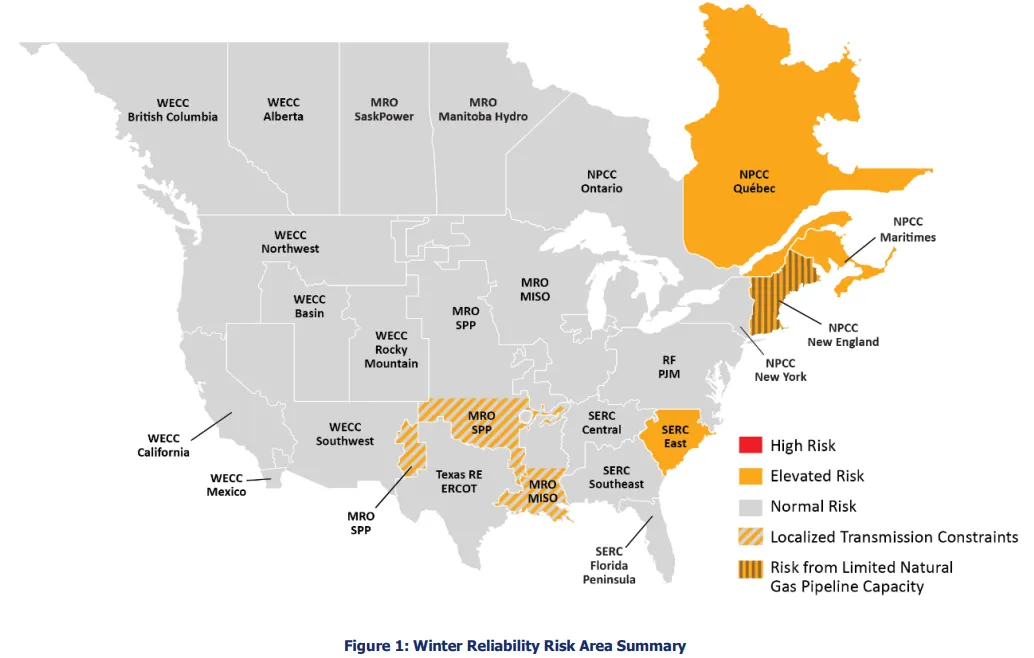
Listen to the article 3 min This audio is auto-generated. Please let us know if you have feedback. Dive Brief: The bulk power system’s winter reliability outlook has improved since last season, but the El Niño weather pattern and potential for extreme cold can present challenges that grid operators must remain aware of, the North American Electric Reliability Corp. said Wednesday in its annual seasonal outlook. On-peak capacity resources grew 26.2 GW over the 2025-26 winter, a 2.4% increase led by batteries and gas-fired generation, according to the 2026–2027 Winter Reliability Assessment. A slowdown in generator retirements is also contributing to the improved resource outlook, NERC said. The reliability watchdog’s outlook identified no areas facing a high risk of resource shortfalls this winter, but it found some areas in the Midwest, Southeast and New England where transmission system constraints, pipeline constraints and fuel risk scenarios may present problems during periods of extreme weather. Dive Insight: Electric demand is growing, but “there has also been strong growth in resources,” Mark Olson, manager of reliability assessments, said Wednesday in a call discussing the outlook. “In many ways, the industry is on better footing going into winter this year,” he said. However, Olson added that “historically, winter is the toughest operating period for the North American electric grid.”  While some models show the El Niño weather pattern can bring milder-than-average conditions that are a help to a constrained power system, “the reality is that extreme storms with ice and abnormal cold temperatures can lie within those averages,” Olson said. Retrieved from North American Electric Reliability Corp. “We’re talking to our industry stakeholders about the need for extra vigilance. El Niño is a variable that adds to uncertainty for the winter,” he said. Peak winter electric heating demand often coincides with higher residential gas usage,

Read More »

Energy Secretary Acts to Protect Mid-Atlantic Grid

WASHINGTON—U.S. Secretary of Energy Chris Wright issued an emergency order to reduce the risk of power outages and strengthen grid reliability across the mid-Atlantic region. The order permits PJM Interconnection, L.L.C. (PJM), in coordination with Talen Energy Corporation, to run Unit 4 at the Wagner Generating Station in Anne Arundel County, Maryland, to meet anticipated electricity demand. The order follows an application from PJM submitted on October 23, 2026.  “Energy shortfalls for 65 million Americans are simply unacceptable,” said U.S. Secretary of Energy Chris Wright.  “Previous orders in the mid-Atlantic region have helped keep the lights on and I’m confident this order will help do so in the coming months as well. Today’s order helps temporarily address the urgent need to strengthen grid reliability and ensure Americans across the mid-Atlantic region have access to affordable, reliable, and secure power, regardless of whether the sun shines or the wind blows.”   Secretary Wright previously granted PJM’s requests to operate Wagner Unit 4 beyond its operating limit to help maintain grid reliability.  PJM relied on Wagner Unit 4 during periods of unusually high temperatures earlier this summer, using the unit’s remaining operating hours. PJM has since reaffirmed to the Department of Energy (DOE) the continued need for Wagner Unit 4 to meet high electricity demand, strengthen grid reliability, and reduce the risk of power outages across the mid-Atlantic region.   The renewed order is effective from November 18, 2026, through December 31, 2026. 

Read More »

EIA: US crude oil inventories up 3.4 million bbl

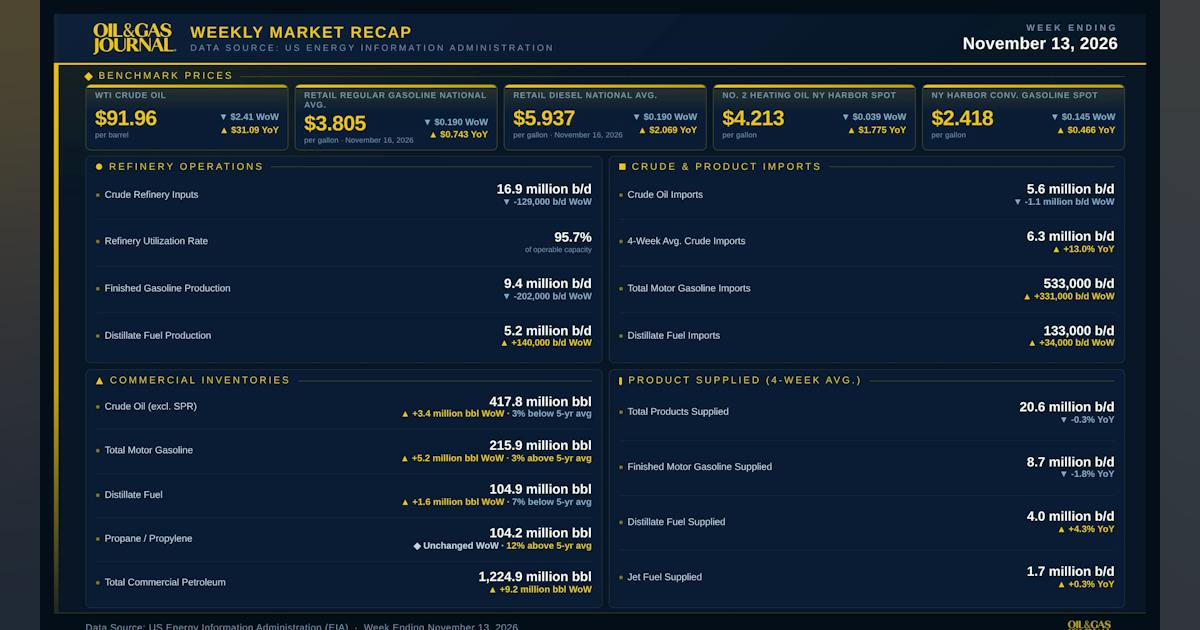
US crude oil inventories for the week ended Nov. 13, excluding the Strategic Petroleum Reserve, increased by 3.4 million bbl from the previous week, according to data from the US Energy Information Administration (EIA). At 417.8 million bbl, US crude oil inventories are 3% below the 5-year average for this time of year, the EIA report indicated. Gasoline inventories increased 5.2 million bbl, 3% above the 5-year average. Propane-propylene inventories remained unchanged, 12% above the 5-year average. Total commercial petroleum inventories increased by 9.2 million bbl for the week. Distillate inventories increased 1.6 million bbl, 7% below the 5-year average. US crude oil refinery inputs averaged 16.9 million b/d for the week ended Nov. 13, which was 129,000 b/d less than the previous week’s average. Refineries operated at 95.7% of capacity. Gasoline output averaged 9.4 million b/d, and distillate production increased to 5.2 million b/d. Crude oil imports decreased 1.1 million b/d to 5.6 million b/d. The 4-week average of 6.3 million b/d is 13% above the year-ago level. Gasoline imports increased and averaged 533,000 b/d; distillate imports also increased and averaged 133,000 b/d. Over the past four weeks, total product supplied averaged 20.6 million b/d, down 0.3% year over year. The 4-week average for gasoline product supplied decreased 1.8% year over year to 8.7 million b/d, while the 4-week average for distillate product supplied increased 4.3% to 4.0 million b/d. The 4-week average for jet fuel product supplied increased 0.3% year over year.

Read More »

Dell and Microsoft drive private AI as enterprises seek greater data control

Dell Technologies and Microsoft are expanding their private cloud partnership with a new set of infrastructure offerings designed to let enterprises run AI models closer to their data, reduce reliance on public cloud services and maintain control over sensitive information. The announcement, made during Microsoft’s Ignite conference, extends Dell’s AI Factory with Nvidia initiative to Dell Private Cloud environments. It also reflects a growing industry push toward internally deployed AI inferencing, particularly among organizations dealing with sensitive corporate information, regulatory requirements and data residency restrictions, Dell stated. The expanded offering combines Dell Private Cloud, Microsoft Azure Local, Microsoft Foundry Local and Nvidia acceleration. The objective is to provide organizations with an integrated infrastructure for deploying heavy AI workloads inside their own data centers and firewalls, the companies said.

Read More »

StarlingX 13.0 updates the network stack for distributed edge deployments

Edge sites do not always come with the network gear that a data center takes for granted. That’s a challenge the open-source StarlingX project from the OpenInfra Foundation is now tackling in its 13.0 update. StarlingX is an open-source distributed cloud platform that combines Linux, Kubernetes, OpenStack, and Ceph. The OpenInfra Foundation hosts the project, and operators including Verizon, Vodafone, T-Systems and KDDI use it for 5G and Open Radio Access Network (O-RAN) infrastructure. Earlier this year, the StarlingX 12.0 update added precision timing capabilities to help networking stay on time. The 13.0 update tackles a different set of issues. Key features include: Gateway API support. Calico-based support is available to hosted applications, while platform services still use Ingress NGINX Optional certificate authority. The Enterprise Java Beans Certificate Authority (EJBCA) runs on the platform and serves certificates to hosted applications. Subcloud restore. A backup restores directly onto a factory-installed node at a subcloud, a remote edge site, with no operating system reinstall. Direct upgrades. Operators can upgrade from two releases back with a single reboot per host. Layer 2 switching. A new Open vSwitch application lets servers at sites with no router next to them bridge traffic and connect directly to aggregation routers. “The OpenvSwitch application adds Layer 2 switching to the K8S platform,” Greg Waines, a senior member of technical staff at Wind River and a StarlingX Technical Steering Committee member, told Network World. “A server can bridge traffic between its SR-IOV network interfaces and other servers, and it can forward traffic to the site routers.”

Read More »

Sovereign AI is about control, not just location

Guetari was open about the term itself being fuzzy. “Sovereignty is very vague and not always clear,” he told me. “It’s about control, auditability, observability.” He drew a line between data locality, meaning the data stays in-country, and sovereignty, which he described as being “more about control, control of what happens to your data and your workload.” He then made the case for why F5 belongs in that conversation: “This is what we have been doing for two decades.” F5 has always sat in the data path, deciding what an application can communicate with, enforcing security rules, and logging what happened. For a regulated bank or government agency, the ability to reconstruct exactly what happened after an incident is worth more than a press release about a data center’s location. The token is the new unit of economics The most interesting part of my conversation with Guetari wasn’t about security. It was about business models. He argued that every successful technology business has found the right unit to monetize. “The cloud is selling the unit of the cloud, which is the CPU core, very well. SaaS is the seat,” he said. “Telcos have been very successful early on using the voice minute, and then they moved to the gigabyte. Sooner or later, that unit will be the token, and most telcos will have to move to the token. And the ones who will not go to token, unfortunately, will be just pipes.”

Read More »

Palo Alto Networks bets $4.5B on enterprise AI with Applied Compute acquisition

GPUs and data centers To train and host those models, Palo Alto plans to build its own compute capacity, CFO Dipak Golechha said on the call. The spending “will mostly go to GPUs and servers,” with a smaller share for the facilities that house them, he said. Palo Alto will “continue to source from our cloud partners” and add dedicated capacity over time, Golechha said. Arora said the company aims for more than100 megawatts of compute in the next three to five years. Gogia said Palo Alto has sovereignty credentials for security data, including customer-held keys and a European Cortex service governed by Deutsche Telekom. “None of that yet extends to GPUs,” he said, adding that a US-headquartered operator faces the same jurisdictional questions as the hyperscalers it rents capacity from. “A sovereign hosting offer with no named region, operator or date is a promise looking for an address,” Gogia said. Compliance officers should ask Palo Alto for a region list, the operator, and a dated certification plan, he said.

Read More »

App developers turn to QVAC for AI tooling without the cloud  

In most instances today, adding AI to an app means sending user data to a third-party API, paying per request, and hoping the connection holds.    Tether’sQVAC is built on the opposite premise. It runs AI models directly on the user’s device. Data never leaves the hardware, there are no per-request costs, no rate limits, and no need for an internet connection once a model is downloaded.   QVAC SDK: the next milestone in cloud-free AI  While open-source tools and standards like llama.cpp, GGML, and ONNX have made local AI much more accessible in recent years, creating new possibilities for consumer devices, the edge AI ecosystem remains fragmented.    Against this backdrop, in 2026, Tether released a software development kit (SDK) that pulls together the best open tooling from across different domains of machine learning.    The centerpiece of Tether’sQVACSDK isFabric. Built on llama.cpp, it expands the engine to enable on-device fine tuning and additional AI capabilities—opening access to memory-intensive workloads previously only possible with expensive hardware or cloud services.    Building on GGML’s modular framework, QVAC Fabric is primarily oriented toward three backends: Vulkan, which covers most consumer-grade desktop and mobile chips; Metal and Core ML for Apple Silicon; and CUDA for higher-end NVIDIA GPU setups.   The QVAC SDK empowers developers with a unified interface for building multiplatformAIappsthatrunon-device. But although significant progress has been made in bringing inference to consumer devices, text generation alone is only one part of the pipeline that makes modern AI useful.    Bringing search to edge AI   RAG (retrieval-augmented generation) is what equips AI to import and process contextual information to enhance its output. Instead of language models relying solely on their training  data to answer questions, RAG lets them answer using a specific set of documents.    Implementing RAG into an AI app incurs significant memory overhead versus running a

Read More »

DCF Video: CoolIT’s 3 MW CDU Brings Smart Monitoring and Fanless Cooling to AI Infrastructure

As AI infrastructure moves toward higher rack densities and increasingly liquid-cooled architectures, the next challenge is not simply removing more heat. It’s ensuring that the cooling systems themselves remain reliable, efficient, and capable of protecting increasingly valuable computing hardware. At the 2026 OCP Global Summit in San Jose, CoolIT Systems Director of Marketing Charles Robison gave Data Center Frontier a close-up look at several technologies addressing that challenge, including the company’s new 3-megawatt CHx 3000 coolant distribution unit (CDU), integrated coolant health monitoring, and a fifth-generation cold plate loop designed for fanless servers. The demonstration comes at a significant moment for CoolIT, which was acquired by Ecolab for approximately $4.75 billion in July 2026. On November 16, Ecolab formally introduced its new integrated AI cooling platform at SC26 in Chicago, placing the CHx 3000 and its embedded 3D TRASAR technology at the center of a broader strategy combining liquid cooling hardware, fluid management, and digital monitoring. Looking Inside the CHx 3000 The CoolIT CHx 3000 is a liquid-to-liquid CDU rated for 3 MW of cooling capacity at a 3°C approach temperature difference, with a specified flow rate of 4,500 liters per minute. Designed for high-density AI deployments, the unit incorporates Ecolab’s 3D TRASAR technology to continuously monitor the condition of the circulating coolant. In the video, Robison points directly to the sensor array that makes the integration possible. “3D TRASAR, and you can see the array of sensors here, allows coolant health monitoring,” Robison explains. “It allows people to see real-time what’s going on with the coolant. So before it goes out of spec, they know what’s happening and they can address it.” The distinction is important. Traditional cooling monitoring typically emphasizes temperature, pressure, and flow. Ecolab’s technology adds visibility into fluid chemistry and contamination, allowing operators to identify deteriorating

Read More »

Microsoft will invest $80B in AI data centers in fiscal 2025

And Microsoft isn’t the only one that is ramping up its investments into AI-enabled data centers. Rival cloud service providers are all investing in either upgrading or opening new data centers to capture a larger chunk of business from developers and users of large language models (LLMs).  In a report published in October 2024, Bloomberg Intelligence estimated that demand for generative AI would push Microsoft, AWS, Google, Oracle, Meta, and Apple would between them devote $200 billion to capex in 2025, up from $110 billion in 2023. Microsoft is one of the biggest spenders, followed closely by Google and AWS, Bloomberg Intelligence said. Its estimate of Microsoft’s capital spending on AI, at $62.4 billion for calendar 2025, is lower than Smith’s claim that the company will invest $80 billion in the fiscal year to June 30, 2025. Both figures, though, are way higher than Microsoft’s 2020 capital expenditure of “just” $17.6 billion. The majority of the increased spending is tied to cloud services and the expansion of AI infrastructure needed to provide compute capacity for OpenAI workloads. Separately, last October Amazon CEO Andy Jassy said his company planned total capex spend of $75 billion in 2024 and even more in 2025, with much of it going to AWS, its cloud computing division.

Read More »

John Deere unveils more autonomous farm machines to address skill labor shortage

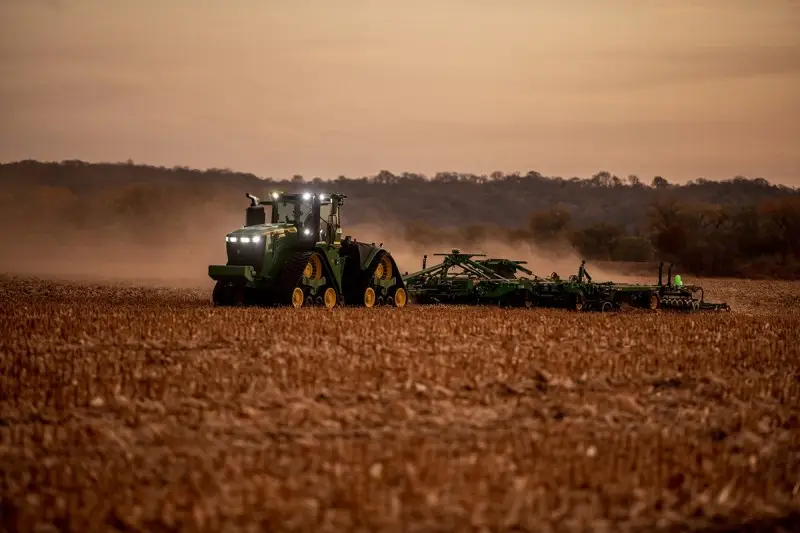
Join our daily and weekly newsletters for the latest updates and exclusive content on industry-leading AI coverage. Learn More Self-driving tractors might be the path to self-driving cars. John Deere has revealed a new line of autonomous machines and tech across agriculture, construction and commercial landscaping. The Moline, Illinois-based John Deere has been in business for 187 years, yet it’s been a regular as a non-tech company showing off technology at the big tech trade show in Las Vegas and is back at CES 2025 with more autonomous tractors and other vehicles. This is not something we usually cover, but John Deere has a lot of data that is interesting in the big picture of tech. The message from the company is that there aren’t enough skilled farm laborers to do the work that its customers need. It’s been a challenge for most of the last two decades, said Jahmy Hindman, CTO at John Deere, in a briefing. Much of the tech will come this fall and after that. He noted that the average farmer in the U.S. is over 58 and works 12 to 18 hours a day to grow food for us. And he said the American Farm Bureau Federation estimates there are roughly 2.4 million farm jobs that need to be filled annually; and the agricultural work force continues to shrink. (This is my hint to the anti-immigration crowd). John Deere’s autonomous 9RX Tractor. Farmers can oversee it using an app. While each of these industries experiences their own set of challenges, a commonality across all is skilled labor availability. In construction, about 80% percent of contractors struggle to find skilled labor. And in commercial landscaping, 86% of landscaping business owners can’t find labor to fill open positions, he said. “They have to figure out how to do

Read More »

2025 playbook for enterprise AI success, from agents to evals

Join our daily and weekly newsletters for the latest updates and exclusive content on industry-leading AI coverage. Learn More 2025 is poised to be a pivotal year for enterprise AI. The past year has seen rapid innovation, and this year will see the same. This has made it more critical than ever to revisit your AI strategy to stay competitive and create value for your customers. From scaling AI agents to optimizing costs, here are the five critical areas enterprises should prioritize for their AI strategy this year. 1. Agents: the next generation of automation AI agents are no longer theoretical. In 2025, they’re indispensable tools for enterprises looking to streamline operations and enhance customer interactions. Unlike traditional software, agents powered by large language models (LLMs) can make nuanced decisions, navigate complex multi-step tasks, and integrate seamlessly with tools and APIs. At the start of 2024, agents were not ready for prime time, making frustrating mistakes like hallucinating URLs. They started getting better as frontier large language models themselves improved. “Let me put it this way,” said Sam Witteveen, cofounder of Red Dragon, a company that develops agents for companies, and that recently reviewed the 48 agents it built last year. “Interestingly, the ones that we built at the start of the year, a lot of those worked way better at the end of the year just because the models got better.” Witteveen shared this in the video podcast we filmed to discuss these five big trends in detail. Models are getting better and hallucinating less, and they’re also being trained to do agentic tasks. Another feature that the model providers are researching is a way to use the LLM as a judge, and as models get cheaper (something we’ll cover below), companies can use three or more models to

Read More »

OpenAI’s red teaming innovations define new essentials for security leaders in the AI era

Join our daily and weekly newsletters for the latest updates and exclusive content on industry-leading AI coverage. Learn More OpenAI has taken a more aggressive approach to red teaming than its AI competitors, demonstrating its security teams’ advanced capabilities in two areas: multi-step reinforcement and external red teaming. OpenAI recently released two papers that set a new competitive standard for improving the quality, reliability and safety of AI models in these two techniques and more. The first paper, “OpenAI’s Approach to External Red Teaming for AI Models and Systems,” reports that specialized teams outside the company have proven effective in uncovering vulnerabilities that might otherwise have made it into a released model because in-house testing techniques may have missed them. In the second paper, “Diverse and Effective Red Teaming with Auto-Generated Rewards and Multi-Step Reinforcement Learning,” OpenAI introduces an automated framework that relies on iterative reinforcement learning to generate a broad spectrum of novel, wide-ranging attacks. Going all-in on red teaming pays practical, competitive dividends It’s encouraging to see competitive intensity in red teaming growing among AI companies. When Anthropic released its AI red team guidelines in June of last year, it joined AI providers including Google, Microsoft, Nvidia, OpenAI, and even the U.S.’s National Institute of Standards and Technology (NIST), which all had released red teaming frameworks. Investing heavily in red teaming yields tangible benefits for security leaders in any organization. OpenAI’s paper on external red teaming provides a detailed analysis of how the company strives to create specialized external teams that include cybersecurity and subject matter experts. The goal is to see if knowledgeable external teams can defeat models’ security perimeters and find gaps in their security, biases and controls that prompt-based testing couldn’t find. What makes OpenAI’s recent papers noteworthy is how well they define using human-in-the-middle

Read More »

Introducing Gemini 4 Neon

Delivers across enterprise, analytical, and scientific workEnterprise work lives in spreadsheets, PDFs, charts, audio, and video. Neon can synthesize across all of these inputs in

Read More »