Stay Ahead, Stay ONMINE

The problem with thinking you’re part Neanderthal

You’ve probably heard some version of this idea before: that many of us have an “inner Neanderthal.” That is to say, around 45,000 years ago, when Homo sapiens first arrived in Europe, they met members of a cousin species—the broad-browed, heavier-set Neanderthals—and, well, one thing led to another, which is why some people now carry a small amount of Neanderthal DNA.  This DNA is arguably the 21st century’s most celebrated discovery in human evolution. It has been connected to all kinds of traits and health conditions, and it helped win the Swedish geneticist Svante Pääbo a Nobel Prize. But in 2024, a pair of French population geneticists called into question the foundation of the popular and pervasive theory.  Lounès Chikhi and Rémi Tournebize, then colleagues at the Université de Toulouse, proposed an alternative explanation for the very same genomic patterns. The problem, they said, was that the original evidence for the inner Neanderthal was based on a statistical assumption: that humans, Neanderthals, and their ancestors all mated randomly in huge, continent-size populations. That meant a person in South Africa was just as likely to reproduce with a person in West Africa or East Africa as with someone from their own community.  Archaeological, genetic, and fossil evidence all shows, though, that Homo ­sapiens evolved in Africa in smaller groups, cut off from one another by deserts, mountains, and cultural divides. People sometimes crossed those barriers, but more often they partnered up within them.  In the terminology of the field, this dynamic is called population structure. Because of structure, genes do not spread evenly through a population but can concentrate in some places and be totally absent from others. The human gene pool is not so much an Olympic-size swimming pool as a complex network of tidal pools whose connectivity ebbs and flows over time. This dynamic greatly complicates the math at the heart of evolutionary biology, which long relied on assumptions like randomly mating populations to extract general principles from limited data. If you take structure into account, Chikhi told me recently, then there are other ways to explain the DNA that some living people share with Neanderthals—ways that don’t require any interspecies sex at all. “I believe most species are spatially organized and structured in different, complex ways,” says Chikhi, who has researched population structure for more than two decades and has also studied lemurs, orangutans, and island birds. “It’s a general failure of our field that we do not compare our results in a clear way with alternative scenarios.” (Pääbo did not respond to multiple requests for comment.) The inner Neanderthal became a story we could tell ourselves about our flaws and genetic destiny: Don’t blame me; blame the prognathic caveman hiding in my cells. Chikhi and Tournebize’s argument is about population structure, yes, but at heart, it is actually one about methods—how modern evolutionary science deploys computer models and statistical techniques to make sense of mountains upon mountains of genetic data.  They’re not the only scientists who are worried. “People think we really understand how genomes evolve and can write sophisticated algorithms for saying what happened,” says William Amos, a University of Cambridge population geneticist who has been critical of the “inner Neanderthal” theory. But, he adds, those models are “based on simple assumptions that are often wrong.”  And if they’re wrong, what’s at stake is far more than a single evolutionary mystery.  A captivating story of interspecies passion Back in 2010, Pääbo’s lab pulled off something of a miracle. The researchers were able to extract DNA from nuclei in the cells of 40,000-year-old Neanderthal bones. DNA breaks down quickly after death, but the group got enough of it from three different individuals to produce a draft sequence of the entire Neanderthal genome, with 4 billion base pairs.  As part of their study, they performed a statistical test comparing their Neanderthal genome with the genomes of five present-day people from different parts of the world. That’s how they discovered that modern humans of non-African ancestry had a small amount of DNA in common with Neanderthals, a species that diverged from the Homo sapiens line more than 400,000 years ago, that they did not share with either modern humans of African ancestry or our closest living relative, the chimpanzee.  This model of a Neanderthal man was exhibited in the “Prehistory Gallery” at London’s Wellcome Historical Medical Museum in the 1930s.WELLCOME COLLECTION Pääbo’s team interpreted this as evidence of sexual reproduction between ancient Homo sapiens and the Neanderthals they encountered after they expanded out of Africa. “Neanderthals are not totally extinct,” Pääbo said to the BBC in 2010. “In some of us, they live on a little bit.” The discovery was monumental on its own—but even more so because it reversed a previous consensus. More than a decade earlier, in 1997, Pääbo had sequenced a much smaller amount of Neanderthal DNA, in that case from a cell structure called a mitochondrion. It was different enough from Homo sapiens mitochondrial DNA for his team to cautiously conclude there had been “little or no interbreeding” between the two species.  After 2010, though, the idea of hybridization, also called admixture, effectively became canon. Top journals like Science and Nature published study after study on the inner Neanderthal. Some scientists have argued that Homo sapiens would never have adapted to colder habitats in Europe and Asia without an infusion of Neanderthal DNA. Other research teams used Pääbo’s techniques to find genetic traces of interbreeding with an extinct group of hominins in Asia, called the Denisovans, and a mysterious “ghost lineage” in Africa. Biologists used similar tests to find evidence of interbreeding between chimpanzees and bonobos, polar and brown bears, and all kinds of other animals.  The inner-Neanderthal hypothesis also took a turn for the personal. Various studies linked Neanderthal DNA to a head-spinning range of conditions: alcoholism, asthma, autism, ADHD, depression, diabetes, heart disease, skin cancer, and severe covid-19. Some researchers suggested that Neanderthal DNA had an impact on hair and skin color, while others assigned individuals a “NeanderScore” that was correlated with skull shape and prevalence of schizophrenia markers. Commercial genetic testing companies like 23andMe started offering customers Neanderthal ancestry reports.  The inner Neanderthal became a story we could tell ourselves about our flaws and genetic destiny: Don’t blame me; blame the prognathic caveman hiding in my cells. Or as Latif Nasser, a host of the popular-science program Radiolab, put it when he was hospitalized with Crohn’s disease, another Neanderthal-associated condition: “I just keep imagining these tiny Neanderthals … just, like, stabbing me and drawing these little droplets of blood out of me.” “These things become meaningful to people,” Chikhi says. “What we say will be important to how people view themselves.”  The pitfalls of simplistic solutions  When population geneticists built the theoretical framework for evolutionary biology in the early 20th century, genes were only abstract units of heredity inferred from experiments with peas and fruit flies. Population genetics developed theory far more quickly than it accumulated data. As a result, many data-driven scientists dismissed the study of evolution as a form of storytelling based on unexamined assumptions and preconceived ideas. By the ’90s, though, genes were no longer abstractions but sequenced segments of DNA. Genomic sequencing grounded evolutionary studies in the kind of hard data that a chemist or physicist could respect.  Yet biologists could not simply read evolutionary history from genomes as though they were books. They were trying to determine which of a nearly infinite number of plausible histories was the most likely to have created the patterns they observed in a small sample of genomes. For that, they needed simplified, algorithmic models of evolution. The study of evolution shifted from storytelling to statistics, and from biology to computer science.  That suited Chikhi, who as a child was drawn to the predictable laws and numerical precision of math and science. He entered the field in the mid-’90s just as the first big studies of human DNA were settling old debates about human origins. DNA showed that Africa harbored far more genetic diversity than the entire rest of the planet. The new evidence supported the idea that modern humans evolved for hundreds of thousands of years in Africa and expanded to the other continents only in the last 100,000 years. For Chikhi, whose parents were Algerian immigrants, this discovery was a powerful challenge to the way some archaeologists and biologists talked about race. DNA could be used to deconstruct rather than encourage the pernicious idea that human races had deep-seated evolutionary differences based on their places of origin.  At the same time, though, he was wary of the tendency to treat DNA as the final verdict on open questions in evolution. Chikhi had been surprised when, back in 1997, Pääbo and his team used that small amount of mitochondrial DNA to rule out hybridization between Homo sapiens and Neanderthals. He didn’t think that the absence of Neanderthal DNA there necessarily meant it wouldn’t be found elsewhere in the Homo sapiens genome. Chikhi’s own research in the aughts opened his eyes to the gaps between historical reality and models of evolution. For one, despite the assumption of random mating, none of the animals Chikhi studied actually mated randomly. Orangutans lived in highly fragmented habitats, which restricted their pool of potential mates, and female birds were often extremely picky about their male partners.  These factors could confound an evolutionary biologist’s traditional statistical tool kit. Scientists were starting to apply a mathematical technique to estimate historical population sizes for a species from the genome of just a single individual. This method showed sharp population declines in the histories of many different species. Chikhi realized, though, that the apparent declines could be an artifact of treating a structured population as one that evolved with random mating; in that case, the technique could indicate a bottleneck even if all the subgroups were actually growing in size. “This is completely counterintuitive,” he says.  That’s at least partly why, when Pääbo’s 2010 Neanderthal genome came out, Chikhi was impressed with the sheer technical accomplishment but also leery of the findings about hybridization. “It was the type of thing we conclude too quickly based on genetic data,” he says. Pääbo’s work mentioned population structure as a possible alternative explanation—but didn’t follow up. Just a couple of years later, a pair of independent scientists named Anders Eriksson and Andrea Manica picked up the idea, building a model with simple population structure that explicitly excluded admixture. They simulated human evolution starting from 500,000 years ago and found that their model produced the same genomic patterns Pääbo’s group had interpreted as evidence of hybridization. “Working with structured models is really out of the comfort zone of a lot of population geneticists,” says Eriksson, now a professor at the University of Tartu in Estonia. Their research impressed Chikhi. “At the time, I thought people would focus on population structure in the evolution of humans,” he says. Instead, he watched as the inner-Neanderthal hypothesis took on a life of its own. Scientists produced new methods to quantify hybridization but rarely examined whether population structure would yield the same results. To Chikhi, this wasn’t science; it was storytelling, like some of the old narratives about the evolution of racial differences.  Chikhi and Tournebize decided to take a crack at the problem themselves. “I’ve always been very skeptical about science, and population genetics in particular,” says Tournebize, now a researcher at the French National Research Institute for Sustainable Development. “We make a lot of assumptions, and the models we use are very simplistic.” As detailed in a 2024 paper published in Nature Ecology & Evolution, they built a model of human evolution that replaced randomly mating continent-wide populations with many smaller populations linked by occasional migration. Then they let it run—a million times. At the end of the simulation, they kept the 20 scenarios that produced genomes most similar to the ones in a sample of actual Homo sapiens and Neanderthals. Many of these scenarios produced long segments of DNA like the ones their peers argued could only have been inherited from Neanderthals. They showed that several statistics, which other scientists had proposed as measurements of Neanderthal DNA, couldn’t actually distinguish between hybridization and population structure. What’s more, they showed that many of the models that supported hybridization failed to accurately predict other known features of human evolution. “A model will say there was admixture but then predict diversity that is totally incompatible with what we actually know of human diversity,” Chikhi says. “Nobody seems to care.” So how did Neanderthal DNA wind up in living people if not via interspecies passion? Chikhi and Tournebize think it’s more likely that it was inherited by both Neanderthals and some sapiens groups in Africa from a common ancestor living at least half a million years ago. If the sapiens groups carrying those genetic variants included the people who migrated out of Africa, then the two human species would have already had the DNA in common when they came into contact in Europe and Asia—no sex required.  “The interpretation of genetic data is not straightforward,” Chikhi says. “We always have to make assumptions. Nobody takes data and magically comes up with a solution.”  Embracing the uncertainty  Most of the half-dozen population geneticists I spoke with praised Chikhi and Tournebize’s ingenuity and appreciated the spirit of their critique. “Their paper forces us to think more critically about the model we use for inference and consider alternatives,” says Aaron Ragsdale, a population geneticist at the University of Wisconsin–Madison. His own work likewise suggests that the earliest Homo sapiens populations in Africa were probably structured—and that this is the likely reason for genomic patterns that other research groups had attributed to hybridization with a mysterious “ghost lineage” of hominins in Africa. Yet most researchers still believe that modern humans and Neanderthals did probably have children with each other tens of thousands of years ago. Several pointed to the fact that fossil DNA of Homo sapiens who died thousands of years ago had longer chunks of apparent Neanderthal DNA than living people, which is exactly what you would expect if they had a more recent Neanderthal ancestor. (To address this possibility, Chikhi and Tournebize included DNA from 10 ancient humans in their study and found that most of them fit the structured model.) And while the Harvard population geneticist David Reich, who helped design the statistical test from Pääbo’s 2010 study, declined an interview, he did say he thought Chikhi and Tournebize’s model was “weak” and “very contrived,” adding that “there are multiple lines of evidence for Neanderthal admixture into modern humans that make the evidence for this overwhelming.” (Two other authors of that study, Richard Green and Nick Patterson, did not respond to requests for comment.)  Nevertheless, most scientists these days welcome the development of structured, or “spatially explicit,” models that account for the fact that any given member of a population is usually more closely related to individuals living nearby than to those living far away.  Loosening our attachment to certain narratives of evolution can create space for wonder at the sheer complexity of life’s history. Other scientists also say that random mating isn’t the only assumption in population genetics that merits scrutiny. Models rarely factor in natural selection, which can also create genetic patterns that look like hybridization. Another common assumption is that everyone’s DNA mutates at the same, constant rate. “All the theory says the mutation rate is fixed,” says Amos, the Cambridge population geneticist. But he thinks that rate would have slowed drastically in the group of Homo sapiens that expanded to Europe around 45,000 years ago. This, too, could have created genomic patterns that other scientists interpret as evidence of interbreeding with Neanderthals.  Commercial genetic testing companies like 23andMe started offering customers Neanderthal ancestry reports.COURTESY OF 23ANDME The point here isn’t that a complex model of evolution with many moving pieces is necessarily better than a simple one. Scientists need to reduce complexity in order to see the underlying processes more clearly. But simple models require assumptions, and scientists need to reevaluate those assumptions in light of what they learn. “As you get more data, you can justify more complex models of the world,” says Mark Thomas, a population geneticist at University College London, who wrote a history of random mating in population genetics that highlighted how the field was starting to see it as “a limiting assumption as opposed to a simplifying one.”  It can feel discouraging to couch conversations about the past in confusing terms like “population structure” and “mutation rates.” It seems almost antithetical to the spirit of science to talk more about uncertainty at the same time we are developing powerful technologies and enormous data sets for analyzing evolution. These tools often yield novel answers, but they can also limit the questions we ask. The French archaeologist Ludovic Slimak, for example, has complained that the idea of the inner Neanderthal has domesticated our image of Neanderthals and made it difficult to imagine their humanity as distinct from our own. Investigating Neanderthal DNA is sexier to many young researchers than searching for archaeological and fossil evidence of how Neanderthals actually lived.  Loosening our attachment to certain narratives of evolution can create space for wonder at the sheer complexity of life’s history. Ultimately, that’s what Chikhi and Tournebize hope to do. After all, they don’t believe the question of population structure versus hybridization is either-or. It’s possible, and even likely, that both played a role in human evolution. “Our structured model does not necessarily mean that no admixture ever took place,” Chikhi and Tournebize wrote in their study. “What our results suggest is that, if admixture ever occurred, it is currently hard to identify using existing methods.”  Future methods might disentangle the different factors, but it’s just as important, Chikhi says, for scientists to be up-front about their assumptions and test alternatives. “There’s still so much uncertainty on so many aspects of the demographic history of Neanderthals and Homo sapiens,” he notes.  Keep that in mind the next time you read about your inner Neanderthal. The association between this DNA and some diseases may be real, of course—but would journals publish these studies without the additional claim that the DNA is from Neanderthals? Any good storyteller knows that sex sells, even in science.  Ben Crair is a science and travel writer based in Berlin.

You’ve probably heard some version of this idea before: that many of us have an “inner Neanderthal.” That is to say, around 45,000 years ago, when Homo sapiens first arrived in Europe, they met members of a cousin species—the broad-browed, heavier-set Neanderthals—and, well, one thing led to another, which is why some people now carry a small amount of Neanderthal DNA. 

This DNA is arguably the 21st century’s most celebrated discovery in human evolution. It has been connected to all kinds of traits and health conditions, and it helped win the Swedish geneticist Svante Pääbo a Nobel Prize.

But in 2024, a pair of French population geneticists called into question the foundation of the popular and pervasive theory. 

Lounès Chikhi and Rémi Tournebize, then colleagues at the Université de Toulouse, proposed an alternative explanation for the very same genomic patterns. The problem, they said, was that the original evidence for the inner Neanderthal was based on a statistical assumption: that humans, Neanderthals, and their ancestors all mated randomly in huge, continent-size populations. That meant a person in South Africa was just as likely to reproduce with a person in West Africa or East Africa as with someone from their own community. 

Archaeological, genetic, and fossil evidence all shows, though, that Homo ­sapiens evolved in Africa in smaller groups, cut off from one another by deserts, mountains, and cultural divides. People sometimes crossed those barriers, but more often they partnered up within them. 

In the terminology of the field, this dynamic is called population structure. Because of structure, genes do not spread evenly through a population but can concentrate in some places and be totally absent from others. The human gene pool is not so much an Olympic-size swimming pool as a complex network of tidal pools whose connectivity ebbs and flows over time.

This dynamic greatly complicates the math at the heart of evolutionary biology, which long relied on assumptions like randomly mating populations to extract general principles from limited data. If you take structure into account, Chikhi told me recently, then there are other ways to explain the DNA that some living people share with Neanderthals—ways that don’t require any interspecies sex at all.

“I believe most species are spatially organized and structured in different, complex ways,” says Chikhi, who has researched population structure for more than two decades and has also studied lemurs, orangutans, and island birds. “It’s a general failure of our field that we do not compare our results in a clear way with alternative scenarios.” (Pääbo did not respond to multiple requests for comment.)

The inner Neanderthal became a story we could tell ourselves about our flaws and genetic destiny: Don’t blame me; blame the prognathic caveman hiding in my cells.

Chikhi and Tournebize’s argument is about population structure, yes, but at heart, it is actually one about methods—how modern evolutionary science deploys computer models and statistical techniques to make sense of mountains upon mountains of genetic data. 

They’re not the only scientists who are worried. “People think we really understand how genomes evolve and can write sophisticated algorithms for saying what happened,” says William Amos, a University of Cambridge population geneticist who has been critical of the “inner Neanderthal” theory. But, he adds, those models are “based on simple assumptions that are often wrong.” 

And if they’re wrong, what’s at stake is far more than a single evolutionary mystery. 

A captivating story of interspecies passion

Back in 2010, Pääbo’s lab pulled off something of a miracle. The researchers were able to extract DNA from nuclei in the cells of 40,000-year-old Neanderthal bones. DNA breaks down quickly after death, but the group got enough of it from three different individuals to produce a draft sequence of the entire Neanderthal genome, with 4 billion base pairs. 

As part of their study, they performed a statistical test comparing their Neanderthal genome with the genomes of five present-day people from different parts of the world. That’s how they discovered that modern humans of non-African ancestry had a small amount of DNA in common with Neanderthals, a species that diverged from the Homo sapiens line more than 400,000 years ago, that they did not share with either modern humans of African ancestry or our closest living relative, the chimpanzee. 

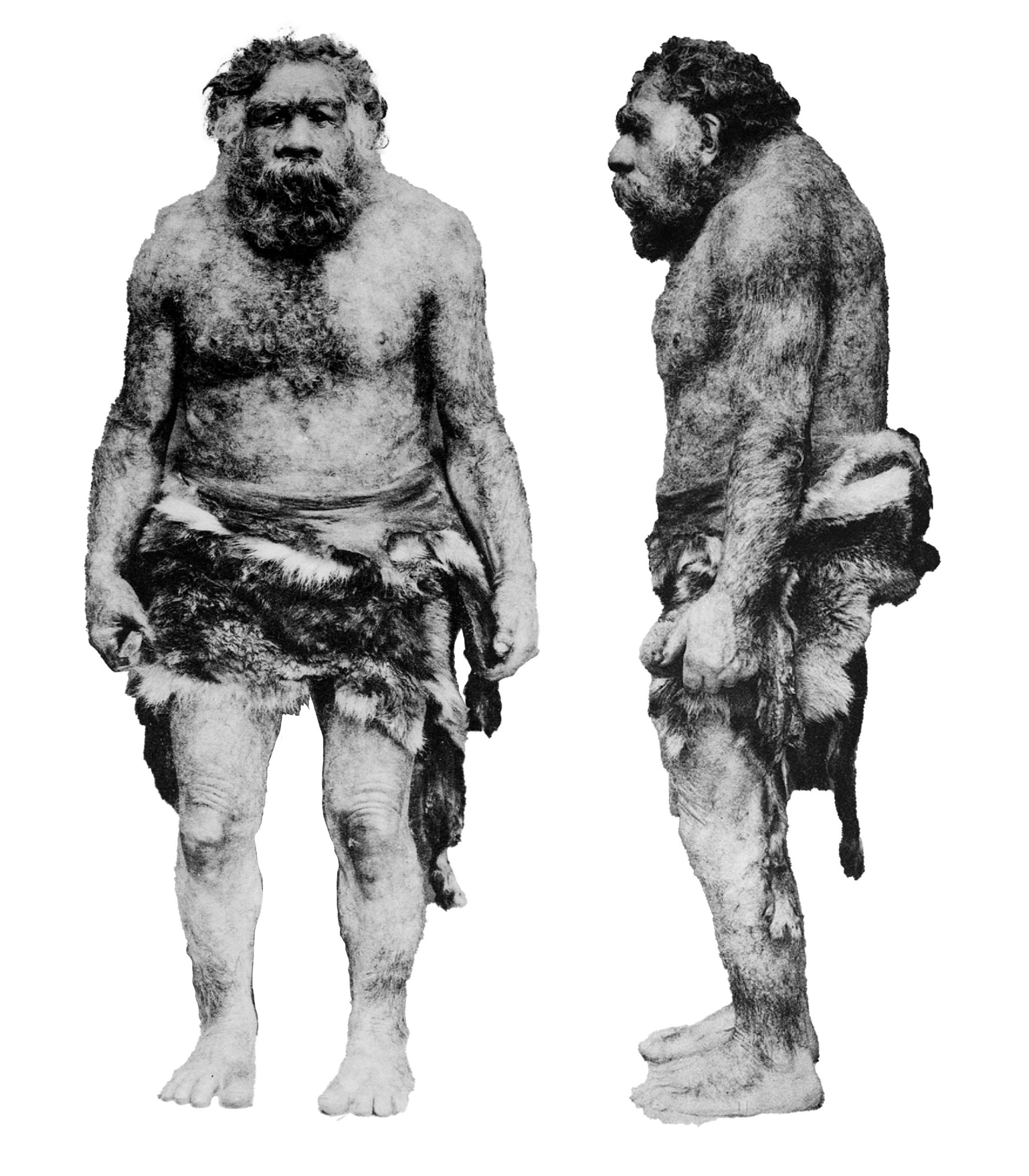
Neanderthal front and profile view
This model of a Neanderthal man was exhibited in the “Prehistory Gallery” at London’s Wellcome Historical Medical Museum in the 1930s.
WELLCOME COLLECTION

Pääbo’s team interpreted this as evidence of sexual reproduction between ancient Homo sapiens and the Neanderthals they encountered after they expanded out of Africa. “Neanderthals are not totally extinct,” Pääbo said to the BBC in 2010. “In some of us, they live on a little bit.”

The discovery was monumental on its own—but even more so because it reversed a previous consensus. More than a decade earlier, in 1997, Pääbo had sequenced a much smaller amount of Neanderthal DNA, in that case from a cell structure called a mitochondrion. It was different enough from Homo sapiens mitochondrial DNA for his team to cautiously conclude there had been “little or no interbreeding” between the two species. 

After 2010, though, the idea of hybridization, also called admixture, effectively became canon. Top journals like Science and Nature published study after study on the inner Neanderthal. Some scientists have argued that Homo sapiens would never have adapted to colder habitats in Europe and Asia without an infusion of Neanderthal DNA. Other research teams used Pääbo’s techniques to find genetic traces of interbreeding with an extinct group of hominins in Asia, called the Denisovans, and a mysterious “ghost lineage” in Africa. Biologists used similar tests to find evidence of interbreeding between chimpanzees and bonobos, polar and brown bears, and all kinds of other animals. 

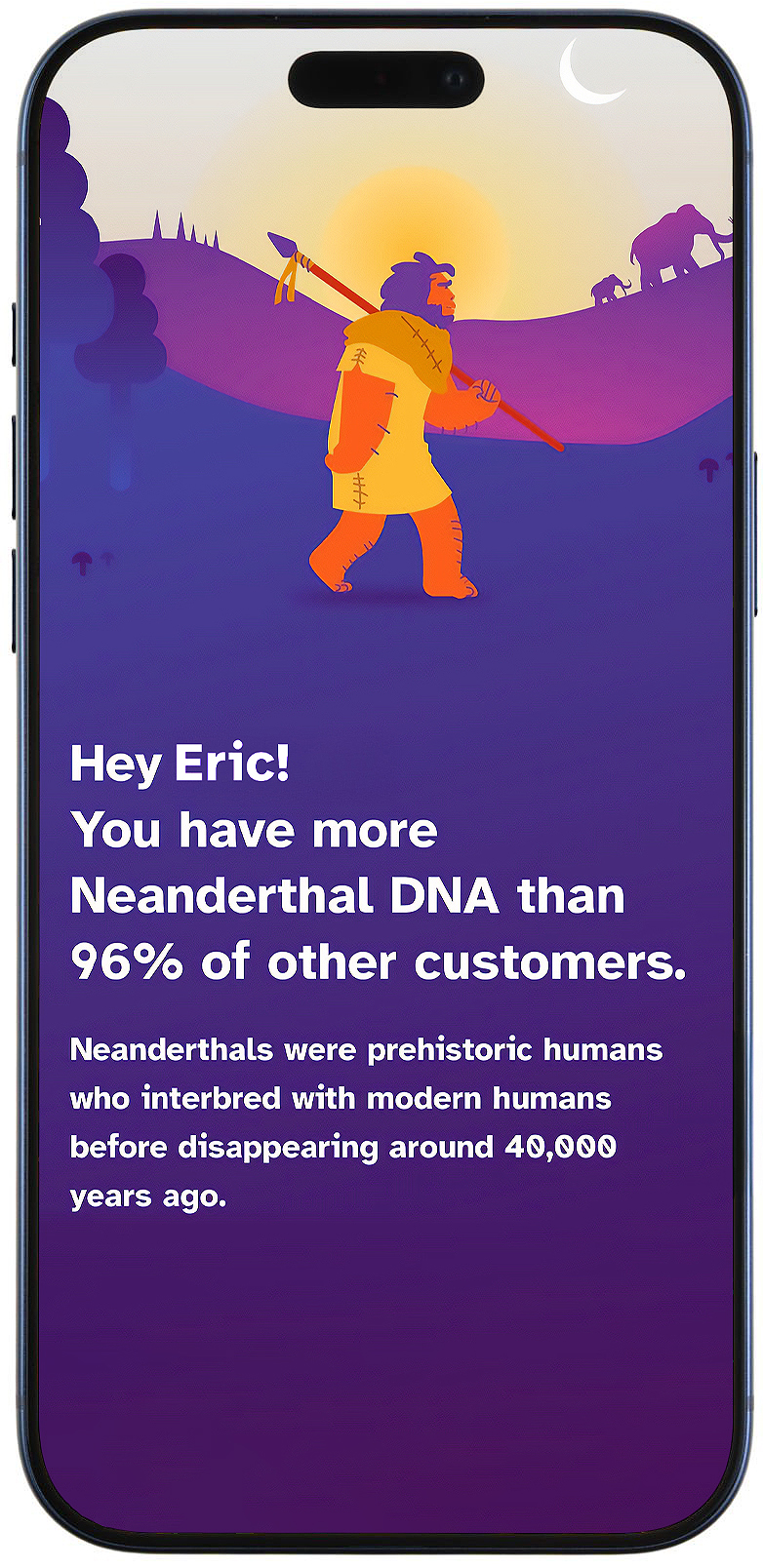
The inner-Neanderthal hypothesis also took a turn for the personal. Various studies linked Neanderthal DNA to a head-spinning range of conditions: alcoholism, asthma, autism, ADHD, depression, diabetes, heart disease, skin cancer, and severe covid-19. Some researchers suggested that Neanderthal DNA had an impact on hair and skin color, while others assigned individuals a “NeanderScore” that was correlated with skull shape and prevalence of schizophrenia markers. Commercial genetic testing companies like 23andMe started offering customers Neanderthal ancestry reports. 

The inner Neanderthal became a story we could tell ourselves about our flaws and genetic destiny: Don’t blame me; blame the prognathic caveman hiding in my cells. Or as Latif Nasser, a host of the popular-science program Radiolab, put it when he was hospitalized with Crohn’s disease, another Neanderthal-associated condition: “I just keep imagining these tiny Neanderthals … just, like, stabbing me and drawing these little droplets of blood out of me.”

“These things become meaningful to people,” Chikhi says. “What we say will be important to how people view themselves.” 

The pitfalls of simplistic solutions 

When population geneticists built the theoretical framework for evolutionary biology in the early 20th century, genes were only abstract units of heredity inferred from experiments with peas and fruit flies. Population genetics developed theory far more quickly than it accumulated data. As a result, many data-driven scientists dismissed the study of evolution as a form of storytelling based on unexamined assumptions and preconceived ideas.

By the ’90s, though, genes were no longer abstractions but sequenced segments of DNA. Genomic sequencing grounded evolutionary studies in the kind of hard data that a chemist or physicist could respect. 

Yet biologists could not simply read evolutionary history from genomes as though they were books. They were trying to determine which of a nearly infinite number of plausible histories was the most likely to have created the patterns they observed in a small sample of genomes. For that, they needed simplified, algorithmic models of evolution. The study of evolution shifted from storytelling to statistics, and from biology to computer science. 

That suited Chikhi, who as a child was drawn to the predictable laws and numerical precision of math and science. He entered the field in the mid-’90s just as the first big studies of human DNA were settling old debates about human origins. DNA showed that Africa harbored far more genetic diversity than the entire rest of the planet. The new evidence supported the idea that modern humans evolved for hundreds of thousands of years in Africa and expanded to the other continents only in the last 100,000 years. For Chikhi, whose parents were Algerian immigrants, this discovery was a powerful challenge to the way some archaeologists and biologists talked about race. DNA could be used to deconstruct rather than encourage the pernicious idea that human races had deep-seated evolutionary differences based on their places of origin. 

At the same time, though, he was wary of the tendency to treat DNA as the final verdict on open questions in evolution. Chikhi had been surprised when, back in 1997, Pääbo and his team used that small amount of mitochondrial DNA to rule out hybridization between Homo sapiens and Neanderthals. He didn’t think that the absence of Neanderthal DNA there necessarily meant it wouldn’t be found elsewhere in the Homo sapiens genome.

Chikhi’s own research in the aughts opened his eyes to the gaps between historical reality and models of evolution. For one, despite the assumption of random mating, none of the animals Chikhi studied actually mated randomly. Orangutans lived in highly fragmented habitats, which restricted their pool of potential mates, and female birds were often extremely picky about their male partners. 

These factors could confound an evolutionary biologist’s traditional statistical tool kit. Scientists were starting to apply a mathematical technique to estimate historical population sizes for a species from the genome of just a single individual. This method showed sharp population declines in the histories of many different species. Chikhi realized, though, that the apparent declines could be an artifact of treating a structured population as one that evolved with random mating; in that case, the technique could indicate a bottleneck even if all the subgroups were actually growing in size. “This is completely counterintuitive,” he says. 

That’s at least partly why, when Pääbo’s 2010 Neanderthal genome came out, Chikhi was impressed with the sheer technical accomplishment but also leery of the findings about hybridization. “It was the type of thing we conclude too quickly based on genetic data,” he says. Pääbo’s work mentioned population structure as a possible alternative explanation—but didn’t follow up.

Just a couple of years later, a pair of independent scientists named Anders Eriksson and Andrea Manica picked up the idea, building a model with simple population structure that explicitly excluded admixture. They simulated human evolution starting from 500,000 years ago and found that their model produced the same genomic patterns Pääbo’s group had interpreted as evidence of hybridization.

“Working with structured models is really out of the comfort zone of a lot of population geneticists,” says Eriksson, now a professor at the University of Tartu in Estonia.

Their research impressed Chikhi. “At the time, I thought people would focus on population structure in the evolution of humans,” he says. Instead, he watched as the inner-Neanderthal hypothesis took on a life of its own. Scientists produced new methods to quantify hybridization but rarely examined whether population structure would yield the same results. To Chikhi, this wasn’t science; it was storytelling, like some of the old narratives about the evolution of racial differences. 

Chikhi and Tournebize decided to take a crack at the problem themselves. “I’ve always been very skeptical about science, and population genetics in particular,” says Tournebize, now a researcher at the French National Research Institute for Sustainable Development. “We make a lot of assumptions, and the models we use are very simplistic.” As detailed in a 2024 paper published in Nature Ecology & Evolution, they built a model of human evolution that replaced randomly mating continent-wide populations with many smaller populations linked by occasional migration. Then they let it run—a million times.

At the end of the simulation, they kept the 20 scenarios that produced genomes most similar to the ones in a sample of actual Homo sapiens and Neanderthals. Many of these scenarios produced long segments of DNA like the ones their peers argued could only have been inherited from Neanderthals. They showed that several statistics, which other scientists had proposed as measurements of Neanderthal DNA, couldn’t actually distinguish between hybridization and population structure. What’s more, they showed that many of the models that supported hybridization failed to accurately predict other known features of human evolution.

“A model will say there was admixture but then predict diversity that is totally incompatible with what we actually know of human diversity,” Chikhi says. “Nobody seems to care.”

So how did Neanderthal DNA wind up in living people if not via interspecies passion? Chikhi and Tournebize think it’s more likely that it was inherited by both Neanderthals and some sapiens groups in Africa from a common ancestor living at least half a million years ago. If the sapiens groups carrying those genetic variants included the people who migrated out of Africa, then the two human species would have already had the DNA in common when they came into contact in Europe and Asia—no sex required. 

“The interpretation of genetic data is not straightforward,” Chikhi says. “We always have to make assumptions. Nobody takes data and magically comes up with a solution.” 

Embracing the uncertainty 

Most of the half-dozen population geneticists I spoke with praised Chikhi and Tournebize’s ingenuity and appreciated the spirit of their critique. “Their paper forces us to think more critically about the model we use for inference and consider alternatives,” says Aaron Ragsdale, a population geneticist at the University of Wisconsin–Madison. His own work likewise suggests that the earliest Homo sapiens populations in Africa were probably structured—and that this is the likely reason for genomic patterns that other research groups had attributed to hybridization with a mysterious “ghost lineage” of hominins in Africa.

Yet most researchers still believe that modern humans and Neanderthals did probably have children with each other tens of thousands of years ago. Several pointed to the fact that fossil DNA of Homo sapiens who died thousands of years ago had longer chunks of apparent Neanderthal DNA than living people, which is exactly what you would expect if they had a more recent Neanderthal ancestor. (To address this possibility, Chikhi and Tournebize included DNA from 10 ancient humans in their study and found that most of them fit the structured model.) And while the Harvard population geneticist David Reich, who helped design the statistical test from Pääbo’s 2010 study, declined an interview, he did say he thought Chikhi and Tournebize’s model was “weak” and “very contrived,” adding that “there are multiple lines of evidence for Neanderthal admixture into modern humans that make the evidence for this overwhelming.” (Two other authors of that study, Richard Green and Nick Patterson, did not respond to requests for comment.) 

Nevertheless, most scientists these days welcome the development of structured, or “spatially explicit,” models that account for the fact that any given member of a population is usually more closely related to individuals living nearby than to those living far away. 

Loosening our attachment to certain narratives of evolution can create space for wonder at the sheer complexity of life’s history.

Other scientists also say that random mating isn’t the only assumption in population genetics that merits scrutiny. Models rarely factor in natural selection, which can also create genetic patterns that look like hybridization. Another common assumption is that everyone’s DNA mutates at the same, constant rate. “All the theory says the mutation rate is fixed,” says Amos, the Cambridge population geneticist. But he thinks that rate would have slowed drastically in the group of Homo sapiens that expanded to Europe around 45,000 years ago. This, too, could have created genomic patterns that other scientists interpret as evidence of interbreeding with Neanderthals. 

phone with dna testing results and a cartoon neanderthal that says,
Commercial genetic testing companies like 23andMe started offering customers Neanderthal ancestry reports.
COURTESY OF 23ANDME

The point here isn’t that a complex model of evolution with many moving pieces is necessarily better than a simple one. Scientists need to reduce complexity in order to see the underlying processes more clearly. But simple models require assumptions, and scientists need to reevaluate those assumptions in light of what they learn. “As you get more data, you can justify more complex models of the world,” says Mark Thomas, a population geneticist at University College London, who wrote a history of random mating in population genetics that highlighted how the field was starting to see it as “a limiting assumption as opposed to a simplifying one.” 

It can feel discouraging to couch conversations about the past in confusing terms like “population structure” and “mutation rates.” It seems almost antithetical to the spirit of science to talk more about uncertainty at the same time we are developing powerful technologies and enormous data sets for analyzing evolution. These tools often yield novel answers, but they can also limit the questions we ask. The French archaeologist Ludovic Slimak, for example, has complained that the idea of the inner Neanderthal has domesticated our image of Neanderthals and made it difficult to imagine their humanity as distinct from our own. Investigating Neanderthal DNA is sexier to many young researchers than searching for archaeological and fossil evidence of how Neanderthals actually lived. 

Loosening our attachment to certain narratives of evolution can create space for wonder at the sheer complexity of life’s history. Ultimately, that’s what Chikhi and Tournebize hope to do. After all, they don’t believe the question of population structure versus hybridization is either-or. It’s possible, and even likely, that both played a role in human evolution. “Our structured model does not necessarily mean that no admixture ever took place,” Chikhi and Tournebize wrote in their study. “What our results suggest is that, if admixture ever occurred, it is currently hard to identify using existing methods.” 

Future methods might disentangle the different factors, but it’s just as important, Chikhi says, for scientists to be up-front about their assumptions and test alternatives. “There’s still so much uncertainty on so many aspects of the demographic history of Neanderthals and Homo sapiens,” he notes. 

Keep that in mind the next time you read about your inner Neanderthal. The association between this DNA and some diseases may be real, of course—but would journals publish these studies without the additional claim that the DNA is from Neanderthals? Any good storyteller knows that sex sells, even in science. 

Ben Crair is a science and travel writer based in Berlin.
Shape
Shape
Stay Ahead

Explore More Insights

Stay ahead with more perspectives on cutting-edge power, infrastructure, energy,  bitcoin and AI solutions. Explore these articles to uncover strategies and insights shaping the future of industries.

Shape

Linux 7.0 debuts with some big changes for networking

The problem is that the existing ECN is too blunt. It’s a situation that AccECN looks to fix. “ECN was originally specified for TCP in such a way that only one feedback signal can be transmitted per Round-Trip Time,” the IETF draft specification for AccECN states. For basic congestion control

Read More »

BW Energy granted 25-year extension of license offshore Gabon

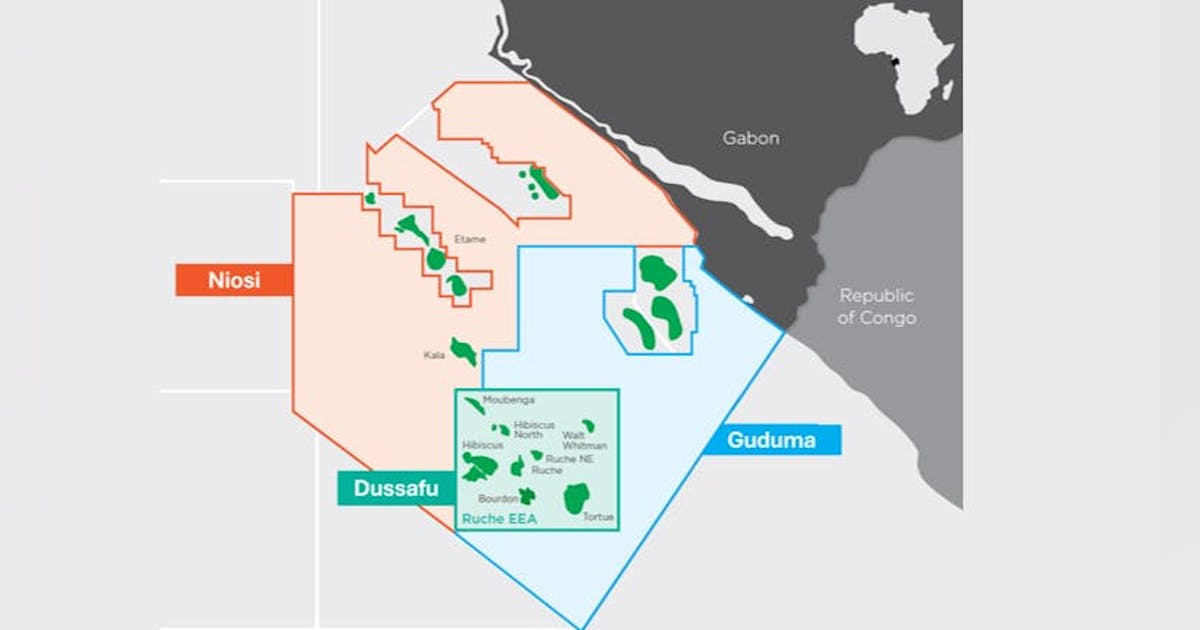
BW Energy Gabon has received approval from the Ministry of Oil and Gas of the Gabonese Republic to extend the Dussafu Marin production license offshore Gabon, West Africa. The license period has been extended to 2053 from 2028, inclusive of three 5-year option periods from 2038 onwards. The prior contract was until 2038 inclusive of two 5-year option periods from 2028 onwards. The extra time “provides long-term visibility for production, investments, and reserve development” of the operator’s “core producing asset,” the company said in a release Apr. 7. Ongoing license projects include MaBoMo Phase 2, with planned first oil in second-half 2026, and the Bourdon development following its discovery last year. The timeline also “strengthens the foundation for future infrastructure‑led growth opportunities across the adjacent Niosi and Guduma licenses, both operated by BW Energy,” the company continued. The Dussafu Marin permit is a development and exploitation license with multiple discoveries and prospects lying within a proven oil and gas play fairway within Southern Gabon basin. To the northwest of the block is the Etame-Ebouri Trend, a collection of fields producing from the pre-salt Gamba and Dentale sandstones, and to the north are Lucina and M’Bya fields which produce from the syn-rift Lucina sandstones beneath the Gamba. Oil fields within the Dussafu Permit include Moubenga, Walt Whitman, Ruche, Ruche North East, Tortue, Hibiscus, and Hibiscus North. BW Energy Gabon is operator at Dussafu (73.50%) with partners Panoro Energy ASA (17.5%) and Gabon Oil Co. (9%). Dussafu.

Read More »

Santos plans development of North Slope’s Quokka Unit

Santos Ltd. has started development planning in the Quokka Unit on Alaska’s North Slope after further delineating the Nanushuk reservoir. The Quokka-1 appraisal well spudded on Jan. 1, 2026, about 6 six miles from the Mitquq-1 discovery well drilled in 2020. It was drilled to 4,787 ft TD and encountered a high-quality reservoir with about 143 ft of net oil pay in the Nanushuk formation, demonstrating an average porosity of 19%. Following a single stage fracture stimulation, the well achieved a flow rate of 2,190 bo/d. Reservoir sands correlated between the two discoveries, coupled with fluid analyses, confirm the presence of high‑quality, light‑gravity oil, supporting strong well performance and improved pricing relative to Pikka oil. Together with additional geological data, these results underpin the potential for a two‑drill‑site development with production capacity comparable to Pikka phase 1, the company said.  Rate and resource potential for the two-drill-site development is being evaluated. Resource estimation is ongoing and appraisal results will be evaluated as part of the FY26 contingent resource assessment. In FY25, Santos reported 2C contingent resources of 177 MMboe for the Quokka Unit. Based on these results, Santos has started development planning, including the initiation of key permitting activities. Santos is operator of the Quokka Unit (51%) with partner Repsol (49%).

Read More »

Fluor, Axens secure contracts for US grassroots refinery project

Fluor Corp. and Axens Group have been awarded key contracts for America First Refining’s (AFR) proposed grassroots refinery at the Port of Brownsville, Tex., advancing development of what would be the first new US refinery to be built in more than 50 years. Fluor will execute front-end engineering and design (FEED) for the project, while Axens will serve as technology licensor of core refining process technologies to be used at the site, the service providers said in separate Apr. 7 releases. The AFR refinery is designed to process more than 60 million bbl/year—or about 164,400 b/d—of US light shale crude into transportation fuels, including gasoline, diesel, and jet fuel. Contract details Without disclosing a specific value of its contract, Fluor said the scope of its FEED study will cover early-stage engineering and design required to define project execution, cost, and schedule based on a complex that will incorporate commercially proven technologies to improve efficiency and emissions performance while processing domestic shale crude. As technology licensor, Axens said it will deliver process technologies for key refining units at the site, including those for: Naphtha, diesel hydrotreating. Continuous catalytic reforming. Isomerization. Alongside supporting improved fuel-quality specifications, the unspecified technologies to be supplied for the refinery will also help to reduce overall energy consumption at the site. Axens—which confirmed its involvement since 2017 in working with AFR on early-stage development of the project—said this latest licensing agreement will also cover engineering support, equipment, catalysts, and services across the refinery’s process configuration. Project background, commercial framework Upon first announcing the project in March 2026, AFR said the proposed development came alongside an already signed 20-year offtake agreement with a global integrated oil company covering 1.2 billion bbl of US light shale crude, as well as capital investment to support construction. As part of the

Read More »

EIA: US crude inventories up 3.1 million bbl

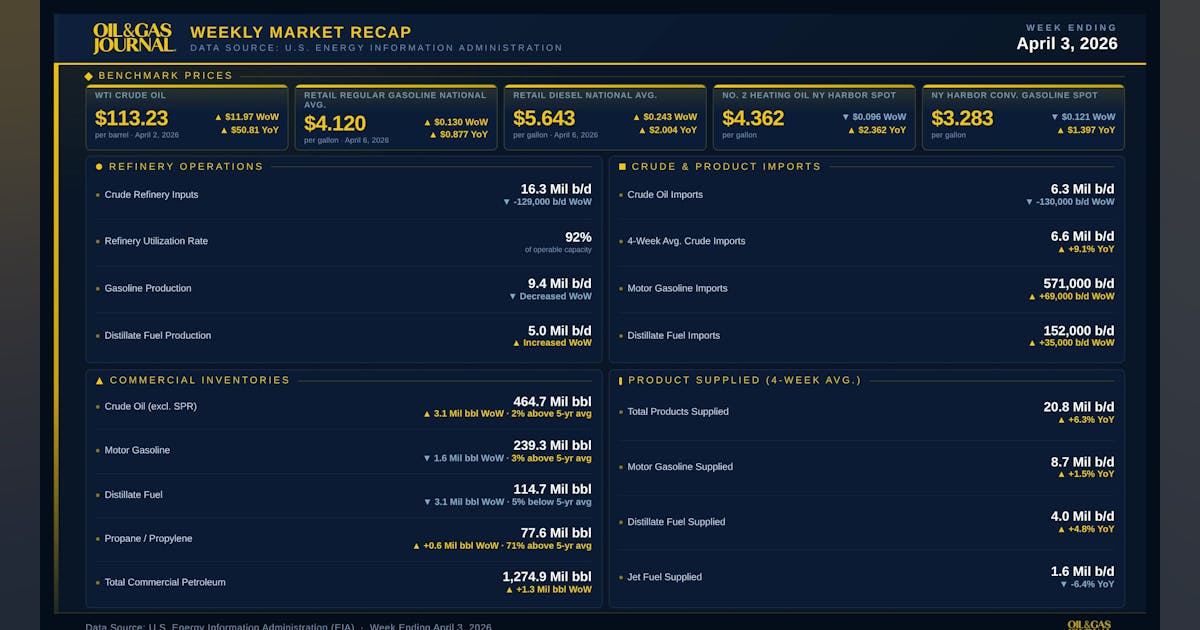
US crude oil inventories for the week ended Apr. 3, excluding the Strategic Petroleum Reserve, increased by 3.1 million bbl from the previous week, according to data from the US Energy Information Administration (EIA). At 464.7 million bbl, US crude oil inventories are about 2% above the 5-year average for this time of year, the EIA report indicated. EIA said total motor gasoline inventories decreased by 1.6 million bbl from last week and are about 3% above the 5-year average for this time of year. Finished gasoline inventories increased while blending components inventories decreased last week. Distillate fuel inventories decreased by 3.1 million bbl last week and are about 5% below the 5-year average for this time of year. Propane-propylene inventories increased by 600,000 bbl from last week and are 71% above the 5-year average for this time of year, EIA said. US crude oil refinery inputs averaged 16.3 million b/d for the week ended Apr. 3, which was 129,000 b/d less than the previous week’s average. Refineries operated at 92% of capacity. Gasoline production decreased, averaging 9.4 million b/d. Distillate fuel production increased, averaging 5.0 million b/d. US crude oil imports averaged 6.3 million b/d, down 130,000 b/d from the previous week. Over the last 4 weeks, crude oil imports averaged about 6.6 million b/d, 9.1% more than the same 4-week period last year. Total motor gasoline imports averaged 571,000 b/d. Distillate fuel imports averaged 152,000 b/d.

Read More »

Oil prices plunge as Iran war tensions ease amid tentative Hormuz reopening

Crude oil prices plunged sharply on Apr. 7 after US President Donald Trump announced a conditional 2-week ceasefire agreement with Iran, contingent on reopening the Strait of Hormuz and restoring safe passage for energy shipments. Both Brent and WTI crude oil fell towards $95/bbl, marking their largest single-day decline since 2020. Under the agreement, Iran signaled willingness to halt attacks on shipping and allow transit through Hormuz while broader negotiations continue. The US also indicated it would assist in clearing a backlog of tankers and stabilizing maritime traffic. Benchmark crude prices initially surged above $110/bbl in early April amid fears of prolonged supply disruption after Iran effectively restricted traffic through the strait—a corridor responsible for roughly 20% of global oil flows. The blockade, triggered by escalating US-Iran hostilities, caused tanker traffic to collapse and stranded millions of barrels of crude and refined products in the region. Despite the price correction, analysts caution that supply disruptions and infrastructure damage will continue to constrain markets. The conflict has already impaired regional energy assets, including LNG infrastructure in Qatar, and forced producers across the Middle East to curtail output or delay exports. The US Energy Information Administration (EIA) warned that fuel prices may remain elevated for months even if flows normalize, citing logistical bottlenecks, depleted inventories, and continued geopolitical uncertainty. “In theory, the 10–13 million b/d of crude oil and product supply stranded behind the Strait should now be gradually released. Whether the pre-March status quo will be re-established depends entirely on whether the truce can be turned into a permanent peace during the negotiations in Pakistan,” said Tamas Varga, analyst, PVM Oil Associates. “What appears evident, at least for now, is that the current quarter, the April–June period, will be the tightest, as the scarcity of available oil, both crude and refined

Read More »

EIA: Brent crude to reach $115/bbl in second-quarter 2026

Global oil markets have entered a period of acute volatility, with prices expected to surge into second-quarter 2026 as war-driven supply disruptions in the Middle East constrain flows through the Strait of Hormuz, according to the US Energy Information Administration (EIA)’s April Short-Term Energy Outlook. The agency estimates that Brent crude averaged $103/bbl in March and will climb further to a quarterly peak of about $115/bbl in second-quarter 2026, reflecting a sharp tightening in global supply following widespread production shut-ins across key Gulf producers. The disruption stems from the effective closure of the Strait of Hormuz, a critical chokepoint that typically carries nearly 20% of global oil supply. The US-Iran war in the region has forced producers including Saudi Arabia, Iraq, Kuwait, and the UAE to curtail output significantly. EIA estimates that crude production shut-ins averaged 7.5 million b/d in March and will rise to a peak of 9.1 million b/d in April. In this outlook, EIA assumes the conflict does not persist past April and that traffic through the Strait of Hormuz gradually resumes. Under those assumptions, EIA expects production shut-ins will fall to 6.7 million b/d in May and return close to pre-conflict levels in late 2026. The scale of the outage has rapidly flipped the market from prior expectations of oversupply into a pronounced deficit, with global inventories drawing sharply during the second quarter. Despite an assumption that the conflict does not persist beyond April, the agency warns that supply chains will take months to normalize, keeping a geopolitical risk premium embedded in prices through late 2026. EIA forecasts the Brent crude oil price will fall below $90/bbl in fourth-quarter 2026 and average $76/bbl in 2027, about $23/bbl higher than in its February STEO forecast. This price forecast is highly dependent on EIA’s assumptions of both the

Read More »

Hillwood, PowerHouse Advance $20B Joliet Data Campus as Midwest AI Buildout Accelerates

The approval of the Joliet Technology Center signals that the Chicago region is being pulled into the Midwest’s next phase of AI infrastructure development, one that has so far been led by Ohio and defined by scale, power demand, and rising public scrutiny. It also underscores a growing reality: local governments are beginning to understand exactly what that shift entails. On March 19, 2026, the Joliet City Council voted 8–1 to approve the conditional annexation of roughly 795 acres for the proposed Joliet Technology Center, a $20 billion data center campus backed by Hillwood and PowerHouse Data Centers. The site, near Rowell and Bernhard Roads on Joliet’s east side, is planned as a 24-building, multi-phase development that would rank among the most consequential digital infrastructure projects ever approved in Illinois. Joliet is now a clear case study in how the Midwest’s data center market is evolving: massive land assemblies, utility-scale power requirements, front-loaded community concessions, increasingly organized local opposition, and regulators working to ensure that the costs of AI infrastructure are not shifted onto ratepayers. A Project Too Large to Call Routine The Joliet Technology Center is a campus-scale industrial platform built for the AI era. Plans call for 24 two-story buildings of roughly 144,500 square feet each, with total development estimated at approximately 6.9 million square feet and up to 1.8 GW of eventual capacity. That places the project firmly in the emerging “AI factory” category, e.g. far-removed from the incremental, metro-edge data center expansions that defined earlier growth cycles. The distinction is critical. AI-scale campuses operate on a different economic and technical model. Fiber access and metro proximity are no longer enough. These developments require large, contiguous power blocks, land to support phased substation and utility infrastructure, and a political framework capable of absorbing what is effectively heavy

Read More »

AI is a Positive Catalyst for Grid Growth

Data centers, particularly those optimized for artificial intelligence workloads, are frequently characterized in public discourse as a disruptive threat to grid stability and ratepayer affordability. But behind-the-narrative as we are, the AI‑driven data center growth is simply illuminating pre‑existing systemic weaknesses in electric infrastructure that have accumulated over more than a decade of underinvestment in transmission, substations, and interconnection capacity. Over the same period, many utilities operated under planning assumptions shaped by slow demand growth and regulatory frameworks that incentivized incremental upgrades rather than large, anticipatory capital programs. As a result, the emergence of gigawatt‑scale computing campuses appears to be a sudden shock to a system that, in reality, was already misaligned with long‑term decarbonization, electrification, and digitalization objectives. Utilities have been asked to do more with aging grids, slow permitting, and chronically constrained capital, and now AI and cloud are finally putting real urgency — and real investment — behind modernizing that backbone. In that sense, large‑scale compute is not the problem; it is the catalyst that makes it impossible to ignore the problem any longer. We are at a moment when data centers, and especially AI data centers, are being blamed for exposing weaknesses that were already there, when in reality they are giving society a chance to fix a power system that has been underbuilt for more than a decade. Utilities have been asked to do more with aging grids, slow permitting, and limited investment, and now AI and cloud are finally putting real urgency — and real capital — behind modernizing that backbone. In that sense, data centers aren’t the problem; they are the catalyst that makes it impossible to ignore the problem any longer. AI Demand Provided a Long‑Overdue Stress Test The nature of AI workloads intensified this dynamic. High‑performance computing clusters concentrate substantial power

Read More »

From Land Grab to Structured Scale: Kirkland & Ellis Explains How Capital, Power, and Deal Complexity Are Defining the AI Data Center Boom

The AI data center market is no longer defined by speed alone. For much of the past three years, capital moved aggressively into digital infrastructure, chasing land, power, and platform scale as generative AI workloads began to reshape demand curves. But as Melissa Kalka, M&A and private equity partner, and Kimberly McGrath, real estate partner at Kirkland & Ellis, explain on the latest episode of the Data Center Frontier Show, the industry is now entering a more complex and more consequential phase. The land grab is over. Execution has begun. Capital remains abundant, but it is no longer forgiving. From Capital Rush to Capital Discipline As noted by Kalka and McGrath, the period from roughly 2022 through 2025 marked a rapid acceleration in AI infrastructure investment. Take-private deals involving CyrusOne, QTS, and Switch signaled a structural shift, while hyperscale demand scaled from tens of megawatts to hundreds, and now toward gigawatt-class campuses. But the current phase is not defined by a pullback in capital. Instead, it reflects an expansion of investment pathways and a corresponding increase in scrutiny. “There’s actually more deal flow now,” Kalka notes, pointing to the growing range of entry points across the capital stack, including development vehicles, yield-oriented structures, and private credit. With more capital chasing larger and more complex opportunities, investors are evaluating not just platforms, but the full lifecycle of assets from early-stage development through stabilization and long-term hold. That shift has pulled capital earlier into the process, where risk is higher and less defined. Power availability, permitting, and execution timelines are now central to underwriting decisions. What Defines a “Bankable” Platform In this environment, the definition of a bankable data center platform has tightened. Execution history remains foundational. Investors are looking for consistent delivery, operational reliability, and clean contractual performance. But those factors alone

Read More »

CoreWeave and Bell Canada Reset AI Data Center Scale

From GPU Cloud to AI Factory Operator In sum, CoreWeave is moving beyond its origins as a fast-scaling GPU cloud built on scarcity. The company is increasingly positioning itself as an AI infrastructure operator, where competitive advantage comes from integration across hardware, networking, cooling, platform software, workload orchestration, and early access to NVIDIA’s latest systems. That positioning has been reinforced by NVIDIA itself. In January, NVIDIA outlined a deeper alignment with CoreWeave focused on building AI factories, accelerating the procurement of land, power, and shell, and validating CoreWeave’s AI-native software and reference architecture. The partnership also includes deployment of multiple generations of NVIDIA infrastructure across CoreWeave’s platform, including Rubin systems, Vera CPUs, and BlueField data processing units, alongside a $2 billion equity investment. No simple vendor relationship, this is co-development around physical AI infrastructure. Bell Canada and the Rise of Sovereign AI Capacity Viewed through that lens, Bell Canada’s Saskatchewan announcement can be seen as part of the same structural shift. On March 16, Bell and the Government of Saskatchewan unveiled plans for a 300 MW AI Fabric data center in the Rural Municipality of Sherwood, outside Regina. CoreWeave is expected to anchor the site’s NVIDIA-based GPU infrastructure, extending its AI-native platform into a sovereign, hyperscale, power-dense environment. BCE described the project as its largest-ever investment in the province and said it is expected to become Canada’s largest purpose-built AI data center campus. Bell projects up to $12 billion (CDN) in long-term economic impact, along with at least 800 construction jobs and a minimum of 80 permanent roles once the site is operational. More importantly, Bell is explicitly framing the development as a foundation for domestic compute capacity, positioning AI infrastructure as a national asset tied to economic growth and technological sovereignty. That project extends Bell’s broader sovereign AI strategy.

Read More »

From Reactor Designs to Real Projects: SMRs Enter the Execution Era as AI Power Demand Accelerates

The pattern emerging is clear. The SMR story is no longer about reactor design. Recent announcements are centered on permits, fuel, supply chains, financing, and customer traction, i.e. the factors that determine whether SMRs become a viable market or remain a technology narrative. The conversation has transitioned from technically compelling reactor concepts to the harder problem of industrial execution. Through the first quarter of 2026, and especially in March, vendors moved beyond partnership announcements to concrete progress in licensing, fuel access, supply-chain development, control systems, customer alignment, and capital formation. The distinction now is between companies building credible deployment pathways and those still positioned around long-dated opportunity. At a high level, these developments fall into three categories. First, regulatory progress: the most difficult and time-consuming milestone. Second, efforts to establish manufacturing and fuel ecosystems that can support repeatable, fleet-scale deployment. Third, a broad repositioning toward power-intensive industrial users, utilities, and increasingly data center–driven load growth. The result is an SMR market that looks less like a single competitive race and more like a set of parallel business models converging on the same objective: dispatchable, carbon-free power that can be financed and deployed with greater predictability than traditional gigawatt-scale nuclear. X-energy: Building a Commercial Path to Scale X-energy has emerged as one of the more credible commercialization stories in the SMR market, with recent moves spanning capital markets, customer development, and supply-chain expansion. Reuters reported on March 20 that the company has confidentially filed for an IPO, aiming to capitalize on renewed investor interest in nuclear and rising electricity demand tied to AI infrastructure. That filing followed closely on an agreement with Talen Energy to evaluate multiple four-unit Xe-100 deployments across U.S. power markets, as well as a MOU with Japan’s IHI to expand U.S.-Japan supply chain capabilities for the reactor.

Read More »

DCF Poll: Data Centers and the Public Trust Gap

Matt Vincent is Editor in Chief of Data Center Frontier, where he leads editorial strategy and coverage focused on the infrastructure powering cloud computing, artificial intelligence, and the digital economy. A veteran B2B technology journalist with more than two decades of experience, Vincent specializes in the intersection of data centers, power, cooling, and emerging AI-era infrastructure. Since assuming the EIC role in 2023, he has helped guide Data Center Frontier’s coverage of the industry’s transition into the gigawatt-scale AI era, with a focus on hyperscale development, behind-the-meter power strategies, liquid cooling architectures, and the evolving energy demands of high-density compute, while working closely with the Digital Infrastructure Group at Endeavor Business Media to expand the brand’s analytical and multimedia footprint. Vincent also hosts The Data Center Frontier Show podcast, where he interviews industry leaders across hyperscale, colocation, utilities, and the data center supply chain to examine the technologies and business models reshaping digital infrastructure. Since its inception he serves as Head of Content for the Data Center Frontier Trends Summit. Before becoming Editor in Chief, he served in multiple senior editorial roles across Endeavor Business Media’s digital infrastructure portfolio, with coverage spanning data centers and hyperscale infrastructure, structured cabling and networking, telecom and datacom, IP physical security, and wireless and Pro AV markets. He began his career in 2005 within PennWell’s Advanced Technology Division and later held senior editorial positions supporting brands such as Cabling Installation & Maintenance, Lightwave Online, Broadband Technology Report, and Smart Buildings Technology. Vincent is a frequent moderator, interviewer, and keynote speaker at industry events including the HPC Forum, where he delivers forward-looking analysis on how AI and high-performance computing are reshaping digital infrastructure. He graduated with honors from Indiana University Bloomington with a B.A. in English Literature and Creative Writing and lives in southern New Hampshire with

Read More »

Microsoft will invest $80B in AI data centers in fiscal 2025

And Microsoft isn’t the only one that is ramping up its investments into AI-enabled data centers. Rival cloud service providers are all investing in either upgrading or opening new data centers to capture a larger chunk of business from developers and users of large language models (LLMs).  In a report published in October 2024, Bloomberg Intelligence estimated that demand for generative AI would push Microsoft, AWS, Google, Oracle, Meta, and Apple would between them devote $200 billion to capex in 2025, up from $110 billion in 2023. Microsoft is one of the biggest spenders, followed closely by Google and AWS, Bloomberg Intelligence said. Its estimate of Microsoft’s capital spending on AI, at $62.4 billion for calendar 2025, is lower than Smith’s claim that the company will invest $80 billion in the fiscal year to June 30, 2025. Both figures, though, are way higher than Microsoft’s 2020 capital expenditure of “just” $17.6 billion. The majority of the increased spending is tied to cloud services and the expansion of AI infrastructure needed to provide compute capacity for OpenAI workloads. Separately, last October Amazon CEO Andy Jassy said his company planned total capex spend of $75 billion in 2024 and even more in 2025, with much of it going to AWS, its cloud computing division.

Read More »

John Deere unveils more autonomous farm machines to address skill labor shortage

Join our daily and weekly newsletters for the latest updates and exclusive content on industry-leading AI coverage. Learn More Self-driving tractors might be the path to self-driving cars. John Deere has revealed a new line of autonomous machines and tech across agriculture, construction and commercial landscaping. The Moline, Illinois-based John Deere has been in business for 187 years, yet it’s been a regular as a non-tech company showing off technology at the big tech trade show in Las Vegas and is back at CES 2025 with more autonomous tractors and other vehicles. This is not something we usually cover, but John Deere has a lot of data that is interesting in the big picture of tech. The message from the company is that there aren’t enough skilled farm laborers to do the work that its customers need. It’s been a challenge for most of the last two decades, said Jahmy Hindman, CTO at John Deere, in a briefing. Much of the tech will come this fall and after that. He noted that the average farmer in the U.S. is over 58 and works 12 to 18 hours a day to grow food for us. And he said the American Farm Bureau Federation estimates there are roughly 2.4 million farm jobs that need to be filled annually; and the agricultural work force continues to shrink. (This is my hint to the anti-immigration crowd). John Deere’s autonomous 9RX Tractor. Farmers can oversee it using an app. While each of these industries experiences their own set of challenges, a commonality across all is skilled labor availability. In construction, about 80% percent of contractors struggle to find skilled labor. And in commercial landscaping, 86% of landscaping business owners can’t find labor to fill open positions, he said. “They have to figure out how to do

Read More »

2025 playbook for enterprise AI success, from agents to evals

Join our daily and weekly newsletters for the latest updates and exclusive content on industry-leading AI coverage. Learn More 2025 is poised to be a pivotal year for enterprise AI. The past year has seen rapid innovation, and this year will see the same. This has made it more critical than ever to revisit your AI strategy to stay competitive and create value for your customers. From scaling AI agents to optimizing costs, here are the five critical areas enterprises should prioritize for their AI strategy this year. 1. Agents: the next generation of automation AI agents are no longer theoretical. In 2025, they’re indispensable tools for enterprises looking to streamline operations and enhance customer interactions. Unlike traditional software, agents powered by large language models (LLMs) can make nuanced decisions, navigate complex multi-step tasks, and integrate seamlessly with tools and APIs. At the start of 2024, agents were not ready for prime time, making frustrating mistakes like hallucinating URLs. They started getting better as frontier large language models themselves improved. “Let me put it this way,” said Sam Witteveen, cofounder of Red Dragon, a company that develops agents for companies, and that recently reviewed the 48 agents it built last year. “Interestingly, the ones that we built at the start of the year, a lot of those worked way better at the end of the year just because the models got better.” Witteveen shared this in the video podcast we filmed to discuss these five big trends in detail. Models are getting better and hallucinating less, and they’re also being trained to do agentic tasks. Another feature that the model providers are researching is a way to use the LLM as a judge, and as models get cheaper (something we’ll cover below), companies can use three or more models to

Read More »

OpenAI’s red teaming innovations define new essentials for security leaders in the AI era

Join our daily and weekly newsletters for the latest updates and exclusive content on industry-leading AI coverage. Learn More OpenAI has taken a more aggressive approach to red teaming than its AI competitors, demonstrating its security teams’ advanced capabilities in two areas: multi-step reinforcement and external red teaming. OpenAI recently released two papers that set a new competitive standard for improving the quality, reliability and safety of AI models in these two techniques and more. The first paper, “OpenAI’s Approach to External Red Teaming for AI Models and Systems,” reports that specialized teams outside the company have proven effective in uncovering vulnerabilities that might otherwise have made it into a released model because in-house testing techniques may have missed them. In the second paper, “Diverse and Effective Red Teaming with Auto-Generated Rewards and Multi-Step Reinforcement Learning,” OpenAI introduces an automated framework that relies on iterative reinforcement learning to generate a broad spectrum of novel, wide-ranging attacks. Going all-in on red teaming pays practical, competitive dividends It’s encouraging to see competitive intensity in red teaming growing among AI companies. When Anthropic released its AI red team guidelines in June of last year, it joined AI providers including Google, Microsoft, Nvidia, OpenAI, and even the U.S.’s National Institute of Standards and Technology (NIST), which all had released red teaming frameworks. Investing heavily in red teaming yields tangible benefits for security leaders in any organization. OpenAI’s paper on external red teaming provides a detailed analysis of how the company strives to create specialized external teams that include cybersecurity and subject matter experts. The goal is to see if knowledgeable external teams can defeat models’ security perimeters and find gaps in their security, biases and controls that prompt-based testing couldn’t find. What makes OpenAI’s recent papers noteworthy is how well they define using human-in-the-middle

Read More »