Stay Ahead, Stay ONMINE

Making the AI-powered case for legacy modernization

In partnership withInfosys For years, legacy technology has been a problem companies knew they needed to solve, but one they often struggled to tackle. The cost, complexity, and risk of replacing business-critical systems could make modernization feel like a disruption to manage instead of an opportunity to pursue. But with the rise in customer expectations and the changes AI brought to the economics of software development, that calculation is changing. Bupa’s modernization of its My Bupa mobile application offers a case study in what becomes possible when a legacy migration is treated as a business transformation rather than a technology rewrite. Bupa CIO of health insurance Asifa Sherazi describes the risks of waiting for legacy systems to become an emergency: “The end-of-life technology is a risk that compounds quietly, and then arrives all at once.” For Bupa, moving its application from Xamarin to native Swift and Kotlin improved the app rating from 3.7 to 4.7, while the user-perceived crash rate fell by nearly 24 percentage points on Android and eight points on iOS. “What they’ll notice is that when they need us, often at a stressful moment, it just simply works,” Sherazi says. Sanjeev Tripathi, senior vice president and region head of BFSI, healthcare, and public sector for Australia, New Zealand, and Southeast Asia at Infosys, contends that AI is helping change the equation. “The emergence of AI is fundamentally shifting the economics of modernization,” he says, reducing the effort, risk, and time traditionally associated with these programs. At Bupa, combining AI-assisted reverse engineering with forward engineering helped deliver the transformation in approximately 60% less time than would have been possible in the pre-AI era. Sherazi and Tripathi also highlight the human dimension of modernization: preserving institutional knowledge, giving teams capacity to adapt, and creating an environment where employees can surface problems early. Looking ahead, both experts see modernized platforms as foundations for more personalized, predictive and AI-driven experiences. The payoff of modernization may be less about replacing aging technology and more about building the flexibility needed for whatever comes next.  “Modern platforms will become the base for far more intelligent AI-driven ecosystems, where AI is not just an add-on, but it is built into everything from design to operations. That’s how the modern platforms will evolve, and the customer experiences will become far more personalized and predictive,” says Tripathi. For Sherazi, that shift is already changing the questions organizations can ask: “It used to be, can our platform support that? Now, it’s: is that the right thing to do for our customers?” This episode of Business Lab is produced in partnership with Infosys. Full Transcript: Megan Tatum: From MIT Technology Review, I’m Megan Tatum, and this is Business Lab, the show that helps business leaders make sense of new technologies coming out of the lab and into the marketplace.Our topic today is legacy modernization. Companies across industries continue to struggle to bring AI modernization to legacy technology stacks, increasing the risk of losing vendor support, degraded customer experience, and limited capacity for innovation. Two words for you: future-ready foundation. My guests are Asifa Sherazi, who is CIO of health insurance at Bupa, and Sanjeev Tripathi, who is senior vice president, region head of BFSI, healthcare, and public sector for Australia, New Zealand, and Southeast Asia at Infosys. This podcast is produced in association with Infosys. Welcome, Asifa and Sanjeev. Asifa Sherazi: Thank you, Megan. Delighted to be here. Sanjeev Tripathi: Thanks, Megan. Wonderful to be here. And good talking to you again, Asifa. Megan: Thank you both so much for being here. Asifa, if I could start with you just to set the context for our conversation. There are seven million healthcare customers across the Asia-Pacific. Could you tell us a bit more about Bupa and the challenges it’s faced in its modernization plan? Asifa: Yes, absolutely. Let me start with something about Bupa that shapes everything we do. We are a global healthcare organization. Think hospitals, clinics, dental, age care, digital health, alongside our insurance business. We reinvest back into the organization, so into our services, our capability, our teams, and our outcomes that we deliver for our customers. In Asia-Pacific, we serve around, as you said, seven million customers across health insurance and health services, individuals, families, corporate clients, patients. Our purpose, helping people live longer, healthier, happier lives is more than just a statement. It actually shapes our strategy, guides our investment decisions, and influences the choices our teams make every day. Now, for most of our health insurance members, the day-to-day digital relationship with Bupa begins through My Bupa, our self-service platform. It’s the front door for managing cover, updating policy details, submitting claims, checking entitlements. Alongside of it, Blua plays a complimentary role. Where My Bupa helps members manage their cover, Blua helps them manage their health, digital healthcare services, clinical support, preventative health. And together, they let us move beyond transactional interactions towards more personalized, proactive care. Here was our challenge. Our mobile app, My Bupa, was built on Xamarin, and Microsoft support for it ended sometime in 2024. We had extended support in place, so our customers remained protected throughout, but we were clear-eyed that this was a bridge, not a destination. The runway was finite, and it was shortening for us. We made the decision to modernize from a position of stability proactively for the long-term safety and experiences of our customer rather than waiting until circumstances forced our hand, because the platform carrying our most important customer relationship was in effect standing still while the world around it was moving. Megan: Right. So you decided to act really proactively in that sense. And so, Asifa, what are some of the risks then of sticking with end-of-life technologies, and how will moving away from legacy technologies help you improve the customer experience? Asifa: Yeah. Look, the end-of-life technology is a risk that compounds quietly, and then arrives all at once. We saw it in three ways. The first is security and compliance. Once a technology is out of vendor support, the flow of security updates and fixes changes fundamentally. In our case, we put extended support in place as a bridge so our customers stayed protected. But extended support buys you time, it doesn’t buy you a future. In healthcare, we hold some of the most sensitive information a person will ever share with an organization. That isn’t data to us, it’s trust. And trust is extraordinarily expensive to rebuild. We weren’t prepared to run that risk on a shortening runway. The second is losing control of your own roadmap. How I’d explain that is iOS and Android don’t stand still. Every operating system release, every change to app store requirements becomes something that you react to rather than plan for. As each one slows you down a little further, over time, that opens a widening gap between what customers expect and what you can actually give them. We’re all customers. We don’t benchmark a health insurer against other health insurers. We benchmark against whatever app we used last. And the third way was, and this is one red flag for peers, is the shrinking talent pool. Xamarin is legacy technology, and the engineering expertise available for it is limited. You end up with a critical customer platform supported by a narrowing group of specialists. That’s a workforce risk wearing a technology costume. We partnered with Infosys and we migrated the entire application estate from Xamarin to fully native Swift and Kotlin, and the customer outcomes are why we’re comfortable talking about this today. Our app rating moved from 3.7 to 4.7. Some of the stats that I’d love to share are that the user-perceived crash rate fell by nearly 24 percentage points on Android and eight points on iOS. The Android login success per visit doubled back up to 77%, and that’s one the team that is most proud of, because a login failure isn’t a technical event. It’s a person who wanted to check their cover and they couldn’t. The team achieved 100% feature parity in a single release, and 90% of our active customer base moved to a new version, and they’ve, I think, downloaded nearly 1.8 million unique downloads. From our customers’ perspective, customers will never think about any of this as a technology change, and they shouldn’t have to either. What they’ll notice is that when they need us, often at a stressful moment, it just simply works, and that’s the outcome we were really after. Megan: Those are some really striking results and statistics that you’ve shared there on the success of the migration. I mean, Sanjeev, could you talk a bit about why modernizing legacy technologies is so critical at this time, and how Infosys has approached that transformation journey with Bupa? Sanjeev: Sure, Megan. To be honest, legacy modernization initiatives are not new, and there has always been a strong desire to drive modernization across the entire technology landscape. And Asifa covered all the points that I was going to cover about the risks that have been there. But I’ll reiterate, the reality is the industry has been held back by the cost complexity, and also the risks that have been associated with any legacy modernization initiative that has been undertaken historically.As Asifa mentioned, customer expectations of what was acceptable five, 10 years back are simply not acceptable anymore. The customers today expect a seamless, intuitive, responsive interaction across every channel. And Asifa also covered the growing challenges around security, resilience, talent availability, and so on. Finding talent on legacy technology is extremely, extremely difficult, and that introduces risk in every organization and in every legacy platform, most of which are actually business-critical platforms as well. Security vulnerabilities are getting increasingly difficult to manage, and as I mentioned, finding deep expertise in older technologies is very, very difficult now. So what has changed? What has changed is that we now have new tools that are available to us to address these challenges. The emergence of AI is fundamentally shifting the economics of modernization, and it’s doing that by helping organizations to reduce the effort, risk, and also the time that is traditionally taken for programs like these, and that is why we believe that the time is now for legacy modernization. In fact, in Infosys, we have six strategic value pools that we have identified in our AI-first value framework, which is publicly available, and legacy modernization is one of these six value pools. And in the market, we are seeing very strong interest across our client base, and they recognize that the opportunity to unlock both technical and business value is now. With Bupa in particular, we approached the journey as a business transformation rather than simply a technology rewrite, and our approach had two key phases. One is reverse engineering, and then forward engineering. Let me just quickly cover what these two are.Reverse engineering, what we did is we extracted and we understood the rules, the processes, and the logic within the legacy environment, and that’s a standard approach we took, we take in any legacy modernization program. What that does is it allows us to preserve the critical business functionality, but at the same time, it avoids the risks that often come with large-scale migration programs. The second aspect is forward engineering, where we re-architected the solution to enable a reimagined customer experience. The objective is not just a feature-by-feature migration or ensuring feature parity, which is important, but it is even more important that since we’re investing this kind of money to create a modern platform that is scalable, maintainable, and is also capable for future innovation, and that’s what Asifa mentioned about you need to be in control of your own roadmap. You have to build a platform which is capable of supporting future innovation as well. We essentially ensured nothing was lost in translation, and we significantly improved the platform stability and long-term maintainability. And some of the metrics that Asifa mentioned reflects the meaningful improvement in customer experience as well. Finally, just one more point before I close this question is the time to market. I spoke about the time is now, and because we’ve got the power of the tools that are available now. What AI allowed us is to accelerate the transformation dramatically. What would have traditionally been a long and complex modernization, was delivered in approximately 60% less time than what would have happened in pre-AI era, and that is the real story. Megan: So AI in this context is a real enabler in terms of the economics and the speed and all of those things you’re talking about. If I could come back to you, Asifa, as much as modernization is a technology challenge, there is the human component as well, and I wondered if you could talk about how you prepared employees for these new technologies, and what challenges and solutions you faced on that front as well? Asifa: The human side of it is what I’m really passionate about. Technology was only half the challenge. The real work was helping people move from what they knew to what was possible. Modernization isn’t just about replacing systems, it’s about giving teams the confidence, the capability, the clarity to embrace a different future, and that’s what determines whether change actually succeeds. From that experience, there were three human challenges that stood out for us. The first one was scarcity of expertise on both sides of the transition, and like we said before, Xamarin is a legacy app. We were moving away from a legacy technology, supported by a rapidly shrinking specialist talent pool, and modernizing onto two native platforms. Documentation of that existing environment was limited. Much of the operational knowledge sat in individual experience and in the code base itself, and that created a real dependency on a small number of people. And for the team, it was a confronting reality and a powerful reminder that modernization isn’t just about technology imperative, it’s actually a resilience one. What changed the dynamic was using AI to do the archeology. As Sanjeev mentioned, Infosys applied AI-assisted reverse engineering to harvest the legacy Xamarin code and extract the flows, the rules, the business logic, and generate native-ready user stories and acceptance criteria from it. The team did a lot of work. They mapped hundreds, I think nearly 1,500 regression scenarios to native epics, and that way, parity critical journeys were preserved by design rather than by memory. The human effect was just as important. Knowledge stopped living with a handful of individuals and became shared across the team, and our people could spend less energy holding institutional memory and more on designing and improving. So that was the first challenge. The second challenge, Megan, was capacity and not willingness. Our business analysts were fully committed to ongoing feature delivery. And this is a live customer-facing app, and you cannot pause improving the customer experience while you rebuild underneath it. AI-driven discovery and documentation removed almost an estimated of 400 hours of manual BA effort, and that’s not a headcount story, that’s actually people not being asked to do two full-time jobs at once. The third challenge that stood out was space. Our original internal estimate was around 18 months, and thanks to Sanjeev and the team, almost like a one-team approach of how do we tackle this, the team delivered it in seven, and that’s exhilarating. t’s also demanding, and both things need saying out loud. We mobilized cross-functional squads across engineering, architecture, testing, release, because managing parallel environments while protecting BAU commitments is such an emotional load as well as a logistical one. We leaned in hard alongside the team, being present rather than reporting from a distance, regular check-ins, genuinely listening to concerns, unblocking things quickly so people weren’t sitting waiting on a decision. And Megan, one thing I’ll say is when you’re compressing 18 months to seven, the most useful thing leadership can do is remove the friction in front of someone else and get out of their way. But the thing that made the biggest difference was surprisingly simple, actually. We built a visual depiction of the transformation journey, and we updated it every month so the team could actually see how far they’ve come. Because when you deepen migration of this scale, it’s really easy to only see what’s left to be done, and being able to look back at the ground that’s already been covered gave people real intent and real momentum. And genuinely, it was exhilarating to watch. Watching the team’s pride became their fuel. Megan: I love that idea of it being exhilarating, but exhausting. I think that’s a great description. Asifa: Yeah. And the leadership lesson for all of us was just simpler than any of it. Programs like this have hard weeks, there’s going to be incidents, delay, difficult conversations. And Sanjeev, you and I have had those conversations many times. The job of leadership in those moments is to absorb the ambiguity rather than transmit anxiety, because if people feel safe telling you bad news early, there’s almost nothing you can’t fix. I say this plainly because it’s the truest thing about the whole program. I am so incredibly proud of this team, because what they achieved in seven months, while continuing to serve customers every single day without disruption, was genuinely remarkable. But what I’m really proud of isn’t the speed and it isn’t the engineering, it’s that the team never lost sight of who it was for, so every decision that we were making, and they came back, it just came back to the person at the other end of the app. Megan: It sounds like you did an incredible job focusing on that people element just as much as the technology, which is so important. And Sanjeev, we’ve heard some of the incredible results Bupa has had with this, but more broadly, I suppose, looking across modernization use cases, where do you find that companies see the most ROI, and what advice do you have for leaders who need to focus on transformation at that legacy level? Sanjeev: Thanks, Megan. That’s a very important and actually a very good question, because what we see is modernization ROI is sometimes viewed too narrowly through just a technology lens, and as Asifa mentioned, it is broader than just technology. Legacy modernization has aspects associated with business implications as well, so I’ll just cover that very quickly. There are two dimensions, as I mentioned. One is technical ROI or technology-related ROI, and second is business ROI. On the technical side, and as you heard from Asifa as well, the biggest benefits come from faster time to market, platform stability and resilience, of course, and a lot of times, in fact, almost in all the cases, lower operating costs, and that is one of the aspects associated with some of the legacy modernization programs. Besides this, access to broader, more readily available talent pool, and security management, and ensuring that the platforms are secure and free from, as much as possible, free from vulnerabilities in the current environment. At the same time, making it easier to innovate, releases become faster so that the feature delivery into the market becomes faster, and also able to respond to any new technology innovation that comes into play. But this is only on the technology side. On the business side, however, the returns are often reflected in customer outcomes, and what we typically see are improvements in measures such as net promoter score, and in this case, for example, application ratings that you see on the app store. Both of which are actually very strong indicators of customer satisfaction and digital experience quality. I think it is important for us to cover, look at the ROI from both technology, but more importantly, from a business perspective.The second part of your question was about what would be my advice to leaders, and I think Asifa covered it very well, where she mentioned that the one-team approach, the providing safe environment to the team to be able to say what is going well, but also what is not going well, and keeping your eye on the end outcome. I think those are very important things. But I would also like to add that don’t treat modernization as a technology initiative. It is a unique opportunity for us to rethink the business platform itself, and rather than pursuing a like-to-like migration, use the investment that you’re making to improve customer experience, simplify processes, and re-architect for capabilities such as real-time personalization and data-driven decision-making. The greatest returns come when technology transformation is directly linked to business outcomes.And finally, and this is something that I have seen from personal experience multiple times, is you have to think from first principles. AI does not replace good engineering practices. It enables organizations to execute those practices faster, and it enables it faster, but also more consistently and at greater scale. The foundations of good architecture, sound engineering, and clear business objectives will continue to remain important, and in fact, their importance is going to increase as we progress. That, I think, is what I would say anybody embarking on a legacy modernization program should be focused on. Megan: I love the idea that this is not just about migration. This a chance, as you say, to reimagine what you can deliver and what’s possible. Fantastic. Let’s close with a forward look. Asifa, what innovation are you looking forward to that wouldn’t have been possible before this, and what do you see on the horizon? Asifa: There’s definitely lots of things on the horizon. But what excites us most isn’t specific technology, it’s that the question in our conversations has changed. It used to be, can our platform support that? Now, it’s is that the right thing to do for our customers? And that’s a profound shift.There’s three things, Megan, that generally weren’t possible before, and we’ve touched on this a little bit, and Sanjeev’s touched on it as well. This first is speed as a permanent capability. Since launch, Android and iOS, the team has shipped multiple rapid-fire releases, including our migration to a new payment gateway. Bills are now completing four times faster, codes are reaching to testers in about an hour, and we’ve reduced our code base by 30%, and our application footprint’s reduced 18% as well. A simpler estate isn’t an aesthetic preference anymore, it’s what makes the next change cheap, and we’ve bought ourselves optionality to do that.The second is quality at that speed, which is the part we’ve been most skeptical about five years ago. AI-driven triage and predictive defect analysis, we ran it across nearly 1,400 cases to focus on testing on the highest risk journeys, which meant we went live with zero security defects and zero high severity defects, and Sanjeev mentioned that just before. The old trade-off between moving fast and moving safely is being renegotiated right in front of us, so that’s the second point.The third one is AI-driven accessibility testing, which the teams treated as a critical rather than an optional opportunity. In healthcare, people who most need to reach us are very often the people whom our poorly designed interface is a genuine barrier, and so being able to test that systematically at scale was a real advance for us as well. And Megan, you mentioned on the horizon. It’ll be remiss of me not to take the name of agentic AI. The shift from AI that supports a task to AI that completes an outcome end-to-end with proper governance, human oversight at the key decision points. What this program showed us is that the constraint is no longer the models. It’s whether your platforms, data, processes are more than enough to let AI act safely, which is precisely why this work mattered now. Sanjeev alluded to it as well about that underlying architecture. Responsible AI as a source of advantage, not a compliance exercise, I would say. In health, if people don’t trust how you’re using their information, nothing else you build matters. We didn’t modernize to have modern technology. We modernized to earn the right to do the next thing, and to do it in weeks rather than years. Megan: Absolutely. And now you have those foundations in place, like you say, all of these opportunities open up. Fantastic. And Sanjeev, just finally, as companies complete these migrations, what kinds of innovations and benefits are you seeing, and what do you expect in the next five years? Sanjeev: Sure. Again, good question, Megan. The reason is there is no uniformity on how these migrations are being done even today. As I mentioned earlier, so where there is simple lift and shift of existing code base onto a new platform, a like-to-like replacement, the benefits generally tend to be limited. Where we apply first principles, thinking about re-imagining, re-architecting, and refactoring the system to establish foundations for a far more flexible system, where rules are not boxed into the architecture, but are managed in a way that changes can be incorporated faster, personalization can be achieved in real time, and time to market improves multifold. That’s where we are really seeing far more benefits coming through.And to take the example of Bupa, it is a pretty clear step change, both in terms of customer experience and how fast teams can actually deliver now. I think the app ratings have gone up significantly. The customer experience has improved. Even simple things, such as login success rate, has improved quite significantly. And on the engineering side, we are now building and releasing features roughly about four times faster, and we are also seeing the migration of nearly 100% of the customers onto the new platform. Now, if I look ahead over the next, you mentioned about next five years, I don’t know about five years, four years, but over the next few years at least, I think it is going to get very interesting, because modern platforms will become the base for far more intelligent AI-driven ecosystems, where AI is not just an add-on, but it is built into everything from design to operations. That’s how the modern platforms will evolve, and the customer experiences will become far more personalized and predictive. And even the way we build software will shift, with AI playing a much bigger role in the development process itself. Megan: Fantastic. Really exciting changes on the horizon then. Thank you both so much. That was Asifa Sherazi, who is the CIO of health insurance at Bupa, and Sanjeev Tripathi, senior vice president, region head of BFSI, healthcare, and public Sector for Australia, New Zealand, and Southeast Asia at Infosys, whom I spoke with from Brighton in England.That’s it for this episode of Business Lab. I’m your host, Megan Tatum. I’m a contributing editor at Insights, the custom publishing division of MIT Technology Review. We were founded in 1899 at the Massachusetts Institute of Technology, and you can find us in print, on the web, and at events each year around the world. For more information about us and the show, please check out our website at technologyreview.com.This show is available wherever you get your podcasts. And if you enjoyed this episode, we hope you’ll take a moment to rate and review us. Business Lab is a production of MIT Technology Review, and this episode was produced by Giro Studios. Thank you so much for listening. This content was produced by Insights, MIT Technology Review’s custom content arm, not its editorial staff. It was researched and written by humans, with any AI tools that may have been used limited to production processes under human oversight.

In partnership withInfosys

For years, legacy technology has been a problem companies knew they needed to solve, but one they often struggled to tackle. The cost, complexity, and risk of replacing business-critical systems could make modernization feel like a disruption to manage instead of an opportunity to pursue. But with the rise in customer expectations and the changes AI brought to the economics of software development, that calculation is changing. Bupa’s modernization of its My Bupa mobile application offers a case study in what becomes possible when a legacy migration is treated as a business transformation rather than a technology rewrite.

Bupa CIO of health insurance Asifa Sherazi describes the risks of waiting for legacy systems to become an emergency: “The end-of-life technology is a risk that compounds quietly, and then arrives all at once.” For Bupa, moving its application from Xamarin to native Swift and Kotlin improved the app rating from 3.7 to 4.7, while the user-perceived crash rate fell by nearly 24 percentage points on Android and eight points on iOS. “What they’ll notice is that when they need us, often at a stressful moment, it just simply works,” Sherazi says.

Sanjeev Tripathi, senior vice president and region head of BFSI, healthcare, and public sector for Australia, New Zealand, and Southeast Asia at Infosys, contends that AI is helping change the equation. “The emergence of AI is fundamentally shifting the economics of modernization,” he says, reducing the effort, risk, and time traditionally associated with these programs. At Bupa, combining AI-assisted reverse engineering with forward engineering helped deliver the transformation in approximately 60% less time than would have been possible in the pre-AI era.

Sherazi and Tripathi also highlight the human dimension of modernization: preserving institutional knowledge, giving teams capacity to adapt, and creating an environment where employees can surface problems early.

Looking ahead, both experts see modernized platforms as foundations for more personalized, predictive and AI-driven experiences. The payoff of modernization may be less about replacing aging technology and more about building the flexibility needed for whatever comes next. 

“Modern platforms will become the base for far more intelligent AI-driven ecosystems, where AI is not just an add-on, but it is built into everything from design to operations. That’s how the modern platforms will evolve, and the customer experiences will become far more personalized and predictive,” says Tripathi. For Sherazi, that shift is already changing the questions organizations can ask: “It used to be, can our platform support that? Now, it’s: is that the right thing to do for our customers?”

This episode of Business Lab is produced in partnership with Infosys.

Full Transcript:

Megan Tatum: From MIT Technology Review, I’m Megan Tatum, and this is Business Lab, the show that helps business leaders make sense of new technologies coming out of the lab and into the marketplace.

Our topic today is legacy modernization. Companies across industries continue to struggle to bring AI modernization to legacy technology stacks, increasing the risk of losing vendor support, degraded customer experience, and limited capacity for innovation.

Two words for you: future-ready foundation.

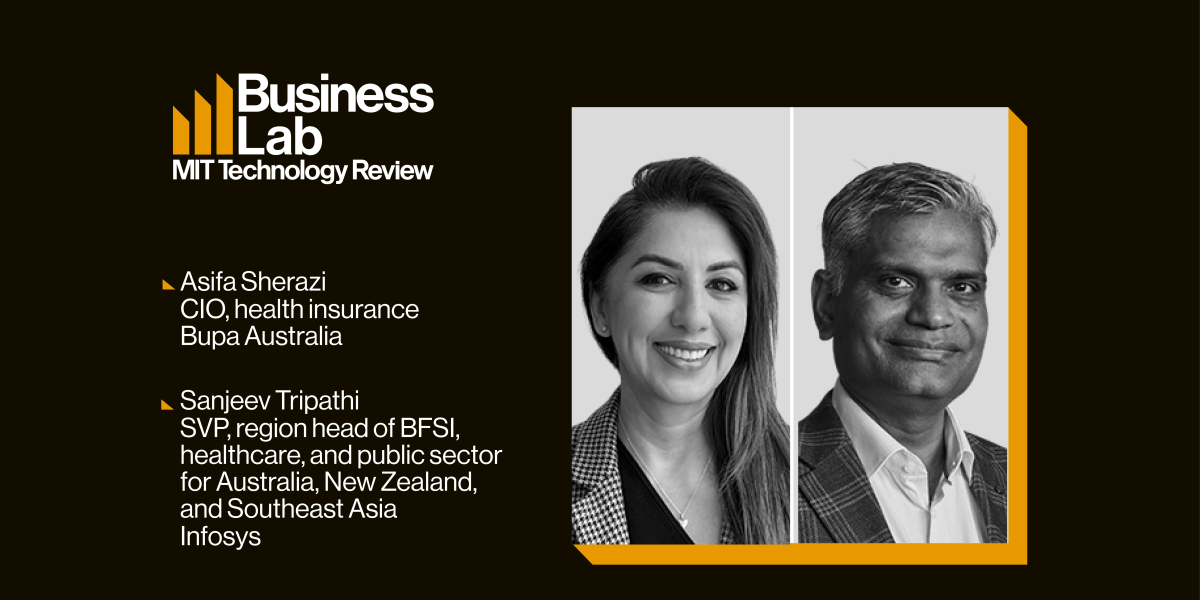
My guests are Asifa Sherazi, who is CIO of health insurance at Bupa, and Sanjeev Tripathi, who is senior vice president, region head of BFSI, healthcare, and public sector for Australia, New Zealand, and Southeast Asia at Infosys.

This podcast is produced in association with Infosys.

Welcome, Asifa and Sanjeev.

Asifa Sherazi: Thank you, Megan. Delighted to be here.

Sanjeev Tripathi: Thanks, Megan. Wonderful to be here. And good talking to you again, Asifa.

Megan: Thank you both so much for being here. Asifa, if I could start with you just to set the context for our conversation. There are seven million healthcare customers across the Asia-Pacific. Could you tell us a bit more about Bupa and the challenges it’s faced in its modernization plan?

Asifa: Yes, absolutely. Let me start with something about Bupa that shapes everything we do. We are a global healthcare organization. Think hospitals, clinics, dental, age care, digital health, alongside our insurance business. We reinvest back into the organization, so into our services, our capability, our teams, and our outcomes that we deliver for our customers. In Asia-Pacific, we serve around, as you said, seven million customers across health insurance and health services, individuals, families, corporate clients, patients. Our purpose, helping people live longer, healthier, happier lives is more than just a statement. It actually shapes our strategy, guides our investment decisions, and influences the choices our teams make every day.

Now, for most of our health insurance members, the day-to-day digital relationship with Bupa begins through My Bupa, our self-service platform. It’s the front door for managing cover, updating policy details, submitting claims, checking entitlements. Alongside of it, Blua plays a complimentary role. Where My Bupa helps members manage their cover, Blua helps them manage their health, digital healthcare services, clinical support, preventative health. And together, they let us move beyond transactional interactions towards more personalized, proactive care.

Here was our challenge. Our mobile app, My Bupa, was built on Xamarin, and Microsoft support for it ended sometime in 2024. We had extended support in place, so our customers remained protected throughout, but we were clear-eyed that this was a bridge, not a destination. The runway was finite, and it was shortening for us. We made the decision to modernize from a position of stability proactively for the long-term safety and experiences of our customer rather than waiting until circumstances forced our hand, because the platform carrying our most important customer relationship was in effect standing still while the world around it was moving.

Megan: Right. So you decided to act really proactively in that sense. And so, Asifa, what are some of the risks then of sticking with end-of-life technologies, and how will moving away from legacy technologies help you improve the customer experience?

Asifa: Yeah. Look, the end-of-life technology is a risk that compounds quietly, and then arrives all at once. We saw it in three ways. The first is security and compliance. Once a technology is out of vendor support, the flow of security updates and fixes changes fundamentally. In our case, we put extended support in place as a bridge so our customers stayed protected. But extended support buys you time, it doesn’t buy you a future. In healthcare, we hold some of the most sensitive information a person will ever share with an organization. That isn’t data to us, it’s trust. And trust is extraordinarily expensive to rebuild. We weren’t prepared to run that risk on a shortening runway.

The second is losing control of your own roadmap. How I’d explain that is iOS and Android don’t stand still. Every operating system release, every change to app store requirements becomes something that you react to rather than plan for. As each one slows you down a little further, over time, that opens a widening gap between what customers expect and what you can actually give them. We’re all customers. We don’t benchmark a health insurer against other health insurers. We benchmark against whatever app we used last.

And the third way was, and this is one red flag for peers, is the shrinking talent pool. Xamarin is legacy technology, and the engineering expertise available for it is limited. You end up with a critical customer platform supported by a narrowing group of specialists. That’s a workforce risk wearing a technology costume. We partnered with Infosys and we migrated the entire application estate from Xamarin to fully native Swift and Kotlin, and the customer outcomes are why we’re comfortable talking about this today. Our app rating moved from 3.7 to 4.7. Some of the stats that I’d love to share are that the user-perceived crash rate fell by nearly 24 percentage points on Android and eight points on iOS. The Android login success per visit doubled back up to 77%, and that’s one the team that is most proud of, because a login failure isn’t a technical event. It’s a person who wanted to check their cover and they couldn’t.

The team achieved 100% feature parity in a single release, and 90% of our active customer base moved to a new version, and they’ve, I think, downloaded nearly 1.8 million unique downloads. From our customers’ perspective, customers will never think about any of this as a technology change, and they shouldn’t have to either. What they’ll notice is that when they need us, often at a stressful moment, it just simply works, and that’s the outcome we were really after.

Megan: Those are some really striking results and statistics that you’ve shared there on the success of the migration. I mean, Sanjeev, could you talk a bit about why modernizing legacy technologies is so critical at this time, and how Infosys has approached that transformation journey with Bupa?

Sanjeev: Sure, Megan. To be honest, legacy modernization initiatives are not new, and there has always been a strong desire to drive modernization across the entire technology landscape. And Asifa covered all the points that I was going to cover about the risks that have been there. But I’ll reiterate, the reality is the industry has been held back by the cost complexity, and also the risks that have been associated with any legacy modernization initiative that has been undertaken historically.

As Asifa mentioned, customer expectations of what was acceptable five, 10 years back are simply not acceptable anymore. The customers today expect a seamless, intuitive, responsive interaction across every channel. And Asifa also covered the growing challenges around security, resilience, talent availability, and so on. Finding talent on legacy technology is extremely, extremely difficult, and that introduces risk in every organization and in every legacy platform, most of which are actually business-critical platforms as well. Security vulnerabilities are getting increasingly difficult to manage, and as I mentioned, finding deep expertise in older technologies is very, very difficult now.

So what has changed? What has changed is that we now have new tools that are available to us to address these challenges. The emergence of AI is fundamentally shifting the economics of modernization, and it’s doing that by helping organizations to reduce the effort, risk, and also the time that is traditionally taken for programs like these, and that is why we believe that the time is now for legacy modernization. In fact, in Infosys, we have six strategic value pools that we have identified in our AI-first value framework, which is publicly available, and legacy modernization is one of these six value pools. And in the market, we are seeing very strong interest across our client base, and they recognize that the opportunity to unlock both technical and business value is now.

With Bupa in particular, we approached the journey as a business transformation rather than simply a technology rewrite, and our approach had two key phases. One is reverse engineering, and then forward engineering. Let me just quickly cover what these two are.

Reverse engineering, what we did is we extracted and we understood the rules, the processes, and the logic within the legacy environment, and that’s a standard approach we took, we take in any legacy modernization program. What that does is it allows us to preserve the critical business functionality, but at the same time, it avoids the risks that often come with large-scale migration programs.

The second aspect is forward engineering, where we re-architected the solution to enable a reimagined customer experience. The objective is not just a feature-by-feature migration or ensuring feature parity, which is important, but it is even more important that since we’re investing this kind of money to create a modern platform that is scalable, maintainable, and is also capable for future innovation, and that’s what Asifa mentioned about you need to be in control of your own roadmap. You have to build a platform which is capable of supporting future innovation as well. We essentially ensured nothing was lost in translation, and we significantly improved the platform stability and long-term maintainability. And some of the metrics that Asifa mentioned reflects the meaningful improvement in customer experience as well.

Finally, just one more point before I close this question is the time to market. I spoke about the time is now, and because we’ve got the power of the tools that are available now. What AI allowed us is to accelerate the transformation dramatically. What would have traditionally been a long and complex modernization, was delivered in approximately 60% less time than what would have happened in pre-AI era, and that is the real story.

Megan: So AI in this context is a real enabler in terms of the economics and the speed and all of those things you’re talking about. If I could come back to you, Asifa, as much as modernization is a technology challenge, there is the human component as well, and I wondered if you could talk about how you prepared employees for these new technologies, and what challenges and solutions you faced on that front as well?

Asifa: The human side of it is what I’m really passionate about. Technology was only half the challenge. The real work was helping people move from what they knew to what was possible. Modernization isn’t just about replacing systems, it’s about giving teams the confidence, the capability, the clarity to embrace a different future, and that’s what determines whether change actually succeeds.

From that experience, there were three human challenges that stood out for us. The first one was scarcity of expertise on both sides of the transition, and like we said before, Xamarin is a legacy app. We were moving away from a legacy technology, supported by a rapidly shrinking specialist talent pool, and modernizing onto two native platforms. Documentation of that existing environment was limited. Much of the operational knowledge sat in individual experience and in the code base itself, and that created a real dependency on a small number of people. And for the team, it was a confronting reality and a powerful reminder that modernization isn’t just about technology imperative, it’s actually a resilience one.

What changed the dynamic was using AI to do the archeology. As Sanjeev mentioned, Infosys applied AI-assisted reverse engineering to harvest the legacy Xamarin code and extract the flows, the rules, the business logic, and generate native-ready user stories and acceptance criteria from it. The team did a lot of work. They mapped hundreds, I think nearly 1,500 regression scenarios to native epics, and that way, parity critical journeys were preserved by design rather than by memory. The human effect was just as important. Knowledge stopped living with a handful of individuals and became shared across the team, and our people could spend less energy holding institutional memory and more on designing and improving. So that was the first challenge.

The second challenge, Megan, was capacity and not willingness. Our business analysts were fully committed to ongoing feature delivery. And this is a live customer-facing app, and you cannot pause improving the customer experience while you rebuild underneath it. AI-driven discovery and documentation removed almost an estimated of 400 hours of manual BA effort, and that’s not a headcount story, that’s actually people not being asked to do two full-time jobs at once.

The third challenge that stood out was space. Our original internal estimate was around 18 months, and thanks to Sanjeev and the team, almost like a one-team approach of how do we tackle this, the team delivered it in seven, and that’s exhilarating.

t’s also demanding, and both things need saying out loud. We mobilized cross-functional squads across engineering, architecture, testing, release, because managing parallel environments while protecting BAU commitments is such an emotional load as well as a logistical one. We leaned in hard alongside the team, being present rather than reporting from a distance, regular check-ins, genuinely listening to concerns, unblocking things quickly so people weren’t sitting waiting on a decision. And Megan, one thing I’ll say is when you’re compressing 18 months to seven, the most useful thing leadership can do is remove the friction in front of someone else and get out of their way.

But the thing that made the biggest difference was surprisingly simple, actually. We built a visual depiction of the transformation journey, and we updated it every month so the team could actually see how far they’ve come. Because when you deepen migration of this scale, it’s really easy to only see what’s left to be done, and being able to look back at the ground that’s already been covered gave people real intent and real momentum. And genuinely, it was exhilarating to watch. Watching the team’s pride became their fuel.

Megan: I love that idea of it being exhilarating, but exhausting. I think that’s a great description.

Asifa: Yeah. And the leadership lesson for all of us was just simpler than any of it. Programs like this have hard weeks, there’s going to be incidents, delay, difficult conversations. And Sanjeev, you and I have had those conversations many times. The job of leadership in those moments is to absorb the ambiguity rather than transmit anxiety, because if people feel safe telling you bad news early, there’s almost nothing you can’t fix. I say this plainly because it’s the truest thing about the whole program. I am so incredibly proud of this team, because what they achieved in seven months, while continuing to serve customers every single day without disruption, was genuinely remarkable. But what I’m really proud of isn’t the speed and it isn’t the engineering, it’s that the team never lost sight of who it was for, so every decision that we were making, and they came back, it just came back to the person at the other end of the app.

Megan: It sounds like you did an incredible job focusing on that people element just as much as the technology, which is so important. And Sanjeev, we’ve heard some of the incredible results Bupa has had with this, but more broadly, I suppose, looking across modernization use cases, where do you find that companies see the most ROI, and what advice do you have for leaders who need to focus on transformation at that legacy level?

Sanjeev: Thanks, Megan. That’s a very important and actually a very good question, because what we see is modernization ROI is sometimes viewed too narrowly through just a technology lens, and as Asifa mentioned, it is broader than just technology. Legacy modernization has aspects associated with business implications as well, so I’ll just cover that very quickly.

There are two dimensions, as I mentioned. One is technical ROI or technology-related ROI, and second is business ROI. On the technical side, and as you heard from Asifa as well, the biggest benefits come from faster time to market, platform stability and resilience, of course, and a lot of times, in fact, almost in all the cases, lower operating costs, and that is one of the aspects associated with some of the legacy modernization programs.

Besides this, access to broader, more readily available talent pool, and security management, and ensuring that the platforms are secure and free from, as much as possible, free from vulnerabilities in the current environment. At the same time, making it easier to innovate, releases become faster so that the feature delivery into the market becomes faster, and also able to respond to any new technology innovation that comes into play. But this is only on the technology side.

On the business side, however, the returns are often reflected in customer outcomes, and what we typically see are improvements in measures such as net promoter score, and in this case, for example, application ratings that you see on the app store. Both of which are actually very strong indicators of customer satisfaction and digital experience quality. I think it is important for us to cover, look at the ROI from both technology, but more importantly, from a business perspective.

The second part of your question was about what would be my advice to leaders, and I think Asifa covered it very well, where she mentioned that the one-team approach, the providing safe environment to the team to be able to say what is going well, but also what is not going well, and keeping your eye on the end outcome. I think those are very important things. But I would also like to add that don’t treat modernization as a technology initiative. It is a unique opportunity for us to rethink the business platform itself, and rather than pursuing a like-to-like migration, use the investment that you’re making to improve customer experience, simplify processes, and re-architect for capabilities such as real-time personalization and data-driven decision-making. The greatest returns come when technology transformation is directly linked to business outcomes.

And finally, and this is something that I have seen from personal experience multiple times, is you have to think from first principles. AI does not replace good engineering practices. It enables organizations to execute those practices faster, and it enables it faster, but also more consistently and at greater scale. The foundations of good architecture, sound engineering, and clear business objectives will continue to remain important, and in fact, their importance is going to increase as we progress. That, I think, is what I would say anybody embarking on a legacy modernization program should be focused on.

Megan: I love the idea that this is not just about migration. This a chance, as you say, to reimagine what you can deliver and what’s possible. Fantastic. Let’s close with a forward look. Asifa, what innovation are you looking forward to that wouldn’t have been possible before this, and what do you see on the horizon?

Asifa: There’s definitely lots of things on the horizon. But what excites us most isn’t specific technology, it’s that the question in our conversations has changed. It used to be, can our platform support that? Now, it’s is that the right thing to do for our customers? And that’s a profound shift.

There’s three things, Megan, that generally weren’t possible before, and we’ve touched on this a little bit, and Sanjeev’s touched on it as well. This first is speed as a permanent capability. Since launch, Android and iOS, the team has shipped multiple rapid-fire releases, including our migration to a new payment gateway. Bills are now completing four times faster, codes are reaching to testers in about an hour, and we’ve reduced our code base by 30%, and our application footprint’s reduced 18% as well. A simpler estate isn’t an aesthetic preference anymore, it’s what makes the next change cheap, and we’ve bought ourselves optionality to do that.

The second is quality at that speed, which is the part we’ve been most skeptical about five years ago. AI-driven triage and predictive defect analysis, we ran it across nearly 1,400 cases to focus on testing on the highest risk journeys, which meant we went live with zero security defects and zero high severity defects, and Sanjeev mentioned that just before. The old trade-off between moving fast and moving safely is being renegotiated right in front of us, so that’s the second point.

The third one is AI-driven accessibility testing, which the teams treated as a critical rather than an optional opportunity. In healthcare, people who most need to reach us are very often the people whom our poorly designed interface is a genuine barrier, and so being able to test that systematically at scale was a real advance for us as well.

And Megan, you mentioned on the horizon. It’ll be remiss of me not to take the name of agentic AI. The shift from AI that supports a task to AI that completes an outcome end-to-end with proper governance, human oversight at the key decision points. What this program showed us is that the constraint is no longer the models. It’s whether your platforms, data, processes are more than enough to let AI act safely, which is precisely why this work mattered now. Sanjeev alluded to it as well about that underlying architecture. Responsible AI as a source of advantage, not a compliance exercise, I would say. In health, if people don’t trust how you’re using their information, nothing else you build matters. We didn’t modernize to have modern technology. We modernized to earn the right to do the next thing, and to do it in weeks rather than years.

Megan: Absolutely. And now you have those foundations in place, like you say, all of these opportunities open up. Fantastic. And Sanjeev, just finally, as companies complete these migrations, what kinds of innovations and benefits are you seeing, and what do you expect in the next five years?

Sanjeev: Sure. Again, good question, Megan. The reason is there is no uniformity on how these migrations are being done even today. As I mentioned earlier, so where there is simple lift and shift of existing code base onto a new platform, a like-to-like replacement, the benefits generally tend to be limited. Where we apply first principles, thinking about re-imagining, re-architecting, and refactoring the system to establish foundations for a far more flexible system, where rules are not boxed into the architecture, but are managed in a way that changes can be incorporated faster, personalization can be achieved in real time, and time to market improves multifold. That’s where we are really seeing far more benefits coming through.

And to take the example of Bupa, it is a pretty clear step change, both in terms of customer experience and how fast teams can actually deliver now. I think the app ratings have gone up significantly. The customer experience has improved. Even simple things, such as login success rate, has improved quite significantly. And on the engineering side, we are now building and releasing features roughly about four times faster, and we are also seeing the migration of nearly 100% of the customers onto the new platform.

Now, if I look ahead over the next, you mentioned about next five years, I don’t know about five years, four years, but over the next few years at least, I think it is going to get very interesting, because modern platforms will become the base for far more intelligent AI-driven ecosystems, where AI is not just an add-on, but it is built into everything from design to operations. That’s how the modern platforms will evolve, and the customer experiences will become far more personalized and predictive. And even the way we build software will shift, with AI playing a much bigger role in the development process itself.

Megan: Fantastic. Really exciting changes on the horizon then. Thank you both so much.

That was Asifa Sherazi, who is the CIO of health insurance at Bupa, and Sanjeev Tripathi, senior vice president, region head of BFSI, healthcare, and public Sector for Australia, New Zealand, and Southeast Asia at Infosys, whom I spoke with from Brighton in England.

That’s it for this episode of Business Lab. I’m your host, Megan Tatum. I’m a contributing editor at Insights, the custom publishing division of MIT Technology Review. We were founded in 1899 at the Massachusetts Institute of Technology, and you can find us in print, on the web, and at events each year around the world. For more information about us and the show, please check out our website at technologyreview.com.

This show is available wherever you get your podcasts. And if you enjoyed this episode, we hope you’ll take a moment to rate and review us. Business Lab is a production of MIT Technology Review, and this episode was produced by Giro Studios. Thank you so much for listening.

This content was produced by Insights, MIT Technology Review’s custom content arm, not its editorial staff. It was researched and written by humans, with any AI tools that may have been used limited to production processes under human oversight.

Shape
Shape
Stay Ahead

Explore More Insights

Stay ahead with more perspectives on cutting-edge power, infrastructure, energy,  bitcoin and AI solutions. Explore these articles to uncover strategies and insights shaping the future of industries.

Shape

Tailscale expands from VPN into a full connectivity platform

DNS Filtering by Control D packages an existing integration into a single purchase. Control D is a DNS filtering service that blocks malicious, phishing, and unapproved domains before a device connects to them. The new add-on lets customers apply Control D’s filtering profiles directly through Tailscale’s own policy engine, by

Read More »

Energy Department Announces National Petroleum Council Report to Unlock America’s Vast Energy Resources

WASHINGTON — The U.S. Department of Energy’s (DOE) Office of Hydrocarbons and Geothermal Energy today announced the release of the National Petroleum Council’s (NPC) American Resources for a Secure Future: A National Cooperative Subsurface Assessment Program report, which provides recommendations to strengthen America’s understanding of its vast subsurface resources and support expanded domestic energy and mineral development. Requested by DOE, the report examines opportunities to improve how the United States assesses, characterizes, and manages its subsurface resources—including oil and natural gas, geothermal energy, critical minerals, coal, geologic hydrogen, and underground storage—through stronger public-private coordination, modern data systems, advanced technologies, and workforce development.  The report advances President Trump’s commitment to restore American energy dominance by reducing unnecessary barriers to resource development and to deliver affordable, reliable, and secure energy for the American people. “The United States possesses extraordinary subsurface resources that are fundamental to our nation’s energy security, economic prosperity, and industrial competitiveness,” said DOE Under Secretary of Energy Kyle Haustveit. “The National Petroleum Council’s report provides an important framework for strengthening our understanding of the subsurface and advancing the technologies needed to unlock its full potential. These recommendations will help DOE advance President Trump’s agenda to unleash American energy, strengthen domestic supply chains, and secure our nation’s energy future.” The report identifies five key areas to strengthen America’s ability to assess and develop its subsurface resources: Strengthen National Coordination. The report recommends establishing a more coordinated national approach to subsurface resource assessments through stronger collaboration among federal and state agencies, Tribal governments, academia, and industry, supported by a long-term planning process to identify national priorities.  Modernize Data. It emphasizes expanding federal-state data acquisition efforts, improving public access to geological information through a national data portal, preserving valuable legacy data, and evaluating opportunities to responsibly improve access to industry data that

Read More »

DOE Selects Community Partners to Receive Waste to Energy and Materials Recovery Technical Assistance

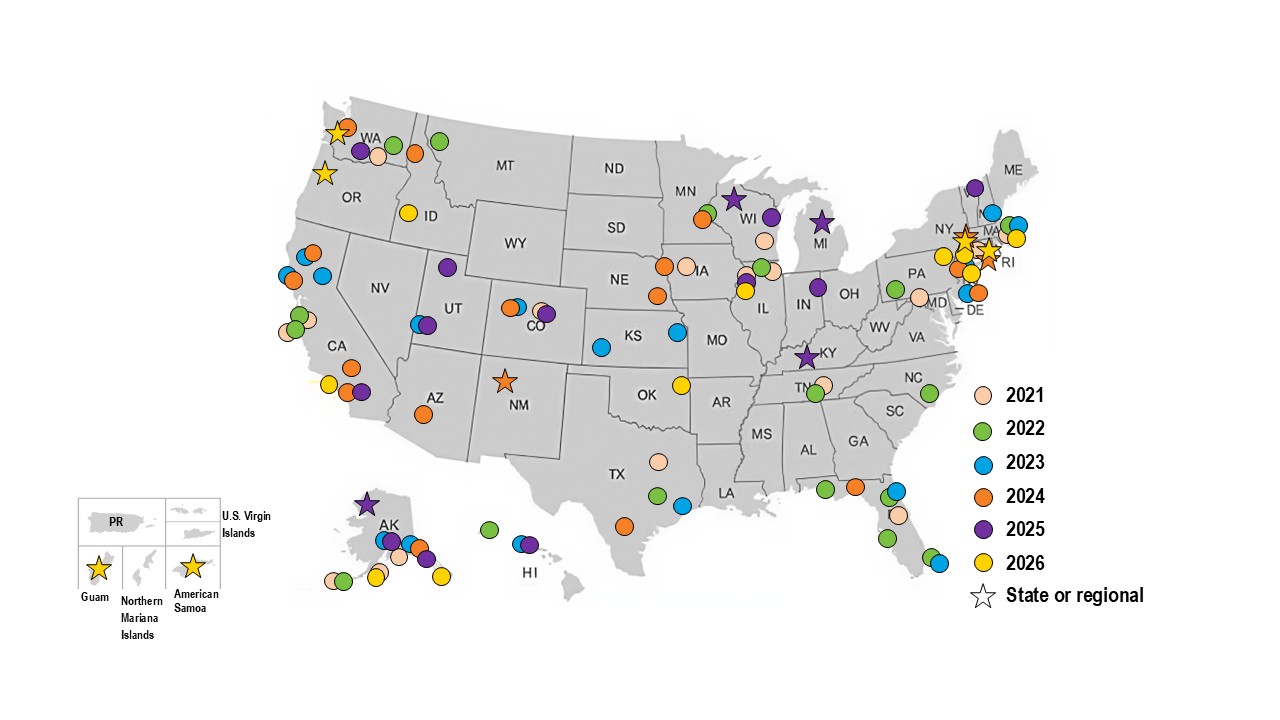
WASHINGTON—The U.S. Department of Energy’s Alternative Fuels and Feedstocks Office (AFFO) and the National Laboratory of the Rockies (NLR) have selected recipients for the FY26 Waste to Energy and Materials Technical Assistance program. Through this program, NLR will provide free guidance to state, local, and Tribal governments to use new technologies that turn waste into energy or recover valuable materials like critical minerals.  The program aims to help local officials create sensible solutions for their waste management issues, fill knowledge gaps, and plan and carry out implementation approaches that fit their communities. This year, the program has expanded to include additional municipal solid waste streams like electronics, industrial wastewater, and other byproducts.  Now in its sixth year, the technical assistance program has supported 67 entities in 31 states and territories. FY26 selections include: Community Name American Samoa Power Authority City of Boise, Idaho Cherokee Nation Natural Resources, Oklahoma Village of Coal Valley, Illinois Guam Energy Office Hudson Valley Regional Council, New York Kodiak Island Borough, Alaska Los Angeles County Public Works, California Metlakatla Indian Community, Arkansas Township of Montclair, New Jersey City of New Bedford, Massachusetts Oregon Department of Energy, Oregon South Central Regional Council of Governments, Connecticut Thompson Township, Pennsylvania Ulster County Resource Recovery Agency, New York Washington State Department of Commerce, Office of Renewable Fuels To learn more about the technical assistance program, visit NLR’s Waste to Energy and Materials Technical Assistance for State, Local, and Tribal Governments webpage. If you have questions, please see frequently asked questions or contact the Waste to Energy and Materials Technical Assistance Team.

Read More »

Santos targets Q4 2026 FID for Papua LNG plant

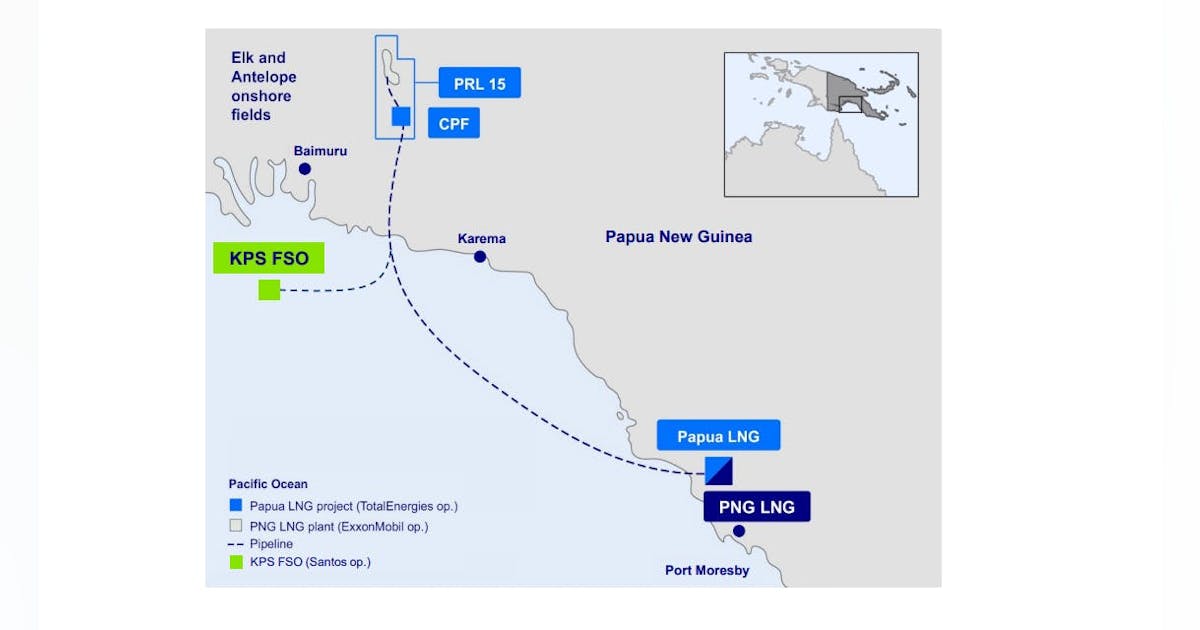
Santos Ltd. is on track to take fourth-quarter 2026 final investment decision (FID) on the 5.6 million tonne/year (tpy) Papua LNG plant at Caution Bay, Papua New Guinea, with project financing and government-led development discussions advancing. At plateau, Papua LNG would contribute about 1 million tpy of Santos equity LNG and roughly 11 million boe/year of equity oil, the company said in its first-half 2026 earnings report and call. Papua LNG would use 4 million tpy of production from new electric liquefaction trains and as much as 2 million tpy of tolling production from ExxonMobil Corp.’s already operating 8-million tpy PNG LNG plant, in which Santos is also a partner. Santos recently took FID on its PNG LNG oil infill drilling campaign, and expects to start drilling fourth-quarter 2026. Santos said it has several options to backfill PNG LNG production if Papua LNG does not proceed but emphasized that all parties remain focused on reaching a Papua LNG FID this year. The company cited Muruk, P’nyang, and Usano as possible resources for such backfill. Muruk has estimated natural gas resources of 1-3 tcf and P’nyang estimated recoverable reserves of 4.36 tcf. Usano, in the PD-L2 production license area, is primarily an oil project, with an estimated 85 million bbl of oil in place but would produce associated gas as well. Santos plans to drill a test well on it in early 2028. TotalEnergies SE holds 40.1% interest in Papua LNG and it the project’s operator. ExxonMobil holds 37.1% interest, with Santos and the state holding the bulk of the balance. Santos equity is 17.7-22.8% depending on government exercise of its back-in rights. ENEOS (formerly JX Nippon) holds a minor participating interest.

Read More »

North American rig count drops 8 units, erasing last week’s gain

The rig count in North America is down 8 units this week, according to data from Baker Huges Inc. With 804 rigs running across North America for the week ended Aug. 21, the drop erased the previous week’s 8-unit gain. There were 5 fewer rigs drilling in the US this week for a total of 588. The count is 50 more than were drilling during the same period last year. A 2-unit drop in offshore rigs left 10 working this week. One fewer rig was drilling in inland waters, leaving 2 still working. The number of rigs drilling on land decreased by 2 to 576. That count is up 53 from the same period in 2025. Three fewer rigs were oil-directed in the US and its waters this week for a total of 452. There were 127 gas-directed rigs working, down one from last week. The number of unclassified rigs working this week decreased by 1 unit to 9. Of the major US oil and gas producing states, Texas saw the largest increase. Four rigs were added to the state’s total this week to bring the count to 281, 41 more than were drilling during the same period last year. New Mexico and Louisiana each dropped 3 rigs to end the week with counts of 96 and 35, respectively. Wyoming’s rig count fell by a single unit this week to leave 9 rigs working. The overall rig count in Canada fell by 3 units to 216. The count is up 36 units from this time a year ago. Of those 216 rigs working, 148 were drilling for oil, down 3 from last week. The number of gas-directed rigs in Canada was unchanged at 65. Three units were unclassified, unchanged from last week.

Read More »

Ring’s 2027 target: 10% growth for 10% less

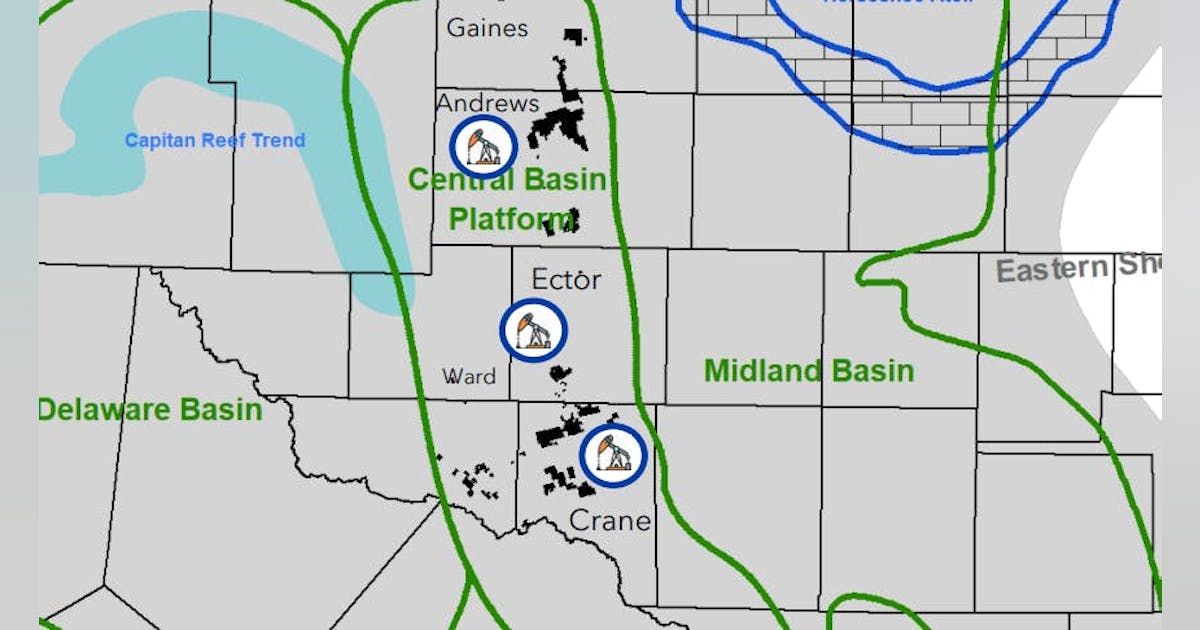
Boosted by an increase in horizontal drilling across its Central Basin Platform (CBP) operations, the leaders of Ring Energy Inc., The Woodlands, Tex., expect a big pop in the company’s 2027 financials. Speaking Aug. 18 at the EnerCom Denver conference, chairman and chief executive officer Paul McKinney said the Permian basin-focused operator has “an incredible runway of high-return opportunities” in the CBP using technologies refined by operators in the Midland and Delaware basins on either side of Ring’s holdings. Recent developments, he said, have made it easier for Ring and others active in the CBP, which has shallower reservoirs, to drill longer wells. Two years ago, half of the wells Ring drilled were horizontal. This year, that figure is on pace to be 81%. The length of new wells is similarly shifting to being at least 1.5 miles: In 2024, new wells of that length accounted for only 5% of Ring’s activity but that will be 70% this year. Those advancements are set to create a big payoff for Ring, which had total production of just under 20,000 boe/d in the second quarter. “The capital is kind of the story,” McKinney told EnerCom attendees. “We believe that we will deliver 10% production growth for 10% less capital in 2027 […] All this means meaningful upside in adjusted free cash flow. It means a significant increase in earnings.”

Read More »

Federal judge allows Sable Offshore to continue California pipeline operations

Despite affirming the jurisdictional shift, Wilson also ordered Sable to pay $1.5 million for violating a federal consent decree. Through its acquisition of the assets, Sable assumed obligations under the decree, including management and reporting requirements and provisions requiring state waivers before restarting operations. “Sable has violated the express provisions of the consent decree, without justification,” Wilson wrote. The judge said California’s proposed injunction “is not the proper remedy.” For one, he said, “the consent decree has been modified to replace OSFM as the regulatory authority with PHMSA, and the pre-restart requirements of the State Waivers are no longer applicable. Nor, too, are OSFM’s approval of a Restart Plan or authorization. PHMSA, the current regulator, has authorized Sable to restart the pipeline. Therefore, Sable is no longer in violation of the Consent Decree, and proactive, injunctive relief is inappropriate,” Wilson wrote. “Rather, the appropriate penalty for Sable’s violations is dictated by the consent decree.” Sable resumed transporting crude oil from the Santa Ynez Unit (SYU) through SYPS in March under the DPA order. The order and company statements indicate gross oil throughput is expected to reach about 50,000 b/d following ramp-up. Current production from six wells is estimated at about 6,000 b/d. SYPS has capacity of up to 200,000 b/d.

Read More »

AMD Helios Takes AI Infrastructure Fight to Rack Scale

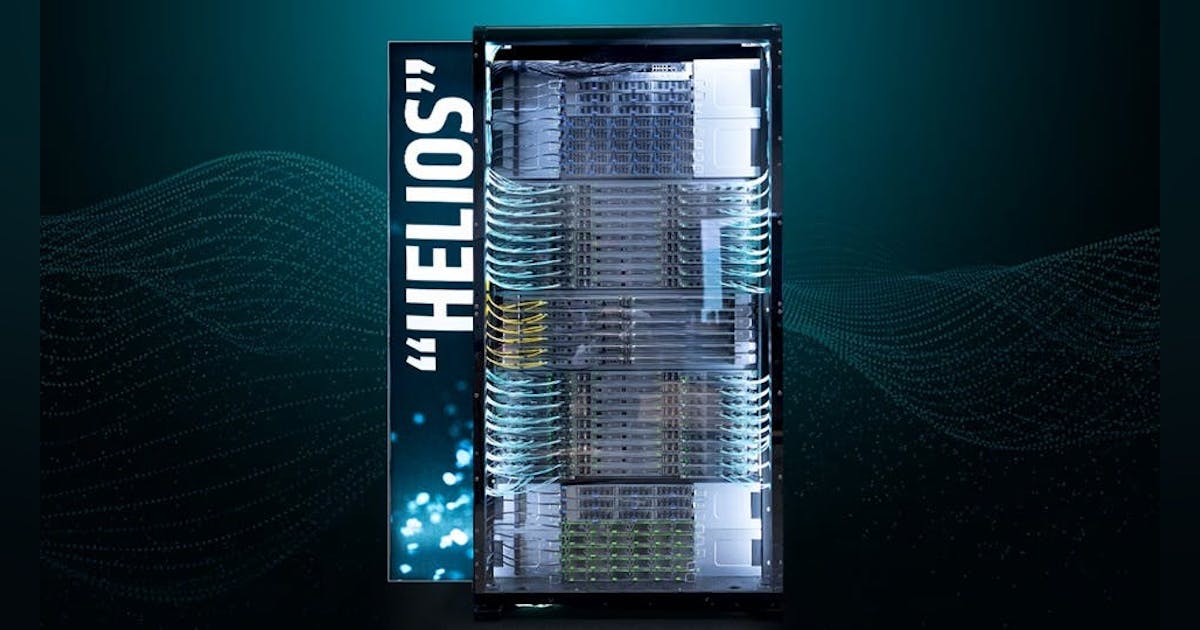
AMD is escalating its challenge to Nvidia with Helios, a rack-scale AI system that puts the company squarely into the race to define how the next generation of AI factories are built. Unveiled in production form at AMD’s Advancing AI 2026 event in San Francisco, Helios combines 72 Instinct MI455X GPUs with sixth-generation EPYC “Venice” CPUs, Pensando networking and AMD’s ROCm software stack. The significance goes beyond another generation of faster accelerators. Like Nvidia’s Vera Rubin platform, Helios treats the rack as an integrated compute system in which GPUs, CPUs, memory, networking, power delivery and cooling increasingly have to be engineered together. For data center operators, that means the competitive battle between the two chip companies is moving directly into infrastructure design. AMD said Helios is now in production, with deployments beginning during the second half of 2026. The Rack Becomes the System Helios is built around AMD’s Instinct MI455X, a liquid-cooled accelerator based on the company’s CDNA 5 architecture and equipped with HBM4 memory. A complete Helios rack delivers 72 GPUs along with EPYC host CPUs and Pensando networking for front-end, scale-up and scale-out traffic. AMD is positioning the platform for both large-scale training and increasingly important inference workloads. AMD says Helios can deliver up to 30% more inference tokens per dollar than a competing system. The company also claims the MI455X provides more peak AI compute and substantially greater memory capacity than Nvidia’s Rubin GPU. Those numbers are AMD benchmarks rather than independent comparisons. But the larger architecture may matter more than the percentages. AI infrastructure is rapidly moving beyond the model of servers being installed as largely independent pieces of IT equipment. Accelerators have to exchange enormous volumes of data with each other while CPUs orchestrate workloads and networking connects increasingly large clusters across rows, halls and

Read More »

Moses Lake Moves From Bitcoin to AI and HPC

Moses Lake and the Quincy Effect Moses Lake should not be understood as an isolated rural data center project. It sits within the larger Grant County infrastructure ecosystem that helped make nearby Quincy one of the defining hyperscale markets of the cloud era. Keel has called Moses Lake “adjacent to one of the most proven data center markets in the United States,” noting that hyperscale infrastructure has operated around Quincy for nearly two decades. In its Q1 remarks, management argued that increasingly constrained regional power leaves operators seeking incremental Pacific Northwest capacity with fewer options. The Grant County Economic Development Council’s data center inventory includes Microsoft, NTT Data, Sabey, Vantage, Intuit and other operators. The organization counts more than 1.5 million square feet of data center operations in the county and points to a diverse fiber network and Grant County PUD’s Columbia River hydroelectric resources as core advantages. That existing cluster changes the equation for an 18-MW project. The headline AI developments of 2026 are increasingly measured in hundreds of megawatts or gigawatts. But another market exists underneath those megacampus announcements: operators that need tens of megawatts in the right geography on a timeline measured in quarters rather than many years. An 18-MW facility with power, fiber, equipment and construction underway can therefore be strategically more relevant than its relatively modest capacity suggests. Keel had previously secured an option for another 10 MW near Moses Lake, but management said during its second-quarter call that it has relinquished that option and is now focused exclusively on the existing 18 MW. The decision further distinguishes Moses Lake from the industry’s race to advertise ever-larger pipelines. This project is about getting capacity online. A Second Life for Crypto Power That may ultimately be the larger Moses Lake story. Bitcoin miners assembled portfolios around

Read More »

ISE Expo 2026: DCF Takes Stage with JLL, TIA

AI Infrastructure’s New Calculus: Speed, Quality and the Race to Revenue NASHVILLE — The defining question in data center development has become brutally simple: How quickly can a site get to revenue? Power availability sits at the center of that calculation. But as AI pushes development into new geographies and compresses construction schedules, an increasingly complicated set of infrastructure dependencies sits behind the megawatts — equipment, suppliers, construction capacity, fiber, optical connectivity, workforce and the quality systems needed to make all of it work reliably. That tension framed a Data Center Frontier-led fireside discussion at EndeavorB2B’s ISE Expo 2026 between Sean Farney, Vice President of Data Center Strategy at JLL, and Dave Stehlin, CEO of the Telecommunications Industry Association (TIA). The conversation began with a new data center quality initiative. It quickly expanded into something larger: an examination of what happens when time to revenue becomes the organizing principle for an entire infrastructure industry. “There is absolutely, positively no room for pause right now,” Farney said. DCE 9000 Meets the AI Buildout For TIA, the answer begins with a problem Google brought to the association last year. According to Stehlin, Google was seeing recurring quality and delivery problems among operational technology suppliers — the companies providing equipment such as generators, cooling systems and other physical infrastructure required to make a data center operate. TIA responded by developing DCE 9000, or Data Center Excellence 9000, a third-party-certifiable quality management standard for the data center infrastructure supply chain. Stehlin said more than 70 companies are now participating in the effort, ranging from hyperscalers and data center operators to major infrastructure manufacturers. The first draft is expected in September. That is an unusually compressed development cycle for an industry standard. “Typically standards take five years to get implemented,” Stehlin said. “In nine months, we’re

Read More »

The Phantom Data Center Effect: When Perception Precedes Project Reality

Moving Beyond Speculation The answer is not simply earlier marketing campaigns or more aggressive public relations programs. Effective engagement requires understanding local concerns, motivations and political dynamics—and recognizing when community opposition reflects a durable constraint rather than a communications problem. We need to realize when no means no, and not interpret it as “try harder.” Phantom perception also can’t be handled by any one operator in any one market; this must be a collective, such as a crowd-sourced data platform, market by market. What our industry needs are clearer frameworks for evaluating digital infrastructure against these additional community-readiness criteria, because speculation is increasingly filling information gaps before formal projects reach the public process. Organizations such as OIX have begun working toward that objective. Its Digital Infrastructure Framework is modeled on traditional master planning and is intended to help communities evaluate what infrastructure they have, what they need and what they want as they plan for future technology requirements. The framework includes assessment criteria spanning investment readiness, policy, risk, sustainability and resilience. Greater transparency can narrow the gap between perception and reality. But greater transparency will not eliminate speculation, and unfortunately, it also won’t eliminate fear. Large infrastructure projects have always attracted public interest and scrutiny, and data centers are unlikely to become invisible again as AI demand accelerates. The question is how the industry responds to that visibility. The Next Stage of Data Center Development Community reaction to perceived data center development represents another potential source of site-selection intelligence. If communities begin reacting to a project before a developer has formally advanced one, that response can offer an early indication of whether a market is receptive to large-scale digital infrastructure or already approaching its political limit. This gives operators and investors another axis to measure: not just megawatts, fiber routes,

Read More »

Corvex Tests a Faster Path to Liquid-Cooled AI Infrastructure

The customer agreement expanded an earlier commitment and includes dedicated high-speed storage and CPUs in addition to GPUs. Corvex initially delivered capacity during the first quarter and continued deployment through the second and third quarters. By its Aug. 14 earnings update, the company said the multi-year Blackwell agreement had been fully delivered. Corvex reported approximately $22 million in contracted annualized recurring revenue from compute that was live and accepted by customers. The expansion was financed through debt, customer prepayments and cash on hand rather than additional equity issuance. But the most noteworthy aspect of the project may be the deployment itself. Corvex installed high-density, liquid-cooled NVIDIA HGX B200 systems inside an existing air-cooled data center and says it commissioned the capacity approximately two weeks after the equipment arrived. Instead of rebuilding the facility around a central liquid-cooling system, Corvex worked with Lenovo to use Lenovo Neptune liquid-to-air cooling technology. Liquid removes heat from the servers and transfers it to the existing air-cooled facility infrastructure. The cluster uses Lenovo ThinkSystem systems equipped with NVIDIA HGX B200 GPUs, NVIDIA Quantum-2 QM9700 InfiniBand for GPU traffic, NVIDIA Spectrum SN5600 switches for storage networking and SN2201 switches for management traffic. Corvex says the design allowed it to place high-density Blackwell infrastructure into the existing facility without a conventional facility-wide liquid-cooling conversion. Lenovo, in a case study of the deployment, contrasts the approximately two-week commissioning period with what it describes as typical data center upgrade timelines of seven to 12 months or more. That has significance beyond a single cluster. Power availability and suitable data center capacity increasingly constrain GPU deployment. If the approach proves repeatable, liquid-to-air cooling could allow some existing air-cooled facilities with sufficient power and other supporting infrastructure to accommodate higher-density AI systems without first undergoing a full central liquid-cooling conversion. For

Read More »

CBRE: Record Data Center Construction Fails to Ease Capacity Crunch

The North American data center industry built at record scale during the first half of 2026. It still wasn’t enough to loosen the market. Primary-market supply increased 33.7% year over year to a record 10,903 MW, according to CBRE’s newly released North America Data Center Trends H1 2026. Yet vacancy moved in the opposite direction, falling from 1.6% a year earlier to another record low of 1.4%. Net absorption reached 1,456.2 MW, up 11.7%, as hyperscale cloud and AI infrastructure operators continued competing for increasingly scarce blocks of contiguous power and capacity. Construction climbed 24.8% to a record 7,481.1 MW, surpassing the previous peak of 6,350.1 MW set in the second half of 2024. Perhaps the most telling number in the report is 80.4%. That is the share of primary-market capacity under construction that has already been preleased, up from 74.3% a year ago. CBRE estimates that less than 1,500 MW of all capacity currently under construction remains available—roughly six months of demand at the current absorption rate. The resulting picture is less one of a construction shortage than a race between infrastructure delivery and an AI demand curve that keeps absorbing capacity before it reaches the market. And increasingly, CBRE argues, securing the megawatts is only part of that race. Power, Permitting and Local Approval Converge Power availability and infrastructure delivery timelines remain the primary determinants of where data centers can be built. But CBRE’s H1 report places another constraint alongside them: community acceptance. “Local opposition has also become a serious obstacle,” the report states, with community resistance, zoning disputes and entitlement delays increasingly capable of stopping projects even after developers identify viable power and fiber. CBRE goes further in its outlook, describing community engagement as a development constraint now “on par with power procurement.” In practical site-selection terms,

Read More »

Microsoft will invest $80B in AI data centers in fiscal 2025

And Microsoft isn’t the only one that is ramping up its investments into AI-enabled data centers. Rival cloud service providers are all investing in either upgrading or opening new data centers to capture a larger chunk of business from developers and users of large language models (LLMs).  In a report published in October 2024, Bloomberg Intelligence estimated that demand for generative AI would push Microsoft, AWS, Google, Oracle, Meta, and Apple would between them devote $200 billion to capex in 2025, up from $110 billion in 2023. Microsoft is one of the biggest spenders, followed closely by Google and AWS, Bloomberg Intelligence said. Its estimate of Microsoft’s capital spending on AI, at $62.4 billion for calendar 2025, is lower than Smith’s claim that the company will invest $80 billion in the fiscal year to June 30, 2025. Both figures, though, are way higher than Microsoft’s 2020 capital expenditure of “just” $17.6 billion. The majority of the increased spending is tied to cloud services and the expansion of AI infrastructure needed to provide compute capacity for OpenAI workloads. Separately, last October Amazon CEO Andy Jassy said his company planned total capex spend of $75 billion in 2024 and even more in 2025, with much of it going to AWS, its cloud computing division.

Read More »

John Deere unveils more autonomous farm machines to address skill labor shortage

Join our daily and weekly newsletters for the latest updates and exclusive content on industry-leading AI coverage. Learn More Self-driving tractors might be the path to self-driving cars. John Deere has revealed a new line of autonomous machines and tech across agriculture, construction and commercial landscaping. The Moline, Illinois-based John Deere has been in business for 187 years, yet it’s been a regular as a non-tech company showing off technology at the big tech trade show in Las Vegas and is back at CES 2025 with more autonomous tractors and other vehicles. This is not something we usually cover, but John Deere has a lot of data that is interesting in the big picture of tech. The message from the company is that there aren’t enough skilled farm laborers to do the work that its customers need. It’s been a challenge for most of the last two decades, said Jahmy Hindman, CTO at John Deere, in a briefing. Much of the tech will come this fall and after that. He noted that the average farmer in the U.S. is over 58 and works 12 to 18 hours a day to grow food for us. And he said the American Farm Bureau Federation estimates there are roughly 2.4 million farm jobs that need to be filled annually; and the agricultural work force continues to shrink. (This is my hint to the anti-immigration crowd). John Deere’s autonomous 9RX Tractor. Farmers can oversee it using an app. While each of these industries experiences their own set of challenges, a commonality across all is skilled labor availability. In construction, about 80% percent of contractors struggle to find skilled labor. And in commercial landscaping, 86% of landscaping business owners can’t find labor to fill open positions, he said. “They have to figure out how to do

Read More »

2025 playbook for enterprise AI success, from agents to evals

Join our daily and weekly newsletters for the latest updates and exclusive content on industry-leading AI coverage. Learn More 2025 is poised to be a pivotal year for enterprise AI. The past year has seen rapid innovation, and this year will see the same. This has made it more critical than ever to revisit your AI strategy to stay competitive and create value for your customers. From scaling AI agents to optimizing costs, here are the five critical areas enterprises should prioritize for their AI strategy this year. 1. Agents: the next generation of automation AI agents are no longer theoretical. In 2025, they’re indispensable tools for enterprises looking to streamline operations and enhance customer interactions. Unlike traditional software, agents powered by large language models (LLMs) can make nuanced decisions, navigate complex multi-step tasks, and integrate seamlessly with tools and APIs. At the start of 2024, agents were not ready for prime time, making frustrating mistakes like hallucinating URLs. They started getting better as frontier large language models themselves improved. “Let me put it this way,” said Sam Witteveen, cofounder of Red Dragon, a company that develops agents for companies, and that recently reviewed the 48 agents it built last year. “Interestingly, the ones that we built at the start of the year, a lot of those worked way better at the end of the year just because the models got better.” Witteveen shared this in the video podcast we filmed to discuss these five big trends in detail. Models are getting better and hallucinating less, and they’re also being trained to do agentic tasks. Another feature that the model providers are researching is a way to use the LLM as a judge, and as models get cheaper (something we’ll cover below), companies can use three or more models to

Read More »

OpenAI’s red teaming innovations define new essentials for security leaders in the AI era

Join our daily and weekly newsletters for the latest updates and exclusive content on industry-leading AI coverage. Learn More OpenAI has taken a more aggressive approach to red teaming than its AI competitors, demonstrating its security teams’ advanced capabilities in two areas: multi-step reinforcement and external red teaming. OpenAI recently released two papers that set a new competitive standard for improving the quality, reliability and safety of AI models in these two techniques and more. The first paper, “OpenAI’s Approach to External Red Teaming for AI Models and Systems,” reports that specialized teams outside the company have proven effective in uncovering vulnerabilities that might otherwise have made it into a released model because in-house testing techniques may have missed them. In the second paper, “Diverse and Effective Red Teaming with Auto-Generated Rewards and Multi-Step Reinforcement Learning,” OpenAI introduces an automated framework that relies on iterative reinforcement learning to generate a broad spectrum of novel, wide-ranging attacks. Going all-in on red teaming pays practical, competitive dividends It’s encouraging to see competitive intensity in red teaming growing among AI companies. When Anthropic released its AI red team guidelines in June of last year, it joined AI providers including Google, Microsoft, Nvidia, OpenAI, and even the U.S.’s National Institute of Standards and Technology (NIST), which all had released red teaming frameworks. Investing heavily in red teaming yields tangible benefits for security leaders in any organization. OpenAI’s paper on external red teaming provides a detailed analysis of how the company strives to create specialized external teams that include cybersecurity and subject matter experts. The goal is to see if knowledgeable external teams can defeat models’ security perimeters and find gaps in their security, biases and controls that prompt-based testing couldn’t find. What makes OpenAI’s recent papers noteworthy is how well they define using human-in-the-middle

Read More »