Stay Ahead, Stay ONMINE

Power First: AI Data Centers Become Energy Systems

For decades, data centers consumed electricity much like other large commercial customers: power arrived from the utility, while batteries and diesel generators stood behind it to protect the load. AI is starting to break that model. As data center campuses grow toward hundreds of megawatts and, in some cases, gigawatt scale, developers are increasingly taking […]

For decades, data centers consumed electricity much like other large commercial customers: power arrived from the utility, while batteries and diesel generators stood behind it to protect the load. AI is starting to break that model.

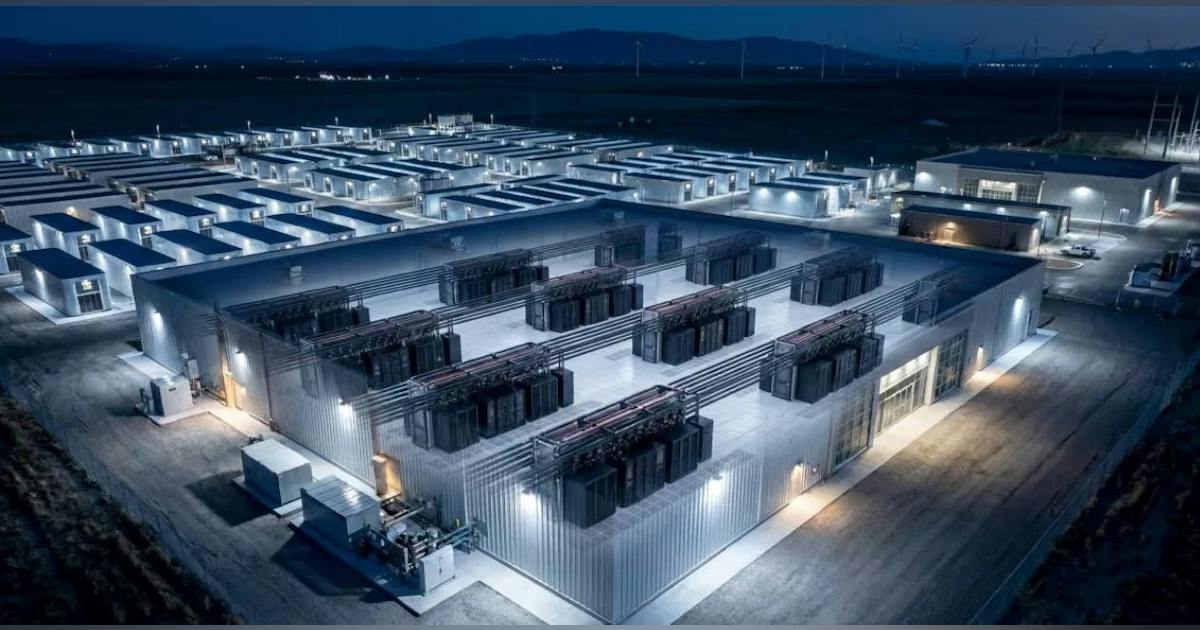
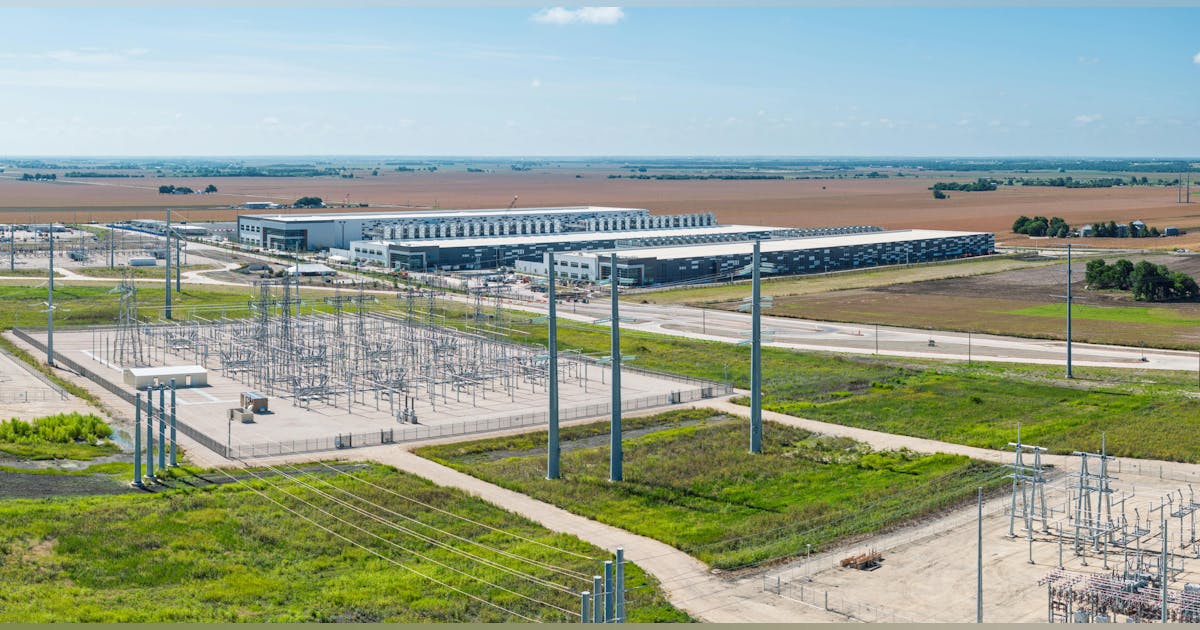
As data center campuses grow toward hundreds of megawatts and, in some cases, gigawatt scale, developers are increasingly taking responsibility for an energy system that once sat largely outside the data center boundary. Natural gas supply, onsite generation, fuel cells, batteries, controls and the behavior of the compute load itself are increasingly becoming parts of the same infrastructure system.

That was the central thread running through “Power First: The New Playbook for Delivering AI Data Centers,” an Aug. 4 session at the Data Center Frontier Trends Summit 2026 in Reston, Virginia.

Moderated by Fengrong Li, Senior Managing Director at FTI Consulting, the panel brought together Jim Summers, CEO of GPC Infrastructure; Shankar Achanta, EVP and Chief Product and Technology Officer at FuelCell Energy; Judith Judson, Executive Vice President at Calibrant Energy; and Yuval Bachar, Founder and CEO of EdgeCloudLink.

The discussion began with the immediate constraint — the grid cannot deliver capacity on the timetable AI developers increasingly require — but quickly moved beyond the familiar concept of “bridge power.”

The larger question was what happens when the data center itself becomes an energy system.

From Backup Power to Prime Power

Behind-the-meter generation is not new. What has changed is its role and scale.

“Traditionally, behind-the-meter generation has been for backup and the sizes were smaller,” Achanta said. “But what they’re seeing is the demand for the power is growing rapidly due to the data center load.”

Interconnection queues, transmission limitations and equipment supply constraints are pushing onsite generation into what Achanta called the “front seat,” supplying primary power rather than waiting behind the utility.

FuelCell Energy, for example, builds around modular 2.5 MW units and adds capacity incrementally. Achanta said customer discussions that once centered on roughly 10 MW are now reaching into the hundreds of megawatts.

That modularity changes more than plant size. Developers can energize portions of a campus while additional generation is still being installed, giving them another tool for managing schedule risk.

Li said she had recently toured a behind-the-meter project under construction in Texas at gigawatt scale, illustrating how far the concept has moved from its earlier role as a niche alternative.

But Achanta pushed against one increasingly common label for these projects: bridge power. “We don’t see it that way,” he said.

Once customers have operationalized onsite generation, he argued, those assets are unlikely simply to disappear when grid service arrives. They become part of the permanent power portfolio.

Bachar made the argument more starkly. The growth rate of the grid, he said, is no longer synchronized with either data center construction or the pace at which companies such as NVIDIA are changing the underlying compute technology.

In California, he said, developers can face utility-power timelines measured in years. “In seven years, this is not a relevant discussion,” Bachar said. “It’s just meaningless for us.”

His distinction was between two emerging versions of behind-the-meter infrastructure. At very large campuses, operators may effectively build a power station alongside the data center. At smaller facilities, generation can instead be distributed across isolated blocks, reducing the consequence of a failure in any single portion of the system.

That second model could become increasingly important as AI infrastructure expands beyond giant training campuses.

Bachar argued that the industry ultimately needs to solve not only the 1 GW campus in a rural power market, but the 25 MW to 35 MW inference site closer to cities and users. Those locations introduce their own constraints — air permits, noise, natural gas access and scarce utility capacity — while leaving developers less room to solve them.

The harder behind-the-meter problem may eventually be not just how to power a gigawatt campus in Texas, but how to deliver several dozen megawatts of AI capacity close to the markets where inference demand emerges.

Reliability Changes With the Load

Moving generation behind the meter also changes the reliability equation. Achanta noted that utility service is generally engineered to a lower availability level than the four or five nines expected from critical data center infrastructure.

Traditionally, operators have closed that gap with UPS systems and diesel backup. But simply reproducing every layer of the traditional architecture behind the meter could become prohibitively expensive.

“If you design your prime generation to meet all five nines, it’ll be extremely expensive,” Achanta said.

His preferred approach is what FuelCell Energy calls a layered architecture: handle the fastest load transients close to the compute through UPS systems or batteries, then work backward through generation and redundancy rather than overbuilding every component independently.

“Creating a grid behind the meter with all the Lego blocks that you have,” Achanta said.

Summers divided the reliability problem into two separate categories. The first is familiar: a forced outage in the generation fleet. The second is increasingly specific to AI: transient load management.

In a conventional environment, power consumption moves within reasonably predictable boundaries. AI training workloads can behave very differently.

“In an AI training scenario, that power may go from hundreds of megawatts to zero within milliseconds,” Summers said.

That creates a challenge not merely for utility infrastructure, but for turbines, reciprocating engines, batteries and the controls tying them together. It also changes how developers think about equipment size.

“If I put a 300-megawatt GE Frame 7 turbine, when that thing goes offline, half my data center just went out,” Summers said. “If I’m putting small reciprocating engines, and I lose one, you’re not going to notice.”

Upstream fuel reliability becomes another part of the same calculation. A natural-gas plant may be technically redundant yet still vulnerable if the project has not secured sufficiently firm gas transportation.

The result is a much broader definition of reliability encompassing prime mover selection, fuel contracts, transient management, controls, maintenance and physical redundancy.

Bachar argued that the industry now has an opportunity to reconsider the backup model entirely.

EdgeCloudLink favors what he described as an active-active architecture, in which generation and storage resources are continuously operating rather than leaving major assets idle until an outage occurs.

That approach also addresses one of the emerging implications of gigawatt-scale campuses: gigawatt-scale backup.

“If you have one gigawatt site and it drops it for eight hours, and let’s say you have a diesel gen backup, you activate the backup system,” Bachar said. “You know how long it’s gonna take to refuel eight hours of diesel?”

The question is increasingly whether the industry should maintain the traditional hierarchy of primary power followed by dormant backup, or design a system in which multiple resources continuously share the job.

Summers similarly left the diesel question open. “If you have a gigawatt campus, are you going to have a gigawatt of diesel generation?” he asked. “Is that logistically feasible?”

For now, he said, the industry is still wrestling with the answer.

Between the Grid and the Island

Yet the panel did not arrive at a simple conclusion that data centers should abandon the grid. In practice, the more likely architecture appears to sit somewhere between complete utility dependence and full islanding.

Li pushed the hybrid concept a step further, asking whether large data center operators could eventually function as a kind of “grid healing agent” — using behind-the-meter generation, storage and flexible load not only to protect their own operations, but to support the wider power system when capacity is available. In that model, onsite infrastructure becomes more than insurance against a constrained grid; it becomes a dispatchable resource that can help manage peaks, provide demand response and potentially create additional economic value for the data center.

Summers described the notion of complete utility dependence vs. full islanding as opposite ends of a spectrum.

Utility-only development remains constrained by aging transmission and generation infrastructure colliding with demand growth the system was not designed to absorb. Fully islanded infrastructure can solve time-to-power, but it creates an energy asset that may ultimately have value to the grid as well.

Summers argued that data centers are moving from being retail electricity customers toward behaving more like major industrial energy consumers. Historically, data centers could simply buy electricity through the local utility. As facilities have grown larger, he said, they have begun to resemble refineries, pulp and paper facilities and other major industrial users that have long managed substantial portions of their own energy supply.

That transition reaches far upstream. Developers must increasingly understand where fuel comes from, how it is transported and treated, how generation technology is selected, how equipment is financed, and how capital can be committed before a tenant is secured.

Projects GPC is working on, Summers said, range from roughly 50 MW to more than a gigawatt, and “there’s always an element of a grid component.”

“It may not be on day one,” he said. “We may not be entirely clear how it integrates, but it’s part of the solution.”

Summers compared the emerging model with cogeneration at refineries, chemical plants and other large industrial facilities, where onsite generation has long operated alongside the bulk power system.

The harder problem may be regulation. Rules being written today are largely attempts to manage reliability problems created by unprecedented load growth.

Summers argued that those rules will eventually need to evolve so onsite power can both meet the operational needs of the data center and become a useful resource to the broader grid.

“It’s going to be painful, I think, before we get all that sorted,” he said. “But I think that’s where we’re headed, is a fully integrated system.”

Judson said the economics of hybrid systems are already moving beyond conventional demand-response revenue. Calibrant worked on a Pacific Northwest data center project where onsite battery capacity allowed the facility to connect to the grid four years earlier than would otherwise have been possible.

That acceleration can be worth considerably more than payments earned by occasionally reducing demand. “Speed means revenue more quickly for that compute capacity,” Judson said.

Consider a 500 MW campus that can initially secure only 300 MW from the utility. If batteries or onsite generation allow the site to reduce consumption to 300 MW during constrained periods, it may be able to operate closer to its full 500 MW capacity through much of the year. Demand flexibility, in that case, becomes a capacity-development tool.

Achanta offered another version of the hybrid case. Even if a 100 MW project receives only 25 MW from the utility and builds the remaining 75 MW behind the meter, that modest grid connection can materially simplify the architecture. Batteries can be smaller. The grid connection itself can absorb some of the variability. Load shifting and energy-management software can coordinate the pieces.

“You use the grid as a battery,” Achanta said. That increasingly requires cooperation far beyond the generation vendor. FuelCell Energy recently announced work with Siemens intended to integrate the electrical architecture from prime generation toward the rack.

“We need to solve this as a whole, not just individual silos,” Achanta said.

AI Can Stress the Grid in Reverse

Hybrid systems introduce another complication. Data centers are commonly discussed as a threat to grid reliability because of how much power they consume. Bachar emphasized the opposite problem: what happens when an enormous load suddenly stops consuming?

Bachar pointed to a recent Virginia grid disturbance, saying data centers rapidly shifted away from utility power and removed hundreds of megawatts of load.

“What will happen if you’re on ERCOT, which is an island, and suddenly there is a fluctuation on the power and like 5 gigawatts gets off the grid in like milliseconds?” Bachar asked.

The point was less the exact hypothetical than the behavior it describes. A data center designed to protect its service-level agreements may switch away from troubled utility power almost instantly. At sufficient scale, that protective action itself becomes something grid operators must plan around.

More transmission and generation alone will not solve that problem, Bachar argued. Grid operations and the coordination between large computational loads and generation will also have to change.

That makes hybrid architecture more complicated than simply connecting an onsite plant to a utility feed. “You have to be very smart on how you do the hybrid,” Bachar said.

Judson similarly framed large computational loads as something that increasingly has to be managed as part of the power system rather than simply attached to it.

The emerging question is not just how the grid provides reliable service to the data center, but how the data center behaves when the grid itself is under stress.

Power, Cooling and Water Become One Design Problem

The same systems approach extends into cooling and water. Bachar argued that many new AI facilities are moving toward closed-loop liquid cooling systems with much lower operational water requirements than older evaporative designs.

Achanta said some fuel-cell technologies can even produce water through their electrochemical process, and suggested that onsite generation should be compared with the water consumed upstream by utility generation rather than considered in isolation.

Judson added that batteries themselves consume essentially no operational water, making storage-plus-generation architectures another option for reducing water use across the power system.

Summers urged a more nuanced calculation. Before founding GPC, he helped build H2O Midstream, which managed water infrastructure in the Permian Basin. His experience made him wary of treating water use as a simple technology scorecard.

Combined-cycle power plants use water to make steam, he noted, but they also extract more electricity from their fuel. A system selected primarily to avoid water may therefore introduce other efficiency tradeoffs.

“If we’re making choices from an optics perspective because it looks like it’s a sustainable solution, but we’re actually doing something so much less efficiently that we’re causing more energy to be used elsewhere, is that really the right balance?” Summers said.

The answer, he argued, requires examining water, energy efficiency, reuse and environmental impact across the full system.

The Last Constraint May Be Dependency

The panel closed with a problem familiar to developers attempting to turn ambitious power strategies into financed projects.

Major infrastructure must often be committed before a hyperscaler is willing to sign. Yet the interconnection work, gas laterals and generation equipment needed to establish a credible path to power can require hundreds of millions of dollars.

That creates a circular problem: developers need customer credit to finance the power, while customers want to see a credible power path before committing. Summers reduced the solution to one word: transparency.

“Laying your cards on the table, working alongside to solve these problems,” he said. “These are complex problems. They’re evolving. They require trust. They require partnership.”

If a hyperscaler wants to manage that complexity itself, Summers said, it needs to build an experienced team capable of understanding the full energy value chain. Otherwise, the better path may be to find partners willing to develop technical and commercial structures collaboratively.

Achanta similarly argued that developers and providers have to expose the full system requirements early: grid availability, generation, load characteristics and the actual use case. “This is a system solution,” he said.

Judson added the capital structure. Energy-as-a-service and tolling arrangements can help prevent a developer from carrying all of the stranded-asset risk before a tenant is secured.

Bachar put the lesson another way: reduce external dependencies wherever possible. “The lower number you have over there, the higher chances to succeed,” he said of the contractors, suppliers and organizations involved in a data center build.

That may ultimately be the defining feature of the power-first model. AI infrastructure has pushed power upstream in the development process, but simply securing generation is not enough. Fuel, electrical architecture, storage, cooling, compute behavior, regulation, capital and grid interaction increasingly have to be considered together.

What is emerging behind the meter is not a substitute utility so much as a new kind of data center architecture. The projects most likely to reach operation may be the ones that treat power not as another utility connection to procure, but as part of the data center architecture itself.

Shape
Shape
Stay Ahead

Explore More Insights

Stay ahead with more perspectives on cutting-edge power, infrastructure, energy,  bitcoin and AI solutions. Explore these articles to uncover strategies and insights shaping the future of industries.

Shape

Leap second proposal will keep software stacks in sync

“That means an enterprise does not only have to worry about what its own servers do. It has to consider what happens when its cloud provider, operating system, identity provider, database, external APIs, and on premises systems interpret the same moment differently,” Kolev said. “This is precisely the type of

Read More »

Cisco bundles fixes for multiple vulnerabilities, some critical, into one patch

CVE-2026-20274 and CVE-2026-20279 both address lifetime resource control issues, such as inappropriate certificate validation, incorrect or missing authorization for critical functions, resource operation after release or expiration, out-of-bounds read or write, initialization of resources with insecure details, and resource allocation without throttling limits. The five other vulnerabilities are rated between

Read More »

Shell, partners sign agreement for Angola offshore blocks

Shell, QatarEnergy, and Sonangol E&P signed Heads of Terms regarding the Risk Service Contracts for Blocks 8 and 22 offshore Angola, with Angola’s National Agency for Oil, Gas and Biofuels (ANPG).  The move is a step in evaluating offshore potential and building on Angola’s established role in Africa’s energy sector, Shell said in a release Sept. 9. Alioune Sourang, country chair of Shell Angola, said the signing is “another positive step in Shell’s renewed engagement with Angola,” and that it “builds on the momentum from exploration block entries with Chevron, Equinor, and Sonangol P&P.”  Under the agreement, Shell will be operator with 50% interest, QatarEnergy will hold 30% working interest, and Sonangol will hold 20% in the two offshore blocks. Shell’s participation in the Heads of Terms is through BG International Ltd. – Sucursal em Angola, a Shell company. The agreement was signed in the Angolan capital Luanda on the sidelines of the Angola Oil & Gas Conference. It is subject to the relevant governmental approvals and final contractual arrangements.

Read More »

Barclays conference: Chevron eyes ‘factory-type’ development in Venezuela; Exxon says operators matter more than ever

Executives from Chevron Corp. and ExxonMobil Corp. spoke at the Barclays 40th Annual Energy-Power Conference in New York this week, expanding on how they’re approaching the next phase of upstream growth, highlighting opportunities from Venezuela to Guyana, and offering clues about how major operators are evaluating future resource development opportunities. As OGJ did following , we’ve gathered notable comments from company leaders about the opportunities and challenges shaping their businesses. Chevron Unsurprisingly, a significant share of the conversation between Barclays analyst Betty Jiang and Chevron Corp. chief financial officer Eimear Bonner focused on the company’s ambitions in Venezuela, where the company last week signed a deal to over the next 5 years. Bonner reiterated the attractive financial picture for Chevron, pointing to operating costs below $20/bbl and a goal of hitting 600,000 b/d in 2031 (from today’s roughly 280,000 b/d) just from primary recovery. Chevron teams expect that production will plateau between 600,000 and 700,000 b/d for most, if not all, of the 2030s. “There’s a lot more upside there,” Bonner said. “This is growth at low cost and very attractive returns.” Helping to solidify Chevron’s financial equation, Bonner added, is that the company’s existing infrastructure in Venezuela is in good shape and that its expansion plans won’t require major capital projects but will instead lean on pipeline and utility expansion work. “The best way to think about this is we are developing or intend to develop this like the way we develop the Permian,” Bonner said. “It really is just another factory-type development. There will be a period of investment and a period of plateau. We’re looking forward to adopting and scaling and implementing all the lessons learned from the factory experience that we have.” ExxonMobil With a next quarter in the Stabroek block offshore Guyana, ExxonMobil Corp. is

Read More »

Hydrocarbons and Geothermal Energy Office Announces $300,000 to Help Identify Hidden Geothermal Systems

WASHINGTON — The U.S. Department of Energy’s (DOE) Hydrocarbons and Geothermal Energy Office (HGEO) today announced the $300,000 Geologic Enhanced Mapping System (GEMS) Prize to help identify hidden geothermal systems by using geophysical data to identify faults and structures indicative of geothermal resources. Activities enabled by this prize will help deliver on President Trump’s Executive Order, Unleashing American Energy, by advancing geothermal exploration, in turn supporting the potential for geothermal to provide affordable, reliable, around-the-clock domestic electricity to Americans. “Unlocking America’s vast geothermal potential is essential to securing our energy dominance and providing the reliable, dispatchable baseload power our nation needs,” said DOE Acting Assistant Secretary of the Hydrocarbons and Geothermal Energy Office Curt Coccodrilli. “By challenging innovators to map hidden geothermal resources, the GEMS Prize will boost efforts to strengthen grid stability, reduce utility expenses for U.S. households, and deliver the secure, steady electricity required to fuel our domestic manufacturing resurgence and next-generation AI data centers.” The GEMS Prize challenges competitors to develop, train, and test algorithms that generate enhanced geologic fault datasets—which, in turn, can support mapping and modeling for geothermal and critical mineral resources. By using real-world datasets and testing ideas against geophysical data, the GEMS Prize is expected to accelerate discoveries of new, commercially viable hidden geothermal systems while reducing exploration and development risks. The competition comprises two rounds, with prizes ranging from $15,000 to $100,000. Both individual and group competitors can participate, and submissions are due December 3, 2026. Learn more on the competition website. Learn how HGEO is unleashing the full potential of America’s hydrocarbon and geothermal resources to provide affordable, reliable, and secure energy here.

Read More »

EIA sees Brent near $90/bbl in second-half 2026 amid Middle East disruptions

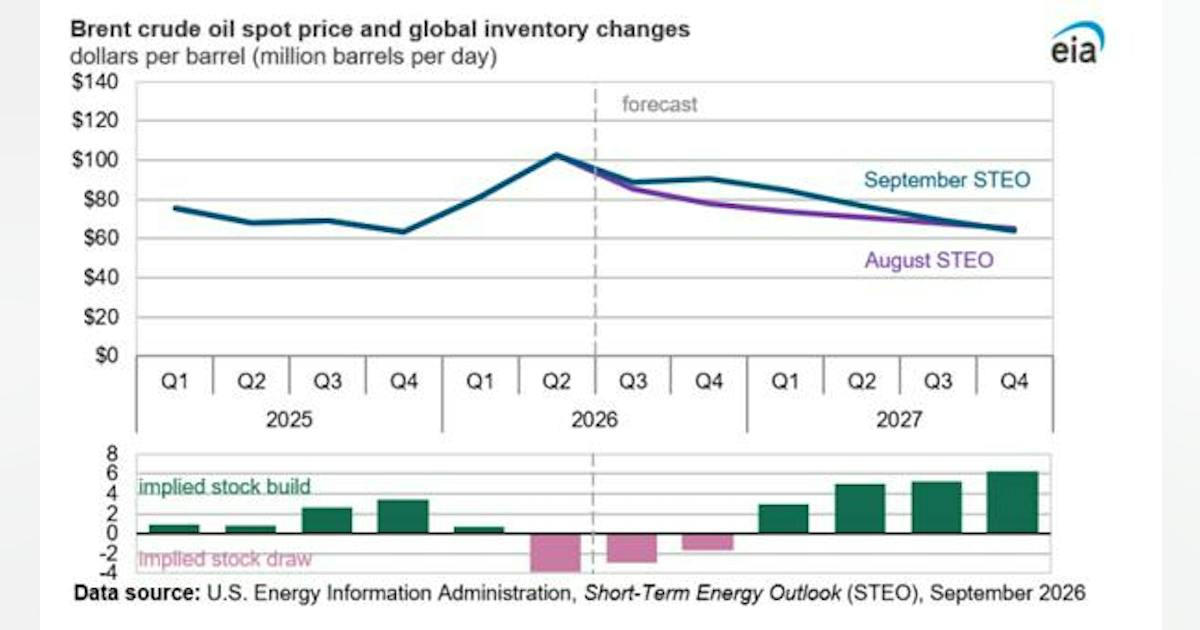
Global crude oil prices are expected to remain elevated through yearend 2026 as Middle East production disruptions and constrained exports continue to draw down inventories, the US Energy Information Administration (EIA) said in its September Short-Term Energy Outlook (STEO). EIA forecasts Brent crude oil spot prices will average about $90/bbl in second-half 2026, $8/bbl higher than projected in its August outlook. Brent averaged $91/bbl in August, up $7/bbl from July, as constrained Middle East exports led to additional production shut-ins. Middle East crude production shut-ins averaged an estimated 6.7 million b/d in August, up from 5.0 million b/d in July. EIA expects disruptions to ease gradually but remain substantial, with shut-in volumes averaging about 5.7 million b/d in fourth-quarter 2026. Oil flows through the Strait of Hormuz and Bab el-Mandeb remain constrained, although producers and shippers are increasingly using pipeline and overland bypass routes and ship-to-ship transfers. Stay updated on oil price volatility, shipping disruptions, LNG market analysis, and production output through OGJ’s Iran war content hub. Renewed US blockade of Iranian exports after Iran’s tanker attacks in Hormuz, plus the Treasury Department’s Office of Foreign Assets Control (OFAC) sanctions against Iranian economic and oil interests, will cut Iran’s exports and production, EIA said. In addition, attacks in Bab el-Mandeb roughly halved August loadings at Yanbu, the Red Sea port that bypasses Hormuz, according to Vortexa estimates. Saudi Arabia has rerouted barrels through the Suez Canal—longer and costlier for Asian buyers—and reportedly started ship-to-ship transfers outside the Persian Gulf, but EIA expects Red Sea constraints to cap Saudi supply near term. The disruptions have led to sharp inventory draws. EIA estimates global oil inventories fell by an average 3.9 million b/d in second-quarter 2026 and forecasts additional draws of 3.0 million b/d in the third quarter and 1.7 million b/d

Read More »

Woodside, PEMEX take initial step toward expanded partnership in Mexico

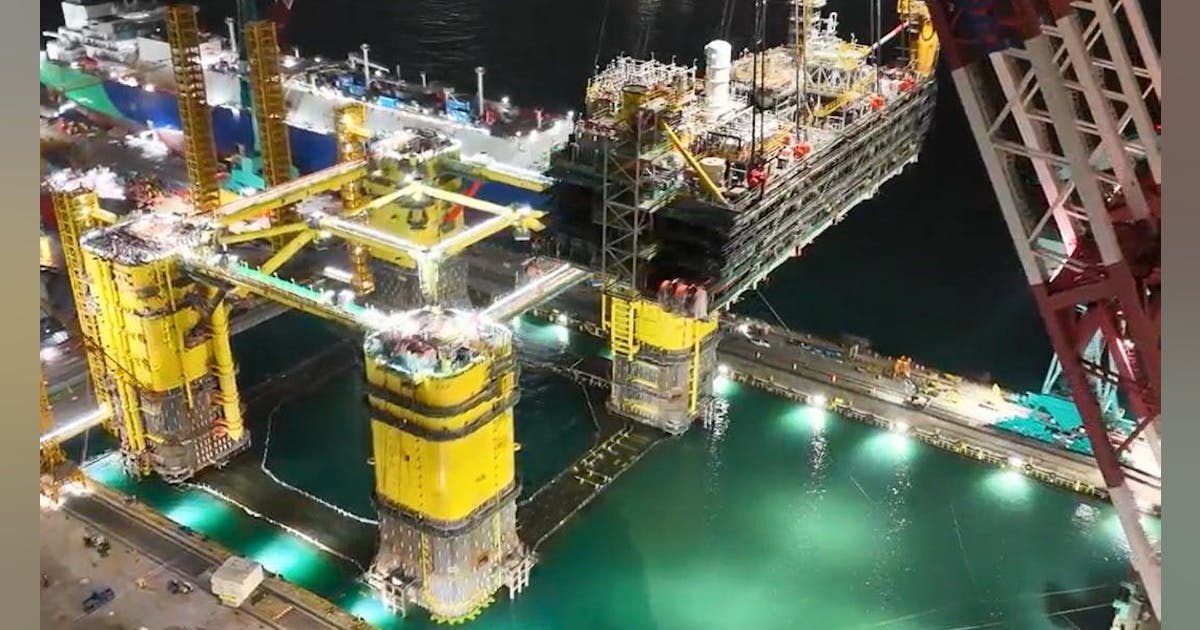
@import url(‘https://fonts.googleapis.com/css2?family=Inter:wght@100..900&display=swap’); .ebm-page__main h1, .ebm-page__main h2, .ebm-page__main h3, .ebm-page__main h4, .ebm-page__main h5, .ebm-page__main h6 { font-family: Inter; } body { line-height: 150%; letter-spacing: 0.025em; } button, .ebm-button-wrapper { font-family: Inter; } .label-style { text-transform: uppercase; color: var(–color-grey); font-weight: 600; font-size: 0.75rem; } .caption-style { font-size: 0.75rem; color: color-mix(in srgb, currentColor 60%, transparent); } #onetrust-pc-sdk [id*=btn-handler], #onetrust-pc-sdk [class*=btn-handler] { background-color: #c19a06 !important; border-color: #c19a06 !important; } #onetrust-policy a, #onetrust-pc-sdk a, #ot-pc-content a { color: #c19a06 !important; } #onetrust-consent-sdk #onetrust-pc-sdk .ot-active-menu { border-color: #c19a06 !important; } #onetrust-consent-sdk #onetrust-accept-btn-handler, #onetrust-banner-sdk #onetrust-reject-all-handler, #onetrust-consent-sdk #onetrust-pc-btn-handler.cookie-setting-link { background-color: #c19a06 !important; border-color: #c19a06 !important; } #onetrust-consent-sdk .onetrust-pc-btn-handler { color: #c19a06 !important; border-color: #c19a06 !important; } Woodside Energy and Petróleos Mexicanos (PEMEX) will explore opportunities to expand oil and gas projects through a newly signed non-binding Memorandum of Understanding (MoU). The MoU will allow analysis of potential opportunities for exploration and extraction of hydrocarbons in Mexico’s deepwater and will enable an exchange of technical knowledge, experience, and industry best practices in the oil and gas sector, the companies said in a release Sept. 3. Woodside and PEMEX are jointly developing the Trion oil project about 180 km off Mexico’s coastline and 30 km south of the US-Mexico maritime border. The project, about 64% complete as of June 30, 2026, lies in the Perdido Fold Belt at depths in 2,500–2,600 m of water. Mexico’s first ultra-deepwater oil development, Trion is designed for 24 subsea wells connected to a new 100,000 b/d floating production unit (Tláloc) and 950,000-bbl floating storage and offloading unit (Chalchi). Through estimated total capital investment of $7.2 billion, the development is targeting 479 MMboe of best estimate (2C) contingent oil and gas with first oil targeted for 2028. Woodside is operator at Trion with a 60% interest. PEMEX holds the remaining 40% interest. Trion field was

Read More »

Diversified Energy to acquire Birch Permian in $1.8-billion deal

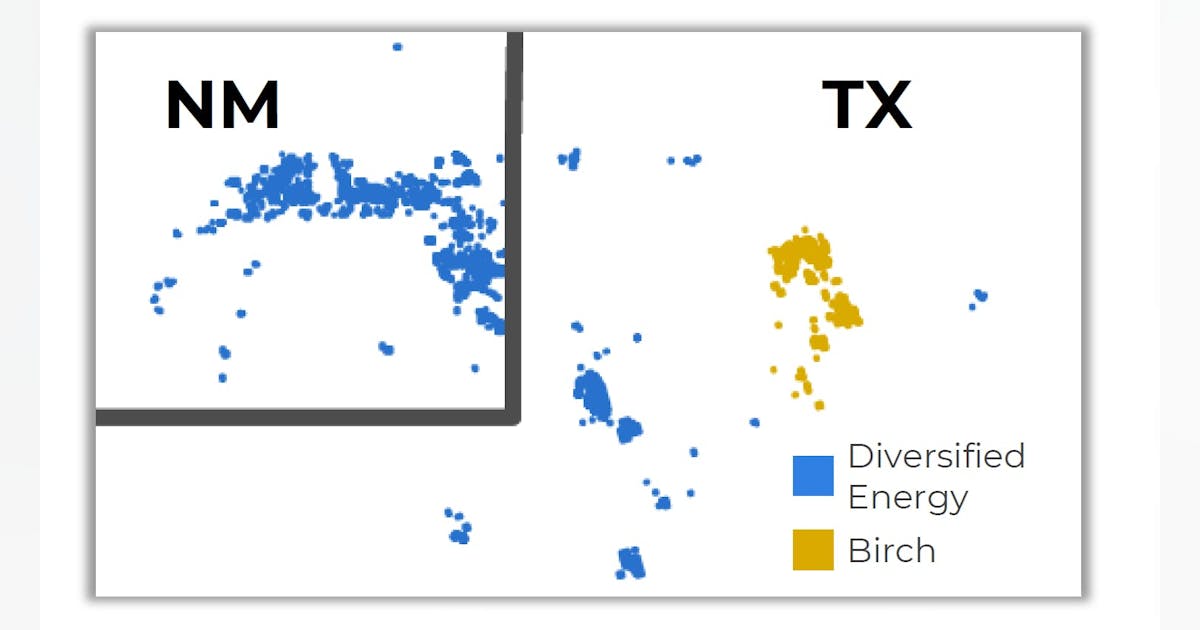
Diversified Energy Co. has agreed to acquire Birch Permian Holdings Inc. and certain affiliated companies from affiliates of Elliott Investment Management LP for about $1.8 billion, expanding its position in the Permian basin and adding operated, producing assets to its portfolio. The acquisition is expected to increase Diversified’s production by about 35%, the company said in a release Sept. 2. Following closing, Diversified said operated gross production volumes are expected to total about 2.5 bcefd, or roughly 1.6 bcfed net. Birch’s assets currently produce about 68,000 boe/d net (about 409 MMcfed), consisting of 38% oil, 32% natural gas liquids, and 30% natural gas. The portfolio includes about 480 net wells across 46,000 net mineral acres in the Permian basin. The acquired properties contain proved reserves of about 1.17 tcfe and a reported PV-10 value of about $2 billion. The transaction also includes gathering, processing, and water-handling infrastructure. Midstream assets comprise 12 central production facilities, nine well gathering facilities, more than 60 miles of gathering pipeline, and five water disposal facilities connected by more than 80 miles of disposal and recycling pipelines. Processing capacity includes up to 345,000 b/d of oil and 310 MMcfd of gas. Diversified said the acquisition establishes a platform for further consolidation of mature, producing Permian assets consistent with its strategy of acquiring and managing proved developed producing (PDP) properties. The company also cited enhanced oil recovery (EOR) potential, noting the acquired position includes more than 150 permitted EOR locations. “This $1.8 billion acquisition is our largest in the company’s 25-year history,” said chairman and chief executive officer Rusty Hutson Jr. He said the assets provide a concentrated operated position in the Permian basin with integrated infrastructure and predictable cash flow characteristics. The acquisition is expected to be funded primarily through a privately rated asset-backed securitization originated

Read More »

Nvidia invests $3.5B in MediaTek to extend its grip on AI

AI infrastructure: MediaTek will work with Nvidia’s NVLink Fusion ecosystem to enable customers to develop custom AI infrastructure designed to integrate with Nvidia rack-scale systems and AI factories. Local AI computing: The companies will continue to collaborate on multiple generations of Nvidia RTX Spark and DGX Spark PC chips, powering consumer PCs, AI developer supercomputers, and enterprise-class workstations, that integrate Nvidia GPUs with MediaTek SoCs. Automotive: MediaTek and Nvidia will continue developing platforms for AI-powered, software-defined vehicles in the era of physical AI.  “MediaTek is one of the world’s great semiconductor companies, with exceptional expertise in system-on-chip design, connectivity, leading performance and power efficiency,” said Jensen Huang, founder and CEO of Nvidia, in a statement. “Together, we’re building platforms that bring Nvidia accelerated computing to new markets and give customers the freedom to create differentiated AI systems at enormous scale.” NVLink is a high-performance interface, but this move also helps lock in customers to the Nvidia platform, since NVLink Fusion is not about to hook up to AMD processors. For MediaTek, the Nvidia investment provides a big pile of cash and access to Nvidia’s infrastructure as it attempts to establish itself as a major supplier of custom data center silicon.

Read More »

AI Puts Fiber on the Critical Path

Fiber Becomes Part of the Build A decade ago, DC Blox might have prioritized land near existing fiber from AT&T, Verizon, Zayo or another established network provider. That calculation is different today. As data center campuses have grown and hyperscalers have become a larger share of the customer base, Wabik said connectivity has increasingly become another construction package associated with the project itself. “If Zayo or Verizon or AT&T just happens to be there close by, that’s a good thing,” he said. “But fiber construction is inherently anymore just part of the construction component.” That changes the site-selection question from Is there fiber nearby? to Can fiber be built here at the scale and diversity the customer requires? For DC Blox, Wabik said that can mean assessing whether sufficient public right-of-way exists to establish three or sometimes four diverse fiber paths into a data center. That distinction is important, as AI workloads push infrastructure into markets where power, land and energy options may be more abundant than established carrier density. The hyperscalers themselves have also become major network builders. Wabik characterized them provocatively as today’s telecom providers, pointing to the scale of terrestrial fiber they commission as well as the growing role of companies such as Amazon, Google and Meta in subsea cable development. The point is less that traditional carriers have disappeared than that hyperscalers increasingly design, commission and control enormous portions of the connectivity required to support their own infrastructure. DC Blox now sees requests for 864-count fiber as routine and, in some cases, 1,728-count cable. That would have been difficult to imagine during an earlier era when a handful of fibers from an established carrier could satisfy a data center’s connectivity requirements. AI-Scale Fiber Gets Physical The scale becomes clearer when the discussion moves from abstract network

Read More »

Power First: AI Data Centers Become Energy Systems

For decades, data centers consumed electricity much like other large commercial customers: power arrived from the utility, while batteries and diesel generators stood behind it to protect the load. AI is starting to break that model. As data center campuses grow toward hundreds of megawatts and, in some cases, gigawatt scale, developers are increasingly taking responsibility for an energy system that once sat largely outside the data center boundary. Natural gas supply, onsite generation, fuel cells, batteries, controls and the behavior of the compute load itself are increasingly becoming parts of the same infrastructure system. That was the central thread running through “Power First: The New Playbook for Delivering AI Data Centers,” an Aug. 4 session at the Data Center Frontier Trends Summit 2026 in Reston, Virginia. Moderated by Fengrong Li, Senior Managing Director at FTI Consulting, the panel brought together Jim Summers, CEO of GPC Infrastructure; Shankar Achanta, EVP and Chief Product and Technology Officer at FuelCell Energy; Judith Judson, Executive Vice President at Calibrant Energy; and Yuval Bachar, Founder and CEO of EdgeCloudLink. The discussion began with the immediate constraint — the grid cannot deliver capacity on the timetable AI developers increasingly require — but quickly moved beyond the familiar concept of “bridge power.” The larger question was what happens when the data center itself becomes an energy system. From Backup Power to Prime Power Behind-the-meter generation is not new. What has changed is its role and scale. “Traditionally, behind-the-meter generation has been for backup and the sizes were smaller,” Achanta said. “But what they’re seeing is the demand for the power is growing rapidly due to the data center load.” Interconnection queues, transmission limitations and equipment supply constraints are pushing onsite generation into what Achanta called the “front seat,” supplying primary power rather than waiting behind the

Read More »

NVIDIA Pushes DSX Deeper Into Data Center Infrastructure

The joint reference design appears in Trane’s Continuum Rubin DSX and Eaton’s Beam Rubin DSX platforms. The goal is a pre-coordinated architecture stretching from grid power to the chip rather than requiring developers and engineering teams to independently assemble electrical and mechanical systems for each project. The systems are also intended to exchange operating data. Rather than cooling and electrical systems responding independently, the systems can instead exchange leading indicators and respond more dynamically to changing operating requirements. This is an approach that closely mirrors NVIDIA’s larger DSX philosophy. Trane and Eaton are also designing the architecture to accommodate future liquid-cooling and direct-current power-distribution technologies. That future-proofing matters as rack power densities continue to rise. An electrical and cooling plant optimized for one GPU generation may otherwise become a constraint several hardware generations later. The Broader DSX Buildout The Lancium, Cloverleaf and Trane/Eaton agreements are part of a considerably wider expansion of the DSX ecosystem. Earlier deals show NVIDIA moving into many of the same infrastructure layers through partnerships spanning powered land, electrical design, digital twins and even project financing. In May, NVIDIA and IREN announced plans to support as much as 5 GW of DSX-aligned AI infrastructure across IREN’s global development pipeline, with the companies identifying IREN’s 2 GW Sweetwater campus in Texas as an expected flagship DSX deployment. NVIDIA also received a five-year right to purchase up to 30 million IREN shares at $70 each, representing a potential investment of as much as $2.1 billion. The infrastructure ecosystem has widened as well. Siemens, NVIDIA and Fluence, incorporating nVent design considerations, have developed a DSX Vera Rubin-aligned electrical, power and controls architecture extending from the utility connection to the rack. ABB is integrating digital models of medium-voltage switchgear, power-distribution equipment and UPS systems into the Omniverse DSX Blueprint, while Vertiv

Read More »

ERCOT Puts Texas AI Megawatts to the Test

Texas has no shortage of proposed data center megawatts. The harder question is how many of them are real. That distinction is becoming central to the Electric Reliability Council of Texas (ERCOT) as the state works through an unprecedented wave of AI, hyperscale and other large-load requests. In June, ERCOT said it was tracking more than 438 GW of proposed large loads, nearly 89% associated with data centers. By Aug. 3, Gov. Greg Abbott said ERCOT was considering approximately 474 GW of connection requests, roughly 90% from data centers and more than five times the system’s record peak demand. Neither figure represents a forecast of what will actually get built. And that is increasingly the point. ERCOT’s new Batch Zero process is beginning to put harder boundaries around Texas’ enormous development pipeline, asking which projects have enough maturity, technical information and commitment to warrant space in the transmission plan. At the same time, new requirements surrounding voltage ride-through and dynamic modeling are forcing another realization on the AI infrastructure industry: at hundreds of megawatts, a data center is no longer simply a customer at the edge of the grid. Its behavior can affect the grid itself. For developers, utilities and investors, Texas is becoming a large-scale test of what separates an announced AI campus from executable infrastructure. The Queue Is Not the Grid The sheer scale of ERCOT’s large-load queue can obscure how early many projects remain. ERCOT’s April 2026 monthly report offered a revealing snapshot. Large-load applications totaled 445.8 GW through 2033, but 321 GW had no studies submitted to ERCOT. Another 93.7 GW was under ERCOT review, while 22 GW had met the applicable Section 9.5 requirements. Against that enormous development funnel, ERCOT reported just 5.9 GW of observed energized large loads, with another 3.2 GW approved to

Read More »

DCF Trends Summit: AI Compresses the Data Center Hardware Lifecycle and Raises the Stakes for ITAD

The AI infrastructure race is largely a story about getting more computing into data centers faster. But the accelerated hardware cycle is creating an equally consequential problem at the other end of the rack: getting yesterday’s equipment back out while it is still valuable. GPU systems built around increasingly dense and specialized AI architectures are beginning to challenge traditional assumptions about IT asset disposition, or ITAD. Where conventional enterprise infrastructure might remain in service for three to five years, newer GPU platforms can face refresh cycles of 18 to 24 months, according to Josh Humm, Data Center Solutions Manager at Dynamic Lifecycle Innovations. That compression changes the economics as well as the mechanics of decommissioning. “The faster we can get the materials out of your building, the more it’s worth, the more we can return to your program,” Humm said. Humm joined DCF Contributing Editor Doug Black for a DCF Show podcast recorded at the third annual Data Center Frontier Trends Summit, held Aug. 4-6 in Reston, Virginia. Their conversation focused on a less visible part of the AI infrastructure buildout: what happens to servers, accelerators, memory, storage and networking gear when the next generation arrives. The answer increasingly touches facility operations, data security, logistics, sustainability and potentially millions of dollars in recoverable hardware value. AI Hardware Changes the Exit Path AI systems create some obvious physical challenges for decommissioning. Traditional ITAD teams accustomed to pulling 1U and 2U servers out of air-cooled racks may instead encounter liquid-cooling manifolds, substantially heavier systems and equipment requiring specialized rigging and handling procedures. Humm said some systems can weigh between 5,000 and 6,000 pounds. “We’re not pulling out just 1U, 2U servers out of racks anymore,” he said. Liquid cooling adds another layer. Removing infrastructure designed around direct-to-chip or other liquid-cooling architectures can

Read More »

Microsoft will invest $80B in AI data centers in fiscal 2025

And Microsoft isn’t the only one that is ramping up its investments into AI-enabled data centers. Rival cloud service providers are all investing in either upgrading or opening new data centers to capture a larger chunk of business from developers and users of large language models (LLMs).  In a report published in October 2024, Bloomberg Intelligence estimated that demand for generative AI would push Microsoft, AWS, Google, Oracle, Meta, and Apple would between them devote $200 billion to capex in 2025, up from $110 billion in 2023. Microsoft is one of the biggest spenders, followed closely by Google and AWS, Bloomberg Intelligence said. Its estimate of Microsoft’s capital spending on AI, at $62.4 billion for calendar 2025, is lower than Smith’s claim that the company will invest $80 billion in the fiscal year to June 30, 2025. Both figures, though, are way higher than Microsoft’s 2020 capital expenditure of “just” $17.6 billion. The majority of the increased spending is tied to cloud services and the expansion of AI infrastructure needed to provide compute capacity for OpenAI workloads. Separately, last October Amazon CEO Andy Jassy said his company planned total capex spend of $75 billion in 2024 and even more in 2025, with much of it going to AWS, its cloud computing division.

Read More »

John Deere unveils more autonomous farm machines to address skill labor shortage

Join our daily and weekly newsletters for the latest updates and exclusive content on industry-leading AI coverage. Learn More Self-driving tractors might be the path to self-driving cars. John Deere has revealed a new line of autonomous machines and tech across agriculture, construction and commercial landscaping. The Moline, Illinois-based John Deere has been in business for 187 years, yet it’s been a regular as a non-tech company showing off technology at the big tech trade show in Las Vegas and is back at CES 2025 with more autonomous tractors and other vehicles. This is not something we usually cover, but John Deere has a lot of data that is interesting in the big picture of tech. The message from the company is that there aren’t enough skilled farm laborers to do the work that its customers need. It’s been a challenge for most of the last two decades, said Jahmy Hindman, CTO at John Deere, in a briefing. Much of the tech will come this fall and after that. He noted that the average farmer in the U.S. is over 58 and works 12 to 18 hours a day to grow food for us. And he said the American Farm Bureau Federation estimates there are roughly 2.4 million farm jobs that need to be filled annually; and the agricultural work force continues to shrink. (This is my hint to the anti-immigration crowd). John Deere’s autonomous 9RX Tractor. Farmers can oversee it using an app. While each of these industries experiences their own set of challenges, a commonality across all is skilled labor availability. In construction, about 80% percent of contractors struggle to find skilled labor. And in commercial landscaping, 86% of landscaping business owners can’t find labor to fill open positions, he said. “They have to figure out how to do

Read More »

2025 playbook for enterprise AI success, from agents to evals

Join our daily and weekly newsletters for the latest updates and exclusive content on industry-leading AI coverage. Learn More 2025 is poised to be a pivotal year for enterprise AI. The past year has seen rapid innovation, and this year will see the same. This has made it more critical than ever to revisit your AI strategy to stay competitive and create value for your customers. From scaling AI agents to optimizing costs, here are the five critical areas enterprises should prioritize for their AI strategy this year. 1. Agents: the next generation of automation AI agents are no longer theoretical. In 2025, they’re indispensable tools for enterprises looking to streamline operations and enhance customer interactions. Unlike traditional software, agents powered by large language models (LLMs) can make nuanced decisions, navigate complex multi-step tasks, and integrate seamlessly with tools and APIs. At the start of 2024, agents were not ready for prime time, making frustrating mistakes like hallucinating URLs. They started getting better as frontier large language models themselves improved. “Let me put it this way,” said Sam Witteveen, cofounder of Red Dragon, a company that develops agents for companies, and that recently reviewed the 48 agents it built last year. “Interestingly, the ones that we built at the start of the year, a lot of those worked way better at the end of the year just because the models got better.” Witteveen shared this in the video podcast we filmed to discuss these five big trends in detail. Models are getting better and hallucinating less, and they’re also being trained to do agentic tasks. Another feature that the model providers are researching is a way to use the LLM as a judge, and as models get cheaper (something we’ll cover below), companies can use three or more models to

Read More »

OpenAI’s red teaming innovations define new essentials for security leaders in the AI era

Join our daily and weekly newsletters for the latest updates and exclusive content on industry-leading AI coverage. Learn More OpenAI has taken a more aggressive approach to red teaming than its AI competitors, demonstrating its security teams’ advanced capabilities in two areas: multi-step reinforcement and external red teaming. OpenAI recently released two papers that set a new competitive standard for improving the quality, reliability and safety of AI models in these two techniques and more. The first paper, “OpenAI’s Approach to External Red Teaming for AI Models and Systems,” reports that specialized teams outside the company have proven effective in uncovering vulnerabilities that might otherwise have made it into a released model because in-house testing techniques may have missed them. In the second paper, “Diverse and Effective Red Teaming with Auto-Generated Rewards and Multi-Step Reinforcement Learning,” OpenAI introduces an automated framework that relies on iterative reinforcement learning to generate a broad spectrum of novel, wide-ranging attacks. Going all-in on red teaming pays practical, competitive dividends It’s encouraging to see competitive intensity in red teaming growing among AI companies. When Anthropic released its AI red team guidelines in June of last year, it joined AI providers including Google, Microsoft, Nvidia, OpenAI, and even the U.S.’s National Institute of Standards and Technology (NIST), which all had released red teaming frameworks. Investing heavily in red teaming yields tangible benefits for security leaders in any organization. OpenAI’s paper on external red teaming provides a detailed analysis of how the company strives to create specialized external teams that include cybersecurity and subject matter experts. The goal is to see if knowledgeable external teams can defeat models’ security perimeters and find gaps in their security, biases and controls that prompt-based testing couldn’t find. What makes OpenAI’s recent papers noteworthy is how well they define using human-in-the-middle

Read More »