Stay Ahead, Stay ONMINE

What must happen for AI’s trillion-dollar gamble to pay off

When Jessica Wachter, a finance professor at the University of Pennsylvania’s Wharton School, wanted to assess AI’s impact on the economy over the next few years, she faced a long list of business and technical uncertainties. So she started with what she calls a “remarkable fact” that is not in question: A handful of so-called hyperscalers are investing huge amounts of money to build AI data centers. Instead of trying to predict how useful and widely deployed AI models will be, she simply asked how fast the hyperscalers’ earnings will need to grow to justify their spending through 2027, when—she and her collaborator estimate—expenditures will reach nearly $1.1 trillion. It’s a no-nonsense accounting approach to making sense of today’s historical AI buildout. The results are eye-opening: The AI companies will need to increase their own productivity by a factor of 2.7 to break even by 2030, accounting for the cost of capital and a 15% return, and depreciation of the assets. Not impossible, says Wachter. The result would lead to the kind of economic growth that we saw during the US IT boom over a period of about 10 years starting in the mid-1990s. But, she says, for it to happen by 2030 “that’s a lot of growth compressed into a few years.” And if the hyperscalers cannot meet such profit goals? “Then they will fall behind on their interest payments, and that risks bankruptcy,” says Wachter, who was previously the SEC’s chief economist and director of its division of economic and risk analysis. If a productivity boom “fails to materialize,” she and her coauthor conclude in their research paper, “the current buildout will be the largest misallocation of capital in history.”   It doesn’t take superintelligence to realize that today’s large investments in the infrastructure for artificial intelligence come with huge risks. The hyperscalers will spend about $750 billion this year, building massive data centers scattered across the country. And the spending spree shows no signs of slowing. According to some projections, total AI capital investments from the hyperscaler companies—Alphabet, Microsoft, Amazon, Meta, and Oracle (which partners with OpenAI)—could be more than $5 trillion over the next four years. It’s one of the largest capital investments by any industry in history. But there’s a problem that’s obvious to anyone paying attention. While the hyperscalers plan to spend trillions, total AI revenues will be around $150 billion to $200 billion this year, says Gary Gensler, who ran the SEC during the Biden administration and is now a professor at MIT’s Sloan School. “The challenge is that the spending does not have commensurate revenues yet. That’s a fact,” he says. “And then the question is, is that an investment that will be paid off in the future?” At stake in that trillion-dollar question is the financial health of the giant AI companies and the overall US economy—the investments could soon balloon to around 3% of GDP. The answer could also determine the fate of the hugely expensive data centers themselves.  No one really knows how profitable and useful these multibillion-dollar behemoths will be down the road. Though AI models have made dazzling progress over the last few years, it’s anyone’s guess how much compute capacity we will need. The technology could become more efficient and therefore less dependent on raw computational power. Or demand for AI products could slow, or customers could turn to cheaper models. The risks, both to investors and to the economy, have become even greater this year, as these AI companies have begun borrowing large amounts of money to build more and more data centers. Free cash flow—operating cash flow minus capital expenditures—is expected to soon dip into negative territory for the group. Even Alphabet, known for generating and hoarding huge amounts of cash, reports in the latest quarter that its impressive revenues of nearly $120 billion were devoured by AI infrastructure spending, leaving it with a free cash deficit of some $5.9 billion—its first shortfall since Google went public in 2004. In the near term, it’s not a big financial worry for most of the companies. They make a lot of money and have very deep pockets. But debt is expensive, and some investors are losing patience. If future demand for the data centers’ computation power drops, the companies will still be on the hook to pay back the borrowed money. What’s more, the risks are spreading to the rest of the economy as the loans get passed along via various financial mechanisms.  It won’t be enough to simply cover the enormous price tags of the new data centers. Hyperscalers will also have to pay for the rising costs of capital as they borrow more money. They will need returns that are impressive enough to justify all their spending to investors and creditors. And to add to those concerns, they will have to make up for the depreciation of billions of dollars in chips housed within the facilities—a ticking time bomb buried in the investments. Performance of the expensive GPU chips at the core of the data centers—such compute electronics represent some 60% of costs—is roughly doubling every two years or so. The pace of progress helps explain the increasing wizardry of the AI models, but it comes with a cost. Owners of AI data centers that come online this year and next will need to spend billions more on the next generation of chips by the end of the decade if they want to stay competitive. Without the investments, says Mihir Kshirsagar at Princeton’s Center for Information Technology Policy, the data centers risk becoming “hulks,” stranded assets “scattered all over the place.” To put it bluntly: The AI companies need to start making a lot more money. And they need to do it fast. But juicing their earnings alone still won’t be enough to sustain their data-center investments for the long term. Productivity is everything At some point, AI is also going to have to create broad economic growth to justify continuing the hyperscalers’ spending spree. Sloan’s Gensler describes today’s large investments into AI infrastructure as “a parlay bet by the capital markets and the economy.” That means success will require winning three related but independent wagers: Hyperscalers must generate massive revenues, AI must boost widespread economic growth, and both must happen while the powerful but expensive so-called frontier models that rely on the data centers fend off cheaper versions, which many businesses might find good enough. What makes this so tricky is that each wager depends on the other two but also poses its own challenges. If the hyperscalers continue to spend huge amounts of money on data centers into the next decade, revenues will need to skyrocket into the trillions. Stijn Van Nieuwerburgh, a finance professor at Columbia Business School, bases his estimates on a scenario in which about 183 gigawatts of planned AI compute capacity is built between 2025 and 2032; he calculates that each gigawatt costs about $41 billion. Assuming a 10% return—the minimum that would be acceptable to most investors—“required” annual revenues will be roughly $3.7 trillion by 2032, he says. Others get a similar number. Winning the second part of the bet—productivity growth across the economy—will be crucial to achieving such numbers. For a few years, AI companies could likely boost their revenues by simply selling subscriptions and tokens to all the businesses clamoring to get into AI. But eventually—and this might be happening already—those paying customers will need to justify their expenses by seeing bottom-line benefits from the technology. AI will need to fulfill its promise of making workers more productive and making businesses more efficient and profitable while expanding their products and services. In economic jargon, that means customers will need to see productivity growth. Taken together, these results will mean the country is prospering and growing. “If you don’t get the productivity gains, at some point people are going to sour on AI, and that will bring down investments and it would also limit revenue growth,” says Daron Acemoglu, an MIT economist and 2024 Nobel laureate. For the investments to be sustainable over, say, the next five to 10 years, we definitely “need to see productivity gains,” he says. Most economists who watch the numbers closely agree that, for now, the economy-wide statistics show little or no productivity growth from AI. There are some hopeful signs it’s on the way, though. In a recent survey of some 6,000 senior business executives in the US, the UK, Germany, and Australia, the vast majority—around 90%—report no increase in productivity over the last three years. But they expect a boost of around 1.45% in total over the next three years; US executives anticipate a 2.25% bump over that time.  In a follow-up survey, the respondents also reported plans for their businesses to spend more on AI, leading the authors to anticipate some $280 billion in private-sector AI expenditures by the end of 2026. That’s good news for the hyperscalers. But it comes with a dose of bad news for those worried about AI’s impact on jobs. The executives expect to increase the productivity of their companies by increasing their sales while significantly cutting the number of employees. If AI improves productivity by destroying jobs, public backlash to the technology—the kind we have seen around data centers, for example—will likely get worse. Perhaps it’s worth adding one more wager to the parlay bet described by Gensler: The public and local communities must feel that they are also benefiting from the massive investments in AI. And let’s not forget how interdependent these wagers are; if productivity growth comes from companies running models like DeepSeek, then the hyperscalers’ revenues could collapse. If productivity comes from cutting jobs, a public backlash could block many of the planned investments—and stunt anticipated revenues. We will need to win all the wagers for the hyperscalers’ bet to pay off.  We’re all part of the AI gamble now It was one thing when the AI companies were spending cash they had accumulated over the years to build their own data centers. Then the risk was largely limited to their own balance sheets and shareholders. But it’s a higher-stakes game when much of the money is borrowed. Morgan Stanley, for one, calculates that more than half of the $2.9 trillion that hyperscalers will spend between 2025 and 2028 to build AI data centers will be financed with “external capital.” The borrowing is leading some of the companies to engineer complex webs of financing that are becoming intertwined with much of the rest of the economy. “A lot of financial institutions, directly or indirectly, are exposed to these data centers either as lenders, or as guarantors of some of the debt, or as backers of the private credit funds who are funding these data centers,” says Columbia’s Van Nieuwerburgh. “People don’t even know they’re holding this stuff. It’s somewhere deep inside their pension fund. Ultimately, it’s backing their life insurance policies. And that risk is getting distributed everywhere in places that are invisible.” As the investments in data centers have spiked, the financial engineering has become more byzantine. Take, for example, Meta’s so-called Hyperion data center under construction in Richland, Louisiana. When the company announced the two gigawatts of compute capacity at a price tag of some $10 billion in late 2024 it was Meta’s largest planned data center. Greeted with much enthusiasm by state and local politicians, the project, located in the rural northeast corner of the state, was seen as a boon to the community. Entergy Louisiana, the state’s largest utility, rushed forward with proposals to build three large natural-gas power plants to service the massive data center. Then last fall—the projected cost was now $30 billion—the financing got a lot more complex and, to some in the community, a lot more disconcerting. Meta transferred an 80% stake to the large (and troubled) private-credit firm Blue Owl Capital, forming a joint venture called Beignet (like the famed New Orleans pastry) to raise financing for the data center. Meta then signed a series of four-year leases with the joint venture, an arrangement that the company says gives it “long-term strategic flexibility.” To backstop the agreement, Meta provides the venture with what is called a residual value guarantee, in which it will make a cash payment to cover the value of the facility “following any non-renewal or termination of a lease.” Got all that?  I hope so. The financial wheeling and dealing is actually even more convoluted, with a cast of wholly owned subsidiaries and LLCs. Beignet has set up Laidley LLC, which owns and operates the site as the landlord. In turn, Laidley leases the facilities to Meta’s wholly owned subsidiary Pelican Leap LLC, which is the tenant. And there is a series of four-year leases that cover the different buildings that make up the data center campus.  It’s not a coincidence, says Van Nieuwerburgh, that the length of the leases matches the expected lifetime of the data center’s GPUs. While Meta has to pay off its loan if it terminates the leases early, that will still leave its investors “with an empty building and no cash flow,” he says. “And then they need to find a new tenant for a huge data center, and good luck with that.” Meanwhile, Meta is doubling down on its bet. In July, the company announced it was expanding the data center to five gigawatts of compute capacity. The total price tag is now $50 billion (so far, Meta hasn’t said whether Blue Owl will be involved in financing the expansion). Meanwhile, Entergy is now planning to build seven more gas-fired power plants, bringing the total capacity of the facilities to around 7.5  gigawatts—some six times the amount of electricity used by New Orleans. An aerial view of the construction of Meta’s data center in Richland Parish, Louisiana.SCOTT BALL/THE NEW YORK TIMES VIA REDUX PICTURES If the complex financing is a puzzle to many investors and even financial experts, it is even more baffling to those directly affected by the construction of the data center. The main worry concerns how Entergy’s spending on the natural-gas power plants will affect electricity prices, and who will be left paying the bill for the power if Meta walks away. Entergy says it has a 20-year guarantee from Meta that the company will purchase electricity over that period to cover the costs of the power plants and related infrastructure.  But there are skeptics, especially given how fast the fortunes of the AI industry are changing. “In four years, is Mark Zuckerberg still going to be interested in this? Or is he going to throw in the towel?” asks Paul Arbaje, a senior analyst at the Union of Concerned Scientists, which has been advocating, largely unsuccessfully, for the Louisiana Public Service Commission to provide more transparency around the data center and its financing. Even if the 20-year deal holds, consumer advocates are worried that Meta or its partners won’t fully cover all the costs, including those associated with operating and maintaining the power plants—and those additional costs that could be passed on to residential ratepayers. What’s more, says Logan Burke, the executive director of the Alliance for Affordable Energy, if Meta doesn’t end up needing as much power as Entergy planned (these projections are not public), consumers could be left paying for the surplus produced by the plants. And if Meta terminates its leases early? “It gets complicated very quickly,” says Burke, who questions whether the shifting roster of financial entities will honor existing agreements. “That everybody is going to do what they’re saying they’re going to do over the next 20 years is just hard to believe.” For UCS’s Arbaje the bottom line is this: “They’re making huge bets that these data centers will be worth it. Bet with your own money, not with ratepayer money.” After the bubble Predicting when the AI investment bubble will burst is a fool’s errand. But there is little doubt a day of reckoning is coming, given the irrational exuberance that has overtaken the hyperscalers and their investors. Of course, you might argue that this time is different, and that the rules of accounting and lessons of economic history don’t apply—that AI is too transformative. Maybe, but don’t count on it. “History tells us that at some point you get a retrenchment, and it’s just a question of when and how severe,” says Sloan’s Gensler. It could be that today’s $750 billion spending rate “goes flat” or decreases next year. Or, he suggests, “we’re now in 2028 or 2029, and then all of sudden they’re retrenching because they’ve got enough capacity.” But, he adds, “you can be pretty assured there’ll be a retrenchment.”  Though a so-called retrenchment might be inevitable, it’s worth keeping in mind that the fates of the financial bubble and the underlying AI technology revolution could be very different. Already, some Silicon Valley insiders are rooting for a crash; in a recent blog post the longtime venture capitalist Vijay Pande wrote that “the coming crash would be the best thing that happens to this technology.” The argument makes some sense. A crash could make AI investments more rational, calm the impulse to build billion-dollar data centers on every vacant field that CEOs fly over, and refocus investors on how to use the technology to create sustainable value. But we should probably be careful what we wish for. After the bursting of the dot-com bubble at the beginning of the 2000s, hundreds of thousands lost their jobs, large and small companies alike went bankrupt, the economy of Silicon Valley and San Francisco was decimated (at least for a while), and the shocks sent the US into a mild recession in 2001. For the financial community and many tech workers, it was no fun. Even more devastating for the economy and the average American was the great recession that began in late 2007. Comparing the financial engineering leading up to it and the methods deployed by hyperscalers today is sobering. So-called special purpose vehicles (SPVs) are back! If Columbia’s Van Nieuwerburgh is right about the dangers of letting investments from the hyperscalers get entangled throughout the economy, the fallout could be severe. But technologies survived and even prospered in the aftermath of both downturns. The early 2000s, even in the face of the dot-com fiasco, were a time of great innovation and tech optimism. The froth came off the spending on silly technologies, helping to focus investments on more promising ones. It’s no coincidence that each of the hyperscalers rose out of the ashes of the crash or started up shortly after. The fiber-optic infrastructure built during the feverish telecom bubble that ran parallel to the dot-com one is still the backbone of much of today’s communication infrastructure; we wouldn’t have Facebook or Amazon or Google without it. This time, however, we’re facing a unique risk: The huge financial investments by the hyperscalers have ensnared the future of AI itself with the fortunes of the massive data centers spreading around the country. The logic is founded on a deeply held belief about the power of scaling in AI; the bigger you build it, the smarter it gets. That might be true, but it’s unproven and a risky bet. There are already plenty of red flags, from strong public opposition to the construction of new data centers to the competitive threat from cheaper, good-enough AI models to the rapid improvement of small, local AI models. None of these trends point toward a future dominated by frontier models housed in massive, billion-dollar data centers. The financial bubble around the colossal spending by the hyperscalers will likely burst eventually—or maybe soon. It might be financially painful, but we’ll survive. Wall Street will survive. AI itself will survive, though it may look different and lose some of today’s hubris. The financial fate and future utility of the massive data centers fueled by trillions of dollars of spending, on the other hand, are far less certain.


When Jessica Wachter, a finance professor at the University of Pennsylvania’s Wharton School, wanted to assess AI’s impact on the economy over the next few years, she faced a long list of business and technical uncertainties. So she started with what she calls a “remarkable fact” that is not in question: A handful of so-called hyperscalers are investing huge amounts of money to build AI data centers.

Instead of trying to predict how useful and widely deployed AI models will be, she simply asked how fast the hyperscalers’ earnings will need to grow to justify their spending through 2027, when—she and her collaborator estimate—expenditures will reach nearly $1.1 trillion. It’s a no-nonsense accounting approach to making sense of today’s historical AI buildout.

The results are eye-opening: The AI companies will need to increase their own productivity by a factor of 2.7 to break even by 2030, accounting for the cost of capital and a 15% return, and depreciation of the assets. Not impossible, says Wachter. The result would lead to the kind of economic growth that we saw during the US IT boom over a period of about 10 years starting in the mid-1990s. But, she says, for it to happen by 2030 “that’s a lot of growth compressed into a few years.” And if the hyperscalers cannot meet such profit goals?

“Then they will fall behind on their interest payments, and that risks bankruptcy,” says Wachter, who was previously the SEC’s chief economist and director of its division of economic and risk analysis. If a productivity boom “fails to materialize,” she and her coauthor conclude in their research paper, “the current buildout will be the largest misallocation of capital in history.”  

It doesn’t take superintelligence to realize that today’s large investments in the infrastructure for artificial intelligence come with huge risks. The hyperscalers will spend about $750 billion this year, building massive data centers scattered across the country. And the spending spree shows no signs of slowing. According to some projections, total AI capital investments from the hyperscaler companies—Alphabet, Microsoft, Amazon, Meta, and Oracle (which partners with OpenAI)—could be more than $5 trillion over the next four years.

It’s one of the largest capital investments by any industry in history. But there’s a problem that’s obvious to anyone paying attention.

While the hyperscalers plan to spend trillions, total AI revenues will be around $150 billion to $200 billion this year, says Gary Gensler, who ran the SEC during the Biden administration and is now a professor at MIT’s Sloan School. “The challenge is that the spending does not have commensurate revenues yet. That’s a fact,” he says. “And then the question is, is that an investment that will be paid off in the future?”

At stake in that trillion-dollar question is the financial health of the giant AI companies and the overall US economy—the investments could soon balloon to around 3% of GDP. The answer could also determine the fate of the hugely expensive data centers themselves. 

No one really knows how profitable and useful these multibillion-dollar behemoths will be down the road. Though AI models have made dazzling progress over the last few years, it’s anyone’s guess how much compute capacity we will need. The technology could become more efficient and therefore less dependent on raw computational power. Or demand for AI products could slow, or customers could turn to cheaper models.

The risks, both to investors and to the economy, have become even greater this year, as these AI companies have begun borrowing large amounts of money to build more and more data centers. Free cash flow—operating cash flow minus capital expenditures—is expected to soon dip into negative territory for the group. Even Alphabet, known for generating and hoarding huge amounts of cash, reports in the latest quarter that its impressive revenues of nearly $120 billion were devoured by AI infrastructure spending, leaving it with a free cash deficit of some $5.9 billion—its first shortfall since Google went public in 2004.

In the near term, it’s not a big financial worry for most of the companies. They make a lot of money and have very deep pockets. But debt is expensive, and some investors are losing patience. If future demand for the data centers’ computation power drops, the companies will still be on the hook to pay back the borrowed money. What’s more, the risks are spreading to the rest of the economy as the loans get passed along via various financial mechanisms. 

It won’t be enough to simply cover the enormous price tags of the new data centers. Hyperscalers will also have to pay for the rising costs of capital as they borrow more money. They will need returns that are impressive enough to justify all their spending to investors and creditors. And to add to those concerns, they will have to make up for the depreciation of billions of dollars in chips housed within the facilities—a ticking time bomb buried in the investments.

Performance of the expensive GPU chips at the core of the data centers—such compute electronics represent some 60% of costs—is roughly doubling every two years or so. The pace of progress helps explain the increasing wizardry of the AI models, but it comes with a cost. Owners of AI data centers that come online this year and next will need to spend billions more on the next generation of chips by the end of the decade if they want to stay competitive. Without the investments, says Mihir Kshirsagar at Princeton’s Center for Information Technology Policy, the data centers risk becoming “hulks,” stranded assets “scattered all over the place.”

To put it bluntly: The AI companies need to start making a lot more money. And they need to do it fast. But juicing their earnings alone still won’t be enough to sustain their data-center investments for the long term.

Productivity is everything

At some point, AI is also going to have to create broad economic growth to justify continuing the hyperscalers’ spending spree.

Sloan’s Gensler describes today’s large investments into AI infrastructure as “a parlay bet by the capital markets and the economy.” That means success will require winning three related but independent wagers: Hyperscalers must generate massive revenues, AI must boost widespread economic growth, and both must happen while the powerful but expensive so-called frontier models that rely on the data centers fend off cheaper versions, which many businesses might find good enough.

What makes this so tricky is that each wager depends on the other two but also poses its own challenges.

If the hyperscalers continue to spend huge amounts of money on data centers into the next decade, revenues will need to skyrocket into the trillions. Stijn Van Nieuwerburgh, a finance professor at Columbia Business School, bases his estimates on a scenario in which about 183 gigawatts of planned AI compute capacity is built between 2025 and 2032; he calculates that each gigawatt costs about $41 billion. Assuming a 10% return—the minimum that would be acceptable to most investors—“required” annual revenues will be roughly $3.7 trillion by 2032, he says.

Others get a similar number.

Winning the second part of the bet—productivity growth across the economy—will be crucial to achieving such numbers.

For a few years, AI companies could likely boost their revenues by simply selling subscriptions and tokens to all the businesses clamoring to get into AI. But eventually—and this might be happening already—those paying customers will need to justify their expenses by seeing bottom-line benefits from the technology. AI will need to fulfill its promise of making workers more productive and making businesses more efficient and profitable while expanding their products and services.

In economic jargon, that means customers will need to see productivity growth. Taken together, these results will mean the country is prospering and growing.

“If you don’t get the productivity gains, at some point people are going to sour on AI, and that will bring down investments and it would also limit revenue growth,” says Daron Acemoglu, an MIT economist and 2024 Nobel laureate. For the investments to be sustainable over, say, the next five to 10 years, we definitely “need to see productivity gains,” he says.

Most economists who watch the numbers closely agree that, for now, the economy-wide statistics show little or no productivity growth from AI. There are some hopeful signs it’s on the way, though. In a recent survey of some 6,000 senior business executives in the US, the UK, Germany, and Australia, the vast majority—around 90%—report no increase in productivity over the last three years. But they expect a boost of around 1.45% in total over the next three years; US executives anticipate a 2.25% bump over that time. 

In a follow-up survey, the respondents also reported plans for their businesses to spend more on AI, leading the authors to anticipate some $280 billion in private-sector AI expenditures by the end of 2026.

That’s good news for the hyperscalers. But it comes with a dose of bad news for those worried about AI’s impact on jobs. The executives expect to increase the productivity of their companies by increasing their sales while significantly cutting the number of employees.

If AI improves productivity by destroying jobs, public backlash to the technology—the kind we have seen around data centers, for example—will likely get worse. Perhaps it’s worth adding one more wager to the parlay bet described by Gensler: The public and local communities must feel that they are also benefiting from the massive investments in AI.

And let’s not forget how interdependent these wagers are; if productivity growth comes from companies running models like DeepSeek, then the hyperscalers’ revenues could collapse. If productivity comes from cutting jobs, a public backlash could block many of the planned investments—and stunt anticipated revenues. We will need to win all the wagers for the hyperscalers’ bet to pay off. 

We’re all part of the AI gamble now

It was one thing when the AI companies were spending cash they had accumulated over the years to build their own data centers. Then the risk was largely limited to their own balance sheets and shareholders. But it’s a higher-stakes game when much of the money is borrowed. Morgan Stanley, for one, calculates that more than half of the $2.9 trillion that hyperscalers will spend between 2025 and 2028 to build AI data centers will be financed with “external capital.”

The borrowing is leading some of the companies to engineer complex webs of financing that are becoming intertwined with much of the rest of the economy. “A lot of financial institutions, directly or indirectly, are exposed to these data centers either as lenders, or as guarantors of some of the debt, or as backers of the private credit funds who are funding these data centers,” says Columbia’s Van Nieuwerburgh. “People don’t even know they’re holding this stuff. It’s somewhere deep inside their pension fund. Ultimately, it’s backing their life insurance policies. And that risk is getting distributed everywhere in places that are invisible.”

As the investments in data centers have spiked, the financial engineering has become more byzantine.

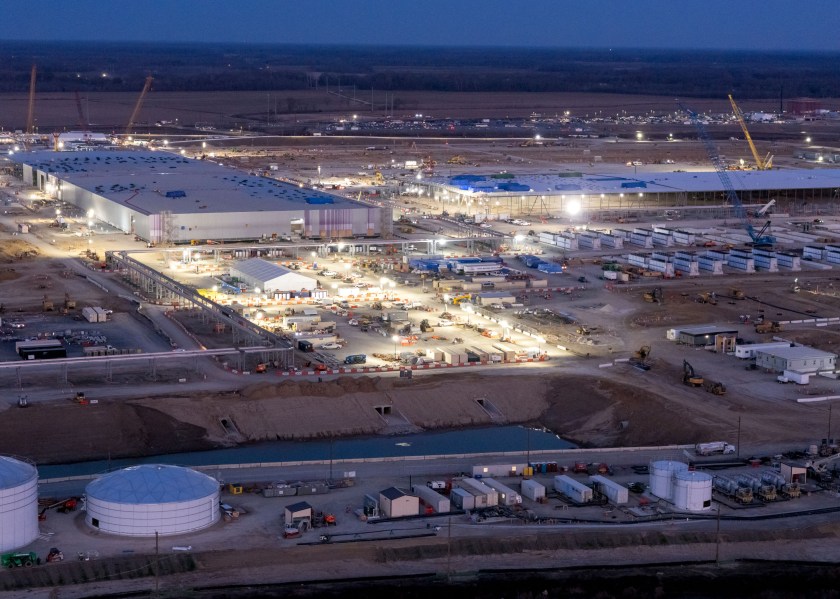
Take, for example, Meta’s so-called Hyperion data center under construction in Richland, Louisiana. When the company announced the two gigawatts of compute capacity at a price tag of some $10 billion in late 2024 it was Meta’s largest planned data center. Greeted with much enthusiasm by state and local politicians, the project, located in the rural northeast corner of the state, was seen as a boon to the community. Entergy Louisiana, the state’s largest utility, rushed forward with proposals to build three large natural-gas power plants to service the massive data center.

Then last fall—the projected cost was now $30 billion—the financing got a lot more complex and, to some in the community, a lot more disconcerting. Meta transferred an 80% stake to the large (and troubled) private-credit firm Blue Owl Capital, forming a joint venture called Beignet (like the famed New Orleans pastry) to raise financing for the data center. Meta then signed a series of four-year leases with the joint venture, an arrangement that the company says gives it “long-term strategic flexibility.” To backstop the agreement, Meta provides the venture with what is called a residual value guarantee, in which it will make a cash payment to cover the value of the facility “following any non-renewal or termination of a lease.” Got all that? 

I hope so. The financial wheeling and dealing is actually even more convoluted, with a cast of wholly owned subsidiaries and LLCs. Beignet has set up Laidley LLC, which owns and operates the site as the landlord. In turn, Laidley leases the facilities to Meta’s wholly owned subsidiary Pelican Leap LLC, which is the tenant. And there is a series of four-year leases that cover the different buildings that make up the data center campus. 

It’s not a coincidence, says Van Nieuwerburgh, that the length of the leases matches the expected lifetime of the data center’s GPUs. While Meta has to pay off its loan if it terminates the leases early, that will still leave its investors “with an empty building and no cash flow,” he says. “And then they need to find a new tenant for a huge data center, and good luck with that.”

Meanwhile, Meta is doubling down on its bet. In July, the company announced it was expanding the data center to five gigawatts of compute capacity. The total price tag is now $50 billion (so far, Meta hasn’t said whether Blue Owl will be involved in financing the expansion). Meanwhile, Entergy is now planning to build seven more gas-fired power plants, bringing the total capacity of the facilities to around 7.5  gigawatts—some six times the amount of electricity used by New Orleans.

An aerial view of the construction of Meta’s data center in Richland Parish, Louisiana.
SCOTT BALL/THE NEW YORK TIMES VIA REDUX PICTURES

If the complex financing is a puzzle to many investors and even financial experts, it is even more baffling to those directly affected by the construction of the data center. The main worry concerns how Entergy’s spending on the natural-gas power plants will affect electricity prices, and who will be left paying the bill for the power if Meta walks away.

Entergy says it has a 20-year guarantee from Meta that the company will purchase electricity over that period to cover the costs of the power plants and related infrastructureBut there are skeptics, especially given how fast the fortunes of the AI industry are changing. “In four years, is Mark Zuckerberg still going to be interested in this? Or is he going to throw in the towel?” asks Paul Arbaje, a senior analyst at the Union of Concerned Scientists, which has been advocating, largely unsuccessfully, for the Louisiana Public Service Commission to provide more transparency around the data center and its financing.

Even if the 20-year deal holds, consumer advocates are worried that Meta or its partners won’t fully cover all the costs, including those associated with operating and maintaining the power plants—and those additional costs that could be passed on to residential ratepayers. What’s more, says Logan Burke, the executive director of the Alliance for Affordable Energy, if Meta doesn’t end up needing as much power as Entergy planned (these projections are not public), consumers could be left paying for the surplus produced by the plants.

And if Meta terminates its leases early? “It gets complicated very quickly,” says Burke, who questions whether the shifting roster of financial entities will honor existing agreements. “That everybody is going to do what they’re saying they’re going to do over the next 20 years is just hard to believe.”

For UCS’s Arbaje the bottom line is this: “They’re making huge bets that these data centers will be worth it. Bet with your own money, not with ratepayer money.”

After the bubble

Predicting when the AI investment bubble will burst is a fool’s errand. But there is little doubt a day of reckoning is coming, given the irrational exuberance that has overtaken the hyperscalers and their investors. Of course, you might argue that this time is different, and that the rules of accounting and lessons of economic history don’t apply—that AI is too transformative. Maybe, but don’t count on it.

“History tells us that at some point you get a retrenchment, and it’s just a question of when and how severe,” says Sloan’s Gensler. It could be that today’s $750 billion spending rate “goes flat” or decreases next year. Or, he suggests, “we’re now in 2028 or 2029, and then all of sudden they’re retrenching because they’ve got enough capacity.” But, he adds, “you can be pretty assured there’ll be a retrenchment.” 

Though a so-called retrenchment might be inevitable, it’s worth keeping in mind that the fates of the financial bubble and the underlying AI technology revolution could be very different. Already, some Silicon Valley insiders are rooting for a crash; in a recent blog post the longtime venture capitalist Vijay Pande wrote that “the coming crash would be the best thing that happens to this technology.” The argument makes some sense. A crash could make AI investments more rational, calm the impulse to build billion-dollar data centers on every vacant field that CEOs fly over, and refocus investors on how to use the technology to create sustainable value.

But we should probably be careful what we wish for. After the bursting of the dot-com bubble at the beginning of the 2000s, hundreds of thousands lost their jobs, large and small companies alike went bankrupt, the economy of Silicon Valley and San Francisco was decimated (at least for a while), and the shocks sent the US into a mild recession in 2001. For the financial community and many tech workers, it was no fun.

Even more devastating for the economy and the average American was the great recession that began in late 2007. Comparing the financial engineering leading up to it and the methods deployed by hyperscalers today is sobering. So-called special purpose vehicles (SPVs) are back! If Columbia’s Van Nieuwerburgh is right about the dangers of letting investments from the hyperscalers get entangled throughout the economy, the fallout could be severe.

But technologies survived and even prospered in the aftermath of both downturns. The early 2000s, even in the face of the dot-com fiasco, were a time of great innovation and tech optimism. The froth came off the spending on silly technologies, helping to focus investments on more promising ones. It’s no coincidence that each of the hyperscalers rose out of the ashes of the crash or started up shortly after. The fiber-optic infrastructure built during the feverish telecom bubble that ran parallel to the dot-com one is still the backbone of much of today’s communication infrastructure; we wouldn’t have Facebook or Amazon or Google without it.

This time, however, we’re facing a unique risk: The huge financial investments by the hyperscalers have ensnared the future of AI itself with the fortunes of the massive data centers spreading around the country. The logic is founded on a deeply held belief about the power of scaling in AI; the bigger you build it, the smarter it gets. That might be true, but it’s unproven and a risky bet.

There are already plenty of red flags, from strong public opposition to the construction of new data centers to the competitive threat from cheaper, good-enough AI models to the rapid improvement of small, local AI models. None of these trends point toward a future dominated by frontier models housed in massive, billion-dollar data centers.

The financial bubble around the colossal spending by the hyperscalers will likely burst eventually—or maybe soon. It might be financially painful, but we’ll survive. Wall Street will survive. AI itself will survive, though it may look different and lose some of today’s hubris. The financial fate and future utility of the massive data centers fueled by trillions of dollars of spending, on the other hand, are far less certain.
Shape
Shape
Stay Ahead

Explore More Insights

Stay ahead with more perspectives on cutting-edge power, infrastructure, energy,  bitcoin and AI solutions. Explore these articles to uncover strategies and insights shaping the future of industries.

Shape

Cornelis lands $205M to make AI networks compute, not just connect

In Ethernet mode, the CN6000 can pair with switches from other vendors, including Broadcom’s Tomahawk line. Traffic sent over Ethernet still passes through an internal encapsulation layer built around Omni-Path. Spelman said that internal architecture preserves congestion management, credit-based flow control, and packet spraying, aimed at low latency and high

Read More »

AI inferencing is headed for the network edge

On the chip front, AI edge models run on an advanced type of chip called a neural processing unit or NPU. These chips, such as Google’s Tensor Processing Unit (TPU) or Qualcomm’s Snapdragon, are small, efficient, and don’t use as much energy or create as much heat as traditional CPUs

Read More »

Insights: Prioritizing process safety management over profits across the refining industry (Pt. 1)

In this Insights episode of the Oil & Gas Journal ReEnterprised podcast, downstream editor and lead reporter Robert Brelsford talks with Joe Barnes, principal of Barnes’ Engineering Consultants and a veteran oil and gas operations, maintenance, reliability, and major-projects leader with more than 30 years of industry experience. Barnes, who spent roughly half of his career in refining and half in exploration and production, discusses why process safety management must remain a central concern for everyone working in oil and gas—not only safety professionals. Drawing on his experience with a major refinery accident and the aftermath of a separate major offshore incident, Barnes explains why good intentions are not enough to prevent major incidents, particularly in times when the potential for high margins could tempt operator’s into promoting maximized production over execution of maintenance on processing and production installations to ensure safe and reliable operations. During the conversation, Robert and Joe examine recurring root causes identified through Barnes’ review of process-safety incidents dating back to the mid-1980s, including absence of  leadership, poor communication, inadequate risk identification and mitigation, aging equipment, deferred maintenance, workforce turnover, and the loss of experienced personnel. They also discuss why the industry has sometimes failed to consistently share and apply lessons from previous incidents, particularly when investigation findings are not widely accessible. The two consider the difference between personal safety and process safety metrics, the warning signs that preceded the 2005 BP Texas City refinery explosion, and the role of management of change (MOC) in evaluating staffing, maintenance, turnaround, efficiency, and capital-reduction decisions. Barnes also outlines the questions boards and executive leaders should be asking to ensure that process safety remains a business priority across economic cycles. Robert and Joe further explore how refineries can use past incident scenarios as practical training tools, strengthen external oversight

Read More »

Energy Department Launches $16 Million Prize To Grow the Mining and Critical Minerals Workforce

WASHINGTON—The U.S. Department of Energy’s (DOE) Office of Critical Minerals and Energy Innovation (CMEI) today launched the PROSPECT Planning Prize to support universities in developing the skilled workforce required to produce, process, recover, and recycle critical minerals on American soil. Each winner will receive up to $1 million from a total prize pool of $16 million. “Mining and critical minerals professionals are essential to America’s success in manufacturing, AI, energy, and national security—but this country isn’t producing enough of them,” said Assistant Secretary of Energy Audrey Robertson. “Through this prize competition, DOE will empower universities to pursue more ambitious strategies for attracting and educating the workers we need for a robust critical mineral supply chain.” This prize competition is part of DOE’s $100 million Providing Opportunities for Specialized Education in Critical Technologies (PROSPECT) initiative, which delivers on President Trump’s bold agenda to restore American energy dominance, rebuild domestic supply chains, and reduce reliance on foreign adversaries for critical minerals. The initiative’s near-term goal is to double the number of graduates with mining, minerals, and associated supply chain credentials across the United States. U.S.-based academic institutions with prize-eligible degree programs are encouraged to submit plans. Proposed programs should aim to substantially increase the number of graduates and other credentialed professionals prepared for relevant mining and supply chain careers in the next two years. Programs may target a range of beneficiaries, including early-career professionals, incumbent workers, educators, and students in university, community college, or high school. Applications are now open. The deadline for submission is Oct. 5, 2026. Learn more about this competition, including key dates and submission details, on the PROSPECT Prize page. The PROSPECT Planning Prize is funded by CMEI and managed by the National Laboratory of the Rockies under the American-Made prize program. ###

Read More »

U.S. Secretary of Energy Chris Wright Delivers U.S. National Statement at the General Conference of the International Atomic Energy Agency in Vienna, Austria

VIENNA, AUSTRIA—U.S. Secretary of Energy Chris Wright today delivered the U.S. National Statement at the General Conference of the International Atomic Energy Agency (IAEA) in Vienna, Austria. Secretary Wright’s full remarks from the International Atomic Energy Agency (IAEA) General Conference are below: I am honored to represent the United States of America at the 70th IAEA General Conference. This year, as we celebrate the 250th anniversary of the founding of the United States, we reflect on a history defined by a tireless spirit of innovation and bold exploration. It was this American drive that, over seven decades ago, moved President Dwight D. Eisenhower to deliver his historic ‘Atoms for Peace’ address, sowing the seeds for the creation of this very Agency. Together, our high-level cooperation has achieved monumental milestones—pioneering global safeguards, securing vulnerable fissile materials across the globe, countering and preparing for radiological and nuclear threats, creating energy abundance, and advancing nuclear science to improve living standards. As the world’s foremost nuclear innovator, the United States remains steadfastly dedicated to the IAEA’s mission. I would like to take a moment to congratulate Timor Leste on becoming the newest member of the IAEA. America looks forward to working with you. Thanks to President Trump’s leadership, the United States is ushering in an American nuclear renaissance. President Trump directed the Administration to revitalize America’s nuclear sector, modernizing regulations, improving processes and streamlining advanced reactor testing to rebuild the nuclear industrial base. This agenda allows the United States to establish an expedited pathway for testing and approving advanced reactors, set standards for converting surplus uranium and plutonium into reactor fuel, and support the energy infrastructure needed for America’s reindustrialization and artificial intelligence. These actions advance President Trump’s bold goal of adding 300 gigawatts of new nuclear capacity in the United States by 2050.

Read More »

YPF taps Axens for new diesel hydrotreater at Argentinian refinery

YPF SA has let a contract to Axens Group to license proprietary technology and provide associated equipment for a new 5,000-cu m/day diesel hydrotreating unit to be installed at one of the Argentine operator’s in-country industrial complexes. As part of the contract announced in September, Axens will deliver the new diesel hydrotreating unit—which will be configured with Prime-D technology—in prefabricated modules, an approach the technology provider said will reduce project execution time by 6 months compared with conventional site construction. The modular design will integrate pressure vessels, structural components, piping, and instrumentation before shipment to the refinery. The approach is intended to limit on-site construction and interference with ongoing refinery operations, Axens said. While Axens confirmed it will execute the project in a way that allows YPF to maintain ongoing operations of the refinery, neither the service provider nor YPF identified which industrial complex will receive the new unit or disclose its capital cost, schedule, or anticipated startup date. Broader fuel-improvement program The new unit comes as part of YPF’s broader program to bring its refining system into compliance with Argentina’s tighter diesel specifications. YPF operates three refineries with combined capacity of 338,000 b/d: La Plata, Luján de Cuyo, and Plaza Huincul. In the operator’s second-quarter 2026 earnings report and accompanying presentation, YPF confirmed completing installation and commissioning in July of its previously announced new hydrotreating unit at the 113,900-b/d Luján de Cuyo refining complex in Mendoza Province, Argentina. In its 2025 annual report published earlier in 2026, YPF said the Luján de Cuyo project also was to include a new hydrogen-generation unit, as well as a revamp of a separate hydrotreating unit at the site. The report identified an estimated $637 million investment for the refinery’s wider fuel-quality program. The annual report also confirmed advanced engineering design for new

Read More »

IEA: Ukrainian drone campaign degrades Russian refining resilience

Increasingly frequent and precise Ukrainian drone attacks are damaging Russian processing units and lengthening repair times, forcing Moscow into unprecedented export bans, relaxed fuel-quality standards, and imports to protect domestic supply, according to the International Energy Agency (IEA). Russia’s 32 major refineries, with 6.5 million b/d of nameplate capacity, make it the world’s third-largest refined-products producer after the US and China. But crude runs fell to 3.8 million b/d in June 2026, down 30% year on year and the lowest since May 2004. Gasoline output is reportedly down about 20%. Ukraine has targeted Russian oil infrastructure since the 2022 full-scale invasion, but IEA said the campaign’s scale, range, and effectiveness increased sharply during 2025-26. A Russian refinery was successfully struck once every 3 days on average in the first 8 months of 2026. Ukrainian forces are now sending multiple drone waves against single sites, overwhelming protective netting and air defenses. Reach has expanded as well. On July 7, Ukraine struck Gazprom Neft PJSC’s 450,000-b/d Omsk refinery, Russia’s largest, some 2,500 km from the border, while several refineries closer to Ukraine have been hit as many as 15 times. By late August, only four major refineries—all in Eastern Siberia or farther east, 3,500-6,500 km from Ukraine—remained untouched. Secondary units targeted Targeting also appears more precise, increasingly hitting secondary units alongside crude distillation units. Fluid catalytic crackers, reformers, and hydrotreaters are critical to light-product yields and fuel specifications. Minor damage to a crude distillation unit can often be repaired in 1-2 weeks, but serious damage to more complex units can require 6-8 months, IEA said. The 250,000-b/d Moscow refinery, heavily damaged in June, is reportedly offline until early 2027. Sanctions are compounding the problem by restricting access to replacement equipment and specialist suppliers. Refiners have tried to preserve throughput by postponing maintenance,

Read More »

BLM Wyoming lease sale generates $82 million, Colorado’s sale fetches $4.7 million

The US Bureau of Land Management (BLM)’s quarterly lease sale in Wyoming Sept. 10 showed a robust $82.4 million in high bids, while its Colorado lease sale pulled in $4.7 million, a fraction of the $35.26 million in revenue generated at the bureau’s last lease sale in the state in June. In Wyoming, BLM leased 99 parcels totaling 114,389 acres, with strong interest and competition in Converse and Campbell Counties in the Powder River basin of northeastern Wyoming. The two counties produced 64% of Wyoming’s crude oil in 2024, with Converse leading at 43.3 million bbl, according to the Wyoming State Geological Survey. BLM’s sales statistics show that of the 17 parcels receiving 10 or more bids during the sale, all but 2 were in Converse and Campbell Counties. Most parcels there fetched over $1000/acre, with one in Converse receiving an $8,000/acre winning bid. In contrast, many other counties saw little competition, with 37,000 acres receiving no bids and 12 parcels, totaling over 16,000 acres, going for the legal minimum of $10/acre. In Colorado, BLM leased 29 parcels totaling 14,212 acres. The bureau offered far more acreage in the two previous sales–leasing 134,173 acres in June and 42,532 acres in September. Details of the Colorado sale were unavailable pending the state’s final review. Federal onshore oil and gas leases extend 10 years or as long as production continues in paying quantities, and they carry a 12.5% royalty rate, with revenues split between the federal government and the state.

Read More »

Nuclear’s Next AI Test: Building at Scale

For data center developers facing multiyear utility interconnection queues and tightening power markets, nuclear energy is entering a different phase of its AI infrastructure story. The near-term opportunity still rests largely with the existing reactor fleet. Holtec International has moved the Palisades Nuclear Plant in Michigan into fuel loading, one of the final major stages before reactor startup activities. Constellation Energy, meanwhile, continues to work toward a 2027 restart of the former Three Mile Island Unit 1, now the Christopher M. Crane Clean Energy Center, under its long-term power agreement with Microsoft. Together, Palisades and Crane represent roughly 1.64 GW of existing nuclear capacity that could return to service without waiting for entirely new plants to be licensed, financed and constructed. That makes reactor restarts one of the few ways nuclear generation can materially intersect with data center power demand before the end of the decade. But the more consequential change may be taking place further upstream. A burst of activity from advanced nuclear developers at the end of August pointed increasingly toward the industrial systems required to move new reactor designs from demonstrations to repeatable infrastructure. X-energy, TerraPower, GE Vernova Hitachi, Oklo, Westinghouse, Kairos Power and others reported progress involving fuel supply, reactor testing, manufacturing, licensing and commercial deployment. None of these advanced reactor projects will solve the industry’s 2027 or 2028 power shortage. That is no longer the most useful test. The more important question is whether advanced nuclear can begin acquiring the characteristics of an industrial supply chain: dependable fuel, standardized manufacturing, repeatable construction, tested reactor systems and enough commercial certainty for large power customers to plan around deployment schedules measured in years rather than speculation. For data center infrastructure, that is the transition worth watching. Palisades Moves From Restoration to Startup The clearest near-term proof point

Read More »

The waste heat paradox: How data centers can cool AI with the heat AI creates

A 40-year-old technology built for this exact moment Absorption chillers produce chilled water the way a conventional chiller does, but they use heat instead of electricity to drive the refrigeration cycle. A generator uses hot water, steam, or exhaust gas to separate refrigerant vapor from a lithium bromide solution; the vapor condenses, evaporates under low pressure to produce the cooling effect, and is reabsorbed to close the loop. Because there’s no large electrically driven compressor, the electrical footprint is small: industry analysis puts absorption chillers at roughly 2 MW of cooling output for just 20–25 kW of electrical input, compared to 500 kW or more of electrical draw for a conventional chiller doing the same job. The technology has existed commercially for decades and never displaced electric chillers at scale, for one simple reason: it needs a steady, moderate-to-high-temperature heat source to run, and building a boiler specifically to feed one erased most of the savings. That missing piece is exactly what two current infrastructure trends are now supplying as a byproduct. Two trends CIOs are already funding that solve the “missing heat” problem 1. On-site power generation is becoming standard, not exceptional Grid interconnection delays in major data center markets now stretch into years, pushing hyperscale operators toward gas turbines, engines, and fuel cells built directly on campus — all of which reject substantial heat as a byproduct of making electricity. Bloom Energy already pairs its fuel-cell systems directly with absorption chillers at data center sites, using exhaust heat to generate chilled water and reduce reliance on the electric chiller plant. Some industry forecasts expect roughly a third of data centers to run fully on-site-powered campuses by 2030 — meaning this heat stream is a permanent feature of the infrastructure roadmap, not a one-off opportunity.

Read More »

DCF Poll: How Should Utilities Vet Real vs. ‘Ghost’ Data Center Demand?

Matt Vincent is Editor in Chief of Data Center Frontier, where he leads editorial strategy and coverage focused on the infrastructure powering cloud computing, artificial intelligence, and the digital economy. A veteran B2B technology journalist with more than two decades of experience, Vincent specializes in the intersection of data centers, power, cooling, and emerging AI-era infrastructure. Since assuming the EIC role in 2023, he has helped guide Data Center Frontier’s coverage of the industry’s transition into the gigawatt-scale AI era, with a focus on hyperscale development, behind-the-meter power strategies, liquid cooling architectures, and the evolving energy demands of high-density compute, while working closely with the Digital Infrastructure Group at Endeavor Business Media to expand the brand’s analytical and multimedia footprint. Vincent also hosts The Data Center Frontier Show podcast, where he interviews industry leaders across hyperscale, colocation, utilities, and the data center supply chain to examine the technologies and business models reshaping digital infrastructure. Since its inception he serves as Head of Content for the Data Center Frontier Trends Summit. Before becoming Editor in Chief, he served in multiple senior editorial roles across Endeavor Business Media’s digital infrastructure portfolio, with coverage spanning data centers and hyperscale infrastructure, structured cabling and networking, telecom and datacom, IP physical security, and wireless and Pro AV markets. He began his career in 2005 within PennWell’s Advanced Technology Division and later held senior editorial positions supporting brands such as Cabling Installation & Maintenance, Lightwave Online, Broadband Technology Report, and Smart Buildings Technology. Vincent is a frequent moderator, interviewer, and keynote speaker at industry events including the HPC Forum, where he delivers forward-looking analysis on how AI and high-performance computing are reshaping digital infrastructure. He graduated with honors from Indiana University Bloomington with a B.A. in English Literature and Creative Writing and lives in southern New Hampshire with

Read More »

Nvidia invests $3.5B in MediaTek to extend its grip on AI

AI infrastructure: MediaTek will work with Nvidia’s NVLink Fusion ecosystem to enable customers to develop custom AI infrastructure designed to integrate with Nvidia rack-scale systems and AI factories. Local AI computing: The companies will continue to collaborate on multiple generations of Nvidia RTX Spark and DGX Spark PC chips, powering consumer PCs, AI developer supercomputers, and enterprise-class workstations, that integrate Nvidia GPUs with MediaTek SoCs. Automotive: MediaTek and Nvidia will continue developing platforms for AI-powered, software-defined vehicles in the era of physical AI.  “MediaTek is one of the world’s great semiconductor companies, with exceptional expertise in system-on-chip design, connectivity, leading performance and power efficiency,” said Jensen Huang, founder and CEO of Nvidia, in a statement. “Together, we’re building platforms that bring Nvidia accelerated computing to new markets and give customers the freedom to create differentiated AI systems at enormous scale.” NVLink is a high-performance interface, but this move also helps lock in customers to the Nvidia platform, since NVLink Fusion is not about to hook up to AMD processors. For MediaTek, the Nvidia investment provides a big pile of cash and access to Nvidia’s infrastructure as it attempts to establish itself as a major supplier of custom data center silicon.

Read More »

AI Puts Fiber on the Critical Path

Fiber Becomes Part of the Build A decade ago, DC Blox might have prioritized land near existing fiber from AT&T, Verizon, Zayo or another established network provider. That calculation is different today. As data center campuses have grown and hyperscalers have become a larger share of the customer base, Wabik said connectivity has increasingly become another construction package associated with the project itself. “If Zayo or Verizon or AT&T just happens to be there close by, that’s a good thing,” he said. “But fiber construction is inherently anymore just part of the construction component.” That changes the site-selection question from Is there fiber nearby? to Can fiber be built here at the scale and diversity the customer requires? For DC Blox, Wabik said that can mean assessing whether sufficient public right-of-way exists to establish three or sometimes four diverse fiber paths into a data center. That distinction is important, as AI workloads push infrastructure into markets where power, land and energy options may be more abundant than established carrier density. The hyperscalers themselves have also become major network builders. Wabik characterized them provocatively as today’s telecom providers, pointing to the scale of terrestrial fiber they commission as well as the growing role of companies such as Amazon, Google and Meta in subsea cable development. The point is less that traditional carriers have disappeared than that hyperscalers increasingly design, commission and control enormous portions of the connectivity required to support their own infrastructure. DC Blox now sees requests for 864-count fiber as routine and, in some cases, 1,728-count cable. That would have been difficult to imagine during an earlier era when a handful of fibers from an established carrier could satisfy a data center’s connectivity requirements. AI-Scale Fiber Gets Physical The scale becomes clearer when the discussion moves from abstract network

Read More »

Power First: AI Data Centers Become Energy Systems

For decades, data centers consumed electricity much like other large commercial customers: power arrived from the utility, while batteries and diesel generators stood behind it to protect the load. AI is starting to break that model. As data center campuses grow toward hundreds of megawatts and, in some cases, gigawatt scale, developers are increasingly taking responsibility for an energy system that once sat largely outside the data center boundary. Natural gas supply, onsite generation, fuel cells, batteries, controls and the behavior of the compute load itself are increasingly becoming parts of the same infrastructure system. That was the central thread running through “Power First: The New Playbook for Delivering AI Data Centers,” an Aug. 4 session at the Data Center Frontier Trends Summit 2026 in Reston, Virginia. Moderated by Fengrong Li, Senior Managing Director at FTI Consulting, the panel brought together Jim Summers, CEO of GPC Infrastructure; Shankar Achanta, EVP and Chief Product and Technology Officer at FuelCell Energy; Judith Judson, Executive Vice President at Calibrant Energy; and Yuval Bachar, Founder and CEO of EdgeCloudLink. The discussion began with the immediate constraint — the grid cannot deliver capacity on the timetable AI developers increasingly require — but quickly moved beyond the familiar concept of “bridge power.” The larger question was what happens when the data center itself becomes an energy system. From Backup Power to Prime Power Behind-the-meter generation is not new. What has changed is its role and scale. “Traditionally, behind-the-meter generation has been for backup and the sizes were smaller,” Achanta said. “But what they’re seeing is the demand for the power is growing rapidly due to the data center load.” Interconnection queues, transmission limitations and equipment supply constraints are pushing onsite generation into what Achanta called the “front seat,” supplying primary power rather than waiting behind the

Read More »

Microsoft will invest $80B in AI data centers in fiscal 2025

And Microsoft isn’t the only one that is ramping up its investments into AI-enabled data centers. Rival cloud service providers are all investing in either upgrading or opening new data centers to capture a larger chunk of business from developers and users of large language models (LLMs).  In a report published in October 2024, Bloomberg Intelligence estimated that demand for generative AI would push Microsoft, AWS, Google, Oracle, Meta, and Apple would between them devote $200 billion to capex in 2025, up from $110 billion in 2023. Microsoft is one of the biggest spenders, followed closely by Google and AWS, Bloomberg Intelligence said. Its estimate of Microsoft’s capital spending on AI, at $62.4 billion for calendar 2025, is lower than Smith’s claim that the company will invest $80 billion in the fiscal year to June 30, 2025. Both figures, though, are way higher than Microsoft’s 2020 capital expenditure of “just” $17.6 billion. The majority of the increased spending is tied to cloud services and the expansion of AI infrastructure needed to provide compute capacity for OpenAI workloads. Separately, last October Amazon CEO Andy Jassy said his company planned total capex spend of $75 billion in 2024 and even more in 2025, with much of it going to AWS, its cloud computing division.

Read More »

John Deere unveils more autonomous farm machines to address skill labor shortage

Join our daily and weekly newsletters for the latest updates and exclusive content on industry-leading AI coverage. Learn More Self-driving tractors might be the path to self-driving cars. John Deere has revealed a new line of autonomous machines and tech across agriculture, construction and commercial landscaping. The Moline, Illinois-based John Deere has been in business for 187 years, yet it’s been a regular as a non-tech company showing off technology at the big tech trade show in Las Vegas and is back at CES 2025 with more autonomous tractors and other vehicles. This is not something we usually cover, but John Deere has a lot of data that is interesting in the big picture of tech. The message from the company is that there aren’t enough skilled farm laborers to do the work that its customers need. It’s been a challenge for most of the last two decades, said Jahmy Hindman, CTO at John Deere, in a briefing. Much of the tech will come this fall and after that. He noted that the average farmer in the U.S. is over 58 and works 12 to 18 hours a day to grow food for us. And he said the American Farm Bureau Federation estimates there are roughly 2.4 million farm jobs that need to be filled annually; and the agricultural work force continues to shrink. (This is my hint to the anti-immigration crowd). John Deere’s autonomous 9RX Tractor. Farmers can oversee it using an app. While each of these industries experiences their own set of challenges, a commonality across all is skilled labor availability. In construction, about 80% percent of contractors struggle to find skilled labor. And in commercial landscaping, 86% of landscaping business owners can’t find labor to fill open positions, he said. “They have to figure out how to do

Read More »

2025 playbook for enterprise AI success, from agents to evals

Join our daily and weekly newsletters for the latest updates and exclusive content on industry-leading AI coverage. Learn More 2025 is poised to be a pivotal year for enterprise AI. The past year has seen rapid innovation, and this year will see the same. This has made it more critical than ever to revisit your AI strategy to stay competitive and create value for your customers. From scaling AI agents to optimizing costs, here are the five critical areas enterprises should prioritize for their AI strategy this year. 1. Agents: the next generation of automation AI agents are no longer theoretical. In 2025, they’re indispensable tools for enterprises looking to streamline operations and enhance customer interactions. Unlike traditional software, agents powered by large language models (LLMs) can make nuanced decisions, navigate complex multi-step tasks, and integrate seamlessly with tools and APIs. At the start of 2024, agents were not ready for prime time, making frustrating mistakes like hallucinating URLs. They started getting better as frontier large language models themselves improved. “Let me put it this way,” said Sam Witteveen, cofounder of Red Dragon, a company that develops agents for companies, and that recently reviewed the 48 agents it built last year. “Interestingly, the ones that we built at the start of the year, a lot of those worked way better at the end of the year just because the models got better.” Witteveen shared this in the video podcast we filmed to discuss these five big trends in detail. Models are getting better and hallucinating less, and they’re also being trained to do agentic tasks. Another feature that the model providers are researching is a way to use the LLM as a judge, and as models get cheaper (something we’ll cover below), companies can use three or more models to

Read More »

OpenAI’s red teaming innovations define new essentials for security leaders in the AI era

Join our daily and weekly newsletters for the latest updates and exclusive content on industry-leading AI coverage. Learn More OpenAI has taken a more aggressive approach to red teaming than its AI competitors, demonstrating its security teams’ advanced capabilities in two areas: multi-step reinforcement and external red teaming. OpenAI recently released two papers that set a new competitive standard for improving the quality, reliability and safety of AI models in these two techniques and more. The first paper, “OpenAI’s Approach to External Red Teaming for AI Models and Systems,” reports that specialized teams outside the company have proven effective in uncovering vulnerabilities that might otherwise have made it into a released model because in-house testing techniques may have missed them. In the second paper, “Diverse and Effective Red Teaming with Auto-Generated Rewards and Multi-Step Reinforcement Learning,” OpenAI introduces an automated framework that relies on iterative reinforcement learning to generate a broad spectrum of novel, wide-ranging attacks. Going all-in on red teaming pays practical, competitive dividends It’s encouraging to see competitive intensity in red teaming growing among AI companies. When Anthropic released its AI red team guidelines in June of last year, it joined AI providers including Google, Microsoft, Nvidia, OpenAI, and even the U.S.’s National Institute of Standards and Technology (NIST), which all had released red teaming frameworks. Investing heavily in red teaming yields tangible benefits for security leaders in any organization. OpenAI’s paper on external red teaming provides a detailed analysis of how the company strives to create specialized external teams that include cybersecurity and subject matter experts. The goal is to see if knowledgeable external teams can defeat models’ security perimeters and find gaps in their security, biases and controls that prompt-based testing couldn’t find. What makes OpenAI’s recent papers noteworthy is how well they define using human-in-the-middle

Read More »