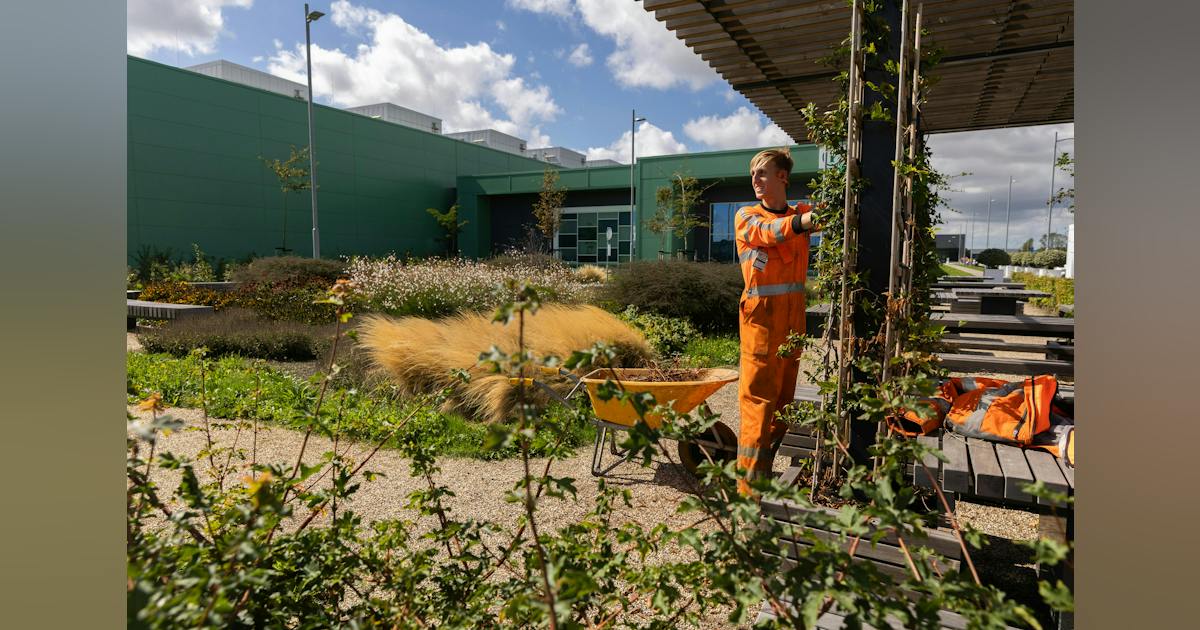
As a result, Microsoft has said six additional data centers planned in the region are being designed around biomimicry principles rather than treating landscaping as something added after the engineering work is finished. The change, from landscaping as decoration to ecology as a design input, is now being applied elsewhere.
There is already a significant US example, set in Mecklenburg County, Virginia, where Microsoft originally announced the Chase City Conservancy in 2022, as part of a data center development south of Chase City. The completed project, which opened in April 2025, protects more than 230 acres from development. It includes more than eight acres of wetlands, over 16,300 linear feet of restored streams, 185 acres of native pollinator habitat, more than 25,000 planted trees and over three miles of publicly accessible walking trails.
Local environmental organizations helped shift the design away from what the company describes as a more conventional recreational area toward biodiversity and habitat conservation illustrating the community-engagement side of Microsoft’s model, which, given the current temperature of such relationships, can’t be understated. For data center developers, that may be as important as the ecological results.
Community impact is no longer being evaluated on just tax revenue and jobs. Turning portions of a site into protected wetlands, forests, trails or habitat potentially creates a visible local benefit in ways that renewable-energy contracts hundreds of miles away cannot. Microsoft’s commitment to the local community has been led by their Community First AI Infrastructure Plan announced in January 2026.
Wetlands in Wisconsin, Screening in Georgia
At Microsoft’s massive Mount Pleasant, Wisconsin, AI data center development, the company is working with the Root-Pike Watershed Initiative Network on restoration projects involving wetlands, native prairie and forested riparian buffers.
One element involves returning previously straightened streams to more natural, winding channels, improving aquatic habitat while slowing runoff and reducing erosion before water reaches Lake Michigan.
The relationship predates Microsoft’s latest biodiversity initiative. Microsoft began supporting Root-Pike restoration projects several years ago, including work at Cliffside Park and Lamparek Creek. In announcing its expanding Wisconsin AI infrastructure plans in 2025, Microsoft said its funding supported 20 ecological restoration projects in Racine and Kenosha counties. Its latest sustainability material describes an even broader portfolio of 30 high-priority projects.
In East Point, Georgia, where the data center sits closer to residential development, the ecological strategy looks different. The groundbreaking, in February 2026, talked about the collaboration with community groups in designing the public green space. Plans include native trees and plants, a walking trail and mature, faster-growing vegetation intended to create a natural visual barrier between the campus and its neighbors. The design itself was modified following community feedback, including relocating infrastructure and increasing buffers between the data center and nearby homes.
Measuring Whether Nature-Based Design Works
One concern with corporate biodiversity programs has always been measurement. A company can count trees planted. Determining whether those trees created a functioning ecosystem or whether a wetland is actually improving water quality is much more difficult.
Microsoft’s team is using an Azure-hosted tool called Ecosystem Intelligence to quantify environmental functions including biodiversity, water quality and even the ability of landscapes to reduce noise impacts. Ecosystem Intelligence describes its platform as a system for quantifying ecological services including water-quality improvement, nitrogen removal, stormwater management, air-temperature regulation, habitat development and visual and acoustic screening.
If these measurements can accurately quantify these ecological efforts over the long term it would mean that the measurement component could become particularly important as biodiversity moves into data center permitting, ESG reporting and community-benefit agreements.
Microsoft has already been moving in that direction at the corporate level. In its 2024 corporate sustainability report the company reported that it had permanently protected 15,849 acres, exceeding its goal of protecting more land than it uses by more than 30%.
Microsoft Isn’t Alone
Microsoft’s program also reflects a broader shift among the largest data center developers.
Meta may have the closest parallel. The company says it uses a standardized, science-based approach to biodiversity at its data center campuses, beginning with assessments by local habitat specialists during site development and continuing through construction and operations.
More than 50% of Meta’s operational data center footprint, over 4,000 acres, has now been planned, restored or preserved specifically to support native habitat. Its standard campus design dedicates much of its undeveloped land to native vegetation while largely eliminating turf grass and ornamental non-native plantings.
Vantage Data Centers is pushing the concept further into its development standards. In March 2026, the company said all new developments would aim for biodiversity net gain, alongside water-positive outcomes and green-building certification. The company outlined its biodiverse development plans in a blog entry titles “Our Approach to Responsible Growth.”
Its Lighthouse campus in Port Washington, Wisconsin, which is being developed as part of the OpenAI/Oracle Stargate infrastructure buildout is an early example. Vantage says it plans to develop roughly 500 acres of the 672-acre property while preserving and enhancing remaining natural areas, planting more than 2,000 native trees, protecting and enhancing wetlands and using a planted berm with native species as a natural noise barrier.
CyrusOne has been incorporating similar measures for years. Its Dublin I development in Ireland included restored grasslands, pollinator-friendly landscaping and amphibian habitat. The operator now describes biodiversity as a formal component of its sustainability strategy, based on reducing impacts through site selection, restoring habitat with native landscaping and supporting off-site ecological projects. CyrusOne has also created wildflower meadows, wetlands supporting frogs and newts, native woodland and pollinator-friendly orchards. The company’s 2026 Sustainability Report can be found here.
Digital Realty is combining ecological restoration with brownfield redevelopment at its proposed Fort Gillem campus outside Atlanta. The company expects to spend more than $100 million on remediation and environmental work at the former military property, including stream mitigation, soil remediation and habitat restoration intended to support local biodiversity.
Google’s approach has focused heavily on watershed restoration rather than specifically redesigning every data center campus, its data center communities are increasingly part of the same movement. Near Google’s Clarksville, Tennessee, facility, for example, the company is supporting reforestation of previously mined land in the Cumberland River watershed and soil restoration across 1,000 acres of farmland in the Red River watershed.
Google has also incorporated watershed-risk analysis into the planning process for new data center locations, including using the results to choose air cooling for its Mesa, Arizona, facility because of local water scarcity.
From Landscaping to Infrastructure
Historically, landscaping around a data center largely meant satisfying zoning requirements, providing visual screening and maintaining enough grass and trees to make an industrial building less conspicuous. But the next generation of campuses is treating that acreage differently.
Wetlands can become stormwater infrastructure. Forested buffers can address both habitat and noise. Native plants can reduce irrigation. Restored streams can manage runoff. Tree canopy can reduce local heat. Conservation acreage can provide both wildlife habitat and community recreation. These are not marginal concerns for companies increasingly developing campuses measured in hundreds or thousands of acres.
AI infrastructure is expanding into markets where resistance to large data center projects is rising over power requirements, water consumption, noise, transmission lines and changes to rural landscapes. Biodiversity programs will not erase those concerns, nor compensate for poor siting decisions.
Microsoft’s effort suggests ecosystem planning is beginning to become another engineering discipline within hyperscale development rather than a sustainability initiative applied after a campus has already been designed.
The company’s data center strategy has been moving in the same direction. New Microsoft facilities designed since August 2024 employ closed-loop cooling intended to eliminate ongoing water consumption for cooling. In Newport, Wales, Microsoft is constructing a data center whose structure is 74% upcycled steel, while a Finland project will capture data center heat for a district-energy system expected eventually to serve 250,000 people and businesses.
For Chuzi, the objective is ultimately to stop treating the data center and the environment around it as separate systems: