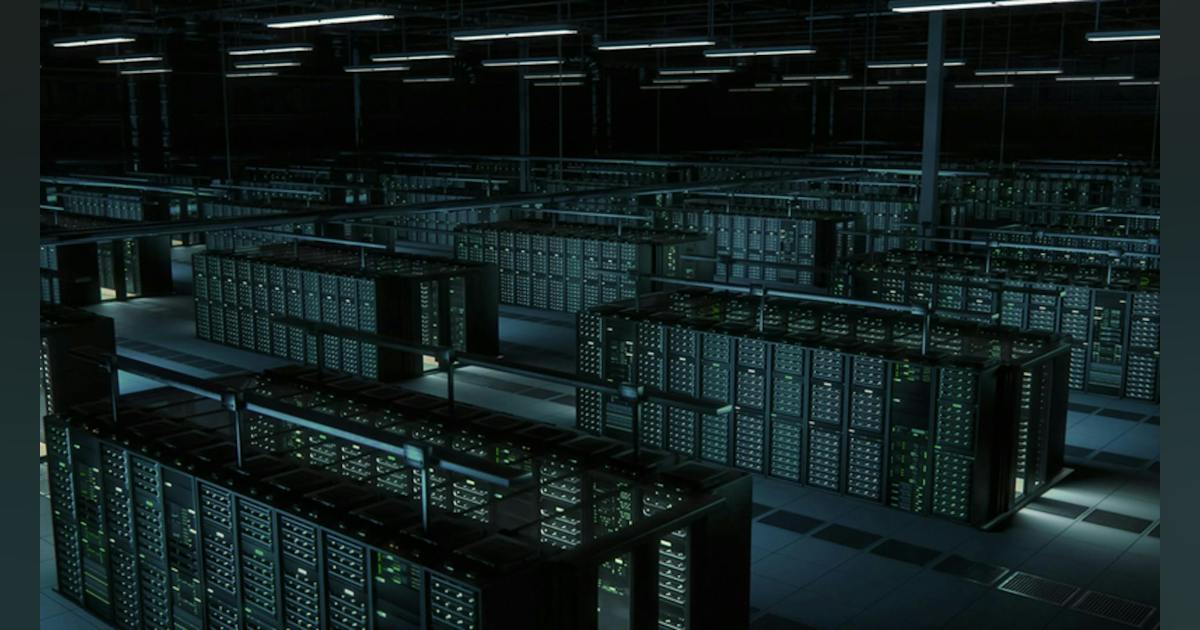
Today’s advanced AI data center can be viewed as a vast, complex and interdependent digital organism in which a virtually infinite number of components must be tracked all the time, in real time. It’s a monitoring job of staggering proportions. At stake is the operation of highly critical workloads and the maintenance of return on investment for high-cost compute equipment. At risk is sub-optimal performance or, in worst-case scenarios, the nightmare of data center downtime.
Sponsored Resources:
Why traditional telemetry misses nanosecond power-rail events
Telemetry has long been relied upon to monitor data center servers, test and measurement equipment, wireless infrastructure and other systems for real-time information about voltage, current, power, temperature and overall system health. But most systems operate at millisecond-level intervals or slower, which is six orders of magnitude longer than the transient events that now occur at the processor power rails and the tools meant to observe them. The requirements and high stakes of today’s AI data centers and workloads have called for a new generation of advanced, nanosecond-level telemetry gear.
Texas Instruments has established a leadership position in this sector. The company has developed the first analog-to-digital converter (ADC) to enable 24/7, low-power, event-based remote monitoring at nanosecond resolution. Let’s unpack this statement and examine why TI’s new monitoring technology is so important for the data center industry.
What is the TI ADC34DSO75?
We’re talking specifically about TI’s ADC34DSO75, the industry’s highest-performance, 3 gigasamples per second (GSPS) ADC, delivering thousands of times faster performance than current offerings. Launched at the Open Compute Project Global Summit conference in October, the ADC34DSO75 addresses the shortcomings of existing monitoring solutions that can’t detect the nanosecond-level power-rail glitches that cause costly data center downtime. The ADC34DSO75 combines ultra-high-speed sampling with advanced on-chip digital signal processing in a small form factor, detecting and capturing transient fault events in real time.
“AI deployments span tens of thousands of GPUs producing enormous compute power combined with operating conditions that change by the second,” said Shannon Lippincott, TI product marketing manager, high-speed data convertors in a technical article for TI. “Workloads continually ramp up and down, requiring server power systems to respond to dynamic demands. The result is voltage droops, overshoots and other transient events at the processor power rail, many of which can occur in nanoseconds.”
Lippincott explained that although nanosecond-level telemetry exists today, many events can occur during complex workflows and result in brownouts or downtime without showing up on existing telemetry systems. Within 100 ms, a server can experience several nanosecond-scale electrical events that, left undetected, can trigger resets, retests, triage, throttling and interrupted workloads. The result: reduced AI compute performance and underutilization of processors and other components at major cost.
What do undetected power glitches cost data centers?
Without effective detection capabilities, technicians are forced to manually debug the situation, spending hours or days combing through hardware, firmware and system logs to isolate nanosecond-scale transients that have caused problems. The Uptime Institute reported that 57 percent of major outages cost more than $100,000, with one in five outages surpassing $1 million.
Another shortfall of traditional high-speed detection technology, including those with nanosecond telemetry, is that they tend to be too large, too power-hungry and too costly for at-scale deployment across thousands of AI data center server racks.
Critical advantages of TI’s ADC34DSO75 are its small size and low power consumption. It leverages advanced analog design and an integrated digital signal processor, processing and refining signals in real time while simplifying the overall architecture and reducing the need for field-programmable gate arrays (FPGAs) and their complexity and high cost. It combines a signal-to-noise (SNR) ratio of 68 dBFS with low phase and amplitude noise and has half the power consumption of competing solutions within a one-inch-by-two-inch form factor.
“The glitches technicians look for are like a needle in a haystack,” said Karthik Vasanth, vice president of TI’s Data Converters and Clocks business unit. “Engineers program the parameters of the needle, and the chip searches the haystack. The ADC34DSO75 detects the glitches data centers can’t see.”
Inside the eight-channel system-on-module board
TI also built around the ADC34DSO75 an eight-channel system-on-module (SOM) board. The board measures eight voltages inside a processor with nanosecond resolution using two of the data converters, each handling four channels. The board includes a microcontroller unit (MCU) and flash memory for storing event data, so if power goes out, the information stays on the card for retrieval later. Designers can offload the full onboard memory in about 10 ms at 200 Mbps.
In all, the ADC34DSO75’s configurable, integrated event detection and capture enable engineers to tailor monitoring to their specific needs. And its remote event reporting capability eliminates the need to send a technician on-site or connect an oscilloscope to troubleshoot an event, minimizing downtime and reducing the security risk of physical hardware access.
From nanosecond visibility to predictive fault detection
The bar for data center reliability is always rising even as reliability grows in complexity. Moving forward, TI plans to combine nanosecond-level monitoring with system intelligence to support predictive fault detection and autonomous system management with the goal of anticipating and fixing problems before they occur. Data center design is increasingly being pushed toward meeting automotive-grade reliability standards, and in some cases, operators are targeting parts-per-billion levels of reliability. As electronics become increasingly complex, the ability to address stability challenges depends on ultrafine visibility.
Monitoring nanosecond-level events, Vasanth said, is “a forerunner or precursor to the reliability of a data center.” That is, this level of visibility allows engineers to anticipate failures rather than just react to them.
“As AI workloads drive massive scale, the need for real-time visibility and architectural stability has never been greater,” said Vasanth. “By delivering industry-leading solutions for high-speed telemetry, advanced power protection and precision timing, TI is enabling hyperscalers and operators to design the next generation of AI data centers with optimized performance and minimal downtime.”
Sponsored Resources: