The Cases Writing the Rules
The regulatory questions surrounding private power are no longer theoretical. Federal regulators, regional grid operators and state utility commissions are already confronting disputes over co-located generation, transmission obligations, large-load tariffs and the financial commitments required from data center customers.
Amazon–Talen Puts Co-Location Before FERC
The Amazon–Talen–Susquehanna dispute became the most prominent federal test of how far a co-located data center can separate its power supply from the regional grid while remaining connected to the grid’s reliability framework.
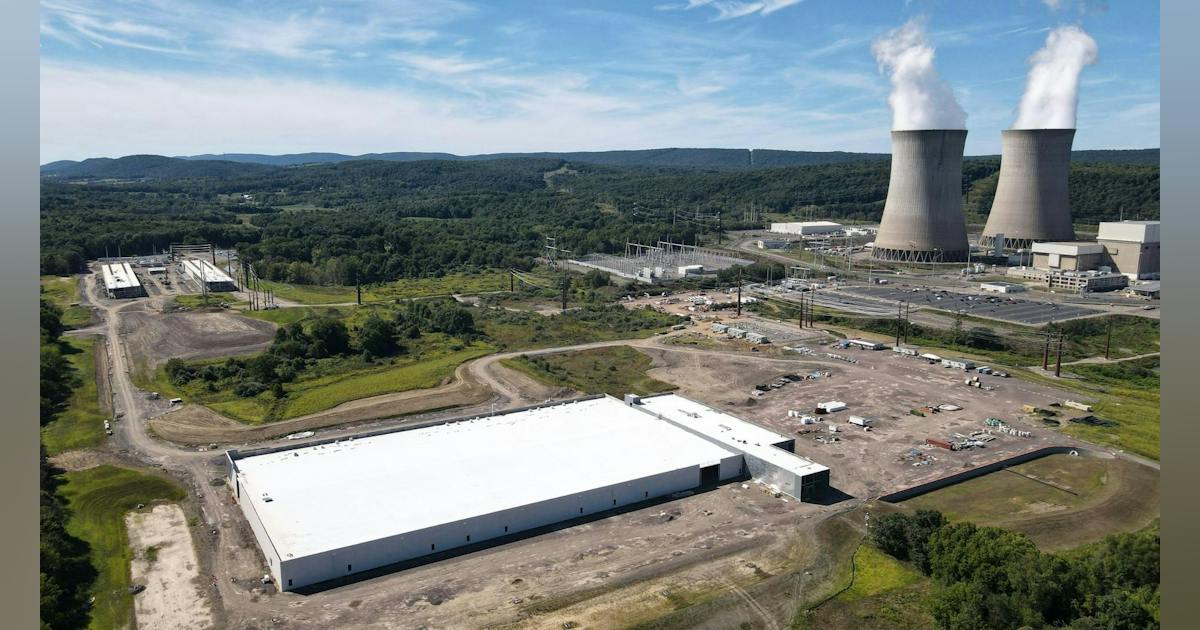
Amazon Web Services operates a data center campus adjacent to Talen Energy’s Susquehanna nuclear plant in Pennsylvania. In 2024, the parties sought to expand the co-located load from 300 MW to 480 MW through an amended interconnection agreement with PJM. The proposed structure would have allowed the campus to receive more power directly from the nuclear plant while reducing the plant’s capacity interconnection rights on the PJM system.
FERC rejected the amendment in November 2024, concluding that PJM had not justified the nonstandard provisions in the agreement. Importantly, the Commission did not prohibit co-location or dedicated generation. The dispute instead exposed a larger gap in existing transmission rules: how should a large load located beside a generator be measured, what transmission service does it require, what happens when the generator is unavailable, and how should the project pay for continued access to regional reliability?
Those questions soon moved beyond the Amazon–Talen project itself. In December 2025, FERC found that PJM’s existing framework did not provide sufficiently clear and consistent rules for generators serving co-located loads or for transmission customers taking service on their behalf. The Commission directed PJM to develop defined interconnection and operating requirements along with transmission options ranging from conventional network service to firm and non-firm contract-demand structures.
The central issue is deceptively simple: physical proximity to a power plant does not necessarily remove a data center from the transmission system.
A campus may ordinarily obtain most of its electricity directly from adjacent generation, but the grid may still have to stand ready when that plant trips, enters maintenance, experiences a fuel constraint or cannot meet the site’s full demand. That retained capability has value — and cost.
From One Dispute to a National Large-Load Proceeding
FERC widened that inquiry in June 2026, issuing show-cause orders requiring jurisdictional regional transmission organizations and transmission owners to explain or revise how their tariffs address the study, interconnection, cost recovery and transmission service of very large loads.
The proceedings brought the gross-versus-net-load question to the center of the national debate.
Consider a 500 MW data center supplied by 400 MW of on-site or adjacent generation. Under normal conditions, the campus might draw only 100 MW from the regional grid. But if the private plant becomes unavailable, the transmission system could potentially be called upon to support far more than that 100 MW.
That distinction affects much more than the monthly power bill. It can influence transmission planning, network upgrades, reserve requirements, resource adequacy, standby obligations and ultimately the economics of co-locating data centers with dedicated generation.
FERC’s 2026 action also examined whether certain reliability services should be assessed on gross rather than net demand and whether large loads capable of curtailing during grid stress should have access to different firm or non-firm transmission products. The broader direction is clear: self-supply and co-location remain viable, but projects that retain material access to regional reliability increasingly will need to define precisely what service they require and how they will pay for it.
The Earlier Warning From Nevada
The underlying tension predates today’s AI-scale power demand.
A decade ago, Switch fought to leave NV Energy and procure electricity from alternative suppliers for its Nevada data center operations. State regulators initially denied the request despite a proposed exit payment intended to protect remaining utility customers from stranded costs. Switch later reached an agreement allowing it to leave utility service subject to substantial financial obligations.
That case was not a behind-the-meter or co-location dispute in the modern sense. But it established an enduring principle: securing an alternative source of electricity does not necessarily allow a large customer to walk away from costs incurred by the utility system on its behalf.
Today’s debate extends that same question from leaving utility service to remaining connected while relying increasingly on private supply.
Ohio: Large-Load Commitments Meet Behind-the-Meter Rights
Ohio illustrates how the issue is developing at the state level.
In 2025, the Public Utilities Commission of Ohio approved an AEP Ohio tariff for new data centers and certain other large loads above 25 MW. The structure requires long-term capacity commitments and minimum payments tied to contracted demand, along with exit provisions intended to protect the utility and other customers if a project delays, scales back or leaves service after infrastructure has been built for it.
The tariff dispute goes directly to the allocation of development risk. Utilities want assurance that generation, transmission and substation investments made for a large customer will be recovered even if the project’s expected load does not fully materialize. Data center operators, meanwhile, must evaluate whether long-term minimum commitments restrict their ability to respond to changing workloads, technology and power strategies.
Ohio is especially significant because the state has simultaneously clarified a path for behind-the-meter generation. That creates both an obligation and an alternative: large-load customers may face more demanding terms for conventional utility service while gaining greater latitude to develop generation of their own.
Michigan Makes the Commitment Explicit
Michigan has taken a similar approach through the terms of conventional utility service.
In late 2025, the Michigan Public Service Commission approved new Consumers Energy requirements for data centers and other very large customers of at least 100 MW. Those terms included a 15-year minimum contract, an 80 percent minimum billing demand, defined load-ramp provisions, financial security and case-specific review of major new customers.
The commission also required scrutiny of whether the generation, storage, interconnection and other investments needed to serve qualifying projects would be subsidized by existing residential, commercial or industrial customers.
Michigan’s framework does not prohibit self-supply. Rather, it makes the financial obligations associated with utility service more explicit. For developers, that can alter the relative economics of the choices now available: accept a long-term utility commitment, build or contract for dedicated generation, or assemble some combination of the two.
Taken together, these cases show the same regulatory principle emerging at different levels of the electric system. Utilities and grid operators are not simply asking whether a data center can obtain power. They are asking what infrastructure must remain available when that customer’s preferred supply is unavailable, what financial commitments should accompany that availability, and how much risk can properly remain with the broader system.
For data center operators, the corresponding question is becoming equally concrete: How much independence does private power actually buy if the campus still needs the grid behind it?