Stay Ahead, Stay ONMINE

An AI “mind-reading” tool can reconstruct what you’re looking at based on a brain scan

EXECUTIVE SUMMARY A new AI tool can guess what you’re looking at just by analyzing your brain scans—and recreate that image with remarkable precision. It can go the other way too, and predict a person’s brain activity based on what they’re looking at.  In the image above, for example, the left-hand image of each pair is what the user actually saw—and its right-hand counterpart is what the model recreated based on the brain scan.   Michal Irani, who developed the tool with her colleagues at the Weizmann Institute of Science in Rehovot, Israel, hopes her “mindreading” tool will ultimately reveal more about how the brain works, and could perhaps be used to help locked-in people communicate, or allow scientists to recreate the content of dreams.  Judy Illes, a neuroethicist and professor of neurology at the University of British Columbia in Canada, who was not involved in the research, describes the work as “magnificent.” “The idea [of using this approach] to help people with neurologic conditions … therapeutically is tremendously exciting,” she says. But other scientists warn that a similar approach could be used to reveal the inner thoughts and mental imagery of people, potentially without their consent. “The results seem very impressive,” says Tommy Sprague, a neuroscientist at the University of California Santa Barbara.  “But if there’s a way to surreptitiously extract information about what you’re thinking about, then…150 years of sci-fi can come true anytime, and that’s worrisome in a lot of ways.” Peeking into the brain Neuroscientists have been working on ways to reconstruct what people see—and what’s going on in their minds—for years. The first attempts produced images that were blurry and hard to make sense of. Advances in technology—both in the fMRI scans themselves and the tools used to make sense of the results—have led to improvements over the years. Irani and her colleagues started by analyzing publicly available brain scan data. Other researchers had already collected scans from volunteers who were shown hundreds of images while they lay in fMRI scanners. fMRI uses a giant magnet to track the flow of oxygenated blood through the brain. Brain areas that “light up” on fMRI scans are thought to be those that are particularly active at any given moment. They’re not especially specific—in typical fMRI scanners, each highlighted “voxel” of activity covers around three cubic millimiters, containing around 16,000 neurons. But Irani and her colleagues used newer datasets collected using scanners with a higher resolution—with each voxel covering around one cubic millimeter of neurons, she says. Those datasets showed what the brain activity of volunteers looked like when they viewed various images. Other teams have done this, too, and several other tools have been used to recreate images based on brain scan data. But they’re not good enough, says Irani. Say a person saw a banana. These models can generate an image of a banana, but it would look different, she says. “It wouldn’t have the same structure, the same position.” A better decoder The team  wanted to more closely recreate the images that had been seen. The first step was to train an AI model on already available data from eight people who each had been shown around 9,000 images while in a high-resolution fMRI scanner. Crucially, their “brain decoder” has two branches—one to predict the structure of an image (where the colors are, for instance) and a second to predict its content (for example, a bunch of bananas on a plate). The predictions allow a diffusion model, a type of AI best known for creating video and images by gradually cleaning up a noisy mess of pixels, to produce a much more accurate representation of what the person saw. But to improve the models they needed more data—far more than was actually available.   To get around this problem, she and her colleagues trained another model in the other direction—an encoder that can predict brain activity from an image. The team then used the encoder and decoder together to improve both tools. It works like this: start with a new image, say, of a leopard. Then use the encoder to predict what the fMRI brain scan of a person would look like when they saw that picture. The decoder is then used to reconstruct the image again. At first, that image probably won’t look much like a leopard, says Irani. But repeatedly training the models this way eventually leads to dramatic improvements. This approach also allows the team to train their models on as many images as they want, even though they might never have been shown to a person in an fMRI scanner. Irani says that around 70% of the training data is from images that were not originally paired with fMRI scans. By combining data from multiple studies, they were also able to identify brain regions that seem to share functions across all individuals. One region seemed to respond to images of food, for example, while another responded to images of sports. Irani, a computer scientist, says she is now working with neuroscientists “to see if we can actually use these tools that we’ve developed to really find out new things about the brain.” The resulting “universal brain encoder” can work on a scan from a new person with minimal calibration. In other attempts, a tool typically requires about 40 hours of fMRI data on a new person before it can be used to predict what they’re seeing. Irani’s decoder only needs one hour of data, she says. The finding was presented at the Cognitive Computational Neuroscience conference in New York last month. That could make it valuable for neuroscientists studying the brain, says Sprague. “None of us can afford 40 hours of imaging for a new subject,” he says. “It’s something like $600 to $1000 an hour.” Tools like this one could speed up research, he says. State of the art The encoder and decoder aren’t perfect. “Of course we have failures,” says Irani. Over a Zoom call, she pointed out an image of a cake that her tool reconstructed as a pile of three sandwiches, and another of a dog in a bathtub that was reconstructed as a similarly-colored goat in a bathtub. But they represent the state of the art. In a comparison test, the tool was found to be much better than previously described ones. “All in all, really we outperformed the others by a significant margin,” Irani says. “Mindreading” is a “cute, jazzy name” for what they’re doing, she adds. Irani is now planning to move beyond images, and onto video and audio. She wants to be able to reconstruct what people are thinking about or imagining, and the contents of their dreams. “That’s something we don’t have yet,” she says. “But we’re striving to achieve it.” Such a tool might also enable people who are “locked-in” and completely paralyzed to communicate using their brain activity alone, she says. It could also help scientists unpick some enduring mysteries surrounding the inner workings of our minds, such as what PTSD flashbacks look like. Advances like this inevitably raise questions about mental privacy. What if some bad actor could recreate a person’s mental image, replaying their thoughts or something they’ve seen? “If you’d asked me that 10 years ago, I’d have laughed a lot,” says Sprague. Getting a person to lie still in a scanner and actively engage with a research question is hard enough, let alone doing so against their will. But Irani and other scientists are working on similar approaches to decode brain activity from EEG—electrical brain activity measures collected via a cap of electrodes or even through headphones.  And as models improve, it will become even easier to analyze the brain activity collected this way. “We have to be a little more serious about the ethical considerations,” says Sprague. He thinks Irani’s approach would probably “work quite well” in predicting images that a person is thinking about but not looking at. The move to EEG would be a “gamechanger,” says Marcello Ienca, a neuroscientist and philosopher at the Technical University of Munich, Germany. Once an EEG device has been calibrated to a user’s own brain, it could be relatively easy for companies to extract additional information from that person’s brain—potentially without their consent. Ienca can also imagine some courts allowing mental image reconstructions as legal evidence. “I have no doubt that this is, you know, well-intentioned research, but I think it’s also pretty obvious that it could be co-opted for … ethically and societally problematic commercial uses,” he says. Irani acknowledges the potential for misuse with the use of EEG. But she’s not concerned for now. “I’m trying to think only of good things,” she says.

A new AI tool can guess what you’re looking at just by analyzing your brain scans—and recreate that image with remarkable precision. It can go the other way too, and predict a person’s brain activity based on what they’re looking at. 

In the image above, for example, the left-hand image of each pair is what the user actually saw—and its right-hand counterpart is what the model recreated based on the brain scan.  

Michal Irani, who developed the tool with her colleagues at the Weizmann Institute of Science in Rehovot, Israel, hopes her “mindreading” tool will ultimately reveal more about how the brain works, and could perhaps be used to help locked-in people communicate, or allow scientists to recreate the content of dreams. 

Judy Illes, a neuroethicist and professor of neurology at the University of British Columbia in Canada, who was not involved in the research, describes the work as “magnificent.” “The idea [of using this approach] to help people with neurologic conditions … therapeutically is tremendously exciting,” she says.

But other scientists warn that a similar approach could be used to reveal the inner thoughts and mental imagery of people, potentially without their consent. “The results seem very impressive,” says Tommy Sprague, a neuroscientist at the University of California Santa Barbara. 

“But if there’s a way to surreptitiously extract information about what you’re thinking about, then…150 years of sci-fi can come true anytime, and that’s worrisome in a lot of ways.”

Peeking into the brain

Neuroscientists have been working on ways to reconstruct what people see—and what’s going on in their minds—for years. The first attempts produced images that were blurry and hard to make sense of. Advances in technology—both in the fMRI scans themselves and the tools used to make sense of the results—have led to improvements over the years.

Irani and her colleagues started by analyzing publicly available brain scan data. Other researchers had already collected scans from volunteers who were shown hundreds of images while they lay in fMRI scanners.

fMRI uses a giant magnet to track the flow of oxygenated blood through the brain. Brain areas that “light up” on fMRI scans are thought to be those that are particularly active at any given moment. They’re not especially specific—in typical fMRI scanners, each highlighted “voxel” of activity covers around three cubic millimiters, containing around 16,000 neurons.

But Irani and her colleagues used newer datasets collected using scanners with a higher resolution—with each voxel covering around one cubic millimeter of neurons, she says. Those datasets showed what the brain activity of volunteers looked like when they viewed various images.

Other teams have done this, too, and several other tools have been used to recreate images based on brain scan data. But they’re not good enough, says Irani. Say a person saw a banana. These models can generate an image of a banana, but it would look different, she says. “It wouldn’t have the same structure, the same position.”

A better decoder

The team  wanted to more closely recreate the images that had been seen. The first step was to train an AI model on already available data from eight people who each had been shown around 9,000 images while in a high-resolution fMRI scanner.

Crucially, their “brain decoder” has two branches—one to predict the structure of an image (where the colors are, for instance) and a second to predict its content (for example, a bunch of bananas on a plate). The predictions allow a diffusion model, a type of AI best known for creating video and images by gradually cleaning up a noisy mess of pixels, to produce a much more accurate representation of what the person saw.

But to improve the models they needed more data—far more than was actually available.  

To get around this problem, she and her colleagues trained another model in the other direction—an encoder that can predict brain activity from an image. The team then used the encoder and decoder together to improve both tools.

It works like this: start with a new image, say, of a leopard. Then use the encoder to predict what the fMRI brain scan of a person would look like when they saw that picture. The decoder is then used to reconstruct the image again. At first, that image probably won’t look much like a leopard, says Irani. But repeatedly training the models this way eventually leads to dramatic improvements.

This approach also allows the team to train their models on as many images as they want, even though they might never have been shown to a person in an fMRI scanner. Irani says that around 70% of the training data is from images that were not originally paired with fMRI scans.

By combining data from multiple studies, they were also able to identify brain regions that seem to share functions across all individuals. One region seemed to respond to images of food, for example, while another responded to images of sports. Irani, a computer scientist, says she is now working with neuroscientists “to see if we can actually use these tools that we’ve developed to really find out new things about the brain.”

The resulting “universal brain encoder” can work on a scan from a new person with minimal calibration. In other attempts, a tool typically requires about 40 hours of fMRI data on a new person before it can be used to predict what they’re seeing. Irani’s decoder only needs one hour of data, she says. The finding was presented at the Cognitive Computational Neuroscience conference in New York last month.

That could make it valuable for neuroscientists studying the brain, says Sprague. “None of us can afford 40 hours of imaging for a new subject,” he says. “It’s something like $600 to $1000 an hour.” Tools like this one could speed up research, he says.

State of the art

The encoder and decoder aren’t perfect. “Of course we have failures,” says Irani. Over a Zoom call, she pointed out an image of a cake that her tool reconstructed as a pile of three sandwiches, and another of a dog in a bathtub that was reconstructed as a similarly-colored goat in a bathtub.

But they represent the state of the art. In a comparison test, the tool was found to be much better than previously described ones. “All in all, really we outperformed the others by a significant margin,” Irani says. “Mindreading” is a “cute, jazzy name” for what they’re doing, she adds.

Irani is now planning to move beyond images, and onto video and audio. She wants to be able to reconstruct what people are thinking about or imagining, and the contents of their dreams. “That’s something we don’t have yet,” she says. “But we’re striving to achieve it.”

Such a tool might also enable people who are “locked-in” and completely paralyzed to communicate using their brain activity alone, she says. It could also help scientists unpick some enduring mysteries surrounding the inner workings of our minds, such as what PTSD flashbacks look like.

Advances like this inevitably raise questions about mental privacy. What if some bad actor could recreate a person’s mental image, replaying their thoughts or something they’ve seen?

“If you’d asked me that 10 years ago, I’d have laughed a lot,” says Sprague. Getting a person to lie still in a scanner and actively engage with a research question is hard enough, let alone doing so against their will. But Irani and other scientists are working on similar approaches to decode brain activity from EEG—electrical brain activity measures collected via a cap of electrodes or even through headphones. 

And as models improve, it will become even easier to analyze the brain activity collected this way. “We have to be a little more serious about the ethical considerations,” says Sprague. He thinks Irani’s approach would probably “work quite well” in predicting images that a person is thinking about but not looking at.

The move to EEG would be a “gamechanger,” says Marcello Ienca, a neuroscientist and philosopher at the Technical University of Munich, Germany. Once an EEG device has been calibrated to a user’s own brain, it could be relatively easy for companies to extract additional information from that person’s brain—potentially without their consent. Ienca can also imagine some courts allowing mental image reconstructions as legal evidence.

“I have no doubt that this is, you know, well-intentioned research, but I think it’s also pretty obvious that it could be co-opted for … ethically and societally problematic commercial uses,” he says.

Irani acknowledges the potential for misuse with the use of EEG. But she’s not concerned for now. “I’m trying to think only of good things,” she says.

Shape
Shape
Stay Ahead

Explore More Insights

Stay ahead with more perspectives on cutting-edge power, infrastructure, energy,  bitcoin and AI solutions. Explore these articles to uncover strategies and insights shaping the future of industries.

Shape

Cisco SD-WAN Manager hit by zero-day admin access attack

“While every configuration is affected, the practical exposure is not identical across organizations: an internet-accessible management interface presents a much more immediate risk than one isolated within a tightly controlled administrative network,” Grover said, reinforcing Cisco’s advice. Compromising the management layer can give an attacker considerably more leverage than having

Read More »

AMD agrees to buy World Labs to fill out its AI stack

This is where World Labs fits into AMD’s ecosystem, according to Parv Sharma, Senior Research Analyst at Counterpoint Research. “World Labs builds AI that understands space, where models need to understand geometry, physics and time, unlike LLMs, which understand languages. These world models are used for training in physical AI

Read More »

Why a network digital twin is the missing piece for AI-era operations

The e-book draws an important distinction between two approaches that share the label. One emulates the network by running the actual device firmware against specific test scenarios. The other builds a deterministic mathematical model from the network’s configuration and state, computing all possible forwarding behaviors at once. The guide sums

Read More »

NetScaler admins told to patch critical zero-days in ADC and Gateway now

NetScaler appliances are an important part of many enterprise networks, providing VPN and remote access, load balancing and other application delivery services. Citrix is tracking the two exploited vulnerabilities as CVE-2026-88771 and CVE-2026-88772. It has released fixes in NetScaler ADC and Gateway 14.1-73.37 and later, 13.1-64.23 and later, with corresponding

Read More »

Dallas Fed survey: More than one in five firms plan to grow capex in 2027

The share of exploration and production (E&P) companies planning to add to their capital spending in 2027 versus this year has grown to 22% from 10% in June, a new Federal Reserve Bank of Dallas survey shows. Of the more than 80 E&P leaders in Texas, northern Louisiana, and southern New Mexico who responded to the latest Dallas Fed Energy Survey earlier this month, a third said their oil production has increased over the past 3 months and only 1 in 8 said they’re pumping less oil. On the capex side, 46% said their spending this quarter was up from this year’s second quarter. Both of those data points were down slightly from the Fed’s June poll. What appears to be changing more substantially on the ground in the Permian basin, Eagle Ford, and other areas in the Dallas Fed’s footprint are expectations about 2027 spending. Only 5% of E&P leaders now expect they’ll trim capex next year while 73% said they’ll keep spending level. Three months ago, those figures were 10% and 81%, respectively. That means 22% of executives now think their capex will climb in 2027 compared to less than 10% 3 months ago. And it suggests that production in the region will climb from here as producers look to take advantage of consistently high prices for their products—even if they’ve retreated from their recent highs. Jon Costello, an analyst at HFI Research, said an industry response—with Texas firms in the vanguard—to higher prices similar to how it recovered starting in late 2016 would grow total US production more than 4% to about 14.4 million b/d.

Read More »

EIA: US crude oil inventories up 900,000 bbl

US crude oil inventories for the week ended Sept. 25, excluding the Strategic Petroleum Reserve, increased by 900,000 bbl from the previous week, according to data from the US Energy Information Administration (EIA). At 427.3 million bbl, US crude oil inventories are 2% above the 5-year average for this time of year, the EIA report indicated. Gasoline output averaged 9.5 million b/d, and distillate production decreased to 5.0 million b/d. Propane-propylene inventories increased 1.8 million bbl, 20% above the 5-year average. Total commercial petroleum inventories decreased by 7 million bbl for the week. Distillate inventories decreased 2.3 million barrels, 14% below the five-year average. US crude oil refinery inputs averaged 16.3 million b/d for the week ended Sept. 25, which was 554,000 b/d less than the previous week’s average. Refineries operated at 92.5% of capacity. Crude oil imports decreased 179,000 million b/d to 5.7 million b/d. The 4-week average of 6.4 million b/d is 4.8% above the year-ago level. Gasoline imports averaged 500,000 b/d; distillate imports averaged 153,000 b/d. Over the past four weeks, total product supplied averaged 20.8 million b/d, up 2.1% year over year. The 4-week average for gasoline product supplied increased 0.3% year over year to 8.7 million b/d, while the 4-week average for distillate product supplied increased 5.2% to 3.8 million b/d. The 4-week average for jet fuel product supplied increased 6.5% year over year.  

Read More »

INEOS begins commercial CCS at Project Greensand

INEOS Energy and its partners Harbour Energy PLC and Nordsøfonden AS have begun commercial operations at Project Greensand, the European Union’s (EU) first full-scale site for transport and permanent offshore storage of CO2. The CO2 will come mainly from Danish biomethane plants. Once captured, the CO2 is liquefied, sent by truck to a dedicated CO2 terminal at Port Esbjerg, Denmark, shipped aboard the purpose-built CO2 carrier Carbon Destroyer 1, and injected into the Nini West reservoir in the Danish North Sea. Nini West is a depleted oil field 250 km offshore, and roughly 1,800 m below the seabed in about 200-ft water depths. The initial commercial phase provides storage capacity of up to 400,000 tonnes/year (tpy) of CO2, with plans to expand to 4-8 million tpy as demand increases. The EU is working to meet carbon capture and storage targets of 50 million tpy by 2030, rising to 250–280 million tpy by 2040, but remains far from that scale.

Read More »

Morningstar DBRS: Global diesel squeeze boosts US refiners

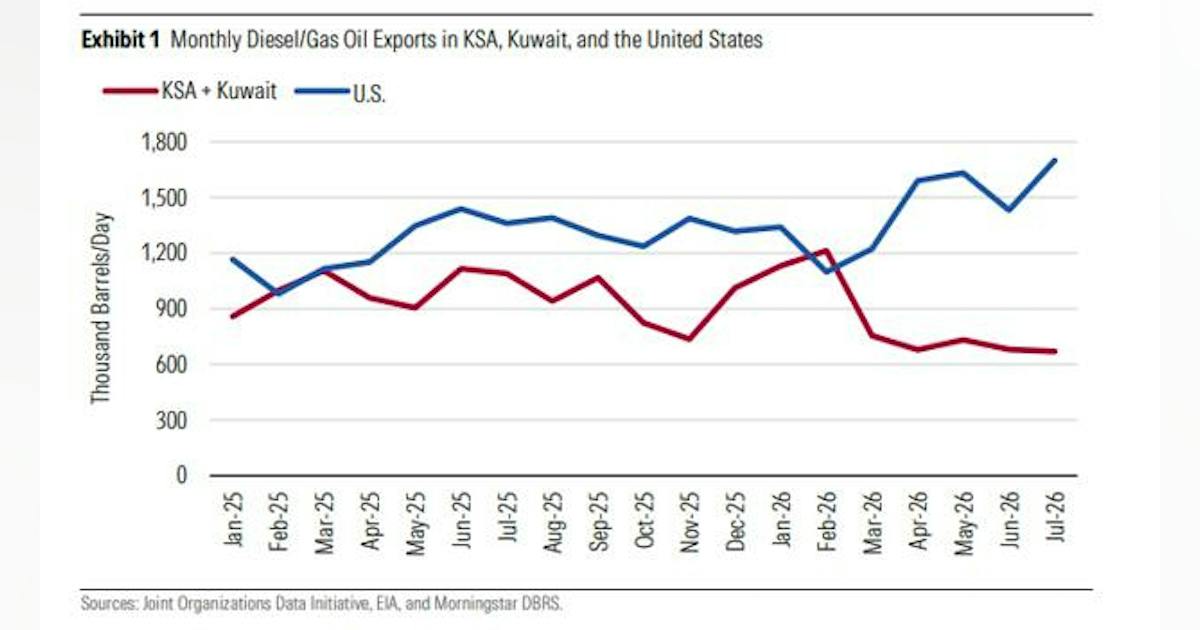
US refiners are benefiting from a tightening global diesel market as disruptions in the Middle East and Russia constrain supply, lift crack spreads, and keep refinery utilization near capacity, according to Morningstar DBRS. Morningstar DBRS said the current market is creating a strong but likely temporary earnings and cash-flow tailwind for US refiners. High utilization, low inventories, and elevated diesel margins are supporting operating cash flow and EBITDA, although the benefit could fade if geopolitical disruptions ease. Global diesel supply has tightened since the start of the Iran war as refinery outages, lower crude runs, and constraints on product exports through the Strait of Hormuz reduced Middle East supply. Saudi Arabia and Kuwait diesel exports were down about 40% year over year in July. Russia, meanwhile, extended restrictions on most diesel exports into October. Russia exported more than 780,000 b/d of diesel in 2025, just under 10% of global exports. US refiners have increased output and exports to help fill the gap. Distillate production averaged 5.1 million b/d during January-August, the highest since 2019. Refinery utilization is already near capacity in several regions, leaving limited room for further increases in output. PADDs 2 and 4 are operating at or near capacity, supported by discounted Canadian crude, strong diesel export demand, and agricultural and rural consumption. Together, the two regions account for more than 27% of US refining capacity and have an average distillate yield of 32%, DBRS said. On the Gulf Coast, PADD 3 refinery utilization exceeded 98% in September. More than half of US refining capacity is concentrated in PADD 3, where complex refineries serve both export markets and other US regions. The stronger operating environment is translating into higher refining margins. The US Gulf Coast ultra-low-sulfur diesel premium over crude has risen to its highest level this year,

Read More »

US seeks to release another 40 million bbl from SPR despite low inventory levels

The Trump administration Sep. 29 said it would put another 40 million bbl of crude from the Strategic Petroleum Reserve (SPR) into the market even as the emergency stockpile has fallen to its lowest level in more than four decades, raising fresh questions about how much of a buffer remains should another major supply disruption occur. The SPR held 283.8 million bbl as of the week ended Sept. 25. If companies take all 40 million bbl before they return replacement crude, the SPR’s physical inventory would temporarily fall to about 244 million bbl, before accounting for other inventory changes. That would put the stockpile below the 252-million-bbl statutory threshold that applies to certain limited SPR drawdowns. The threshold does not apply to the Department of Energy (DOE)’s exchange authority. SPR risks, exchange demand uncertain The Government Accountability Office (GAO) in May warned that the SPR’s ability to meet future drawdown and fill demands faced risks from aging infrastructure, maintenance backlogs, and low inventory levels. “The SPR’s operational capability is at risk,” the report noted, saying that as of last December, when inventories were over 410 million bbl, the SPR could withdraw oil at only 61% of its design rate and refill the reserve at 56% of its design rate. More than a quarter of the inventory was unavailable for drawdown at the time because of construction and cavern outages. GAO also warned that additional inventory declines from emergency releases could further limit the SPR’s drawdown capability. There is no guarantee that companies will take all 40 million barrels offered under the latest exchange. DOE offered the same amount in June, but only one company agreed to borrow about 500,000 bbl. The limited interest followed concerns among oil traders that the exchange’s repayment premiums and crude-quality requirements could make the SPR

Read More »

Plains names Liollio to succeed Chandler as EVP, COO

Plains All American Pipeline LP and Plains GP Holdings have appointed Dean Liollio to serve as executive vice-president and chief operating officer effective Oct. 2, 2026. Liollio will succeed Chris Chandler, who is resigning from Plains to pursue other interests, the company said in a release Sept. 29. Chandler joined Plains in 2018 after previously serving in leadership roles at Phillips 66. Liollio previously served as senior vice-president, special projects, prior to his appointment as executive vice-president and COO. Prior, the served as president of Plains Midstream Canada from 2020 until 2024, as president of PAA Natural Gas Storage from 2008 until 2020 and as president of Plains Gas Solutions from 2016 until 2020. Prior to joining Plains in 2008, Liollio held a number of executive roles including serving as president, ceief executive officer and director of EnergySouth Inc. and as president and COO of Centerpoint’s natural gas distribution operations across a five-state area.

Read More »

Data Center Thermal Management Series-Part 1 of 3

The biggest driver in today’s global economy is the data center, and in the process, data centers are generating and taking more heat than ever before. Heat — the generation of it and public concerns about it — is the most pressing issue facing the data center industry. In response, data center managers and engineers are viewing the problem in new ways, devising innovative, next-generation thermal control strategies that manage the problem more effectively. In the minds of IT managers and the public, data centers and AI are joined at the hip, along with increasing power demands and associated issues of environmental impact, water usage, and higher utility costs. As community activists, political leaders, and now even some prominent AI industry CEOs call for limits on AI development and data center construction, it’s imperative that the data center industry better manage the heat they’re producing — and taking. Sponsored Resources: Texas Instruments’ portfolio of data center thermal management systems spans the full coolant path. It’s been under active development at TI for decades and has evolved in response to the rising power, computing demands, and complexity of advanced data centers. Traditional thermal management techniques can’t keep up with AI’s intense computing requirements. For decades, air cooling was sufficient. Fans blew cool air across hot components and carried heat away, keeping data centers and AI servers operating reliably. But with AI training and inference pushing rack power beyond 20kW to 40kW, air alone can no longer remove heat quickly enough. In addition, air cooling is noisy and consumes too much energy. AI server racks are coming online now that draw 100kW of power, and they’re on their way to more than a megawatt in a few years. Each generation of servers grows denser, more powerful, and hotter as they move and compute massive volumes

Read More »

LiquidStack unveils liquid-cooling platform targeting AI data centers

“Operators need cooling infrastructure that can adapt as GPU platforms and rack densities evolve,” said Scott Smith, general manager of LiquidStack, in a statement. “CDU 2.X combines the performance and flexibility customers need today with the headroom to prepare for what comes next, allowing them to configure cooling around their facility and deployment strategy rather than designing the facility around the CDU.” A key feature is the platform’s support for different deployment configurations, including end-of-row and rack-adjacent installations. The idea is to give data center operators more flexibility in how they place their equipment with increasingly high thermal loads. The system offers configurable control-valve, power-feed and redundancy options, including dual-feed A/B configurations and automatic transfer switch support. These features allow operators to tailor the CDU to different facility architectures and resiliency requirements.

Read More »

If Apple returns to enterprise server game (with help from Nvidia), what market could it target?

Nvidia introduced NVLink Fusion as part of a broader effort to make its interconnect technology available to companies developing custom AI processors. The approach allows third-party silicon to be incorporated into Nvidia-oriented data center architectures, potentially extending Nvidia’s influence beyond its own GPUs. A similar strategy is already being pursued with inference-chip developer d-Matrix. Apple also already operates specialized servers for its Private Cloud Compute system, which handles Apple Intelligence workloads that require processing beyond the user’s device. Scaling that infrastructure, however, reportedly creates bandwidth, cost, and performance challenges. A commercial AI server would allow Apple to extend its silicon strategy into the data center while giving customers direct access to Apple processors rather than Apple’s own cloud services.

Read More »

From Coal to Compute: How Pennsylvania Is Rebuilding Power for AI Data Centers

Western Pennsylvania is becoming a test bed for one of the most consequential changes underway in data center development: the migration from simply finding grid capacity to building the power supply along with the data center. Two projects illustrate that transition particularly well. Aligned Data Centers is advancing the roughly $10 billion, 2-GW Project Phoenix campus at the former Bruce Mansfield coal-fired power station site in Shippingport, Beaver County. About 60 miles to the east, the former Homer City Generating Station is being transformed into the Homer City Energy Campus, centered on as much as 4.4 GW of new natural-gas generation and a proposed Amazon Web Services campus that could ultimately include 39 data center buildings. The projects share a number of similarities. Both reuse former coal-generation properties. Both already possess much of the infrastructure that greenfield data center developers spend years trying to obtain: high-voltage transmission, industrial zoning, water infrastructure, pipeline access, large parcels and proximity to the Marcellus and Utica natural-gas fields.But technically and commercially, they are also very different. Project Phoenix is essentially a data-center-led development using behind-the-meter generation, supplemented by a separate plan to repower the former coal station. While Homer City is the reverse: a power-generation project being constructed first, with the hyperscale data center development forming around the available power supply. This isn’t a competition, but it is a comparison on speed of delivery and the issues both development models face. Project Phoenix: Aligned Moves Into Pennsylvania Aligned calls Shippingport its first Pennsylvania campus and a regional flagship. The company formally broke ground on Project Phoenix on September 10, 2026, describing it as a 2-GW campus spanning three data center facilities and representing roughly $10 billion in regional investment. Aligned estimates the development will support approximately 3,000 construction jobs and 640 full-time jobs in

Read More »

OpenStack Hibiscus adds DNS security features and confidential computing to the open-source cloud platform

Type-5 support is aimed at data center integration. “It lets the tenant network prefixes be advertised directly into the physical fabric, so that really that’s basically how modern data center networks are built,” Carrez explained. “So really helps OpenStack fit into those environments without extra gateway layers that we’ve seen in use before.” Routable tenant addresses: The OVN BGP integration gains a route leaking option. An operator turns it on with the leak_routes attribute of a subnet. The extended OVN features follow the same approach. “OVN BGP features that let the tenant addresses be routable directly from the underlay, and that again is exposing how modern data centers are built directly into OpenStack,” Carrez said. Lower memory use: In deployments that use Open vSwitch, a monitoring daemon tracked keepalived state changes for HA routers. Hibiscus replaces the daemon with a shell script. The change applies to every HA router, so the savings add up across a deployment. “The 15 times reduction in memory footprint for the high availability router monitoring is, I think, really interesting,” Carrez said.

Read More »

DCF Trends Summit: ON.energy’s Asser Elsamahy – Using AI UPS Systems to Tame AI Load Swings

The power challenge surrounding artificial intelligence is increasingly about more than finding enough megawatts. AI data centers can also introduce rapid changes in electricity demand as large clusters of accelerators ramp workloads up and down. Those swings create a different kind of infrastructure problem: how to serve highly dynamic compute loads without passing that volatility directly onto the electric grid. That challenge is helping move battery energy storage deeper into data center power architecture. In an onsite podcast interview recorded live at the Data Center Frontier Trends Summit 2026, DCF Contributing Editor Doug Black spoke with Asser Elsamahy, P.E., vice president of engineering at ON.energy, about the emerging role of battery-based power quality infrastructure for AI data centers. Elsamahy said battery power systems themselves are hardly new. Energy storage has been deployed at gigawatt scale around the world for roughly two decades. What is new is the way the technology is being adapted to the operating characteristics of large AI facilities. “They’re new to the data center industry, but they’re not necessarily new in the market,” Elsamahy said. “They’ve been deployed at gigawatt scale already, multiple gigawatts all over the world.” The difference now is the load. Major swings in AI computing demand can create additional stress for grid operators already confronting rapid growth in large-load interconnection requests. Elsamahy said that dynamic is accelerating interest in energy storage as a way to manage the interface between AI infrastructure and the grid. From Battery Storage to an “AI UPS” ON.energy’s approach is built around what the company calls an AI UPS, or medium-voltage uninterruptible power supply. The architecture differs from the parallel battery energy storage system, or BESS, configuration commonly used for standalone grid storage. ON instead uses a double-conversion design with two sets of inverters. One inverter set faces the

Read More »

Microsoft will invest $80B in AI data centers in fiscal 2025

And Microsoft isn’t the only one that is ramping up its investments into AI-enabled data centers. Rival cloud service providers are all investing in either upgrading or opening new data centers to capture a larger chunk of business from developers and users of large language models (LLMs).  In a report published in October 2024, Bloomberg Intelligence estimated that demand for generative AI would push Microsoft, AWS, Google, Oracle, Meta, and Apple would between them devote $200 billion to capex in 2025, up from $110 billion in 2023. Microsoft is one of the biggest spenders, followed closely by Google and AWS, Bloomberg Intelligence said. Its estimate of Microsoft’s capital spending on AI, at $62.4 billion for calendar 2025, is lower than Smith’s claim that the company will invest $80 billion in the fiscal year to June 30, 2025. Both figures, though, are way higher than Microsoft’s 2020 capital expenditure of “just” $17.6 billion. The majority of the increased spending is tied to cloud services and the expansion of AI infrastructure needed to provide compute capacity for OpenAI workloads. Separately, last October Amazon CEO Andy Jassy said his company planned total capex spend of $75 billion in 2024 and even more in 2025, with much of it going to AWS, its cloud computing division.

Read More »

John Deere unveils more autonomous farm machines to address skill labor shortage

Join our daily and weekly newsletters for the latest updates and exclusive content on industry-leading AI coverage. Learn More Self-driving tractors might be the path to self-driving cars. John Deere has revealed a new line of autonomous machines and tech across agriculture, construction and commercial landscaping. The Moline, Illinois-based John Deere has been in business for 187 years, yet it’s been a regular as a non-tech company showing off technology at the big tech trade show in Las Vegas and is back at CES 2025 with more autonomous tractors and other vehicles. This is not something we usually cover, but John Deere has a lot of data that is interesting in the big picture of tech. The message from the company is that there aren’t enough skilled farm laborers to do the work that its customers need. It’s been a challenge for most of the last two decades, said Jahmy Hindman, CTO at John Deere, in a briefing. Much of the tech will come this fall and after that. He noted that the average farmer in the U.S. is over 58 and works 12 to 18 hours a day to grow food for us. And he said the American Farm Bureau Federation estimates there are roughly 2.4 million farm jobs that need to be filled annually; and the agricultural work force continues to shrink. (This is my hint to the anti-immigration crowd). John Deere’s autonomous 9RX Tractor. Farmers can oversee it using an app. While each of these industries experiences their own set of challenges, a commonality across all is skilled labor availability. In construction, about 80% percent of contractors struggle to find skilled labor. And in commercial landscaping, 86% of landscaping business owners can’t find labor to fill open positions, he said. “They have to figure out how to do

Read More »

2025 playbook for enterprise AI success, from agents to evals

Join our daily and weekly newsletters for the latest updates and exclusive content on industry-leading AI coverage. Learn More 2025 is poised to be a pivotal year for enterprise AI. The past year has seen rapid innovation, and this year will see the same. This has made it more critical than ever to revisit your AI strategy to stay competitive and create value for your customers. From scaling AI agents to optimizing costs, here are the five critical areas enterprises should prioritize for their AI strategy this year. 1. Agents: the next generation of automation AI agents are no longer theoretical. In 2025, they’re indispensable tools for enterprises looking to streamline operations and enhance customer interactions. Unlike traditional software, agents powered by large language models (LLMs) can make nuanced decisions, navigate complex multi-step tasks, and integrate seamlessly with tools and APIs. At the start of 2024, agents were not ready for prime time, making frustrating mistakes like hallucinating URLs. They started getting better as frontier large language models themselves improved. “Let me put it this way,” said Sam Witteveen, cofounder of Red Dragon, a company that develops agents for companies, and that recently reviewed the 48 agents it built last year. “Interestingly, the ones that we built at the start of the year, a lot of those worked way better at the end of the year just because the models got better.” Witteveen shared this in the video podcast we filmed to discuss these five big trends in detail. Models are getting better and hallucinating less, and they’re also being trained to do agentic tasks. Another feature that the model providers are researching is a way to use the LLM as a judge, and as models get cheaper (something we’ll cover below), companies can use three or more models to

Read More »

OpenAI’s red teaming innovations define new essentials for security leaders in the AI era

Join our daily and weekly newsletters for the latest updates and exclusive content on industry-leading AI coverage. Learn More OpenAI has taken a more aggressive approach to red teaming than its AI competitors, demonstrating its security teams’ advanced capabilities in two areas: multi-step reinforcement and external red teaming. OpenAI recently released two papers that set a new competitive standard for improving the quality, reliability and safety of AI models in these two techniques and more. The first paper, “OpenAI’s Approach to External Red Teaming for AI Models and Systems,” reports that specialized teams outside the company have proven effective in uncovering vulnerabilities that might otherwise have made it into a released model because in-house testing techniques may have missed them. In the second paper, “Diverse and Effective Red Teaming with Auto-Generated Rewards and Multi-Step Reinforcement Learning,” OpenAI introduces an automated framework that relies on iterative reinforcement learning to generate a broad spectrum of novel, wide-ranging attacks. Going all-in on red teaming pays practical, competitive dividends It’s encouraging to see competitive intensity in red teaming growing among AI companies. When Anthropic released its AI red team guidelines in June of last year, it joined AI providers including Google, Microsoft, Nvidia, OpenAI, and even the U.S.’s National Institute of Standards and Technology (NIST), which all had released red teaming frameworks. Investing heavily in red teaming yields tangible benefits for security leaders in any organization. OpenAI’s paper on external red teaming provides a detailed analysis of how the company strives to create specialized external teams that include cybersecurity and subject matter experts. The goal is to see if knowledgeable external teams can defeat models’ security perimeters and find gaps in their security, biases and controls that prompt-based testing couldn’t find. What makes OpenAI’s recent papers noteworthy is how well they define using human-in-the-middle

Read More »