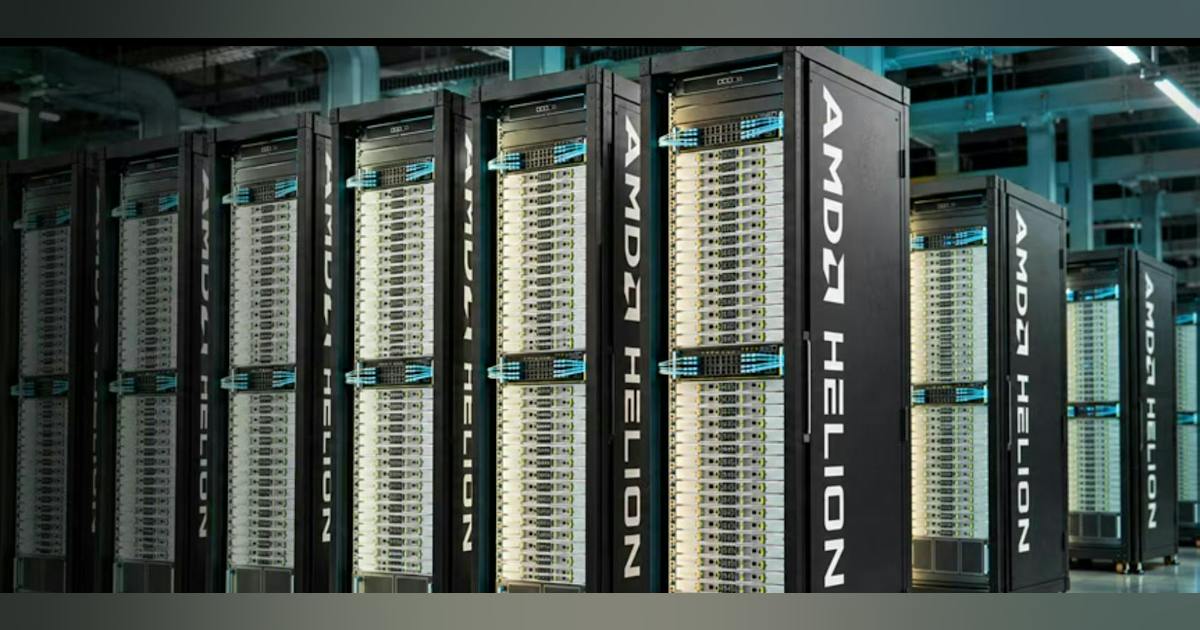
AMD expects the growth of agentic applications to substantially increase demand for server CPUs alongside GPU infrastructure. During her October 12 OCP keynote, CEO Lisa Su said the company now projects the server CPU market will exceed $200 billion by 2030, a significant upward revision from its earlier $120 billion estimate. While that remains AMD’s market forecast rather than an independent measure of future demand, it underscores the company’s conviction that general-purpose computing will play a much larger role in AI infrastructure.
Two Rack Designs for Different Markets
Helion’s two principal configurations reflect different approaches to deploying and managing agentic workloads. For hyperscale operators, the architecture emphasizes high-density CPU infrastructure dedicated to agent execution, with model inference handled by separate GPU-accelerated systems. This separation allows operators to expand CPU and GPU capacity independently, potentially improving resource utilization as the balance between agent activity and inference demand changes.
The approach also introduces infrastructure considerations. Agents may communicate repeatedly with models hosted elsewhere in a data center or across distributed environments, making network performance, latency and workload orchestration important factors in overall system efficiency. The ability to scale computing resources independently is an architectural advantage, but realizing that benefit will depend on how effectively those resources are connected and managed.
For enterprise deployments, Helion takes a more integrated approach, combining EPYC CPU blades, Instinct MI350P GPU blades and general-purpose computing resources within the same rack. The reference design accommodates up to 16 MI350P accelerators in two independent eight-GPU servers, each occupying five rack units. These GPU nodes operate separately rather than through a common rack-level scale-up fabric, reflecting the architecture’s emphasis on enterprise inference rather than the tightly coupled accelerator environments used for frontier-model training.
The enterprise configuration also accommodates dedicated resources for databases, storage and technical computing, supporting the broader range of operations performed by AI agents. Rather than requiring separate infrastructure for every function, the design allows system manufacturers to assemble combinations of computing resources appropriate to specific workloads.
Another component is AMD’s integrated token-routing capability, designed to direct model requests between locally hosted open-source models and larger frontier models running in external infrastructure. This could allow enterprises to keep selected workloads close to their data while drawing on cloud-based inference for more demanding tasks. Decisions about model placement, data security and latency would remain important considerations in implementing such an approach.
Taken together, the configurations illustrate a shift from treating AI infrastructure primarily as a collection of accelerator systems toward designing computing environments around the full sequence of tasks performed by AI applications. For operators, the question is how effectively those resources can be deployed, connected and managed within the electrical, cooling and networking capacity available to them.
CPU Selection Becomes a Power and Cooling Decision
Helion’s modularity extends to processor selection, allowing system manufacturers to configure CPU resources around the performance and power requirements of different agentic workloads. Rather than applying a uniform processor configuration across the rack, AMD’s reference architecture supports varying combinations of core density, processing speed and electrical demand.
AMD outlines three principal options. High-density configurations use 256-core EPYC processors rated at 400 watts, targeting maximum agent concurrency within a given power envelope. Balanced configurations retain 256 cores but increase the processor power rating to 600 watts, providing additional performance headroom for more demanding workloads. For latency-sensitive technical applications, a high-frequency configuration offers 96 cores operating at up to 5 GHz, prioritizing individual task performance over maximum core density.
The ability to combine these profiles could help operators avoid deploying the highest-performance processors for workloads that do not require them. That flexibility may improve utilization and overall computing efficiency, although the actual benefits will depend on workload characteristics, system configuration and the performance delivered per watt.
For data center operators, these choices have implications beyond processor performance. CPU power ratings are only one component of total rack consumption, which also includes memory, networking, storage and supporting systems. The combined electrical and thermal loads will determine how much computing capacity can be accommodated within a facility’s available power and cooling infrastructure.
AMD has not yet published comprehensive rack-level power and cooling requirements for the different Helion configurations. Without those figures and independently validated workload benchmarks, the potential infrastructure efficiencies remain a design proposition rather than a demonstrated operating advantage.
Open Standards and the Infrastructure Ecosystem
Helion’s approach to hardware flexibility depends in part on its adoption of Open Compute Project standards. The reference architecture uses a 21-inch, 44 OpenU rack based on the OCP Open Rack Version 3 (ORv3) specification, with standardized components for power distribution, processor modules, networking, system management and security. These include the Data Center Modular Hardware System (DC-MHS), Data Center Secure Control Module (DC-SCM), High Power Rack Version 2 (HPRv2), OCP NIC 3.0 and Caliptra silicon root-of-trust technology.
For data center operators, the significance extends beyond component compatibility. Open specifications provide equipment manufacturers with a common foundation for developing systems that can be adapted to different computing requirements, potentially reducing dependence on proprietary hardware configurations. Standardization may also simplify integration, maintenance and future upgrades, although interoperability across implementations will still require validation.
AMD plans to contribute the Helion specifications to OCP for further development and industry adoption. The company is relying on original equipment manufacturers (OEMs), original design manufacturers (ODMs) and infrastructure partners to translate the reference architecture into commercial systems. Initial supporters include Cisco, Dell Technologies, HPE, Lenovo, Foxconn, QCT, Supermicro and Wiwynn.
Several partners have outlined their intended approaches. Dell plans to extend its PowerRack infrastructure to support Helion, including networking and storage capabilities. Supermicro intends to incorporate the architecture into its Data Center Building Block Solutions portfolio, while HPE has emphasized support for air-cooled and direct-liquid-cooled networking infrastructure. Together, these commitments indicate an emerging manufacturing and integration ecosystem, although commercial deployment and operational performance remain to be demonstrated.
The broader challenge is ensuring that modular computing resources can operate as a coordinated infrastructure platform. As agentic workloads distribute processing across CPUs, GPUs, storage systems and networks, integration, management and security become as important as the flexibility of the underlying hardware. Jeremy Foster, senior vice president and general manager of Cisco Compute, addressed that challenge in AMD’s announcement: