Stay Ahead, Stay ONMINE

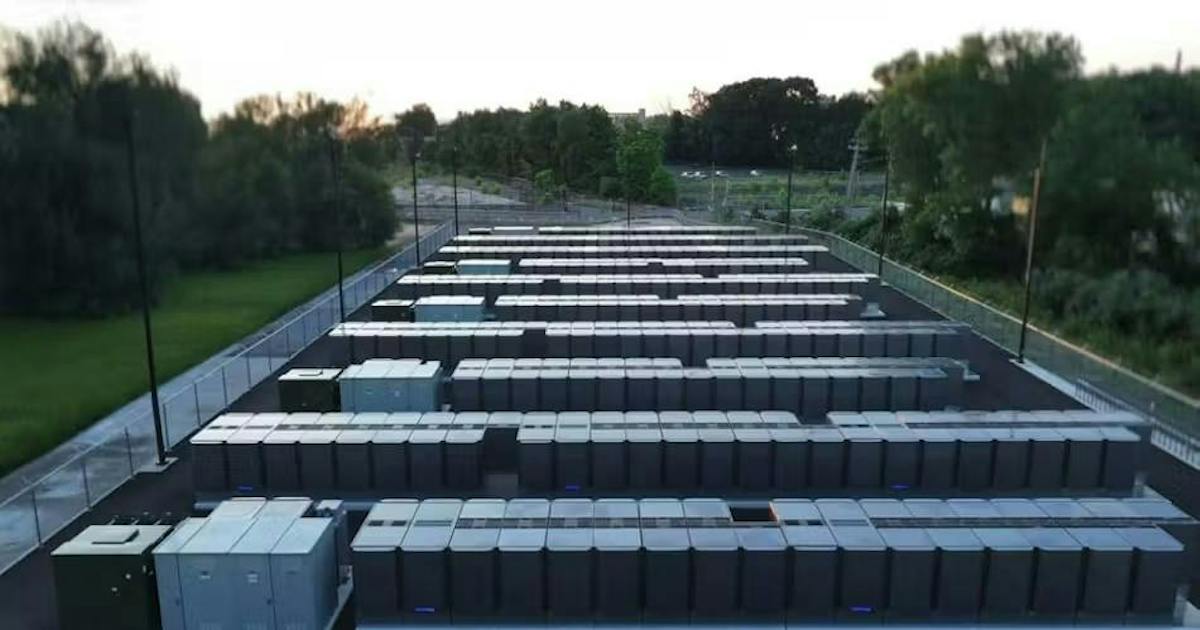
AEP, Google Advance $4 Billion Fuel-Cell Project to Power Cheyenne Data Centers

A Power Commitment That Began Two Years Earlier Although Google’s participation was publicly identified in October 2026, the procurement strategy underlying the Cheyenne project dates to November 2024, when Bloom Energy announced an agreement with AEP covering up to 1 gigawatt of solid oxide fuel-cell equipment. As Data Center Frontier reported at the time, the […]

A Power Commitment That Began Two Years Earlier

Although Google’s participation was publicly identified in October 2026, the procurement strategy underlying the Cheyenne project dates to November 2024, when Bloom Energy announced an agreement with AEP covering up to 1 gigawatt of solid oxide fuel-cell equipment. As Data Center Frontier reported at the time, the agreement included an initial commitment to purchase 100 MW, with options for an additional 900 MW. The arrangement was intended to help AEP serve large commercial and industrial customers facing growing electricity requirements without waiting for the completion of conventional grid infrastructure upgrades.

The relationship advanced in January 2026, when AEP disclosed in a regulatory filing that an unregulated subsidiary had committed approximately $2.65 billion to purchase a substantial portion of the fuel-cell capacity covered by its earlier option. The company also reported a 20-year agreement to sell the planned facility’s entire electricity output to an unidentified investment-grade customer, now confirmed as Google. The equipment purchase formed part of the project’s development history, rather than representing a separate $2.65 billion investment in addition to the $4 billion project announced in October.

The scale of the investment is significant, but so is the transaction structure. Rather than requiring Google to own and operate the generation equipment directly, the arrangement places development and ownership responsibilities with an established energy company while providing the hyperscaler long-term access to the facility’s electricity output. For AEP, it also represents an opportunity to deploy capital in support of large-load customers beyond its traditional regulated utility territory.

At approximately $4 billion for 702 MW, the project represents roughly $5.7 million per megawatt of planned generating capacity. That figure offers a measure of the investment’s capital intensity, although it is not directly comparable with the construction cost of a conventional gas-fired power plant without accounting for differences in project scope, fuel infrastructure, electrical integration and operating characteristics.

The price Google will ultimately pay for electricity has not been publicly disclosed. Neither party has released the PPA’s pricing structure, including any energy charges, capacity payments or other detailed commercial terms.

Why Fuel Cells Are Attracting Hyperscale Investment

Solid oxide fuel cells are an established technology, but their deployment at the scale proposed for Cheyenne represents a significant evolution in how data centers obtain electricity. Depending on their configuration, the systems can operate on natural gas, biogas or hydrogen. Unlike conventional combustion-based generators, they convert fuel into electricity through an electrochemical process. When operating on natural gas, the fuel is reformed into a hydrogen-rich mixture that reacts with oxygen ions passing through a solid ceramic electrolyte, producing electricity, heat, water vapor and carbon dioxide. The process avoids conventional combustion but does not eliminate carbon emissions when natural gas is the primary fuel.

One of the principal advantages of fuel cells for AI data center development is modularity. Standardized generating assemblies can be combined into larger installations, allowing capacity to be added incrementally rather than requiring construction of a single large generating unit. This flexibility offers a potential scheduling and investment advantage, enabling developers to coordinate additional generating capacity with successive phases of data hall construction, electrical commissioning and computing equipment deployment. As DCF’s reporting on emerging behind-the-meter power strategies has documented, modular generation is becoming an increasingly important consideration in the development of large AI campuses.

Multiple independent fuel-cell modules can also reduce dependence on any single generating unit, potentially allowing individual modules to be serviced or replaced without shutting down the entire installation. That distributed architecture offers operational flexibility, although its contribution to overall reliability depends on how the generating equipment is integrated with the facility’s electrical infrastructure.

Modularity alone does not guarantee the availability required by hyperscale operations. Fuel-cell installations must still be engineered as part of a complete power delivery system incorporating appropriate electrical redundancy, energy storage, backup capacity, protection and control systems. The ability to accommodate changing AI workloads, maintain stable power quality and manage equipment failures remains essential regardless of the generation technology.

Fuel cells also present an opportunity for closer integration with emerging high-voltage DC data center architectures. In September 2026, Bloom promoted an 800-volt DC-native power architecture designed to reduce conversion equipment, electrical losses and infrastructure costs. Because its solid oxide fuel cells generate direct-current electricity, Bloom contends that the technology could simplify the power delivery chain for next-generation AI systems. That approach aligns with the broader industry transition toward 800V DC distribution for high-density AI infrastructure.

AEP and Google have not disclosed whether the Wyoming installation will employ a DC-native distribution architecture or rely on conventional power conversion and interconnection equipment. The distinction will be important in determining how closely the fuel-cell installation can be integrated with the data center’s electrical infrastructure and whether the potential efficiency and equipment savings of direct-current generation can be realized.

Carbon Capture Is Part of the Plan, Not Yet an Operating Result

AEP says the Cheyenne project is being designed to incorporate carbon-capture technology, with the objective of delivering near-zero-emissions electricity from a natural gas-fueled installation. Whether that objective can be achieved will depend on the design, performance and integration of a capture system that has not yet been publicly detailed.

According to Bloom Energy, its solid oxide fuel-cell technology produces a relatively concentrated carbon dioxide stream, potentially simplifying capture compared with conventional gas-fired generating equipment, where carbon dioxide is diluted in much larger volumes of combustion exhaust. The manufacturer maintains that this characteristic could reduce some of the equipment requirements, energy consumption and costs associated with carbon capture.

In February 2025, Bloom announced a partnership with Chart Industries to advance carbon-capture technology for its fuel-cell systems. The arrangement combines Bloom’s electrochemical generation technology with Chart’s gas-processing capabilities, with the aim of preparing captured carbon dioxide for industrial use or permanent geological storage. The companies presented the partnership as a potential pathway to lower-carbon, continuously available power for energy-intensive customers, including data centers.

The technical advantages remain distinct from demonstrated environmental performance at the Cheyenne site. AEP has not publicly disclosed a guaranteed capture rate, identified the carbon-capture equipment supplier for the facility, or detailed the transportation, utilization or permanent storage arrangements for the captured carbon dioxide. Those elements will be necessary to determine whether the project can meet its stated emissions objective, and what additional infrastructure and operating costs will be required.

The distinction is particularly relevant to Google’s broader energy strategy. In its June 2026 environmental report, the company acknowledged that its AI infrastructure expansion is proceeding faster than electricity grids are decarbonizing, complicating efforts to achieve its climate objectives. Natural gas-powered fuel cells equipped with effective carbon capture could help address part of that challenge. Their ultimate environmental value, however, will depend not only on carbon-capture performance but also on upstream methane emissions, the energy required to operate the capture system and whether the captured carbon dioxide is permanently stored or eventually released.

Cheyenne’s Larger Power Development

The AEP project is one component of a much broader energy development effort taking shape around Google’s planned data center expansion near Cheyenne.

Eight days before AEP’s announcement, Black Hills Corp. disclosed definitive agreements with Google covering an arrangement that combines grid-connected electricity, new natural gas generation and privately contracted power resources. Effective September 30, 2026, the agreements provide for a resource portfolio totaling approximately 2.7 GW, including reserve margins, to support the planned campus.

Under the arrangement, Black Hills will provide up to 590 MW of grid-connected energy service while managing approximately 2.1 GW of Wyoming-based, third-party contracted resources through a privately managed microgrid. The company plans to invest $1.8 billion between 2027 and 2029 to construct 564 MW of natural gas generation at its existing Cheyenne Prairie Generating Station site. The remaining 26 MW of grid-connected service will come through a combination of market purchases and retail utility service. Initial electricity service is expected in late 2027, with demand projected to ramp toward its peak in 2030.

An important question is how AEP’s planned 702 MW fuel-cell installation fits within that larger resource portfolio. Neither AEP nor Black Hills has publicly confirmed whether the fuel-cell capacity is included in the approximately 2.1 GW of third-party generation Black Hills is contracted to manage. Consequently, the AEP announcement and Black Hills’ resource figures should not be treated as additive measures of generating capacity.

Another major participant is Tallgrass, which is advancing the Cheyenne Power Hub in southeast Wyoming. In May 2026, Tallgrass and Mitsubishi Power Americas identified two M501JAC gas turbines for the project’s initial phase, representing approximately 1,150 MW of planned generation. Tallgrass has described the power hub as an investment exceeding $7 billion, with natural gas supplied through its Rockies Express Pipeline system. The project is intended to provide dedicated power to a large-scale data center within the Switchgrass Industrial Park, although the precise relationship between its planned capacity and the broader Black Hills resource portfolio has not been fully established in public disclosures.

The destination for much of this infrastructure is Google’s Project Tembo, previously known as Project Jade, a proposed data center campus in the Switchgrass Industrial Park south of Cheyenne. Laramie County planning records identify a development encompassing approximately 716 acres, with a revised plan calling for four major data center buildings totaling about 3.08 million square feet, along with supporting office, logistics and network facilities.

The project has undergone a significant change in development structure. Crusoe, which had been associated with the earlier Project Jade proposal, withdrew from the development in 2026. Subsequent county filings identify Google, operating through its subsidiary Jupiter Star Holdings LLC, as the party responsible for the revised campus proposal. The changes reduced the planned development from five principal data center buildings to four, while retaining the broader ambition of a major hyperscale installation supported by dedicated power infrastructure.

Beyond the generation technologies themselves, the Cheyenne agreements illustrate how utilities and independent power developers are adapting their business models to serve hyperscale customers.

AEP’s established utility operations span 11 states, encompassing substantial transmission, distribution and generating assets serving regulated customers. Wyoming lies outside that traditional service territory. Through Cheyenne Fuel Cell LLC, AEP is instead participating as a generation developer and majority owner under a long-term commercial agreement with a specific hyperscale customer. The arrangement enables AEP to pursue large-load opportunities beyond its established regulated footprint without relying exclusively on conventional rate-regulated utility investment.

Black Hills represents a related but different model. Under its agreements with Google, the company will own new generation through an unregulated affiliate, provide grid-connected electricity service and receive fees for coordinating third-party generation and other resources through the private microgrid. The company will therefore combine traditional utility service with dedicated generation investment and contracted energy management responsibilities.

Black Hills says the agreements are designed to protect existing retail customers against cost shifting associated with Google’s planned data center. Those protections include provisions addressing full recovery of generation investment, early termination, customer credit support and changes in project costs. Google has also provided $399 million in refundable advances for procurement of long-lead equipment, which Black Hills expects to reimburse by June 30, 2027.

The agreements reflect a broader industry shift toward assigning more of the financial responsibility for dedicated data center infrastructure to the customers creating the demand. As Data Center Frontier has reported in its examination of evolving state policies, regulators are increasingly requiring large-load customers to demonstrate credible power commitments and assume responsibility for infrastructure costs that might otherwise fall on existing utility ratepayers.

The consequences of a delayed, reduced or canceled data center development become considerably more complicated when utilities and their partners have already purchased turbines, secured transformers or begun constructing generation facilities specifically to support the project. Long-term contracts, financial guarantees and customer funding commitments do not eliminate those risks, nor do they establish that cost-shifting protections will work as intended under every circumstance. They do, however, provide a framework for allocating financial exposure among the developer, power providers and other customers.

These arrangements also raise operational and regulatory questions about how privately contracted generation interacts with the wider electricity system. As DCF’s analysis of behind-the-meter power regulation has explored, dedicated generation does not necessarily eliminate dependence on transmission infrastructure, grid support or other utility services. The practical division of responsibilities among generation owners, utilities and data center operators remains central to determining both reliability and cost.

The Challenge of Delivering 702 MW by 2028

AEP’s announced schedule provides just over two years from the October 2026 announcement to bring the full 702 MW fuel-cell installation into operation. Modular construction may offer advantages over conventional large-scale generating projects, but the schedule will still require substantial coordination across equipment manufacturing, site development, fuel supply and electrical infrastructure.

The installation will need natural gas supply arrangements, electrical interconnection and distribution infrastructure, construction logistics, protection and control systems, regulatory approvals and long-term operating support. Each must be developed in coordination with the generating equipment itself, and delays in one area could affect the availability of the overall system.

AEP has not disclosed the project’s exact physical footprint, the number and configuration of fuel-cell modules or a detailed phased commissioning schedule. Nor has it provided public details on how the fuel-cell installation will operate alongside the other electricity resources being developed to support Google’s Cheyenne expansion. The extent to which the facility will rely on conventional AC infrastructure or employ elements of Bloom’s proposed DC-native architecture also remains unclear.

The timing of power availability will need to align with successive stages of data hall construction, commissioning of electrical and cooling systems, and installation of computing hardware. That coordination is particularly important for AI infrastructure, where power demand can increase sharply as large concentrations of accelerators and supporting equipment are brought online.

The challenge extends beyond the initial commissioning schedule. Once operational, the generation portfolio will need to support demanding availability requirements while accommodating equipment maintenance, variations in computing load and the operating characteristics of multiple power sources. The resulting system must deliver not simply enough generating capacity on paper, but dependable electricity under real operating conditions.

The Cheyenne buildout will test more than the ability to deploy hundreds of megawatts of fuel cells on an accelerated schedule. It will test whether multiple generation technologies, financing structures and operating arrangements can be coordinated into a reliable power system for hyperscale computing.

For AEP, Google and their partners, the central challenge is no longer simply securing generating capacity. It is turning a portfolio of ambitious power commitments into an operating infrastructure system.


Shape
Shape
Stay Ahead

Explore More Insights

Stay ahead with more perspectives on cutting-edge power, infrastructure, energy,  bitcoin and AI solutions. Explore these articles to uncover strategies and insights shaping the future of industries.

Shape

Ovintiv shuffles some fourth-quarter spending to Permian basin

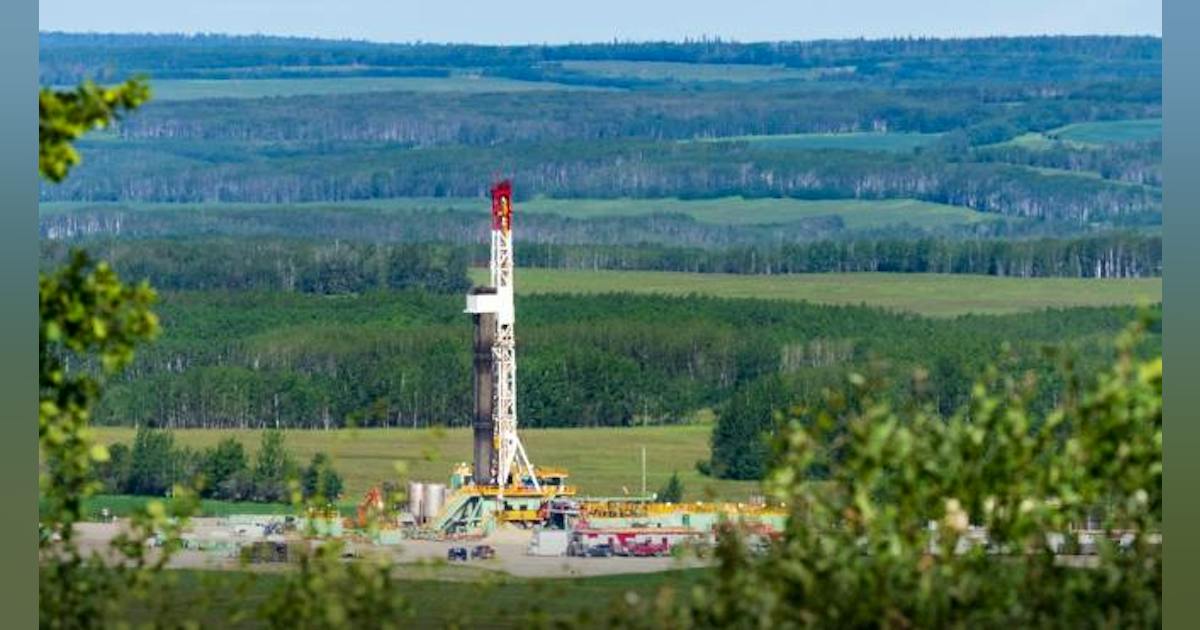
The leaders of Ovintiv Inc., Denver, are diverting $50 million in fourth-quarter capital spending to the operator’s Permian basin operations from the Montney to account for an Alberta gas plant being offline. President and chief executive officer Brendan McCracken and his team told analysts and investors on Nov. 4 that the adjustment to fourth-quarter spending plans should help oil and condensate production in the Permian basin average 125,000 and 130,000 b/d this quarter, in line with the third-quarter’s 127,000 b/d. The $50 million amounts to about 9% of Ovintiv’s planned capex this quarter and will let the company further manage the unplanned outage of CSV Midstream Solutions’ Albright sour gas plant in northern Alberta, which went offline in late July. Greg Givens, Ovintiv’s chief operating officer, said the CSV team has told Ovintiv that Albright should be up and running again before yearend and that Ovintiv has been able to manage the plant’s outage so that the company is only losing out on 3,000 boe/d. “If we think about that [capex] shift, that is really just us leaning into the flexibility of our portfolio,” Givens said on a conference call discussing Ovintiv’s third-quarter results. “The team has been doing a great job operating year to date. Our drilling performance was a little ahead of schedule so it just allowed us to accelerate some completion activity there.”

Read More »

EIA: US crude oil inventories down 900,000 bbl

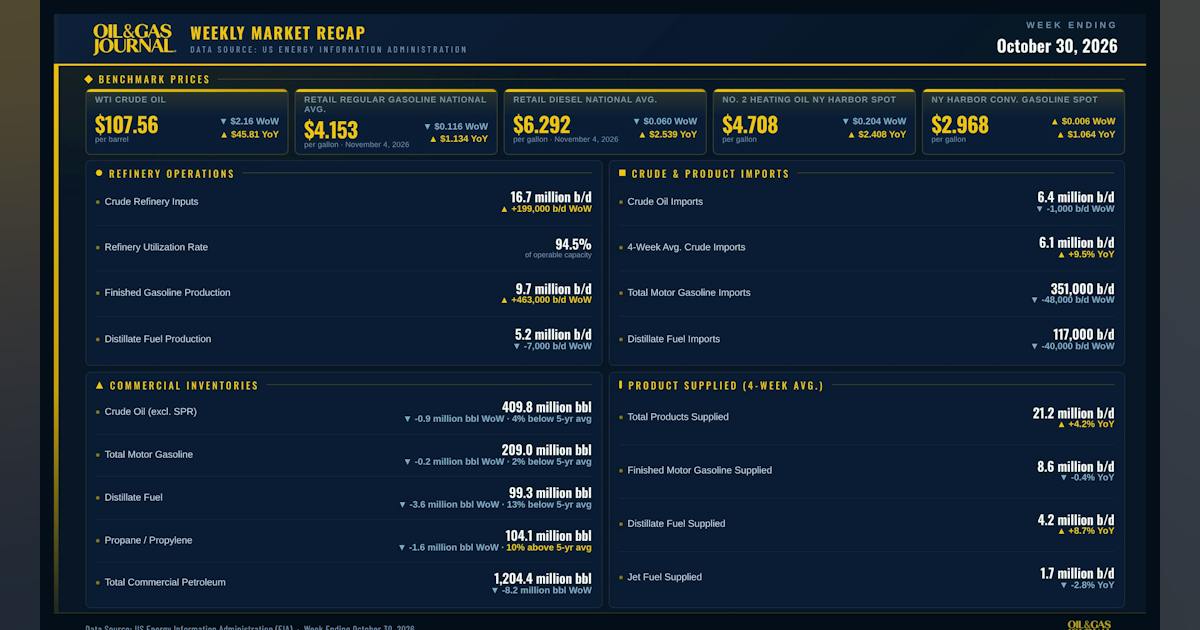
US crude oil inventories for the week ended Oct. 30, excluding the Strategic Petroleum Reserve, decreased by 900,000 bbl from the previous week, according to data from the US Energy Information Administration (EIA). At 409.8 million bbl, US crude oil inventories are 4% below the 5-year average for this time of year, the EIA report indicated. Gasoline inventories decreased 200,000 bbl, 2% below the 5-year average. Propane-propylene inventories decreased 1.6 million bbl, 10% above the 5-year average. Total commercial petroleum inventories decreased by 8.2 million bbl for the week. Distillate inventories decreased 3.6 million bbl, 13% below the 5-year average. US crude oil refinery inputs averaged 16.7 million b/d for the week ended Oct. 30, which was 199,000 b/d more than the previous week’s average. Refineries operated at 94.5% of capacity. Gasoline output averaged 9.7 million b/d, and distillate production decreased to 5.2 million b/d. Crude oil imports decreased 1,000 b/d to 6.4 million b/d. The 4-week average of 6.1 million b/d is 9.5% above the year-ago level. Gasoline imports averaged 351,000 b/d; distillate imports averaged 117,000 b/d. Over the past four weeks, total product supplied averaged 21.2 million b/d, up 4.2% year over year. The 4-week average for gasoline product supplied decreased 0.4% year over year to 8.6 million b/d, while the 4-week average for distillate product supplied increased 8.7% to 4.2 million b/d. The 4-week average for jet fuel product supplied decreased 2.8% year over year.  

Read More »

Vedanta to explore off India’s east coast

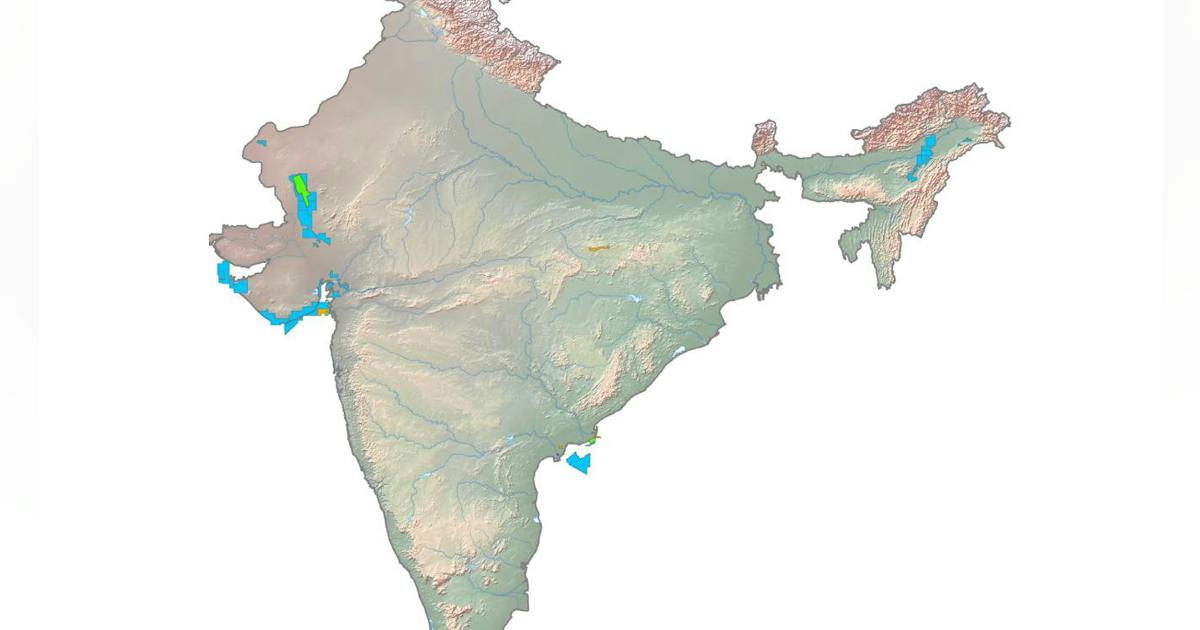
@import url(‘https://fonts.googleapis.com/css2?family=Inter:wght@100..900&display=swap’); .ebm-page__main h1, .ebm-page__main h2, .ebm-page__main h3, .ebm-page__main h4, .ebm-page__main h5, .ebm-page__main h6 { font-family: Inter; } body { line-height: 150%; letter-spacing: 0.025em; } button, .ebm-button-wrapper { font-family: Inter; } .label-style { text-transform: uppercase; color: var(–color-grey); font-weight: 600; font-size: 0.75rem; } .caption-style { font-size: 0.75rem; color: color-mix(in srgb, currentColor 60%, transparent); } Vedanta Oil & Gas Ltd. (VOGL) entered a strategic partnership with Exceed to explore the KG-DWHP-2017/1 deepwater block in Krishna-Godavari (KG) basin off India’s east coast. The block, which lies in 600-2,000 m of water, contains four existing gas discoveries spanning 4,616.85 sq m. Under the agreement, Exceed will provide integrated support across the campaign, including subsurface evaluation, well planning, drilling readiness, and operational management. Vedanta expects a multi-well exploration drilling campaign to begin early next year. The plan follows a phased approach covering project planning, engineering, operational readiness, and well execution. The company is evaluating the Vermilion prospect as a distinct new play with potential. Recently, Vedanta secured two offshore blocks including deepwater block KG/DWDSF/GD10/2025 in the KG basin. Vedanta is operator at DWHP-2017/1 with 100% interest.

Read More »

JPMorgan sees global oil market return to surplus

The global oil market returned to surplus in September as recovering Middle Eastern exports and weaker demand eased supply pressures stemming from the Iran war, according to JPMorgan estimates. The assessment contrasts with the International Energy Agency’s (IEA) October outlook, which projected continued supply deficits through yearend. JPMorgan estimated that global oil supply exceeded demand by 1.1 million b/d in September, with the surplus widening to 1.4 million b/d in October. By comparison, IEA’s Oct. 14 Oil Market Report estimated a supply deficit of about 790,000 b/d in September, a difference of nearly 1.9 million b/d between the two assessments. IEA’s estimates indicated continued inventory depletion. Global observed oil stocks declined by about 10 million bbl in September, as a 113 million bbl draw in onshore inventories more than offset a 103 million bbl increase in oil on water. At the end of September, global observed inventories were 509 million bbl below end-February levels. The contrasting assessments may reflect differences in supply and demand estimates, inventory coverage, and reporting cutoffs. IEA’s October report projected a fourth-quarter supply deficit of about 1.8 million b/d, based on global supply of 101.7 million b/d and demand of 103.5 million b/d. Supply recovery According to JPMorgan, Middle Eastern oil exports recovered to about 20.7 million b/d in October from a low of 9.8 million b/d in March, although volumes remained below prewar levels. Global crude imports reached 44.9 million b/d, up 1.3 million b/d year over year (y-o-y). Supply growth outside the Middle East also contributed to the improving balance. JPMorgan estimated Latin American crude production increased by about 1.5 million b/d y-o-y, supported by gains in Brazil, Venezuela, Guyana, and Argentina. At the same time, global oil demand has declined by an estimated 3.3 million b/d since the conflict began in late February,

Read More »

Trump ban on foreign grid components sparks industry concern over practicality, cost

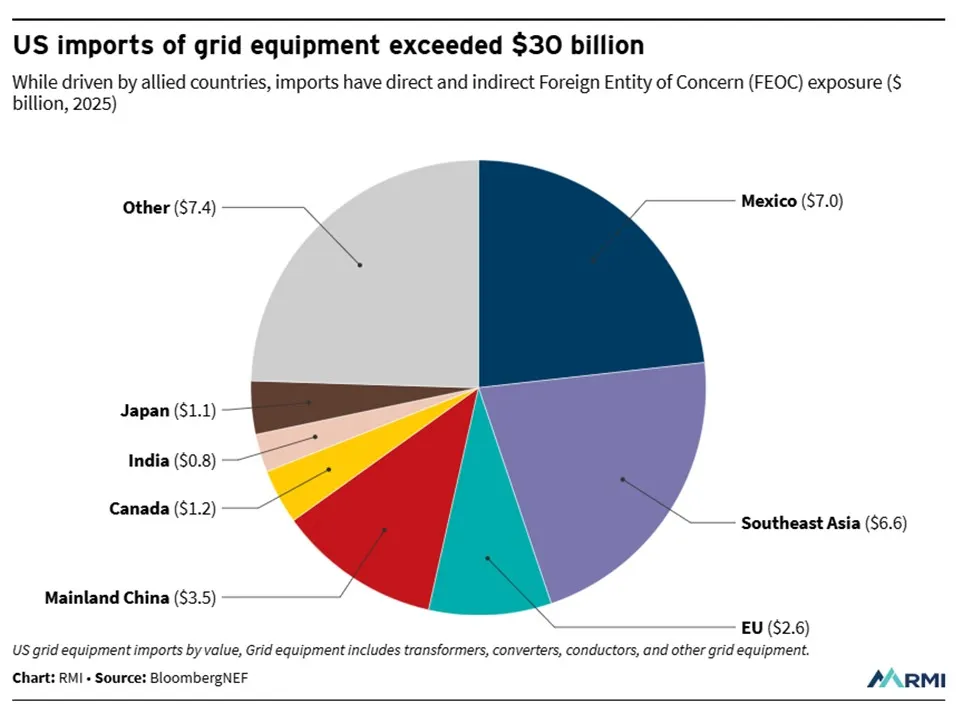
Listen to the article 8 min This audio is auto-generated. Please let us know if you have feedback. President Donald Trump’s recent executive order seeking to protect the bulk power system from foreign threats correctly identifies the risk of U.S. reliance on outside suppliers, but mitigating those risks without stalling the grid’s buildout or saddling ratepayers with even more costs will be tricky, stakeholders told Utility Dive. Executive Order 14421, issued Aug. 26, gives Secretary of Energy Chris Wright the power to block the installation of foreign-produced equipment – “or any critical component, software, firmware, digital service, maintenance service, or remote-access capability associated with such equipment” – that poses an “undue risk” to national security, either through intentional sabotage or supply chain disruption.  It also gave the secretary the authority to order the removal and replacement of previously installed equipment. The Department of Energy has until Dec. 24 to publish rules and regulations implementing the order. In September, DOE asked industry and other stakeholders to weigh in.  Their responses to DOE’s request show broad support for the intent of the order, but concern over how it will be implemented. A number pointed out that security standards, especially for software that would enable remote access, can be more important than country of origin since flaws in any system can be exploited by anyone, anywhere. The vast majority of stakeholder responses that took a position on the “function over origin” question favored DOE emphasizing functional controls as opposed to a software product’s origin, according to data compiled by industry analyst Brendon Shank. Many respondents also said they wanted DOE to take a phased approach to introducing new compliance rules and allow some vendors to “prequalify” as trustworthy. Utilities are projected to spend more than a trillion dollars on grid upgrades through 2030

Read More »

APS expects sales to double by 2041, plans extending coal use to 2038

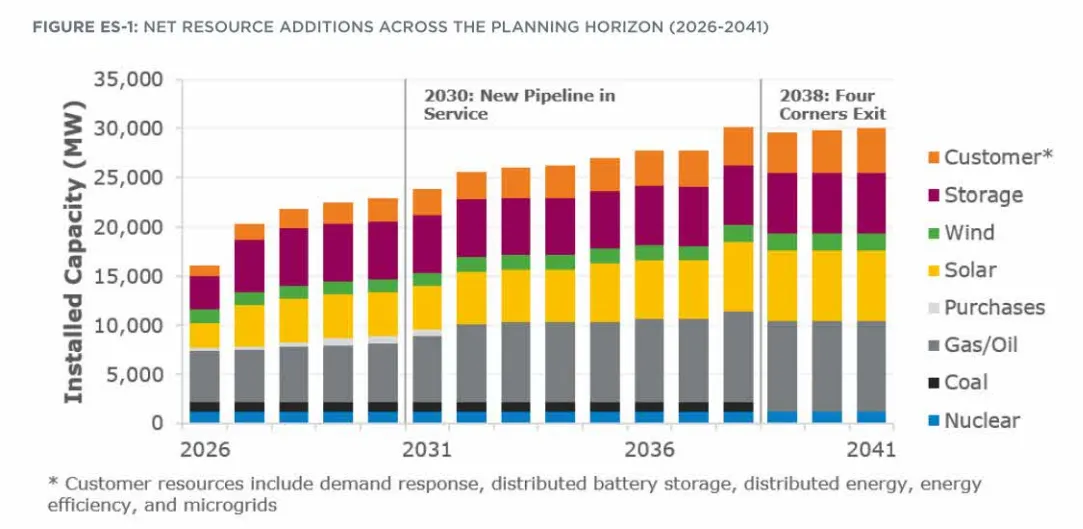
Listen to the article 6 min This audio is auto-generated. Please let us know if you have feedback. Dive Brief: The largest electric utility in Arizona projects retail sales to double in the next 15 years and peak demand to grow 3.4% annually, after accounting for customer resources like demand-side management, driven by large-load industrial and data center customers. Arizona Public Service filed in an integrated resource plan with state regulators on Friday indicating it will extend the life of its Four Corners coal plant seven years past a planned 2031 retirement, in addition to bringing 2,000 MW of solar and 2,500 MW of storage resources online by 2029 and adding 4,000 MW of gas generation through 2036. APS also said it expects customer adoption of electric vehicles and behind-the-meter solar resources to be 18% and 30% lower than previous forecasts, respectively; customer-sited storage, however, could reach 1.2 GW by 2045, almost doubling the last storage forecast developed in 2023. Dive Insight: APS projects peak demand of more than 14.5 GW in 2041, almost 60% higher than its current record peak of about 9.2 GW, set in August. And the utility expects annual retail sales to grow to about 80,600 GWh in 2041, up from about 34,200 GWh in 2025. There is some uncertainty behind APS’ load projections, but the utility said it has taken steps to protect customers. Despite refinements to APS’ large-load interconnection process, the “sustained record levels of interest” from large customers poses “a risk in increased potential for unrealized loads,” APS said in its resource plan, which it files every three years with the Arizona Corporation Commission. To mitigate the risk, APS said it adopted strategies such as having customers commit to “minimum demand and energy-based contract terms, providing collateral in case of default, and instituting early exit fees.” As a

Read More »

Arista posts record growth as AI networking supercycle accelerates

One of the core answers to that threat is the company’s Autonomous Virtual Assistant (AVA), which lets administrators ask it questions about network conditions and receive explanations, recommendations, and assistance diagnosing problems. “AVA is incredibly powerful. It seamlessly navigates networking and security infrastructure from campus to WAN, to data center, to cloud, continuously monitoring and troubleshooting, isolating root causes without manual labor-intensive tasks,” said Ken Duda, Arista co-founder, president, CTO & director. “The bad news, of course, is the massive challenge AI poses for us and our customers by discovering and exploiting security vulnerabilities. This threat landscape demands secure and robust networking. Over the past few months, we’ve been collaborating with Anthropic, Google, OpenAI, and many others to integrate new AI-enabled security capabilities from frontier models into our existing software security pipeline,” Duda said.

Read More »

AEP, Google Advance $4 Billion Fuel-Cell Project to Power Cheyenne Data Centers

A Power Commitment That Began Two Years Earlier Although Google’s participation was publicly identified in October 2026, the procurement strategy underlying the Cheyenne project dates to November 2024, when Bloom Energy announced an agreement with AEP covering up to 1 gigawatt of solid oxide fuel-cell equipment. As Data Center Frontier reported at the time, the agreement included an initial commitment to purchase 100 MW, with options for an additional 900 MW. The arrangement was intended to help AEP serve large commercial and industrial customers facing growing electricity requirements without waiting for the completion of conventional grid infrastructure upgrades. The relationship advanced in January 2026, when AEP disclosed in a regulatory filing that an unregulated subsidiary had committed approximately $2.65 billion to purchase a substantial portion of the fuel-cell capacity covered by its earlier option. The company also reported a 20-year agreement to sell the planned facility’s entire electricity output to an unidentified investment-grade customer, now confirmed as Google. The equipment purchase formed part of the project’s development history, rather than representing a separate $2.65 billion investment in addition to the $4 billion project announced in October. The scale of the investment is significant, but so is the transaction structure. Rather than requiring Google to own and operate the generation equipment directly, the arrangement places development and ownership responsibilities with an established energy company while providing the hyperscaler long-term access to the facility’s electricity output. For AEP, it also represents an opportunity to deploy capital in support of large-load customers beyond its traditional regulated utility territory. At approximately $4 billion for 702 MW, the project represents roughly $5.7 million per megawatt of planned generating capacity. That figure offers a measure of the investment’s capital intensity, although it is not directly comparable with the construction cost of a conventional gas-fired power plant

Read More »

DCF Show: Can AI Unlock Data Centers’ Stranded Megawatts?

The data center industry’s race for power has become a contest against time. Developers are pursuing new generating capacity, transmission upgrades, utility interconnections, and increasingly elaborate behind-the-meter strategies to satisfy an AI infrastructure market whose demand keeps outrunning delivery schedules. Yet another possibility is emerging alongside the construction boom: Some of the power needed to expand AI computing may already be available inside operational facilities, committed to customers but not consistently consumed. That is the proposition behind Hammerhead AI, a Redwood City, California-based company developing software to coordinate electrical infrastructure, cooling systems, and computing workloads. Rather than treating a data center’s power allocation as a fixed ceiling that can only be raised through construction, Hammerhead argues that more compute can be accommodated by managing existing resources dynamically. In a new episode of the Data Center Frontier Show, Hammerhead AI founder and CEO Rahul Kar discussed the company’s approach with DCF Editor-in-Chief Matt Vincent, examining how reinforcement learning and workload orchestration could convert otherwise idle electrical capacity into revenue-producing AI infrastructure. The idea arrives at a consequential moment for the colocation market. DCF’s analysis of CBRE’s first-half 2026 data center market report found North American primary-market vacancy at just 1.4%, even as new construction reached record levels. Power commitments, delivery timelines, and access to ready infrastructure continue to determine where and when additional compute can be deployed. Hammerhead’s central argument is that the industry should examine how much of its already allocated capacity can be made productive before assuming that every increment of computing demand requires another increment of physical infrastructure. The commercial opportunity is substantial. Whether it can be realized without undermining the reliability expectations of mission-critical facilities is the harder question. A Power Shortage, or a Utilization Problem? Kar begins with a distinction between the electricity infrastructure available to

Read More »

Data Center Jobs: Engineering, Construction, Commissioning, Sales, Field Service and Facility Tech Jobs Available in Major Data Center Hotspots

Each month Data Center Frontier, in partnership with Pkaza, posts some of the hottest data center career opportunities in the market. Here’s a look at some of the latest data center jobs posted on the Data Center Frontier jobs board, powered by Pkaza Critical Facilities Recruiting. Looking for Data Center Candidates? Check out Pkaza’s Active Candidate / Featured Candidate Hotlist  Lead Mechanical Engineer – Data Center Design Dallas, TX / Remote This position is also available in: Denver, CO; Indianapolis, IN; Cedar Rapids, IA; Austin, TX; White Plains, NY; New York, NY; Richmond, VA; Ashburn, VA; Charlotte, NC; Atlanta, GA; Phoenix, AZ; Salt Lake City, UT; Kansas City, MO; Chicago, IL; Los Angeles, CA; Seattle, WA or San Jose, CA. Our client is a leading engineering design and commissioning company that is a subject matter expert in the data center space. They will provide design coordination and construction administration, consulting and management support for the data center / mission critical facilities space with the mindset to provide reliability, energy efficiency, and sustainable design expertise when providing these consulting services for enterprise, colocation and hyperscale companies. This career-growth minded opportunity offers exciting projects with leading-edge technology and innovation as well as competitive salaries and benefits. Electrical Commissioning Agent – Data Centers Phoenix, AZ (limited travel) Non-traveling CxA positions available in: Indianapolis, IN; Cedar Rapids, IA; Atlanta, GA and Columbus, OH. Traveling CxA based near any major airport, otherwise traveling to: New York, NY; White Plains, NY; Montvale, NJ; Richmond, VA; Boydton, VA; York, SC; Charlotte, NC; Salt Lake City, UT; Kansas City, MO; Chesterton, IN or Chicago, IL. *** Also looking for a lead EE and ME CxA agents and CxA PMs *** This opportunity is with a leading EPC company of data center design / build / commissioning solutions. This company provides a

Read More »

OCP 2026: Cooler Master Scales Liquid Cooling from Cold Plates to 2.5 MW CDUs

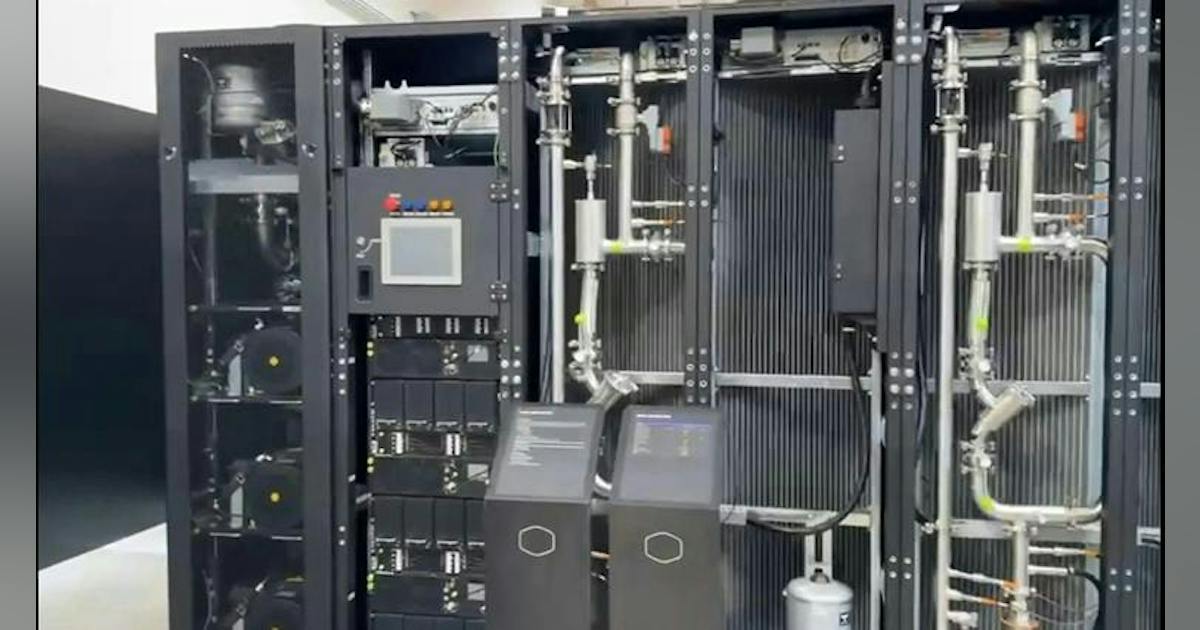
Modular Air-Assisted Cooling Targets Existing Data Centers One of the most instructive systems examined during the tour was Cooler Master’s 300 kW Air-Assisted Liquid Cooling (AALC) CDU, a modular liquid-to-air design intended for data centers without an existing facility water distribution system. Rather than transferring server heat into a building’s chilled-water or facility-water loop, the AALC system circulates coolant through the IT equipment and rejects the captured heat through fan-driven radiators. The distinction matters for operators seeking to introduce liquid-cooled AI racks into facilities that were not built with dedicated liquid cooling infrastructure. Although air-assisted systems still require sufficient facility airflow and heat rejection capacity, they offer an alternative to extending a new water distribution network throughout the data hall. The approach is already finding applications in the field. As DCF recently reported, Corvex deployed liquid-cooled NVIDIA Blackwell infrastructure inside an existing air-cooled data center, using Lenovo Neptune technology to avoid a conventional facility-wide liquid cooling conversion. Cooler Master’s 300 kW design separates the pumping equipment from its radiator assemblies. During the tour, a company representative explained that the system can be configured with a central pump rack and either one or two radiator racks, each providing a nominal 150 kW of cooling capacity. This modular arrangement allows cooling capacity to be matched more closely to the installation, rather than requiring every deployment to use the full 300 kW configuration. Serviceability is a major feature of the design. The system uses redundant pumps in a 2+1 arrangement, with two pumps supporting normal operation and a third providing standby capacity. Pump modules are designed for replacement without interrupting cooling operations. Other field-replaceable components include fans, filters, expansion tanks, and power-related assemblies. The product also incorporates redundant filtration and monitoring capabilities intended to help operators identify faults and maintain cooling performance. The

Read More »

7×24 Fall 2026: AI Frontier Futurist Meets Data Center OG

A 1988 Data Center Becomes a 20 MW AI Asset The second presentation, Converting a 1990 Enterprise Data Center to 20MW AI Workloads, featured Coe alongside Ari Chernikoff, vice president of development at Legacy Investing, and Dan Amundson, project manager at Gardner Builders. The project centered on 1001 Third Avenue South in downtown Minneapolis, a financial-services computing facility originally constructed in 1988. The building had supported earlier generations of enterprise computing before portions were converted to commercial office space and smaller colocation operations. Although its remaining operating data center load had declined to approximately 500 kilowatts by the time the AI redevelopment began, the property retained substantial infrastructure inherited from its original mission-critical design. Tall ceilings, robust floor loading, raised access floors, existing medium-voltage substations, and established utility connections made the building an unusually strong candidate for conversion. These characteristics, Chernikoff explained, can determine whether an existing building offers a practical path to high-density computing or proves economically unsuitable for redevelopment. Legacy Investing had identified a market opportunity in what Chernikoff called the industry’s “missing middle”: facilities generally ranging from 20 MW to 80 MW, rather than the 100 MW-plus campuses increasingly associated with hyperscale and frontier AI development. The company viewed existing buildings with available power and favorable infrastructure characteristics as potential shortcuts to deployment, particularly where demand for AI inference and other latency-sensitive workloads favored proximity to major urban markets. Following an AI tenant commitment in summer 2024, the development team faced an aggressive initial requirement: Deliver the first 5 MW of capacity by the end of that year. The first phase was ready for service approximately four months after Gardner’s involvement became formalized, followed by another 5 MW in 2025 and an expansion program ultimately reaching 20 MW over roughly 20 months. All of this had to

Read More »

Microsoft will invest $80B in AI data centers in fiscal 2025

And Microsoft isn’t the only one that is ramping up its investments into AI-enabled data centers. Rival cloud service providers are all investing in either upgrading or opening new data centers to capture a larger chunk of business from developers and users of large language models (LLMs).  In a report published in October 2024, Bloomberg Intelligence estimated that demand for generative AI would push Microsoft, AWS, Google, Oracle, Meta, and Apple would between them devote $200 billion to capex in 2025, up from $110 billion in 2023. Microsoft is one of the biggest spenders, followed closely by Google and AWS, Bloomberg Intelligence said. Its estimate of Microsoft’s capital spending on AI, at $62.4 billion for calendar 2025, is lower than Smith’s claim that the company will invest $80 billion in the fiscal year to June 30, 2025. Both figures, though, are way higher than Microsoft’s 2020 capital expenditure of “just” $17.6 billion. The majority of the increased spending is tied to cloud services and the expansion of AI infrastructure needed to provide compute capacity for OpenAI workloads. Separately, last October Amazon CEO Andy Jassy said his company planned total capex spend of $75 billion in 2024 and even more in 2025, with much of it going to AWS, its cloud computing division.

Read More »

John Deere unveils more autonomous farm machines to address skill labor shortage

Join our daily and weekly newsletters for the latest updates and exclusive content on industry-leading AI coverage. Learn More Self-driving tractors might be the path to self-driving cars. John Deere has revealed a new line of autonomous machines and tech across agriculture, construction and commercial landscaping. The Moline, Illinois-based John Deere has been in business for 187 years, yet it’s been a regular as a non-tech company showing off technology at the big tech trade show in Las Vegas and is back at CES 2025 with more autonomous tractors and other vehicles. This is not something we usually cover, but John Deere has a lot of data that is interesting in the big picture of tech. The message from the company is that there aren’t enough skilled farm laborers to do the work that its customers need. It’s been a challenge for most of the last two decades, said Jahmy Hindman, CTO at John Deere, in a briefing. Much of the tech will come this fall and after that. He noted that the average farmer in the U.S. is over 58 and works 12 to 18 hours a day to grow food for us. And he said the American Farm Bureau Federation estimates there are roughly 2.4 million farm jobs that need to be filled annually; and the agricultural work force continues to shrink. (This is my hint to the anti-immigration crowd). John Deere’s autonomous 9RX Tractor. Farmers can oversee it using an app. While each of these industries experiences their own set of challenges, a commonality across all is skilled labor availability. In construction, about 80% percent of contractors struggle to find skilled labor. And in commercial landscaping, 86% of landscaping business owners can’t find labor to fill open positions, he said. “They have to figure out how to do

Read More »

2025 playbook for enterprise AI success, from agents to evals

Join our daily and weekly newsletters for the latest updates and exclusive content on industry-leading AI coverage. Learn More 2025 is poised to be a pivotal year for enterprise AI. The past year has seen rapid innovation, and this year will see the same. This has made it more critical than ever to revisit your AI strategy to stay competitive and create value for your customers. From scaling AI agents to optimizing costs, here are the five critical areas enterprises should prioritize for their AI strategy this year. 1. Agents: the next generation of automation AI agents are no longer theoretical. In 2025, they’re indispensable tools for enterprises looking to streamline operations and enhance customer interactions. Unlike traditional software, agents powered by large language models (LLMs) can make nuanced decisions, navigate complex multi-step tasks, and integrate seamlessly with tools and APIs. At the start of 2024, agents were not ready for prime time, making frustrating mistakes like hallucinating URLs. They started getting better as frontier large language models themselves improved. “Let me put it this way,” said Sam Witteveen, cofounder of Red Dragon, a company that develops agents for companies, and that recently reviewed the 48 agents it built last year. “Interestingly, the ones that we built at the start of the year, a lot of those worked way better at the end of the year just because the models got better.” Witteveen shared this in the video podcast we filmed to discuss these five big trends in detail. Models are getting better and hallucinating less, and they’re also being trained to do agentic tasks. Another feature that the model providers are researching is a way to use the LLM as a judge, and as models get cheaper (something we’ll cover below), companies can use three or more models to

Read More »

OpenAI’s red teaming innovations define new essentials for security leaders in the AI era

Join our daily and weekly newsletters for the latest updates and exclusive content on industry-leading AI coverage. Learn More OpenAI has taken a more aggressive approach to red teaming than its AI competitors, demonstrating its security teams’ advanced capabilities in two areas: multi-step reinforcement and external red teaming. OpenAI recently released two papers that set a new competitive standard for improving the quality, reliability and safety of AI models in these two techniques and more. The first paper, “OpenAI’s Approach to External Red Teaming for AI Models and Systems,” reports that specialized teams outside the company have proven effective in uncovering vulnerabilities that might otherwise have made it into a released model because in-house testing techniques may have missed them. In the second paper, “Diverse and Effective Red Teaming with Auto-Generated Rewards and Multi-Step Reinforcement Learning,” OpenAI introduces an automated framework that relies on iterative reinforcement learning to generate a broad spectrum of novel, wide-ranging attacks. Going all-in on red teaming pays practical, competitive dividends It’s encouraging to see competitive intensity in red teaming growing among AI companies. When Anthropic released its AI red team guidelines in June of last year, it joined AI providers including Google, Microsoft, Nvidia, OpenAI, and even the U.S.’s National Institute of Standards and Technology (NIST), which all had released red teaming frameworks. Investing heavily in red teaming yields tangible benefits for security leaders in any organization. OpenAI’s paper on external red teaming provides a detailed analysis of how the company strives to create specialized external teams that include cybersecurity and subject matter experts. The goal is to see if knowledgeable external teams can defeat models’ security perimeters and find gaps in their security, biases and controls that prompt-based testing couldn’t find. What makes OpenAI’s recent papers noteworthy is how well they define using human-in-the-middle

Read More »